Stocking Your Kitchen
When my husband and I married, he took me grocery shopping. Bags and bags later, I said “we have to come back for spices.” He thought to himself “salt. pepper. How complicated can that be?” only to see another whole bag appear. He discovered a love of cooking, and cooks much fancier, more complicated dishes than I do. I still laugh at the day when he thought spices were just salt and pepper.
Here is the list I made for the newlyweds and independants in our family. What would you add? What are your staples in the kitchen?
Staples for Your Pantry
small cans of tomato paste
whole tomatos, 16 oz cans
tomato sauce, 16 oz. cans
artichoke hearts, 16 oz. can
evaporated milk
powdered milk
Dream Whip
olive oil
cider vinegar
red wine vinegar
balsamic vinegar
canned tuna
1 can crab (opt)
1 can smoked salmon (opt)
1 can shrimp (opt)
1 can chunk pineapple
1 can some kind of fancy fruit juice concentrate – raspberry, pomegranate, etc. (mix with soda water for a “drink” when unexpected guests drop in)
1 package nice crackers
1 pkg chocolate chips
Soups – cans, packages
bouillon cubes (chicken, beef, veg)
Saltines (for queasy stomach and when there is no bread good with PB or tuna)
Baking Staples
flour (NOT self-rising)
fine white sugar
brown sugar
baking powder
baking soda
vanilla flavoring
almond flavoring
lemon flavoring
red food coloring
green food coloring
Spices
salt
pepper
cinnamon
thyme
sage
basil
marjoram
oregano
cumin
chili
cilantro
parsley
turmeric (makes things yellow)
Spices II Only if you are into cooking:
saffron
coriander
cardomon
ginger
cloves
Pasta
spaghetti noodles
lasagne noodles
stars/alphabets (small noodles)
penne noodles (for stronger sauces)
Freezer
cheddar cheese
mozarella cheese
hamburger
chicken breasts
leftover ham
leftover turkey
1 stick real butter
frozen spinace
frozen peas
individual biscuits
Refrigerator Basics
Milk
Eggs
Ketchup
sweet pickle relish
Mayonnaise
Butter spread
Pillsbury Crescent Rolls (trust me)
cheddar cheese
Horseradish
Mustard (basic everyday yellow)
Really good French Mustard (opt)
jalepeno’s (if you use them)
Soda water (removes stains)
capers (opt)
sour cream (opt)
cream cheese (opt)
jam and jelly (your favorites)
chocolate syrup
tomato pesto (jazzes things up)
Thai chili sauce
soy sauce
Traditional Thanksgiving Day Greeting
To husband/father/son/brother/ significant other:
Choose one:
a) Sweetie,
b) Honey,
c) Snookums,
d) Lover Boy,
e) Daddums,
“______________ I need for you to run to the market before THE game starts and pick up some ______________.” (whatever you thought you had and you don’t, and you need desperately)
Deal Clincher:
If they whine about this being the only morning they get to sleep in, you say:
Dad/brother/son: “I’ll tell Mom!”
Husband or significant other: “I’ll make it worth your while!”
(Joke)
Happy Thanksgiving, hope your day is filled with the joys of family and friends.
Still Learning – Alhamdallah
Another Side of Thanksgiving . . .
My friend asked about my father, and when I told her he was slipping away, losing a little more every day, she said “Alhamdallah!”
I was caught up short. Her face was smiling. I had just told her my father is dying and she says “Thanks be to God?”
I know this woman like my own sister. Her daughters are my own daughters. I am welcome in every corner of her house, I pray for every one of her children, and being in her home is like being in my own home, we are all so comfortable together.
“No,” I said, “You’ve misunderstood what I said!” and she hugged me and said “I understood, but no matter what happens, we say ‘alhamdallah’. If you father is dying, we say ‘alhamdallah’. If Hurricane Katrina strikes, we say ‘alhamdallah’. All things come from Allah, and He knows all things. It is his will, so we say ‘alhamdallah’.”
We are both religious women. My faith says the same thing, to give thanks in all things. In my daily life, I sometimes forget. Truly, in my culture, you would never say “thanks be to God” if someone had just told you something very sad.
Being exposed to the Islamic world has complemented my own faith. No, I don’t need to be a Muslim; I think the differences between us are much smaller than the similarities. But truly, I thank God for all that I learn about my own faith by living is Moslem countries.
I love the call to prayer; nothing wrong with being reminded during the day – and night – to love and honor God. I love living among people who give thanks to God so many times a day, even for Hurricane Katrina, even for my failing father. I love watching the fathers and sons headed to the mosque on Fridays. There’s even a very gentle station with Moslem films in English that I watch from time to time because it is so peaceful, and tolerant and sweetly loving.
My friend took time from her very busy life and made a special trip to the bookstore to buy me a book called Don’t Be Sad. It’s a wonderful book by ‘Aaidh ibn Abdullah al-Qarni with chapters like “How to deal with bitter criticism,” “Do Not Carry the Weight of the Globe on Your Shoulders,” Do Not be Shaken by Hardships'” “Jealousy is Not Something New” and one of my favorites – “Do Not Be Sad – Do Good to Others.” This book is helpful to me in so many ways, including giving me good sura that are very similar to writings in our own book. This helps me clarify to others in my culture how alike we are, and how similar our faith is. My friend loves me, and I know she wants only the best for me. I give thanks to have her as a friend.
Every now and then, I come across something that shakes me – like when my friend said “alhamdallah” about my Father . . . but in the end, I learn something and my understanding broadens. Alhamdallah!
Qatteri Cat
We were flying back to Qatar after visiting our son. It was December, and we would not see him at Christmas; he was in his first real-life grown-up job and couldn’t get the time off for the long trip to Qatar and back. We were desolate.
I turned to my husband and said “I need a cat.” I expected a fight. “You work all the time, and I need a cat to keep me company.”
He said “I need a cat, too.” His eyes were kind of teary.
When we came to Qatar, we came with a 14 year old diabetic cat. When I arrived at the airport, without the right papers, the customs guy told me he would have to hold her overnight while I got the right papers from the Department of Agriculture. I started digging out all the hypodermic needles, and her insulin, and telling him she needed her shot at exactly seven in the morning and seven at night and he looked at me in shock and said “take her! take her!” and I scampered out of there as fast as I could, before he could change his mind.
When she died, the Gulf War was starting. In the middle of an important meeting, my husband came home because I kept thinking maybe she wasn’t really dead. It was heartbreaking. She was like a member of our family. My husband said “No more cats; I can’t go through this again.”
So it was only 9 months later when he agreed we could get another cat.
I went straight to the vet, who said he had just the cat for me. He was the longest, skinniest cat I had ever seen, with a great big fluffy tail like a fox. I adored him.

When he got home, he wouldn’t have anything to do with me. Every time I came near him, he cringed, and ran and hid. But the minute my husband walked in the door – it was love at first sight. Later on, we met his original owners, and one of the women said “is he still such a naughty cat?” and we said NO! that he was a good cat! The truth was that when he got scared, he would forget and use his claws and teeth. I still have the scars to prove it. It took a long time to teach him to trust again, but now, he is the sweetest and most loving cat you could meet. It just took time.
It took time for him to trust me. Now, he hangs out with me all day, and he loves to curl up with me. I don’t kid myself that this is love – he just loves my warm body and he loves that I feed him.
True love is when my husband comes home. Qatteri Cat can hear him coming long before he opens the door. He will leap from wherever he is sleeping and run for the door, and sit there waiting like a dog until my husband comes in the door. His body quivers with anticipation. He leaps for joy, and runs like a crazy cat around the house, scraping all the carpets into piles as he tries to get a grip on the marble tile floors.
When my husband showers or bathes, the Qatteri cat is there. When he works at his computer, the Qatteri cat is on his desk, or at his feet. He is content just to look at my husband with utter adoration.
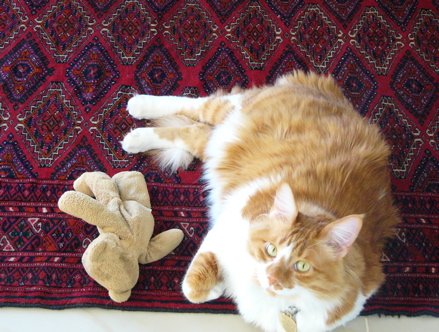
And then, in the morning, when my husband leaves, the Qatteri cat cries. His cries would break your heart. He sits by the door and asks why my husband has abandoned him, once again. And then he goes and gets his babies, one by one, and puts them by the door. Who knows what this cat is thinking?

Mom’s Fruit Cake Recipe
Wooo Hooooooo! The fruitcakes are in the oven, and already the house smells wonderful. I’ve been making these cakes since I got married. I don’t think I have missed a year, but I may have. I grew up smelling these delicious cakes every winter. I don’t think my Mom makes them every year any more. I wish I were close enough to pop one into her refrigerator for their holidays.
Mom’s Fruit Cake
Even people who think they HATE fruit cake like this fruit cake. It has a secret ingredient – chocolate!
This is the original recipe. I remember cutting the dates and prunes with scissors when I was little; now you can buy dates and prunes without pits and chop them in the food processor – a piece of cake!
1 cup boiling water
1 cup sugar
1/2 cup lard or butter
1 T. cinnamon
1 t. cloves
3 Tablespoons chocolate powder
1/4 cup jelly
1 cup seeded raisins
1 cup chopped walnuts
1/2 cup candied citron
1/2 cup cut prunes
1/2 cup cut dates
Put all in a pan on stove and bring to a boil. Boil for three minutes. Let cool. Add:
2 cups flour
1 teaspoon baking soda
Flavor with lemon
Bake at 350° in loaf pans for one hour. Makes 2 normal bread loaf sized cakes.
My variations: I put in about three times the fruit, the difference primarily in the candied citron – I prefer using whole candied cherries, because they are so pretty when the loafs are cut. This recipe doubles, or quadruples with no problems.
Pans: Mom used to line all the pans with brown paper and grease the paper. I grease the pans, then dust with more of the chocolate powder. Use a good quality chocolate, not cocoa. When the cakes come out of the oven, let them cool for ten minutes, loosen them with a knife, then they will shake out easily. Let continue to cool until they are totally cool, then wrap in plastic wrap, with several layers, then foil, then seal in a sealable plastic bag. Let them age a couple months in a corner of your refrigerator. I make mine around Halloween, and serve the first one at Thanksgiving.
I never make these the same any two years in a row. This is the first year, ever, that I won’t be using any brandy – alcohol in Kuwait being against the law. Yeh, I have some friends who laugh and say “you can get it anywhere!” but we made a decision to obey the law. Only rarely do I regret it . . . sigh . . .fruitcakes really need brandy.
Update: If you are in a country where brandy is available, and if you want to use brandy, here is how to use it in this recipe. You know how raisins get all dried out and taste yucky in fruitcakes? The night before you intend to make the fruitcakes, take all the raisins you intend to use (depending on how many fruitcakes you intend to make) and put them in a glass container. Pour brandy over them, to cover. Microwave just to the boiling point. Let stand in the microwave overnight.
The next day, you can drain that brandy and use it in a stew or something, and in the meanwhile, you now have plump, juicy raisins to use in your fruitcake, and just a hint of brandy flavor. Yummmm!
What is YOUR Comfort Food?
You know how it is. You’re not yourself. Your throat hurts or your tummy hurts and Mom fixes something something you love, and it happens so often throughout your childhood that when you get to be an adult, and you find yourself sick, it’s the food you think of.
And, of course, it depends on the illness. For tummy things, I remember chicken broth and jello. But for colds and flu, it was always tomato soup and grilled cheese sandwiches. Now, even if I just had a bad day, grilled cheese sandwich and tomato soup can still cheer me up.
For my husband, raised in another part of the country, it is vegetable soup and cornbread. After we married, I learned to make cornbread in an iron skillet, and it is pretty good. He breaks it up and puts it in a glass of milk, though, and I can’t even watch him eat it.
Our son grew up in Tunis – when he has a sore throat, nothing will do but mint tea.

So what is YOUR comfort food? What did your Mamma (or Papa) make you when you were sick as a child? What do you dream of even now, all grown up, but sick and miserable?
25 Reasons Why You Should Drink Green Tea
I never get sick. I am sick now. I thought it was just an allergic tickle in the back of my throat, but it turned into a full blown cold/flu, whatever it is that is going around.
A friend sent me this. I am drinking Green Tea like crazy. I’m not entirely sure I buy the entire list, especially green tea stopping the spread of Hiv/AIDs, that seems a little far fetched – wouldn’t we have heard about that? But it’s an interesting list.

by http://www.FineGreenTea.com
Green tea has increasingly become a very popular drink worldwide because of its immensely powerful health benefits.
It is extraordinarily amazing what green tea can do for your health.
And if you’re not drinking 3 to 4 cups of green tea today, you’re definitely NOT doing your health a big favor.
Here Are The 25 Reasons Why You Should Start Drinking Green Tea Right Now:
1. Green Tea and Cancer
Green tea helps reduce the risk of cancer.
The antioxidant in green tea is 100 times more effective than vitamin C and 25 times better than vitamin E.
This helps your body at protecting cells from damage believed to be linked to cancer.
http://www.finegreentea.com/green-tea-cancer.html
2. Green Tea and Heart Disease
Green tea helps prevent heart disease and stroke by lowering the level of cholesterol.
Even after the heart attack, it prevents cell deaths and speeds up the recovery of heart cells.
http://www.finegreentea.com/green-tea-and-heart-disease.html
3. Green Tea and Anti-Aging
Green tea contains antioxidant known as polyphenols which fight against free radicals.
What this means it helps you fight against aging and promotes longevity.
4. Green Tea and Weight Loss
Green tea helps with your body weight loss. Green tea burns fat and boosts your metabolism rate naturally.
It can help you burn up to 70 calories in just one day.
That translates to 7 pounds in one year.
http://www.finegreentea.com/green-tea-weight-loss.html
5. Green Tea and Skin
Antioxidant in green tea protects the skin from the harmful effects of free radicals, which cause wrinkling and skin aging.
Green tea also helps fight against skin cancer.
http://www.finegreentea.com/green-tea-skin.html
6. Green Tea and Arthritis
Green tea can help prevent and reduce the risk of rheumatoid arthritis.
Green tea has benefit for your health as it protects the cartilage by blocking the enzyme that destroys cartilage.
http://www.finegreentea.com/green-tea-and-arthritis.html
7. Green Tea and Bones
The very key to this is high fluoride content found in green tea.
It helps keep your bones strong.
If you drink green tea every day, this will help you preserve your bone density.
8. Green Tea and Cholesterol
Green tea can help lower cholesterol level.
It also improves the ratio of good cholesterol to bad cholesterol, by reducing bad cholesterol level.
http://www.finegreentea.com/green-tea-and-cholesterol.html
9. Green Tea and Obesity
Green tea prevents obesity by stopping the movement of glucose in fat cells.
If you are on a healthy diet, exercise regularly and drink green tea, it is unlikely you’ll be obese.
10. Green Tea and Diabetes
Green tea improves lipid and glucose metabolisms, prevents sharp increases in blood sugar level, and balances your metabolism rate.
http://www.finegreentea.com/diabetes-and-green-tea.html
11. Green Tea and Alzheimer’s
Green tea helps boost your memory.
And although there’s no cure for Alzheimer’s, it helps slow the process of reduced acetylcholine in the brain, which leads to Alzheimer’s.
12. Green Tea and Parkinson’s
Antioxidants in green tea helps prevent against cell damage in the brain, which could cause Parkinson’s. People drinking green tea also are less likely to progress with Parkinson’s.
13. Green Tea and Liver Disease
Green tea helps prevent transplant failure in people with liver failure. Researches showed that green tea destroys harmful free radicals in fatty livers.
http://www.finegreentea.com/green-tea-liver.html
14. Green Tea and High Blood Pressure
Green tea helps prevent high blood pressure.
Drinking green tea helps keep your blood pressure down by repressing angiotensin, which leads to high blood pressure.
http://www.finegreentea.com/green-tea-and-high-blood-pressure.html
15. Green Tea and Food Poisoning
Catechin found in green tea can kill bacteria which causes food poisoning and kills the toxins produced by those bacteria.
16. Green Tea and Blood Sugar
Blood sugar tends to increase with age, but polyphenols and polysaccharides in green tea help lower your blood sugar level.
17. Green Tea and Immunity
Polyphenols and flavenoids found in green tea help boost your immune system, making your health stronger in fighting against infections.
18. Green Tea and Cold and Flu
Green tea prevents you from getting a cold or flu.
Vitamin C in green tea helps you treat the flu and the common cold.
19. Green Tea and Asthma
Theophylline in green tea relaxes the muscles which support the bronchial tubes, reducing the severity of asthma.
20. Green Tea and Ear Infection
Green tea helps with ear infection problem.
For natural ear cleaning, soak a cotton ball in green tea and clean the infected ear.
21. Green Tea and Herpes
Green tea increases the effectiveness of topical interferon treatment of herpes.
First green tea compress is applied, and then let the skin dry before the interferon treatment.
22. Green Tea and Tooth Decay
Green tea destroys bacteria and viruses that cause many dental diseases.
It also slows the growth of bacteria which leads to bad breath.
http://www.finegreentea.com/green-tea-tooth-decay.html
23. Green Tea and Stress
L-theanine, which is a kind of amino acids in green tea, can help relieve stress and anxiety.
24. Green Tea and Allergies
EGCG found in green tea relieves allergies.
So, if you have allergies, you should really consider drinking green tea.
http://www.finegreentea.com/green-tea-allergy.html
25. Green Tea and HIV
Scientists in Japan have found that EGCG (Epigallocatechin Gallate) in green tea can stop HIV from binding to healthy immune cells.
What this means is that green tea can help stop the HIV virus from spreading.
Lisey’s Story: Stephen King
Mostly I wait for books to come out in paperback, so that they don’t hurt me if I fall asleep while I am reading (!), but for a few authors I will make an exception. One, James Lee Burke, I told you about in a previous post He Had Me From Hello.
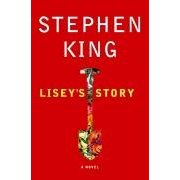
My most recent exception was for Lisey’s Story, the newest novel out by Stephen King. It’s a departure from Stephen King as we know him, and yet, there are resonances and echoes of earlier writings. Stephen King is brilliant at capturing the terrors of childhood, and the diaphanously thin membrane separating reality as we know it (not that we agree on what “reality” is! 😉 ) from the “otherworld”. In the Dark Tower series, the otherworld was where all the bad things were created and passed over to this side through leaks, places where the membrane holding worlds apart thinned and even disappeared.
This book is covered with flowers, bright pink and fushia and purple peonies, lupin and daisies, shading into blacks, whites and greys at the top, so that the holleyhocks are only faintly blue. It’s a very odd cover for a Stephen King book, but this is a very odd book. Early reviews say it is about as autobiographical a book by Stephen King as he has ever written, and I believe it. Stephen King writes what he knows – from Misery, written shortly after his nearly fatal accident as he was walking along a road near his Vermont farm and was hit by a van and nearly crippled for life, to this one, Lisey’s Story, in which we spend a lot of time in a dead author’s writing loft in an old barn in – you guessed it – Vermont.
As Lisey’s Story opens, we learn that she is the widow of an author (an author a whole lot like Stephen King) who has made a fortune writing fantasy/horror books. As the book unfolds, we walk with her through her devastating grief, bitter anger, and the endless exhaustion of trying to clear out her husband’s study. Every time she tackles the task, she is distracted by vivid and disturbing memories, memories she has tried to keep deeply buried because of their troubling implications.
King is writing on multiple levels. On one level, it is about a widow coming to terms with the death of her life partner. On another level, it is about a woman who doesn’t know her own strength and who comes to understand more about herself and about her relation to the world, and to her family of sisters. We’re there. We walk with her. If you’ve ever had sisters, you will particularly appreciate King’s treatment of how sisters relate to one another, and how that relationship both stays strong and loyal, and also evolves as sisters become adult people facing adult crises.
Throughout the book are whispers reminding us that the dead are all around us, leaving hints and reminders that their reality, too, is only a thin membrane away from our own.
And, on the most obvious level, King is writing about a boy and the source of his nightmares, the same source of his healing powers, the real life nightmares that haunt us all, and how with bravery and goodness and tools we don’t even know we have, we can triumph over evil.
Stephen King taps into the child within us all. He knows the terrors of our childhood, and he knows that evil gains power from the ability to terrify. Stephen King believes good can triumph over evil – when good people band together, evil can be beaten. In every book, there is a moment when one has to make a choice to stand against evil or be crushed by evil, and while his heroes and heroines are flawed and human – they are good, and they choose to stand against the evil. They may come out scarred and bloody, but they also come out triumphant.
It may not be great literature, but it’s a fine read. Stephen King’s books also are great vocabulary builders. He uses unusual and precise words to paint his word pictures.
Sweet, Sweet Luxury
My husband whisked me away for the weekend yesterday, a break we both need badly. We arrived early, checked in, had lunch in an old favorite restaurant, and took a driving tour around Doha, our former home. Whew! Little Doha is all grown up! Continuous building of high rising towers on the Corniche, huge road building and traffic improvement program, and of course, amazing new construction for the upcoming Doha games. We joked that we would love to have had the contract just for the signage for the games – they are awesome, and they are everywhere.
(I forgot to bring my photo-uploading-stick – I will upload some photos when I get back.)
And then, back to the room, to continue enjoying the sweetest luxury of all – time alone together. Just for today, no dinners with friends, no planned activities – we have the books and magazines we have been intending to read, there is a spa and great masseuse here, but best of all – just time together, time to catch up on all the little conversations we haven’t had time to have, time to dream a little about the future, time to give thanks for what we have.
Today, we will attend services in our former church, meet with old friends for brunch and then again for dinner. These are the friends who walk through the tough times with one another, who laugh together and cry together, and who know where all your skeletons are hidden – friends you can trust, friends who wear well over a lifetime. Tomorrow, a big charity bazaar and an evening event. In between – more time together. Thanks be to God for the luxury of time and for our good friends!

Doha Dhow and Skyline Before
Little Diamond
My neice is blogging! She started just as I did, without telling anyone. When I saw her on Friday, she very casually mentioned it in passing. Woooo Hoooooo! She is beautiful, and articulate, and always full of amazing information, and a lot of fun. Her website is A Diamond in Sunlight.
Recent Comments
intlxpatr on Shampoo Ginger tigerbutterya0c5ff1d… on Shampoo Ginger intlxpatr on British Soldier Kidnapped, Esc… John on British Soldier Kidnapped, Esc… intlxpatr on British Soldier Kidnapped, Esc… Wikipedia Donate Button

Amazina


Early Voting in Florida


 Here There and Everywhere