A Season of Losses
Its been a sad couple of months, starting with our cat’s death, and a friend’s death. We grieve Pete, we miss him, and we ask ourselves if we made a big mistake thinking a knee operation would be the right thing, if he would have lived happily without it? Pete was in pain. There were days he couldn’t go up the stairs. There were days he spent almost the entire day in his heated bed. We didn’t see a lot of options. Other sad news has hit; it feels like a season of losses.
In the Lectionary readings, we are reading Job, Ayyoub, and I think if my friend who said “Al-hamdallah!” when I told her my father is dying. I learned so much from her. She made me understand I am to thank God even for the bad things, it is God’s will, and a part of a bigger picture I will never see. And then this morning, I saw a reference to an old post, a post from 2006, a post I don’t even remember writing.
Thorns
Sandra felt as low as the heels of her shoes as she pushed against a November gust and the florist shop door.
Her life had been easy, like a spring breeze. Then in the fourth month of her second pregnancy, a minor automobile accident stole that from her.
During this Thanksgiving week she would have delivered a son. She grieved over her loss. As if that weren’t enough, her husband’s company threatened a transfer. Then her sister, whose holiday visit she coveted, called saying she could not come for the holiday.
Then Sandra’s friend infuriated her by suggesting her grief was a God-given path to maturity that would allow her to empathize with others who suffer. She has no idea what I’m feeling, thought Sandra with a shudder.
Thanksgiving? Thankful for what? She wondered. For a careless driver whose truck was hardly scratched when he rear-ended her? For an airbag that saved her life but took that of her child?
“Good afternoon, can I help you?” The shop clerk’s approach startled her.
“I….I need an arrangement,” stammered Sandra.
“For Thanksgiving? Do you want beautiful but ordinary, or would you like to challenge the day with a customer favorite I call the Thanksgiving “Special?” asked the shop clerk. “I’m convinced that flowers tell stories,” she continued. “Are you looking for something that conveys ‘gratitude’ this thanksgiving?”
“Not exactly!” Sandra blurted out. “In the last five months, everything that could go wrong has gone wrong.”
Sandra regretted her outburst, and was surprised when the shop clerk said, “I have the perfect arrangement for you.”
Just then the shop door’s small bell rang, and the shop clerk said, “Hi, Barbara…let me get your order.” She politely excused herself and walked toward a small workroom, then quickly reappeared, carrying an arrangement of greenery, bows, and long-stemmed thorny roses. Except the ends of the rose stems were neatly snipped: there were no flowers.
“Want this in a box?” asked the clerk.
Sandra watched for the customer’s response. Was this a joke? Who would want rose stems with no flowers! She waited for laughter, but neither woman laughed.
“Yes, please,” Barbara, replied with an appreciative smile. “You’d think after three years of getting the special, I wouldn’t be so moved by its significance, but I can feel it right here, all over again,” she said as she gently tapped her chest. And she left with her order.
“Uh,” stammered Sandra, “that lady just left with, uh….she just left with no flowers!
“Right, said the clerk, “I cut off the flowers. That’s the Special. I call it the Thanksgiving Thorns Bouquet.”
“Oh, come on, you can’t tell me someone is willing to pay for that!” exclaimed Sandra.
“Barbara came into the shop three years ago feeling much like you feel today,” explained the clerk. “She thought she had very little to be thankful for. She had lost her father to cancer, the family business was failing, her son was into drugs, and she was facing major surgery.”
“That same year I had lost my husband,” continued the clerk, “and for the first time in my life, had just spent the holidays alone. I had no children, no husband, no family nearby, and too great a debt to allow any travel.”
“So what did you do?” asked Sandra.
“I learned to be thankful for thorns,” answered the clerk quietly. “I’ve always thanked God for the good things in my life and never questioned the good things that happened to me, but when bad stuff hit, did I ever ask questions! It took time for me to learn that dark times are important. I have always enjoyed the ‘flowers’ of life, but it took thorns to show me the beauty of God’s comfort. You know, the Bible says that God comforts us when we’re afflicted, and from His consolation we learn to comfort others.”
Sandra sucked in her breath as she thought about the very thing her friend had tried to tell her. “I guess the truth is I don’t want comfort. I’ve lost a baby and I’m angry with God.”
Just then someone else walked in the shop. “Hey, Phil!” shouted the clerk to the balding, rotund man.
“My wife sent me in to get our usual Thanksgiving Special….12 thorny, long-stemmed stems!” laughed Phil as the clerk handed him a tissue-wrapped arrangement from the refrigerator.
“Those are for your wife?” asked Sandra incredulously. “Do you mind me asking why she wants something that looks like that?”
“No…I’m glad you asked,” Phil replied. “Four years ago my wife and I nearly divorced. After forty years, we were in a real mess, but with the Lord’s grace and guidance, we slogged through problem after problem. He rescued our marriage. Jenny here (the clerk) told me she kept a vase of rose stems to remind her of what she learned from “thorny” times, and that was good enough for me. I took home some of those stems. My wife and I decided to label each one for a specific “problem” and give thanks for what that problem taught us.”
As Phil paid the clerk, he said to Sandra, “I highly recommend the Special!”
“I don’t know if I can be thankful for the thorns in my life.” Sandra said. “It’s all too…fresh.”
“Well,” the clerk replied carefully, “my experience has shown me that thorns make roses more precious. We treasure God’s providential care more during trouble than at any other time. Remember, it was a crown of thorns that Jesus wore so we might know His love. Don’t resent the thorns.”
Tears rolled down Sandra’s cheeks. For the first time since the accident, she loosened her grip on resentment. “I’ll take those twelve long-stemmed thorns, please,” she managed to choke out.
“I hoped you would,” said the clerk gently. “I’ll have them ready in a minute.”
“Thank you. What do I owe you?”
“Nothing. Nothing but a promise to allow God to heal your heart. The first year’s arrangement is always on me.” The clerk smiled and handed a card to Sandra. “I’ll attach this card to your arrangement, but maybe you would like to read it first.”
It read: “My God, I have never thanked You for my thorns. I have thanked You a thousand times for my roses, but never once for my thorns. Teach me the glory of the cross I bear; teach me the value of my thorns. Show me that I have climbed closer to You along the path of pain. Show me that, through my tears, the colors of Your rainbow look much more brilliant.”
Praise Him for your roses; thank him for your thorns!
I know God can bring great good out of all things. I have seen this in my own life, out of the worst circumstances can come good I could never have foreseen. I am praying this fervently; that he will bring great good out of all circumstances.
“You Can Be Right, Or You Can Be Happy”
As AdventureMan and I were trying a new place for lunch yesterday, the booth next to us filled with a group of roofers (roofers have a lot of good business in a place like Pensacola which gets both heavy winds and heavy rains). While they were not talking overly loud, one had a voice that carried and he shared with his friends – and us – a rule of life his Grandfather had told him.
“You can be right, or you can be happy.”
We laughed. When AdventureMan wants to annoy me, he tells other people that the reason we’ve been married so long is that whenever we disagree, he apologizes.
Hilarious.
Pockets of Silence
Every now and then, after all these years, I can still crack my husband up by saying something unexpected.

Retirement carries some unexpected adjustments. There was a time, when he was managing a major contract in Germany, where over dinner, I once told AdventureMan I needed him to look at me and to listen. He looked at me in horror; he told me later he thought I was leaving him. No. No. I just looked at him and told him that I am very independent, but that at least once, every single day of our lives together, I need five minutes of his undivided attention.
“Five minutes isn’t much,” he said to me.
“Five minutes is more than I am getting now,” I responded. I knew he was busy, and under a lot of stress, but relationships require nurturing, and I knew I could get by on five minutes, as long as I could count on that five minutes to stay connected.
Now, years later, the shoe is on the other foot. AdventureMan LOVES retirement, and he comes into my office all the time to tell me about a new Tiger Swallowtail in his garden, or to update me on our financial worth, or to use me as a sounding board for a political item that has come up in his garden club.
There are times I need focus. All the years we were married, I had that time, and more, I had all this time to myself, and I learned how to fill and manage my time. I rarely had to coordinate anything with AdventureMan, he just trusted me to manage the house and finances and making sure everything was in its place.
Once he had time, I had to learn how to share my time. I also had to let go of a lot of control. The first time he organized and cleaned out the garage, I almost had a heart attack. He was so proud! And I was so horrified! I am very logical, and more than a little compulsive, and I knew where everything was, in its logical place, and now . . . things were, very literally, out of control. A part of me wanted to kill him, and another part of me said “hey, cool, now you don’t have to clean out the garage, he he he” but making that gain meant giving up control over where things were!
AdventureMan started cooking, and suddenly pots and pans and measuring spoons were not where they were “supposed” to be. AdventureMan took over the garden, and I danced for joy at not having to go out and water in the heat, but I lost control over what was planted out there.
It’s hard. We are both managers, and both very good at it. We’ve had to draw some lines. I’ve had to share territory I always thought of as mine, and he has had to consult with me, when he would much rather carry out his plans directly.
We’ve both had to draw some lines. We don’t touch stuff in one another’s offices. We consult. When I clean out the pantry, the first thing I do is show him the logic, even put little signs so he will know where to find things when he is cooking. I put up with things ending up in the wrong place, except for the spice drawers, where all the normal cooking herbs and in spices are in the left drawer and all the chilis and peppers and exotic herbs are in the right drawer, with all the teas. It can be irrational, but sometimes it is the smallest things that matter.
From time to time, I need a pocket of silence.
I welcome my sweet husband into my office; he is always welcome. From time to time, however, if I am working on paying bills or a blog post or designing a quilt, or trying to get my readings done for my bible study, I tell him I can listen for five minutes, and then I need a pocket of silence.
The first time I said it, he looked at me in horrified disbelief, what I was saying was so astonishing to him that he couldn’t even take it in. Once he comprehended, he started laughing, and now he tells his friends he has a wife who needs her “pockets of silence” – and I do. As he has become more relaxed and stress free, he has become chattier. As I live a life of commitments and connections in retirement, I need some times with no talking.
I need silence in my life the way some people need to be around other people hanging out. Silence refreshes me. Silence helps me focus, helps me think things through and develop a strategy. I am never bored with silence; for me silence is a resource I use with great respect and gratitude. I love my family and my friends, and then – I need a pocket of silence.
Wayfaring Stranger and James Lee Burke in the Heat of August
Just in time to save August from being my most hated month EVER, a new James Lee Burke novel, Wayfaring Stranger.

LOL, escaping from the relentless heat and humidity of Pensacola, I enter the heat and humidity of Burke country, ranging from the oil fields in Louisiana to the desolate social scene of Houston in the 1950’s.
I got hooked on James Lee Burke in a very cold winter February in Wiesbaden, Germany, when I came across a book called A Morning for Flamingos. I like mysteries, but this was a mystery by a poet! When I read about the what an approaching thunderstorm looks like when you live in a little cabin in New Iberia on Bayou Teche, I was lost. I-don’t-know-how-many books later, I’ve been to New Iberia, had lunch by the Bayou Teche and explored Burke country.
Louisiana is soulful, all those little roads, and sugar cane factories (think True Detective, here) but, (sigh) no matter how colorful, no matter how beautiful, the Louisiana in James Lee Burke’s books is better. He’s been there longer, he has the eye to see that heron, that shiver of wind over the water, that glint of pure evil in a bad guy’s eye. I know you think I am blathering on, but kinda-sorta the Dave Robicheaux detective series are all pretty similar, what changes is the particular social injustice. So this is what hooks me – Burke’s relentless battle against injustice, by writing powerful books that get read by a lot of people, and the elegant prose and philosophy he inserts to lift it way beyond the run of the mill mystery book.
The Wayfaring Stranger is the best yet. It’s not one of the Robicheaux series, it’s part of a Holland series, lawmen whose Texas lives and challenges we’ve read about in previous books. Wayfaring Stranger is the story of Weldon Holland (Burke tells us in an after word that Hollan – no D – is an old Texas family name in his line) who lives with his grandfather and runs into the real Bonnie and Clyde. Fast forward and he is fighting in the Ardennes, and the only reason you have faith he will survive is that there are so many pages ahead of you . . . he and one of his men trek, hop a train, and end up in a deserted death camp, where they find one survivor – a woman. The three of them are surrounded by fighting armies and find safety in a local farm’s cellar.
Oops. I’ve already given away that Weldon survives the battle. It’s hard to write much more without giving too much away. It’s a powerful story, powerfully written. It’s about good men and women and weak men and women and how sometimes an evil person can surprise you with a goodness.
Warning. Once you pick up Wayfaring Stranger, you’ll need a block of time so you can just go ahead and finish it. You won’t be putting it down.
Pope Meets With Sudanese Woman Condemned for Apostasy
I am not Catholic, but what I love about this humble Pope shines through in these photos – the Pope, the revered leader of the Christian world, is standing, while the family sits in his presence. His loving actions speak loudly. You can see all the photos on AOL News by clicking here.

ROME (AP) – Pope Francis met privately Thursday with a Sudanese woman who refused to recant her Christian faith in the face of a death sentence, blessing the woman as she cradled her infant born just weeks ago in prison.
The Vatican characterized the visit with Meriam Ibrahim, 27, her husband and their two small children as “very affectionate.”
The 30-minute encounter took place just hours after the family landed at Rome’s Ciampino airport, accompanied by an Italian diplomat who helped negotiate her release, and welcomed by Italy’s premier, who hailed it as a “day of celebration.”
Vatican spokesman the Rev. Federico Lombardi said the pope “thanked her for her faith and courage, and she thanked him for his prayer and solidarity” during the half-hour meeting Thursday. Francis frequently calls attention to the suffering of those persecuted for their religious beliefs.
Lombardi said the presence of “their wonderful small children” added to the affectionate tone of the meeting. Ibrahim was presented with a rosary, a gift from the pope.
Ibrahim held her sleeping infant as she stepped off the plane from Sudan, which had blocked her from leaving the country even after the country’s highest court overturned her death sentence in June. An Italian diplomat carried her 18-month-old son and they were followed by her husband, Daniel Wani, who is a citizen of the United States and South Sudan.
Ibrahim and her family are expected to spend a few days in Rome before heading to the United States.
Ibrahim, whose father was Muslim but whose mother was an Orthodox Christian from Ethiopia, was sentenced to death over charges of apostasy. She married her husband, a Christian, in a church ceremony in 2011. As in many Muslim nations, Muslim women in Sudan are prohibited from marrying non-Muslims, though Muslim men can marry outside their faith.
The sentence was condemned by the United States, the United Nations and Amnesty International, among others, and both the United States and Italy – a strong death penalty opponent with long ties to the Horn of Africa region – worked to win her release.
Sudan’s high court threw out her death sentence in June, but she was then blocked from leaving the country by authorities who questioned the validity of her travel documents.
Lapo Pistelli, an Italian diplomat who accompanied the family from Sudan, said Italy was able to leverage its ties within the region. “We had the patience to speak to everyone in a friendly way. This paid off in the end,” he said.
For All Young Parents: I Salute You
Every time I see this commercial, it gives me a big grin. These little babies and children need so much attention, and we applaud the loving care their parents put into cherishing them, sustaining them, nurturing them, civilizing them, educating them, exercising them, and sharing with them until they can care for themselves.
Young parents, you are doing the toughest job in the world. We see you. We see your sacrifices, and the effects of sleep deprivation, we see you giving, giving, giving to those who cannot give back, and we are in awe of your loving patience to your children.
I also love it that men are also featured prominently as caregivers 🙂
Rest in Peace, Qatari Cat
His name was Pete. He died last night. The operation was a success, but the shock to his system caused his kidneys to fail. We are grieving, and having a very very bad day.


We are heartsick.
This little cat was a blessing to us for 11 years. He came to us a skittish little street cat in Qatar. While AdventureMan worked long hours, he kept me company, helping me quilt, entertaining my friends, almost always in the same room or close by. When AdventureMan would come home, he would play hide-and-seek with him and adored AdventureMan with all his little heart. I was the Mama; AdventureMan was the FunGuy.
He was not such a little cat; he was only a kitten in his own mind. He was a very long cat, and appeared much bigger than he really was because of his length, and his big long fur, which made him a fluffy cat. He was polite, always greeting us when we came in, and talking to us when we were sitting together.
He leaves a great hole in our hearts. Rest in Peace, Sweet Kitty.
The Qatari Cat Gets a New Knee
******* WARNING ********* WARNING **********
If you are squeamish at all, do not read this blog post or look at the last photo, which is graphic.
****** END WARNING *********************
Qatari Cat Before

The Qatari Cat is home now, quiet and relaxed, stretched out in his favorite area. The Vet told us, as he scratched his head, that they would really like to keep him for another day, but he wasn’t acting normally. He’s all groaning and moaning and biting anything around him. They were at their wit’s end, and hated to see him so unhappy. Did we want to leave him or did we think he might be better at home?
We didn’t hesitate.
“We’ll take him home,” we said, knowing home is a quiet, safe place where the Qatari Cat can calm down and focus on healing.
Who knew? Who knew cats could bust their anterior crucial ligament? Who knew that it doesn’t repair itself, and that it would put stress on the other leg and that one would eventually tear, too?
We are learning all the time. In the old days, cats didn’t live long enough to get diabetes, to need a knee replacement. Cats went outdoors and had fatal run ins with cars, or racoons, or bad dogs, or mean people, or poisons. We’ve had five other cats in our lives together, and the Qatari Cat is the one we expected would not live so long, a tiny little street-cat with an infection when adopted.
We’ve kept him indoors (except for the rare instances, in Qatar, when he escaped, but not for long). Once, when he escaped, he climbed a tree. It was a very skinny tree, and as the wind blew and he got frightened, he kept climbing higher, until he was swaying back and forth, back and forth, and yowling at the top of his voice in pure panic.
Good thing he had that set of lungs, so I could find him. It took me another hour to talk him down out of that tree. “Qatari Cat” I said, over and over, “You are OK. You can come down,” and I would pat the tree. Over and over – you have to keep it simple for a scared cat. At long last, we locked eyes, he turned around and slowly edged his way down the tree, head first. I think that was a very scary thing for him, but he trusted me, and he came down. When he would hesitate, I would pat the tree and say “Qatari Cat, come.” He still comes when I call him and pat.
While we were still living in Qatar, he jumped from somewhere and developed a limp. From time to time, especially when the weather is cold, the limp, always the same leg, would become more pronounced. Recently, as he was trying to make a sharp turn, he screeeeeeched in pain, and after that, he had a serious limp.
The vet showed us his x-rays; his knee was totally torn. We waited until we were back from Alaska, so we could be here exactly for his reason – the Qatari Cat does best at home. He also does well at We Tuck ‘Em Inn, but he does not do well when he can smell fear and when he is fearful. When he is fearful, he is a fearful and awesome creature, spitting, hissing, biting and twisting. He instills fear in the most stalwart heart.
When we first saw him, at the vet’s office, (they were SO glad to get rid of him) he was growling and snarling, and he settled down in the car, a little, growling only now and then.
As soon as we got him home, we opened the carrier door and left him alone. Then the moaning began in earnest. He wanted to come out, but when he would turn to get in leaving position, his leg hurt, his wound hurt – a LOT, and he would let out a long, low, pitiful GROOOO-AAAAAAAA-AAAANNNNNNNNN. We had to leave him be. We had to let him do it himself.

AdventureMan had a special treat for him, canned catfood with SALMON. It helped him move himself out of the carrier:

And this is what his leg looks like. The instructions say it should heal in 10 to 14 days. We’re hoping he feels a lot better before then.

Dancers, Costumes, Transmitting Culture at Celebration 2014
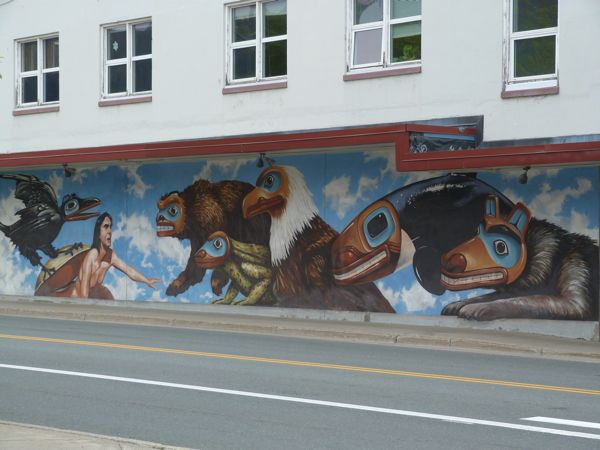
I am getting questions about the clans and tribes. I can’t answer your questions. I know there are the Ravens, and the Eagles, and I know they are not hostile but two halves of a whole. I know the raven legend; raven steals the sun – knowledge – and shares it with everyone. He is often shown with a long beak and/or curled around a ball. Eagles have short curved sharp beaks. But, with dispensation, an Eagle may marry a Raven. There are also subgroups, so you can be at once a Raven and a Bear, or a Killer Whale, or maybe a Wolf.
I try to understand, but it is a lot to absorb, and sort of complicated and flexible. As I look at my photos, I can see I was most interested in focusing on the costumes / textiles and less interested in the story. I wish I could tell you more, but you will have to read it for yourselves!
Here is a mural in downtown Juneau that demonstrates some of the artistic traditions of some of the various clans:
It’s important to remember – this is about them. It’s about holding on to traditional values and core beliefs, and transmitting knowledge of the culture to children and grandchildren. It’s not about us. As I said, we are there to witness and observe and celebrate, but they are there to celebrate who they are. Meanwhile, you can share the experience with these photos:


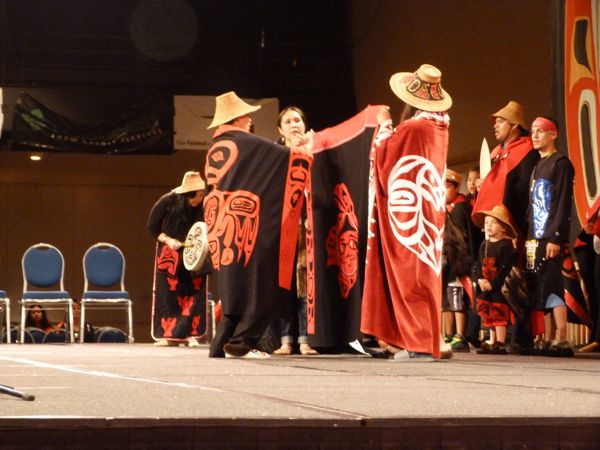


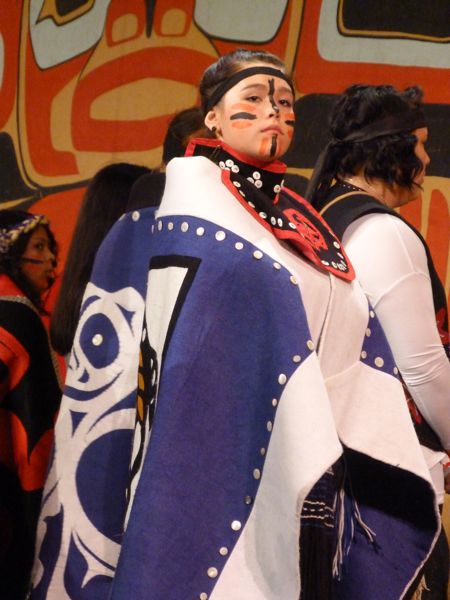




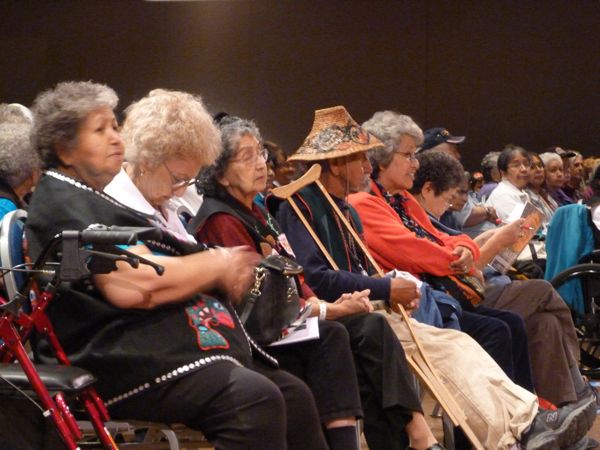
The front and center rows were reserved for the elders, and once the dancers started, every seat was filled. There were wet eyes, and open weeping. There were joyful moments, too, when the dancers would invite ‘all the Eagles’ or (something I didn’t understand) to rise and join them in their dance. My own heart swelled to witness their joy.

From Juneau to Tracy Arms Fjord on AdventureBound
Taking a break from The Celebration, we get up early, drive to our Juneau friend’s house and park our car and she drives us over and drops us off to catch the AdventureBound trip out to Tracy Arms. For two weeks the weather forecasts have told us that this day will be sunny, bright and warm, and ha ha ha on us, it is cloudy and cold, but not much rain. In Juneau, not much rain is a pretty good day :-).
We meet some really fun people as we wait to board – one couple married four days, one couple of young adventurers who, like us, travel on their own as opposed to group travel or cruise ship travel. Our lively conversation made us late to board, only to discover that everyone else had booked for this “sunny” day and every seat in the cabin would be occupied. Once you sit down, that is YOUR spot, oh ugh, this is the worst kind of tour for us, but we discover we can go in and out at will and this works. We spend a lot of time outside, taking photos, watching for whale and porpoise and bear and eagles – all kinds of wildlife. It’s not so bad.
Before we leave, I shoot this photo. It’s not original; I had a similar poster once from the 1920’s or 1930’s advertising trans-Atlantic boat travel on some French line. I just love the lines:

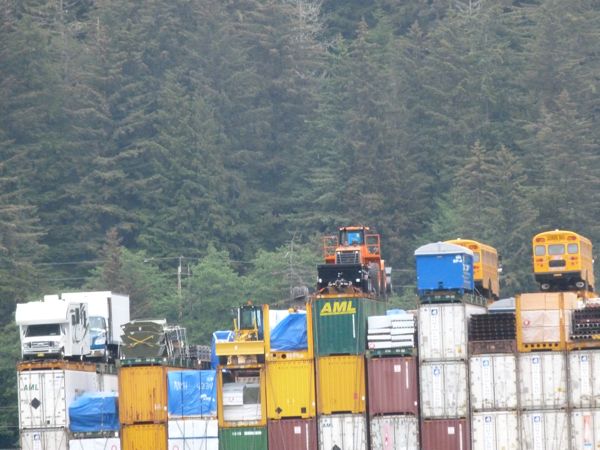
Juneau is landlocked, so everything that comes in or goes out goes by boat or plane. Container barges bring in larger items, and I was amazed how high they can stack a barge. I was also amazed that on top of the containers are vehicles strapped on tight; school buses, campers, snow plows – no wonder everything costs so much more in Alaska!

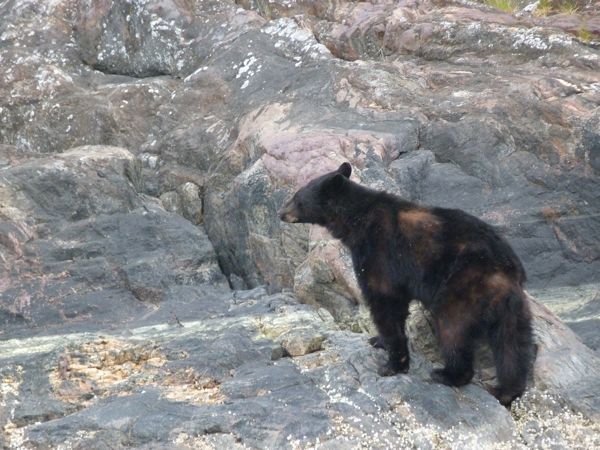
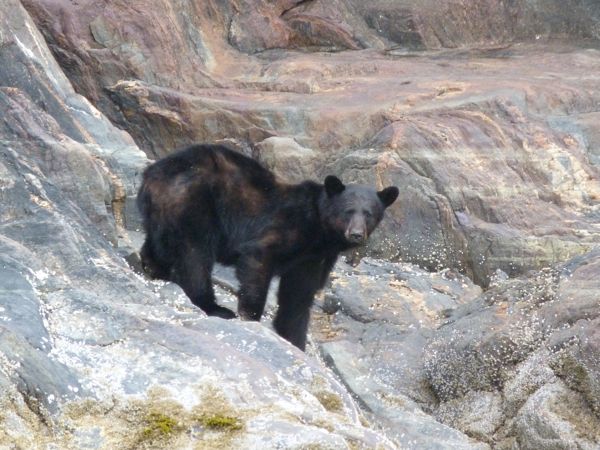
These bear made me so sad. Look how skinny they are, down at the bottom of tall, steep cliffs, eating barnacles. Bear eating barnacles – they must be starving. Some of them look all molty and have fur coming off.

I never saw these glaciers when I was little. The Mendenhall glacier is relatively large compared to the Sawyer glaciers (1) and (2) but the Sawyer glaciers are calving. The sound is unforgettable, the cracking, the thunder, and entire sections of the glacier falling into the bay. Other burgs crack off underwater, and they come up huge, whole and a sparkling, unforgettable icy deep blue:


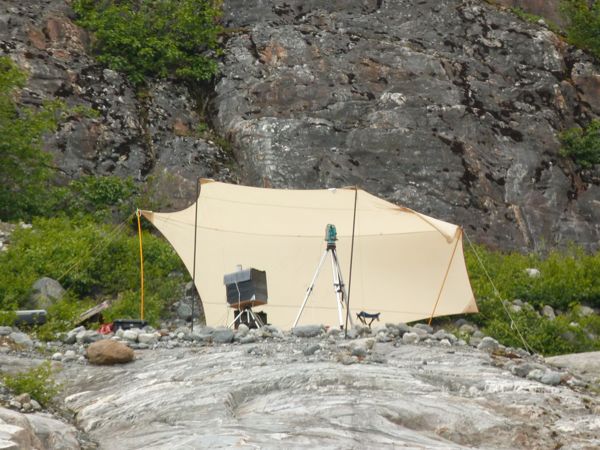
There is equipment going all the time at Tracy Arms to record the calving, the sights and sounds:
Mama and baby seals catching a few rays at high noon near the glacier:




Here is a piece breaking and falling into the water:



You can see the tour boat is surrounded by ice and icebergs:
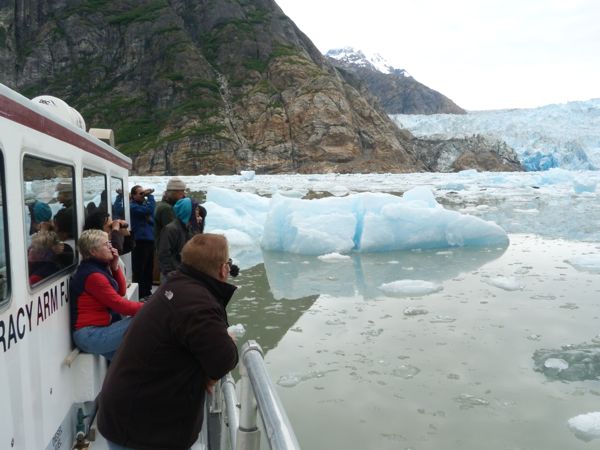
The glaciers are currently neither advancing nor receding, but you can read the trail of the glacier’s recession over thousands of years in the steep, ice-scraped mountains on both sides:

On our way home, we spot whale. You can shoot a lot of shots of a piece of whale, or where the whale was a split-second ago, LOL.


As we reach the dock, I call our friend to tell her we are arriving and she laughs and tells me she is already on her way; she was watching the boat arrive from her place across the channel. Within minutes, she is picking us up for home made fish cakes and chop chop salad. Best of all, great conversation, lots of laughter and wonderful stories of past times in Alaska. Her family was a pioneer family in Nome before she married and came to Juneau, so she has some great tales to share. Our families have had a lot of joint adventures, in Alaska, in Germany and in Edmonds.
She also asks great questions like “how did you buy groceries in Kuwait?” and “what did you do about laundry?”, practical questions, and exactly the kinds of things that made our lives more challenging – and interesting – to us. It was a great evening.
Recent Comments
ExpatAlien on What Country am I Living … intlxpatr on Yellowstone: Old Faithful to C… Michelle on Yellowstone: Old Faithful to C… Cathy on No Grown-Ups in Charge intlxpatr on Waiting for Snow Wikipedia Donate Button

Amazina


Early Voting in Florida


 Here There and Everywhere