“I Make Three Times What She Makes and She Wants To Talk About Chore Charts?!”
The man in the next booth was pushing all my buttons. The truth is, we don’t want to hear about his personal life. I don’t want to hear about anyone’s personal lives unless it is me and one of my oldest bestest friends, and we keep our voices down. Private lives are PRIVATE!
He is talking with someone, maybe his co-worker, and his entire monologue is about his failing relationship with his wife. I really don’t want to hear this.
And then he says “I make three times what she makes, and she wants to talk about chore charts???” and please, I need a pat on the back, I didn’t say anything, I didn’t get up and clock him, I didn’t even blink. AdventureMan laughed, he knew I was choking mad on the inside.
It doesn’t matter what you make, big man. If you are both working, you share the household chores. You both live there. You clean up your own mess, you pick up your own dirty clothes and put them in the laundry basket. You rinse your own dishes. You change the baby, you drive your son to his soccer game. It’s called teamwork.
Sure, I totally get division of labor. What I don’t get is this attitude of entitlement; like the fifties are long gone and we all work and we all share the duties of home and children and making it all work out at the end of the day. It’s never giving 50% – 50% – It’s always giving at least 75% – 75%.
We call it the Well of Good Will. If we were perfect people we wouldn’t need it, but we are people who screw up. We need mercy. We need forgiveness. So you give a little extra every day and hope that on a day when you fall short, there is enough on deposit in the well of good will that you can get a pass on your shortcomings for today.
If you are having a problem with your primary relationship, have a straight talk with that person. It doesn’t do any good to bad-mouth your spouse to a co-worker, and it certainly is not amusing to those of us forced to overhear. Ugh.
A TCK Wedding (Third Culture Kids)
Several years ago, back in my earlier blogging years, a Kuwaiti friend, Amer al Hilaliya wrote a wonderful post: I Am a Third Culture Kid, Are You? He never anticipated the result – comment after comment, some short, some a little bitter, some longer and insightful. The Third Culture Kids know who they are, and are eager to share their insights and experiences – but mostly with other Third Culture Kids, who understand.
Others . . . don’t get it.
This weekend, we went to a wonderful Third Culture Kids wedding. It wasn’t billed that way, but it was so thoroughly that way that I couldn’t stop seeing it. It doesn’t hurt that we are reading the seminal work on Third Culture Kids by David C. Pollock and Ruth E Van Renken called, yep, you guessed it, Third Culture Kids.

It’s almost like reading a whole new book. It has all the Third Culture Kids stories, but has expanded to include third culture kids cousins, like the adult third culture kids, ATCKs (those who have lived a goodly share of their lives in a non-native culture), cross culture adoptees, cross cultural marriages, etc. One of the points they make is that being third culture kids cuts across a lot of boundaries and makes for odd – odd by normal standards – friendships. Once again, across the boundaries – countries, old, young – friendships are determined by a commonality in experiences outside the native culture. It is a fascinating read.
People don’t think of how LONG Florida is, tip to tip, but from Pensacola to Fort Myers is a fuuur piece, as they say, even if it is on an inside curve. Thank God it wasn’t Key West! We thought it would be an eight hour drive, and it turned into thirteen, with heavy traffic from Lake City to Ft Myer.
The wedding was sweet, simple and heart felt. Both sets of parents had done significant missionary work in foreign countries, and the kids were definitely third culture kids. The groom would speak Turkish in his sotto voce asides to his best man, who grew up with him on the streets of Ankara. The bride’s brother read all the greetings and best wishes to the bride from her friends in Hungary – and he read them all in Hungarian.


Just as the ceremony started, along came a pirate ship! Some things, you just can’t plan, they just happen.

They all told family stories, and one of them stuck in our hearts because it reflects our own experiences growing up in the Moslem world. The groom, as a young man, came home flustered because a woman on the metro, as he was coming home, noticed he was not wearing an undershirt under his T-shirt, and assumed he was a homeless child. She started talking with all the other passengers, and they marched him off the train to the souks, where they insisted on buying him an undershirt (who knew that you were not properly dressed in Turkey unless you were wearing a sleeveless undershirt?) and also a sweater, to keep him warm on the streets. All this, in spite of the fact that this homeless boy spoke excellent Turkish and kept telling them he had a home! No! No undershirt, he has to be homeless.
Few people in America know the kindnesses we experience living in the Moslem world. It may not always make sense to us – in Tunis, we always wondered if we were getting the annual Eid platter of lamb and couscous showed up because we were thought to be poor or because we were strangers? There has always been a sweetness and generosity to our Moslem neighbors that humbled us. Because of the layering upon layering of these kindnesses, we see Islam, and the Middle East, differently from most of our American friends who have never lived among Moslems. Maybe if we all knew one another a little better, we would have less cause to fear one another, and maybe without all that fear, we could manage a little less hatred.
What is a wedding without babies and children to remind us of the Circle of Life (which AdventureMan calls The Circle of Death). This little one speaks English and Turkish already, and loved the sugar white sands of Ft. Myers Beach and the little seashells, just her size.

As more and more people cross borders, for work, for play, for marriage, for education, as we live in ‘alien’ cultures and learn other ways of thinking, maybe we are growing into an entire world with a larger viewpoint?
Ghost of Christmas Past
I remember Thanksgiving. It was yesterday. The season has never gone so fast, with Thanksgiving being so close to Christmas. Taking care of my sweet little granddaughter in the afternoons was a wonderful, quiet interlude in an otherwise swirling-with-events December, complicated by AdventureMan and I both catching terrible colds and lacking energy during the middle part leading up to Christmas.
I wouldn’t pass up the babysitting part for anything. My little granddaughter is the sweetest little baby ever. If she fusses, she doesn’t fuss much, and it is easily covered by “change my diaper” or “feed me” or “I really need to sleep” or I’m bored, walk me around a little until I fall asleep” or “Now I really really need to go to sleep!” Every now and then she fools you with an “I’m too hot! Take some clothes off!” but that makes me laugh, because once you do she is so grateful she just gurgles and coos. She is also beautiful 🙂
We had a wonderful Christmas, colds gone, great houseguests, fun family times, including taking our grandson to his first Nutcracker. Just after Christmas we rushed off to a family wedding in south Florida – a horrid 13 hour drive down – so I grabbed a few Christmas photos before it all gets taken down:
Here’s what I love. We have so many decorations loaded with Christmas baggage – you know the kind. “Oh! We got those candlesticks the year we moved to Wiesbaden!” “Oh! Remember that palm tree from our CENTCOM years?” “Look! Our creche!” “Oh! Our Damascus ornaments!” It is wonderful, and it is time consuming, and with a short Christmas this year, and a lot going on, I did something I have never done before. I saw some ornaments in WalMart, I call them “bang-for-your-buck” ornaments, sparkling snowflakes and stars, 20 for $2.98.
I bought a lot. Maybe about $25 worth. A lot of twinkling little stars and snowflakes.
The tree was all silver balls and silver stars this year, with an ivory cross on top.

The stairwell was all silver snowflakes. It was magical. It was also quick and easy and inexpensive – I grinned every time I saw it.

I did pull the Nurnburg angel out; I don’t think I can do Christmas without her and she provided a pop of red against all the greenery and silver and white.

The little silver reindeer are easy; stored all together in a box that says “Early Christmas” right along with the suction cups that hold them up – if it takes me five minutes, it’s a slow year, LOL.

A King is Given

It is the sweetest, quietest morning in the year; the Qatari Cat awoke me early – well actualy, he awoke me often as the temperatures have dropped dramatically and he wanted my body heat. He is a BIG cat, and takes up a lot of room wherever he stretches out, so I end up sleeping cramped much of the night, LOL. He is such a sweet cat, who can complain?
Yesterday, our church started a new service, a noon service, to help drain off some of the 4:00 and crush of good Episcopalians wanting to start Christmas with a moment of holiness and order before the chaos. Noon was a perfect time for me, and it was a perfect service, full of great readings and music, a goodly crowd, many people I know, and cold enough to wear one of my vintage German coats, coats I considered ‘investments’ when I thought we would be living in Seatte after retirement. If I get to wear them one day each year, they still look new at the end of this century.
A little later in the day, the festivities began, friends arriving from out of town, a family gathering and Christmas Eve dinner where my beloved daughter in law made some of the best crab cakes with Remoulade sauce I have ever eaten, the children were adorable, and the conversation full of laughter and memories. This morning has dawned clear and cold, the Qatari Cat is fed, AdventureMan still snoozing, and I have a few minutes to share a Psalm from today’s lectionary with you. Life is sweet.
Happy, happy Christmas to all!
Psalm 2
1 Why do the nations conspire,
and the peoples plot in vain?
2 The kings of the earth set themselves,
and the rulers take counsel together,
against the Lord and his anointed, saying,
3 ‘Let us burst their bonds asunder,
and cast their cords from us.’
4 He who sits in the heavens laughs;
the Lord has them in derision.
5 Then he will speak to them in his wrath,
and terrify them in his fury, saying,
6 ‘I have set my king on Zion, my holy hill.’
7 I will tell of the decree of the Lord:
He said to me, ‘You are my son;
today I have begotten you.
8 Ask of me, and I will make the nations your heritage,
and the ends of the earth your possession.
9 You shall break them with a rod of iron,
and dash them in pieces like a potter’s vessel.’
10 Now therefore, O kings, be wise;
be warned, O rulers of the earth.
11 Serve the Lord with fear,
with trembling 12kiss his feet,*
or he will be angry, and you will perish in the way;
for his wrath is quickly kindled.
Happy are all who take refuge in him.
Saudi Women Working in Shops
This weeks New Yorker, with a delightful cartoon of Pope Francis on the cover, making snow angels (Isn’t it great to see a powerful man having so much fun doing his job?)

. . . there is also a truly wonderful article, sympathetic and well written, about Saudi women being allowed to work in select shops. New Yorker only allows me to print an few lines from the article, but I loved how it captured the delight these women take in having a little bit of life outside the home to call their own. It also covers the dilemma of dealing with the religious police, the Muttawa, who are in a fit because now women will be in contact with MEN and who knows what might happen?
I had not read anything in the papers – our papers rarely cover smaller details of life in the Middle East. We were there when men were in every shop, selling underwear, selling abayas, and not a woman to be seen. This is a major change, done so so quietly, and women who need more space to breathe are finding a little bit of that space.
Not every woman wants to work outside the home, but many are bored and restless. When they talk about working, they talk about the friendships they form with other women, the pride they take in having a purpose to their daily life, and the increased respect with which they are treated by family members – all good things. The article is sensitively and sympathetically written.
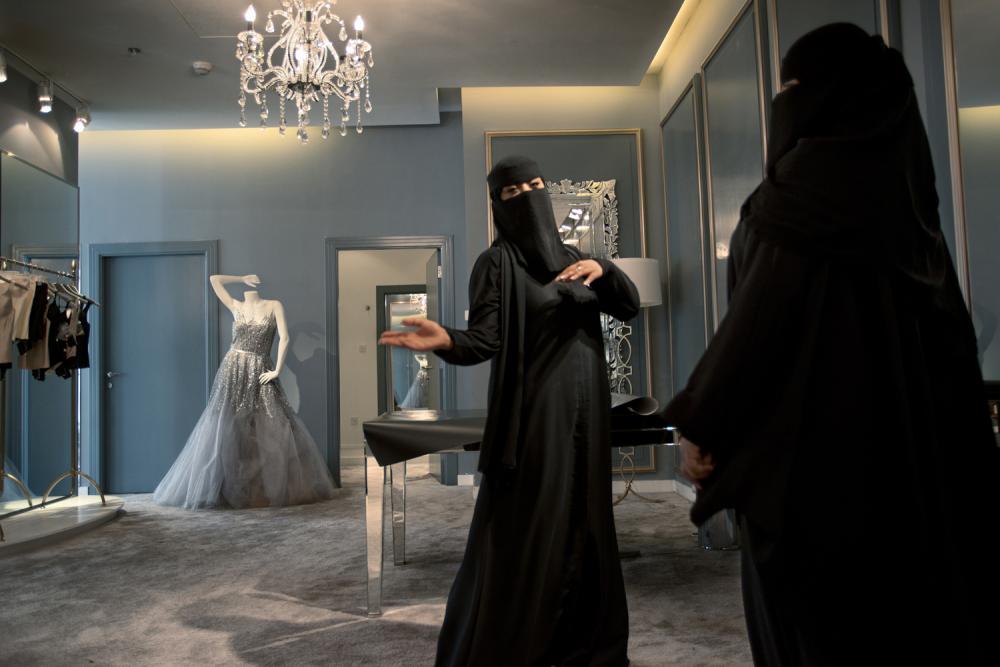
LETTER FROM RIYADH SHOPGIRLS: The art of selling lingerie.
BY KATHERINE ZOEPF
DECEMBER 23, 2013
A women’s revolution has begun in Saudi Arabia, although it may not be immediately evident. This fall, only a few dozen women got behind the wheel to demand the right to drive. Every female Saudi still has a male guardian—usually a father or husband—and few openly question the need for one. Adult women must have their guardians’ permission to study, to travel, and to marry, which effectively renders them legal minors. It took a decree from King Abdullah to put tens of thousands of them into the workforce. For the first time, they are interacting daily with men who are not family members, as cashiers in supermarkets and as salesclerks selling abayas and cosmetics and underwear.
One afternoon in late October, at the Sahara Mall, in central Riyadh, the Asr prayer was just ending. The lights were still dimmed in the mall’s marble corridor, but the Nayomi lingerie store had been unlocked. The rattle of steel and aluminum could be heard as security grilles were raised over nearby storefronts. Twenty-seven-year-old Nermin adjusted a box of perfume on a tiered display near the entrance, then turned to greet six saleswomen as they filed out of a storeroom, preparing to resume their shift. Nermin started working at Nayomi eighteen months ago, as a salesclerk herself. She was warm and engaging with customers, and was recently promoted to a position in which she oversees hiring and staff training for Nayomi stores across four Saudi provinces. All the employees wore long black abayas and niqabs, which revealed nothing but their eyes. They positioned themselves among the racks of bras, underpants, nightgowns, and foundation garments—black-cloaked figures moving against a backdrop of purples, reds, and innumerable shades of pink.
Nermin is one of the Nayomi chain’s longest-serving female employees. She was hired nearly a year after King Abdullah issued a decree, in June of 2011, that women were to replace all men working in lingerie shops. Early in 2012, on a visit to the Nayomi store in a mall near her house with her younger sister, Ruby, Nermin noticed a poster advertising positions for saleswomen. The sisters had never considered working, since there were virtually no jobs for women without a college degree or special skills. Nermin and Ruby mostly spent their days watching television, exercising, and surfing the Internet. In a blisteringly hot city with few parks, the mall was one of the only places to go for a walk. They filled out applications on the spot, and their family encouraged the idea. “I was surprised to find that I like to work,” Nermin said. Ruby, who got a job at the same store, is now the manager there. She wore its key on a yellow lanyard around her neck; pink-trimmed platform sneakers were visible beneath the hem of her abaya. After graduating from high school, she had spent four years feeling increasingly trapped at home, she said. “Nayomi gave me the chance to go on with life.” . . .
David, and Where is Yambio, South Sudan?
A year ago, we had an extraordinary experience. We often entertain delegates visiting from other countries, and this time we had three African journalists, and, strictly by chance, they all turned out to be Christian. Most of our gatherings are strictly ecumenical, but these were joyful, praying Christians, and the evening took a turn we never anticipated.
“So how did you find Jesus?” one woman asked David, from the newest country in the world, South Sudan. Inside, I was shocked, and when I am shocked, my tendency is to laugh, I don’t know why, it is just the way I am wired. Every culture is so different. In the South, people might ask that of one another, particularly if you worship in a fundamental sect, but our sect is more formal, and to inquire into another’s spiritual life can be perceived as intrusive.
David, however, was not taken aback. “It’s a long story,” he said, and we all settled into comfortable chairs to listen better. It was Christmas, the decorations were up, the lights all twinkling and we had eaten. A good time for a story.
It was a long story. It started with a little boy in a happy family, who one day was told to run! Run! Run into the forest and hide! The riders were coming! His family grabbed a very few things and ran.
His family ran for years. His family ran into forests, across borders, into dry arid spaces. Sometimes some of the children would get separated from their parents for a while, but they would keep asking, and eventually meet up again, only to face separation again. Their whole lives were running, from the Janjaween, from border police, from robbers.
At one point, he and a brother stayed in a church, and a priest taught them about Jesus. Simple stories, simple songs, and he drew letters and numbers in the dirt – that was his early schooling. It was a haven of peace for him.
Many years later, the family was reunited in their village in the new country of South Sudan. Miraculously, every member of his family survived, indeed, most of his village survived. They had maintained lines of communication through all those years of running and separation, and were so thankful. Most of all, now, they were thankful – they had a church in their village. David had learned to love learning, and had completed his education and had found a wonderful job.
“I don’t know the book like you do,” he told us, “I only know it like a little child sitting at the feet of that priest, but I am learning.”
I can’t help but think that David knows more than he thinks. David holds his belief in Jesus like a child, simple and direct. His testimony is powerful and unforgettable. I am in awe, even a year later, of his story and testimony.
Today the church prays for the diocese of Yambio, in the South Sudan:

Rosettes in 2013
Tomorrow is the day I’ve been waiting for – a crisp, cool, dry day when I can make thin, delicate rosettes. We have so many special occasions coming up and I want to be able to share them with others.

The weather here is so erratic – from hot with high humidity and fog to sudden cold and clear. I knew the weather was changing last night when the Qatari Cat came running in to snuggle up close to me. Today I ran errands so I would have tomorrow all to myself – it takes a major portion of the day; you make the rosettes one at at time. Bless his heart, AdventureMan will take care of the new happy baby for me tomorrow afternoon so I won’t even have to rush. 🙂
American Shedding Reliance on Cars
. . . in bigger cities where good public transportation is available, at least. But across the board, Americans are driving less. When I was a young woman living in Seattle, I took the bus to work. It was fast, reliable and I got to read going to and fro. A generation later, my son would park his car at the park and ride lot and take the bus into downtown. When you have GOOD public transportation, it makes a lot of sense. Found this article on AOL Auto News:
Commuters are shedding their reliance on cars.
They’re not driving to work in their own vehicles as often as they once did. They’re not carpooling with other workers as often. They’re increasingly using public transportation or simply working from home.
Those are the conclusions of a study released this week by U.S. PIRG, which reviewed data from the Federal Highway Administration, Federal Transit Administration and U.S. Census figures.
It says the proportion of workers commuting in private vehicles, either alone or in a car pool, declined in 99 of the 100 largest urban areas in America between since 2000.
Newark, New Jersey saw the greatest percentage of workers put down their keys, with a 4.8 percent drop, followed by Washington D.C., down 4.7 percent and Austin, Texas, down 4.5 percent.
In recent years, there have been numerous indications that Americans overall are shifting away from driving. The number of per capita vehicle miles traveled reached its peak in 2004. This study claims to be the first to specifically look at the decline in American cities.
“Many existing transportation plans continue to reflect outdated assumptions that the number of miles driven will continue to rise steadily over time,” wrote Phineas Baxandall, senior analyst at U.S. PIRG and the study’s author. “Officials at all levels should revisit transportation plans to ensure they reflect recent declines in driving and new understandings of the future demand for travel.”
The U.S. PIRG study details changes that on a market-by-market basis. Among its other findings:
– The proportion of residents working form home has increased in every one of the 100 largest urban areas since 2000
– The proportion of households without cars increased in 84 of the 100 largest markets between 2006 and 2011
– The proportion of households with two cars or more decreased in 86 of the 100 largest markets between 2006 and 2011
One of the more notable trends appears to be the death of carpooling as a commuting option. Between 2000 and 2011, carpooling declined 17.8 percent, according to the U.S. PIRG study. Only 9.7 percent of workers now report they share rides to work.
The results are not entirely surprising: The number of Americans who work from home increased 45 percent between 1997 and 2010, according to an earlier study conducted by the U.S. Census Bureau.
Curiously, the decline in driving hasn’t dampened demand for cars. Automakers expect to sell approximately 16.4 million vehicles this year, according to the latest projections released earlier this week. It’s the best year for auto sales since 2007, when more than 17 million cars were sold.
Pete Bigelow is an associate editor at AOL Autos. He can be reached via email at peter.bigelow@teamaol.com and followed on Twitter @PeterCBigelow.
Southern Family Thanksgiving
Oh, what fun!
Some photos from the gathering.
My daughter-in-law made these fabulous bacon-wrapped stuffed dates:


The kids dish up their plates first, and go to the Cousins Table:

These are all the desserts waiting to be unveiled:

AdventureMan did the roasted root vegetables on this table 🙂


Re-telling old family stores – so much laughing!
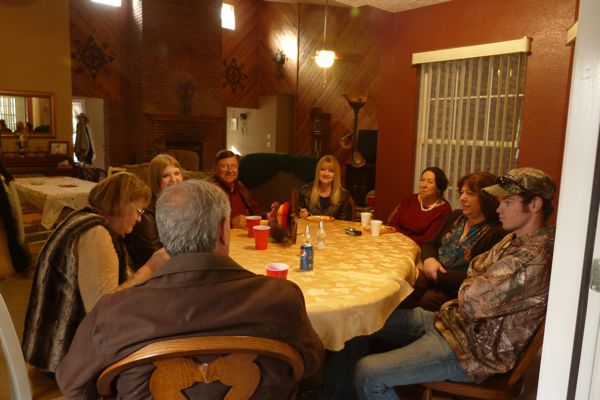

Uncle Woodrow introduces the cousins to farm-grown sugar cane:

Clean House = Better Physical and Mental Health
Time for some pre-Christmas cleaning 🙂 This from AOL/Huffpost:
A clean house isn’t just “nice to have,” it’s actually a necessity for good mental and physical health. According to a study published in Time, the Indiana University department of Physical Activity, led by associate professor Nicole Keith, discovered a correlation between clean houses and healthy people.
Researchers tracked the physical health of 998 African Americans between the ages of 49 and 65 — a demographic with a high-risk for heart disease – by comparing their levels of physical activity with the cleanliness of their homes. Those people with the cleanest homes were also the healthiest and most active, according to the study results. In fact, the findings also suggested that encouraging people to maintain their home’s cleanliness may be even more important to their overall health than the walkability of the neighborhood they live in.
“At the end of the day, the interior condition of their house seemed to be the only thing affecting their physical activity,” said Keith. “It was not at all what we expected.”
It’s clear by Keith’s statement that their discovery surprised even the researchers, but are these findings really so shocking? Florence Nightingale, a pioneer of modern nursing, famously quoted, “The connection between health and the dwelling of the population is one of the most important that exists.”
Even the Environmental Protection Agency admits that indoor air can be up to five times more polluted than the outdoors. If the average person spends up to 90 percent of their time indoors, we are breathing in dust mites, pet dander, pollen, mold, bug skeletons, and toxins from such innocuous sources as conventional cleaning products and even chemicals emitted from our own clothing and bedding. These toxins manifest themselves as symptoms most people attribute to allergies such as itchy eyes, runny nose, and wheezing, but which should actually be blamed on an unclean house.
And the germy culprits aren’t always where you think they are. Elizabeth Scott, PhD, co-director of the Center for Hygiene and Health in Home and Community at Simmons College in Boston, found staphylococcus bacteria, a common cause of serious skin infections, in 26 percent of the tubs she tested, compared with just 6 percent of garbage cans.
Yes, these statistics provide scientific proof that the mental and health benefits of a clean environment are very real; but, we also look to the renewed energy and happiness our clients describe to us after one of our visits. When we hear our clients use words such as “therapeutic,” “relaxing,” and “motivating” to describe their newly cleaned homes and offices we are reminded that a clean home is truly the embodiment of the science and soul holistic cleaning philosophy we maintain at GreenHouse Eco-Cleaning.
Recent Comments
ExpatAlien on What Country am I Living … intlxpatr on Yellowstone: Old Faithful to C… Michelle on Yellowstone: Old Faithful to C… Cathy on No Grown-Ups in Charge intlxpatr on Waiting for Snow Wikipedia Donate Button

Amazina


Early Voting in Florida


 Here There and Everywhere