Kuwait Divorce Rate “50% and Rising”
How did I miss this truly excellent article in the Arab Times?
Divorce Rate In Kuwait 50pc … And Rising
Huge Increase Seen In ‘Cheating’
A good, productive and stable marriage is built on one’s ability to love someone else and make sacrifices for that person. We in this region as a whole are sometimes very materialistic and usually wealthy. Many a time couples get married for the wrong reasons. Sometimes because marriage is the new “thing to do”, it’s merely the new toy. Maybe the honeymoon period is the only highlight of the whole affair.
Lawyer Waleed Khaled Al-Dousari was talking to the Arab Times on marriages in Kuwait, exploring the causes behind the increasing rate of divorces in the society. “The rate of divorce in Kuwait has reached more than 50 per cent, and the number is still on the rise,” he adds.
Q: How would you describe marriage in Kuwait, and have the trends changed?
A: Traditionally, the ideal marriage was tribal, related families encouraging their offspring to marry cousins or other relatives in order to increase and strengthen the tribe, or occasionally to marry into another tribe in order to heal rifts between families. Another reason for such marriages was that families knew the background of the partner.
As is the case in some Latin countries, young couples in the region are allowed to meet under the watchful eyes of a chaperon. In Kuwait, however, the marriage is arranged without any part of the girl’s body (including her face) being seen by the prospective groom, who must rely on the reports of his female relatives as to his wife’s appearance.
There are three main elements in an Arab marriage. First, the groom must discuss and agree the dowry with the bride’s father. This might include gold, jewelry and clothing and is usually of considerable valuable. After the dowry settlement, comes the actual marriage contract, which is conducted by a legal or religious representative.
The bride is asked in the absence of the prospective groom if she agrees to the marriage and this question is then put to the groom. After the agreement, the groom joins hands with his future father-in-law and, with two witnesses present, the marriage becomes official.
However, there’s another stage before the couple actually meet as man and wife: the wedding party. Celebrations are segregated, with the women in one section of the house or private ballroom and the men in another. Finally, on the last night of celebrations, the couple meets, accompanied by all their friends, and eventually leaves for their honeymoon. On their return, they either live with the groom’s parents and become members of the extended family or – as is increasingly the case – set up a separate home by themselves.
According to Sharia, a Muslim man may have four wives, provided that he can look after them materially and treats them equally. This practice is now dying out, however, not only because only a few can afford it, but also because women are becoming more independent and assertive and many refuse to accept it.
In fact, a Muslim woman can insert a clause in the marriage contract that restricts her husband from marrying another woman for as long as the contract is valid. The wife also retains her own name after the marriage.
Although gender roles have always been clearly defined in the Islamic world, with the man as ‘provider’ and the woman as ‘nurturer’, both the man and the woman are increasingly going out to work, although this is much less common in Saudi Arabia, where there are restrictions on women working, except in culturally ‘acceptable’ occupations such as medicine and teaching. However, many Saudi men are reluctant to marry doctors and nurses, who have physical contact with male patients.
A man can divorce his wife simply by saying ‘I divorce you’ three times. He can rescind the divorce if this was done in the heat of the moment, but only if the wife agrees (and only on three occasions though). On the other hand, even if a wife has a good reason to seek a divorce (e.g. if her husband has been unfaithful, abused or deserted her, or engaged in criminal activity), she must go to a court for the case to be heard.
The husband must maintain a divorced wife and any children from the marriage if the wife is unable to support herself. He can claim custody of any sons when they reach a certain age; however, the priority is given to the mother, but this still depends on the sect of the couple. A female divorcee usually returns to her family, and few remarry.
Although a Muslim woman may not marry a non-Muslim man unless he converts to Islam, the reverse isn’t the case. Non-Muslim women are often pressurized into converting, and there have been many cases of foreign women marrying Arabs and then discovering that the local culture and lifestyle are unacceptably restrictive. It should also be noted that, in the event of the breakdown of such a union, the children are usually kept by the husband in his home country.
Expatriate workers can usually be married in the Gulf, provided that they meet the civil and religious requirements of their home country. Embassy and consulate staff sometimes performs civil marriage ceremonies, again provided that certain requirements are met. Religious ceremonies can be arranged, but only in countries that allow churches or similar non-Muslim places of worship.
Although many young citizens in Kuwait are still seeking the blessing and help of their parents for choosing life partners, some youngsters in Kuwait prefer finding their partners without parental guidance and mediation. This approach is the result of cultural interactions. This changing trend has become quite noticeable in the countries of the region.
Q: Why are we currently encountering an increasing rate of divorce in the country?
A: A good, productive and stable marriage is built on one’s ability to “love” someone else and make sacrifices for them. We in this region as a whole are sometimes very materialistic and usually wealthy. Many a time couples get married for the wrong reasons. Sometimes because marriage is the new “thing to do”, it’s merely the new toy. Maybe the honeymoon period is the only highlight of the whole affair.
In some cases, both partners may be in need of intimacy and so they get married to have that kind of intimacy. There’s nothing wrong with that. In fact in this arrangement, there is one good thing in that youngsters feel that they should “get married first” before “becoming intimate with anyone”. That’s a noble and encouraging thought.
But after the first few months or the first couple of years, we start noticing the first signs of trouble, and you see both sides contemplating the “D” word. They think “I don’t need this.” And rightly so, they really don’t need it. Both are wealthy, both have high paying jobs, their rooms in their parents’ houses are still empty and perhaps are still untouched with their original furniture in place and in tact.
Other reasons, however, come along due to the change in the definition of marriage as a whole from the perspective of both men and women. Even families in Kuwait today no longer feel shameful that their daughter or son is divorced. Some families are actually encouraging their daughters to divorce, because sometimes that divorce gives her more financial gains than she already has.
In Kuwait, it is a huge problem when a man cannot provide a luxurious life to his wife. It is his duty to provide her with the maid, driver, shopping every now and then, and the ability to travel at least on a yearly basis.
However, not all Kuwaitis are able to provide this kind of lifestyle for their wives and children.
Another issue is that of cheating. There is a huge increase in the percentage of cheating wives and husbands. It has become so easy for a husband or wife to cheat on each other, especially because marriages are neither based on love nor respect.
The high divorce rate in Kuwait insinuates that we are too spoiled to remain stuck to our marriages.
So what will happen to us in say 50 years? The world will be less dependent on our oil, and the oil will become less abundant anyway. We will become poorer in general. Isn’t that right?
We will have less materialistic “toys” to play with. And therefore we will be less spoiled. And I think we will tend to stay committed to our marriages more.
Our men will start actually doing some “work” to earn a living. And less of these jobs will be suited to women, and women will have less incentive to leave the umbrella of her husband’s (modest) financial security. Just like the times of our grandfathers and grandmothers.
Now, this might be a bleak picture, but maybe with less material distractions, and with healthier marriages, I only see us becoming happier people.
Q: So what happens, when a couple comes asking for a divorce?
A: From my experience as a lawyer, the usual scene when two couples ask for a divorce is that they come to my office in the image of two enemies who completely hate each other, and cannot even stand being in the same room with each other.
The women usually tries to file as much cases against her husband to get all the rights that she wants, and the man tries to do the same thing.
Q: What is the role of Shari’a law in divorce cases? Is there a difference between the rights that a woman may take if she was Sunni or Shi’ite?
A: In Kuwait we abide by the Islamic Sharia law when it comes to marriage or divorce. Therefore, when a couple asks for a divorce, usually there are certain proceedings that should take place.
To apply for divorce, you should be of sound mind and be able to make your own choices.
The first step the couple should do is to register the case at the Moral and Family Guidance Section at the court.
Shortly afterwards, a counselor will meet the couple and discuss their problems. They are then given a three-month time to try and solve the problems, before beginning the divorce process.
If the couple, or either of them, still insists on divorce, the papers will be forwarded to the court for the judge to study the case. The judge will discuss it with the couple and listen to the witnesses. It could take a couple of sessions before the judge makes his decision. The couple needs to attend all the proceedings.
A woman may be granted a divorce if she can prove that her husband has physically hurt her or mentally tortured her. A woman also may sue for divorce if her husband abandons her for a period of three months, or if he has not taken care of her needs or that of their children.
The law allows women to obtain a khula – a separation, when she returns the dowry to the husband.
The Sharia Court will accept a divorce lawsuit from Muslim men or Christian or Jewish women married to a Muslim and apply the Islamic laws.
If the divorce applicants are both Muslims, but from different countries and are residents in Kuwait, they will be divorced according to the administrative laws in their country, or the Kuwaiti law, whichever they wish. While Sharia is same in all Muslim countries, there are a few administrative differences between the various schools of thought.
If the couple is from the same country, the law of their country, will be applied or the Kuwaiti law may be applied, if they so wish.
If the husband is a Muslim and the woman is not a Muslim, the Kuwaiti laws will be applied, or the law of the country where they had got married will be applied.
If the couple is non-Muslim, they can seek divorce according to the law of their country, at the embassy or consulate.
There is not much difference between the two sects when it comes to divorce; there is only one main difference, and that is a Sunni women can take the custody of her children without ever having to return them to their father. However, the father can be with his children on previously arranged days.
According to the Shi’ite sect, the father can take his children when the children reach the age of seven or above, by which time the children too have a say in that kind of decision.
However, even the issue of custody is abused by some women, who place a huge financial burden on the man under the pretext of asking for the children’s upkeep. Some women do so despite being financially well off themselves.
Q: Can you give us examples of some divorce cases in Kuwait?
A: One intriguing divorce case involved a woman who divorced her husband on their wedding day because she found out at the wedding ballroom that groom had not made the costly arrangements that she had asked for, and instead chose a reception that cost much.
Some women get divorced because they see divorce as a financial gain for them. Men are sometimes forced to provide his divorcee with a house, a maid, a driver, and a monthly alimony for her and her children.
In many cases the reasons are very silly, which makes it very difficult for us lawyers to take any stand on the issue. For example one woman filed for a divorce because she didn’t like the way her husband made sounds while eating.
Q: What do you think is the role of society to tackle the problem of increasing divorce rates? How can education help reduce the rate of divorce, or help couple’s understand and appreciate the true value of marriage?
A: In light of high rates of divorce cases, social authorities should play a role in educating youth about the basic criteria for sound marriages. Grassroots associations and the media in the Gulf have to educate families about potential negative aspects of coercing young males and females to marry relatives, in the first place, and also how arranged marriages can have very harmful results on both couples, especially as they might not be suitable for each other.
Most of the persons I have met expressed desire to marry non-relatives, thus affirming the idea that parents must refrain from coercion. Moreover, to by taking away the right of youngsters to choose their life partners is against religious values and common sense.
Some official reports estimate that divorce cases in Kuwait are at 50 percent, and the phenomenon has been linked to diverse factors related to modern-day developments in the country, and western concepts and values and post-oil-boom social transformations.
Most males in Kuwait tend to get acquainted with the would-be “soul mate” personally while the majority of the females favor the parents’ role in this regard.
In Kuwait, we are starting to have many welfare societies that are helping couples to refrain from divorce as much as possible. However, the problem is that we do not have the right education concerning marriage in the country.
Neither families nor schools educate children on marriage or even give them the chance to fall in love and make their own choices of who they want to get married to.
We need to set a proper age limit for marriage for both males and females, because some are getting married at a very young age, such as 17 and 18. This is also leading to the great increase in divorce rates. The proper age for males to get married should be between 26 and 30, and that for the females should be above 20. However, that is only my opinion.
As to the qualifications of the would-be partner, the couples should believe in commitment. They should be educated. There is the need to be attracted to the physical appearance of each other and not be forced to get married to people they don’t know. Then of course financial capacities and employment are important factors. These are not the most important issues though.
biography
Born in 1983
Khaled Al-Dousari: currently a divorce lawyer at the Mohamad Saleh Al-Sabti, Lawyer Office. Started at the office in January 2007.
Graduated from the Academic Law Institute in Jordan in 2006.
Until today he has taken up to 300 cases of divorce.
By: Rena Sadeghi
Taliban Says Malala ‘Has Done Nothing To Earn Prize’
Mr. Taliban, did you see Jon Stewarts interview with Malala? (See below) All she wants is an education. She wants an education for herself, but also for all children in Pakistan. Your children, too! She wants them to have that opportunity, that’s all. And she has paid the price for her courage speaking out, and she bravely continues to state the obvious – there is nothing in Islam against educating women.
MIRANSHAH, Pakistan: The Pakistani Taliban Thursday said teenage activist Malala Yousafzai had done “nothing” to deserve a prestigious EU rights award and vowed to try again to kill her.
The European Parliament awarded the Sakharov human rights prize to the 16-year-old, who has become a global ambassador for the right of all children to go to school since surviving a Taliban murder attempt.
Malala survived being shot in the head by a TTP gumnan on October 9 last year and is seen as a leading contender for the Nobel Peace prize, to be announced on Friday.
“She has done nothing. The enemies of Islam are awarding her because she has left Islam and has became secular,” Tehreek-e-Taliban Pakistan (TTP) spokesman Shahidullah Shahid told AFP by telephone from an undisclosed location.
“She is getting awards because she is working against Islam. Her struggle against Islam is the main reason of getting these awards.”
He repeated the TTP’s threat – made numerous times in recent months -try again to kill Malala, “even in America or the UK”.
Malala and moved to Britain in the wake of the shooting for treatment and to continue her education in safety.
Feted by world leaders and celebrities for her courage, Malala has addressed the UN, this week published an autobiography, and could become the youngest ever Nobel Peace Prize laureate on Friday.
Her autobiography “I am Malala”, written with journalist Christina Lamb, has gone on sale in Pakistan and Shahid warned the Taliban would target bookshops stocking it.
“Malala is the enemy of Islam and Taliban and she wrote this book against Islam and Taliban,” he said. (AFP)
Not The Day We Expected . . .
And once again, we have to laugh at God’s perfect timing.
I love Thursdays. Thursdays are the only day I have unscheduled. Once a month on a Thursday I have a meeting, but other than that, Thursdays are mine, and I luxuriate in them.
This morning I slept in an hour, then went leisurely through my Lectionary readings and scanned my e-mail. AdventureMan had other plans, but as we talked over our day, decided he wanted to come with me to the commissary. It’s fine with me. We have always had some of our best conversations in the car, and he doesn’t follow me around in the commissary asking questions like “do we really need this?” the kinds of questions that drive wives to homicidal thinking. There are some benches in the commissary, AdventureMan calls them the Old Farts benches, and he picks up his specialty bird seeds and supplies, then settles in to watch for me coming down the last lane.
Four minutes after we left the house, we got a call from our son, tied up on a case, that little Q broke his arm on the playground, could we go pick him up? We were only about five minutes from his school and were there in a flash. AdventureMan/BaBa rode in the ambulance while I drove over to our son’s home to care for the baby while Q’s Mom zipped to meet them at the hospital emergency room.
It took all day. Between the transporting and the paperwork and the x-rays and the setting of the bones (yep, two bones broken), by the time we all met up again, I no longer had any interest in hitting the commissary. I will try again tomorrow, God willing.

Meanwhile, we marvel at how wonderful it is to be here in Pensacola, to be on call for emergencies like this, and that we were just minutes from his school when our son’s call came. We love it that we can be useful in these emergencies, that we are here to help and that we can be helpful. Once again, we thank God for his perfect timing.
Meanwhile, Mom called and gave me no sympathy whatever. She laughed! “Remember your sister broke both her arms before she was six, and you both broke legs skiing!” she chortled. Ouch! I guess little boy Q comes from a family of risk-takers. His dad broke exactly the same arm in the same place jumping to grab on to a high bar once. His son said “I thought I could fly. . . but I can’t.” It’s in the genes. :-}
God Vs. Worry; God Wins
One of the things that adds texture to my life, and helps keep me on the straight and narrow (and that takes a LOT) is reading the daily lectionary every single morning of the year, before I do anything else. Normal days, I access it from my computer, traveling or appointment days, I can access it from my iPad or iPhone. It’s like a little extra fence that helps keep me safe from myself and my own creativity when it comes to evil.
There is another side, the blessing side. In one of the bible studies I attend, we learn, over and over that God blesses the believer. You don’t have to be perfect – and it’s a good thing, because none of us are. If you want to see how much God can love a sinner, just read your bible. Sin is one of the main characters, right along side Abraham and Sarah, Job, Lot, and especially King David.
But in my life, I have seen wondrous things, and I have had some totally WOW moments when God has blessed me beyond any prayer I could have raised. One of those moments was showering under a waterfall near an oasis in the Tunisian desert. Two others happened this year, and these were blessings that stopped me in my tracks with their timing and aptness. First, we got an unexpected tax refund which arrived in our account just in time to cover the big expensive air conditioning system on the main floor when it broke and had to be replaced.
Second, when we were looking for the last few thousand dollars to help us buy a new car (we prefer to pay cash) we got another tax refund – we had asked that they re-look taxes for a move, and they allowed the moving expenses. We had waited almost a year for that decision; we had waited so long we had pretty much forgotten and given up on it. I mean tax refunds – it’s a never-never land, it all seems so arbitrary. You can have a perfect case, and it can be denied for a reason you’ve never heard of.
God’s timing is perfect. His sense of humor is breath-taking. The funds we needed poured into our hands just when we needed them, in just the right amount.
Matthew 6:25-34
25 ‘Therefore I tell you, do not worry about your life, what you will eat or what you will drink,* or about your body, what you will wear. Is not life more than food, and the body more than clothing? 26Look at the birds of the air; they neither sow nor reap nor gather into barns, and yet your heavenly Father feeds them. Are you not of more value than they? 27And can any of you by worrying add a single hour to your span of life?* 28And why do you worry about clothing? Consider the lilies of the field, how they grow; they neither toil nor spin, 29yet I tell you, even Solomon in all his glory was not clothed like one of these.
30But if God so clothes the grass of the field, which is alive today and tomorrow is thrown into the oven, will he not much more clothe you—you of little faith? 31Therefore do not worry, saying, “What will we eat?” or “What will we drink?” or “What will we wear?” 32For it is the Gentiles who strive for all these things; and indeed your heavenly Father knows that you need all these things. 33But strive first for the kingdom of God* and his* righteousness, and all these things will be given to you as well.
34 ‘So do not worry about tomorrow, for tomorrow will bring worries of its own. Today’s trouble is enough for today.
“Is Your Cat Always Fractious?”

“Fractious” isn’t a word you often hear. Clearly the veterinary tech had just read the word off the record, perhaps there is some warning in there about the Qatari Cat.
The Qatari Cat was born on the streets of Qatar, and had a bumpy start with another owner. While the man and his daughter liked him just fine, the wife and her mother did not. When the Qatari cat came to live with us, he was very wary of me. It took a couple years for him to fully trust me. He watched my feet all the time. He quailed in fear, ears back, if I used a loud voice. He was terrified of the sound of plastic bags.
Slowly, slowly, we built a relationship. Today, ten years later, he is a sweet cat.
He is a sweet cat every single day of the year, but he still has his street instincts. AdventureMan has learned that you can’t play rough with the Qatari Cat; you play rough, you lose. I never speak loudly to him; it just won’t work, it just gets his back up. Because he knows I am the boss, I speak sternly, but softly to him and he will do just what I ask him to do.
Our first visit to the vet went badly. You can read about it here. He was fine until the buzzing razor hit his bottom and then all his survival instincts kicked in. He’s been back twice, and he has been as good as gold, but somehow . . . that notation has stuck.
“No!” I replied, maybe a little bit too loudly.”No! He is a sweet kitty! He is snuggly and loving and quiet and good! But if he is scared, he wants to defend himself.” I told the tech about the Italian vet the Qatari Cat fell in love with in Kuwait, she snuggled him and told him how beautiful he was and how much she loved him and he was putty in her hands. I was almost jealous. I thought maybe she distilled some catnip and mixed it with her perfume or something, Qatari Cat’s eyes glazed a little in sheer adoration when he was around her, and he even drooled a little. She could take his temperature, give him a shot and check his innards and he never complained, just looked at her adoringly.
The tech shot a skeptical look at me and exited the room. I could hear her repeat this to the vet, and muffled laughter before she entered the room again.
So the vet came in and snuggled Qatari Cat, and told him he was pretty, and while she did not say it with an Italian accent, Qatari Cat was clearly intrigued – and on his best behavior. It doesn’t take much . . . he’s a male. Snuggle him a little, rub his fur the right way, chat him up . . . it doesn’t have to be rational, it’s all in the tone of voice and the flirtation. He totally digs it, he eats it up. A little grope here, a quick look at the teeth, a quick injection and he’s finished, not a fractious moment in the entire visit.
On the way home, we laughed thinking of our sensitivity at having our cat called “fractious.” We remember the indignant response of friends whose cat was annotated as “vicious” by a German vet. The cat was diabetic and objected to the roughness with which the vet wanted to take his blood. I think if you are a veterinarian, you might have an understanding that a sick animal, or a scared animal, might act unpredictably or defensively, there are big thick gloves you can wear if an animal seems wired up.
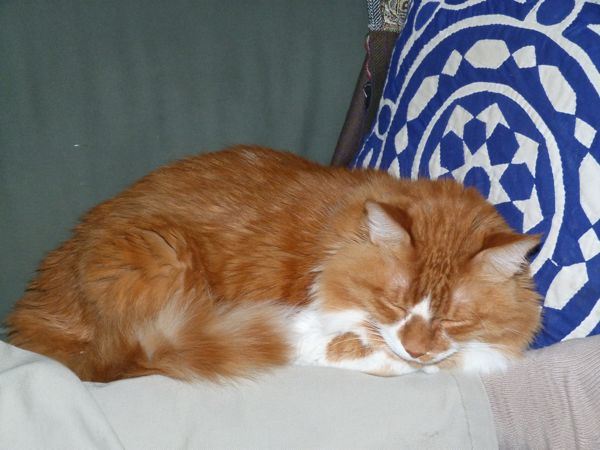
Does this look like a fractious cat to you?

Kuwait Marriage and Divorce 2013
The presentation is a little confusing, but I have to guess that if 19% of the divorces are “non-Kuwaiti” by which they mean that one member of the marriage is not Kuwaiti. So what they are not saying is that 80% of the divorces are Kuwaitis married to Kuwaitis.
They also did not say how long marriages lasted – how many of those marriages were divorced in the first year, how many after many years? If the statistics are accurate, Kuwait is doing OK – more than half the marriages are succeeding.
OOps – found second report in the same Kuwait Times! See below
9,404 Kuwaiti marriages, 4,067 divorces in 2012
KUWAIT: More than 9,000 Kuwaiti couples married last year and more than 4,000 marriages ended in divorce the same year, a local daily reported yesterday quoting official statistics.
The statistics released by the Ministry of Justice and published by Al-Qabas daily indicate that 9,404 marriages between Kuwaitis took place last year compared to 4,067 divorces, or 43.3 percent.
The same statistics also indicated that 4,910 marriages took place between a Kuwaiti and non-Kuwaiti spouse in 2012, compared to 2,605 divorces in the same category. In detail, the statistics show that 814 Kuwaiti men married non-Kuwaiti women in 2012, while 648 Kuwaiti women married non-Kuwaiti men the same year.
The percentage of Kuwait couples in the total number of marriages last year reached 65 percent, according to the statistics, while 19 percent took place between non-Kuwaiti couples. 10 percent of marriages took place between a Kuwaiti man and a non-Kuwaiti woman, while marriages between a non-Kuwaiti man and a Kuwaiti woman also reach 10 percent.
Regarding divorce percentages, the statistics show that 19 percent of divorce cases happened between non-Kuwaiti couples; 12 percent between couples in which the husband is Kuwaiti and the wife is non-Kuwaiti, and 7 percent between couples in which the husband is non-Kuwaiti and the wife is Kuwaiti.
Regarding academic qualifications, the statistics show that 35 percent of women married last year have university degrees, 30 percent have high school degrees, and 19 percent have diplomas, whereas 29 percent of men have university degrees, 24 percent have high school degrees, 21 percent have middle school qualifications and 20 percent have diplomas. On the other hand, the statistics show that the majority of women divorced last year have university degrees (29 percent), while the majority percentage of divorced men have middle school qualifications (29 percent).
55% couples married in last 4 years seek divorce
KUWAIT: Almost 55 percent of couples filing for divorce in Kuwait have been married for four years only, including 25 percent who are yet to celebrate the first anniversary of their wedding, a local daily reported yesterday quoting official statistics. The statistical report released by the Research and Statistics Department in the Ministry of Justice and obtained by Al- Qabas daily further indicates that out of 5,662 couples who sought marriage counseling, only 20 percent had their issue successfully resolved.
Lack of willingness to coexist was identified as the primary cause for divorce requests, with 32 percent of the requests made by husbands and 23 percent by wives.
The statistics further indicate that 77 percent of couples who attended marriage counseling were Kuwaitis compared to 22 percent non-Kuwaitis.
Meanwhile, 62 percent of those couples do not have children, 34 percent have one to three children, and 2.7 percent have between four and six children.
Regarding age groups, the statistics show that 42 percent of couples seeking marriage counseling are aged between 25 and 34, 22 percent aged between 35 and 44, and 20 percent aged between 15 and 25. And according to the couples’ academic levels, the statistics indicate that 28 percent of husbands have middle school degrees, 22 percent have high school degrees and 21 percent have university degrees, whereas 27 percent of wives have high school degrees, 23 percent have university degree, 22 percent have diploma and 20 percent have middle school
One Thing Leads to Another
“I’m afraid to go home,” AdventureMan told our son. “She’s moving the furniture.”
“She can do that without consulting?” our son asked.
“Yeh, she can,” AdventureMan responded, “And I count myself lucky that she hasn’t bought another house and said we’re moving.”

Moving furniture is one of those things I do. I get tired of everything the same-old same-old. If I’m not moving, it gives me a chance to re-think things, and try something else to see if that works better.
We have a dining room we hardly ever use. We have never eaten a meal in there. We had too much furniture, and besides, in the family room we have a huge circular teak table that seats eight. It’s less formal and a lot more fun. The dining room is in a very quiet part of the house, so we talked about turning it into a library (see! we talked!) and that is what I did. But when you move a piece of furniture, or get rid of another, or both, you end up also having to evaluate all the things inside that piece of furniture, and having to think through where things need to go.
Life is so different. As an Army wife, we entertained all the time. I hit the sales in Czechoslovakia and have bar ware and wine glasses for our 48 closest friends, and we just don’t entertain like that any more. We don’t even drink like that!
We do entertain; we host the monthly book club some months, I have my quilting group in frequently, and we have dinners for family and dinners for visiting IVLP delegates. We entertain people we like. It’s a whole different world when it’s a choice. I’m getting rid of a lot of pieces I’ll never use again and I’ll never miss once they’re gone.
I’m getting rid a lot of irrelevant things, including an old TV cabinet, you remember them? They enclosed an old fashioned TV, had shelves for videos (remember them?) and little drawers for CDs? I’ve been using it as storage for art work and a thing that plays music from an iPod or two. I’ll hang some of the art work, get rid of some, and find another place for the MP3 player.
Yesterday was the big work, the figuring out how to change furniture and carpets into new positions. Of course, once you move something, you have to clean the places no one ever sees, so it takes more time, but you’ve got to do it right.

Today was the small but time-consuming work of getting things put away in a kind of order so that they can be found again. When I put books on the shelves three years ago, it was like fiction here and non-fiction there, and I never went back. Now, I have them sorted into subjects and country, art related, or religious. Got rid of about half my CD’s but still have too many.
It’s a messy process; you take something fixed, turn it into chaos and slowly, slowly, bring a new pattern into being. Tomorrow I need to hang some more art work. It’s been three years.
Then we live with the changes and see if they work for us. If not . . . the process starts over, but in the meanwhile, got rid of some stuff! One of these days, need to tackle the closets . . . Have an entire closed full of evening clothes I never wear, and can’t bear to part with . . . yet.
Adventures in Chenega Bay
By the time we reach Chenega Bay, we are READY! The departure board tells us we only have a half an hour, but a half an hour is enough to hike to the top of the hill, see the church, take some photos and return. Actually, it took us more than half an hour. It didn’t matter. The ship needed to offload and onload, and the Chenega Bay residents needed their fix of hamburgers and ice cream.
As it turns out – and we should have known this by now – we really had a lot longer. It took a while to load the snow plow and all of its accessories 🙂
Chenega Bay was totally wiped out in a tsunami following an earthquake. Here is what their official site tells us:

Chenega IRA Council
PO Box 8079 * Chenega Bay, AK 99574 * 907-573-5132
The Chenega IRA Council is a federally recognized Indian Tribe that serves the Alutiiq people of Chenega Bay, Alaska. The Chenega IRA Council operates a variety of social, cultural and economic development programs designed to enhance the quality of life within Chenega Bay.
Chenega Bay – Description & Location
The village of Chenega Bay is located on Evans Island in Crab Bay, (42) miles Southwest of Whittier in the Prince William Sound. It is one hundred and four (104) air miles southeast of Anchorage. Until the March 27,1964 earthquake, Chenega was an Alutiiq Native tranquil fishing village located on the southern end of Chenega Island in western Prince William Sound. Founded before the Russian arrival in the late 1700s, Chenega was the longest occupied village in Prince William Sound at the time of the earthquake. Moments after the earthquake, a tsunami destroyed all of the buildings in Chenega village with the sole exception of a single home and the village school. Over a third of the village residents were killed and the survivors were taken initially to Cordova and then were later resettled in the village of Tatitlek by the Bureau of Indian Affairs.
With the passage of the Alaska Native Claims Settlement Act, the former residents of Chenega formed the Chenega Corporation that acquired the right to select 76,093 acres around the old Chenega Village Township. The Alutiiq Natives enrolled in the Chenega Corporation selected their new village site at Crab Bay on Evans Island in the Prince William Sound in March of 1977. This site was carefully chosen following extensive research as the site best able to meet the needs of the residents’ subsistence lifestyle. The Chenega Corporation and the Chenega IRA Council worked together to obtain funding for roads, a water and sewer system, electric generators, a boat and floatplane dock and a school. The new village named Chenega Bay was finally occupied in 1984 following the construction of 21 Housing and Urban Development homes.
Chenega Bay is an isolated community accessible only by air or water. Charter airlines provide the majority of the transportation and the Alaska Marine Highway Ferry System provides weekly ferry service year round.
Commercial fishing and subsistence activities are an important part of the lifestyle of the people of Chenega Bay. Commercial employment is primarily with the local school, the Tribal council, health clinic, and commercial fishing.
The primary business area of the village includes village council offices, a community center, the Russian Orthodox church, small boat harbor, the Alaska marine highway ferry terminal, and a future local display facility.
It felt so good to be able to get off and do some hiking. It was also a little overwhelming trying to imagine living in a village this small. Almost all the houses I saw looked exactly alike; maybe the tribe built them all. It is very very small and very isolated, the boat comes in once every week. There are no scheduled airlines, only charters.






The Russian Orthodox Church, The Nativity of Theodokos, is very new, and very beautiful. We wondered where people sit? Or maybe there are chairs hidded away that are brought out for services, or brought from across the street at the Indian Affairs office? I always check, I love it that so many of the ikons look native. 🙂




This last photo from the church is St. Herman of Alaska. Here is what Wikipedia says:
Saint Herman of Alaska (Russian: Преподобный Герман Аляскинский, c. 1750s – November 15, 1836) was a Russian Orthodox monk and missionary to Alaska, which was then part of Russian America. His gentle approach and ascetic life earned him the love and respect of both the native Alaskans and the Russian colonists. He is considered by many Orthodox Christians as the patron saint of North America.[1]
The patron saint of North America?! Who knew?!

The Johnny Totemoff Museum is sometimes open – not today – and also sells homemade jams made from salmonberry and high mountain cranberries. I would have loved to have some of that! Johnny Totemoff was a local fisherman who always knew where the fish were, and was always coming to the rescue of other in troubled times. I love it that they named the museum after him. (Don’t you wonder how I knew that? On board the ship, they have a notebook at the Purser’s office they put out before you reach each stop. I read about the Totmnoff Museum in the Purser’s book.:-) Now you know.)

We loved watching the kids play – two of them were waiting for their father to come off the ship with their ice cream. They reminded me of my mom telling me of all the times she wanted to kill me because I did unsafe things, but oh, what fun!

Local transportation:

This is not the Homer otter, this is the Chenega Bay otter, and totally by chance and not by talent, I caught him catching a fish!


Too soon, it is time to depart.

Presenter Ses Condoléances
Some things you do. Some things are hard, and you do them anyway. I always think of them in the formal – pour prendre conge’, respondez, pour rendre petite assistance . . . must do’s, societal niceties, the grease that keeps civilization running, never mind smoothly.
I had to call a friend this morning to tell her how sorry I am that her husband had died. When she came to the phone, I was initially shocked. For months, since her husband’s stroke, she has been subdued and tired, but this morning she sounded happy and energetic.
“He’s free!” she said to me. “”As it says in the Bible, his passing was a breath; if I hadn’t been holding his hand and paying attention, I wouldn’t have known he was gone. It was so easy.” She was joyful. We wept together, for joy. He was free of the burden his life had become.
What I thought was going to be a sad call turned out to be a joyful call. She loves her husband still. They had years and years and children and grandchildren together, and she let him go with joy because he was ready.
Thanks be to God.
Recent Comments
ExpatAlien on What Country am I Living … intlxpatr on Yellowstone: Old Faithful to C… Michelle on Yellowstone: Old Faithful to C… Cathy on No Grown-Ups in Charge intlxpatr on Waiting for Snow Wikipedia Donate Button

Amazina


Early Voting in Florida


 Here There and Everywhere