Presenter Ses Condoléances
Some things you do. Some things are hard, and you do them anyway. I always think of them in the formal – pour prendre conge’, respondez, pour rendre petite assistance . . . must do’s, societal niceties, the grease that keeps civilization running, never mind smoothly.
I had to call a friend this morning to tell her how sorry I am that her husband had died. When she came to the phone, I was initially shocked. For months, since her husband’s stroke, she has been subdued and tired, but this morning she sounded happy and energetic.
“He’s free!” she said to me. “”As it says in the Bible, his passing was a breath; if I hadn’t been holding his hand and paying attention, I wouldn’t have known he was gone. It was so easy.” She was joyful. We wept together, for joy. He was free of the burden his life had become.
What I thought was going to be a sad call turned out to be a joyful call. She loves her husband still. They had years and years and children and grandchildren together, and she let him go with joy because he was ready.
Thanks be to God.

For Unto Us a Child is Given . . .
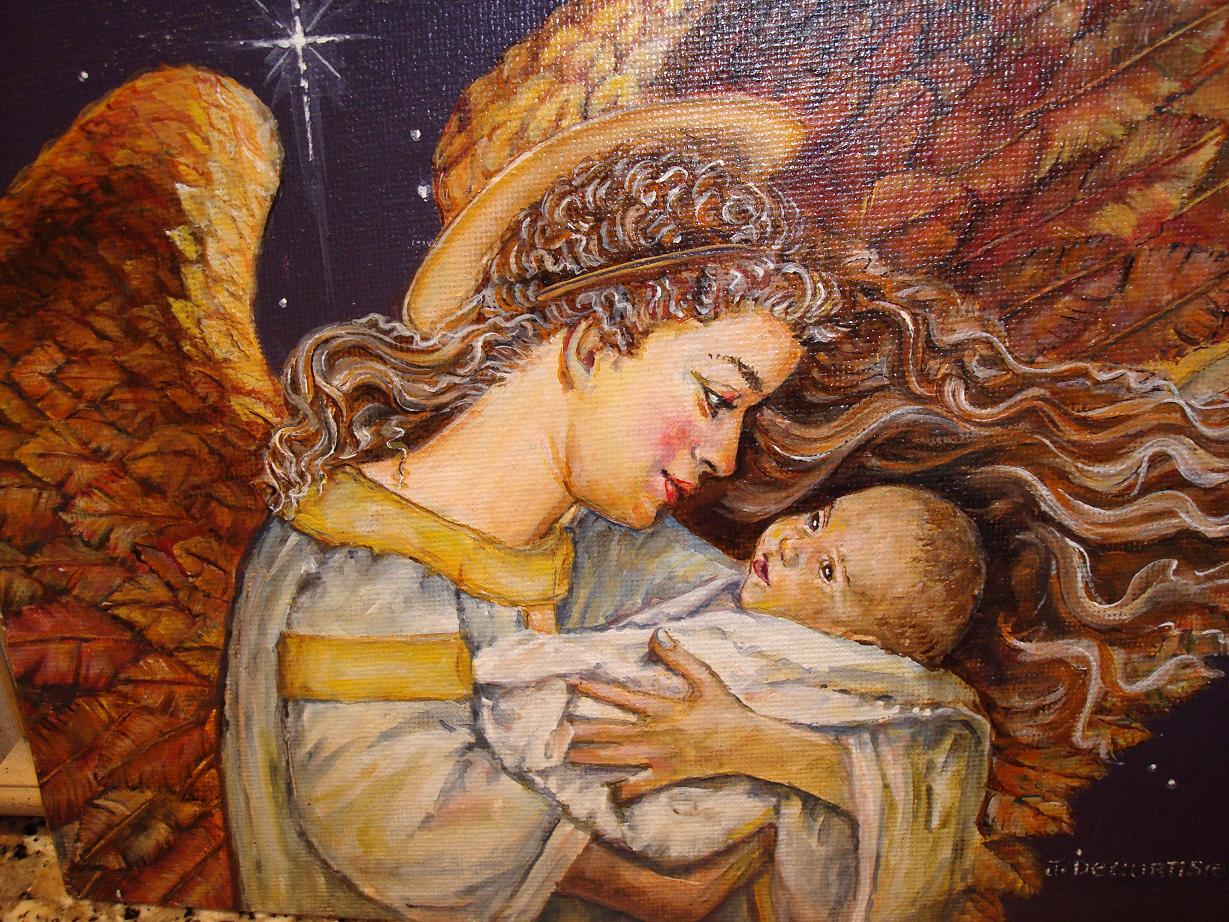
I am hearing those wonderful lines from Handel’s Messiah, because on this wonderful day, just after noon, a new child came into this world, a treasured girl-child, a warrior-princess is born. Thanks be to God, al hamd’allah!
Her Mother’s prayer for her is that she be the child that God created her to be. She hopes her daughter has courage, and a heart for adventure. When we met her, this amazing daughter-in-law, she played rugby, and she went off to France for a year to teach English.
We all pray that she will be healthy, and compassionate, with a heart for others. Courageous and passionate, and a woman of strength who will, like her Father, “give voice to those who have no voices.”
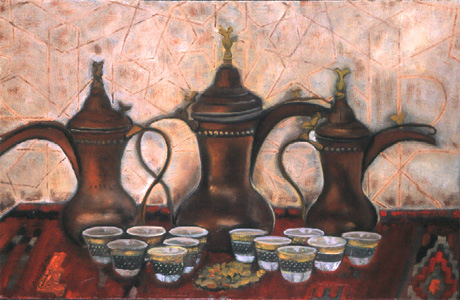
It is taking all our strength not to run to the hospital to visit. We feel very Middle-Eastern at this time; I am remembering my friend who went to Hamad hospital to have her babies. I took her daughters there the next morning, laden with canisters of coffee to serve guests.
“Guests?” I thought to myself. I had NO idea. Our Western idea is to give the new parents and their new baby time to recover from the physical and mental exertion of giving birth, time to bond as a small family unit.
When we got to Hamad Hospital, my friend had a huge suite, like a hotel suite, and her hospital bed was maybe King sized, with a curtain that could be drawn around it. She had a wall of mirrored closets and a seating area for about twenty people. No. I am not kidding.
We got there around seven in the morning, and within fifteen minutes, guests started arriving, all women, of course, come to give congratulations to the new Mom. Each came, greeted the new Mother, sat and drank a couple cups of coffee served by the delighted older daughters, greeted their friends, cousins and new arrivals, and then departed. Waves of guests arrived, and, thank God, waves of re-inforcing coffee pots.
So so different from our own customs, but today, oh, how I would love to fill a canister or two and be at the hospital sooner, rather than later, to greet the parents and to meet my new little lion-hearted grand-daughter, who insisted she would arrive when SHE wanted, LOL, not on schedule.
Here is the quilt I made for her:
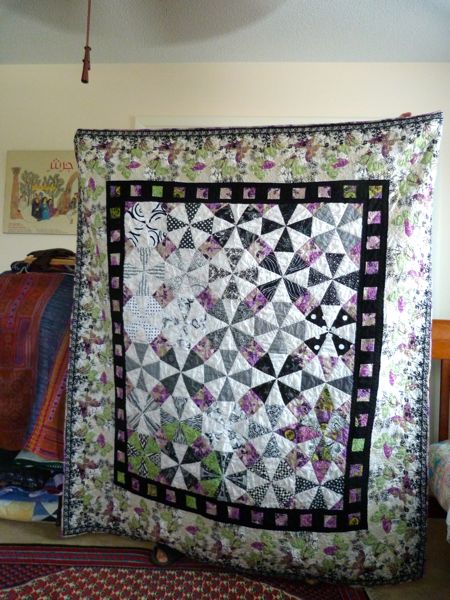
And here is the guide to the colors; I bought the border five years ago:

When AdventureMan say it, he said “that doesn’t look like a baby quilt” because it is so black and white, but, if you have eyes to see, it isn’t all black and white, it also has shades of purple, fuchsia, and a celery Spring green. I made the center Kaleidoscope pieces with a variety of blacks and whites, because babies LOVE black and white, and it can fascinate them and calm them.
I call it “I See Things Differently” because no, it doesn’t look like a baby quilt, but it is very much a baby quilt, it just doesn’t meet our cultural expectations. The longer I live, the less I meet any one’s expectations, LOL!
Thanks be to God! Thanks be to God for the safe delivery of this precious baby!
God Laughs; Life’s Craziness
One of my favorite Psalms is Psalm 2, which advises us to humbly submit to the will of Almighty God or suffer the consequences of our own actions. I’ve heard God laughing all week, sometimes at me, sometimes with me.
Psalm 2
1 Why do the nations conspire,
and the peoples plot in vain?
2 The kings of the earth set themselves,
and the rulers take counsel together,
against the Lord and his anointed, saying,
3 ‘Let us burst their bonds asunder,
and cast their cords from us.’
4 He who sits in the heavens laughs;
the Lord has them in derision.
5 Then he will speak to them in his wrath,
and terrify them in his fury, saying,
6 ‘I have set my king on Zion, my holy hill.’
7 I will tell of the decree of the Lord:
He said to me, ‘You are my son;
today I have begotten you.
8 Ask of me, and I will make the nations your heritage,
and the ends of the earth your possession.
9 You shall break them with a rod of iron,
and dash them in pieces like a potter’s vessel.’
10 Now therefore, O kings, be wise;
be warned, O rulers of the earth.
11 Serve the Lord with fear,
with trembling 12kiss his feet,*
or he will be angry, and you will perish in the way;
for his wrath is quickly kindled.
Happy are all who take refuge in him.
I’m a planner. I figure out what I want, and then I figure out how to get it. When we decided we wanted to take a trip to Alaska, we booked – and paid – a year in advance to get the kind of room we wanted. We also planned to buy a new car, and started saving for that, being pay-cash kind of people.
Then, early in the year we discovered we were going to become grandparents to a granddaughter! She would arrive shortly after we get back from our Alaska trip.
This week, God laughed. The doctors told our son and his wife that she needed to go on bedrest, and that this baby will be coming early. All the grandparents have been helping with childcare through the summer, now we just ratcheted it up a notch.
Do you know why God gives children to YOUNG parents? LOL, a three year old has SO much energy! So much curiousity! We have such a good time with him and when at the end of the day, we return him to his parents – we need a nap!
We are also trying to pack and prepare for our trip, get the Qatari Cat prepared for the cat hotel, get the guest suite prepared for the people who will stay while we are gone, and oh yes, finish up the purchase of that new car.
I had thought the first week in August would be a snooze, isn’t it always? Those long, hot humid days hit Pensacola, often one of those violent and emotional thunderstorms that clears the air in the late afternoon, lazy day after lazy day, right?

Not this year. This year was fly to Seattle for my Mom’s 90th birthday celebration, fly back, take care of our grandson for a week, do whatever we can to help out our son and his wife while she is on bed rest, buy and sell two cars, do our normal volunteer work – oh, and we had scheduled two meetings at our house, so we had to be presentable, and have some delicious things available. I could hear God laughing.

In the midst of all this, we are healthy. We have a good roof over our heads. We have the means to get a new car and travel to Seattle for Mom’s birthday. We pre-paid much of the Alaska vacation. Our little grandson is happy, and strong, and articulate, and fun to be around. Our son and his wife are wonderful, loving parents, and hard workers, and are preparing for this sweet new arrival. God laughs, and we thank him for his abundant blessings, and his abundant patience with us thinking we have any control over the months that come. We pray for the safe and healthy arrival of this little granddaughter who may arrive while we are gone, for a safe delivery, and a speedy recovery for her mother, and for strength and courage for her father, our son, who is a valiant man. We welcome your prayers.
Family Culture Early Rising

There are some great things about being with family. You know how things are done. You know what people mean when they say things. You exchange ‘looks.’
When I am with my family, there are some funny things that make me feel at home. Both my sisters have smashing views, one looking southeast at Lake Washington and Mt. Rainier and the other at Puget Sound and the Olympics. Growing up on the side of a mountain with a view of water, game and mountains, it just feels ‘right.’ Not a lot of mountains in Florida to build a house on the side of. Or to view . . . sigh.
Staying at my sister’s house, I was the last one up. My body time was two hours earlier then all of theirs, but I was the last one up. They are early-to-rise people. I totally love it – for so many years, I’ve been an early riser living in countries where the day starts around noon and runs well past midnight . . . especially during Ramadan. In Kuwait, I took photos of the sunrises for this blog; my friends told me it was the only sunrise they ever saw, LOL.
Being around other early risers – aw, what a joy. As I left the house for the airport, Little Diamond was already up eating breakfast and I was able to hug her one last time before departing.
The photo above is the view of the I-90 bridge crossing Lake Washington in a cool, breezy pre-dawn.
Non-Essential State Department Personnel Ordered to Leave Yemen
I know, I know, it is not a funny headline. But here is the thing. People have egos. You might wonder why anyone would stay in the face of a threat so grave. It isn’t by coincidence that so many prisoners were busted out of prison – hundreds in Iraq, in Yemen, also if I remember correctly, in Pakistan.
These countries, under international understandings and agreements, provide security for one another’s embassies. Like WE provide security for the Saudi and the Yemeni and French diplomats in the United States. When a country suffers massive prison breaks, it is only prudent to wonder how well they might be able to protect international diplomats – it’s all security.
But – and here is why a very serious headline can make me laugh so early in the morning – who wants to be “non-essential?” I’ve lived through similar situations; people want to think themselves important – you would be surprised how many people will choose to stay, knowing the dangers, because they want to consider themselves “mission-essential”. 🙂

WASHINGTON — The State Department on Tuesday ordered non-essential personnel at the U.S. Embassy in Yemen to leave the country following the threat by al-Qaida that has triggered temporary shutdowns of 19 American diplomatic posts across the Middle East and Africa.
The department said in a travel warning that it had ordered the departure of non-emergency U.S. government personnel from Yemen “due to the continued potential for terrorist attacks” and said U.S. citizens in Yemen should leave immediately because of an “extremely high” security threat level.
“As staff levels at the Embassy are restricted, our ability to assist U.S. citizens in an emergency and provide routine consular services remains limited and may be further constrained by the fluid security situation,” the travel warning said.
The U.S. Embassy is located in Sanaa, the capital of Yemen.
The State Department on Sunday closed a total of 19 diplomatic posts until next Saturday. They include posts in Bangladesh and across North Africa and the Middle East as well as East Africa, including Madagascar, Burundi, Rwanda and Mauritius.
This is only an excerpt from AOL/Huffpost World News where you can read the rest of the story by clicking the blue type here.
Breath of Fresh Air in Seattle
Miss me?
I’ve been in Seattle for a truly grand event, my Mother’s 90th Birthday. She was queen for almost a week, with visitors and well wishers and a smashing party with friends and family and faces she has known and loved for years – many many people.
When I arrived in Seattle it was cool and cloudy and everyone told me how sad it was that I had missed the glorious weather they have had for weeks. Coming in from the airport I was shocked to see all the scorched grass; it looked more like California than green green Seattle.
I wasn’t sad to miss the warm sunshine at all. I have all of that I need in Pensacola. What I loved, from the moment I arrived, was the fresh air.
Seattle smells good. Seattle smells like mown grass, and flowers, lush flowers everywhere. Youcan drive with your windows open. I slept with my window open, and when it got COLD in the middle of the night, I used a BLANKET! This is the best luxury for me, cool weather, fresh air, cool breezes, even a little thunder and lightning and rain.
The days were warm and sunny, and the nights were cool and fresh. I was in heaven.
It wasn’t that I forgot about you – I have all kinds of material – but blogging with the iPad just doesn’t work for me. It’s fine for picking up e-mail and checking the news and playing a game or two, but it isn’t a real computer, with real capabilities. If blogging gets to technical, I’m not going to do it, life is too short. I love WordPress for making life so easy, making it so easy to put in all the photos I want, easy easy easy. I just had too much going on, and didn’t have time to fiddle. The iPad just doesn’t do it for me. I wish I had a computer small enough to just stuff in my purse like the iPad, I wish I didn’t have to pull the computer out of my purse, like the iPad. The iPad is convenient, better than slogging a lot of books on the plane with me, but . . . What I really want is an iPad sized computer . . .
Home again, on the flight in the pilots must have mentioned the heat and humidity in Pensacola six times. Ahhh . . . .for those sweet cool breezes and cool nights . . .
Worse Than Crack Cocaine? Growing up Poor
From AOL Daily Finance Poverty damages children more than being born to a crack addicted mother. Poverty keeps children from attaining their full potention, and hurts us all as a society as a huge waste of potential resource:

In the 1980s, the crack baby epidemic was hard to ignore. Television show after television show, article after article proclaimed that children born to addicts of the increasingly prevalent “crack” cocaine were all-but-guaranteed to have birth defects, including extremely low IQs and severe emotional problems. This “lost generation,” commentators emphasized, would be incapable of forming relationships or reaching full emotional maturity. They would be, in the words of Washington Post columnist Charles Krauthammer, condemned to “a life of certain suffering, of probable deviance, of permanent inferiority.”
A little over 20 years later, Krauthammer’s predictions have proven almost embarrassingly inaccurate. Last week, the findings of a 24-year-long study of crack babies revealed that parental use of the drug had little or no direct effect on the children. In the process of investigating the babies, however, researchers discovered another environmental problem that did, in fact, lead to problems with depression, anxiety, cognitive functioning, and a host of other issues: poverty.
In 1989, Dr. Hallam Hurt, chair of the neonatology department at Philadelphia’s Albert Einstein Medical Center, began tracking 224 near-term or full-term children who were born to crack addicts. In the ensuing years, her longitudinal study followed the children, finding that, overall, their IQs were about the same as a control group of children of non-addicted mothers. Further, the children in Hurt’s study had comparable outcomes when it came to educational and emotional development.
That having been said, Hurt’s study found that children raised in poverty — regardless of whether or not their mothers were addicted to crack — tended to have lower IQs and lower school readiness than those who weren’t raised in poverty. A big part of the problem, she argues, is environmental: Of the children in her study, “81 percent of the children had seen someone arrested; 74 percent had heard gunshots; 35 percent had seen someone get shot; and 19 percent had seen a dead body outside.” The children themselves acknowledged the effect of these events: “Those children who reported a high exposure to violence were likelier to show signs of depression and anxiety and to have lower self-esteem.”
In other words, while prenatal crack abuse may not have a major effect on children, the societal conditions in crack-ravaged communities most certainly do. As Hurt emphasized, “Given what we learned, we are invested in better understanding the effects of poverty. How can early effects be detected? Which developing systems are affected? And most important, how can findings inform interventions for our children?” Or, to put it another way, now that we understand that poverty is more dangerous for children than crack, what can we do to protect our children from its effects?
In Florida, the worst schools are those serving the poor. Many fell a full grade point in the Florida evaluations and would have fallen further if there were not a law – I am not kidding – that says they can only fall one grade point in a year. We are failing in the two most important areas that can help children pull themselves out of poverty – good health care, and good education.
Uwem Akpan and Say You’re One of Them

This is a very troubling book, and, for me, a difficult book to read. It has taken me weeks, and I will admit I have often interrupted the reading of it to read other, easier books. This book makes me very uncomfortable. The stories and images trouble my sleep.
Uwem Akpan is of the tribe of Annang, from Nigeria, and has committed to an even larger tribe, the Catholic Church, of which he is a priest, and this gives him a unique perspective. The stories in this book often focus on tribal differences, including religious differences, and although they are set in different African states, have parallels in lives lived elsewhere. Those tribal differences are between Moslem and Christian, but also between Pentecostal and Catholic, Tutsi and Hutu, and, most significantly, the differences between to tribe of the very poor and the very rich.
Each story is told through the eyes of a child living in a different African state – Kenya, Benin, Ethiopia, Nigeria, Rwanda.
In one of my favorite segments of the book, strife has broken out in Nigeria, strife between the Moslems and the Christians, but also throw in the Pentecostals and the Pagans and really mix it up. A bus is waiting in the bus station to take people back to the southern part of Nigeria, and on this bus is a young man, half Moslem, half Christian. The bus stands idle for hours, while the bus driver seeks fuel to make the trip. During this time on the bus, many conversations take place, and what I loved was how alliances shifted with each conversation. The people on the bus were from different traditions, but came together as a community. No community is without arguments and dissensions, however, and consensus builds, diminishes, shifts – it is a microcosm of the tensions and stressors pulling apart the Nigerian nation state.
Uwem Akpan treats the children in each story lovingly, treasuring their innocent perspective and the sweetness of their hearts and vision. The adults don’t come off so well, passing their days in drug-induced stupors, drunk, selling children into slavery and prostitution, chopping off their limbs with machetes, and closing themselves off into groups which protect themselves and exploit others.
It would be an easier book to read if it were about aliens, or if these stories were confined to Africa, but the stories of these abused, neglected and exploited children echo in every continent, country and city in the world.
Uwem Akpan writes prose that is poetry; the surroundings are described with such detail that you feel in the moment, you see through the eyes of each child, and you see things that are beautiful as well as scenes you did not want to see. As you can see, I have a lot of ambiguous feelings about this book. At the same time I can admire the writing, the stories have left images in my mind that cannot be erased. Dark images. There is hope in the persistence and resilience of many of the children, but concern about their long term survival. It leaves a heavy weight on my heart.
Pakistan’s Swat Valley Women Fight Back with Jirga
I love this. Women are using technology – and the traditional system – to persist in seeking justice for women who are often little more than slaves to their husband.

Tahira
Women in Pakistan’s Swat valley are making history, and perhaps some powerful enemies, by convening an all-female jirga, a forum for resolving disputes usually reserved for men. Some readers may find details of this report by the BBC’s Orla Guerin disturbing.
Tahira was denied justice in life, but she continues to plead for it in death – thanks to a grainy recording on a mobile phone.
As she lay dying last year the young Pakistan wife and mother made a statement for use in court.
In the shaky amateur video, she named her tormentors, and said they should burn like she did.
Tahira was married off at the age of 12 and died last year following a suspected acid attack
Tahira’s flesh was singed on 35% of her body, following a suspected acid attack. Her speech was laboured and her voice was hoarse, but she was determined to give her account of the attack, even as her flesh was falling off her bones.
“I told her you must speak up and tell us what happened,” her mother Jan Bano said, dabbed her tears with her white headscarf. “And she was talking until her last breath.”
Tahira’s husband, mother-in-law, and father-in-law were acquitted this month of attacking her with acid. Her mother plans to appeal against that verdict, with help from a new ally – Pakistan’s first female jirga.
Under the traditional – and controversial – jirga system, elders gather to settle disputes. Until now this parallel justice system has been men-only, and rulings have often discriminated against women. The new all-women jirga, which has about 25 members, aims to deliver its own brand of justice.
It has been established in an unlikely setting – the scenic but conservative Swat valley, formerly under the control of the Pakistan Taliban. We sat in on one of its sessions in a sparsely furnished front room. Women crowded in, sitting in a circle on the floor, many with children at their feet. Most wore headscarves, and a few were concealed in burqas.
Probing injustice
For more than an hour they discussed a land dispute, problems with the water supply, unpaid salaries, and murder. The only man in the room was a local lawyer, Suhail Sultan. He was giving legal advice to jirga members including Jan Bano who he represents.
“In your case the police is the bad guy,” he told her. “They are the biggest enemy. ” He claims the police were bribed by the accused, and were reluctant to investigate the case properly.

The jirga tackled land disputes, water supplies, and murder
The jirga is making history, and perhaps making enemies. In Swat, as in many parts of Pakistan, men make the key decisions – like whether or not their daughters go to school, when they marry, and who they marry. And oppression starts early. Tahira was married off at just 12 years old, to a middle-aged man.
“Our society is a male-dominated society, and our men treat our women like slaves,” said the jirga founder, Tabassum Adnan. “They don’t give them their rights and they consider them their property. Our society doesn’t think we have the right to live our own lives.”
This chatty social activist, and mother of four, knows that challenging culture and tradition comes with risks. “Maybe I could be killed,” she said, “anything could happen. But I have to fight. I am not going to stop.”
They glued [my daughter’s] mouth and eyes closed. Just her face was left, the rest was flesh and broken bones”
Taj Mehal
As we spoke in a sun-baked courtyard Tabassum got a disturbing phone call. “I have just been told that the body of another girl has been found, ” she said. ” Her husband shot her.” She plans to investigate the case, and push the authorities to act.
“Before my jirga women have always been ignored by the police and by justice, but not now. My jirga has done a lot for women,” she said.
There was agreement from Taj Mehal, a bereaved mother with a careworn face, sitting across the courtyard on a woven bed.
Her beloved daughter Nurina was tortured to death in May.
“They broke her arm in three places, and they strangled her,” she told me, putting her hands to her own throat to mimic the action. “They broke her collarbone. They glued her mouth and eyes closed. Just her face was left, the rest was flesh and broken bones.”
She speaks of her daughter’s suffering with a steady voice, but grief is wrapped around her, like a heavy shawl.
“When I looked at her, it was like a piece was pulled out of my heart,” she said. “I was turned to stone. I see her face in front of my eyes. I miss her laughter.”
Women are a rare sight on the streets of Mingora
Nurina’s husband, and his parents, have now been charged with her murder, but her mother says that initially the courts took no interest.
“Whenever we brought applications to the judge he would tear them up and throw them away,” she said. “Now our voice is being heard, because of the jirga. Now we will get justice. Before the jirga husbands could do whatever they wanted to their wives.”
Women are little seen or heard on the bustling streets of Mingora, the biggest city in Swat. Rickshaw taxis dart past small shops selling medicines, and hardware supplies.
There are stalls weighed down with mangoes, and vendors dropping dough into boiling oil to make sugar-laden treats. Most of the shoppers are men.
‘No justice’ at jirgas
When we asked some of the local men their views on the women’s jirga, the results were surprising. Most backed the women.
“It’s a very good thing,” said one fruit seller, “women should know about their rights like men do, and they should be given their rights.”
Another said: “The jirga is good because now finally women have someone to champion their cause.”
The response from the local male jirga was less surprising. They were dismissive, saying the women have no power to enforce their decisions.
Most local men who spoke to the BBC expressed support for the women’s initiative
That view was echoed by the prominent Pakistani human rights activist Tahira Abdullah. “I don’t see it as more than a gimmick,” she said. “Who is going to listen to these women? The men with the Kalashnikovs? The Taliban who are anti-women? The patriarchal culture that we have?”
Ms Abdullah wants jirgas stopped whether male or female. “The jirga system is totally illegal, and has been declared illegal by the Supreme Court of Pakistan. It can never be just. There are several extremely notorious cases where we have noticed that women do not get justice from jirgas, neither do non-Muslims.”
One of those cases took place last year in a remote region of northern Pakistan where a jirga allegedly ordered the killing of five women – and two men – for defying local customs by singing and dancing together at a wedding.
And there are regular reports of jirgas decreeing that women and young girls be handed over from one family to another to settle disputes.
But for some, like Jan Bano, the women’s jirga is bringing hope. Every day she climbs a steep hill to visit Tahira’s grave, and pray for the daughter whose voice has still not her heard. Her video recording was not played in court.
Recent Comments
ExpatAlien on What Country am I Living … intlxpatr on Yellowstone: Old Faithful to C… Michelle on Yellowstone: Old Faithful to C… Cathy on No Grown-Ups in Charge intlxpatr on Waiting for Snow Wikipedia Donate Button

Amazina


Early Voting in Florida


 Here There and Everywhere