“We’ve started the count-down calendar,” said my beautiful and very pregnant daughter-in-law, “We have so many things we want to get done before the baby comes.”
We were gathered at one of our favorite casual lunch places, a place where we could eat well and our 3 year old could be both free to roam a little, and safe to roam, while the grown-ups talked.
“We’ve started, too,” I smiled at her, “I need to finish up her baby quilt, and two quilts for the homeless project I have due in September. And of course, we will be out of the loop the last two weeks before she is born, so I need to keep motivated now.” I know she will call on me once the new baby is here; I am the back-up, the “can you fix dinner / wash the dishes / hold the baby while I shower / clean up the baby spit / run to the grocery store/ feed the cats” person. I love it. It’s why we moved here, to be here when they need us, when they need the help. Being close to family, being there to help when they need the help – this is one of the great lessons we learned from our friends in Amman, in Kuwait, in Doha, in Tunis.
We also have an Alaska adventure in store, planned before any of us knew the new baby was en route. It’s not Africa, but we aren’t up for another of those 17 hour rides from Atlanta to Johannesburg this year. Alaska will be fun, a sentimental journey back to my origins for me, and a whole new environment for AdventureMan.
“We’ll also have the school break to cover,” beautiful D-I-L added, “but I know there is going to be a cousin’s camp; I just don’t know when it is going to be.”
Cousins camp – oh what fun. All the little like-aged cousins get together for a week of hell-bent-for-leather activities, from water parks to fire departments to scavenger hunts, they keep those little rascals so busy that they just fall into bed at night. It’s all good.
“I know it’s all going to fall into place,” she sighed, smiling at our son, “but we need that calendar to keep us on track.”
Yeh. Us too!
June 23, 2013
Posted by intlxpatr |
Alaska, Arts & Handicrafts, Circle of Life and Death, Communication, Community, Cross Cultural, Cultural, Eating Out, ExPat Life, Family Issues, Generational, Living Conditions, Pensacola, Travel |
2 Comments

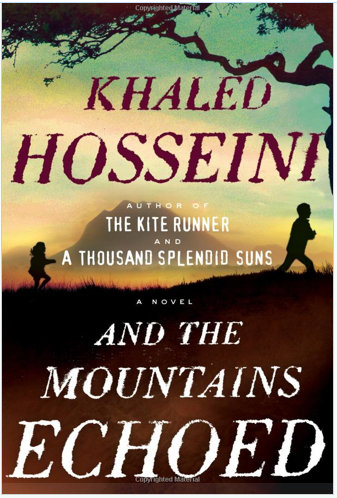
I danced when I saw the Amazon box; rarely do I buy hardcover (hurts too much when they fall over if I fall asleep reading, too bulky to carry on planes) but this one I was on the waiting list for, mail it as soon as it is published! Khaled Housseini, author of Kite Runner and A Thousand Splendid Suns has a new runaway best-seller; thanks to him I’ve just spent three days in Afghanistan, Paris and Los Angeles.
As the book opens, I am big brother to a baby sister whose Mom died in childbirth, living in a remote village in Afghanistan. Life is tough, but through the eyes of these children, life is idyllic, even though food is scarce and winters are cold. We have a huge oak tree with a swing, we play with the other children, and we have each other. Our father’s new wife is kind enough, but is busy with her own children, and the drudgery of cooking, cleaning and making do in a very small, poor Afghan village.
Later, I am Pari, living in Paris with an alcoholic, self-absorbed mother, making a life for myself, but always with a nagging feeling of something just outside my peripheral vision, another life . . .
The tale is told through the eyes of many, and on the way to the end of the tale we meet a wide spectrum of humanity, suffer the ills of war, callousness and unintended cruelties. We find that the man with superficial charm also saves and changes the lives of many, we find a doctor who finds fulfillment serving in the poorly resourced hospitals of Afghanistan, and we feel the agonies of a dutiful daughter watching her father fade into the world of Alzheimer’s.
It’s a wonderful, wild ride, richly textured, and when it finishes, you are not ready for it to end.
June 21, 2013
Posted by intlxpatr |
Adventure, Books, Bureaucracy, Character, Circle of Life and Death, Cross Cultural, Cultural, ExPat Life, Family Issues, Fiction, Living Conditions, Marriage, Mating Behavior, Paris, Political Issues, Relationships | Afghanistan |
4 Comments
WHO report into violence against women: key data
A new report from the World Health Organisation has drawn together data from dozens of studies and found that worldwide, 35% of women have experienced violence – and that the consequences for their and that the consequences for their health can be devastating.

Indian women attend a prayer ceremony for a rape victim. Though rape has become a prominent issue in India, it’s certainly not the only country where violence against women is an issue Photograph: Adnan Abidis/Reuters
Most women know their attackers. 35% of women worldwide have experienced violence and, according to a new report from the World Health Organisation (WHO), that figure only falls to 30% when they studied violence against women that was by intimate partners.
This is the first time that WHO have gathered this worldwide data by pulling together dozens of national and regional studies. Here, we look at which women are most likely to be experience violence and how their health is affected as a result.
Regional differences
Though violence against women is undoubtedly a universal problem, the WHO research suggests that there are regional patterns in its prevalence. It finds that women in Africa are almost twice as likely to experience violence than women in Europe – a particularly striking finding given that ‘women’ are defined in the study as females aged 15 and over.
However, the term ‘Europe’ may be slightly misleading here. Only Europe’s low and middle-income countries are included (from Albania to Ukraine) while countries like the UK and France are grouped together with those from other regions in the ‘High Income’ category.
Types of violence
Violence by an intimate partner and violence by someone other than a woman’s partner are both considered in this report – although the two differ hugely in their prevalence.
The fact that 38% of all murders of women worldwide are committed by intimate partners stands out as one of the most startling figures in the entire report..
Most violence against women worldwide, whether sexual or not, is committed by their intimate partners. In South-East Asia for example, women are almost eight times more likely to experience violence by a current or former partner than someone else. Looking at the ratio between partner and non-partner violence makes these trends more explicit.
Health consequences
The report catalogues the disastrous consequences that violence has on women’s physical, mental and sexual and reproductive health. Many of these are complex and not immediately evident, but their impact is often enormous.
Non-fatal injuries are one of the most direct effects of violence. The report uses the USA as an example where half of women in abusive relationships are physically injured by their partners and that most of them sustain multiple types of injuries – the head, neck and face being the most common, followed by muscular, skeletal and genital injuries.
Several studies identified that women with a history of intimate partner violence are 16% more likely to have a low-birth-weight baby and twice as likely to report having had an induced abortion – nearly half of which globally take place in unsafe conditions. What’s more, when compared with women who have not experienced partner violence, those that have are 1.5 times more likely to acquire HIV.
Every study that looked at the relationship between intimate partner violence and harmful alcohol use found a positive correlation between the two – although substance abuse may also be linked mental health disorders which also increase a woman’s vulnerability to violence.
Depression and suicide was also consistently cited as a severe health consequence of violence against women. Traumatic stress is the mechanism most likely to explain the fact that depression rates are double for women who have experienced violence.
Conflict and violence against women
Several studies have explored how violence against women rises in times of conflict. In March this year Maplecroft, a risk analytics company, analysed the risk of sexual violence in conflict across 15 years using indicators such as the “systematic use of sexual violence as a weapon of war”.
 Click to view full map. Source: Maplecroft 2013
Their findings may shed light on some of the regional trends in violence against women. Of the ten countries where the risk of sexual violence in conflict was highest, seven were in Africa.
The problem has also been recognised by the UN who have a specificcampaign called Stop Rape Now aimed at ending sexual violence in conflict.
Today’s report sheds light on not only how widespread violence against women is – but also the deep effect it has on their health. By highlighting the connection between violence and health, WHO has marked the first step in a public health response.
June 20, 2013
Posted by intlxpatr |
Family Issues, Health Issues, Interconnected, Marriage, Parenting, Women's Issues |
Leave a comment

I don’t know what it is about summer reading, but now and then I go on a theme-fest; a couple years ago it was Nigerian literature, and, once hooked . . . when my friend who is now living in Lagos recommended The Secret Lives of Baba Segi’s Wives, I ordered it right away, thinking from the title it would be maybe light and sweet and humorous.
From the start, that assumption was blown. This is a direct and edgy Nigeria, darker, rougher and full of family secrets, domestic details and messy relationships.
It is a very Nigerian book – this is a good thing. There are cultural things that are not explained, but it all ends up making sense in the end. There are foods I have never heard of – ekuro with shrimp sauce, asun. There is a rudeness in the way they speak to one another, (“Is this a parking lot?” “Do I look like a parking attendant?”), a crudeness in the constant need to carry small bills for bribes, even on public streets. People speak their minds, with little or no mitigation, depending on the status of the person and their own personal goals and agendas.
At the weekly meeting of wives, the senior wife, Iya Segi, doles out rations of household supplies to the other wives, including chocolate powder and hair conditioner . . . and as the senior wives complain about the new wife thrown in their midst, she says:
“You will trip over in your hate if you are not careful, woman. Your mouth discharges words like diarrhea. Let Bolanle draw on every skill she learned in her university! Let her employ every sparkle of youth! Let her use her fist-full breasts. Listen to me, this is not a world she knows. When she doesn’t find what she came looking for, she will go back to wherever she came from.”
There is a whole other world in that one paragraph – a whole other way of seeing life and expressing thoughts. The culture may be alien, but I thoroughly enjoyed being a tiny mouse in the corner at that meeting – and others – and inside the minds of the wives, of Baba Segi, of the driver – so many good stories, so many points of view, and I learned things from behind those high compound walls and closed and locked doors that I might never otherwise have learned. Alien as it was, for me, this was a very good book, new ways of looking at things, and a great recommendation from my friend in Lagos.
June 18, 2013
Posted by intlxpatr |
Africa, Books, Character, Circle of Life and Death, Civility, Community, Cross Cultural, Cultural, Customer Service, Family Issues, Living Conditions, Mating Behavior, Relationships, Values, Women's Issues | Nigeria |
Leave a comment
I don’t know that this has been studied closely, or that there is any evidence supporting the theory, but it is a hilarious theory – blame men for menopause!
By: Tia Ghose, LiveScience Staff Writer
Published: 06/13/2013 05:04 PM EDT on LiveScience
Ladies, here’s one more thing you can blame on men: menopause. At least, that’s according to a new theory.
Women go through menopause because men have consistently preferred younger women in recent evolutionary history, according to a study published today (June 13) in the journal PLOS Computational Biology.Thus, menopause is not evolutionarily advantageous and may be the result of a series of random, harmful mutations that accumulated in women but weren’t acted on by evolution because the women had already reproduced by the time the mutations affected them.
“Our first assumption is that mating in humans is not random with respect to age, which means men of all ages prefer to mate with younger women,” said study co-author Rama Singh, an evolutionary biologist at McMaster University in Canada. “If mating is with younger women, any deleterious mutations which affect women’s reproduction later in life will accumulate because they are not being acted on by natural selection.”
Menopausal mystery
Menopause, in which women stop menstruating and become infertile, has been a long-standing puzzle for biologists: Why would evolution have led to a trait that essentially reduces the reproductive potential of an animal?
Most other animals don’t go through menopause (although killer whales do). Even chimpanzees, humans’ closest living relatives, seem to reproduce into old age in the wild, and males even prefer older females.
Biologists have proposed the grandmother hypothesis to explain the conundrum. The hypothesis holds that menopause allows a grandmother who is done rearing her own kids to help rear the young of her children, thereby increasing the survival odds of her grandkids, and therefore, her genes.
But grandchildren and grandparents share just a quarter of their genes, versus half for children and their parents, so menopause would have to dramatically boost survival of grandchildren to be evolutionarily advantageous. Past studies have shown that maternal grandmothers boost their grandkids’ survival rates, though exactly how much depends on the society.
Younger women
For thousands of years (at least), men have, on average, mated with younger women, Singh said.
That’s because, if all else is equal, “those who reproduce earlier, their genes are passed on faster,” Singh told LiveScience.
So the researchers created a computer simulation to model that preference.
Early on, both men and women in the model reproduced until death. But over time, the model found, men’s preference for youth reduced older women’s odds of reproducing.
Simultaneously, people accumulated random mutations, some of which decreased later-life reproductive ability. But since older women were left out in the cold anyways, those mutations didn’t impact their reproductive success, whereas mutations in men that could reduce late-life reproduction were weeded out. (Men who stopped reproducing at some point in life would produce fewer offspring than those who didn’t, and the late reproducers would outcompete those who stopped breeding earlier.)
Over 50,000 to 100,000 years, the accumulation of all those mutations could have led to universal menopause, the researchers suggest. Menopause would then be another form of aging akin to graying hair or wrinkles.
If later childbearing becomes the norm, as current societal trends suggest, women who can reproduce at older ages might gain an evolutionary advantage, and menopause could, in theory be pushed later, Singh said.But it’s more plausible that technological changes such as fertility treatments will artificially extend women’s ability to reproduce, Singh said.
Questionable assumptions
But the new model might have the causation reversed, wrote Kristen Hawkes, an anthropologist at the University of Utah, who was not involved in the study, in an email to LiveScience.
As human life spans increased, women might have had many healthy years after fertility. As a result, men grew to prefer younger women because older women couldn’t reproduce.
Supporting that hypothesis, female chimpanzees see their egg reserves decline around the same age as human females, Hawkes noted. But unlike humans, they die shortly after this age, whereas humans have decades of healthy life left.
“The preference men have for young partners is a striking contrast with other primates,” Hawkes said. “My guess about that has been it’s a consequence of our life history.”
June 15, 2013
Posted by intlxpatr |
Aging, Circle of Life and Death, Family Issues, Generational, Health Issues, Mating Behavior, Parenting, Relationships, Statistics, Women's Issues | Fertility, menopause |
Leave a comment
Don’t you love demographics? Demographics are a great forecasting tool, if you have the courage to use them. Demographics forced change on the United States military, forcing them to include women in more roles, recently increasing their job opportunities as the demographic pool dwindles. The same demographics are hurting the military budget now, as the huge bulge of baby-boomers retires, takes pensions and guaranteed free medical care, living a LONG time with more serious age-related illnesses, while the military struggles to allocate scarce resources.
Here is a fascinating factoid from The New York Times, a journal which notices small – but significant – changes, and gives us a little idea what the impact may be.
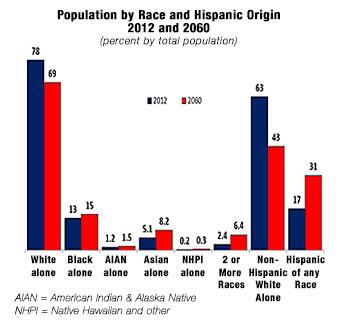
Census Benchmark for White Americans: More Deaths Than Births
By SAM ROBERTS
Published: June 13, 2013 232 Comments
Deaths exceeded births among non-Hispanic white Americans for the first time in at least a century, according to new census data, a benchmark that heralds profound demographic change.
The disparity was tiny — only about 12,000 — and was more than made up by a gain of 188,000 as a result of immigration from abroad. But the decrease for the year ending July 1, 2012, coupled with the fact that a majority of births in the United States are now to Hispanic, black and Asian mothers, is further evidence that white Americans will become a minority nationwide within about three decades.
Over all, the number of non-Hispanic white Americans is expected to begin declining by the end of this decade.
“These new census estimates are an early signal alerting us to the impending decline in the white population that will characterize most of the 21st century,” said William H. Frey, a demographer with the Brookings Institution.
The transition will mean that “today’s racial and ethnic minorities will no longer be dependent on older whites for their economic well-being,” Dr. Frey said. In fact, the situation may be reversed. “It makes more vivid than ever the fact that we will be reliant on younger minorities and immigrants for our future demographic and economic growth,” he said.
The viability of programs like Social Security and Medicare, Dr. Frey said, “will be reliant on the success of waves of young Hispanics, Asians and blacks who will become the bulwark of our labor force.” The issues of minorities, he added, “will hold greater sway than ever before.”
In 2010, according to the National Center for Health Statistics, more non-Hispanic whites died than were born in 11 states, including California, Florida and Pennsylvania. White deaths exceeded births in a majority of counties, including Los Angeles, the most populous.
The disparity between deaths and births in the year that ended last July surprised experts. They expected that the aging white population would eventually shrink, as it has done in many European countries, but not for another decade or so.
Nationally, said Kenneth M. Johnson, the senior demographer at the Carsey Institute, a research center based at the University of New Hampshire, “the onset of natural decrease between 2011 and 2012 was not anticipated.” He attributed the precipitous shift in part to the recession, adding that “the growing number of older non-Hispanic whites, which will accelerate rapidly as the baby boom ages, guarantees that non-Hispanic white natural decrease will be a significant part of the nation’s demographic future.”
Professor Johnson said there were 320,000 more births than deaths among non-Hispanic whites in the year beginning July 2006, just before the recession. From 2010 to 2011, the natural increase among non-Hispanic whites had shrunk to 29,000.
Census Bureau estimates indicate that there were 1.9 million non-Hispanic white births in the year ending July 1, 2012, compared with 2.3 million from July 2006 to 2007 during the economic boom, a 13.3 percent decline. Non-Hispanic white deaths increased only modestly during the same period, by 1.6 percent.
The census population estimates released Thursday also affirmed that Asians were the fastest-growing major ethnic or racial group. Their ranks grew by 2.9 percent, or 530,000, with immigration from overseas accounting for 60 percent of that growth.
The Hispanic population grew by 2.2 percent, or more than 1.1 million, the most of any group, with 76 percent resulting from natural increase.
The non-Hispanic white population expanded by only 175,000, or 0.09 percent, and blacks by 559,000, or 1.3 percent.
The median age rose to 37.5 from 37.3, but the median declined in Alaska, Hawaii, Kansas, North Dakota and Oklahoma. It ranged from 64.8 in Sumter, Fla., to 23 in Madison, Idaho.
The number of centenarians nationally neared 62,000.
June 13, 2013
Posted by intlxpatr |
Aging, Circle of Life and Death, Community, Cultural, Family Issues, Financial Issues, Generational, Living Conditions, Mating Behavior, Parenting, Political Issues, Social Issues, Women's Issues, Work Related Issues |
Leave a comment
A Qatar Mental Health survey shows 1 in 5 Qataris suffering from a mental ailment, commonly depression or schizophrenia, with fewer than 1 in 4 of those afflicted receiving treatment, due to fears of social stigma . . . from the Gulf Times, Qatar.
By Noimot Olayiwola/Staff Reporter
A Mental Health Strategy, which is awaiting the endorsement of the Supreme Council of Health’s executive committee, is expected to be completed this year.
It is being envisaged that the Mental Health Strategy will lead to a reduction in the incidence and severity of mental illness in Qatar, besides increasing the proportion of people with emerging or established mental illness who are able to access the right care at the right time, with a focus on early intervention.
The strategy will also provide the opportunity to increase the ability of people with mental illness to participate in education, employment and training, enhance public education and awareness and thereby reduce the stigma associated with mental ailment, reduce the prevalence of risk factors that contribute to the onset of mental illness and prevent longer-term recovery, and establish Qatar as a centre of academic excellence in mental health research and education.
Speaking on the strategy at an event held recently, Hamad Medical Corporation’s (HMC) General Adult Psychiatry senior consultant and Weill Cornell Medical College in Qatar assistant professor Dr Suhaila Ghuloum said the mental health initiative contributes to the Human Development pillar of Qatar National Vision 2030, which recognises that a healthy mind is as important as a healthy body.
She said a study has shown that around 20% of the country’s population suffers from a form of mental disorder and less than 25% of the people with mental ailments actually receive the care that they need.
Stating that the actual prevalence rate of mental health ailments would soon be published, Dr Ghuloum added that around 20% and 18% of the population also suffered from depression and anxiety disorder, respectively.
The Psychiatry Department is the only facility providing primary, secondary and tertiary care for people with mental illness in Qatar. “We conducted the study on adult patients visiting the primary healthcare centres and found that one in five people here will experience a mental disorder with conditions such as schizophrenia and depression on top of the list,” she said.
According to her, schizophrenia, depression and substance abuse are three of the top five causes of disabilities in Qatar. “A condition like schizophrenia can prevent a child from attending school,” she said.
Dr Ghuloum said social stigma, which is a combination of ignorance and discrimination, is the biggest challenge facing people with mental illness in Qatar.
“Through interaction with some of our patients, we realised that many had delayed getting medical help due to fear of stigma and the negative attitudes of some of the patients themselves, their family members as well as physicians,” she noted.
The official called for comprehensive care for people with mental illness, saying the Psychiatry Department has already started a system that is all encompassing and comprehensive – through primary care – besides providing treatment for some patients on an in-patient basis, who are co-located in general hospitals, as well as community-based services being offered to those in need of long-term care.
“The transformation of Qatar’s mental health services focuses on early intervention and recovery, and will give people a range of options on how to access mental healthcare tailored to their needs. Whether it is in a primary care, community-based or a hospital setting, people with mental health issues will have access to the right care, at the right time and in the right place,” she asserted.
June 12, 2013
Posted by intlxpatr |
Bureaucracy, Cross Cultural, Cultural, Customer Service, Doha, Family Issues, Health Issues, Qatar, Social Issues, Statistics |
Leave a comment
From The Business Standard, a recent study verifies that men simply mature later than women do. “Men were nearly twice as likely as women to describe themselves as immature.” (!)
Women often accuse men of being immature – and there may be some truth in it after all!
The age that men mature completely is 43 – which is 11 whole years after women, a new UK study has found.
Women were regarded as being mature at the age of 32, the research commissioned by Nickelodeon UK found.
Eight out of 10 women quizzed in the study believed men ‘never stop being childish’ and said the biggest bug-bears were how they found flatulence amusing, eating fast food in the early hours and playing video games, ‘The Daily Express’ reported.
Staying silent after rows, racing another car at traffic lights, being unable to cook simple meals and sniggering at rude words were also regarded by women as signs of male immaturity.
Men were nearly twice as likely as women to describe themselves as immature.
Also, females were twice as likely as men to feel that they were the ‘grown up’ in a relationship. A third had broken up with a man they thought was too immature.
Men whose mothers still did their washing or cooked them meals rated low in the maturity stakes.
Owning a skateboard or BMX bike was another no-no for women, as was wearing cartoon pyjamas or having a cartoon bedspread.
One in four women felt they were the ones who made all the important decisions in the relationship with the same percentage wishing their partner would talk about themselves and their feelings more often.
Almost 46 per cent of women have had a relationship in which they felt they had to mother their partner a bit too much, the study found.
June 11, 2013
Posted by intlxpatr |
Character, Cultural, Family Issues, Mating Behavior |
Leave a comment
We had a great weekend, and thank you for all your good wishes. 🙂
In spite of the storm warnings, Friday and Saturday were glorious beach days, and oh what fun we had in the pool with our son, his wife, and our grandson, who is becoming a real swimmer. Then, some time during the night, a storm really did blow in, lowering the temperatures, lowering the skies and creating the perfect opportunity to get back home to the Qateri Cat.
The sitting area in our room; around the corner was also a little kitchen 🙂




In contrast the the previous two days, this morning was cool and very very rainy and windy, a great day to head back home. There were people body surfing those waves!


Thank you, AdventureMan. After all these years, so many great times, so many adventures, and the fun continues. 🙂
June 10, 2013
Posted by intlxpatr |
Adventure, Beauty, Family Issues, Living Conditions, Marriage, Pensacola, Relationships, Sunsets |
2 Comments
Wooo HOOOO on You, Major General Abdulfattah Al-Ali!

Sometimes, when you are reading a newspaper looking for content, the most significant articles can be little small ones:
Major Al-Ali vows to redraw traffic map
KUWAIT: “I have orders from higher authorities to organize the traffic and the law will be implemented strictly, Assistant Interior Ministry Under Secretary for Traffic Affairs Major General Abdelfattah Al-Ali said. “I will change the traffic map within six months and wipe out the word wasta from the traffic dictionary ,” he added. “I have strict orders from higher authorities to organize traffic and the law will be implemented very strictly,” Major Ali said.
The Kuwait Times got his title wrong; it is Major GENERAL, not Major, LOL, that’s a big difference. It appears he has the clout – and the backing – to make a brave and steadfast stand:
“WIPE OUT THE WORD WASTA FROM THE TRAFFIC DICTIONARY”
I can hardly believe my eyes. This is going to be very painful for young Kuwait men, who have learned – from prior experience – that the rules do not apply to them. IF Major General Abdulfattah Al-Ali can maintain his strong position, there may be more young Kuwait men who live to be grown-up men, there may be fewer heart-wrenching funerals, far fewer trips to the emergency room (did you know that some of the best head-trauma physicians in the world are in the ER’s in Qatar, Kuwait, and the UAE? There’s a reason for that.) The days of seeing babies on their daddy’s laps in traffic may be over. People may actually start wearing seatbelts!
Wooo HOOO on You, Major General Abdulfattah Al-Ali. You are a brave and courageous man, with a vision for a safer future for Kuwait.
June 9, 2013
Posted by intlxpatr |
Bureaucracy, Character, Civility, Cultural, Family Issues, Kuwait, Law and Order, Leadership, Safety | Major General Abdulfattah Al-Ali |
2 Comments












 Here There and Everywhere