Pensacola: Fiesta of Five Flag Parade
I’ve never lived anywhere with so many parades, and as Pensacola cools down a little and an offshore breeze blows away the heat of the day, a parade sounds like fun. Tonight is the Fiesta of Five Flags Parade. I can’t think of a parade since Lent, so maybe this is the kick off of the new season. Pensacola has an active and lively social scene, with all these Mardi Gras Krewes, and the older our grandson gets, the more of the parade we get to see! I think we got through three quarters of the parade tonight, and oh what fun.
The people on the floats are having a great time. They have these great alter-egos, get to wear elaborate costumes, and there may be some alcohol involved, LOL. The people on the ground are having a great time, you can really get into the waving and trying to catch the beads. Some of the beads are prettier than others, but as AdventureMan says, it’s all plastic. Having said that, you should see him scramble! He is good at catching beads.
And oh my, they are so good to the kids, with stuffed toys, beads, ice cream bars, frisbees, trinkets, including pieces of eight!
Honestly, there are some things in life I will never get tired of – parades and fireworks. I feel so blessed to live in Pensacola.
These photos are not in the right order because I just did a group dump into the photo gallery, and it scrambled them when they were inserted into the blog entry.
The parade always starts with the Pensacola motorcycle police, with flashing lights and roaring engines!

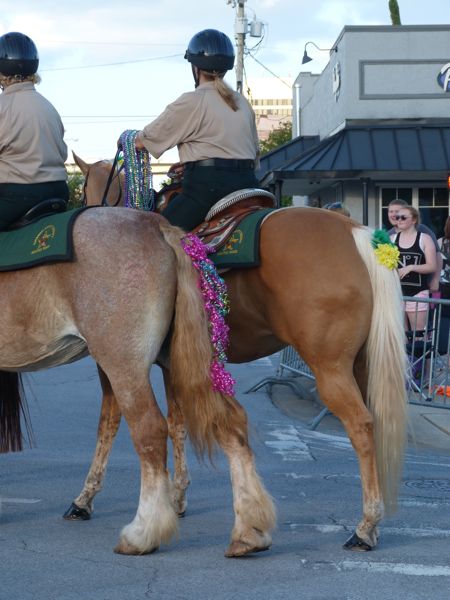
I love that they decorate the horses tails:
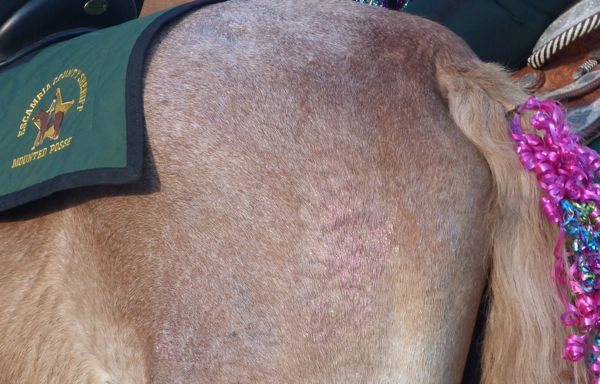
And then AdventureMan pointed out they also rubbed glitter into the horses haunches to make them pretty 🙂
So many beads! We got to the parade a mere ten minutes before it began, but it was more lightly attended, and we were able to be right up front. Our little grandson had a great view, and people were so kind giving him beads, throwing him beads, toys, etc.
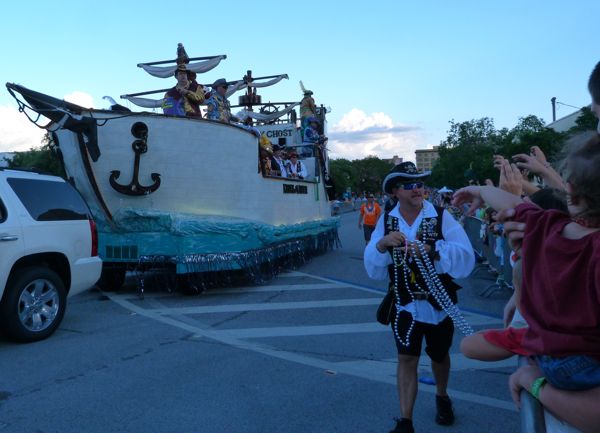

Look at all those beads they plan to throw! There was a throne on this float with King Tut!

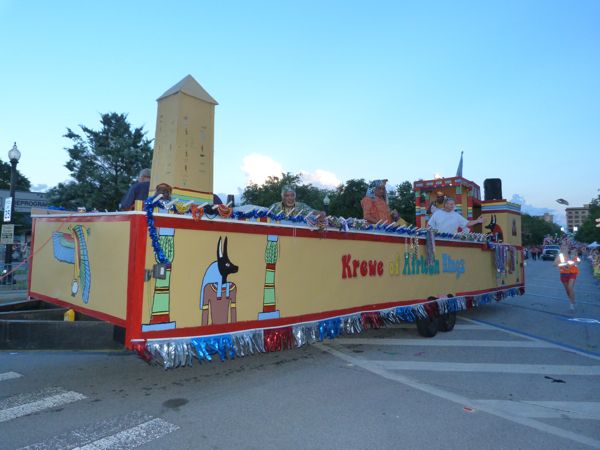

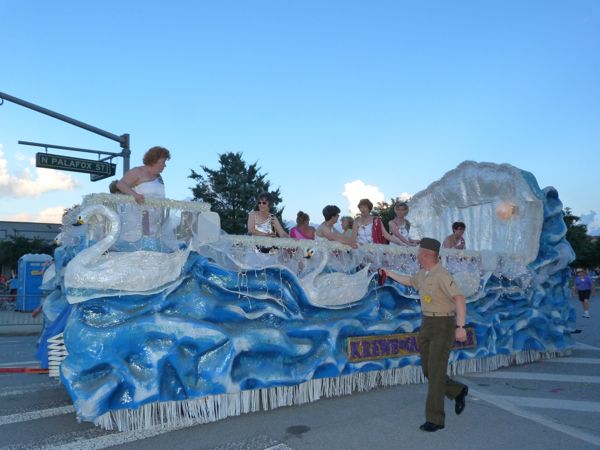
These ladies were having a grand time!


The Mayoki Indians seemed to be the Krewe having the best time of all, with two floats loaded with beads, and more ‘foot Indians’ handing and throwing beads into the crowds:





The flame throwing baton twirler got lots of applause:

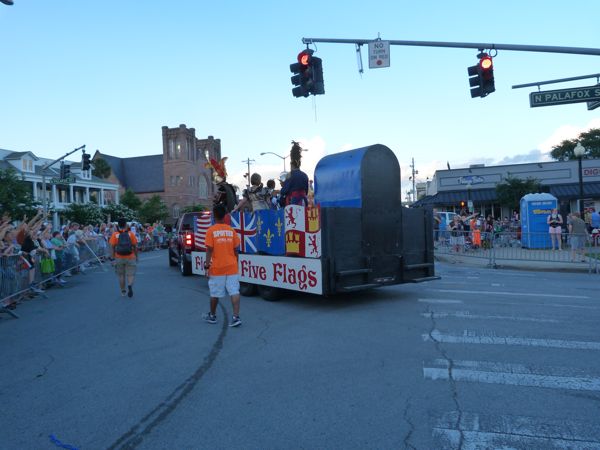






We saw our little grandson rubbing his eyes and asked if he was ready to go home, and he was. One of these days he will be old enough we will see an entire parade. I had a minor concern that Tropical Storm Andrea would blow in bad weather and make the parade unlikely, but nothing of the sort, we had great weather, a lovely evening and a wonderful time making good memories with our little grandson.
Forty Years Wedding Anniversary

“You’re going to celebrate your anniversary for three days?” my friend asked incredulously.
“No, no, actually, it’s in two parts, we are celebrating the entire weekend, three days, but it’s because it is too hot to walk around New Orleans; so this is just part one, and in December we will celebrate part two with a trip to New Orleans when we can walk around and enjoy all the Christmas decorations and stay somewhere nice.”
It’s what we do.
There have been some years, particularly years with moves, or new positions, or new contracts in them, when anniversaries have sort of fallen by the wayside. We are enjoying making up for all the missed anniversaries, now that we have the great luxury of time.

We have all kinds of fun plans, a hotel stay, a dinner in a fine restaurant, star gazing out at Ft. Pickens, maybe a dolphin cruise, and a trip up in the very large beach ferris wheel, while it is still at Pensacola Beach. We plan a day in several pools with our son and his wife and our little grandson. All. or part, or some of this may really happen, depending on what the weekend weather looks like. Ft. Pickens has already evacuated all the campers with concerns over this Tropical Storm Andrea coming in, and a dolphin cruise or a trip up on the great wheel may not be such a hot idea at 40 – 50 mph winds, LOL.

AdventureMan and I knew when we married that we were in it for the long haul. We also knew it wouldn’t be easy. We come from different cultures, different life styles. We both had independent lives and responsibilities. We moved a lot. It wasn’t always easy, but then whose life is, when you know that life from the inside? We’ve had some great adventures, and some fabulous, astounding experiences. We’ve met extraordinary people and made very special life-long friends.

When I told AdventureMan our weekend might not be as exciting as planned, he laughed and said “we can bring our books.” He always knows how to make me laugh, and taking books is exactly what we did when we first got married, and would take weekend trips to a lakeside resort called Chiemsee; it would be snowing and cold and we would go into this large old lodge with it’s double doors and double shuttered windows, with it’s eiderdown comforters and huge fireplace, and we would pack books. We would sleep and read, and sometimes go eat. If that’s how this anniversary turns out, it’s a very comfortable and familiar way to celebrate.:-)

AdventureMan loves this blog. He always looks for his name. 🙂 Happy Anniversary, dear husband.
Three Little Kittens

This morning, driving to the commissary, about ten feet apart on the highway, I saw the smooshed bodies of three little kittens. They must have been about five or six weeks old. I felt sick; I still do. What kind of animal would throw little kittens out the window of a car to let them die in terror on a busy highway? Who raises these people who could act with such cruelty?
I am a believer; I believe God put each one of us here for a purpose. I think we often misunderstand some of God’s intentions; I think sometimes we get it very wrong. I fantasize that maybe these little cats and dogs we adopt are really our guardian angels, who will speak up for us on the last days and tell the Lord Jesus how we treated his little ones. Imagine the punishment for hurting a helpless animal! Imagine the penalty for hurting an innocent, defenseless child!
Anesthesia Linked to Dementia Risk in Seniors
It may not be dementia. It may be a reaction to a medication in the elderly that LOOKS like dementia.
My father was 87, and doing pretty well for a man 87. He still walked on his own, using a walker when he had to, and very rarely, a wheelchair if we were going a long ways. He went into the hospital for a minor surgery. The tube inserted in his hand for the anesthetic became infected. Dad was acting weird, he was having hallucinations, and my sister rightly identified that Dad had a reaction to the diuretic drug Lasix; when they switched him to an alternative, the raving and hallucinations stopped.
He was transferred to a rehabilitation unit, where for two days, they put him back on Lasix. Poor communication between hospital and the rehab facility, plus standardization of drug regimens – they switched him without telling him, or us. Once again, he went loony tunes, and at the same time, his right hand began to swell until it looked like a lobster claw. He kept saying it hurt, and it was big and red, and the rehab people kept saying it would get better.
Dad was rushed to another hospital, one the rehab clinic worked with, and the doctors told us he had a ‘cascade of problems’ and which were the primary three we wanted them to work with?
Get him off the Lasix, first thing, we all agreed, and find a way to have it annotated on any record that he is never to have Lasix. (It did no good; the next hospitalization, back at the first hospital, they gave him Lasix again, which made him crazy and masked all the other symptoms.)
Long story short, there were a cascade of hospital mistakes – not one hospital, two hospitals and the rehab clinic – where miscommunications, inattentions and shortage of trained personnel resulted in a cascade of issues that led to my father’s death later that year. The other lesson learned is that if you go into a hospital, make sure you have a good support system, someone with you who will bravely ask questions, and remind someone if an inappropriate medication is prescribed. You need a family member with you for protection against inattention, mistakes, miscommunications and personnel shortages.
It’s not like there’s anyone to bring a lawsuit against; they were all doing the best they could, but Dad was old. My bet is that he might have lived another couple years, at the very least, had he not gone in for that first non-essential minor surgery. To me, the moral of the story is if you want to live a long life, stay away from hospitals.

Anesthesia Linked to Increased Dementia Risk in Seniors
Exposure to anesthesia has been linked to a 35 percent increase of dementia in patients over age 65, according to a new study.
By Jeffrey Kopman, Everyday Health Staff Writer
FRIDAY, May 31, 2013 — Caregivers and seniors struggling with the dilemmas of elder care have another risk to weigh against potential rewards — senior patients exposed to general anesthesia face an increased risk of dementia, according to research presented at Euroanaesthesia, the annual congress of the European Society of Anaesthesiology (ESA).
Researchers reviewed the medical information of 9,294 French patients over the age of 65. The patients were interviewed several times over a ten year period to determine their cognitive status.
After two years, 33 percent of participants had been exposed to anesthesia. Most of the exposed patients (19 percent overall) were exposed to general anesthesia — a medically induced coma. The rest were exposed to local/locoregional — any technique to relieve pain in the body — anesthesia.
In total, 632 participants developed dementia eight years after the study began. A majority of these patients, 512, were diagnosed with probable or possible Alzheimer’s disease. The remainder had non-Alzheimer’s dementia.
The gap between dementia related to general anesthesia (22 percent) and non-dementia patients (19 percent) was associated with a 35 percent increased risk of developing dementia. This risk was linked to at least one general anesthesia.
“Elderly patients are at an increased risk for complications following anesthesia and surgery,” said Jeffrey H. Silverstein, MD, MS, and vice chair for research at the Department of Anesthesiology at Mount Sinai in New York City. “[They] are particularly prone to postoperative delirium, which is a loss of orientation and attention. Anesthesiologists have been evaluating higher cognitive functions (for example, memory and executive processing) and found that a substantial number have decreases in one or more of these areas after a surgical procedure.”
Researchers hope this study will lead to more awareness for surgeons.
“Recognition of postoperative cognitive dysfunction (POCD) is essential in the perioperative management of elderly patients,” said study author Dr. Francois Sztark, INSERM and University of Bordeaux, France, in a press release. “A long-term follow-up of these patients should be planned.”
Elderly Care: Risk vs. Reward
Senior citizens and their caregivers might be willing to accept an increased risk of dementia if it means getting necessary anesthesia for an important medical procedure. Dementia is a relatively common occurrence in old age: One in three seniors has Alzheimer’s disease or dementia by the time of their death.
But surgery at old age can also carry more severe, and less common, health risks. In fact, simply surviving surgery can be difficult for elderly patients, especially those over the age of 80.
While the numbers vary depending on procedure, researchers have found that mortality risk tied to elective major surgeries increases with age. The risk more than doubles for patients over 80 compared to patients ages 65 to 69.
But other surgery complications are even more common in seniors.
“The major risk for elderly patients following surgery is pneumonia,” said Dr. Silverstein. “Cardiac complications are next most common.”
However, Dr. Silverstein still feels that if surgery is deemed necessary, patients should not fear the risks.
“In theory, only necessary surgery is done,” he said. “Knowing how [patients] reacted to anesthesia and surgery in the past may give them some idea of their postoperative course.”
Last Updated: 05/31/2013
It’s Why We’re Here: Lunch at Taco Rock
There is a graciousness in Pensacola that reminds me of life in the Middle East, although the local Pensacolians would be astounded to be compared with the Middle East. If you look closely, though, you can see the similarities.

There is politeness and civility toward others, even strangers. When workmen are in your home, you offer them ice water, or iced tea, and you ask about their families before they start work. It seems to us that when we call for help, we get the same service people coming to our house; I don’t think it is an accident.
People chat a little before they get down to business. I think many a Pensacolian would feel comfortable in the souks, sitting and drinking a little tea before they start to discuss the appropriate price level for the bauble they are considering. They ask about a person’s health, and they ask about your family. They take meals to those who are suffering or recovering.
People spend time with family. Families go to church together, families have meals together, families share child rearing. Multi-generations live near one another. People who went to school together more than fifty years ago form their own kind of family, sharing deeply, attending the funerals of one another’s kin. Funerals are well attended. Very Arab, if only they knew.
There are pockets in the United States where you find groups of Arab nationals; Pensacola has these groups, even a discreet mosque or two. There are stores selling international supplies, including zaat’r and sumak and harissa, chana dal, bulger, wuhammara . . . and restaurants billing themselves as ‘Mediterannean’ whose food would be recognizable to those in the Levant and the Gulf.

There is almost always a breeze off the Gulf to fight the heat and humidity and mosquitoes, and, by the grace of God, there is air conditioning and ice water coming out of the refrigerators. Life is sweet.
Life is all the sweeter because we can get together with our son and his family on the spur of the moment, and end up at a great family place like Taco Rock, where our little grandson can get down when he gets restless, and where there is plenty of time for us to chat, discuss Django Unchained, discuss new developments in entertainment technology, discuss upcoming vacations and arrangements – there is that great luxury of time together, and tasty food at reasonable prices. LOL, this is the Pensacola equivalent of a Michelin Red R, good local cuisine at reasonable prices. Hmmmm, Mexican is probably not qualified as good local food at reasonable prices, but close enough . . .


He is such a delight, our little grandson, who calls the coming baby “that little girl,” as in “when that little girl comes, I’m going to teach her how to float on her back!”
This week, there is another parade! Pensacola must be the parade capital of the world; so many parades! We’ll pick up our grandson, stand on the corner and wave our arms until they throw us some beads. Great fun and good exercise. 🙂


This post is really a great excuse to post some new photos of our grandson 🙂
The Little Blue Pill
I’m not a person who feels a lot of pain. I hardly ever get a headache, rarely get even a paper cut. At one point in my life, when my biliary duct blocked, the doctor gave me pictures and looked at me sternly and said “You could have died, politely waiting out there in the waiting room. When this happens, come in immediately, show the ER people these photos and tell them you need this blockage cleared immediately.”
That one really did hurt, but I’m not much for groaning and writhing in pain, so I didn’t.
Today was a confluence of events. Yesterday, when the air conditioning people were at our house, all day, configuring and installing the new air conditioning system, the terrified and disoriented Qatari Cat spent the day in the large laundry room, with his cat bed and his food and water, and his litter box. It was a long day, and he was alone, and he could hear loud bumps and thuds, and he could smell strange smells, and hear strange voices. Therefore, when let out, he needed to snuggle, closely, to the one he thinks is his mother, i.e. me.
He curled into my arm and purred and cried about his long day and how scared he had been. He was still snuggling, closer and closer, during the night, as I was trying to sleep. He is a good sleeper, doesn’t move around a lot, but when he is snuggled up against me, it is hard to move. Now and then he will snore, or go into kitty-dream state, legs thrumming along and sub-vocal snarling, which can wake me.
Our normal water aerobics instructor was out, and the substitute was wonderful, but we did more repetitions of high kicks, jacks-crunches, and more high kicks; it was a great workout, different from what we are used to.
We really needed to clean our floors after the air conditioning crew, so AdventureMan took all the carpets outside for a good vacuum front and back while I tackled the tile floors throughout the main level of the house. Some of the grime was ground in, this wasn’t one of those quick swish washes but a lot of stoop and scrape, or hands and knees and scrub kind of jobs. While down close, I also noticed the base boards needed a swab, more bending and stooping.
I still had one appointment to go before I could kick back, and while waiting, I noticed my back was a little uncomfortable. By a little uncomfortable, I mean it had my attention, I couldn’t get comfortable. By the time I got home, it had my undivided attention. I know what works for me, back when I had a reaction to a root canal, I discovered Aleve, so I had some on hand.

When I went to take one, I saw this great big capsule. I remembered tiny little blue tablets, sort of ovoid, but I guess I had just grabbed whatever I saw and it happened to be a capsule. Swallowed the capsule.

There is a reason I don’t like taking medicines, and that reason is that because I don’t take a lot of medications, when I do, I can tell. It takes the edge off. I feel slow. I feel a little loopy. I feel tired. And then, by the grace of God, in an hour or so, I feel no pain in my back.
It wasn’t a bad day, just a day with some unexpected conditions. Scrubbing floors is not my favorite thing. In Kuwait and in Doha I had wonderful women who kept my floors sand-free, and sparkling clean. As I clean my floors, I found myself remembering them fondly.
AdventureMan popped his head in the door to tell me how much he likes vacuuming the carpets outdoors, where he can see the intricacies of the patterns. He can see I am grumpy. “I don’t really like cleaning floors!” I grump.
“Let’s hire someone to do it for us!” he responds, and my day suddenly looks a lot brighter. 🙂
The Blessing of NNW
“I don’t think our downstairs A/C is working right,” I said tentatively to AdventureMan, “It’s like I hesitate to even say anything, that might make it true. It seems to me that the fan is blowing, but I never hear the air cycle on, and the fan never stops.”
A quick call and the A/c people are on the way to check it out.
“Do you know how old this A/C is?” he asked. Yep. It’s twenty years old. And now it has a leak in the coils. It could be fixed; we’ve been having it fixed from time to time already, and maybe it could limp along a little while longer, but this little Alaska girl can’t take that chance; it is getting HOT in Pensacola.
New air conditioners, I learned, are more efficient, even the cheapest will save on our electricity bill, which, in the three hottest months of the summer, can soar by three hundred dollars and change. They run more quietly. With more efficiency, they can save more. They are also chillingly expensive.
Since we have another unit running upstairs, he schedules our replacement for Tuesday, AFTER the three day weekend, and oh, did I mention, it has gotten hot? Wednesday and Thursday hit the 90’s (F) and the downstairs is more than a little stuffy, even with all the ceiling fans whirling madly.
But late last night I heard our upstair unit cycle off . . . and stay off for a good long while. This morning, there is an almost-cool breeze, a freshness in the air, and what a blessing, that in the middle of what might be a long hot weekend, to have some winds from the north blowing through, blowing away the humid heat that blows up from the Gulf.
I lay awake, thinking that for us, it is only a wait until Tuesday, because, by the grace of God, we have an emergency fund to cover events like this. I think of the trio of homeless men we passed on Palafox on our way to a meeting, cheerily greeting us, but sleeping out in the heat and humidity, with mosquitos biting. I am sure I am not the only one this morning thankful for the blessings of the NNW winds.
Afghanistan: Such Laws Give Women Ideas . . .
Law Protecting Afghanistan Women Blocked By Conservatives
By KAY JOHNSON 05/18/13 08:03 AM ET EDT 
KABUL, Afghanistan — Conservative religious lawmakers in Afghanistan blocked a law on Saturday that aims to protect women’s freedoms, with some arguing that parts of it violate Islamic principles or encourage women to have sex outside of marriage.
The failure highlights how tenuous women’s rights remain a dozen years after the ouster of the hard-line Taliban regime, whose strict interpretation of Islam kept Afghan women virtual prisoners in their homes.
Khalil Ahmad Shaheedzada, a conservative lawmaker for Herat province, said the legislation was withdrawn shortly after being introduced in parliament because of fierce opposition from religious parties who said parts of the law are un-Islamic.
“Whatever is against Islamic law, we don’t even need to speak about it,” Shaheedzada said.
The Law on Elimination of Violence Against Women has actually been in effect since 2009 by presidential decree. It is being brought before parliament now because lawmaker Fawzia Kofi, a women’s rights activist, wants to cement it with a parliamentary vote to prevent its reversal by any future president who might be tempted to repeal it to satisfy hard-line religious parties.
Among the law’s provisions are criminalizing child marriage and banning “baad,” the traditional practice of selling and buying women to settle disputes. It also criminalizes domestic violence and specifies that rape victims should not face criminal charges for fornication or adultery.
“We want to change this decree as a law and get the vote of parliamentarian for this law,” said Kofi, who is herself running for president in next year’s elections. “Unfortunately, there were some conservative elements who are opposing this law. What I am disappointed at is because there were also women who were opposing this law.”
Afghanistan’s parliament has more than 60 female lawmakers, mostly due to constitutional provisions reserving certain seats for women.
The child marriage ban and the idea of protecting female rape victims from prosecution were particularly heated subjects in Saturday’s parliamentary debate, said Nasirullah Sadiqizada Neli, a conservative lawmaker from Daykundi province.
Neli suggested that removing the custom – common in Afghanistan – of prosecuting raped women for adultery would lead to social chaos, with women freely engaging in extramarital sex safe in the knowledge they could claim rape if caught.
Lawmaker Shaheedzada also claimed that the law might encourage promiscuity among girls and women, saying it reflected Western values not applicable in Afghanistan.
“Even now in Afghanistan, women are running from their husbands. Girls are running from home,” Shaheedzada said. “Such laws give them these ideas.”
Freedoms for women are one of the most visible – and symbolic – changes in Afghanistan since 2001 U.S.-led campaign that toppled the Taliban regime. Aside from their support for al-Qaida leaders, the Taliban are probably most notorious for their harsh treatment of women under their severe interpretation of Islamic law.
For five years, the regime banned women from working and going to school, or even leaving home without a male relative. In public, all women were forced wear a head-to-toe burqa veil, which covers even the face with a mesh panel. Violators were publicly flogged or executed. Freeing women from such draconian laws lent a moral air to the Afghan war.
Since then, women’s freedoms have improved vastly, but Afghanistan remains a deeply conservative culture, especially in rural areas.
___
Associated Press writer Rahim Faiez contributed in Kabul.
Baby Wants . . .
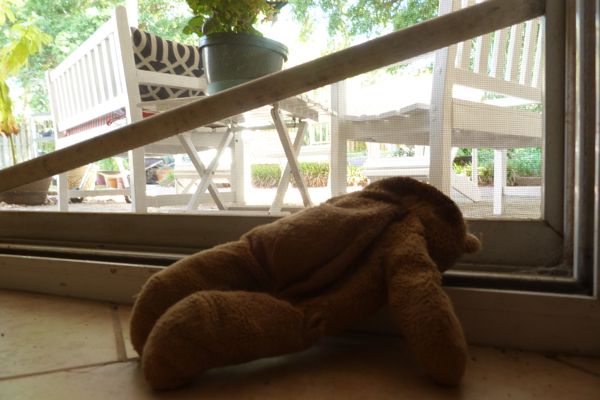
You’ve seen photos of Baby in the food dish, and Baby by the garage door. I opened the door into summer for the Qatari Cat, just the door, and propped the screen door tightly shut so QC could watch the birds and squirrels from the safety of the house.
In Qatar, when he was young and strong, he actually knocked a screen off and escaped. When we replaced the screen, he scratched a long rent in the screening and escaped again. He had a tree he would run for, and once on the wall – he was king of the roost. Only cheese or sardines would get him back again, and it could take hours just to find him before we could tempt and capture him.
Now, he is more content to be an indoor cat. At least, content most of the time. There are times he leaves a message telling us he still yearns to chase a squirrel or two . . .
Maldives President Urges Patience in Lashing Sentence of Rape Victim
Little drops of water, little grains of sand, make the mighty ocean and the beauteous land . . .
Little drops of water, in the form of expressions of international outrage against the sentence of 100 lashings for a 15 year old girl, impregnated by her stepfather, who bore his still-born babe, and was ordered punished by the court system for immorality. A call to express outrage by boycotting travel to the Maldives seems to have gotten the attention of the government. It appears they will try to find a way to avoid this grueling punishment . . . thanks to the attention being paid.
From the English edition of Haveeru Online:
President Dr Mohamed Waheed Hassan Manik on Tuesday urged patience from the international community in the case of the 15 year old alleged rape victim who received a flogging after being convicted of adultery in a separate incident.
The conviction had sparked an international outcry and condemnation from rights groups such as Amnesty International. While an online petition condemning the Maldives over the sentencing has received over two million signatures. The petition, started by New York-based campaign group avaaz.org, calls on President Waheed to intervene and has been signed by over two million users.
“We appreciate the international compassion for this young woman and ask for your patience as this case moves through the judicial system,” President Waheed said in a statement.
“Currently the case is being appealed and I have urged the judiciary to resolve this matter as quickly as possible.”
“This case should never have been presented in the courts and we are working to ensure that cases like this are never brought to the courts again.”
In the statement, President Waheed also assured that the young woman remains under the care of the Gender Ministry and is receiving the appropriate physical and psychological counseling at this time.
“As both the President and as a father, I am fully committed to protecting and advancing the rights of women and girls in the Maldives and throughout the world and share your deep concern about this young victim.”
In its attempt to pressure the Maldives government to overturn the sentence, Avaaz had called for tourism to be boycotted.
“Tourism is the big earner for the Maldives elite, including government ministers. Let’s build a million-strong petition to President Waheed this week, then threaten the islands’ reputation through hard-hitting ads in travel magazines and online until he steps in to save her and abolish this outrageous law,” Avaaz said on its website.
In that regard, President noted that the Maldives is a young democracy working to balance religious faith with new democratic values and asked the international community to support as partners as the country works through this challenge.
“A boycott on tourism will only serve as a setback to the economic opportunities and rights we are all striving to uphold for women, girls and the hardworking Maldivian people in general,” Waheed stressed.
The 15 year old girl who gave birth and buried the baby in Shaviyani Atoll Feydhoo had been sentenced to eight months under house arrest and 100 lashes after the Juvenile Court found her guilty of pre marital sex.
Prosecutors have maintained that the 15 year old was charged with adultery over another case which came to light during the investigation of the buried baby.
The baby born last June was found buried in the bath house of the girl’s home. The child delivered out of wedlock was dead at the time of discovery. Charges have been filed against the 15 year old’s mother and step-father over the deliberate murder of the baby.
Recent Comments
ExpatAlien on What Country am I Living … intlxpatr on Yellowstone: Old Faithful to C… Michelle on Yellowstone: Old Faithful to C… Cathy on No Grown-Ups in Charge intlxpatr on Waiting for Snow Wikipedia Donate Button

Amazina


Early Voting in Florida


 Here There and Everywhere