A Thorny Sermon: The Prodigal Son
From today’s Lectionary reading, the Gospel:
GOSPEL: Luke 15: 1 – 3, 11b – 32 (RCL)
Luke 15: 1 – 3, 11 – 32 (Roman Catholic)

Gustave Dore: The Prodigal Son in the Arms of his Father
Luke 15:1 (NRSV) Now all the tax collectors and sinners were coming near to listen to him. 2 And the Phar’isees and the scribes were grumbling and saying, “This fellow welcomes sinners and eats with them.”
3 So he told them this parable:
11 Then Jesus said, “There was a man who had two sons. 12 The younger of them said to his father, “Father, give me the share of the property that will belong to me.’ So he divided his property between them. 13 A few days later the younger son gathered all he had and traveled to a distant country, and there he squandered his property in dissolute living.
14 When he had spent everything, a severe famine took place throughout that country, and he began to be in need. 15 So he went and hired himself out to one of the citizens of that country, who sent him to his fields to feed the pigs. 16 He would gladly have filled himself with the pods that the pigs were eating; and no one gave him anything.
17 But when he came to himself he said, “How many of my father’s hired hands have bread enough and to spare, but here I am dying of hunger! 18 I will get up and go to my father, and I will say to him, “Father, I have sinned against heaven and before you; 19 I am no longer worthy to be called your son; treat me like one of your hired hands.” ‘
20 So he set off and went to his father. But while he was still far off, his father saw him and was filled with compassion; he ran and put his arms around him and kissed him. 21 Then the son said to him, “Father, I have sinned against heaven and before you; I am no longer worthy to be called your son.’ 22 But the father said to his slaves, “Quickly, bring out a robe–the best one–and put it on him; put a ring on his finger and sandals on his feet. 23 And get the fatted calf and kill it, and let us eat and celebrate; 24 for this son of mine was dead and is alive again; he was lost and is found!’ And they began to celebrate.
25 “Now his elder son was in the field; and when he came and approached the house, he heard music and dancing. 26 He called one of the slaves and asked what was going on. 27 He replied, “Your brother has come, and your father has killed the fatted calf, because he has got him back safe and sound.’
28 Then he became angry and refused to go in. His father came out and began to plead with him. 29 But he answered his father, “Listen! For all these years I have been working like a slave for you, and I have never disobeyed your command; yet you have never given me even a young goat so that I might celebrate with my friends. 30 But when this son of yours came back, who has devoured your property with prostitutes, you killed the fatted calf for him!’
31 Then the father said to him, “Son, you are always with me, and all that is mine is yours. 32 But we had to celebrate and rejoice, because this brother of yours was dead and has come to life; he was lost and has been found.'”
Sometimes people will leave off the part about the elder son, and just concentrate on the return of the younger son, focusing on the father watching always, hoping for the return of the younger son, ready to forgive and welcome before the words can even get out of the younger son’s mouth.
It is wonderful, and reassuring, for those of us sinners.
Many, however – including me – can also identify with the oldest son who says “I’ve always done everything right and you’ve NEVER given me a tiny goat, much less a fatted calf, and you’re throwing this party for the son who blew his entire fortune on louche living???”
It doesn’t seem fair, does it? Isn’t that really the point of the story, that we can’t behave our way into heaven, it is sheer grace, the love of the heavenly creator, that allows us in? It’s not an easy concept to wrap my mind around, so today I struggle to take it in, and I give thanks for Father Neil who tackles the hard questions and doesn’t just sweep them under the carpet because they are inconvenient. (The sermon isn’t up yet, but when it is available, you will find it here)
CDC Issues Warning on New Virus
Initial reports of this deadly virus came out a short time ago, and now the Center for Disease Control has issued a warning:
Deadly New Virus Warning Issued By CDC After Novel Coronavirus Causes 8 Deaths
The Huffington Post | By Dominique Mosbergen
Posted: 03/08/2013 2:58 pm EST | Updated: 03/08/2013 5:35 pm EST
In a cautionary report on Thursday, the Centers for Disease Control and Prevention (CDC) warned of a deadly new virus that has sickened more than a dozen people and killed eight in the Arabian peninsula and the U.K. so far.
No cases of the new virus — a coronavirus that experts say had previously never been seen in humans — have been reported in the United States. Still, the CDC has advised anyone visiting countries in or near the Arabian peninsula, including Iraq, Israel, Saudi Arabia and the United Arab Emirates, to see a doctor if a fever or symptoms of a lower respiratory illness develop within 10 days of their travels.
As Reuters points out, the new virus is “part of the same family of viruses as the common cold and the deadly outbreak of Severe Acute Respiratory Syndrome (SARS) that first emerged in Asia in 2003.”
Since April last year, a total of 14 people were confirmed to have been infected by the new coronavirus. Nine of them were infected in either Saudi Arabia, Qatar or Jordan; three people in the U.K. have also been infected.
“In the U.K., an infected man likely spread the virus to two family members. He had recently traveled to Pakistan and Saudi Arabia and got sick before returning to the U.K.,” according to a CDC release on the virus. The man’s son, one of the family members who was infected, died last month.
Child Marriage Increases Due to Financial Crisis
I have mixed feelings about child marriage. On one hand, girls are so immature in their teen years, and their bodies are not fully formed for child bearing. On the other hand, they are physically mature, and the hormones are raging.
A good friend married off her daughter at fifteen. She was actually “married” by contract at fourteen, but the families waited for the official marriage until she was fifteen. I was heartsick, but the girl herself was delighted. She liked the man she was marrying. She had no fears, no concerns. She started having babies – and she continued going to school, through university. I know it can work; I have seen it.
On the other hand, selling off a thirteen year old to a man she has never met, especially an OLD man, fills me with disgust. It’s a whole different situation.
Neither is it such a good thing, in our own culture, to have fourteen year old girls raising their babies with no husband around to be a father to the child. We all have some problems to face working out mating.
This is an excerpt from an article I found on Huffpost for International Women’s Day. You can read the whole article here.

Child Marriage On Rise As Global Crises Increase, New Study Says
Jessica Prois
Jessica.Prois@huffingtonpost.com
Half of all girls living in the world’s 51 least-developed countries have been married before the age of 18, according to the U.N. The World Vision study, released to coincide with International Women’s Day on March 8, found that such marriages are on the rise due to an increase in global poverty and crises. Researchers highlighted that parents living in areas prone to political instability or natural disasters are more likely to marry off their daughters at a young age, largely due to fear from these crises. Children living in these areas, such as South Sudan or Somalia, are also more likely to be forced into child marriage, the study said.
Erica Hall, Child Rights Policy director at World Vision, explained that the root causes of child marriage — poverty and gender inequality — are being exacerbated.
“Worldwide, there are increases in security issues and increases in natural disasters linked to global warming,” Hall said. She cited the recent humanitarian crisis in the Sahel region of North Africa and Somalia due to drought and political unrest as an example in which many girls often quit school and are sent to work as domestic workers or are married, to reduce the burden on their families.
For Bangladeshi families such as Humaiya’s, drought and lack of food are the primary reasons to discharge a young girl from her home. One of the most unjust impacts of this is education inequality. World Vision’s research in Bangaldesh revealed that girls who were unable to attend school due to disruptions from natural disasters were more likely to marry early.
Humaiya speaks out about child rights issues such as early marriage and became an advocate through World Vision, which introduced Humaiya to HuffPost. She said she knows that her ongoing education in Bangladesh is rare. Some 66 percent of girls in Bangladesh are married before age 18, according to World Vision. Humaiya works to educate her peers in her village and speaks to government leaders, asking them to do more to stem child marriage and provide greater education opportunities.
But Humaiya told The Huffington Post that she has seen many of her friends married off, and described how disconnected she feels from the girls she has been friends with for five or more years.
“Now they are good cooks,” she said. “They are like my mother, even though we are the same age. I don’t know how to manage a family, but they know.”
She explained that her mother was 16 when she was forced to get married, and lost a son by the time she was 18 years old.
In Bangladesh, the law is that girls can’t marry until they’re 18 and boys can’t marry until they’re 21. But the rules are not implemented, Hall said.
“The law is not the problem,” she pointed out. “You have to have political will to do that and capacity and understanding among law enforcement. The goal is to get governments to enforce these things, and — this is such an NGO word — but it has to be a holistic approach.”
Hall pointed out that requiring marriage registration and working on a grassroots community level is key to creating systemic change. She cited examples such as the Grandmother’s Project in southern Senegal, a nonprofit partner of World Vision that focuses on reducing early marriage, female genital mutilation and early pregnancy by creating an intergenerational dialogue about how to shift the gender-role paradigm.
“That’s been successful — you know how grandmothers are — in getting an idea like that across that it doesn’t have to be part of the tradition,” Hall said.
World Vision also works with religious leaders to address the practice of child marriage.
“There is a strong foundation in religion that children should be protected and they don’t want girls dying in childbirth and these leaders say, ‘This is a tenet of our faith and this is why we are going to start speaking out against it,'” Hall explained.
The issue of child marriage has gained momentum outside of the NGO world as well. Former Secretary of State Hillary Clinton announced last October a public-private initiative that focuses on ending child marriage by increasing education opportunities, providing training among officials and tracking every country’s legal minimum age of marriage — in particular in Humaiya’s home country of Bangladesh.
New Virus in Middle East Kills 50% Victims
I found this on WeatherUnderground News this morning. What scares me is that there may be more victims, many more, shepherds who work with goats, laborers, people thought to have very bad colds, maybe even pneumonia, who don’t have the kind of money to fly to London to be diagnosed. If one man spread it to two family members, imagine how many people he had contact with on that airplane flying to London.
LONDON, Feb 27 (Reuters) – The emergence of a deadly virus previously unseen in humans that has already killed half those known to be infected requires speedy scientific detective work to figure out its potential.
Experts in virology and infectious diseases say that while they already have unprecedented detail about the genetics and capabilities of the novel coronavirus, or NCoV, what worries them more is what they don’t know.
The virus, which belongs to the same family as viruses that cause the common cold and the one that caused Severe Acute Respiratory Syndrome (SARS), emerged in the Middle East last year and has so far killed seven of the 13 people it is known to have infected worldwide.
Of those, six have been in Saudi Arabia, two in Jordan, and others in Britain and Germany linked to travel in the Middle East or to family clusters.
“What we know really concerns me, but what we don’t know really scares me,” said Michael Osterholm, director of the U.S.-based Center for Infectious Disease Research and Policy and a professor at the University of Minnesota.
Less than a week after identifying NCoV in September last year in a Qatari patient at a London hospital, scientists at Britain’s Health Protection Agency had sequenced part of its genome and mapped out a so-called “phylogenetic tree” – a kind of family tree – of its links.
Swiftly conducted scientific studies by teams in Switzerland, Germany and elsewhere have found that NCoV is well adapted to infecting humans and may be treatable medicines similar to the ones used for SARS, which emerged in China in 2002 and killed a tenth of the 8,000 people it infected.
“Partly because of the way the field has developed post-SARS, we’ve been able to get onto this virus very early,” said Mike Skinner, an expert on coronaviruses from Imperial College London. “We know what it looks like, we know what family it’s from and we have its complete gene sequence.”
Yet there are many unanswered questions.
Spotlight on Saudi Arabia, Jordan
“At the moment we just don’t know whether the virus might actually be quite widespread and it’s just a tiny proportion of people who get really sick, or whether it’s a brand new virus carrying a much greater virulence potential,” said Wendy Barclay, a flu virologist, also at Imperial College London.
To have any success in answering those questions, scientists and health officials in affected countries such as Saudi Arabia and Jordan need to conduct swift and robust epidemiological studies to find out whether the virus is circulating more widely in people but causing milder symptoms.
This would help establish whether the 13 cases seen so far are the most severe and represent “the tip the iceberg”, said Volker Thiel of the Institute of Immunobiology at Kantonal Hospital in Switzerland, who published research this month showing NCoV grows efficiently in human cells.
Scientists and health officials in the Middle East and Arab Peninsular also need to collaborate with colleagues in Europe, where some NCoV cases have been treated and where samples have gone to specialist labs, to try to pin down the virus’ source.
“One Big Virological Blender”
Initial scientific analysis by laboratory scientists at Britain’s Health Protection Agency (HPA) – which helped identify the virus in a Qatari patient in September last year – found that NCoV’s closest relatives are most probably bat viruses.
It is not unusual for viruses to jump from animals to humans and mutate in the process – high profile examples include the human immunodeficiency virus (HIV) that causes AIDS and the H1N1 swine flu which caused a pandemic in 2009 and 2010.
Yet further work by a research team at the Robert Koch Institute at Germany’s University of Bonn now suggests it may have come through an intermediary – possibly goats.
In a detailed case study of a patient from Qatar who was infected with NCoV and treated in Germany, researchers said the man reported owning a camel and a goat farm on which several goats had been ill with fevers before he himself got sick.
Osterholm noted this, saying he would “feel more comfortable if we could trace back all the cases to an animal source”.
If so, it would mean the infections are just occasional cross-overs from animals, he said – a little like the sporadic cases of bird flu that continue to pop up – and would suggest the virus has not yet established a reservoir in humans.
Yet recent evidence from a cluster of cases in a family in Britain strongly suggests NCoV can be passed from one person to another and may not always come from an animal source.
An infection in a British man who had recently travelled to Saudi Arabia and Pakistan, reported on Feb. 11, was swiftly followed by two more British cases in the same family in people who had no recent travel history in the Middle East.
The World Health Orgnisation says the new cases show the virus is “persistent” and HPA scientists said the cluster provided “strong evidence” that NCoV, which like other coronaviruses probably spreads in airborne droplets, can pass from one human to another “in at least some circumstances”.
Despite this, Ian Jones, a professor of virology at Britain’s University of Reading, said he believes “the most likely outcome for the current infections is a dead end” – with the virus petering out and becoming extinct.
Others say they fear that is unlikely.
“There’s nothing in the virology that tells us this thing is going to stop being transmitted,” said Osterholm. “Today the world is one big virological blender. And if it’s sustaining itself (in humans) in the Middle East then it will show up around the rest of the world. It’s just a matter of time.”
Mediterranean Diet Cuts Heart Attacks, Strokes and Deaths by 30%
What I love about the report of this study is that all the related researchers have gone to a Mediterranean diet – see the end of this article 🙂 I found this article at the New York Times.

About 30 percent of heart attacks, strokes and deaths from heart disease can be prevented in people at high risk if they switch to a Mediterranean diet rich in olive oil, nuts, beans, fish, fruits and vegetables, and even drink wine with meals, a large and rigorous new study has found.
The findings, published on The New England Journal of Medicine’s Web site on Monday, were based on the first major clinical trial to measure the diet’s effect on heart risks. The magnitude of the diet’s benefits startled experts. The study ended early, after almost five years, because the results were so clear it was considered unethical to continue.
The diet helped those following it even though they did not lose weight and most of them were already taking statins, or blood pressure or diabetes drugs to lower their heart disease risk.
“Really impressive,” said Rachel Johnson, a professor of nutrition at the University of Vermont and a spokeswoman for the American Heart Association. “And the really important thing — the coolest thing — is that they used very meaningful endpoints. They did not look at risk factors like cholesterol or hypertension or weight. They looked at heart attacks and strokes and death. At the end of the day, that is what really matters.”
Until now, evidence that the Mediterranean diet reduced the risk of heart disease was weak, based mostly on studies showing that people from Mediterranean countries seemed to have lower rates of heart disease — a pattern that could have been attributed to factors other than diet.
And some experts had been skeptical that the effect of diet could be detected, if it existed at all, because so many people are already taking powerful drugs to reduce heart disease risk, while other experts hesitated to recommend the diet to people who already had weight problems, since oils and nuts have a lot of calories.
Heart disease experts said the study was a triumph because it showed that a diet was powerful in reducing heart disease risk, and it did so using the most rigorous methods. Scientists randomly assigned 7,447 people in Spain who were overweight, were smokers, or had diabetes or other risk factors for heart disease to follow the Mediterranean diet or a low-fat one.
Low-fat diets have not been shown in any rigorous way to be helpful, and they are also very hard for patients to maintain — a reality borne out in the new study, said Dr. Steven E. Nissen, chairman of the department of cardiovascular medicine at the Cleveland Clinic Foundation.
“Now along comes this group and does a gigantic study in Spain that says you can eat a nicely balanced diet with fruits and vegetables and olive oil and lower heart disease by 30 percent,” he said. “And you can actually enjoy life.”
The study, by Dr. Ramon Estruch, a professor of medicine at the University of Barcelona, and his colleagues, was long in the planning. The investigators traveled the world, seeking advice on how best to answer the question of whether a diet alone could make a big difference in heart disease risk. They visited the Harvard School of Public Health several times to consult Dr. Frank M. Sacks, a professor of cardiovascular disease prevention there.
In the end, they decided to randomly assign subjects at high risk of heart disease to three groups. One would be given a low-fat diet and counseled on how to follow it. The other two groups would be counseled to follow a Mediterranean diet. At first the Mediterranean dieters got more intense support. They met regularly with dietitians while members of the low-fat group just got an initial visit to train them in how to adhere to the diet, followed by a leaflet each year on the diet. Then the researchers decided to add more intensive counseling for them, too, but they still had difficulty staying with the diet.
One group assigned to a Mediterranean diet was given extra-virgin olive oil each week and was instructed to use at least 4 four tablespoons a day. The other group got a combination of walnuts, almonds and hazelnuts and was instructed to eat about an ounce of the mix each day. An ounce of walnuts, for example, is about a quarter cup — a generous handful. The mainstays of the diet consisted of at least three servings a day of fruits and at least two servings of vegetables. Participants were to eat fish at least three times a week and legumes, which include beans, peas and lentils, at least three times a week. They were to eat white meat instead of red, and, for those accustomed to drinking, to have at least seven glasses of wine a week with meals.
They were encouraged to avoid commercially made cookies, cakes and pastries and to limit their consumption of dairy products and processed meats.
To assess compliance with the Mediterranean diet, researchers measured levels of a marker in urine of olive oil consumption — hydroxytyrosol — and a blood marker of nut consumption — alpha-linolenic acid.
The participants stayed with the Mediterranean diet, the investigators reported. But those assigned to a low-fat diet did not lower their fat intake very much. So the study wound up comparing the usual modern diet, with its regular consumption of red meat, sodas and commercial baked goods, with a diet that shunned all that.
Dr. Estruch said he thought the effect of the Mediterranean diet was due to the entire package, not just the olive oil or nuts. He did not expect, though, to see such a big effect so soon. “This is actually really surprising to us,” he said.
The researchers were careful to say in their paper that while the diet clearly reduced heart disease for those at high risk for it, more research was needed to establish its benefits for people at low risk. But Dr. Estruch said he expected it would also help people at both high and low risk, and suggested that the best way to use it for protection would be to start in childhood.
Not everyone is convinced, though. Dr. Caldwell Blakeman Esselstyn Jr., the author of the best seller “Prevent and Reverse Heart Disease: The Revolutionary, Scientifically Proven, Nutrition-Based Cure,” who promotes a vegan diet and does not allow olive oil, dismissed the study.
His views and those of another promoter of a very-low-fat diet, Dr. Dean Ornish, president of the nonprofit Preventive Medicine Research Institute, have influenced many to try to become vegan. Former President Bill Clinton, interviewed on CNN, said Dr. Esselstyn’s and Dr. Ornish’s writings helped convince him that he could reverse his heart disease in that way.
Dr. Esselstyn said those in the Mediterranean diet study still had heart attacks and strokes. So, he said, all the study showed was that “the Mediterranean diet and the horrible control diet were able to create disease in people who otherwise did not have it.”
Others hailed the study.
“This group is to be congratulated for carrying out a study that is nearly impossible to do well,” said Dr. Robert H. Eckel, a professor of medicine at the University of Colorado and a past president of the American Heart Association.
As for the researchers, they have changed their own diets and are following a Mediterranean one, Dr. Estruch said.
“We have all learned,” he said.
Maldives Rape Victim Sentenced to 100 Lashes for PreMarital Sex
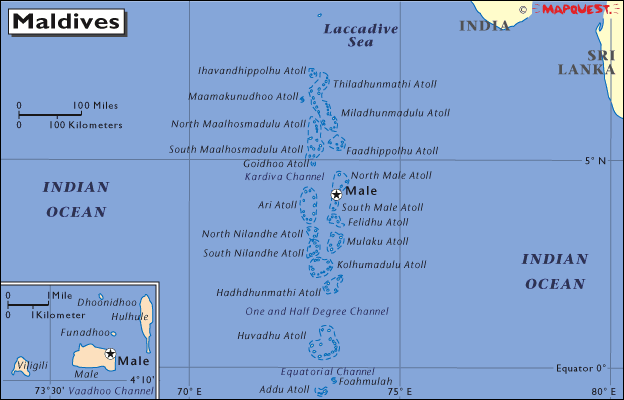
Where are the Maldives Islands?
Raped by her stepfather, impregnated against her will, her stepfather killed the baby, and now, sentenced by Sharia law to 100 lashes for pre-marital sex. How can this be justice? (This is from BBC News)
Maldives girl to get 100 lashes for pre-marital sex
By Olivia Lang
BBC News
A 15-year-old rape victim has been sentenced to 100 lashes for engaging in premarital sex, court officials said.
The charges against the girl were brought against her last year after police investigated accusations that her stepfather had raped her and killed their baby. He is still to face trial.
Prosecutors said her conviction did not relate to the rape case.
Amnesty International condemned the punishment as “cruel, degrading and inhumane”.
The government said it did not agree with the punishment and that it would look into changing the law.
Baby death
Zaima Nasheed, a spokesperson for the juvenile court, said the girl was also ordered to remain under house arrest at a children’s home for eight months.
She defended the punishment, saying the girl had willingly committed an act outside of the law.
Officials said she would receive the punishment when she turns 18, unless she requested it earlier.
The case was sent for prosecution after police were called to investigate a dead baby buried on the island of Feydhoo in Shaviyani Atoll, in the north of the country.
Her stepfather was accused of raping her and impregnating her before killing the baby. The girl’s mother also faces charges for failing to report the abuse to the authorities.
The legal system of the Maldives, an Islamic archipelago with a population of some 400,000, has elements of Islamic law (Sharia) as well as English common law.
Ahmed Faiz, a researcher with Amnesty International, said flogging was “cruel, degrading and inhumane” and urged the authorities to abolish it.
“We are very surprised that the government is not doing anything to stop this punishment – to remove it altogether from the statute books.”
“This is not the only case. It is happening frequently – only last month there was another girl who was sexually abused and sentenced to lashes.”
He said he did not know when the punishment was last carried out as people were not willing to discuss it openly.
Endless Rain in Pensacola

“I am so thankful we had such good weather when our house guests were here,” I said to AdventureMan. Not only was it raining steadily as we headed home from the commissary, but we had thunder and lightning early in the morning, and it meant no water-aerobics class – pools are not a safe place to be when there is a thunderstorm outside.
“And I am thankful to have a garage.” he added, and I totally agree. When you have a big load of groceries is not a great time for a rain storm if you are toting them inside, pelted by a pouring rain.
We thought of all the places we have lived. I thought of all the groceries we have toted. Probably, for me, the worst was in Kuwait, where we had underground parking (very nice protection from the heat and merciless sun) and you had to take groceries and other shopping up in an elevator. We’ve lived in many countries, however, with no garage at all, and carried groceries inside through all kinds of weather.
And the rain keeps coming down . . . .
Putting TEETH into Anti-Rape Solutions :-)
Thank you, Hayfa, you always find the most amazing articles. What I love about this one is that if everything is where it is supposed to be, nobody gets hurt. Only invasive behavior results in . . . .lets hope excruciating pain 🙂 It also gives an attacker something else to focus on. This invention is a public service.
Rape-aXe: The Anti-Rape Condom
This is so brilliant! An anti-rape female condom invented by Sonette Ehlers.… A South African woman working as a blood technician with the South African Blood Transfusion Service, during which time she met and treated many rape victims. The device, known as The Rape-aXe, is a latex sheath embedded with shafts of sharp, inward-facing microscopic barbs that would be worn by a woman in her vagina like a tampon. If an attacker were to attempt vaginal rape, their penis would enter the latex sheath and be snagged by the barbs, causing the attacker pain during withdrawal and (ideally) giving the victim time to escape. The condom would remain attached to the attacker’s body when he withdrew and could only be removed surgically, which would alert hospital staff and police. This device could assist in the identification and prosecution of rapists.


A medieval device built on hatred of men? Or a cheap, easy-to-use invention that could free millions of South African women from fear of rape, in a country with the world’s worst sexual assault record?
Dubbed the “rape trap”, trademarked “Rapex”, the condom-like device bristling with internal hooks designed to snare rapists has re-ignited controversy over South Africa’s alarming rape rate, even before plans for its production were announced in Western Capethis week.
Some say the inventor, Sonette Ehlers, a former medical technician, deserves a medal, others that she needs help.
The device, concealed inside a woman’s body, hooks onto a rapist during penetration and must be surgically removed.
Ms Ehlers said the rape trap would be so painful for a rapist that it would disable him immediately, enabling his victim to escape; but would cause no long-term physical damage and could not injure the woman.
Some women’s activists call the device regressive, putting the onus on women to address a male problem.
Charlene Smith, an anti-rape campaigner, said it “goes back to the concept of chastity belts” and would incite injured rapists to kill their victims.
“We don’t need these nut-case devices by people hoping to make a lot of money out of other women’s fear,” Ms Smith said.
But Ms Ehlers contends that South Africa’s rape problem is so severe women cannot wait for male attitudes to improve.
“I don’t hate men. I love men. I have not got revenge in mind. All I am doing is giving women their power back,” Ms Ehlers said. “I don’t even hate rapists. But I hate the deed with a passion.”
The United Nations says South Africahas the world’s highest per capita rate of reported rapes – 119 per 100,000 people. Analysts say the total, including unreported rapes, could be nine times higher.
Ms Ehlers sees her invention as particularly attractive to poorer black women, because they often walk long distances through unsafe areas to and from work. She foresees women inserting the device as part of a daily security routine.
She said a majority of women surveyed said they were willing to use the device, which will go into production next year and sell for one rand (20 cents).
Ms Ehlers said she was inspired after meeting a traumatised rape victim who told her, “If only I had teeth down there.”
Auction Navajo First Phase Chief’s Wearing Blanket Game Changer
You’ve got to watch this video for the best thing that will happen to you all day. Just when you think you hit bottom, something wonderful can happen. It happened to this man, who had lost a lower leg in an accident, was living on $800 plus disability and wondering how he was going to survive. (Thank you, Hayfa, for sending this!)
Published on Jul 11, 2012
This stunning Navajo First Phase Chief’s Wearing Blanket made headlines when it sold for 1.8 million dollars at John Moran Auctioneers’ June 19th sale in Southern California, smashing the previous world record of $522,500 for a similar blanket. An example of the rarest type of the earliest phase of Navajo blankets, it emerged from obscurity when it was brought into Moran’s free appraisal clinic by a man whose family handed it down through the generations, casually using it around the house. The sale of this museum-quality treasure has dramatically changed his life, and made auction history.
Video from JohnMoranAuctions:
Relationship Anxiety Hard on Your Immune System
Relationship Anxiety Is Hard On The Immune System, Study Says
Katherine Bindley
katie.bindley@huffingtonpost.com
This is from AOL News/Huffpost:
Relationship anxiety is known to be tough on a person’s mental well-being, but a new study suggests that fear of rejection — and worry that someone doesn’t love you enough — can also serve as chronic stressors that tax the immune system.
In a study of 85 couples who’d been married for an average of 12 years, a team of researchers led by Lisa Jaremka with Ohio State University College of Medicine examined the level of anxiety participants had about close relationships, as well as samples of their blood and saliva.
They found that the levels of cortisol — a hormone associated with stress — were on average 11 percent higher in people with higher levels of attachment anxiety than those who were less anxious. In addition, the more anxious people had between 11 percent and 20 percent fewer T-cells, which help the body to fight off disease.
“The thing that was surprising was the magnitude of the difference, especially in the immune cells that we saw,” Jaremka told The Huffington Post. “Some of the differences in the immune cell numbers, between the higher and the less high anxious attached people, were on the magnitude of what you’d see between obese and non-obese people.”
Attachment styles are believed to be derived from the type of caregiving people experienced in childhood, but the effects extend to, and impact, relationships in adulthood.
Most people are bound to have some level of concern and stress during the ups and downs of a relationship, Jaremka explained to HuffPost. But those with higher levels of attachment anxiety are hypersensitive to signs that a person they’re close to will leave them on a regular basis. They’re also more likely to seek reassurance and interpret their partner’s behaviors in a negative way.
Because the team did not include study participants who fell on the very high end of the anxiously attached spectrum, it’s possible that the effects of relationship anxiety could be even greater than the study suggests. Incidentally, while more women in the study suffered from higher levels of attachment anxiety, the researchers saw the same elevated levels of cortisol and lower T-cells in the men who were anxious.
Previous research had already established that relationship anxiety can have negative effects on a person’s physical health, but less was known about how exactly the anxiety and the health effects related to one another.
According to the Wall Street Journal, it’s believed that about 20 percent of the population falls on the anxious side of the anxiously attached spectrum. Another 25 percent fall into the avoidant category, which means those people may not get close to their partner out of fear that it could lead to a loss of autonomy.
Experts told the Journal that emotional opposites are often initially attracted to one another, but they may eventually face obstacles if they exacerbate one other’s attachment tendencies. For example, an anxious person might push for more affection and attention. This behavior might make an avoidant partner pull further away, in turn, making the anxious person even more insecure.
Despite the negative effects that attachment styles can have on a person’s relationships and physical health, Jaremka explained these traits are not inalterable.
“Anybody that is experiencing something that feels like high levels of attachment anxiety would think, ‘Oh great I’m doomed, but I think it’s important to acknowledge the fact that just because you are highly anxiously attached now doesn’t mean you have to be that way forever,” Jaremka told HuffPost. “We do know based on research that people can change and people can be very anxiously attached in one relationship and not at all in a different relationship.”
So what kind of relationship can serve as an antidote to pre-existing anxiety? One with a secure partner.
“If they are a very caring and loving and responsive partner, who attends to your needs when you need them, who is there for you when you’re stressed…Those relationships seem to be the types of relationships that people are able to feel secure in and are able to overcome anxieties in, if they have them,” Jaremka said.
The study, titled “Attachment Anxiety Is Linked to Alterations in Cortisol Production and Cellular Immunity,” is slated to be published in the journal Psychological Science.
Recent Comments
ExpatAlien on What Country am I Living … intlxpatr on Yellowstone: Old Faithful to C… Michelle on Yellowstone: Old Faithful to C… Cathy on No Grown-Ups in Charge intlxpatr on Waiting for Snow Wikipedia Donate Button

Amazina


Early Voting in Florida


 Here There and Everywhere