Alaskan Heritage Celebration
I’m researching the Inuit / Eskimo / Yup’ik mask my Mother bought lo, these many many moons ago, and like anyone born to research, I am hopelessly lost, and enjoying every minute of the journey.
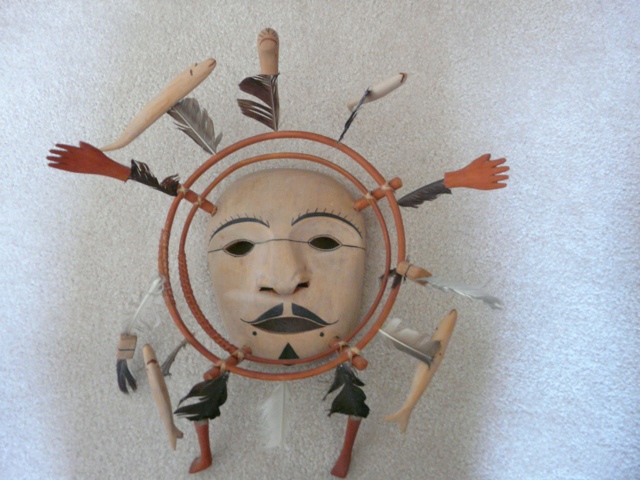
I’m not Alaskan. I was born in Alaska, and so many times through the years when I see blocks that need ticking, I have been tempted to tick “native Alaskan” but I know that they don’t mean me, and that there are people who really deserve those preferences. I FEEL Alaskan, even though I’ve been gone a long time.
(My Mother used to tell us not to play with the “natives” because “they had knives!” (Big scary eyes). LLLOOOLLLL! Can you think of any quicker way to get your kids to play with the forbidden group? They had knives! Plus, they were our neighbors, and our classmates, and we all played together. Skied together. Played Cowboys and . . . Indians. Yes! We did! LLOOOLLL!)
I found this fabulous video of segments from the “Celebration 2010” There is a reason I am sharing this – first, for all my friends of all nations who love textiles and handwork as I do – and our name is legion – I want you to see this video and to see the magnificant ceremonial robes they are wearing. They have to be hand made; they are each so individual, even among people of the same clan, the bear is different, one from the other, the fish – different, the raven – fabulously different, I even saw a sun! I hope your heart goes pitter patter, just as mine is going.
I wish I could bring this entire celebration to Kuwait and do a presentation with the KTAA (Kuwait Textile Arts Association.) They would LOVE these crafts, and the dancing. Look at the wonderful drums!
Second – did you hear them ululate? This is what I love about my travels; no matter what our differences, we have some amazing similarities.
Celebration, a First Nation heritage event taking place in Juneau, Alaska, originated and was sponsored in 1982 by Sealaska. The gathering takes place every other year and is the biggest event for Native Americans in Alaska for Tlingit, Haida and Tsimshian peoples.
To me, the coolest thing of all is that this is not done for tourists, but for the First Nation peoples, to transmit their culture to their children, and to celebrate themselves. This second video focuses on the clans and their special dances:
Now here is the exciting thing. It only happens every two years. This year it will take place June 6 – June 9. Here’s the information:
Celebration Native Cultural Conference
June 06, 2012 to June 09, 2012
A biennial Native cultural celebration featuring colorful costumed processions, dance performances, authentic arts and crafts and gatherings. Held in various venues including Centennial Hall Convention Center.
907-463-4844
http://www.sealaskaheritage.org
We already have plans for this June (I’ll share more about that later) but I talked to AdventureMan and said I really, really want to go in 2014. He said (are you sitting down?) “That’s just the kind of thing I LOVE! We’ve been planning to go to Alaska anyway, let’s go for that celebration!”
And that is why, after all these years of being married, I still adore my husband. He is a man with a heart for Adventure, and he gets all excited about the same things I do, well, some of the time. There was a falcon fest once in Tunisia that he dragged his feet on because he had just gotten in from a long trip, but once we got there, we all agreed it was one of those things that we would have regretted forever if we missed it. He is always up for a new adventure!
Wooooo HOOOOOOOOO!
See you there?
Diversity: No Holding Back the Tide
From today’s AOL News/ Huffpost:
So here’s the thing. In the USA, as in many countries, people study their ancestry, their bloodlines. Some people want those bloodlines to make them special, but anyone who has read history in any big-picture kind of way understands that most of history is people coming and going, waves of migration, immigration and emmigration, mostly depending on food supply, but often, too, depending on employment opportunities. Bottom line, most of it is about survival.
Now, blood. When we go to the hospital, or are taken there after an accident, do we ask whose blood it is that we receive when we need a transfusion? Blood is blood. The match to your antibodies and needs may be from another, despised race. Do we really know who our fathers are? Do women raped always admit to being raped? Do women admit to having a relationship outside of marriage? Many a child is born whose parenthood is not what it is claimed to be.
National DNA testing is controversial. Kuwait has been trying to do DNA testing to construct a profile for who is or is not Kuwaiti. 🙂 Do you really want to know?

Minority Birth Rate Now Surpasses Whites In US, Census Shows
By HOPE YEN 05/17/12 03:16 AM ET
WASHINGTON — For the first time, racial and ethnic minorities make up more than half the children born in the U.S., capping decades of heady immigration growth that is now slowing.
New 2011 census estimates highlight sweeping changes in the nation’s racial makeup and the prolonged impact of a weak economy, which is now resulting in fewer Hispanics entering the U.S.
“This is an important landmark,” said Roderick Harrison, a former chief of racial statistics at the Census Bureau who is now a sociologist at Howard University. “This generation is growing up much more accustomed to diversity than its elders.”
The report comes as the Supreme Court prepares to rule on the legality of Arizona’s strict immigration law, with many states weighing similar get-tough measures.
“We remain in a dangerous period where those appealing to anti-immigration elements are fueling a divisiveness and hostility that might take decades to overcome,” Harrison said.
As a whole, the nation’s minority population continues to rise, following a higher-than-expected Hispanic count in the 2010 census. Minorities increased 1.9 percent to 114.1 million, or 36.6 percent of the total U.S. population, lifted by prior waves of immigration that brought in young families and boosted the number of Hispanic women in their prime childbearing years.
But a recent slowdown in the growth of the Hispanic and Asian populations is shifting notions on when the tipping point in U.S. diversity will come – the time when non-Hispanic whites become a minority. After 2010 census results suggested a crossover as early as 2040, demographers now believe the pivotal moment may be pushed back several years when new projections are released in December.
The annual growth rates for Hispanics and Asians fell sharply last year to just over 2 percent, roughly half the rates in 2000 and the lowest in more than a decade. The black growth rate stayed flat at 1 percent.
The immigrants staying put in the U.S. for now include Narcisa Marcelino, 34, a single mother who lives with her two daughters, ages 10 and 5, in Martinsburg, W.Va. After crossing into the U.S. from Mexico in 2000, she followed her brother to the eastern part of the state just outside the Baltimore-Washington region. The Martinsburg area is known for hiring hundreds of migrants annually to work in fruit orchards. Its Hispanic growth climbed from 14 percent to 18 percent between 2000 and 2005 before shrinking last year to 3.3 percent, still above the national average.
Marcelino says she sells food from her home to make ends meet for her family and continues to hope that one day she will get a hearing with immigration officials to stay legally in the U.S. She aspires to open a restaurant and is learning English at a community college so she can help other Spanish-language speakers.
If she is eventually deported, “it wouldn’t be that tragic,” Marcelino said. “But because the children have been born here, this is their country. And there are more opportunities for them here.”
Of the 30 large metropolitan areas showing the fastest Hispanic growth in the previous decade, all showed slower growth in 2011 than in the peak Hispanic growth years of 2005-2006, when the construction boom attracted new migrants to low-wage work. They include Lakeland, Fla.; Charlotte, N.C.; Atlanta; Provo, Utah; Las Vegas; and Phoenix. All but two – Fort Myers, Fla., and Dallas-Fort Worth – also grew more slowly last year than in 2010, hurt by the jobs slump.
Pointing to a longer-term decline in immigration, demographers believe the Hispanic population boom may have peaked.
“The Latino population is very young, which means they will continue to have a lot of births relative to the general population,” said Mark Mather, associate vice president of the Population Reference Bureau. “But we’re seeing a slowdown that is likely the result of multiple factors: declining Latina birth rates combined with lower immigration levels. If both of these trends continue, they will lead to big changes down the road.”
William H. Frey, a demographer at the Brookings Institution who analyzed the census data, noted that government debates over immigration enforcement may now be less pressing, given slowing growth. “The current congressional and Supreme Court interest in reducing immigration – and the concerns especially about low-skilled and undocumented Hispanic immigration – represent issues that could well be behind us,” he said.
Minorities made up roughly 2.02 million, or 50.4 percent of U.S. births in the 12-month period ending July 2011. That compares with 37 percent in 1990.
In all, 348 of the nation’s 3,143 counties, or 1 in 9, have minority populations across all age groups that total more than 50 percent. In a sign of future U.S. race and ethnic change, the number of counties reaching the tipping point increases to more than 690, or nearly 1 in 4, when looking only at the under age 5 population.
The counties in transition include Maricopa (Phoenix), Ariz.; King (Seattle), Wash.; Travis (Austin), Texas; and Palm Beach, Fla., where recent Hispanic births are driving the increased diversity among children. Also high on the list are suburban counties such as Fairfax, Va., just outside the nation’s capital, and Westchester, N.Y., near New York City, where more open spaces are a draw for young families who are increasingly minority.
According to the latest data, the percentage growth of Hispanics slowed from 4.2 percent in 2001 to 2.5 percent last year. Their population growth would have been even lower if it weren’t for their relatively high fertility rates – seven births for every death. The median age of U.S. Hispanics is 27.6 years.
Births actually have been declining for both whites and minorities as many women postponed having children during the economic slump. But the drop since 2008 has been larger for whites, who have a median age of 42. The number of white births fell by 11.4 percent, compared with 3.2 percent for minorities, according to Kenneth Johnson, a sociologist at the University of New Hampshire.
Asian population increases also slowed, from 4.5 percent in 2001 to about 2.2 percent. Hispanics and Asians still are the two fastest-growing minority groups, making up about 16.7 percent and 4.8 percent of the U.S. population, respectively.
Blacks, who comprise about 12.3 percent of the population, have increased at a rate of about 1 percent each year. Whites have increased very little in recent years.
Other findings:
_The migration of black Americans back to the South is slowing. New destinations in the South, including Atlanta, Charlotte, N.C., Raleigh, N.C., and Orlando, Fla., saw sharp drop-offs in black population growth as the prolonged housing bust kept African-Americans locked in place in traditional big cities. Metro areas including New York, Chicago, Los Angeles and San Francisco had reduced declines or gains.
_Nine U.S. counties in five states saw their minority populations across all age groups surpass 50 percent last year. They were Sutter and Yolo in California; Quitman in Georgia; Cumberland in New Jersey; Colfax in New Mexico; and Lynn, Mitchell, Schleicher and Swisher in Texas.
_Maverick County, Texas, had the largest share of minorities at 96.8 percent, followed by Webb County, Texas, and Wade Hampton, Alaska, both at 96 percent.
_Four states – Hawaii, California, New Mexico and Texas – as well as the District of Columbia have minority populations that exceed 50 percent.
The census estimates used local records of births and deaths, tax records of people moving within the U.S., and census statistics on immigrants. The figures for “white” refer to those whites who are not of Hispanic ethnicity.
___
Associated Press writer John Raby in Charleston, W.Va., contributed to this report.
May In Seattle
From the bone chilliing 47 degrees mid-day on my arrival, the temperatures in Seattle flew up up and up. By Sunday, the American Mother’s Day, the temperatures were up 30 something degrees, in the mid to high 70’s, and Monday and Tuesday were the same. Good thing we got most of the heavy sorting and tossing andhauling done during the beautiful, but cooler weather before the weekend.
We had a lovely Mother’s Day, Mom got to sit out in the sun, under a huge umbrella, got to play with her great grandchildren, had all her children surrounding her. It was a gorgeous sunny day in a beautiful setting. We all had a lot of fun.
To add icing to the cake, I had the great luxury of time with my best friend from college, time to sit around and catch up, philosophize, all the things we did before husbands and children came along. Now we have as much to talk about as ever, and the great luxury of time in this trip to get to know all the little things, too. What a great blessing. Back to Pensacola, and gearing up for the next big trip!
Jesmyn Ward and Salvage the Bones

You are fifteen, poor, black, and motherless as this book opens. Dad drinks, and isn’t around much. You are the only girl in a family of brothers. Having sex is no big deal, and there is one guy you really like, Manny.
Your oldest brother’s pit bull is having puppies, and you are having trouble with throwing up most of what you eat, especially every morning. Dad says a hurricane is coming, but he’s said that before, no big deal.
As this book opens, it has the feel of a myth of the nightmare kind. We know, because we have the benefit of hindsight, that the impending storm, Katrina, will be catastrophic. The Batiste family has already suffered a catastrophic storm with the death of their Mama, just after the birth of her last child. Throughout the book, we watch these children suffer the daily absence of their mother, raising one another, squabbling, but tenderly looking after one another.
If someone had told me about this book, I don’t think I would have wanted to read it. Amazon.com kept telling me I needed to read it, so finally, I did. From the opening page, I was in a world utterly alien from my own, and yet a world I could understand and inhabit. There are worse things than being poor, and one of them is heartless. This family has heart; they are loyal to one another, they look after one another and they sacrifice for one another. For all the violence – and there is a lot of violence – there is also beauty.
There is the familial love, and there is the love between Skeet, the oldest brother, and his dog, China. There is friendship, and good people who give you refuge in the aftermath of the storm. There is the stunning numbness of surviving the worst hurricane ever.
Jesmyn West has a deft touch, with the language, with the interweaving of the Medea myth, with non-verbal communication, with the complexities of families and love. This is a book worth reading.
Late Afternoon in DeLuna Park
One of the great joys of living in Pensacola is seeing our grandson often. Yesterday, we were picking him up and keeping him until dinner, so we decided to take him to run in the fountains, only to discover that the fountains stop at 5 on Mondays – Wednesdays, and run until 8 on Thursdays, Fridays and Saturdays. No problem – there is always something going on to thrill a two years old’s heart.
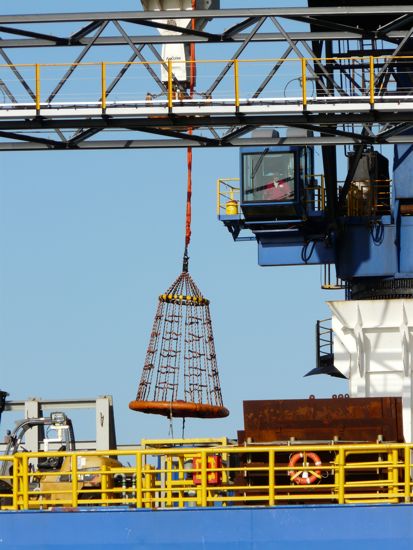
Yesterday, it was a tug-boat bringing in a huge dredger, with CRANES! Our two year old is all-boy. He loves car words, and truck words, and words like bulldozer, and pick-up, and CRANES. Watching the tugboat bring in the dredger thrilled his heart.

The crane lowers a cage onto the deck:
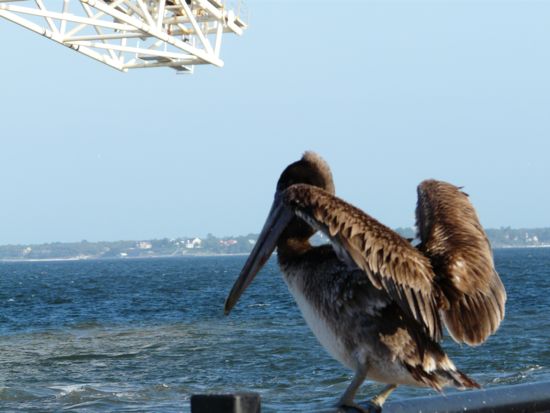
The pelicans are enthralled; the churning engines stir up fish and make finding supper easy pickings:

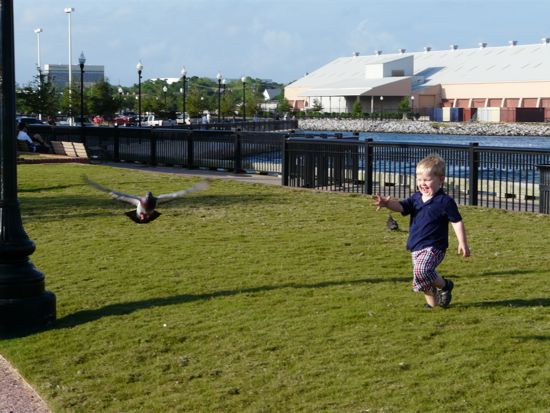
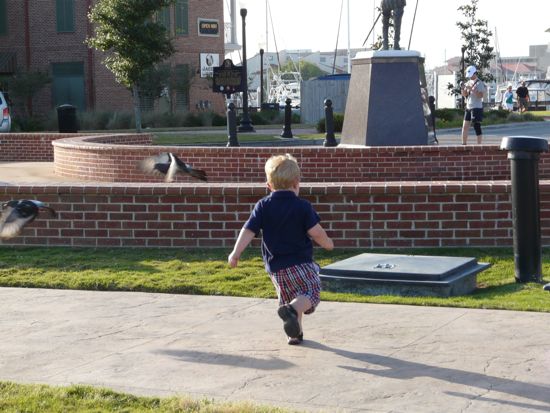
And then, chasing the pigeons! Where do they get the energy? A two-year-old can chase pigeons endlessly!

“You Brought the Sunshine!”
When I arrived in Seattle, my best friend from University said “You brought the sunshine!”

(This week’s weather in Seattle)
Now, when I fly back to Seattle, it takes a mere half day, not a day and a half. When I leave early enough, I can arrive mid-day, and beat the rush hour traffic. You’d think after driving in Kuwait and Qatar that I would find Seattle traffic tame, but Germany, with it’s wide-laned autobahn, and Pensacola, with it’s laid back version of going-home traffic have spoiled me.
Seattle is beautiful, although my trip is one of those more stressful ones, with things to be done to manage changing circumstances. My Mom may – or may not – have had a stroke. What is verifiable is that she has been very very sick, too sick to live on her own any longer, sick enough to need hospitalization, and professional monitoring from now on. The sisters have handled mountains of work and desperate calls for assistance, and now it is my turn to do what I can.
I stayed in Mom’s condo, but it was a little soulless, all her favorite pieces of furniture moved to her new place, her plants languishing, the stuff and detritus of life waiting to be cleared out.
Thank God for my best friend, and for the sunshine.
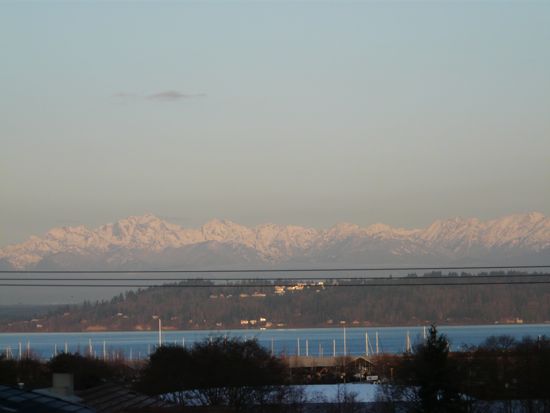
The sun just beginning to color the mountains as it rises off in the east.
The sisters had a full day of business, money, finances, and Mom’s recovery plan. We get a little goofy after a while; it’s a family culture. Our way of handling the worst, worst of times is laughter, and there were several times we were almost breathless from laughing. Yeh, I guess some would find it inappropriate, but for us, for our family, I think it is how we survive.
My second day there, we had a joyful family wedding. It was one of the sweetest events I have attended in a long time, and I loved the way the bride and the groom looked at each other, that they enjoyed their own wedding, smiling, laughing, dancing. Their signature was over everything; the colors (Purples!) and the food and the music and the ceremony, it was all perfectly thought through and delightful.

Sun setting in the west over the Olympic mountains
The rest of the trip was just hard work. And now, back in Pensacola, I have flights booked already for my next trip back. All part of life’s circle, I guess.
Through all this, we have met with kind, helpful people, who have made all the sorting out easier. Thanks be to God.
Rape Victim Commits Suicide After Being Forced to Marry Rapist
Aon AOL-Huffpost:
Amina Filali, Morocco Rape Victim, Commits Suicide After Forced Marriage To Rapist
By PAUL SCHEMM
RABAT, Morocco — The case of a 16-year-old girl who killed herself after she was forced to marry her rapist has spurred outrage among Morocco’s internet activists and calls for changes to the country’s laws.
An online petition, a Facebook page and countless tweets expressed horror over the suicide of Amina Filali, who swallowed rat poison on Saturday to protest her marriage to the man who raped her a year earlier.
Article 475 of the Moroccan penal code allows for the “kidnapper” of a minor to marry his victim to escape prosecution, and it has been used to justify a traditional practice of making a rapist marry his victim to preserve the honor of the woman’s family.
“Amina, 16, was triply violated, by her rapist, by tradition and by Article 475 of the Moroccan law,” tweeted activist Abadila Maaelaynine.
Abdelaziz Nouaydi, who runs the Adala Assocation for legal reform, said a judge can recommend marriage only in the case of agreement by the victim and both families.
“It is not something that happens a great deal – it is very rare,” he said, but admitted that the family of the victim sometimes agrees out of fear that she won’t be able to find a husband if it is known she was raped.
The marriage is then pushed on the victim by the families to avoid scandal, said Fouzia Assouli, president of Democratic League for Women’s Rights.
“It is unfortunately a recurring phenomenon,” she said.”We have been asking for years for the cancellation of Article 475 of the penal code which allows the rapist to escape justice.”
The victim’s father said in an interview with an online Moroccan newspaper that it was the court officials who suggested from the beginning the marriage option when they reported the rape.
“The prosecutor advised my daughter to marry, he said ‘go and make the marriage contract,'” said Lahcen Filali in an interview that appeared on goud.ma Tuesday night.
In many societies, the loss of a woman’s virginity outside of wedlock is a huge stain of honor on the family.
In many parts of the Middle East, there is a tradition whereby a rapist can escape prosecution if he marries his victim, thereby restoring her honor. There is a similar injunction in the Old Testament’s Book of Deuteronomy
Morocco updated its family code in 2004 in a landmark improvement of the situation of women, but activists say there’s still room for improvement.
In cases of rape, the burden of proof is often on the victim and if she can’t prove she was attacked, a woman risks being prosecuted for debauchery.
“In Morocco, the law protects public morality but not the individual,” said Assouli, adding that legislation outlawing all forms of violence against women, including rape within marriage, has been stuck in the government since 2006.
According to the father’s interview, the girl was accosted on the street and raped when she was 15, but it was two months before she told her parents.
He said the court pushed the marriage, even though the perpetrator initially refused. He only consented when faced with prosecution. The penalty for rape is between five and 10 years in prison, but rises to 10 to 20 in the case of a minor.
Filali said Amina complained to her mother that her husband was beating her repeatedly during the five months of marriage but that her mother counseled patience.
A Facebook page called “We are all Amina Filali” has been formed and an online petition calling for Morocco to end the practice of marrying rapists and their victims has already gathered more than 1,000 signatures.
Stop Kony 2012
I love this campaign. I love its focus and specificity. I love that it goes after a merciless bully who uses children as a weapon, and twists religion to serve the evil. I spit on you, Lords Resistance Army.
Please, take twenty-something minutes to watch this, what young people all around the world are doing to stop a hideous abuse of children in Uganda.
April 20. Wooo HOOOO!
Bullying and Community
I found this on AOL/Huffpost Parenting: it contains a line – I italicized it – that I need to think about. In America, we tend to think of the individual over the community. For the most part, we don’t encourage our children to continue with an activity they don’t like ‘for the good of the group,’ we tend to take them out of the activity. I’ve lived in cultures where obligations to the group are much stronger, and I’ve always felt confined and constricted by the burden of those expectations, but it does make for a more peaceful situation when we consider the needs of others and the needs of the group.
Preventing Bullying Begins With Us
Richard Weissbourd and Stephanie M. Jones
On Feb. 29, Lady Gaga will launch a foundation dedicated to creating caring communities and stopping bullying. Hosted by the Harvard Graduate School of Education and Harvard’s Berkman Center, Lady Gaga will be joined by Oprah and other celebrities. A powerful new film, “Bully,” will be widely released at the end of March, and many Americans in recent years have been galvanized by a blizzard of tragic bullying stories.
Yet too often in the past a problem plaguing children like bullying has received huge waves of public attention that simply never translates into any positive changes in kids’ lives. What will it take to capitalize on this attention? How can we curb this problem once and for all?
We can start by recognizing where the main solution lies. There is a tendency to simply blame bullying on “bad” kids or peer groups or destructive media. But bullying often has deep roots in parents’ attitudes and behavior, and stopping bullying begins with us.
How can parents prevent bullying? Parents in recent years have been flooded with articles and books that guide them in shielding, or “bully-proofing,” their own child. But just protecting our own kids won’t stop bullying, and this guidance reinforces the damaging tendency of many parents to just focus on their own children. The best way to prevent bullying — and many other forms of cruelty and harassment — is to encourage and enable children to care for and take responsibility for each other. Research indicates that bullying is greatly reduced in particular when children who witness bullying stand up for the victim. Bullying brings home to parents our fundamental moral responsibilities. How can we help our children widen their circle of concern and stand up for other children? How can we help our children build more just and caring communities?
Bullying, unlike more typically developmental teasing and hurtful remarks, is commonly defined as prolonged or frequent cruelty to others, often characterized by imbalances of power. This kind of cruelty can produce intense and often lasting feelings of shame in children, a sense that they are defective in some core way. About 30 percent of children are bullied each year on school property alone. Adults’ understandable reflex is to curb this kind of bullying by punishing perpetrators. Yet this strategy alone usually fails to stop bullying, and sometimes it backfires.
On the other hand, bystanders — especially a friend of the bully — tend to be far more effective. A bystander is present in 85 percent of bullying situations, and bystanders who intervene appear to prevail over half the time. Yet in the vast majority of cases bystanders elect not to intervene.
What can we do as parents to help our children stand up for others? Research suggests that parents bolster their children’s ability to act independently and to withstand disapproval when they respect their children’s capacity as independent thinkers from early ages and give them input into family decisions. All the things parents do to build in their children a sturdy sense of self make it easier for children to hold their ground against a powerful peer. As parents we strengthen the self, for example, when we praise appropriately, know and appreciate who our children are and maintain their trust and respect. Nurturing empathy in children from early ages certainly matters as well. That means in part helping children appreciate people who may not be on their radar, whether a bus driver, a custodian or a new child in class. It means helping children consider the perspectives of those they’re in conflict with as well as people who are different from them in customs or background or other characteristics.
While it’s vital that we convey high moral expectations and underscore the importance of sticking up for others, we also must listen carefully to our children and understand the complexity of their social worlds and ethical decisions. We as parents will be more real and valuable to children if we pay careful attention to their perceptions and experiences of bullying and discuss when and how to stand up for someone else. We need to talk to them about the complexities of balancing our needs with others and what consequences are worth and not worth bearing. We need to help them figure out how to challenge someone else constructively.
But perhaps most important, stemming bullying will require us to seriously examine our parenting priorities. As a good deal of research now indicates, we live in an era when many parents are intensely focused on their children’s self-esteem, happiness and achievements, not on how well they care for others. And in all sorts of subtle ways we can prioritize happiness over taking responsibility for others. Too many of us, for example, don’t push our children to fulfill obligations that might distress them. We let our children write off friends they find annoying, or fail to reach out to a friendless child on the playground, or quit a team or chorus without asking them to consider what it means for the group. How many of us simply tell our children that their classrooms, schools and neighborhoods are communities to which they have obligations?
Just as worrisome, many of us as parents are failing to model for our children a sense of responsibility for others. Over and over we have heard from teachers that many parents are occupied with their own child and care little about other children in the classroom. “It’s a dog fight,” one recently retired teacher says, driven out of the profession in part by his fatiguing battles with parents. “Parents are out of control. They’re always seeking an advantage for their own kid… they lobby for a gifted class or they want their kid to get extra attention… and they don’t care how they might be hurting other kids.” Some parents say they want kids with behavior problems immediately removed from the classroom because they believe their own child’s learning is compromised. But that message certainly doesn’t convey responsibility for others and the community. At least for some period of time, we as parents ought to encourage teachers to work with that child and ask our own child how she/he might support the struggling child.
It is, of course, a great deal easier and tidier for us as parents to simply wrap our attention around our own child or to periodically remind our child to respect others. But such bland reminders will never get us where we need to go. Our children’s moral development is deeply interwoven with our own. If we want our children to be fair, courageous and humane, we have to take a close, hard look at whether those values are priorities in our parenting, and whether we are living those values day to day.
Recent Comments
intlxpatr on Shampoo Ginger tigerbutterya0c5ff1d… on Shampoo Ginger intlxpatr on British Soldier Kidnapped, Esc… John on British Soldier Kidnapped, Esc… intlxpatr on British Soldier Kidnapped, Esc… Wikipedia Donate Button

Amazina


Early Voting in Florida


