It’s All ‘Insh’allah’
(Forgive me if I ramble a little bit; New Year’s Eve day is always something of a day of reflection for me. It’s not something I plan, it’s something I just find myself compelled to do; I do it whether I want to or not.)
I joke with my friends that the Lord kept sending me back to the Middle East until I learned that it was less my mission to share, than to learn. Once I shut up and watched and listened, I began learning, and what I learned contradicted many of my ignorant prejudices. In learning about my friends in the countries of the Middle East, I learned a lot about our Christian culture, and about myself.
When Westerners first get to the Middle East, the phrase ‘Insh’allah’ (God willing, or ‘if God wills it’) makes them want to tear their hair out. When your heat breaks down in the midst of a cold winter (and yes, there are very cold patches in many Middle Eastern countries) and the heat people tell you ‘Insh’allah’ they will be there ‘in the afternoon’ but won’t give you an exact time, it makes us want to slam the phone down. When you make plans to meet up with a friend for coffee, set a time, and then she says she will see us ‘insh’allah’, we don’t know whether she is going to show up or not.
It was only after many many years in the Middle East that we relaxed and accepted ‘insh’allah.’ Now, living back in the USA, we laugh, because life here is insh’allah, too, it’s just that people don’t know it. We’ve had several things done with our house, and whether or not the workers show up – it’s all insh’allah. When making plans with our family, a lot depends on when the baby is awake or sleeping, insh’allah. How much money our investments are worth? It’s all insh’allah. The same factor is there, it’s just cultural as to whether you acknowledge it or not.
Today’s New Testament reading from The Lectionary is all about insh’allah:
James 4:13-17, 5:7-11
13 Come now, you who say, ‘Today or tomorrow we will go to such and such a town and spend a year there, doing business and making money.’ 14Yet you do not even know what tomorrow will bring. What is your life? For you are a mist that appears for a little while and then vanishes. 15Instead you ought to say, ‘If the Lord wishes, we will live and do this or that.’ 16As it is, you boast in your arrogance; all such boasting is evil. 17Anyone, then, who knows the right thing to do and fails to do it, commits sin.
7 Be patient, therefore, beloved,* until the coming of the Lord. The farmer waits for the precious crop from the earth, being patient with it until it receives the early and the late rains. 8You also must be patient. Strengthen your hearts, for the coming of the Lord is near.* 9Beloved,* do not grumble against one another, so that you may not be judged. See, the Judge is standing at the doors! 10As an example of suffering and patience, beloved,* take the prophets who spoke in the name of the Lord. 11Indeed we call blessed those who showed endurance. You have heard of the endurance of Job, and you have seen the purpose of the Lord, how the Lord is compassionate and merciful.
And I think my New Year’s resolution is clear: Not to grumble against one another. 🙂
Baby’s Room
Our little grandson is old enough to start spending the night with us. First, AdventureMan had to install a gate, as the Baby room is at the top of stairs, and oh, he loves stairs. We can’t take a chance on him tackling the stairs without one of us present to ‘assist’ (i.e. supervise; make sure he is safe).
Back when I first got to Kuwait, I found these gorgeous turquoise panels at the Kuwait Thursday-Friday market for a song. They are a color I think of as Tuareg Blue; the men of the mountains in Algeria and parts of Morocco wear this gorgeous deep turquoise shade, and the dye rubs off and colors their skin, so some call them The Blue Men.
I’ve carted them around for six years now, waiting for the right use. I thought about parting with them when I left Qatar . . . but didn’t. I thought about parting with then here, as I went through a spree of paring down and packing things out to the Waterfront Mission . . . but I didn’t. All of a sudden, I knew how they were meant to be used, and what a wonderful blast of color they put in ‘Baby’s Room.’
I LOVE the patterns on the panels. Every one is different; I could not find any two panels the same. The vendor was Sudanese; I am tempted to think these might be Sudanese; I have never seen anything like them before or since in the fabric souks of Kuwait or Doha. They aren’t quite enough fabric to be saris, but they might be just enough for a sefsari, the cover worn by the women in Tunisia when we lived there – maybe 4.5 – 5 meters each, sold for less than $3.00 a panel. 🙂
We needed to get black-out curtains up, as the Happy Toddler takes after me, up with first light. It’s better for all of us if he can sleep a little later 🙂 But these panels attatched easily to the under curtains, and now his room is all ready for him – now he sleeps in a big boy bed and the crib has converted to a settee.

After all the wonderful days of family and friends, and eating meals back and forth, I was ready for a quiet projects day. I feel so good getting this project DONE! Don’t you love the color of these panels?


Dinner at the Happy Pig
We were all meeting up at the Happy Pig; the mood was meat, specifically BBQ meat, and as it is a family gathering, all tastes had to be considered. Happy Pig is centrally located, great food and, a big plus with the Happy Toddler, family oriented.
Happy Toddler is so much more verbal these days, which is a joy, and gives us many moments of hilarity, but also can be a pain. He believes that “please” means he will be given what he wants when he wants it. He believes that “all done” means he is free not to eat meals when the rest of us are eating. Ah well – he isn’t quite two and has time to learn all these distinctions. Meanwhile, we have to hide our laughter when he exerts his will so unselfconsciously.
What we loved are the Christmas lights:
This is the angel on the top of the Happy Pig Christmas Tree

Outside lights – Christmas gifts

This is a giraffe
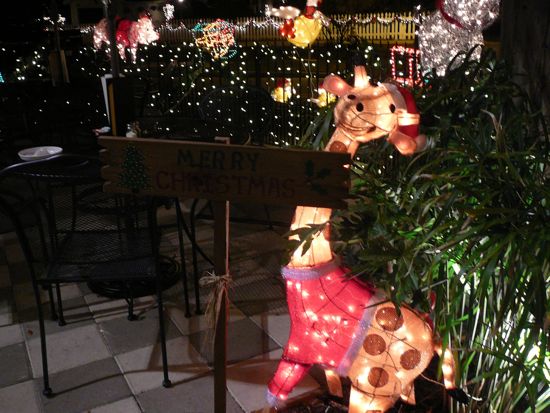
This is a hippo – have you ever seen a hippopotamus in Christmas lights before?

Another Happy Pig pig

A Happy Pig Polar Bear

We are having a particularly good Christmas this year; AdventureMan and I are on the same continent, in the same country, in the same time zone, in the same city, and thanks be to God, in the same house celebrating Christmas. We are so thankful. We are so thankful to be near our son and his wife, and our amazing and darling little Happy Toddler.
He loves the train gifts he got, but, again, this is where almost-two can be hilarious – he got a table and chairs he loves. What he loves is to move those chairs all over the house and to line them up in different ways, often as – a train, LOL. He is so serious, as he is creating, and so focused. You can almost catch a glimpse of him as the adult he will one day be.
Mary at Christ Church, Pensacola
Today was all about Mary, at Christ Church in Pensacola, about the brave young woman who said “yes” to God and conceived out of wedlock, and had to explain about how God sent a messenger angel and the Holy Spirit impregnated her – and who can help but think, as a parent, how hard some of this would be to believe? Brave little Mary, who said “yes.”
There is an ikon of Mary at the front of Christ Church:

I bet you can guess why I love this ikon, why it makes me smile . . . Mary, and her baby boy, are brown! They look like people really look in the Middle East, not Botticelli blondes with big blue eyes, dressed in Italian silks. I also love the way this Mama snuggles her precious little baby to her cheek; he is a baby, this King of Kings, and I like to think he grew up with a lot of cuddling and snuggling.
Whose Point of View?
“What a dumb cat!” AdventureMan says. “Every morning, he goes to the door and says ‘MEOW! Let me out!’ I NEVER let him out, but he goes to the door every morning and does the same thing!”
The Qatari cat sighs.
“I know he’s not stupid . . . ” he thinks, “I patiently go to the door every morning to let him know I want to go out. One of these days he is going to get it! I know it! One of these days he will understand, and let me out! All I have to do is to get him to understand just once, and then I will be OUTSIDE!”
The Tiger’s Wife by Tea Obreht
The Tiger’s Wife was the perfect book to get me from Pensacola to Seattle, and through the Atlanta airport, full of bustle on a Sunday, packed flights, no quiet, no privacy. Thank God for a good, engrossing book, that takes you totally out of where you are to a world where things are not always what they seem.

The book is set in an unnamed country in East Europe which has just come out of a war, and the main character and her best friend are en route across a border which did not exist before the war, on an aid mission to immunize children who were once neighbors, and are now in a different country.
The primary relationship in the book is the bond between a young girl and her grandfather, and the stories he tells her as they walk up to the zoo, the Jungle Book he reads to her as they visit the animals, and the stories she finds for herself as she participates in the post-war rebuilding. It is a fascinating book because what she is writing about is not always what she is really writing about; the stories and legends and experiences are metaphors for another reality and a life lesson.
I don’t want you to think that this is one of the mindless airport books I sometimes tell you about. If it were, I would tell you “this is not great literature; this is an airport read.” Not this book. This book is literature. This book has meaning, and events you will think about and talk over with other readers long after you have finished the book.
In the back of The Tiger’s Wife is an interview in which one of my favorite new authors, Jennifer Egan (A Visit From the Good Squad) interviews Tea Obreht about her writing process, her life, her vision, etc. Fascinating reading, too, and also reader’s guide questions help you see things you might need to see and might otherwise miss.
Saudi Arabia: Women Driving Will Have Sex, Report Says
I am sorry, but if this were a joke, it would be hilarious. It IS hilarious, or it would be, if it didn’t impact so darkly on the lives of so many women.
So my friends in Saudi Arabia, here is the solution. Let the women drive. Tell the men not to have sex with these driving women, not until they are married. Tell the men that no matter how much the women beg, to keep themselves pure, and not to let these women tempt them away from their purity. Teach the men that it is a CHOICE, and that they can behave themselves honorably, and withhold themselves from these driving women who want to have sex with them.
That’ll teach those women 🙂
From the Huffington Post
Saudi Arabia: Women Driving Will Have Sex, Report Says
RIYADH, Saudi Arabia — A report given to a high-level advisory group in Saudi Arabia claims that allowing women in the kingdom to drive could encourage premarital sex, a rights activist said Saturday.
The ultraconservative stance suggests increasing pressure on King Abdullah to retain the kingdom’s male-only driving rules despite international criticism.
Rights activist Waleed Abu Alkhair said the document by a well-known academic was sent to the all-male Shura Council, which advises the monarchy. The report by Kamal Subhi claims that allowing women to drive will threaten the country’s traditions of virgin brides, he said. The suggestion is that driving will allow greater mixing of genders and could promote sex.
Saudi women have staged several protests defying the driving ban. The king has already promised some reforms, including allowing women to vote in municipal elections in 2015.
There was no official criticism or commentary on the scholar’s views, and it was unclear whether they were solicited by the Shura Council or submitted independently. But social media sites were flooded with speculation that Saudi’s traditional-minded clerics and others will fight hard against social changes suggested by the 87-year-old Abdullah.
Saudi’s ruling family, which oversees Islam’s holiest sites, draws its legitimacy from the backing of the kingdom’s religious establishment, which follows a strict brand of Islam known as Wahhabism. While Abdullah has pushed for some changes on women’s rights, he is cautious not to push too hard against the clerics.
In October, Saudi Arabia named a new heir to the throne, Prince Nayef, who is a former interior minister and considered to hold traditionalist views, although he had led crackdowns against suspected Islamic extremists. His selection appeared to embolden the ultraconservative clerics to challenge any sweeping social reforms.
Prince Nayef was picked following the death of Crown Prince Sultan.
. . . Hurray for the Pumpkin Pie . . .
“You’ve worked HARD!” our water aerobics instructor told us. “You get a free pass tomorrow; you can eat anything!”
I wish she hadn’t said that. We did work hard, but it wasn’t just one day of feasting, it was pretty much four days, and we enjoyed ourselves too much. No matter how hard we had worked Wednesday morning, it wasn’t enough to cover four days.
Arriving at Papa’s and Grammy’s we were welcomed with a bubbling gumbo, a combined effort of Papa and Grammy; Grammy did all the shopping and chopping, and PaPa worked the roux, which is the butter and flour combination that makes that smoky flavored base for the gumbo. They had just finished cleaning and deveining about 40 pounds of shrimp for Thanksgiving, and threw a few in the gumbo. Oh YUM. The next morning was full of preparations, and then, mid-morning, the feasting began, with all the guys shucking oysters and eating boiled shrimp. As you drive up, you can smell smoke from an outdoor fire, and chairs and tables are out everywhere, but the shucking goes on down near the creek:



The house is beautiful, spacious and welcoming for so many people. The happy baby, who is now a happy toddler, was in heaven – he was surrounded by boy toys – tractors and golf carts and a Model A and all sorts of age appropriate toys, as well as cousins, aunts, uncles and a lot of hilarious rough housing. Why is it kids just love the terror of being turned upside-down?
For me, this was the best Thanksgiving with the family; finally I am beginning to figure out who is who from year to year. I still have to ask questions, but they seem more comfortable with me, and I had some really good conversations, sort of beyond the polite-passing-the-time conversations. I’m not that great in big crowds, but now I am beginning to have some good one-on-ones, and for me, that’s a great Thanksgiving.
And on, man, the food. Tables and tables of food. I don’t know how they do it, but I saw the list of cakes, and there must have been twenty cakes on THE LIST. They each have responsibilities, and somehow, it all works.
Three turkeys, all carved, and so much dressing (which I grew up calling stuffing, it all depends on where you grew up):
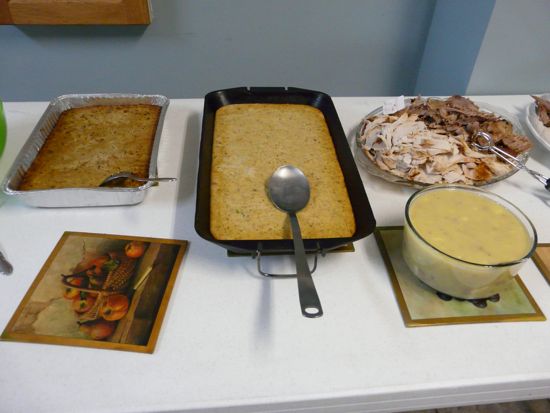

That green container is AdventureMan’s first foray into cranberry chutney. This one was a little tart, but tasty. As are darling daughter in law so diplomatically put it, “I would probably like it more if my taste buds were accustomed to having cranberries without sugar.”
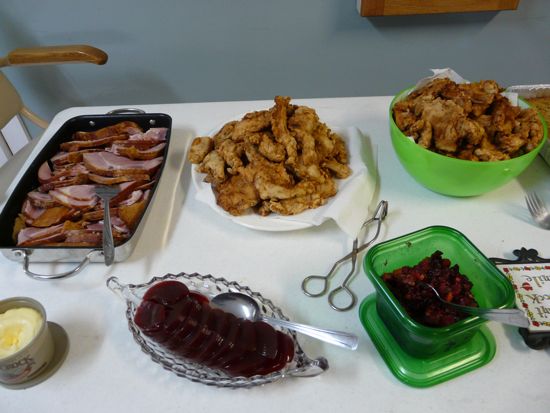


About half of the sides were sweet potato casseroles; you can’t believe how good these are. This year this front dish was one of the favorites, squash cassarole:

This photo doesn’t begin to do justice to the desserts – holy smokes:

So the biggest brother blessed the food and we ate around one, then we visited for a few hours, people going back and grazing a little. Then the next generation cleaned everything up and got all the food packaged up and put away. About an hour later, that broccoli salad started calling me, and I went out to try a little more and discovered it was all put away, but a partner in crime knew where it was, and we pulled it out and had some, which started a whole landslide of second-platers, just when everything had been all put away, LLOOLLL!
It was a great day, a day full of thanks for all the things in life that really matter.
Over the River and Through the Woods
. . . . to the co-grandparents house we go!
This is preparation week, and we are scurrying to get things together for Thanksgiving with the large family group. When we were first invited, one of the aunts told us “You’re not invited, you’re family! You’re expected!” It made us feel so welcome, and the gathering is so much fun we look forward to our time together.
Mom’s Cranberry Salad
Christmas Punch, Rum and Rumless
Rosettes
The world’s cutest grandbaby will be there; we are all having so much fun with him as he is in the steep learning curve phase, and pops out with language which astonishes us daily. While bathing him the other night, I was explaining about washing with soap and he said “I know.” I almost dropped the soap! He adores his BaBa, and whenever he sees me, he gets a big grin – and looks for BaBa to be behind me. LOL!
He loves going to his other PaPa’s house; he has a TRACTOR! And a Boat! The happy baby loves trains and motorcycles and buses; he loves anything that GOES.
We have so much for which we are thankful. God has blessed us mightily with family, and with friends, and with a wide and spacious place in which to live our lives. He has surrounded us with his grace, and we feel blessed, so blessed.
Happy Thanksgiving!
Jesus Loves the Little Children
There are many times Jesus speaks obliquely, using an analogy to convey the message, and his disciples have trouble understanding. This time, Jesus speaks very clearly, telling his disciples that the most humble child will enter heaven, and that anyone who causes that child to lose innocence and belief is in big trouble.
I think of my little grandson. Since he was born, I have been singing to him a song I learned in my childhood, “Jesus Loves the Little Children, all the little children of the world, red and yellow, black and white, we are precious in his sight, Jesus loves the little children of the world.”
Matthew 18:1-9
18 At that time the disciples came to Jesus and asked, ‘Who is the greatest in the kingdom of heaven?’ 2 He called a child, whom he put among them, 3 and said, ‘Truly I tell you, unless you change and become like children, you will never enter the kingdom of heaven. 4 Whoever becomes humble like this child is the greatest in the kingdom of heaven. 5 Whoever welcomes one such child in my name welcomes me.
6 ‘If any of you put a stumbling-block before one of these little ones who believe in me, it would be better for you if a great millstone were fastened around your neck and you were drowned in the depth of the sea. 7 Woe to the world because of stumbling-blocks! Occasions for stumbling are bound to come, but woe to the one by whom the stumbling-block comes!
8 ‘If your hand or your foot causes you to stumble, cut it off and throw it away; it is better for you to enter life maimed or lame than to have two hands or two feet and to be thrown into the eternal fire. 9 And if your eye causes you to stumble, tear it out and throw it away; it is better for you to enter life with one eye than to have two eyes and to be thrown into the hell of fire.
Recent Comments
intlxpatr on Shampoo Ginger tigerbutterya0c5ff1d… on Shampoo Ginger intlxpatr on British Soldier Kidnapped, Esc… John on British Soldier Kidnapped, Esc… intlxpatr on British Soldier Kidnapped, Esc… Wikipedia Donate Button

Amazina


Early Voting in Florida


