Pensacola Navy Exchange and Customer Service
One of the things that totally blows us away in the United States is customer service. Every now and then you run into bad customer service and it is so noticeable because most of the customer service is so GOOD. It is so good so often that you take it for granted, if you haven’t lived in countries where sometimes they treat you like you are lucky they notice your existence and maybe you aren’t good enough for their product, LOL!
I have a sweet, very elegant Indian friend in Kuwait. One time she told me she wanted to buy a beautiful pen for her husband, but when she went to the store, the man behind the counter didn’t want to show her the pen she wanted – because she is Indian. She said “here he is, working behind the counter, and he treats me like he doesn’t think I can afford to buy the pen I want to look at!” How insulting is that??
Oops. I digress. Sorry.
We decided to check out the Navy Exchange in Pensacola. Pensacola is a big military retirement area. It is a beautiful place, beautiful white powdery sands, green to turquoise to blue to purple waters, green palms and trees and right now azaleas blooming everywhere – many military people think it is heaven on earth, and come back to retire here. It’s a fun place, the Blue Angels practicing on Tuesday and Wednesday mornings; you can hear them thundering through the skies and over the Gulf, practicing their moves.
We get to the exchange (the souks, for my Gulf readers 😉 ) I am disappointed – it’s small. There is another building, but it is also small, and I am looking for big appliances, like a clothes washer and dryer. As we are leaving, a store guy asks us if we found everything OK, and we said ‘no, not really’ and he listened to us and then laughed and told us we were at the wrong place, and he took his time to tell us how to get to the right place, and to make sure we understood.
When we got to the right exchange (and it is HUGE!) there were lots of parking places – I love this place. We parked next to a reserved space. There are lots of reserved spaces – remember, this is a military base. The commander of this, the commander of that, a space for flag officers (generals) and then . . .this space. It gave me a big grin. And there are TWO of them, right in front of the Naval Exchange:

In my seven years in the Gulf, in Qatar and in Kuwait, I saw some amazing changes, including going from total disregard of handicapped spaces to increasing respect for the handicapped spaces. Wouldn’t it be cool to have a couple Expectant Mother spaces reserved in front of the Co-ops, and maybe in front of Toys R Us, and the hospitals?
Once inside, I was looking at washer and dryers, and a lady asked if she could help me. I said no, but then I couldn’t find the ones I was looking for, the ones recommended by Consumer Reports and I saw the lady behind a counter so I asked her. She said if we didn’t see them, we could order them, looked them up and told me the price, which was only minimally lower than I had seen them off base, except that on base we don’t have to pay the sales tax, which would make a difference.
But then, she started telling me more. Right now, we could take off 15% for this sale, and get a $50 mail-in rebate (better!) but if I could wait to order until April 12, the price would be 20% off for three days (woo hoo, even better!) AND if I used my Navy Star card for the first time, I could take an additional 10% off anything I purchased on the first day (WOOO HOOOOO, better and better!)
We are about to set up an entire household in a country where we haven’t lived for 12 years. We need EVERYTHING. We’ve been saving, so this isn’t going to put us in debt, but it’s like God just handed us this huge gift when he sent this woman our way to explain how it all works. So I applied for the credit card and was instantly approved, and I asked if I should put AdventureMan on the card and she laughed and said “no!” because what if we wanted something else BIG down the road, then he could apply for his own card and we would get the 10% all over again.
Now, my friends, THAT is customer service. What a woman!
Washer
Dryer
Vacuum Cleaner
2 Plasma TVs
wireless BlueRay/DVD player channels Netflix
All-in-one fax/scanner/printer
etc.
We are going to save a bundle.
First, AdventureMan is coming with me to our Water Aerobics class at the YMCA. He has toured the Y, met the instructor, and no longer thinks this is going to be ‘girly’. From there, we will head for the NEX (Naval Exchange) to make our purchases and place our orders.
Next week, the major start-up grocery shop. Imagine, starting your kitchen once again from scratch. No, I have pots and pans and tools, but the basics, from salt and pepper, through olive oil, flour, sugar, etc . . .everything. oh, AARRGH.
Ketchup Entry
“It’s been five days since you blogged,” my friend wrote to me. “Isn’t that some kind of a record?”
Well, no.
Back when I went to Damascus for Christmas, it was also the Eid al Kebir, and I was gone for a week and everyone was so busy with their own celebrations that no one really noticed. 🙂 Well, maybe my Mother. 🙂
This time, it has to do with AdventureMan.
AdventureMan became semi-retired this last week. He and the Qatteri Cat flew to Pensacola, where we met up and now the three of us are staying in a hotel while our heroic contractors are battling to have us in the house by April 15th. Will we make it?
The Qatteri Cat was totally freaked out by his long long trip to the United States. First, for all my annoyances with KLM, we have to tell you that they are totally superb when you are shipping an animal with you. At every stage of the journey, they kept AdventureMan informed on QC’s progress, and he was in great shape when he arrived, except that he was really, really scared. He didn’t understand any of this, the long flight, all the noise, the vibration and then the hotel room full of strange smells of a 1,000 previous guests. (If you are a cat, you can smell things we can’t even dream).
He is OK now. He has a short memory.
Meanwhile, AdventureMan and I have been doing the business of getting ready to get settled, and at the same time, AM is jet lagging. I tell him I think he is catching up on months of sleep deprivation, and he says he thinks it is just jet lag. It makes me happy to see him sleep.
Today, we went by the house so I could pot a cherry tomato, a very special heirloom tomato that I found at the Emerald Coast Garden Show this last weekend. It is a black cherry tomato, and I have never seen one! I have sent for some other heirloom seeds; I love cherry tomatoes and grape tomatoes, tiny little tomatoes with intense flavor. I love to mix them all together with some green onion tops and just a little lemon-y vinaigrette dressing, maybe on some lettuce. YUMMM!
Anyway, AdventureMan likes gardening, too. He comes by it honestly, both his grandfathers gardened. One of them had chickens, too, and grew peanuts, and corn as well as a garden full of vegetables. I garden on a much smaller scale. Mostly I plant things that will take care of themselves – lavender, rosemary. Here, in the mild climate of Pensacola, basil becomes a perennial (I saw that in Kuwait, too, at our Kuwait gardening friend’s house) and I have planted some bougainvillea, which I am hoping will be hardy enough to weather an occasional cold winter or two like the last one.
When we got to the house – and this is Sunday, in the heart of the Bible-belt deep South – the ceiling and drywall people were there, working on a ceiling. We were surprised to see them there, but we know they are all trying really hard to get us into the house as soon as they can.
I was thinking AdventureMan was going to kick back and take it easy, but it hasn’t turned out that way – we are up and at-’em every day, and we have accomplished amazing things. More about some of that in future posts.
Just wanted to let you know I haven’t forgotten about you – just haven’t had the opportunity to sit for very long to organize my thoughts.
Car Seat Base
My new little Sand colored Rav4 is a workhorse! I lug groceries, furniture, boxes, bedding plants and soil, huge pots, and even bookcases, with just a flip of a lever, the middle seats fold down and I have a long flat bed to carry longer items.
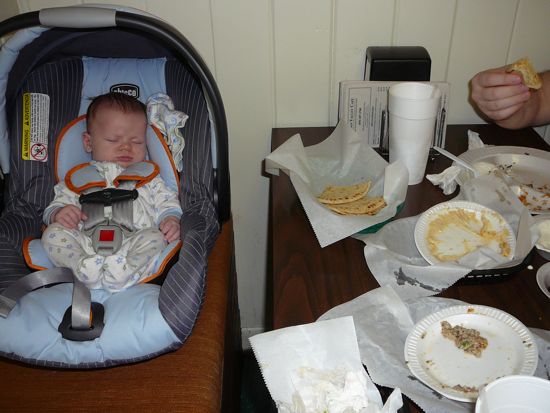
The accessory I like the best doesn’t come with the Rav4. I had to buy it separately. It is a Chicco car seat base, so that I can load and lock my little grandson in my car when we need to pick him up or take him somewhere. 🙂 We had our first trial run taking him to lunch at the Jordan Valley Restaurant in downtown Pensacola, where they had decent baba ghannoush and hummus, bland olives, and felafel – but it isn’t the Beirut. 😦
There are camels on the wall. There are some fabulous cushions. They have some gyros platters and I had a chicken shish taouk . . . it isn’t the Gulf, or – it isn’t the Arabian Gulf – but I am thankful there is one place in town that has felafel and tabbouli. 😉
The good news is, baby Q slept the whole time. 🙂

Easter Dinner
I can’t remember when I was last in the United States for Easter, but it was probably back when our son married . . . I remember a church service held at the hotel where we were staying, just down below our room, and I remember Easter Brunch, but barely – the wedding had been held the day before, and everything is a little blurry in my memory, it all happened so fast!
So this year was a lot of fun. We had a small family dinner, with all the traditional foods.

My son’s wife loves sweet potatoes; these are baked in balsamic vinegar and olive oil with a topping of pineapple:

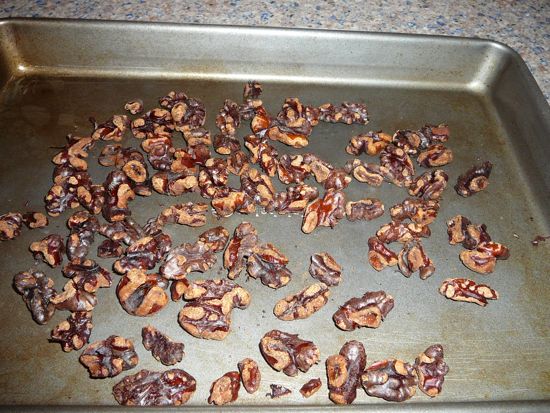
We all love a green salad with roasted walnuts:

Cole slaw, oil, vinegar, poppy seed, no mayonnaise:

Yummy green beans (my favorite):

And after dinner, we had the traditional clogged sink, and spent hours running to the only store open (Easter Sunday in the South, remember?), first for plungers, then later for a plumber’s snake. We tried Liquid Plumber – nothing worked. So I am waiting this morning for the plumber to come and do his magic so our water will run out of the sink again. 😦
If you think you hate cole slaw because of all that mayonnaise, try this dressing – we love it!
Poppy Seed Cole Slaw
1/2 cup sugar
1/3 cup vinegar
1 teaspoon salt
1 cup oil
1 Tablespoon poppy seed
1 teaspoon dry mustard
1/2 teaspoon onion juice
Bring all to a boil. Cool before using. Enough for one medium large head of cabbage, shredded thinly.
ReWire Chaos
It’s exactly like when I decide to clean and organize my quilt room; things look worse for a while, even when they are getting better.
My house now:



The good news is that they are finishing up early next week, and the ceiling / drywall man comes in to enclose all the new work. God willing, they will finish soon. 🙂
Pensacola Ramadan Lanterns
Have I mentioned how low my shopping resistence is? Oh? More than once? LLOOLLL . . . . it is a serious problem for expats coming back to settle. It is even a problem these days for expats coming back just for a few weeks! You see all the kinds of things available that you never see, or you see things you never buy at prices you cannot believe, and if you are returning, you return with a ton of chocolate chips (if you are me) and Hidden Valley Ranch Dressing Mix, Knox gelatine, colored sugar crystals, and . . . well, you get the idea.
At one time, we could take two big duffels, even in economy. At one time, when you checked in overweight bags, the people checking you in just looked the other way, most of the time. So we brought stuff back, books, computers, printers, whatever you could get in a duffel – and trust me, you can get a LOT in a duffel.
There was one thing, though, that I couldn’t resist in Doha, and in Kuwait, the Ramadan lanterns. I loved those lanterns, so beautiful, so exotic. I bought many, different styles, I loved them.
So imagine, I walk into the local Pensacola TJMaxx and what do I see? These are advertised as ‘garden’ lanterns, but many of them bear an amazing resemblance to ‘Ramadan’ lanterns:

Long Term Care for The Aged: Hidden In Plain Sight
One of the most amazing things that happened to me while I was living in Doha was a conversation I had with a group of Qatteri and Palestinian women. We were talking about our summer plans, and when it was my turn, I told them I was going back to the US to take care of my Dad while my Mom had a knee replacement. They all looked at me in stunned silence, and I wondered what I had said wrong.
“You do this?” one of them finally asked me, “You take care of your parents?”
“Yes, of course,” I replied, not understanding her puzzlement.
There was a burst of excited chatter I couldn’t follow, and then one of the younger women said to me “but we NEVER see this on TV.”
Things have probably changed by now, with all the cable stations available, with Lifetime and a broader spectrum, but what they think of as America is Dynasty and – well, think of what your favorite programs are, and then imagine an alien culture watching and trying to figure out your culture from what you watch. If you are living with the aliens, they way we portray our own culture on television and in movies is appalling!
Long story short, most adults want to stay independent as long as possible. They never want to be a burden on their sons and daughters and grandchildren. I am willing to bet that this is almost universal. For one thing, from the point of view of the aging, if you live with someone else, you know you will increase their work load, and if you go to a facility, you lose a lot of options to choose. Being able to have someone to come into your own house allows you to remain independent as long as possible. If you live with one of your children, you still get to have home-care, which relieves a lot of the burden on those with whom you are living.
Here is an AOL Health News article on a ‘hidden’ provision of the new health care act which will make it possible to keep our elders at home longer. Believe me, this is a very good thing, if you have ever dealt with a rehab facility, or a residence for the aged.
Health Care Reform Will Impact Long-Term Care
From AOL News: HealthCare
Robert W. Stock
Contributor
(March 26) — As health care reform became the law of the land this week, a huge bloc of Americans with a unique interest in the outcome sat watching on the sidelines.
The 49 million people who care for older family members were hidden in plain sight, as usual, quietly shouldering a burden that so often takes a heavy toll on their finances and their physical and emotional well-being. Many of them — I know a few — are opposed to the new health care law, even though it includes one of the most important steps ever taken to improve caregivers’ lot, especially those of the middle-class persuasion. Of course, hardly any of them are aware of that.
The Community Living Assistance Services and Supports Act, otherwise known as CLASS, provides for a national insurance program to help cover the cost of long-term care — something 70 percent of people over 65 will need at some point along the way. The premiums will be much lower than those for private plans, and you won’t get screened out because you’ve already had some health problems. Once vested after five years, enrollees unable to care for themselves will be able to claim cash benefits for as long as needed.
Joe Raedle, Getty Images
A health aide helps a patient at his home in Miami. The new health care reform law could “transform long-term care” and make it possible for more patients to stay at home, said the chief of the National Council on Aging.
If you’re rich, you don’t require much financial help with long-term care. If you’re poor and can no longer fend for yourself, Medicaid pays the bills, often at a nursing home. For the rest of us, long-term care — at home or in an institution — now requires that we, or our caregivers, choose from among some unpleasant options.
We can spend down our retirement savings until we’re eligible for Medicaid funds. We can protect our savings by taking out expensive long-term care insurance — it costs my wife and me more than $5,000 a year. Or, depending on how dependent we are, we can throw ourselves, or be thrown, on the mercy of our families.
My friend — I’ll call him Frank — was a retired lawyer and in great shape until four years ago. He had just turned 90 when emergency surgery laid him low for months on end. Then his sight and hearing began to go. “I’m one of the lucky ones,” his wife, Helen, told me. “His mind is fine. But he can’t get around on his own — he falls, even with a walker. He can’t make a cup of tea or shower by himself.”
For now, Helen can afford to hire an aide for a few hours a day to help with Frank and allow her to get out of the apartment. “James gives me a life,” she said. The future looks darker.
Surveys show that 90 percent of Americans want to age at home. Frank is no exception, but he never signed up for long-term care insurance. “If I couldn’t keep taking care of him, I don’t what I’d do,” Helen said. “If he went into assisted living, it would use up all our money. It’s very scary.”
CLASS, one of the legacies of the late Ted Kennedy, offers caregivers and care recipients another option. “If it’s successful, if a large enough number of people sign up, it will transform long-term care,” says James Firman, president and CEO of the National Council on Aging. “It will create a market-based economy for keeping aging people at home.”
That’s an important “if,” since the program, by law, must be self-sustaining. Premiums will generally be collected as part of workers’ payroll deductions unless they opt out. The younger the worker, the smaller the premium.
There is a vicious circle built into the current arrangements. Many caregivers must hold down a job and maintain their own separate family household while also watching over an aging parent. That kind of pressure can have consequences.
In recent studies, workers 18 to 39 years of age who were caring for an older relative had significantly higher rates of hypertension, depression and heart disease than non-caregivers of the same age. Overall, caregivers cost their companies an extra 8 percent a year in health care charges and many more unplanned days off.
In other words, the strains of family caregiving can hasten the caregiver’s need to be the recipient of care.
CLASS bids to crack if not break that vicious circle. Its benefits would make it much simpler and less expensive for families to make sure Mom gets the support she needs to be able to spend life’s endgame where she wants — in her own home. Good news for Mom, and good news for the future health of her caregivers.
In the last few days, I’ve conducted a poll of a dozen friends who have been closely following the health care reform debate. I wanted to find out how much they knew about CLASS.
Not one among them had even heard of it. It somehow seemed fitting that this major program, just like the caregivers themselves, was hidden in plain sight.
Before and Now
No, my house is not undergoing a ‘remodel.’ It is undergoing a rewiring. About the best that will happen is that when it is finished, it will look a lot like it looked before, except with invisible copper wiring instead of aluminum wiring, which, as it turns out, is problematic.
Sigh. And then again, what better time to have this all done than BEFORE you move in? If it had to happen, it couldn’t have happened at a better time, and we have some truly great contractors. How many times have you ever heard someone say that?
Today I went by the house to pick up the mail and holy smokes – the garage is full of ceiling, and my house is bare bones!
Here are some before and after shots:
Family Room Before:

Family Room Now:

Kitchen Before:

Kitchen Now:

Living Room Before:

Living Room Now:

And last but not least – the Garage before:

And the Garage now:

“Health Care Could be Fixed Overnight . . .”
Today, AOL ran commentaries on American health care and whether the new proposals will make a difference. The comment of one CEO who runs an enormous health provider, caught my eye. As I read it, I thought “he is talking about the USA, but the exact same thoughts apply to Qatar, to Kuwait, to Germany, where an epidemic of self-inflicted health problems is growing wildly.” And it also occurs to me that he is laying the accountability squarely where it belongs – on our shoulders.
David Feinberg, M.D., M.BA.
CEO, UCLA Hospital System
“The debate they’re having now in Washington is the wrong discussion,” says Feinberg. “They’re not talking about health-care reform. They’re talking about health insurance reform. The bill in Congress has nothing to do with health care.” He explains that health care could be fixed overnight if people would stop using alcohol and drugs, eat right and exercise.
“I have 800 patients in this hospital today, and I bet 50 percent of them have illnesses that could have been completely prevented,” Feinberg says. “That situation is not going to get better with a ‘public option.'”
He points out that even people without health insurance can receive care when they need it in the emergency room, and, while it’s not ideal, they’re not being denied care because they don’t have health insurance. “It’s impossible to give high quality, low cost care to everyone. What we need is to decrease demand for health care.”
According to Feinberg, some 75 percent of illnesses are treated at home, whether that’s a bad cold or a sprained ankle, and he says that health-care reform should be focused on home care. “When you compare us to other countries with similar Gross Domestic Products, they spend half what we do on health care because they have a different lifestyle,” he says. “We either need to change our lifestyle, or it’s going to be very expensive.”
“With all due respect,” he adds, “the surgeon general is obese. I don’t think the President of the United States should be solving this.” Rather, he says, each individual needs to come to terms with the fact that eating right, exercising, and avoiding smoking and alcohol will transform not only their own lives but the ever increasing cost of health care in this country.
You can read all the commentaries on AOL Health News. I know most of us in my age group need more exercise (not you, Big Diamond!) and are beginning to stave off the common age-related problems of high cholesterol, high blood pressure, obesity, diabetes, aches and pains, etc. We all KNOW we could be eating better and exercising more. We are smart educated people – but do we do what we know is best for ourselves? NNoooooooooooo!
I see the same epidemic striking in Germany, in Qatar and in Kuwait, people who have enough to eat are eating too much. Yes. Yes. I’m guilty. And I exercise a lot less than I need to. I was so happy to get back into a house, with stairs, so at least I would get the exercise of going up and down stairs a few times a day.
Japan has instituted a national policy of health, measuring citizens waists and penalizing them for carrying too much weight. I will be interested to see how it works out, if it pays off in health benefits and lowered costs down the road. It’s an inspired mandate.
Recent Comments
intlxpatr on Shampoo Ginger tigerbutterya0c5ff1d… on Shampoo Ginger intlxpatr on British Soldier Kidnapped, Esc… John on British Soldier Kidnapped, Esc… intlxpatr on British Soldier Kidnapped, Esc… Wikipedia Donate Button

Amazina


Early Voting in Florida


