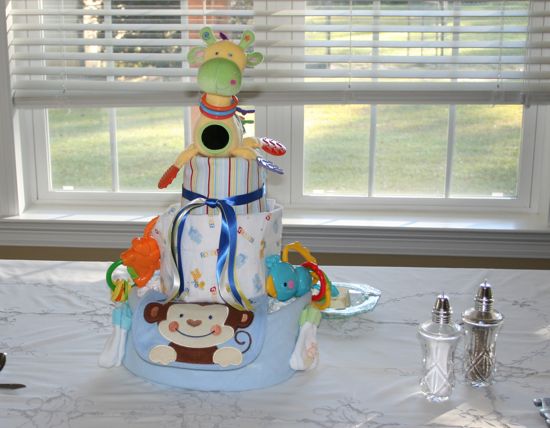
Baby Shower Diaper Cake
I wasn’t there. AdventureMan and I would have loved to be there, but it wasn’t possible. We spent Thanksgiving apart from our son and his wife. We also missed the BABY SHOWER! Her sweet aunts arranged a wonderful shower for them, and sent me a photo of the “diaper cake.” I don’t think this is a real cake . . . but I am not sure entirely what it is. I know only that it is adorable!
Pink Glove Dance
I love this, the whole idea, I love it so much it made me cry to watch it. I’m shy about dancing, but these people – they were dancing for a cause. They didn’t care about making fools of themselves, they just let go and had a good time promoting breast cancer prevention awareness. You gotta love it:
When the video gets 1 million hits, Medline will be making a huge contribution to the hospital, as well as offering free mammograms for the community.
How Good Normal Can Be
Oh no! Just when I need to be at my best, when I need to sparkle, I am struck low by a chest cold – the kind with a wracking tubercular cough accompanied by dizziness and sheer exhaustion. We have house guests, we have Thanksgiving – and I can barely drag myself out of bed. I am not myself! And I am so sick I don’t care!
Thanks be to God, AdventureMan to the rescue. He has taken time off to spend with our houseguests, and he takes over, allowing me to sleep the day away. I am up just in time to dress and head off to dinner, carrying dishes I had prepared days before, thank God. I try to keep a distance between me and anyone I might infect, and I leave early, heading back to bed.
Today I am a new woman. Not well, still coughing a little, but I know how good it feels not to feel rotten. I have some energy. My head is clear. Today, I am truly thankful.
Doha Sunset
When I lived in Kuwait, every day I was thrilled by the sun coming up over the horizon. I never got tired of it.
Today, thanks be to God, I was out when the sun started getting low in the sky, and the colors have added dimensions – what a treat.
Some views of Doha at sunset:


Failproof Easy Pecan Pie From Quail Country
A long long time ago, in a country far away, we lived in one village and our friend lived in another, but we often visited back and forth. One day she called and said they were coming into town with her parents, and I said “oh, we won’t be here those dates, but I will leave the key with my friends down the street and you can stay here.”
Months later, a mysterious package arrived in the mail, from my friend’s parents, with a lovely, gracious note of thanks for letting us stay in our house, and one of the world’s greatest cookbooks, Quail Country, by the Junior League of Albany, Georgia. (Quail Country, Smith House Publications, 516 Flint Avenue, Albany, GA 31701)
One of my all time best recipes, Soused Apple Cake is from there.
Today, I am making pecan pies for Thanksgiving and giving thanks for the never fail Pecan Pie recipe, which I have printed before, but will print again because it is such a life saver.
Pecan Pie
3 eggs
1/2 cup sugar
1 cup light corn syrup
1/2 teaspoon salt
1 teaspoon vanilla extract
1/4 cup butter, melted
1 cup coarsely chopped pecans
1 9-inch deep dish pastryt shell, unbaked
Beat eggs slightly; add sugar, corn syrup, salt and vanilla. Blend well, but do not overbeat; add butter. Stir in pecans. Pour into pastry shell. Bake in preheated 350 F (180 C) oven about 50 minutes, or until a knife inserted in the center comes out clean. Six servings.
I actually cheat on pie crust. I use a Graham Cracker Crust, made with what are called digestive biscuits here in Qatar and in Kuwait. So a small package of digestive biscuits, crushed, add a little cinnamon and about 1/3 cup melted butter. Mix, and press into pie pan. Nothing could be easier. 🙂
And as I am making the pies, I also give thanks that our son found a wonderful woman to marry, and that his wife’s aunt has sent me some of the world’s best Texas pecans, which I hand carried when I moved from Kuwait to Qatar because I was NEVER going to leave them behind!
Cats Purr Purr-posefully
This study cracks me up. When a cat is catting around you in the morning, it is usually because they are hungry, and they want you to feed them. If you get up and feed them, you have just encouraged them to bother you. YOU train the cat to bother you! The Qatteri Cat knows I won’t get up and feed him until I am ready. With me, he will purr, but he settles down and waits for me to get up – and feed him. LOL, I guess he has me trained, too.
From today’s BBC News:
Cat owners may have suspected as much, but it seems our feline friends have found a way to manipulate us humans.
Researchers at the University of Sussex have discovered that cats use a “soliciting purr” to overpower their owners and garner attention and food.
Unlike regular purring, this sound incorporates a “cry”, with a similar frequency to a human baby’s.
The team said cats have “tapped into” a human bias – producing a sound that humans find very difficult to ignore.
Dr Karen McComb, the lead author of the study that was published in the journal Current Biology, said the research was inspired by her own cat, Pepo.
“He would wake me up in the morning with this insistent purr that was really rather annoying,” Dr McComb told BBC News.
“After a little bit of investigation, I discovered that there are other cat owners who are similarly bombarded early in the morning.”
While miaowing might get a cat expelled from the bedroom, Dr McComb said that this pestering purr often convinced beleaguered pet lovers to get up and fill their cat’s bowl.
To find out why, her team had to train cat owners to make recordings of their own cats’ vocal tactics – recording both their “soliciting purrs” and regular, “non-soliciting” purrs.
“When we played the recordings to human volunteers, even those people with no experience of cats found the soliciting purrs more urgent and less pleasant,” said Dr McComb.
How annoying?
She and her team also asked the volunteers to rate the different purrs – giving them a score based on how urgent and pleasant they perceived them to be.
“We could then relate the scores back to the specific purrs,” explained Dr McComb. “The key thing (that made the purrs more unpleasant and difficult to ignore) was the relative level of this embedded high-frequency sound.”
“When an animal vocalises, the vocal folds (or cords) held across the stream of air snap shut at a particular frequency,” explained Dr McComb. The perceived pitch of that sound depends on the size, length and tension of the vocal folds.
“But cats are able to produce a low frequency purr by activating the muscles of their vocal folds – stimulating them to vibrate,” explained Dr McComb.
Since each of these sounds is produced by a different mechanism, cats are able to embed a high-pitched cry in an otherwise relaxing purr.
“How urgent and unpleasant the purr is seems to depend on how much energy the cat puts into producing that cry,” said Dr McComb.
Previous studies have found similarities between a domestic cat’s cry and the cry of a human baby – a sound that humans are highly sensitive to.
Dr McComb said that the cry occurs at a low level in cats’ normal purring. “But we think that (they) learn to dramatically exaggerate it when it proves effective in generating a response from humans.”
She added that the trait seemed to most often develop in cats that have a one-on-one relationship with their owners.
“Obviously we don’t know what’s going on inside their minds,” said Dr McComb. “But they learn how to do this, and then they do it quite deliberately.”
So how does Dr McComb feel about Pepo now she knows he has been manipulating her all these years?
“He’s been the inspiration for this whole study, so I’ll forgive him – credit where credit’s due.”
FYI: How Long is a Generation?
So I get on a track and I can’t get off, like a little hamster running on the wheel. I got to thinking about generations, and how long ago is 10 generations and so I had to ask Google the question: How long is a generation? Don’t you love Google? They always have an answer.
Now I know something new. Now I will share it with you. This comes from Ancestry.com
Research Cornerstones: How Long Is a Generation? Science Provides an Answer
How Long Is a Generation?
By Donn Devine, CG, CGI
We often reckon the passage of time by generations, but just how long is a generation?
As a matter of common knowledge, we know that a generation averages about 25 years—from the birth of a parent to the birth of a child—although it varies case by case. We also generally accept that the length of a generation was closer to 20 years in earlier times when humans mated younger and life expectancies were shorter.
In genealogy, the length of a generation is used principally as a check on the credibility of evidence—too long a span between parent and child, especially in a maternal line, has been reason to go back and take a more careful look at whether the evidence found reflects reality or whether a generation has been omitted or data for two different individuals has been attributed to the same person. For that purpose, the 20- and 25-year averages have worked quite acceptably; birth dates too far out of line with the average are properly suspect.
But now, researchers are finding that facts differ from what we’ve always assumed—generations may actually be longer than estimates previously indicated.
Several recent studies show that male-line generations, from father to son, are longer on average than female-line generations, from mother to daughter. They show, too, that both are longer than the 25-year interval that conventional wisdom has assigned a generation. The male generation is at least a third longer; the female generation is about one-sixth longer.
As early as 1973, archaeologist Kenneth Weiss questioned the accepted 20- and 25-year generational intervals, finding from an analysis of prehistoric burial sites that 27 years was a more appropriate interval but recognizing that his conclusion could have been affected if community members who died away from the village were buried elsewhere.
Why Age Matters
In a more-recent study regarding generation length, sociologist Nancy Howell calculated average generational intervals among present-day members of the !Kung, contemporary hunter-gatherer people of Botswana and Namibia whose lifestyle is relatively similar to that of our pre-agricultural ancestors. The average age of mothers at the birth of their first child was 20 years and at the last birth 31, giving a mean of 25.5 years per female generation—considerably above the 20 years often attributed to primitive cultures. Fathers were six to 13 years older than mothers, giving a male generational interval of 31 to 38 years.
A separate study, conducted by population geneticists Marc Tremblay and Hélène Vézina, was based on 100 ascending Quebec genealogies. Researchers found a generational interval, based on the years between parents’ and children’s marriages, to average 31.7 years, and they determined that male generations averaged 35.0 years while female generations averaged 28.7 years.
Biological anthropologist Agnar Helgason and colleagues used the Icelandic deCODE genetics database to arrive at a female line interval of 28.12 years for the most recent generations and 28.72 years for the whole lineage length. Male line lineages showed a similar difference—31.13 years for the recent generations and 31.93 years overall. For a more mathematically appealing average, Helagason and fellow researchers recommended estimating female generational line intervals at 30 years and male generational intervals at 35 years, based on the Quebec and Iceland studies.
Calculating Ideas
What does this mean to the genealogist? When assigning dates to anthropologically common ancestors 50 or more generations in the past, using the “accepted” 20 or 25 years as a conversion factor can produce substantial underestimates of the time interval.
For my own purposes, however, given the imprecision of the various results and my own need for an estimate that lends itself to easy calculation, I decided that three generations per century (33 years each) for male lines and 3.5 generations per century (29 years each) for female lines, might work better when I needed to convert generations into years.
To check the accuracy of my values, I decided to compare the generational intervals from all-male or all-female ranges in my own family lines for the years 1700 to 2000. I was pleasantly surprised to see how closely the intervals agreed with the estimates I was using. For a total of 21 male-line generations among five lines, the average interval was close to 34 years per generation. For 19 female-line generations from four lines, the average was an exact 29 years per generation.
In genealogy, conclusions about relationships are subject to change whenever better evidence is discovered. Similarly, it’s the nature of the physical and biological sciences that current understandings are subject to change as more data becomes available and that data’s interpretation becomes more certain. So, for now, when genealogists want to convert generations to years and create probable date ranges, using an evidence-based generational interval—like Helagason’s 30 and 35 years or one that you’ve developed based on your own family history research—may be the best solution.
Donn Devine, CGSM, CGISM, a genealogical consultant from Wilmington, Delaware, is an attorney for the city and archivist of the Catholic Diocese of Wilmington. He is a former National Genealogical Society board member, currently chairs its Standards Committee, is a trustee of the Board for Certification of Genealogists, and is the administrator for Devine and Baldwin DNA surname projects.
Only Ten Generations
We were talking about marriage prospects, and I mentioned one young man.
She hesitated, then told me “we don’t marry with this family.”
“Why not?” I asked her. “He’s handsome, and kind, and I am told that they are the richest family in Qatar.”
“They are Iranian,” she said shortly.
“Iranian?” I asked. “They are Qatteri! They have been here more than ten generations!”
She grinned at me.
“It’s not enough,” she said. “They are still Iranian.”
Mom’s Fruit Cake in Qatar
Life has gotten busy, and somehow November is here and I haven’t made my fruitcakes. I need to fix that! For those of you who think fruitcakes are a joke – my Mom’s fruitcake has a secret ingredient – chocolate. Even people who don’t like fruitcake love this fruitcake.
I am in Qatar – I have brandy. I have rum. No, I don’t drink hard liquor, but oh, they do make my fruitcakes tastier. Today, I will soak the raisins in brandy overnight, so they will be ready to go tomorrow!
I am reprinting this recipe for those of you who would like to give fruitcake a try.
Mom’s Fruit Cake
This is the original recipe. I remember cutting the dates and prunes with scissors when I was little; now you can buy dates and prunes without pits and chop them in the food processor – a piece of cake!
1 cup boiling water
1 cup sugar
1/2 cup lard or butter
1 T. cinnamon
1 t. cloves
3 Tablespoons chocolate powder
1/4 cup jelly
1 cup seeded raisins
1 cup chopped walnuts
1/2 cup candied citron
1/2 cup cut prunes
1/2 cup cut dates
Put all in a pan on stove and bring to a boil. Boil for three minutes. Let cool. Add:
2 cups flour
1 teaspoon baking soda
Flavor with lemon
Bake at 350° in loaf pans for one hour. Makes 2 normal bread loaf sized cakes.
My variations: I put in about three times the fruit, the difference primarily in the candied citron – I prefer using whole candied cherries, because they are so pretty when the loafs are cut. This recipe doubles, or quadruples with no problems.
Pans: Mom used to line all the pans with brown paper and grease the paper. I grease the pans, then dust with more of the chocolate powder. Use a good quality chocolate, not cocoa. When the cakes come out of the oven, let them cool for ten minutes, loosen them with a knife, then they will shake out easily. Let continue to cool until they are totally cool, then wrap in plastic wrap, with several layers, then foil, then seal in a sealable plastic bag. Let them age a couple months in a corner of your refrigerator. I make mine around Halloween, and serve the first one at Thanksgiving.
I never make these the same any two years in a row.
You know how raisins get all dried out and taste yucky in fruitcakes? The night before you intend to make the fruitcakes, take all the raisins you intend to use (depending on how many fruitcakes you intend to make) and put them in a glass container. Pour brandy over them, to cover. Microwave just to the boiling point. Let stand in the microwave overnight.
The next day, you can drain that brandy and use it in a stew or something, and in the meanwhile, you now have plump, juicy raisins to use in your fruitcake, and just a hint of brandy flavor. Yummmm!
Curvy Women Smarter?
Not everyone agrees with the conclusions found by a recent US study discussed on BCC News Health but for those of us who are curve endowed, it gives some hope . . . 🙂
Curvy women may be a clever bet
Women with curvy figures are likely to be brighter than waif-like counterparts and may well produce more intelligent offspring, a US study suggests.
Researchers studied 16,000 women and girls and found the more voluptuous performed better on cognitive tests – as did their children.
The bigger the difference between a woman’s waist and hips the better.
Researchers writing in Evolution and Human Behaviour speculated this was to do with fatty acids found on the hips.
In this area, the fat is likely to be the much touted Omega-3, which could improve the woman’s own mental abilities as well as those of her child during pregnancy.
Men respond to the double enticement of both an intelligent partner and an intelligent child, the researchers at the Universities of Pittsburgh and California said.
The findings appear to be borne out in the educational attainments of at least one of the UK’s most famous curvaceous women, Nigella Lawson, who graduated from Oxford.
But experts are not convinced by the findings.
“On the fatty deposits being related to intelligence front, it’s very hard to detangle that from other factors, such as social class, for instance, or diet,” said Martin Tovee of Newcastle University.
“And much as we logically like the idea that men are interested in the waist to hip ratio, it actually features relatively low down the list of feature males look for in a potential partner.”
Recent Comments
intlxpatr on Shampoo Ginger tigerbutterya0c5ff1d… on Shampoo Ginger intlxpatr on British Soldier Kidnapped, Esc… John on British Soldier Kidnapped, Esc… intlxpatr on British Soldier Kidnapped, Esc… Wikipedia Donate Button

Amazina


Early Voting in Florida


