Let’s Go Fly a Kite
There is so much to do!
There is a long walking promenade along the beach, wide enough for bicycles, moms with strollers, people skating, people walking their dogs, and people just walking or jogging.
On the beach, people are swimming, sunning, building magnificent sand castles, fishing, and . . . flying kites.

Some of the kites are purely magnificent. Here is my favorite – a pirate ship!

Oregon Beach Rental
The Oregon coast is a beach lover’s delight. My mother’s family had cabins on the beach that they rented out every summer, so my Mom grew up on the Oregon beaches, and consequently, we did, too. The cabins, which were always beachy and utilitarian, have become increasingly sophisticated.
We have rented both sides of a wonderful cottage. Our side of the cottage easily sleeps 14 people (we are four people) and the other side of the cottage easily sleeps 10 – 12. They have huge dining tables, cupboards full of glasses, dishes, serving platters, dishwashing AND dishwasher detergents – they are fully equipped with stoves, microwaves, coffee makers, washers and dryers, even hair dryers, even shampoos and conditioners, even beach towels and beach equipment and bike helmets. I am astonished at how equipped they are.
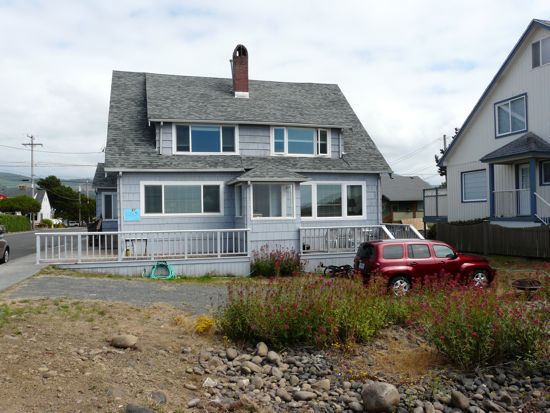
This is called the Little House, and if you want to rent it, you can find it here:
Little House on the Promenade
The cottage has two beautifully furnished living rooms (with additional sleeping on fold out couches if you have a very large family), chairs, TVs, fireplaces, games, books, magazines . . . and it is completely wired for wi-fi. Wooo Hoooo for me!

Although it can be two separate rentals, when it is one family renting both sides, there is a secret passage connecting the two rentals, so we are back and forth in one another’s kitchens all day. Oh, what fun.
Oregon Sunset
This is not your Kuwait sunrise – we are on the way far west coast, and what we get here, when we are on the water, is spectacular sunsets. I thought of you when I saw this sunset last night – and the sun set around 8:45 at night! I didn’t have the energy to share it with you last night, but I will share it with you now.

And just moments later, day is done:

Combination of Events
Yesterday I visited our house. We have been seriously blessed with good renters, people who are good hearted, and take care of the house. We have a good property manager; when something needs to be done – a new roof, a new furnace, a new fence – he has people who can handle the job, and the job gets done well.
The house still has it’s original refrigerator from when it was built. I think it needs a new one – before an emergency happens and our renters lose their food. I measure, take stock of how the house is doing, and then . . . I have to go buy a refrigerator.
For me, this is stressful. A refrigerator is something that is supposed to last for a while. I go to Consumer Reports and I read about all the refrigerators. Here is what is interesting – the top rated model, in terms of keeping things cold or frozen, in terms of energy use, etc. has thirteen consumer reviews, and most of them are negative! Most needed repairs, and most of the repairs had to do with the ice maker and the cold water on the door thingie (to use the technical term)
So I visited three stores, looked at refrigerators. At two of the stores, you had three choices – white, stainless steel or black. I am not a black-appliance person, I am not a person who wants black in my kitchen. Neither, I discovered, am I a white-appliance person. And the stainless steel just makes me tired; it is a fad that is already passing. So what to do?

I went to the third store and there is more choice. I find the top rated model, which is on sale, and then ask the salesman if he has the same model WITHOUT the cold water and ice dispenser on the door, and he does! And it is on sale! And WITHOUT the fancy extras – it is exactly the same price as the ones WITH the fancy extras!
How funny is that?
I went ahead and ordered the one without all the water dispensers. It does have an ice cube maker, that is fine with me. Then, it took me longer to pay for it and arrange for delivery than it took me to research and decide which model to buy.
The salesman was very good, he knew his stuff. This wasn’t his fault. The problem is that I am an anomaly. My billing address is not the same as the address to which the refrigerator will be delivered. I have several different phone numbers, one of which is only active when I am in the USA, one of which rings in Kuwait, and I don’t want people calling in the middle of the night, oh, what to do?
I don’t exactly know what time is a good time for delivery for the renter; that is always handled by the property manager. I don’t have his phone number with me. GROAN!
When I finally get back to my Mother’s place, I am exhausted. A soft rain starts falling around 4 pm and from then on, I keep falling asleep. I am probably still jet lagging, yes, I know, it’s been a week but my body still has a time zone all its own.
I know it is too early to go to sleep so I make myself stay awake, I try to read, but at 9 pm, I totally give up. It’s the exhaustion, and it is the soothing sound of the steadily falling light rain. I keep my window open; I love the fresh air, and I love to hear the birds, and oh, the sound of rain! This morning, yes, 4 a.m. and I am wide awake. It is a GORGEOUS, sunny day, the clouds and rain have gone, and I had better start packing for the next leg of this journey while I have all this energy.
Off the Banned Driver List
When I got to the car rental counter, the polite man behind the counter typed in all the information and then blanched.
“Ummm, ” he started off, very embarrassed, “there is a problem . . . . ”
I knew, I just knew what was coming. I had even sent the car rental agency an e-mail asking them to check to make sure everything was straight.
“You’re on our banned driver list.” he finished up.
If it hadn’t happened before – TWICE – I would have been a lot more embarrassed. Now, I am just annoyed.
When I came in here last time, I didn’t know my license had expired. Fortunately, I have another driver’s license, so they let me use that one – it is the license that is banned, not the driver (yeh, go figure). The very next day, I was the first one in line at the driver’s license place and renewed my license in less than five minutes. It’s easy. I just explain that I live in Kuwait and don’t always have access to registration facilities! They understand.
But when I got to California and went to rent again – same problem. Again, they let me drive on my other license.
So third time is the charm. Once again, they give me a car based on the second license (I mean, isn’t that funny in itself; you have this BANNED person and you give her a car because she can show you another license???)
The counter guy gave me a sheet of paper with an intimidating list of the possible reasons I was banned, including expired license, but also things like fleeing the scene of an accident, or felony warrants and things like that. (If you could see me, you would know how dyingly funny this is.) Before I even took the car, I called their security people. It took a total of 30 seconds. I told them I renewed the license, they checked, found out I was not lying and BINGO! I am no longer a BANNED person.
I knew what the problem was, but being BANNED made me feel terrible. It was so unfair. It made me think about labels, and how even though they are just words, words can make you feel really really BAD. I truly hated being a BANNED person.
Qatteri Cat Takes a Bath
“The Qatteri Cat really needs a bath,” I say to my friend as we sip coffee in her living room, “He’s gotten all matted in the heat. The truth is, I’m afraid to bathe him. He has calmed down so much since we got him, but when he gets scared, his primitive brain takes over and he has scratched and bitten me.”
I am thinking particularly of when we first got him. He was scared of me, he didn’t much like women at all. He adored AdventureMan (still does) and slowly, slowly warmed up to me.
He had a house outside, called a “cat containment center.” Go ahead. Laugh. All our friends did, too, but it gave us peace of mind. Qatteri Cat could be outside in the garden, and we knew he was safe. People put out poisoned fish in our neighborhood, to kill stray cats, and we didn’t want that heartbreak.
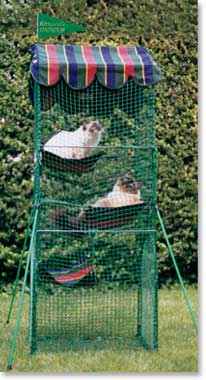
(This is called the cat penthouse, and it is created by Kittywalk. They have all kinds of things for pets, including, I am not kidding, pet strollers, in case you want to take your cat for a walk, but they don’t walk, they ride. I cannot imagine using one of these pet strollers in Kuwait. . . . or anywhere.)
So Qatteri Cat is out in his cathouse, and I hear an snarling, howling YOWWWWWLLLLL. His friend, Satchmo, from up the street has wandered over to say hello and Qatteri Cat is totally out of control. He is mad, he is running and throwing himself against the walls of the kitty penthouse, and Satchmo – all he wants is to be friends!
I get the trusty squirt bottle and shoo Satchmo away. I talk calmly to Qatteri Cat, calmly, calmly, and I open the door. He tries to rush out and I get him by the scruff of the neck, you know, how they tell you so the cat will go immobile? He can’t scratch and bite if you have him by the scruff, right?
Wrong. Wrong. So very very very wrong.
I still have scars. I got him inside, and gave him a 30 minute time out in the bathroom to calm himself down. When I did that, he totally forgot what had happened and would be fine. Actually, most of the time 5 minutes was enough, but I figured with all that adrenelin going through his system, 30 might be safer.
Fast forward. Bath time.
My sweet friend really knows animals.
“Don’t try it alone, Intlxpatr. That isn’t a job for one person. Get AdventureMan to help you, tell him to hold him by the scruff of the neck! Like his mother. He needs to know you are in control.”
So yesterday, I talked AdventureMan through what we needed to do. I will get everything prepared, and then one of us has to hold the Qatteri Cat and one of us has to soap him, massage him and rinse all the soap out.
AdventureMan chose to hold the cat. I was greatly relieved.
We got him into the bidet (first mistake, QC is a BIG cat) with a towel in the bottom, and when I started pouring the water, QC started howling. We are not talking your everyday miow here, we are talking, as AdventureMan put it, the sound of a cat having surgery without anaesthesia. I was so afraid our neighbors were going to report us for pet torture – because that is what he was howling.
Not only that, but it’s one thing to try to hold a terrified cat by the scruff of the neck (bad enough!) and another thing totally to try to control a terrified, wet, soapy cat. I was scrubbing, pouring, QC was howling, AdventureMan is saying “Hurry up! hurry up! I can’t hold him much longer” and there is water water everywhere. We have the bathroom door closed, so when QC gets out of AdventureMan’s grasp, we quickly capture him again. We are all soaking wet, QC is still soapy, and AM and I are panting and laughing and we need to get this job DONE.
We transfer him to the bathtub and finish the rinsing, and wrap him in a towel. At no time does he stop his shrieking, not until we let go. He is still very very wet, but he won’t let us – or a towel – anywhere near him. Finally, I put a towel in a sunny spot and leave, and when I have been gone a significant amount of time, QC seeks the nice warm towel in a nice warm spot.
I check on him every ten minutes or so. He doesn’t want to see me. Finally, maybe an hour later, he comes in and stretches out on my legs. All is forgiven, if not forgotten.
But here is the really cool thing. As terrified as he was, he didn’t scratch and he didn’t bite. Maybe he might have, if AdventureMan had not held him firmly, but we have held him firmly before and gotten terribly scratched and bitten. I think, as bad as it was. Qatteri Cat trusts us enough to suspect we were not trying to kill him. And his coat is a lot nicer, now, except the holes show where I have been cutting out the lumps.
Qatteri Cat Catches Up
Ha ha ha ha ha, Qatteri Cat! Take that! I’ll show you what it is like being awakened from a nice snooze! I’ll take your photo!
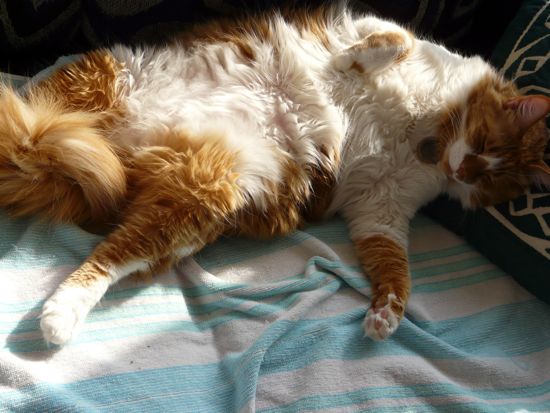
After racing around all night, rearranging the carpets and playing in places he should not have been playing, the Qatteri Cat is ready for a nap – and I am getting revenge for his nighttime capers! Actually, his fur is getting all matted, and while he is napping, I often take the scissors and cut out the badly matted hunks, and try to comb him so he won’t get so matted.
One of these days, I really want to give him a bath. He has come a long way in the four years he has lived with us. He is a gentle cat, a sweet cat, a snuggly cat. Underneath all that veneer of civilization, however, is still the WILD cat. All it takes is for him to be scared, tired, hungry or mistreated and all the wildness comes back to the surface. I know I can’t attempt to give him a bath on my own – I need to have AdventureMan with me to help handle him. In all these years, I have never given him a bath – I am a little afraid of him!
Animal Welfare League Seeks Your Help
From a public service ad in today’s Kuwait Times:
Summer is upon us and with this time of year comes the seasonal abandonment of dogs and cats all over Kuwait. As we rush to bring these animals to safety, we need your help in doing so. In addition to having many wonderful dogs and cats up for adoption, we are always in need of shelter volunteers, foster homes, and donations from our wish list:
Wish list:
Clorox
Canned Dog and Cat food
Dog and Cat toys
Tide
String Cheese
Peanut Butter
Frozen Chicken
Large Capacity Garbage Bags
Extra Large capacity Washer / Dryer
Animal Friends League of Kuwait
“Saving One Animal at a Time”
TEL: 700-1622
Email: info@animalfriendskuwait.org
Website: http://www.animalfriendskuwait.org
Ministry Cracking Down on Porn Sites
A little over a year ago, May 18th, 2007, I remarked on an article in the Kuwait Times called MOC Bans Porno Film Sites. I had no idea that even over a year later, that blog entry would continue getting countless hits.
In this morning’s Kuwait Times, it’s like they say – deja vu all over again.
KUWAIT: Communications Minister Abdulhahman Al-Ghunaim has ordered the establishment of a committee to improve Internet services by finding ways to stop the spread of pornographic websites, which contradict local cultural and religious values.
The committee will reportedly be headed by Engineeer Ali Al-Zibin, the ministry’s Assistant Undersecretary of Information Technology, and will include representatives from the Interior, Awqaf, and Information Ministries, as well as Kuwait University.
A Communications Ministry official said that the committee will coordinate with and supervise the country’s Internet service providers in order to formulate a strategy to limit this phenomenon, by strengthening their supervisory role in this field.
It will also work continually updating the country’s systems to ensure that they are on a par with the latest technological developments to put an end to the spread of pornographic sites, in addition to establishing a map for joint coordination between all ministries.
You can live in a country a long time and barely scratch the surface. I honestly try to figure out what is going on, and even so, I get surprised often. I feel so encouraged when I see people tackling a problem, but then, so often, it turns out to be just meeting, just talking – no fixing.
As I have said before – I hate pornography. It isn’t part of my country’s values, either. It is certainly counter to my values. And yet, when I think of spending a country’s resources on trying to fight pornography, which we have had with us since probably the earliest times, I just feel tired. I don’t think you can win a fight against pornography. I think, to eliminate pornography, prostitution, alcohol and drug abuse – you have to change the way people think. Haven’t you noticed? You restrict something, it only makes it more attractive. Look at the countries that brutalize people arrested for possession of pornography – Saudi Arabia and Iran – have they been successful in eliminating access to pornography – on the net, or elsewhere? Where there is a demand, there will be suppliers, or that is how it seems to me. How do we eliminate the demand?
Who accesses and downloads porn the most, do you think? My bet would be on the 15 – 35 year old male, the most technologically savvy group in any population. How long do you think it will take them to break through any barriers you can place? And how many nanoseconds before they spread the “fix” all over the internet?
There is another article today, one on the air conditioning breakdown at Ibn Sina hospital, patients keeling over from the heat and humidity and then sewer-dwelling insects swarming into the children’s ward. How disgusting is that?
Attack the problems you can solve. Put people first. Fix the infrastructure – the roads, the hospitals, government services, licensing, visas. Make Kuwait state-of-the-art in communication accessibility. Kuwait is RICH, Kuwait can do anything. I hate pornography, but I don’t think any nation has the capacity to stop it.
Strange Practices
This is from the Kuwait Crime section of the Arab Times:
And in an unrelated development, Interior Minister Sheikh Jaber Al-Khaled Al-Sabah should look into the alleged immoral practices on Kuwaiti islands, National Assembly Comptroller Dr Mohammed Al-Huwailah told Alam Al-Yawm. Urging the minister to take stringent measures to curb ‘immorality’ in these islands, Al-Huwailah wondered how could some people engage in strange practices under the supposedly watchful eyes of security authorities, particularly the Coast Guard. Asserting he will closely follow up the issue, Al-Huwailah warned the minister’s lenient attitude on the issue will lead to the destruction of Arab and Islamic values. He called for the strict implementation of the law to protect the Kuwaiti society.
I am guessing these strange practices are alien practices? What kind of practices are taking place on Kuwait’s islands?
Recent Comments
intlxpatr on Shampoo Ginger tigerbutterya0c5ff1d… on Shampoo Ginger intlxpatr on British Soldier Kidnapped, Esc… John on British Soldier Kidnapped, Esc… intlxpatr on British Soldier Kidnapped, Esc… Wikipedia Donate Button

Amazina


Early Voting in Florida


 Here There and Everywhere