Jesmyn Ward and Salvage the Bones

You are fifteen, poor, black, and motherless as this book opens. Dad drinks, and isn’t around much. You are the only girl in a family of brothers. Having sex is no big deal, and there is one guy you really like, Manny.
Your oldest brother’s pit bull is having puppies, and you are having trouble with throwing up most of what you eat, especially every morning. Dad says a hurricane is coming, but he’s said that before, no big deal.
As this book opens, it has the feel of a myth of the nightmare kind. We know, because we have the benefit of hindsight, that the impending storm, Katrina, will be catastrophic. The Batiste family has already suffered a catastrophic storm with the death of their Mama, just after the birth of her last child. Throughout the book, we watch these children suffer the daily absence of their mother, raising one another, squabbling, but tenderly looking after one another.
If someone had told me about this book, I don’t think I would have wanted to read it. Amazon.com kept telling me I needed to read it, so finally, I did. From the opening page, I was in a world utterly alien from my own, and yet a world I could understand and inhabit. There are worse things than being poor, and one of them is heartless. This family has heart; they are loyal to one another, they look after one another and they sacrifice for one another. For all the violence – and there is a lot of violence – there is also beauty.
There is the familial love, and there is the love between Skeet, the oldest brother, and his dog, China. There is friendship, and good people who give you refuge in the aftermath of the storm. There is the stunning numbness of surviving the worst hurricane ever.
Jesmyn West has a deft touch, with the language, with the interweaving of the Medea myth, with non-verbal communication, with the complexities of families and love. This is a book worth reading.
The Tourist; Olen Steinhauer

Haven’t I read this book before? Or didn’t I see a movie, The American, with George Clooney? You know, depressed assassin? Thinking about suicide? In some villa along the Mediterranean or is it the Adriatic? Some enigmatic handler, and who do you trust? And then The Tourist swerves off in another direction and while this particular thread of plot is new, it still seems vintage LeCarre, only maybe a little less solid information. Lots of jumping from place to place with little motivation, lots of shifts in trust, and betrayals.
While I like books where reality keeps shifting, this one had a few too many shifts for me. I have a feeling that spying is a lot less about fast cars and shooting someone so they won’t give away a secret, and lot more about the dull, painstaking work of stitching together swatches of information in ways that form a meaningful pattern, trying hard not to create patterns that don’t exist. I imagine that there is a big problem today with the huge volume of information, sifting through to figure out what matters, and what is mere distraction.
This book is a good airplane read, holds the interest, but give me LeCarre for the grim grey world of spies and their work any day.
We Need to Talk About Kevin: The Movie
“So what is your group reading?” I asked my friend as we talked my last evening in town, after a visit from Qatar, several years ago.
“I’m about to start something called ‘We Need to Talk About Kevin’ for Book Club,” she responded, “it’s like an Orange Award Winner.”
“What’s an Orange Award?” I asked
“I dunno,” she laughed, “but it’s on the list.” I was able to pick it up on my way to the airport.
A week later, I called her. “Are you reading ‘We Need to Talk About Kevin?'” I asked, and there must have been a note in my voice she recognized. “Why did you recommend this AWFUL book to me? It’s awful!”
“Can you put it down?” my friend asked.
“No! No, I can’t! But I can tell this isn’t going to end well.”
“Where are you?” she asked, and I told her.
“I’m right at the same place,” she said. “I hate it.”
We continued talking regularly as we read the book, a book which is truly, truly one of the scariest, most awful books I have ever read. Sometimes an author can make it so real, it’s almost too real, like the nightmare you can’t wake up from.
I passed the book along to some reading friends, and each one had the same reaction.
“WHY am I reading this? It’s awful!”
It IS awful, and, I suspect, so awful because if you have a child you think might have psychopathic tendencies, your life might be a nightmare. And you live with a sense that this isn’t going to end well, and it must be like waiting for the guillotine to fall and chop off your head.
What I didn’t know was that they’ve made it a movie. I haven’t seen any mention of it in the United States, but I’m told it’s opened in England.
The trailer captures some of the terror of the book. I’d suggest you read – or listen to – the book, by Lionel Shriver, before you see the movie. I honestly don’t know if I can go see it, it’s that scary for me. I reviewed We Need to Talk About Kevin, the book, here.
Why I Love Reading James Lee Burke
For James Lee Burke, I make an exception to the paperback only rule. (Paperbacks are lighter, so if you fall asleep, they don’t hurt you when they fall over. They travel well on airplanes, and you can leave them behind when you finish them, and not feel bad. Yes, I have heard about Kindle. No, I don’t think it meets my needs. I like to pass books along.)
I was on the “mail it to me the day it comes out” list at Amazon for his newest book, a Hackberry Holland mystery set in the wilds of Texas. I hit page 2 and came across this:
“The sheriff had arrived at an age when he no longer speculated on the validity of a madman’s visions or, in general, the foibles of human behavior. Instead, Hackberry Holland’s greatest fear was his fellow man’s propensity to act collectively, in militaristic lockstep, under the banner of God and country. Mobs did not rush across town to do good deeds, and in Hackberry’s view, there was no more odious taint on any social or political endeavor than universal approval. . . “
His books transcend the banality of modern mysteries.
This book is Feast Day of Fools, and I’ll tell you more about it when I’ve finished.
Harlan Coben: Long Lost

This totally light weight mystery was just right for a beach read. It was light on motivation, light on character description, light on substance – it was a very fluffy mystery.
Long lost love calls and says “come to Paris; I need you” and doltish hero heads off. Confusing plotting calls for some irrational police interaction, some unknown bogeymen, and a truly thin story line.
You can read it in about an hour, though, or stretched out between beach activities, it might be good for a weekend. Not only lightweight, but forgettable.
Anne Enright: The Gathering
What is it with my problem with Man Booker Award winners? The last one I remember is White Tiger, which we read in our Kuwait book group, and I hated. Actually, it was the main character I hated . . . and possibly that is what is happening with me and The Gathering, now that I think about it.

We meet Veronica, Irish, from a large Irish family, as she learns of the death of her brother Liam. Through claiming the body, preparing for the funeral, the funeral and the aftermath, we are there with Veronica as she whines and complains, as she disparages her family members while ignoring her own husband and family, and she drinks too much. She gets up at noon, and stays up all night, avoiding her husband. Her language is frightful, and her sexual episodes are crude and explicit . . . offensive, but maybe it is the utter distraught nature of a woman in the throes of the deepest grief?
Slowly, slowly, the story unfolds. For me, I was never sure what was truth and what was imagination, in terms of the story. Were the children abused, molested, neglected? Or are these the creative imaginings of a troubled woman? There seems to be a thread of insanity in the family – can we trust that she is a reliable narrator?
As little as I liked the main character – hmmmm, that seems to be a problem I am having a lot right now, or at least I’ve had a run of main characters I don’t like very well – I finished this book. I’m glad I read it so that I can talk about it if it comes up in a discussion, but it did not inspire or elevate me in any way, and I didn’t even feel a lot of compassion for the narrator.
Ann Patchett: The Patron Saint of Liars
I didn’t expect to like this book as much as I did. The main character is odd, a woman who doesn’t really think things through clearly, and somehow doesn’t even really know what she is feeling.
She gets married, and three years later, pregnant, decides “the marriage isn’t working” and leaves her husband, with a note saying only that the marriage isn’t working. We’ve been with her when she met him and fell in love, and she seemed to love him OK, and their lives together seemed to be OK, but somehow, she had to leave. I didn’t understand it when it happens in the book, and I never did understand it. The author tells us that Rose is a private person.
Rose drives from California to Tennesee, to a home for unwed mothers, where she bears a child, whom she keeps. Most of what she does seems to be on automatic pilot. I never really understand what Rose wants, only that she is aware that this isn’t it.
The story is told from three different points of view, and at no time did I have a clear idea of what motivated the main character, Rose. You can’t help but love her husband, Son, and her daughter, and all the women who love Cecilia, and help raise her.
You do get was a rounded picture of people around her, the good sisters running the home for the unwed women, how the women who arrived changed over the years as our culture changed, and how you may not understand how a person’s mind is working but sometimes you can just find a way to accept that she is what she is, and get on with living your life.
I really liked the book, even though I was not taken with the main character. I can’t tell you too much without giving it all away. Read the book and tell me what you think.
Emily Arsenault: In Search of the Rose Notes
I think I got this book because I saw some of my book-loving friends on Good Reads reading it. When I started reading it, I thought, “Hmmm, big print, short chapters and the main character is a pre-teen, hmmm, this has the feel of a teen-book,” but by then it was too late, I was already hooked, so I read the whole book and I am glad I did.
So the writing is not all that complex. I actually like teen books because teens and twenties deal so much with making moral choices. They are at that wonderful age when they think about things and decides what matters to them. There are many of those I would rather hang around than people my own age who want to talk about shopping or shoes or aches and pains.
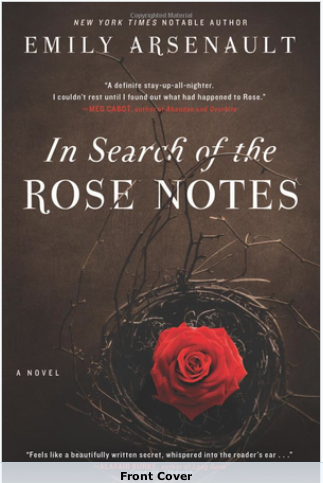
(You can find this book at Amazon.com)
Nora hangs out a lot with Charlotte, her best friend, while her single mother works full time. Charlotte is bossy, but never boring, as they explore the pre-teen world together. They have a babysitter, Rose, who watches over them and keeps them out of trouble. Until one day Rose disappears.
The book switches back and forth from these pre-teen experiences to a later time, maybe 15 years later, when Rose’s body is unearthed, and once again Nora experiences a lot of feelings she had buried. I loved the depiction of high school, where so many kids are suicidal, and life is cruel. High school just isn’t a kind place, even for those who look like they are having a great time.
At the same time, there were some good relationships, and you get to look back with Nora at people who were kind, but you were too absorbed in your own feelings to notice. It’s a complex world, and we get to go back and explore it once again through Nora’s eyes.
I’m glad I read it. This book did not change my life, but it is a great book for people who either are younger, or who like younger people, as I do.
Jennifer Egan: A Visit From the Goon Squad
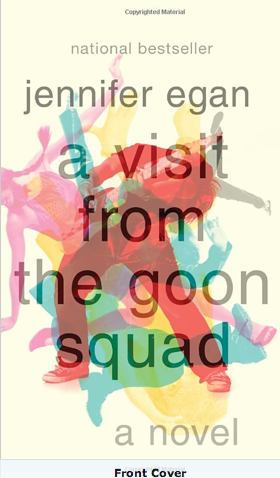
Amazon.com kept telling me I needed to read this book, so finally, I ordered it and waited a couple months before I was ready. I just finished a major project AND I caught a miserable cold, so what better time?
I loved this book. It had a lot going against it; you know irrational factors like how you feel when you have a cold and your sinuses are all stuffed up and your chest is tight? A Visit From the Goon Squad took me out of my misery. While it appears random, it is tightly plotted, and I loved seeing how different strands intertwined. I also loved the effects of the goon squad (no, I am not going to tell you anything specific) and I loved how technology drove differences in how different generations thought and acted.
The last act takes place in a future where (this makes total sense) there is a high value placed on “pure”, no tattoos, no swearing – it is truly hilarious, the lengths to which we will go to NOT be our parents. Babies have their own hand-helds, which is already happening. My eyes have been opened, watching our own 18 month old grandson working an iPad and iPhone. It’s amazing to me the aps that are created to entertain, divert and teach our little ones.
This is not a straight line book, so there are times I had to go back and read a section again to remind myself where I met this character before, and how he tied into the plot earlier. It is a fascinating creation, this book, and I would love to sit down for coffee with this author, and her outside-the-box kind of thinking.
Major Pettigrew’s Last Stand
 Major Pettigrew’s Last Stand by Helen Simonson
My rating: 5 of 5 stars
I loved this book. It follows all the themes I love – how convention blinds us, how our cultural assumptions make us unconsciously snobbish and leads us to hideous behavior, it is very cultural and also very cross-cultural. Major Pettrigrew is widowed, and his grief has made him old. At the beginning of the book, his life seems very dull and grey. It lightens as his friendship sparks with Mrs. Ali, a widow who runs a small convenience market in his small English village. They both love reading (of course I love that part!) and they talk books, and sparks of warmth kindle.
This book is also very uncomfortable for me, as Roger has a grown son who bullies his father. The book isn’t just cross-cultural, it’s cross-generational, and I see glimpses of myself in the boorish behavior of his son toward his father.
There are some amusing scenes, some wickedly insightful village-interaction scenes, some painfully introspective moments, and some truly grand moments when everything becomes clear and a person acts. For me, there was an added bonus in that as I read Mrs. Ali’s words, I could hear them so clearly, and she spoke in the voice of a dear friend. I could picture her, because I could see the sweet smiling face of a dear friend. It was like having a great visit.
<a href=
Recent Comments
ExpatAlien on What Country am I Living … intlxpatr on Yellowstone: Old Faithful to C… Michelle on Yellowstone: Old Faithful to C… Cathy on No Grown-Ups in Charge intlxpatr on Waiting for Snow Wikipedia Donate Button

Amazina


Early Voting in Florida


 Here There and Everywhere