Changes in the Air
“It’s still hot,” I said as we were coming out of the movie, “but can you feel a change in the air? Even though it’s hot, the air is changing, the light is changing – you can feel hints that Fall is coming . . . ”
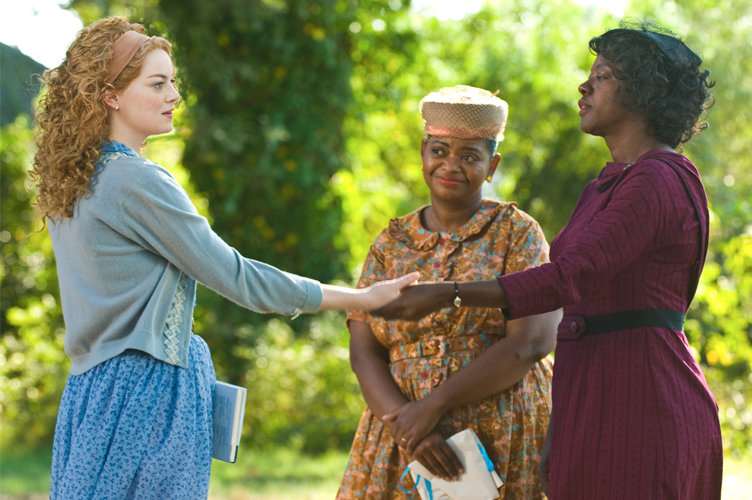
We had just been to see “The Help,” and if you haven’t seen it yet, you need to make plans to see it soon. It is a really good movie, which will make you laugh, and cry, and remember that it wasn’t so long ago in our country when it took place. (You can read my review of the unforgettable book here.)
The movie is a serious movie, and at the same time, I loved the attention to detail – the hair, the fashions, the manners – all very 50’s, even though it is the 1960’s in Jackson, Mississippi.
I remember reading this book in Qatar, just after I had moved back there from Kuwait. The Kuwait book club also read White Tiger and Half of a Yellow Sun, all of which had domestic service as at least part of the theme. It’s another one of those cultural things we all have in common – how do we treat the people who work for us? How do they see us? Who is raising our children and teaching them values?
In the Gulf, there are horror stories in the papers of servants who never receive their wages, or who work 16 hours a day, sun-up to sun-down, with never a day off. The families who take good care of their servants never make the papers, but I have seen good and caring relationships, lasting many years, between employers and employees. We’re glad we saw this movie, which sticks closely to the book. For a fuller experience – read the book.
Meanwhile, the temperature early this morning was below 69° F, which means that my tomatoes will begin setting once again and we may have a good crop coming before the cold sets in. I noticed, to my horror, I have a decent crop of weeds trying to establish themselves while it is too hot for me to go out and do battle with them. Some of my tomatoes actually continued producing even during the hottest days of the summer; I’m going to have to plant more of those next year. The golden pear and the red pear tomatoes are producing merrily; the bigger tomatoes have stopped – I hope temporarily.
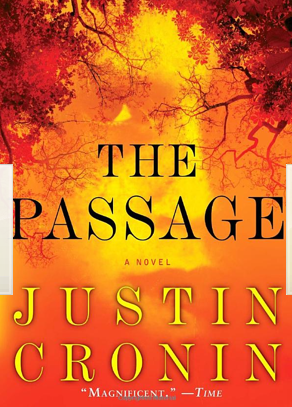
The Passage by Justin Cronin
I subscribe to GoodReads.com, and I buy books through Amazon.com, so I am not sure which one of those recommended this book for me. I held it a couple months before I read it, just wasn’t sure it was something I cared about. Once I started, however, I was hooked.
Don’t you just love summertime reading, the kind where you might even be able to grab a couple hours in a row? When you can focus like that, it’s like you are living two lives; you are in your normal existence, but a part of you is somewhere else, if the book is good enough.
Sometimes that somewhere else isn’t that great, and in The Passage, you are in a post-apocalyptic America where those military scientists have lost control of one of their experiments and life has changed forever as a result. Sorry to sound so cynical, but I started reading Sci-Fi when I was still in middle-school, so I am a little jaded about post-apocalyptic literature, but this one managed to suck me in. Also, even though you know it’s fiction, it is compelling enough to feel very real.
So before I go getting all critical about the little things, I need to tell you that when I had to put the book down, I could hardly wait to get back to it, and I probably need to look after my laundry and my floors and wash up some dishes now that I’ve finished; the book compelled my interest.
I think the author does a great job setting up the world. In order for young people to come into their own, to head out on their quest, you have to get parents out of the way, so all the young people out to solve the problems have parents who have died, or committed suicide (the living situation is a little bleak) and that kind of bugs me, even though I can see the literary usefulness of having this happen.
The survivors, 100 years after the societal meltdown, live a bleak and limited existence, mostly focused on not getting killed. (One of the very scary things is just how fast a society can melt down when faced with an overwhelming threat.)
This is a vampire-novel, but a vampire novel with a total twist, there is nothing attractive about these vampires, called virals. They are demented, and they want blood. They tear into flesh. You don’t want to be out in the open after dark, you don’t want to run into a viral. Justin Cronin makes it very very real. I’m glad my husband wasn’t traveling. I know vampires are not real, and I know there are no virals, and you know sometimes rational doesn’t matter when you hear sounds at night? These bad-guys are very very lethal and very very bad.
And here is what I like. Cronin takes you from utter fear to some compassion for the virals. I imagine this will play into the next book.
I also like his inclusion of children, and they way children perceive and the way children feel, and how those perceptions and feelings grow with the child, and, if you are very lucky or very persistent, how you can gain insights into those perceptions and understand them differently as you reach adulthood. It reminds me of another Sci-Fi author I used to read, Zenna Henderson, who wrote books about specially talented children.
Here is what I don’t like, what I find really frustrating: this is just the first volume. I am satisfied enough with this book, and I know I will have to read the next one, but I think I can see where he is going with it all. I find it frustrating; I am holding my breath for the next Game of Thrones/Fire and Ice volume to come out, and now this Passage follow up won’t be out until 2012, on AAARRGH.
It’s a dark book, but it kept me glued. The things that annoyed me didn’t annoy me enough to discourage me from reading. 🙂 It is a great summer read.
Cutting for Stone by Abraham Verghese

Someone in my book club in Qatar mentioned this book, Cutting for Stone, a while back, and I bought it, but it has sat for months on my to-read shelf (LOL, there are actually several, but one with the most important books, and another with the ‘guilty pleasures,’ the ones I am addicted to and save as a reward for good behavior, like vacuuming.)
When a good friend said she was reading it, and that it was good, I decided to move it up in priority, sort of like taking medicine, read a book that is good for you.
Oh WOW.
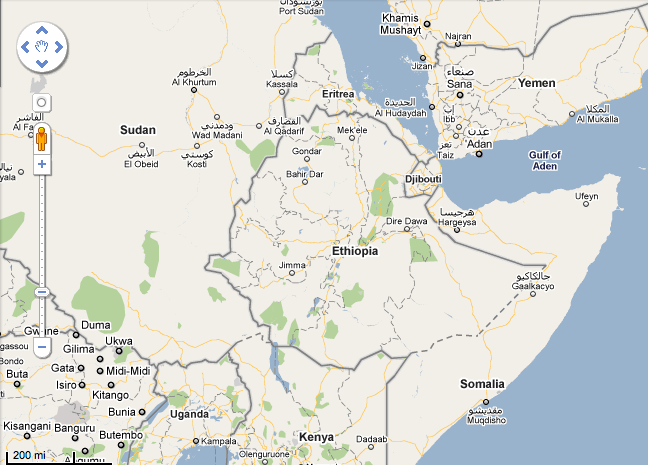
First, it is a great, absorbing story. Twin boys are born, totally unexpected, to an Indian Catholic nun and an English surgeon, working in Addis Ababa. How they were conceived is a mystery. The mother dies in childbirth, the father flees in horror, the children are born conjoined at the head and must be separated. The boys are adopted by an Indian couple, doctors at the hospital, and are raised with love and happiness.
That’s just the beginning!
I’ve always wanted to go to Ethiopia and Eritrea. I want to visit Lalibela, and some of the oldest Christian churches in the world. When my father was sick, he had a home health aid from Ethiopia, Esaiahs, who told me about the customs in his church, and how Ethiopian Christianity is very close to Judaism, with men and women separated in the church, and eating pork forbidden.
Reading this book, I felt like I had lived there, and I want to go back. The author captures the feelings, the smells, the visuals, the sounds, and if I awoke in a bungalow at the MIssing (Mission) Hospital, I would say “Ah yes! I remember this!”
I kept marking sections of this book that I loved. Here is one:
They parked at Ghosh’s bungalow and walked to the rear or Missing, where the bottlebrush was so laden with flowers that it looked as if it had caught fire. The property edge was marked by the acacias, their flat tops forming a jagged line against the sky. Missing’s far west corner was a promontory looking over a vast valley. That acreage as far as the eye could see belonged to a ras – a duke – who was relative of His Majesty, Haile Selassie.
A brook, hidden by boulders, burbled; sheep grazed under the eye of a boy who sat polishing his teeth with a twig, his staff near by. He squinted at Matron and Ghosh and then waved. Just like in the days of David, he carried a slingshot. It was a goatherd like him, centuries before, who had noticed how frisky his animals became after chewing a particuar red berry. From that serendipitous discovery, the coffee habit and trade spread to Yemen, Amsterdam, the Caribbean, South America, and the world, but it had all begun in Ethiopia, in a field like this.
We live inside the hearts and minds of doctors, some practicing under the worst possible conditions, and learn how they make their decisions and why. Verghese is a compassionate author; while his characters may be flawed, they are forgivable and forgiven.
Another section I loved, the man speaking is Ghosh, the man who adopted the twins with Hema, another doctor:
“My genius was to know long ago that money alone wouldn’t make me happy. Or maybe that’s my excuse for not leaving you a huge fortune! I certainly could have made more money if that had been my goal. But one thing I won’t have is regrets. My VIP patients often regret so many things on their deathbeds. They regret the bitterness they’ll leave in people’s hearts. They realize that no money, no church service, no eulogy, no funeral procession no matter how elaborate, can remove the legacy of a mean spirit.”
Things in Ethiopia get sticky, politically, and one of the twins is forced to flee, implicated in an airplane hijacking only because he was raised with a young woman involved. He is spirited into Eritrea, where he awaits his ride out to Kenya, and he helps the Eritrean rebels when large numbers of wounded are brought into his area. When the time comes to leave, his thoughts will strike a chord in anyone who has ever been an expat:
Two days later I took leave of Solomon. There were dark rings under his eyes and he looked ready to fall over. There was no questioning his purpose or dedication. Solomon said “Go and good luck to you. This isn’t your fight. I’d go if I were in your shoes. Tell the world about us.”
This isn’t your fight. I thought about that as I trekked to the border with two escorts. What did Solomon mean? Did he see me as being on the Ethiopian side, on the side of the occupiers? No, I think he saw me as an expatriate, someone without a stake in this war. Despite being born in the same compound as Genet, despite speaking Amharic like a native, and going to medical school with him, to Solomon I was a ferengi – a foreigner. Perhaps he was right, even though I was loath to admit it. If I were a patriotic Ethiopian, would I not have gone underground and joined the royalists, or others who were trying to topple Sergeant Mengistu? If I cared about my country, shouldn’t I have been willing to die for it?
The book has a lot of observations about coming to America; some of which made me laugh, some which made me groan. Coming back is always a shock to people who have lived abroad for a time, but it is a huge shock to those coming for the first time:
The black suited drivers led their passengers to sleek black cars, but myman led me to a big yellow taxi. In no time we were driving out of Kennedy Airport, heading to the Bronx. We merged at what I thought was a dangerous speed onto a freeway and into the slipstream of racing vehicles. “Marion, jet travel has damaged your eardrums,” I said to myself, because the silence was unreal. In Africa, cars ran not on petrol but on the squawk and blare of their horns. Not so here; the cars were near silent, like a school of fish. All I heard was the whish of rubber on concrete or asphalt.
As I neared the end, I read more slowly, unwilling for this book to end. It is one of the most vivid and moving books I have ever read. AdventureMan has gone online to find the nearest Ethiopian restaurant so we can have some injera and wot.
The Dressmaker by Posie Graeme-Evans
When I wrote up this book for another site, I could not even remember the main character’s name. (Ellen Gowan) I found the book annoying, and most of the time, when a book annoys me, I don’t even tell you about it, I just don’t bother reviewing it at all.

I find the plot thin. I find the characters unmotivated. I find many of the choices of the characters unbelievable. We haven’t been given enough back-story to make the characters truly live.
Ellen has a real streak of bad luck. On her 13th birthday, a well-born young man gets fresh with her and in rural Victorian England, it becomes her problem – her reputation is damaged by a callow young man from a wealthy family. On the same day, an earthquake strikes her village, killing her father, and she and her mother subsequently lose their home.
They take up residence with Ellen’s aunt, her mother’s sister, and it is a happy time, all except for her aunt’s husband, a cruel man who isolates and beats his wife, who can do nothing about it. A wife is property. Her marriage was arranged; she has no where to go if she were to leave. She works hard at keeping her husband happy, so he won’t beat her or take it out on anyone she loves.
When you are dealing with an abusive manipulator, however, there is no pleasing, right? Ellen and her mother are thrown out, but also thrown a lifeline, and take up residence with a dressmaker, where Ellen hones and develops a talent for costume design (meaning evening dress, calling clothes, mourning clothes – wealthy Victorian women had huge wardrobes of ever-changing fashionable clothes.)
Ellen makes some really bad choices – in my opinion. I’m not going to tell you what those choices are, because I don’t want to give you too much of the story, in case you want to read it yourself.
Long story short, she ends up a very successful fashion designer/producer in London, only to face ruinous blackmail because of her past.
OK, here is what I really liked about the book. While I found the characters, descriptions, plotlines and dialogues pretty awful, I loved reading about the fashions, and I found reading about the social status of women – not all that long ago – where women in England had few choices and fewer opportunities – fascinating. I have friends in Kuwait and Qatar who face some of the same limitations. How soon we forget; it wasn’t that long ago that we faced the same challenges, the same limitations.
The freedom to live on our own. The freedom to earn and manage our own money. The rights to our children. All these issues are fresh in The Dressmaker, and too easily taken for granted in our own.
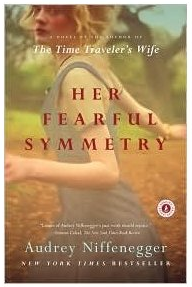
Her Fearful Symmetry by Audrey Niffenegger
This was another find passed along by either Big Diamond or Little Diamond, via my Mom, and oh, what a find. Audrey Niffenegger wrote The Time Traveler’s Wife, a highly unusual book which hit the best seller list like a hurricane. This book, Her Fearful Symmetry, solidifies the perception that this author has real talent, thinks way outside the box, and creates characters and situations that, while unlikely, are likable and who become real enough for us to identify with them.
The title is based on a poem by William Blake, a poem I have always liked:
The Tiger
TIGER, tiger, burning bright
In the forests of the night,
What immortal hand or eye
Could frame thy fearful symmetry?
In what distant deeps or skies 5
Burnt the fire of thine eyes?
On what wings dare he aspire?
What the hand dare seize the fire?
And what shoulder and what art
Could twist the sinews of thy heart? 10
And when thy heart began to beat,
What dread hand and what dread feet?
What the hammer? what the chain?
In what furnace was thy brain?
What the anvil? What dread grasp 15
Dare its deadly terrors clasp?
When the stars threw down their spears,
And water’d heaven with their tears,
Did He smile His work to see?
Did He who made the lamb make thee? 20
Tiger, tiger, burning bright
In the forests of the night,
What immortal hand or eye
Dare frame thy fearful symmetry?
While this tale is a great yarn, it helps to know this poem, there are a lot of literary references in the novel and the title is just one of them.
As the story begins, there is a death, a will, and a set of mirror-image twins who inherit a flat in London overlooking a famous cemetery. The flat is in a building and has an upstairs neighbor, a man succumbing to obsessive-compulsive disease, and a downstairs neighbor, an aging bachelor, all a little eccentric in the nicest, English sort of way. The twins, Valentina and Julia, are twenty years old, and waif-like, still dressing alike, doing almost everything together.
There is also a ghost. No, wait! Two ghosts, and a kitten ghost. No, wait! I forgot! Lots of ghosts!
What I love about Audrey Niffenegger is that she takes what we perceive as reality and gives it a twist, and once you buy the twist, you are off on a wild ride. This book is a wild ride, with unforgettable characters and some unexpected kinks and thrills, as well as more than a couple shudders and chills.
Forgotten Garden by Kate Morton

This book is a mystery, written as a fairy tale. At the beginning, we are given a part of the story, and with every chapter we learn a few additional factors. There are some dark alleys, and maybe some red herrings.
Oh wait! Maybe it’s gothic; there is a huge mansion with a variety of unsavory rich folk and stereotypical kindly servants and a Cinderella-like relative and dark secrets lurking in the corridors.
A young woman researches her grandmother’s history to try to figure out who she was and what her story was. She had arrived in Australia, four years old, and alone in 1913. We go back and forth in time, and we see the story from many different eyes, each adding pieces to our puzzle.
The annoying thing about this mystery – to me, anyway, is that it seems to me that there are a lot of distracting tongue-in-cheek references to fairy tales which seem to imply that the story we are reading follows some kind of prototypical pattern. There is a real book of fairy tales involved, written by someone who seems to be related in some way to the young woman’s grandmother, but there are too many coy coincidences and too many interweavings for me; several times I just wanted to throw the book across the room in disgust.
I finished it, but it left me with a bad taste in my mouth. It was murky, and I never got the feeling that the author truly cared about her characters, but was playing some kind of intellectual game with the plot, and it just annoyed me.
The Glass Rainbow by James Lee Burke
“Here’s the book,” Sparkle said, sliding into the restaurant seat as we all poured over the menu, wafts of garlic, white wine and butter drifting our way. “I’m getting kind of tired of Dave and Clete.”
“What, you mean not just bending the envelope but tearing right through it?” I asked “Or all the gratuitous violence?”
“Mostly the scorn for official procedures,” she started, two little lines between her eyes as she took in all the delicious possibilities, “How about some of that Montepulciano?”
She passed the book along to me. I was in the middle of another book, but oh, the temptation to drop it and get on with a new James Lee Burke.

The book opens with Dave Robicheaux, our recovering alcoholic detective, meeting up with a convict on a work crew whose sister has disappeared and who was found murdered. Bernadette Latiolais’s remains are thought to be the work of a serial killer working the area who targets prostitutes, but Bernadette was an honor student, graduating with a full scholarship promised to a Louisiana university. She was also an heiress, in a small way, to some property at the edge of a swamp. She doesn’t fit the profile, and her brother wants justice – not for himself, he’s doing his time, but for his sister, who never did anything to anyone, and who wanted to create a conservation area to preserve bears.
Right off the top, Robicheaux is outside of his parish, investigating a case nobody cares about in an area out of his jurisdiction.
OK, OK, my sister is right, this is pretty much another formulaic James Lee Burke. There are the corrupt rich families, the amoral women, the voiceless victims. Instead of the old Italian organized crime families, this time there are hired mercenaries, equally creative in killing, but way more efficient in cleaning up afterwards.
I’m just a sucker for James Lee Burke’s writing. Here’s one sample, from his interview with a very rich old man who goes a long way back with Robicheaux’s family:
“Don’t get old, Mr. Robicheaux. Age is an insatiable thief. It steals the pleasures of your youth, then locks you inside your own body with your desires still glowing. Worse, it makes you dependent upon people who are half a century younger than you. Dont’ let anyone tell you that it brings you peace, either, because that’s the biggest lie of all.”
Burke’s Dave Robicheaux and his private-investigator friend Clete are flawed men, prone to violence, but I cut them a lot of slack because in each novel they are bright shining avengers of all the wrongs done to the weak and helpless. They are Quixotic. They fight the rich and powerful for the rights of the common man. They know the risks they take, and they are too old to think they are going to survive every bad guy they go after. It’s a good thing the law of averages doesn’t hold true in novels; they should have been dead a long time ago.
What keeps me coming back are the lyrical descriptions of life along the Atchafalaya Bayou, community life in New Iberia, Louisiana, and Robicheaux’s family life, wife Molly, daughter Alifair (now grown to young womanhood) and Snuggs their cat and Tripod their raccoon, as well as the knowledge that at the end of the book, in spite of every evidence to the contrary, Dave and Clete will emerge alive, if damaged, and their indirect and violent path will have achieved some semblance of justice.

(I ordered the spaghetti with a white-wine mussel sauce, and Sparkle ordered the chicken marsala. Mom had seafood diablo.)
Shhhh! I’m Reading!
The doorbell rang, it was after dinner, and we figured it was our son coming by, so we ran to the door. No-one there, but we can see back of the UPS man trying to cross to his vehicle on the other side of the road, and there is a small package on our porch.
I was briefly disappointed, but not for long. The package was a book I had pre-ordered:
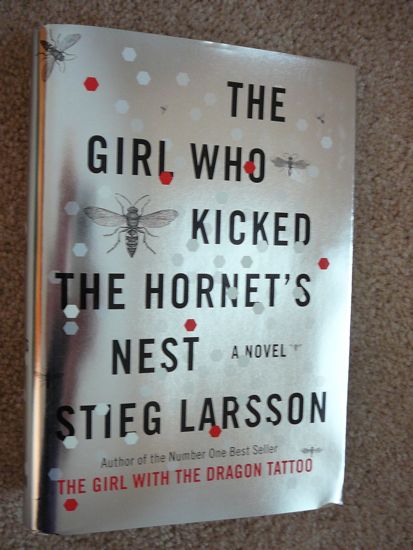
I don’t often order a hardcover book; I don’t care that much. Most of the time. Now Stieg Larsson is another story. His last book, The Girl Who Played With Fire, was a cliff-hanger, which I read while waiting to move in to our house, while it was being rewired. I could hardly wait to find out how everything resolves, so I pre-ordered from Amazon, and started reading as soon as I had opened the box. 🙂
While in Sam’s Club doing some shopping for Memorial Day, I noticed that on a very full book rack, the Stieg Larsson paperback books are flying off the shelf.
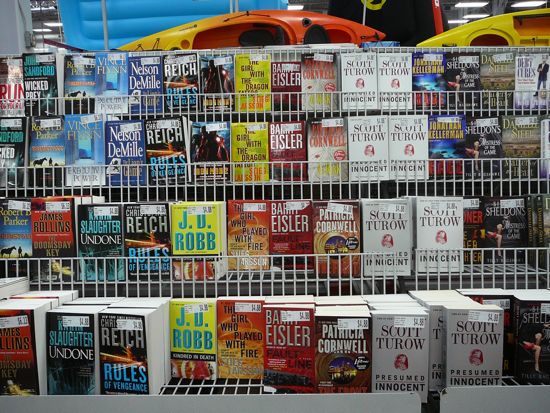
This time, I couldn’t wait for the paperback edition. 🙂
The Party House
We stumbled into the upstairs lounge, all four of us, sleep muzzy and disheveled, but then again, it was 3 in the morning.
“What is that?” asked Mr. Ambassador, who is no longer Ambassador anymore, but still gets to be called that. He was asking about a wailing, like that of an injured cat, only accompanied by music.
I blushed to the roots of my hair. Fortunately, it was dark. No one could see the depth of my humiliation
“It’s the party house.”
This was punctuated by shrieks of laughter from the new influx of ‘hostesses’ invited to entertain the male guests when they ceased their karaoke singing. Doors slamming, karaoke machine at it’s highest setting, the party is in full swing.
AdventureMan broke the ensuing horror-filled silence.
“We are SO sorry. It hardly ever happens. Most of the time they aren’t even there. You just happen to be here on the ONE night.”
With the beautiful weather, we have our windows open. We make up the beds in the rooms on the other side of the house, close all the windows, and turn on the air conditioning to muffle the alcohol-fueled revelry.
“Can’t you do anything? Can’t you complain?” my good friend, the ambassador’s wife, whispered to me.
“It’s their compound. We tried complaining. Nothing happens. I can’t tell you how embarrassed I am that this would happen while you are here, as our guests,” I replied.
She laughed – diplomatically – and brushed my embarrassment aside. She’s a good friend.
Pomegranate Soup by Marsha Mehran
I saw a mention of this book in an Amazon.com referral as a book I might like, and was almost set to order it when something said “go check the stack of books Little Diamond left for you” and sure enough, I already had the book.
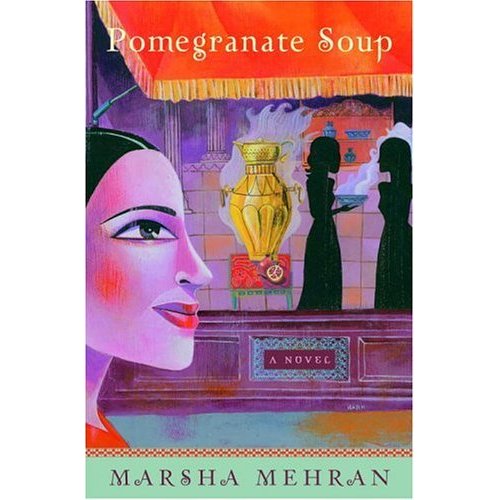
I use books as an incentive to get me through life’s inevitable tasks I don’t like – like “if I finish this project on time, I get to read this book as a reward.” It works for me.
When I first started reading Marsha Mehran’s book about three Persian sisters starting up a cafe in a small Irish town after fleeing Iran, I found it sour. The author has a critical point of view, and generally speaking, I don’t like hanging around with people who criticize others and judge them harshly. At the beginning of the book, Mehran introduces a lot of people, many of whom we are not meant to like.
Even the sisters are not all that sympathetic – at the beginning. But also, near the beginning, she discusses Persian cooking, the idea of balance in a meal, hot and cold, spicy and bland, so you kind of get the idea that if there is sour, then there will also be sweet. In addition, at the end of each chapter there is a wonderful recipe, a wonderful, fairly easy-to-follow recipe, and she included one, Fesanjan, that is my all-time favorite Iranian dish and now, I know how to make it, Wooo HOOOO!
Three sisters, orphaned by fate, held together by love and duty, start a cafe, which, against all odds, becomes a raging success. Raging success does not heal all the old wounds, however, nor the hearts that bear them, and we learn through the book what the sisters have borne and overcome.
It turns out to be a sweet book, one well worth reading. And oh! the recipes! In each chapter, there are also hints that make them even better, so you can’t just copy out the recipes and use them, you really have to read the book. 🙂
It’s a pity that two of the most wonderful countries in the world – Syria and Iran – are off limits. We’ve been back to Syria, and it was everything we remembered (see the Walking Old Damascus blog entries) but oh, how we would love to explore Iran. Sigh. The world turns, and we can only hope to be able to get there in our lifetime. Stranger things have happened.
Recent Comments
ExpatAlien on What Country am I Living … intlxpatr on Yellowstone: Old Faithful to C… Michelle on Yellowstone: Old Faithful to C… Cathy on No Grown-Ups in Charge intlxpatr on Waiting for Snow Wikipedia Donate Button

Amazina


Early Voting in Florida


 Here There and Everywhere