Neil Gaiman’s Smoke and Mirrors

Smoke and Mirrors is a collection of – as the author puts it – short fiction and illusions.
My son got me started with Neil Gaiman when he gave me a book called Good Omens. He is probably not an author everyone would like – he can be cynical, but my experience with cynics is that their cynicism is an attempt to disguise a deeply idealistic nature, so his cynicism doesn’t bother me. I love his attention to world mythologies, those beliefs deep down that are passed from parent to child, beliefs so deep we don’t even know they are there.
Smoke and MIrrors was an easy, if uneven, read. I get the impression Gaiman gathered up a bunch of short writings he had done – like sometimes you jot down an idea for something and keep it to be developed later, into a book, a sub-plot, etc. and that these ones never quite graduated.
There are two stories I will never forget. The last story, Snow, Glass, Apples, is a re-telling of the Snow White legend, told from the point of view of the wicked step-mother, set far back in dark times. I will never see Snow White in the same light again. I love the flicker of perception that changes everything. Snow White as a vampiric, wild, uncontrolled child? When Gaiman writes, all the pieces fit together.
The other story hits me on a deeper level. In a house where stray cats come and are cared for, a cat arrives, scarred and damaged, seeking only love. Every night he goes out onto the porch, and late late on some nights, sounds of wild and horrendous battles are heard, from which the cat emerges more damaged, battered and scarred than before. Horrified, the people try to keep the cat inside, but after he has healed enough, he insists on going out again to do battle. One night, the man watches as an apparition appears; on a deep instinctive level, he knows it is a demon / devil. The cat protects the house and its occupants. The story is called The Price, and after I read it, I couldn’t read the book again for a couple days.
When I read Neil Gaiman, it frees me up to think outside the lines, outside the normal boundaries of what we consider normal. This man was gifted with an amazing imagination.
I think of Jesus, and his disciples, the 12 he gathered to help him in his earthly ministry. I think of how often they listened to Jesus – and got it wrong. He would be explaining something, and they just didn’t get it. I wonder how often it still happens, that we think we understand what he is telling us, but our minds are small and fuzzy, and we can’t begin to comprehend the magnitude of what he is telling us.
So I think about angels, and how they are all around us. . . and what if all these little cats and dogs are part of the angels God has sent to protect us? I think how they love us unconditionally, simply, and how good they are for our health (having a pet can lower blood-pressure, for example) and how truly truly AWFUL it is that we might be abusing, starving, neglecting the very angels God has sent to ease our lives and protect us? It fills me with horror!
Neil Gaiman sets me free to think such thoughts. You can read his stories as just stories, but if you have an ounce of depth, you will find your mind wandering to strange places after reading Gaiman. You can find Smoke and Mirrors on Amazon.com for around $10 in paperback, less if you buy it used.
Again, thank you, son, for introducing me to such a mind-stretching author.
Australia – the movie
Back last November when we were back visiting family, our daughter-in-law went with her cousins to a late showing of Australia, which got later and later and later. The next day, she said “I had no idea it was such a LONG movie! There were like three endings!”
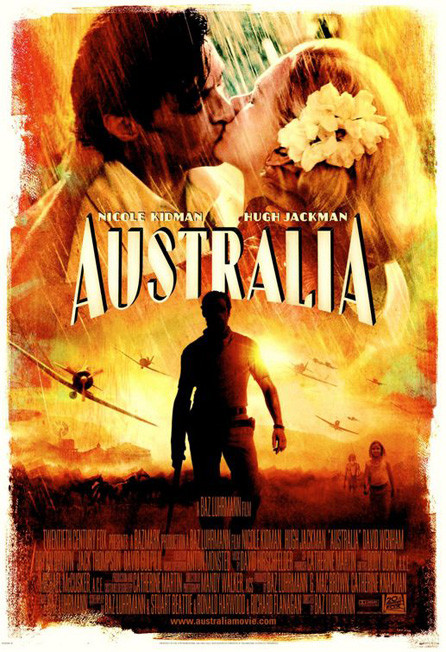
What we didn’t know – until we watched it last night for ourselves – is how much FUN the movie is. No, it probably won’t ever win any awards for great acting, but it had some hilarious scenes, some touching moments and it had allusions to other great adventure-type movies, including Indiana Jones. We loved watching it, and watched it from beginning to end without taking a break, which is amazing – it really is a LONG film.
Romance, drama, adventure, great scenery -it’s all there.
An Interview with Chimamanda Ngozi Adichie
This interview is with a woman I admire very much, Chimamanda Ngozi Adichie, who has a new book out, a collection of stories, called The Thing Around Your Neck. Her most recent prior book, Half of a Yellow Sun, which tells of the three year struggle of the Igbo people to secede from Nigeria to create the independent nation of Biafra, and won the Orange Prize for Literature in 2007. The book is a total WOW.
Geraldine Brooks: People of the Book
I love the way Geraldine Brooks writes. I got hooked when I read Nine Parts of Desire and then again when I read Year of Wonders. You can read my review on her award winning March here. So I could hardly wait for People of the Book to come out in paperback, so I could read it. (Those hard cover books hurt too much when they fall over if I fall asleep, and are too heavy and bulky to carry on airplanes.)

Here is what I like about Geraldine Brooks. Her books are not easy to read. They make you uncomfortable. They make you think. They give you another perspective, and that perspective challenges your assumptions.
The heroine, Hannah, is not very likable. She is cold, she makes poor decisions, and she has a very uneasy relationship with her mother. She is, on the other hand, a master of her craft, which is stabilizing and restoration of old books. She is the specialist called in by museums to help preserve masterful works, and to identify forces at work which can cause grave damage to these books.
While this is a work of fiction, it is based on an actual book and some of the history surrounding it. The Sarajevo Haggadah, a Jewish holy book, is a real book. Some of its history is known – including the fact that it was twice saved from destruction by Moslems, one a very brave librarian in Sarajevo who rescued and preserved it risking his own life, the fact that it was saved from destruction during the Italian inquisition by a Catholic priest. From tiny bits of physical evidence, Geraldine Brooks weaves an entire book creating a story how all the individuals and forces that might have been involved in the creation and preservation of this one special book.
People of the Book is a mystery – Hanna goes in and in the process of evaluating and analyzing the book, gathers tiny bits of “evidence” – a tiny grain of salt, a hair, wine stains. As she investigates, lab results come back, filling in missing pieces of how this book might have travelled from Spain of the convivencia (Medieval Spain) to modern day Sarajevo. Slowly, slowly, Brooks reveals to the readers the real (fictional!) people behind the tiny pieces of evidence.
The plot is interesting. What grabbed me from the beginning, however, is that this is a real book-lovers book, written by a woman who loves books. We learn about how books are created, how book conservators know, from looking at the origin of a sheet of paper, where a book was created and about what time period it was created. We learn about different treatments of paper, we learn about inks, we learn how pigments are created, and we learn about illustrations.
I was captivated by all the love of book-creation present in this book. Most of all, I love it that she dedicated this book to the librarians of the world, those unsung heros who devote their lives to the preservation of information. It was definitely worth a read – and, as an exception to most of my rules, it will probably be worth a re-read.
A friend recommended a video of Geraldine Brooks discussing this book at a book-talk at Northeastern University. It is a little long – you will need about 38 minutes of your time if you want to listen to this amazing woman:
Eliot Pattison: Beautiful Ghosts
It almost always takes me a little while to get into Eliot Pattison’s books, and I can figure out why. He sets you down right in the middle of something going on, so you start off a little confused. You can read each of his Inspector Shan Tao Yun books as a stand-alone, but it helps to have read them in order – as I have.

Even though I have read them in order, I still find myself disoriented each time I start a new book. New names, a new situation, and it takes a few pages to get back in the rhythm of thinking about things in a new way. Within thirty pages, I am in a new world, and I am totally addicted. When I am reading one of the Inspector Shan Tao Yun books, I can hardly wait to get back to the book. My household chores suffer, my projects suffer – even AdventureMan suffers, as I seek to return to Tibet, the Tibetan Monks and the world of Chinese bureaucracy.
One of the things I love in this book – we saw a hint of it in the last book I reviewed, Bone Mountain – is that the worst of the bad characters can have a hint of humanity, and develop a full-blown redemption, as we are watching happen with the prison warden, Captain Tan. The process continues in Beautiful Ghosts. In this book, Pattison strikes several additional chords – he combines a good mystery with art, art thefts, public art and a little bit of history, a family reunion, father-son problems, and a lot of action. I’m a happy reader.
In Beautiful Ghosts, a murder happens, but it is hard to understand, at first, who was murdered, why the murder was committed, where the murder was committed as well as who committed the murder. One answer leads to another, and ultimately, to long buried treasures and long kept secrets.
A great tickle, for me, is that in this book Inspector Shan Tao Yun goes to my home town, Seattle, which he finds very strange, and grey and rainy. Pattison describes Chan’s bewilderment at how Americans live, and as Chan leaves Seattle, he comments on how he has not seen the sunshine in his entire time visiting there, working in co-ordination with an FBI office trying to track down some missing and stolen Tibetan art pieces, stolen from the hidden monasteries by corrupt Chinese bureaucrats.
Shan still stood, studying the strange buildings and the dozens of people who were wandering in and out of the open doorways off the huge main hall. There were shops, he realized, dozens of shops, two floors of shops. When he looked toward Corbett, the American was already ten feet in front of him. Shan followed slowly, puzzling over everything in his path. Adolescents walked by, engaged in casual conversation, seemingly relaxed despite the brass rings and balls that for some reason pierced their faces. He looked away, his face flushing, as he saw several women standing in a window clothed only in underwear. He saw more, nearly identical women, in another window adorned in sweaters and realized they were remarkably lifelike mannequins. One of the sweaters was marked at a few cents less than three hundred dollars, more than most Tibetans made in a year.
“Why did you bring me here?” Shan asked, as Crobett led him into a coffee shop and ordered drinks for both of them. “This place of merchants.”
“I thought you’d want to see America,” Corbett said with an odd, awkward grin, gesturing to a table, then sobored. “And this is where Abigail worked, before getting the governess job. People here knew her, told me stories about her, made her real for me.”
. . . .
Shan began to marvel at the rain itself. Beijing was a dry place, most of Tibet a near desert. He had not experienced so much rain since he was a boy, living near the sea. There were many qualities of American rain, and many types of rain clouds. One moment they were in a driving rain, like a storm, the next in a shower, the next in a drizzle that was little more than a thick fog. Once the water came down so violently, in such a sudden wind, that it struck at the car horizontally. . . .
You learn so much reading Eliot Pattison, more than I can absorb! There are detailed art works, there are geographic features, there are Buddhist customs, there are bureaucratic networks, there are mysteries of Chinese history and dynasties. There are tribal customs and learning to think like Tibetan monks.
Eliot Pattison is a gifted and poetic writer. If you like mysteries that turn out to be very complicated and which teach you a lot about a culture you have never experienced (or would like to learn more about) I would suggest you start at the beginning. These are the books about Inspector Chan in chronological order:
Skull Mantra
Water Touching Stone
Bone Mountain
Beautiful Ghosts
Lost, by Gregory Maguire
Gregory Maguire has found an interesting niche. He takes fairytales we all know – stories like The Wizard of Oz and Cinderella, and tells them from another point of view. The first, Wicked, was very very clever, told from the point of view of the Wicked Witch of the West, who turns out to have been a freedom-fighter, but got a lot of bad press. LLOOLLL. Like, what is not to like about an author who turns “reality” upside-down?
His second book, Confessions of an Ugly Stepsister, did the same for the Cinderella legend – told it from another point of view, and Cinderella comes out looking not-so-saintly at all.
Both of these books became best sellers, and Wicked even went on to become a long-running Broadway play.
I picked up Lost because of the cover and because I wondered what another take on Alice in Wonderland would look like.

It took me forever to start reading it, and once I started, it did not engage me. We meet a woman, an author, and she is behaving very strangely. As we continue to read, she continues to behave strangely, inexplicably, and as the book proceeds, we begin to get a more complete picture. At no point did I see a clear parallel between this plot and Alice in Wonderland, although the main character’s experiences were equally chaotic and full of non-meanings. The book was opaque, and frustrating – to me. You may have a totally different take on it.
The main character, a successful author, seems to be divorced, and decides to travel to London to see her cousin. When she arrives, he is not at home, his kitchen is being destroyed and renovated, and she moves right in anyway. There are apparent hauntings. When I got to the end of the book, I knew a little more about the character than I knew before – and I didn’t care.
I think maybe the fairy-tales-told-from-another-point-of-view thing has gotten old, maybe a little stretched at this point. He’s now done a couple more Wizard of Oz retellings, and I don’t think I will bother with them.
I DO recommend Wicked, if you haven’t read it. It is fresh, and delightful.
Joanna Brady and Tumbleweeds
I have a lot going on right now, and that is when I turn to books, I don’t know why. The more scheduled I am, the more important it is that I have fairly lightweight reading. My favorite genre is mystery, and there are a number of authors I follow, some more important than others.
I was reading the lastest Joanna Brady mystery, Dead Wrong, by Seattle author J.A. Jance. Joanna Brady became Police Chief in the small (fictional) Arizona town of Bisbee when her husband, then the police chief, was killed and she was asked to fill his position. Since then (several books) she has been elected and re-elected, and solved a lot of crimes, and re-married.
Now, in Dead Wrong, she is heavily pregnant, trying to solve a tricky murder that involves a puppy breeding mill and dog fighting ring.
“We have to go to Tumbleweeds tonight!” I call out to AdventureMan. “Joanna Brady is pregnant and she can’t eat creme brulee, but she dives right into tacos and enchiladas! Now I am starving for Mexican food!”
AdventureMan just laughs, he is always ready for Mexican food.
So just after sunset, we are king of the road, and we drive to Tumbleweeds.
I would love to say something nice about Tumbleweeds.
The service was slow. The servers were poorly trained. The food was SO mediocre. The chips were thick, and cold, and you could see fat congealed on them. The salsa was dull. The burritos and tacos were bland. No wonder we go there so rarely.
Peter Bowen and Nails
Three men trundle a naked woman through the desert to a remote place, where she was placed in a container, 6 x 6 x 6 with only a candle, a cot, water and a holy book, until she could come to her senses and behave.
Four girls were strangled, one each day, for refusing the sexual advances of their father and his brother. The two youngest girls, their older sisters dead, complied.
Women with inconvenient views, women who start having thoughts of their own disappear. Many in this tribe are home-birthed and home-schooled, so there aren’t records of their existence, and when they disappear, no-one is the wiser.
Saudi Arabia, you ask? Pakistan? Afghanistan? Where on earth are women treated this vilely?

Peter Bowen, in Nails, gives vent to his frustration of minor fundamentalist Christian cults roaming the American West, many of them ending up in Montana where they believe they will have the privacy to practice their beliefs without interference, and where those who are well-funded can influence poverty-stricken school districts to toss out Science classes and incorporate Intelligent Design. Bowen has utter contempt for their studied ignorance, their need to be the sole authority on what the scriptures say, and their insistence on the utter submission of women.
His worst scorn is for their treatment of women – he attributes it to their fears about their own sexuality. Women are often the victims, Bowen states, when men worry about their size, worry about how to keep women faithful, tractable, and docile. (And let’s face it, who can successfully control a woman? 😉 )
This is the latest Gabriel du Pre novel, or at least the latest I have read. Gabriel du Pre is a retired brand inspector (he goes back every now and then when needed, when the brand inspector is overstretched, insuring that the cows sold are from the herds they are being sold from), Metis (French and Indian mix), a renowned fiddler, and a deputy sheriff when the sheriff – or the FBI – needs help solving a particularly tricky murder. It takes a while to get your ear used to his dialect, and he spends a lot of time in bars, but the man has a real knack for figuring things out.
Gabriel du Pre is everything a straight-living woman like myself shouldn’t like. He drinks, morning to night, keeps his flask of whisky under the driver’s seat in his car. He drives way over the speed limit. He doesn’t go to church, he goes to an ancient Indian spiritualist / medicine man when he needs guidance. He isn’t married to the wry, very smart woman with whom he lives. He breaks the rules, he goes outside the boundaries.
For all his flaws, du Pre has a deep down, rock solid core of decency, and a way of looking at life and situations that is practical and . . . forgiving. He is charitable toward his brothers and sisters. He detests cruelty, especially when the strong take advantage of the weak or the arrogant walk all over the humble. There is something about this flawed hero that keeps the reader coming back for more.
His Gabriel du Pre novels are not heavy reading. You can toss one off in about half a day, but they are not so simple as they appear. You find yourself thinking about the issues he raises, and you find yourself looking to see when the next Gabriel du Pre mystery will appear.
You can find this on Amazon.com for $16. new or from $3.07 used, plus shipping of course. (Yes, I own stock in Amazon.com.) 🙂
Geraldine Brooks: March
Geraldine Brooks knocks my socks off. If she writes a book, fiction or non-fiction, I will buy it and read it. The first one I read by her was Nine Parts Desire: The Hidden World of Islamic Women, and the second most memorable book was her Year of Wonders, a book about how the plague comes to a 17th century English village and how the villagers cope with it – how some survive. She has a knack for keen observations, and for writing so as to place you squarely in the scene she is describing.
So when she came out with a new book extrapolating from the experiences protrayed in Louisa May Alcott’s classic favorite Little Women, why didn’t I rush to buy it? March is described by Publisher’s Weekly as “the Civil War experiences of Mr. March, the absent father in Louisa May Alcott’s Little Women.”

Didn’t you love Little Women when you read it? What’s not to love? Those wonderful sisters, their saintly mother, working together, suffering together, prevailing through sheer grit and determination – we can read that book over and over again, loving it every time.
Geraldine Brooks takes us with Mr. March into the grim realities of the American Civil War, the “war to free the slaves,” the war to keep the United States united, or the war between the states. This is not the idealized world of Little Women, this is not the memory we have of the nice letters he writes home from the field, this is the reality of war and all it’s ugliness. As the book opens, Mr. March is fleeing a massacre, struggling to survive, he is surrounded by the dead and seriously wounded, bullets are flying past him and he has to cross a deep, rushing river. A man grabs him who can’t swim, and he has to push him away to gasp for air. The man drowns, March survives, feeling deep guilt. When he finally finds a group of his men, drying out by the side of the river, he sits down and writes to his girls about the sweet breeze in the air. Not a word about the horrors he has witnessed, not his personal despair about having failed a wounded comrade.
As we experience the horrors of this war with Mr. March, we experience with him the brutality, cruelty, and crudity of all conflict. There are no good guys. There is no “just cause,” just winners and losers, and it’s very hard to tell what they are fighting for. Seeing this war from the point of view of the combatants, we realize that no-one will remain untouched; that this experience will resonate through the rest of their lives.
Geraldine Brooks knows how to grab us and keep us gripped. Every chapter reveals a new facet – how March and Marnee met and married, how they built a life together, how, in their idealism, they lost everything. Most discouraging of all is how, below the surface, they understand themselves and one another and their relationship so little.
I dare you to read this book. It isn’t an easy book, and at the same time, it is a book with timeless qualities, and a book that will get you thinking and keep you thinking for a long time. Isn’t that the definition of a good book?
Obama Magazine Cover Controversy
This is the New Yorker magazine cover that is causing so much controversy in the USA – it shows a newly elected Obama showing up to work in the oval office (US President’s office) in Islamic dress and trading congratulatory fists with his terrorist dressed wife. Obama and his election campaign group find it distinctly unfunny.

Recent Comments
ExpatAlien on What Country am I Living … intlxpatr on Yellowstone: Old Faithful to C… Michelle on Yellowstone: Old Faithful to C… Cathy on No Grown-Ups in Charge intlxpatr on Waiting for Snow Wikipedia Donate Button

Amazina


Early Voting in Florida


 Here There and Everywhere