Bush Tours America To Survey Damage Caused By His Presidency
Hilarious video from The Onion.
Maitland and The Company of Liars: A novel of the plague
I had just finished The Swallows of Kabul and still had a long flight to go. Fortunately, I was in the Johannisburg airport, with it’s truly wonderful bookstore, and came across The Company of Liars: a novel of the plague. Well, it isn’t exactly a novel of the plague. The story opens in 1348, a year in which le morte bleu hit the British Isles, only later to be called the plague. The author captures the times, the filth, the lack of bathing, the superstitions, the ways of life.
The plot centers around a group who wanders through the island, just trying to stay alive. The spreading plague impacts on their wandering, but to call this a novel of the plague is just not accurate. The plague is the reason for the journey, but the journey is the center of the novel, not the plague.
Before I started reading the book, I read the Historical Notes in the back, and that is where I came across the most interesting information in the entire book:
The 1348 plague was only the latest in a series of disasters to hit Britain. The period between 1290 and 1348 had seen a rapid and drastic climate change which was so noticeable that the Pope ordered special prayers to be said daily in every church. Eyewitness accounts claimed that 1348 was a particularly bad year, for it rained every day from Midsummer’s Day to Christmas Day. Climate change brought about crop failure, liver fluke in sheep and murrain in cattle, as well as causing widespread flooding which virtually wiped out the salt industry on the east coast. This, combined with a population explosion, meant that as many people died from starvation as from the plague itself.
Interestingly, the book will not be released in the US until September 2008. The cover shown is nothing like the cover of the book I bought.
American issue cover:

Cover on book bought in Johannisburg:
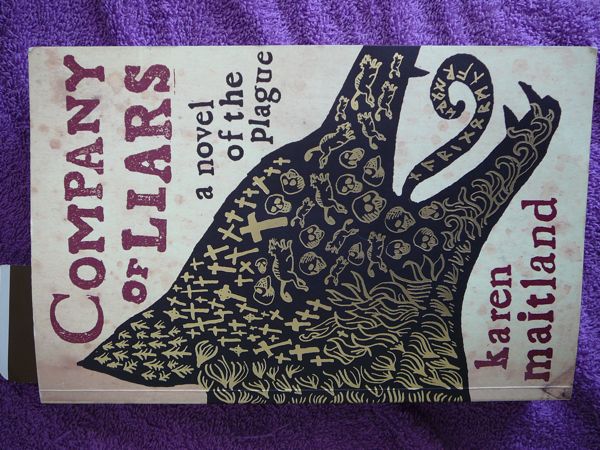
I like the cover of mine better.
Some reviewers call this book “enthralling” or “gripping.” I wans’t all that enthralled or gripped, but it did make good airplane reading. I learned a lot about the grim brutality of life in 1348, but as I told AdventureMan, this is more a book about a slice of time than a book with a great plot. The plot isn’t that great, it is the historical detail that is interesting, and fiction just makes it more easily absorbed. (my opinion)
Cormac McCarthy and No Country For Old Men
“Did you get a chance to watch the DVD?” I asked my friend, “because I have the book, and the book is SO much better. You understand so much more.”
“No! No! I started, but I could not watch it,” said my friend, “It was too violent!”

No Country For Old Men was a very violent movie, done by the Coen Brothers. I reviewed it HERE. When we finished watching the movie, I called our son and said “what happened? I’m not sure I understood what happened!” and indeed, there was a lot I missed. My son didn’t tell me anything – he bought me the book. On one of those long Seattle – Amsterdam – Kuwait flights I read it, and at the end – WOW.
My friend hit the nail on the head – the movie was violent, because the book is about violence, about violence in our societies, about increasing violence, violence without conscience, violence with no understanding of suffering of the victims, violence for no purpose, violence with no meaning, no goal, violence, literally, at the flip of a coin.
The movie is an indictment of violence, taking a circumstantial event and building an entire plot around it, a drug trade gone bad. There are a lot of deaths in this movie, most of them just for being in the wrong place at the wrong time and tangling with people who have no morals, no scruples, no compass by which they live. Even money matters less to the drug dealers, and their employees, than an arbitrary code that takes tribalism to the limit – us or them.
The main character, a sheriff and grandson of a sheriff, takes on a case that leads him to wonder more and more if his service to his community and fellow human beings is even making a difference. He ponders on the changing character of Texas, of youth, and how we are raising our children. It is thought-provoking and unforgettable.
I understand someone, not the Coens, are currently making a movie of an earlier book I read by Cormac McCarthy, The Road which is another bleak story. There is an elemental relationship between the father and son, the father is all goodness and protection in a world driven to brutality and unimaginable behavior by an apocalyptic event.
In No Country for Old Men there are decent, moral, sweet relationships, faithful marriages, men of honor who serve their fellow-man as law enforcement officers, men who have served their country as soldiers, etc. but the point McCarthy seems to be making is that the decent people in the world have little hope of surviving against those who band together in gangs using brute force to get what they want.
No country For Old Men is available from Amazon.com for $11.20 + shipping or from $6.00 used. Yes, I own stock in Amazon.com. 🙂
Conversation in the Background (Fiction)
“Hey, ‘Bama, how’s it going?”
“I am so fried, Hilary. Hey, you looked great at the congressional hearing today. Who prepared your questions? They did a great job.”
“Thanks. You look tired. Are you getting enough sleep?
“No. Are you?”
“I don’t need a lot of sleep, remember? I’m there to answer the phone at 3 a.m.”
(Mutual laughter)
“Hil, my team is going to hit you tomorrow on your candor issue. Just wanted to give you a heads up.”
“Is this necessary?” (she sighs)
“C’mon Hil. One of us has to take second place. You’ve given this a great fight, but I’m beating you everywhere.”
“It ain’t over ’till it’s over. Anything can happen. And I have Bill in my corner.”
“That’s a mixed blessing.” (They both laugh)
“You can stop any time, you can have the #2 slot on MY ticket. Besides, you really do look tired. You can sit back for four years, learn the ropes, and then we can talk about your presidency in four years – or so.”
“I don’t think so, Hil. Hey, good luck. Talk to you tomorrow.”
“Night, ‘Bama.”
Kuwait Book Store
After all the months my reading and blogging friends have been recommending the Kuwait Book Store, I finally got there.
I thought I was in heaven.
Another friend, with us, said she is planning a date night with her husband at the Kuwait Book Store – you can spend hours there, and you can top off the evening with an ice cream cone right outside the door.

This is the only place in Kuwait I have seen Jehan Rejab’s book about the Invasion of Kuwait. I found several other books by her, and by her husband. I found four books on Kuwait by Claudia Al-Rashoud, another of my favorite authors and Kuwait photographers. They have a great selection of books on Kuwait – the best I have seen. They have another couple books which feature or include the unique architectural elements in Kuwait, but not The History of Architecture in Old Kuwait City, the book I reviewed earlier. Some of these other books may be even better! 🙂
There were all kinds of books. Acres of books. Books, and a good selection of greeting cards, and pens, and children’s books. The Kuwait Book Store is huge.

The Kuwait Book Store is just inside the main entrance to the Al Muthanna Mall and Residence, across from the JW Marriott in downtown Kuwait. You go down the escalator, and you are there. I like this mall; it has upper end quality kind of goods; some really good shoe stores, many other great resources. I’m not a big fan of malls, but this mall is a very useful mall.
I only regret it took me so long to get there! What a find! I think a date night at the Kuwait Book Store will be in my future, too. I didn’t get to hit all the shops, just had a brief glance. Do you have any favorites or recommendations at Al Muthanna?
Water for Elephants by Sara Gruen

This is another one of those books I picked up on the last day of my last travels in the US. I had been through the Barnes and Noble nearby several times, picked this up and looked at is at least a dozen times, then put it down, just not that interested. On the last day, who knows why, I bought it and stuck it in my outer pocket of my suitcase. Maybe it was the only thing I could see that would fit, I don’t know. I had rejected it so many times before.
It hasn’t even been on my night stand, the books I really really intend to read. It has been on a shelf of books I will read someday when I don’t have anything else to do. Every now and then, it caught my eye. The Zanzibar Chest was on the same shelf. . . and that turned out to be a pretty good book. So recently, after I had read some books I had to read but were a little dry, and a couple books I wanted to read which were a little light, I grabbed Water for Elephants.
That was day before yesterday. I couldn’t put it down. I had a whole list of things to get done yesterday, but once I started Water for Elephants, I was lost, totally immersed in the tawdry world of circuses, bound in the magic of the illusion and performances, mesmerized by what goes on behind the scenes to make the spectacular possible.
The main character loses his parents in a totally unnecessary car accident just as he is about to take his final exams in Veterinary Science, at Cornell University. (You might think I am throwing in too much useless detail here, but it matters.) Stunned by the triple loss of both his parents, and the discovery that they had hocked everything to the bank to fund his education, he blanks on his exams and hits the road, ending up with a second rate circus.
What is so amazing about this author is that once you start reading, you are THERE.
The above mentioned Zanzibar Chest keeps you hooked by it’s painfullness, but for both AdventureMan and myself, we never liked the author, we found him a little full of himself. It doesn’t take away from the Zanzibar Chest being a worthy read, and unforgettable read.
Water for Elephants, on the other hand, has a hero you love to love. In a world of strict boundaries, a heirarchical social structure, he manages to cross all the boundaries. He truly loves the animals, and in one scene, that love just radiates, emanates, it illuminates the book from the inside, and makes you feel light and crazy with that same sort of love, love of the whole of creation. Jakob is loyal to his friends, and loyal even to his enemies, he is sacrificial in his loyalty, and, in the end, he is vastly and abundantly rewarded for his good character.
There is something for everyone, just like a circus. Like a circus, too, it has illusions, it distracts with one hand while the trick is performed with another, there is sensuality, there is sexuality, there are photos from old circuses. There are things which could offend just about every sensibility; there is kindness, there is cruelty, justice and injustice and cosmic justice. Sometimes you just have to suspend judgement and go with the read. This is one of those books.
I would say this is one of the finest reading experiences I have had for a long time. Brava, Sara Gruen. Worth every penny.
I’ve told AdventureMan as soon as he finishes The Zanzibar Chest, he has to start Water for Elephants. I can hardly wait. It’s that good.
You can find Water for Elephants in paperback at Amazon.com for $8.37 + shipping.
Donna Leon: Suffer the Little Children
After reading Zanzibar Chest I decided it was time to give myself a break, and I allowed myself another Donna Leon book, this one Suffer the Little Children. I am currently reading another detective series, recommended by my sister, set in China. What they all seem to have in common is a very tired, sad, jaded view of corruption in society, and particularly among the poorly paid police. Sigh.
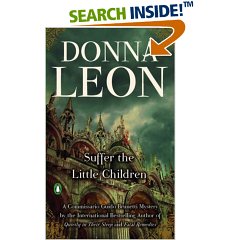
In this book, a Doctor and his wife are invaded in the middle of the night by the carabinieri, a kind of police in Venice. I am not sure how the two agencies differ, maybe it is like the difference between state police and local police in the US, but when the paper was faxed over coordinating with Brunetti’s office, it got lost somewhere, and the action was never coordinated, and Brunetti gets a call in the middle of the night.
The doctor and his wife have adopted a child illegally. They bought an unwanted child from an Albanian woman, paid for her pregnancy expenses, paid a huge fee to her, and then had the child taken from them. Here is the saddest part of the story – the child’s mother doesn’t want the child, the illegally adopting parents want him back desperately, but the child is sent to a state orphanage, because of the illegal adoption.
It is a very sad book.
Here is why I read Donna Leon – some of her paragraphs are just brilliant. Memorable. Unforgettable.
“Brunetti’s profession had made him a master of pauses: he could distinguish them in the way a concert-master could distinguish the tones of the various strings. There was the absolute, almost belligerent pause, after which nothing would come unless in response to questions or threats. There was the attentive pause, after which the speaker measured the effect on the listener of what had just been said. And there was the exhausted pause, after which the speaker needed to be left undistrubed until emotional control returned.
Judging that he was listening to the third, Brunetti remained silent, certain that she would eventually continue. A sound came down the corridor: a moan or the cry of a sleeping person. When it stoped, the silence seemed to expand to fill the place.”
When you read Donna Leon, you forget you live anywhere else. For one brief moment, you become Venetian, you live in Guido Brunetti’s shoes. The speak the Venetian dialect, you think like a Venetian. What an escape!
The paperback edition will be out in April for $7.99 at Amazon.com for $7.99 plus shipping.
Very Funny Jeep Commercials
You have to watch this all the way to the end, when the music – and the mood – changes!
And them watch this one, I think it is called Sandbox, which was the one I was looking for first – reminds me of Qatar and Kuwait:
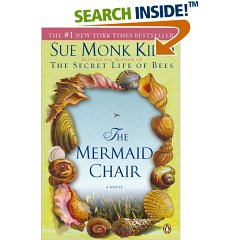
Sue Monk Kidd: Mermaid Chair
It took me a long time to buy this book, and an even longer time to read it. I kept reading the description, and I didn’t like it at all. But it kept popping up on the “recommended for you” list on Amazon, and I had this inner feeling that I was meant to read it, even if I didn’t particularly care to.
After treating myself to Leon and Bowen, I thought now was the time.
At first I found The Mermaid Chair a little Anne Rivers Siddon-ish – and I like Anne Rivers Siddons, and I don’t like imitations, which this felt like. And I thought to myself “Anne Rivers Siddons does it better.”
I kept reading, though. The book was intriguing, and I wanted to know what happened next.
Sue Monk Kidd wrote another book I really liked called The Secret Life of Bees in which I learned a lot about bees, and found the story wonderfully redemptive.
Sue Monk Kidd and Anne Rivers Siddons also share a love of the mystical, and the mystical in religion, and the mystical in human relationships, and the mystical in the sisterhood of women, all of which I find fascinating, and parts of which I would like to believe myself.
In this book, there is a lot going on. The main character is feeling stagnant and small, and invisible in her marriage. Her daughter has left for college, and she is oddly unable to find things in life to interest her. Then, her mother cuts off her finger, her mother’s friends call her to come to Egret Island, and she finds herself suddenly caught up in a whirlwind of emotions and torments that she can barely understand.
She has avoided returning to her Egret Island home to avoid the pain of her father’s death when she was 12, and her mother’s decent into moodiness and madness. She returns, meets a monk and falls in love, copes badly with her mother’s demons, and fights her way through her own personal crisis.
Sue Monk Kidd makes it all work. The work floats with artistic references; Gaugain, Matisse, Chagall, their mysterious, delightful women in particular float throught this book in Mermaid guises, and our heroine, Jessie Sullivan, discovers her own mermaid-within.
I won’t say that this is the best book I have ever read – it isn’t. I will say that I loved reading it. I loved the feel of living on Egret Island, with the tides and the birds and the small town friends, the local dog, the raininess and windiness of it all. I feel like I was there. I know the graveyard, I know the winding paths, I know those little golf carts everyone uses to get around. I know what it’s like to have to take a ferry to get to the mainland, I know the tidal currents of life’s more overwhelming moments.
As our Jessie binds her marriage back together, she says this:
Each day we pick our way through unfamiliar terrain. Hugh and I did not resume our old marriage – that was never what I wanted, and it was not what Hugh wanted either – rather we laid it aside and began a whole new one. Our love is not the same. It feels both young and old to me. It feels wise, as an old woman is wise after a long life, but also fresh and tender, something we must cradle and protect. We have become closer in some ways, the pain we experienced weaving tenacious lines of intimacy, but there is a separateness as well, the necessary distance. . . . .
I tell him, smiling, that it was the mermaids who brought me home. I mean, to the water and the mud and the pull of the tides in my own body. To the solitary island submerged so long in myself, which I desperately needed to find. But I also try to explain they brought me home to him. I’m not sure he understands any more than I do how belonging to myself allows me to belong more truly to him. I just know it’s true.”
This is a good read. It’s worth its reputation, it’s worth picking up and reading through. While some might think it’s very much a chick book, I suspect men reading it might also find a lot with which to identify. You can find this book at Amazon.com (disclosure: yes, I own shares in Amazon) for about $11.20.
Leon: Friends in High Places

After reading two stinkers, I needed a read I could rely on for a good fix. I needed escape, mixed with good food, good clothes and some social awareness. I needed Guido Brunetti, Donna Leon’s Venetian detective, and his smart, savvy wife Paula, and his family meals of pasta with soft shell crabs and risi e bisi, his children, his disgust for the politics that impinge on his doing his job.
If you think Kuwait has “wasta” (doing business by connections, influence, calling in favors), you aint’ seen nuthin’ till you’ve seen how Byzantine Venetians operate.
Friends in High Places opens with Commissario Brunetti lying on his couch re-reading Anabasis when he receives a visit from a building inspector, who determines that the apartment he owns, on the very top of a building in Venice, was probably built illegally – there are no plans or restoration approvals on file at the bureaucracy regulating residential buildings in Venice – and may have to be torn down.
Wouldn’t that be a shock? It’s a shock to Brunetti and to his family, just as it would be to us. We learn all the ins and outs of housing codes, the impact of becoming part of the EEC, and how the clever Venetians devise ways around the codes, all while Brunetti is investigating one murder – and then three other murders.
It is a VERY satisfying book. I will share with you a lengthy quote from Friends in High Places as Guido and Paola discuss how to deal with the problem:
At no time did it occur to him, as it did not occur to Paola, to approach the matter legally, to find out the names of the proper offices and officials and the proper steps to follow. Nor did it occur to either of them that there might be a clearly defined bureaucratic procedure by which they could resolve this problem. If such things did exist or could be discovered, Venetians ignored them, knowing that the only way to deal with problems like this was by means of conoscienze: acquaintances, friendships, contacts and debts built up over a lifetime of dealing with a system generally agreed, even by those in its employ, perhaps especially by those in it’s employ, prone to the abuses resultant from centuries of bribery, and encumbered by a Byzantine instinct for secrecy and lethargy.
I am sorry to tell you that the only copy of this I could find on Amazon.com cost $99.98. I must have bought this one in England, where, I promise you, it was the normal cost of a paperback book.
I will warn you in addition, I was looking forward to reading a second Leon novel, Quietly in their Sleep, only to discover when I started that I had already read it, as The Death of Faith. The books published by Leon in England are often retitled for the American market. Leon fans, beware!
Recent Comments
intlxpatr on Yellowstone: Old Faithful to C… Michelle on Yellowstone: Old Faithful to C… Cathy on No Grown-Ups in Charge intlxpatr on Waiting for Snow intlxpatr on Waiting for Snow Wikipedia Donate Button

Amazina


Early Voting in Florida


 Here There and Everywhere