Sinkholes in Florida
Dont you just love Google? Today I asked Google to find “images sinkholes Florida” hoping I could find some graphic which would show me how often they occur in parts of the state, which is very very long. There it was.

It is not something I ever worried about until the neighborhood we bought a house in near Tampa suddenly had a rash of sinkhole damage and property values plummeted. I was lucky, not only was I not in the “band” of sinkholes, but my house sold very quickly, at the same price we had paid. I breathed a sigh of relief and moved on.
You never know where a sinkhole will suddenly appear, but as the graphic above demonstrates, some places are likelier than others.
Here is an article from today’s AOL Weather News:
ORLANDO, Fla. (AP) – Sections of a building at a resort near Orlando’s theme park district collapsed into a sinkhole late Sunday, forcing the evacuation of 105 guests in the structure and also dozens of visitors staying in two adjacent three-story buildings.

Watch out for those blue zones!
Sinkholes are as much a part of the Florida landscape as palm trees and alligators. Florida has more of them than any state in the nation. Earlier this year, a man near Tampa died when a sinkhole opened up underneath his bedroom.
PHOTOS ON SKYE: Astonishing Sinkholes Around the World
Experts say sinkholes aren’t occurring at a greater rate than usual but that the high-profile nature of recent one in populated areas has drawn attention to them. There also has been a rise in sinkhole claims in Florida, but insurance officials believe some of those claims are questionable. Here are some answers about why sinkholes form and their costs.
WHY ARE THERE SINKHOLES IN FLORIDA?
Florida’s peninsula is made up of porous carbonate rocks such as limestone that store and help move groundwater. Dirt, sand and clay sit on top of the carbonate rock. Over time, these rocks can dissolve from an acid created from oxygen in water, creating a void underneath the limestone roof. When the dirt, clay or sand gets too heavy for the limestone roof, it can collapse and form a sinkhole. Sinkholes are caused naturally but they can be triggered by outside events.
WHAT TRIGGERS SINKHOLES?
Although sinkholes are formed naturally, they can be triggered by heavy rainfall, drought followed by heavy rainfall, tropical storms and human activity. The most common actions by humans that cause sinkholes are heavy pumping of groundwater to spray on oranges and strawberries during freezes to keep them from being damaged, well drilling, excavating, creating landfills, leaking broken water lines and pounding or blasting from construction.
WHERE ARE SINKHOLES MOST COMMON IN FLORIDA?
Three counties in the Tampa region are known as “sinkhole alley.” Two-thirds of thesinkhole damage claims reported to the state Office of Insurance Regulation from 2006 to 2010 came from Hernando, Hillsborough and Pasco counties. Sinkholes are less common in South Florida, home to the state’s two most populous counties – Broward and Miami-Dade.
HOW MANY SINKHOLES OCCUR IN FLORIDA?
The state Office of Insurance Regulation says reported claims from sinkholes have risen in recent years. More than 2,300 claims were reported in Florida in 2006 but that figure jumped to almost 6,700 claims in 2010. There is no geological explanation for the rise and state insurance officials believe many claims are questionable. There must be structural damage to a home for a policyholder to claim a loss from a sinkhole, but insurance officials say claims are often paid without that proof.
HOW MUCH DAMAGE DO SINKHOLES DO?
The state Office of Insurance Regulation says sinkhole claims in Florida cost insurers $1.4 billion from 2006 to 2010.
Worse Than Crack Cocaine? Growing up Poor
From AOL Daily Finance Poverty damages children more than being born to a crack addicted mother. Poverty keeps children from attaining their full potention, and hurts us all as a society as a huge waste of potential resource:

In the 1980s, the crack baby epidemic was hard to ignore. Television show after television show, article after article proclaimed that children born to addicts of the increasingly prevalent “crack” cocaine were all-but-guaranteed to have birth defects, including extremely low IQs and severe emotional problems. This “lost generation,” commentators emphasized, would be incapable of forming relationships or reaching full emotional maturity. They would be, in the words of Washington Post columnist Charles Krauthammer, condemned to “a life of certain suffering, of probable deviance, of permanent inferiority.”
A little over 20 years later, Krauthammer’s predictions have proven almost embarrassingly inaccurate. Last week, the findings of a 24-year-long study of crack babies revealed that parental use of the drug had little or no direct effect on the children. In the process of investigating the babies, however, researchers discovered another environmental problem that did, in fact, lead to problems with depression, anxiety, cognitive functioning, and a host of other issues: poverty.
In 1989, Dr. Hallam Hurt, chair of the neonatology department at Philadelphia’s Albert Einstein Medical Center, began tracking 224 near-term or full-term children who were born to crack addicts. In the ensuing years, her longitudinal study followed the children, finding that, overall, their IQs were about the same as a control group of children of non-addicted mothers. Further, the children in Hurt’s study had comparable outcomes when it came to educational and emotional development.
That having been said, Hurt’s study found that children raised in poverty — regardless of whether or not their mothers were addicted to crack — tended to have lower IQs and lower school readiness than those who weren’t raised in poverty. A big part of the problem, she argues, is environmental: Of the children in her study, “81 percent of the children had seen someone arrested; 74 percent had heard gunshots; 35 percent had seen someone get shot; and 19 percent had seen a dead body outside.” The children themselves acknowledged the effect of these events: “Those children who reported a high exposure to violence were likelier to show signs of depression and anxiety and to have lower self-esteem.”
In other words, while prenatal crack abuse may not have a major effect on children, the societal conditions in crack-ravaged communities most certainly do. As Hurt emphasized, “Given what we learned, we are invested in better understanding the effects of poverty. How can early effects be detected? Which developing systems are affected? And most important, how can findings inform interventions for our children?” Or, to put it another way, now that we understand that poverty is more dangerous for children than crack, what can we do to protect our children from its effects?
In Florida, the worst schools are those serving the poor. Many fell a full grade point in the Florida evaluations and would have fallen further if there were not a law – I am not kidding – that says they can only fall one grade point in a year. We are failing in the two most important areas that can help children pull themselves out of poverty – good health care, and good education.
Uwem Akpan and Say You’re One of Them

This is a very troubling book, and, for me, a difficult book to read. It has taken me weeks, and I will admit I have often interrupted the reading of it to read other, easier books. This book makes me very uncomfortable. The stories and images trouble my sleep.
Uwem Akpan is of the tribe of Annang, from Nigeria, and has committed to an even larger tribe, the Catholic Church, of which he is a priest, and this gives him a unique perspective. The stories in this book often focus on tribal differences, including religious differences, and although they are set in different African states, have parallels in lives lived elsewhere. Those tribal differences are between Moslem and Christian, but also between Pentecostal and Catholic, Tutsi and Hutu, and, most significantly, the differences between to tribe of the very poor and the very rich.
Each story is told through the eyes of a child living in a different African state – Kenya, Benin, Ethiopia, Nigeria, Rwanda.
In one of my favorite segments of the book, strife has broken out in Nigeria, strife between the Moslems and the Christians, but also throw in the Pentecostals and the Pagans and really mix it up. A bus is waiting in the bus station to take people back to the southern part of Nigeria, and on this bus is a young man, half Moslem, half Christian. The bus stands idle for hours, while the bus driver seeks fuel to make the trip. During this time on the bus, many conversations take place, and what I loved was how alliances shifted with each conversation. The people on the bus were from different traditions, but came together as a community. No community is without arguments and dissensions, however, and consensus builds, diminishes, shifts – it is a microcosm of the tensions and stressors pulling apart the Nigerian nation state.
Uwem Akpan treats the children in each story lovingly, treasuring their innocent perspective and the sweetness of their hearts and vision. The adults don’t come off so well, passing their days in drug-induced stupors, drunk, selling children into slavery and prostitution, chopping off their limbs with machetes, and closing themselves off into groups which protect themselves and exploit others.
It would be an easier book to read if it were about aliens, or if these stories were confined to Africa, but the stories of these abused, neglected and exploited children echo in every continent, country and city in the world.
Uwem Akpan writes prose that is poetry; the surroundings are described with such detail that you feel in the moment, you see through the eyes of each child, and you see things that are beautiful as well as scenes you did not want to see. As you can see, I have a lot of ambiguous feelings about this book. At the same time I can admire the writing, the stories have left images in my mind that cannot be erased. Dark images. There is hope in the persistence and resilience of many of the children, but concern about their long term survival. It leaves a heavy weight on my heart.
The Official Worst Drivers in America: Miami
Slate.com has figured out which city has the worst drivers in America: Miami, Fla.
Slate looked at years of data about traffic accidents, automotive fatalities, alcohol-related driving deaths and pedestrian strike rates as indicators of bad driving.
Three out of the five cities with the worst drivers are found in the Sunshine State, with Miami topping the list as the absolute worst. Miami is first in auto fatalities and pedestrian strikes and, according to Slate, first in “obscenity-lace tirades of their fellow driver”. Fellow Floridian cities Hialeah, which comes in at number three, and Tampa at number four also seem to host a populace with a passion for running down pedestrians and fatal car accidents.
Miami shows up on more than just Slate.com’s worst list. The Huffington Post reported that Miami also had the most hit-and-runs in Florida last year, an incredible 35 a day. Transportation for America also ranked the most dangerous cities in America to drive in, with the top four all in Florida. Maybe Floridians should look into buying heavy-duty trucks and steering clear of sidewalks.
From the original report at Slate.com where you can read the entire article:
Adjusting the Allstate rankings for mileage this way has significant effects. Washington, D.C. remains the worst driving city using the insurance claims data, but Philadelphia surges to second worst. Hialeah drops seven places, from fourth to 11th.
Next we consider additional indicators. Car crashes are bad, but some accidents are worse than others. In July 2012, the Centers for Disease Control and Prevention published automobile fatality data for major cities and metropolitan statistical areas from the year 2009. It’s useful for our purposes, but it comes with a couple of caveats. The researchers didn’t publish data for some of the smaller cities on our list. In those cases, we’ll use data from the larger metropolitan area. In addition, three cities (Boston, Newark, N.J., and Providence) had fewer than 20 fatalities, but the precise number is unpublished. We’ll assume that each of these cities had 10 fatalities, so we have a number to enter into the calculations.
Drunk drivers are bad drivers, and some cities have far more of them than others. Not all locales publish reliable data on drunk driving fatalities, so we’ll turn to the Century Council, an association of distillers organized to combat drunk driving. The group published the number of fatalities from alcohol-related car accidents in 2011. The data are, unfortunately, broken down by state rather than city. So, for our purposes, the sins of the state will be visited upon the cities. (New York City has reliable data, so we can use city-specific data in that instance.) We can’t adjust the statewide data for mileage, because our mileage numbers relate only to cities themselves. So DWI fatalities will have to be computed per capita, unadjusted for how many miles residents of a city drive.
Pedestrian strikes are another key metric. For this indicator we turn to the CDC’s WONDER, a searchable database of morbidity and mortality statistics. It’s a priceless epidemiological tool as well as a bottomless source of trivia. The most granular data on pedestrian injuries and deaths is by county.
You might object to the use of pedestrian injuries as a metric of driver incompetence, because some cities have far more pedestrians than others. That’s a fair point, but consider New York City. It is, by far, the most walked city in the United States. Two-thirds of New Yorkers either walk or use public transit to get to work. According to the website WalkScore.com, only 2 percent of New Yorkers live in neighborhoods where cars are necessary. While every pedestrian strike is a tragedy, there are fewer in New York than you might expect. Miami-Dade County, a significantly less walked city, had 20 percent more pedestrian strikes per mile driven between 2006 and 2010 than New York.
. . . . .
And now, America, on to the cities with your worst drivers.
No. 5: Baltimore. Baltimoreans just can’t keep from running into each other. They were outside the top 10 in fatalities, DWI deaths, and pedestrian strikes, but their rate of collision couldn’t keep them out of the top five overall.
No. 4: Tampa, Fla. Tampa doesn’t do any single thing terribly, but it is consistently poor: 18th worst in years between accidents, fifth in traffic fatalities, tied for 11th in DWI fatalities, and 10th in pedestrian strikes. If the city had managed to get outside the bottom half in any individual category, Tampa residents might have avoided this distinction.
No. 3: Hialeah. The drivers of Hialeah get into a middling number of accidents, ranking 11th among the 39 candidates. But when they hit someone, they really mean it. The city finished third for fatalities. They also have a terrifying tendency to hit pedestrians.
No. 2: Philadelphia. Drivers in the city of brotherly love enjoy a good love tap behind the wheel. Second-places finishes in collisions and pedestrian strikes overwhelm their semi-respectable 16th-place ranking in DWI deaths.
No. 1: Miami. And it’s not even close. First in automotive fatalities, first in pedestrian strikes, first in the obscenity-laced tirades of their fellow drivers.
A couple of other noteworthy findings: Californians did reasonably well. Although the Golden State had seven cities among our 39 candidates, only Glendale finished in the top half of the table. Louisiana’s two entries, Baton Rouge and New Orleans, finished 6th and 15th, owing to the state’s terrible record of drunk driving fatalities.
Washington, D.C., the whipping boy of the Allstate rankings, dropped to 16th, owing to low numbers of DWI fatalities. Boston drivers don’t deserve the torment they receive. They have few automotive fatalities and rarely kill people in alcohol-related accidents. It goes to show how flawed opinion polls can be.
World’s Most Expensive Cities for Expats
By Mark Johanson
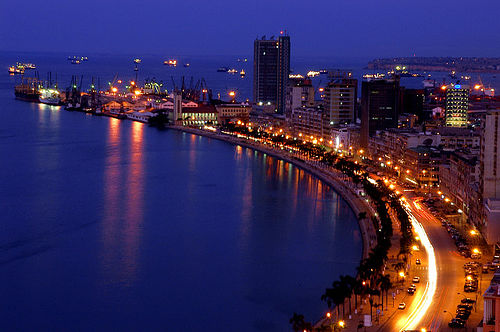
Where is the world’s most-expensive city for expatriates? It’s not notoriously pricey Tokyo. It’s not wallet-shrinking Sydney, Moscow or Oslo. And it’s definitely not surprisingly cheap New York City. Rather, it’s an African seaport you’ve probably never heard of: Luanda, Angola.
This finding from U.S. consulting firm Mercer underscores its annual survey’s purpose: to assess the cost of living around the world so that multinational companies and governments can determine appropriate compensation allowances for their expatriate employees. After all, more than half of oil-rich Luanda’s 5 million residents live below the poverty line.
“Despite being one of Africa’s major oil producers, Angola is a relatively poor country, yet expensive for expatriates since imported goods can be costly,” Barb Marder, senior partner and Mercer’s global mobility practice leader, said. “In addition, finding secure living accommodations that meet the standards of expatriates can be challenging and quite costly.”
Mercer noted in the survey that the difference in cost of various everyday items could be dramatic from country to country. The average cup of coffee, for example, costs about $1.54 in Managua, Nicaragua, while it costs $8.29 in Moscow. A fast-food hamburger meal in Kolkata, India, costs $3.62, compared to $13.49 in Caracas, Venezuela. A ticket to the cinema, meanwhile, can run between $5.91 in Johannesburg and up to $20.10 in London.
Cost of accommodation was another major factor Mercer looked at, and a one-month unfurnished luxury rental in Hong Kong topped the world at about $7,092 — more than 20 times as much as in Karachi, Pakistan. Yet, it was Moscow that crept in just below Luanda as the second-most expensive city for expats, followed by Tokyo, Chad’s capital city of N’djamena, and Singapore.
“Recent world events, including economic and political upheavals, which resulted in currency fluctuations, cost inflation for goods and services, and volatility in accommodation prices have impacted these cities making them expensive,” Marder explained.
Mercer assessed a total of 214 cities across five continents for its 2013 survey, analyzing data from March 2012 to March 2013. Cities were then ranked by the price of housing, transport, food, entertainment and clothing, and ordered on the joint cost of 200 items compared to the benchmark, New York City.
“Given the increasing numbers of business travelers, global ‘commuters’ and longer-term expatriates, companies are keeping a close eye on the cost of living for international assignees in different cities around the world,” Marder said, explaining the purpose of the study. “Organizations need to evaluate the impact of currency fluctuations, inflation, and political instability when sending employees on overseas assignments while ensuring they can facilitate the moves they need to drive the business results by offering fair and competitive compensation packages.”
Nathalie Constantin-Métral, principal at Mercer with responsibility for compiling the survey ranking, said that, overall, cost of living went up across parts of Europe, while it went down in much of Asia. Japan dropped significantly from last year due to a weakening of the yen against the U.S. dollar.
In the Americas, meanwhile, South American cities were the most expensive for expatriates, while Canadian cities moved down in rankings due to a slight decrease of the Canadian dollar against the U.S. dollar. New York remained the most-expensive urban center in the U.S.
“Overall, U.S. cities either remained stable in the ranking or have slightly decreased due to the movement of the U.S. dollar against the majority of currencies worldwide,” Constantin-Métral said. “Yet several cities, including New York, moved up in the ranking due to a rise in the rental accommodation market.”
You Are Not My Friend
I Have a pet peeve. I may have even ranted about this before, but it makes my blood boil.
From time to time, I will get a call from a person working at a financial institution. Or it may be a message on my machine, saying I need to call them about an account. They start out all collegial and friendly, then they want to give me financial advice.
Excuse me? You “noticed” we have money sitting in X account that could be working harder? Mind your own business! If you are going to take a percentage for rolling my money from X to Y, if you are going to take a fee for this service – then this is not friendly advice. Don’t pretend to be my friend.
AdventureMan laughed out loud once when I told the man to annotate our file NEVER to call with financial advice, that I still have all my marbles and I know what I am doing. Every now and then if he wants to make me laugh, he will fake this high voice and say “I still have all my marbles!” It never fails to crack me up; I don’t get angry often, but when I do, I say the most amazingly hilarious things.
I think what makes me outraged is that I still DO have my marbles, and AdventureMan and I have worked hard to make sound financial decisions. We decided long ago that no one cares about our money the way we do, and that we would make our own decisions. We ask for input – we get answers online, we read reviews and analyses, we ask questions of friends we respect. We make informed decisions. One of the secrets to growing investment money and holding on to it is to choose wisely and to minimize trading.
Most of these calls take advantage of people feeling inadequate when it comes to money management, especially the elderly and lonely. They make it seem like the target has a new and caring friend, a knowledgeable friend, who only wants to help. The new friend builds trust, until the target invests in the recommended product, and then . . . huh – they don’t hear from their new friend again, or not for a long while, when the friend has another idea for their money.
You are not my friend. I don’t want your great new ideas about where I should move my money; I understand that this is your job and that there is something in this for you. What you are talking about is an opportunity – it’s like cotton candy, all puffy and pretty but full of air. I know you wouldn’t be calling me if there were not something in this for you. Don’t call me. You are not my friend.
🙂 And I still have all my marbles 🙂
Yemeni Girl Escapes Child Marriage
This little girl is lucky; she has a sympathetic uncle who protected her when her own mother, twice, tried to sell her into marriage.
She is an amazingly articulate and resourceful little girl. I look forward to seeing the woman she grows into, safe under her uncle’s care. I love it that he convinced one prospective husband that she was not modest enough to be his bride 🙂
In a bone-chilling three minutes, a young girl who evaded child marriage tells the world that she would “rather die,” than be forced to undergo an arranged marriage.
After learning that her parents had plans to marry her off to a wealthy suitor, brave Nada al-Ahdal of Yemen risked her life and fled to the refuge of her uncle. The precocious little girl, who saw how her teenage aunt took her own life after being abused in an arranged marriage, shared in a harrowing translated video the cruelty of the child bride practice.
“I would have had no life, no education. Don’t they have any compassion?,” Nada asks. “I’m better off dead. I’d rather die [than be forced into a marriage].”
According to NOW News, Nada’s uncle, Abdel Salam al-Ahdal, a montage and graphics technician at a TV station, has protected his niece from being married off twice. Nada’s parents first accepted an offer from a wealthy expatriate, but al-Ahdel intervened and told the prospective groom that Nada was not nearly modest enough for him, in order to “scare him off.”
“When I heard about the groom, I panicked,” he told NOW. “Nada was not even 11 years old; she was exactly 10 years and 3 months. I could not allow her to be married off and have her future destroyed.”
When Nada’s mother tried once again to marry off her daughter against her will, Nada — despite threats that she could be killed — fled to her uncle’s once more, and filed a complaint with the police. She’ll now be living with al-Ahdal permanently.
But such forced marriages, like Nada’s, are on the rise across the globe.
According to a World Vision study released in March, more child brides are being led into arranged marriages due to an increase in global poverty and crises. Parents who live in fear of natural disasters, political instability and financial ruin look to arranged marriages as a way to save their struggling families.
Every day, 39,000 girls, younger than 18, will marry, according to the World Health Organization.
“Women have no rights to give an opinion in the family,” Humaiya, a 16-year-old from Bangladesh who managed to escape marriage, told The Huffington Post in March. “My father didn’t listen.”
Nada, whose video on YouTube has already garnered more than 2 million hits, hopes that the world will hear her message loud and clear.
“They have killed our dreams. They have killed everything inside us,” Nada said in the video. “This is no upbringing. This is criminal, simply criminal.”
Rape Victim Spends Seven Months in Jail, Framed by her Rapist
This is from the New York Times City Blog:
Man Is Sentenced for Raping Ex-Girlfriend and Then Framing Her
By DAN BILEFSKY
Updated 5:42 p.m. | The Queens private detective who raped his ex-girlfriend and then framed her for a series of fictional crimeswas sentenced to the maximum of 32 years in prison on Wednesday, bringing to a close one of the most bizarre cases to grace a courtroom.
Using knowledge he acquired partly from watching crime dramas like “C.S.I.,” the private detective, Jerry Ramrattan, 39, orchestrated what prosecutors in Queens called one of the most elaborate frame-ups in recent history.
Mr. Ramrattan’s ex-girlfriend, Seemona Sumasar, 36, had accused him of raping her. After she refused to drop the rape charges, he concocted a schemethat landed her in jail for seven months, making it seem as though Ms. Sumasar was the likely perpetrator of a series of brazen armed robberies, for which she was accused of impersonating a police officer.
At his trial in State Supreme Court in Queens, prosecutors produced evidence that Mr. Ramrattan cajoled and extorted witnesses to falsely testify that she had robbed them. He even staged fake crime scenes, prosecutors said, in which he planted evidence, handcuffing one of Ms. Sumasar’s supposed victims to a pole and planting several bullets at the scene of one of the imaginary crimes.
Before Mr. Ramrattan was sentenced on Wednesday, Ms. Sumasar delivered a stinging victim impact statement, noting that he showed no remorse and was so intent on revenge that he would have stopped at nothing to destroy her. “I don’t have words for you,” she said as as he stared ahead, stone-faced, while she spoke. “You are pure evil. You are a sociopath. You need help.”
“Someone needs to put a stop to your madness,” she added.
During her seven months in jail, awaiting a robbery trial, Ms. Sumasar, a former Morgan Stanley analyst, was separated from her young daughter. She lost her business, and her house went into foreclosure. Her bail was set at $1 million, which she could not afford. Mr. Ramrattan, meanwhile, was free until an informant came forward in late 2010 and exposed his plot.
Mr. Ramrattan was convicted in November of a series of charges, including rape, conspiracy and perjury. The nearly monthlong trial offered two opposing plot lines that were seemingly irreconcilable. Prosecutors portrayed Ms. Sumasar as a single mother duped by a wily confidence man intent on malicious vengeance. But the defense characterized her as a dejected lover who had turned on Mr. Ramrattan after he said he was leaving her to return to his wife and family.
Members of the jury said the guilty verdict was predicated on their acceptance of Ms. Sumasar’s account of being bound with duct tape and viciously raped by Mr. Ramrattan, which apparently gave him a motive to create his ruse.
In his plea for leniency, Mr. Ramrattan insisted that he was innocent, saying that he had spent years helping the police solve cases as an informant. “I stand before you with no choice but to accept what is going to happen,” he said. “Think about all the cases I made over the years, the rape victims I assisted. I maintain my innocence.”
Before he was escorted away by police, he added: “There is more to come.” As he spoke, his mother, Shirley Ramrattan, began wailing and was escorted from the courtroom.
His lawyer, Frank Kelly, told the judge that Mr. Ramrattan was not the “monster” he had been made out to be.
But Justice Richard Buchter said Mr. Ramrattan deserved no mercy, calling him a “diabolical conniver and sinister manipulator” who had “shamelessly exploited the criminal justice system.”
The Queens district attorney’s office and the Nassau County district attorney’s office had insisted on Ms. Sumasar’s guilt up until she was freed just weeks before her own robbery trial was set to begin. Ms. Sumasar filed a civil suit in December against the New York City Police Department and the Nassau County Police Department for negligence leading to her wrongful imprisonment..
Justice Buchter railed against the Nassau County police, who had wrongly imprisoned Ms. Sumasar, saying that it did not take “a Sherlock Holmes” to deduce that a 5-foot-2 former Wall Street analyst with no criminal record would not have held people up at gunpoint.
He chastised the police for their egregious handling of the case, saying detectives had “turned a blind eye” to Ms. Sumasar’s protestations that she was innocent and had too easily been taken in by Mr. Ramrattan.
“The police were duped by liars by whom they had a right to be suspicious, and as a result a rape victim was framed by her rapist,” the judge said. “She was victimized by the rapist and then again by the criminal justice system.”
He added: “The defendant is the architect of his own ruin. He deserves no mercy from me, and he won’t get any.”
The Shrink-Wrapped Pensacola Specialty Pawn Shop Car
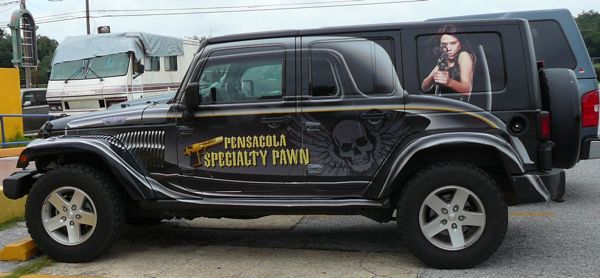
How cool is this? We saw this car at Taco Rock and loved the optical illusion. We also loved it that the car makes a memorable impression; you’ll think of it and you will think Pensacola Specialty Pawn. It’s an effective ad if you remember who the ad is for 🙂
When we walked inside, AdventureMan asked “Whose car is that with the mobster paint job?” and a guy picking up a take-out order grinned and said it was his. He told us it was a shrink-wrap technique – it’s temporary! When you get tired of it and want to try something else, it just peels off and you put something else on. I think that is so totally cool.
Recent Comments
ExpatAlien on What Country am I Living … intlxpatr on Yellowstone: Old Faithful to C… Michelle on Yellowstone: Old Faithful to C… Cathy on No Grown-Ups in Charge intlxpatr on Waiting for Snow Wikipedia Donate Button

Amazina


Early Voting in Florida


 Here There and Everywhere