Florida Ranks #1 in the Nation for Identity Theft and Fraud; Pensacola #10 Beauty-Obsessed City in US

Just yesterday, I gasped when I learned that Time Magazine ranked Pensacola of all the cities in the USA, #10 in “Obsession with Beauty” as measured by internet access to sites for buying make-up and cosmetics at sites like Sephora and Ulta. New York and Miami didn’t make the list.
Then I understood. We don’t have a Sephora in Pensacola. We don’t have an Ulta. To get specialized make-ups like Urban Decay, you go online, to Sephora. Yep. Guilty. But it must take a lot of Pensacolians buying a lot of make-up online to make us #10 of all the beauty-obsessed cities in the USA.
“You Brought the Sunshine!”
When I arrived in Seattle, my best friend from University said “You brought the sunshine!”

(This week’s weather in Seattle)
Now, when I fly back to Seattle, it takes a mere half day, not a day and a half. When I leave early enough, I can arrive mid-day, and beat the rush hour traffic. You’d think after driving in Kuwait and Qatar that I would find Seattle traffic tame, but Germany, with it’s wide-laned autobahn, and Pensacola, with it’s laid back version of going-home traffic have spoiled me.
Seattle is beautiful, although my trip is one of those more stressful ones, with things to be done to manage changing circumstances. My Mom may – or may not – have had a stroke. What is verifiable is that she has been very very sick, too sick to live on her own any longer, sick enough to need hospitalization, and professional monitoring from now on. The sisters have handled mountains of work and desperate calls for assistance, and now it is my turn to do what I can.
I stayed in Mom’s condo, but it was a little soulless, all her favorite pieces of furniture moved to her new place, her plants languishing, the stuff and detritus of life waiting to be cleared out.
Thank God for my best friend, and for the sunshine.
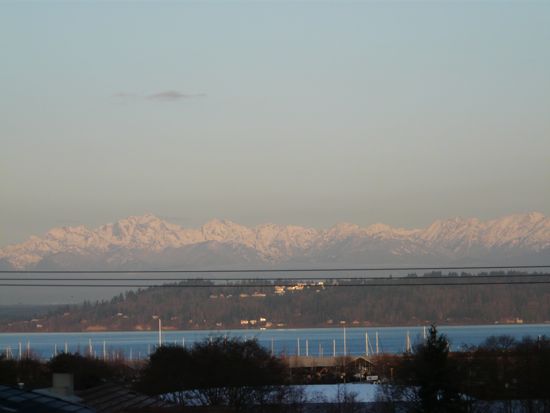
The sun just beginning to color the mountains as it rises off in the east.
The sisters had a full day of business, money, finances, and Mom’s recovery plan. We get a little goofy after a while; it’s a family culture. Our way of handling the worst, worst of times is laughter, and there were several times we were almost breathless from laughing. Yeh, I guess some would find it inappropriate, but for us, for our family, I think it is how we survive.
My second day there, we had a joyful family wedding. It was one of the sweetest events I have attended in a long time, and I loved the way the bride and the groom looked at each other, that they enjoyed their own wedding, smiling, laughing, dancing. Their signature was over everything; the colors (Purples!) and the food and the music and the ceremony, it was all perfectly thought through and delightful.
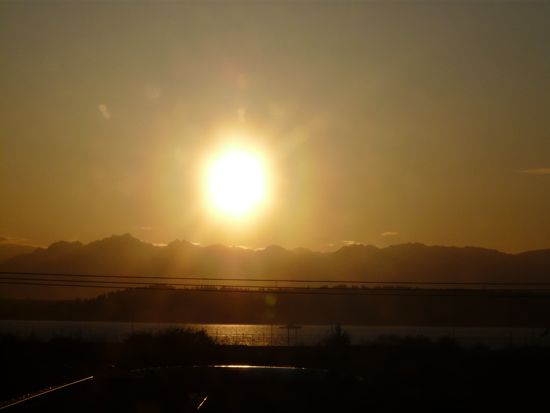
Sun setting in the west over the Olympic mountains
The rest of the trip was just hard work. And now, back in Pensacola, I have flights booked already for my next trip back. All part of life’s circle, I guess.
Through all this, we have met with kind, helpful people, who have made all the sorting out easier. Thanks be to God.
Qatar’s Balancing Act (from National Post)
Fascinating article on Qatar – thank you, John Mueller, who sends me these great news articles.

From the National Post
Qatar’s balancing act
Fadi Al-Assaad, Reuters Files
Qatar’s Emir, Sheikh Hamad bin Khalifa Al-Thani, has steadily built a reputation for mediation and seeks to be regarded as an “honest broker” in the Middle East.
TwitterEmail
inShare
Peter Goodspeed, National Post · Feb. 25, 2012 | Last Updated: Feb. 25, 2012 5:16 AM ET
The tiny country of Qatar used the slogan “Expect the Amazing” when it successfully bid to host soccer’s 2022 World Cup.
It’s a phrase that could summarize the reign of Emir Sheik Hamad bin Khalifa Al-Thani, who in just 17 years has turned a small Arabian peninsula of salt and sand flats, once one of the poorest countries in the Persian Gulf, into the world’s richest country and possibly the Middle East’s most influential state.
A former British protectorate, which was noted for its declining pearl fishery when it became independent in 1971, Qatar was once described by the Lonely Planet Travel Guide as “possibly the most boring place on Earth.”
Now, according to the World Bank, its 250,000 citizens and 1.5 million foreign workers have the highest per capita income in the world (US$84,000, twice that of the United States) and an economy that outstripped China by growing 15.8% last year.
Since 2006, Qatar has been the world’s largest exporter of liquefied natural gas and the kingdom is transforming its new wealth into worldwide influence.
Qatar recently led the Arab League’s expulsion of Syria and, on Friday, called for the creation of an Arab military force to open humanitarian corridors to protect civilians in Syria.
Last month, it allowed Afghanistan’s Taliban to open an office in Doha to facilitate peace talks with the U.S.
And in the spring, it was the first Arab country to recognize the rebel government in Libya.
The emirate sent six Mirage fighters to Crete to help NATO enforce a no fly zone over Libya.
It also supplied rebels with the fuel, weapons, cash and the training they needed to overthrow dictator Muammar Gaddafi. Qatari special forces provided basic infantry training in the Nafusa Mountains, west of Tripoli and some helped lead the final assault on Col. Gaddafi’s compound in the capital.
They were so proud of their achievement, they hung a Qatari flag from the wreckage of his palace.
“The Qataris have really adopted a kind of adventurous foreign policy in the last couple of years and shown a willingness to send special forces to these kind of areas of conflict,” said Andrew McGregor, senior editor of the Global Terrorism Monitor for the Jamestown Foundation.
“They’ve used their considerable wealth to supply arms and whatever else is needed.
“I would be keeping a close eye on what they are doing [in Syria]. They are rapidly emerging as a real power in the Arab League, despite their size. They are very influential and very wealthy, and they have shown a willingness to be engaged.”
The Emir, Sheikh Hamad bin Khalifa Al-Thani, sometimes referred to disparagingly as the “Arab World’s Henry Kissinger,” has steadily built a reputation for mediation and seeks to be regarded as an “honest broker” in the Middle East.
“Since the mid-1990s, Qatar has pursued an activist foreign policy, using its affluence, unthreatening military position and skills as a mediator to interject itself in conflicts around the Middle East and beyond,” said David Roberts, deputy director of the Royal United Services Institute’s Doha Centre.
In recent years, Sheikh Hamad has carefully inserted himself in conflicts in Libya, Lebanon, Gaza and the West Bank, Sudan, Syria, Yemen and Afghanistan.
In 2008, an agreement negotiated in Doha averted another civil war in Lebanon by establishing a power sharing agreement between the country’s different factions. Around the same time, Qatar helped negotiate a short-lived ceasefire in Yemen, mediated a border dispute between Djibouti and Eritrea, and hosted peace talks between Sudan and rebel groups in Darfur.
A regional actor with international reach, Sheikh Hamad has pursued a foreign policy that is ripe with conflicts and contradictions.
Qatar maintains good relations with Iran, while still offering the U.S. its biggest and most important air base in the Middle East at al-Udeid, a few kilometres outside Doha.
Unlike most Arab states, Qatar has generally had good relations with Israel and allowed the Israelis to maintain a commercial office in Doha until the 2009 Gaza invasion.
At the same time, it has warm relations with Israel’s enemies Hamas and Hezbollah, and provides safe haven to hardline Islamists from all over the Arab world.
Leaders of the Muslim Brotherhood in Egypt and Syria fled to Qatar in the 1960s and 1970s, even though the kingdom’s rulers frown on organized political Islam and ban all political parties.
Qatar “has a reputation for ‘omni-balancing’ between seemingly incompatible policies,” said Kristian Coates Ulrichsen, a Gulf expert at the London School of Economics.
“Qatar’s rise, seemingly from nowhere, is rooted in deeper political, economic and security shifts and, in turn, is reconfiguring the balance of regional power.”
Those changes highlight Sheikh Hamad’s own rise to power and his reign in Qatar, where his family has ruled since the 19th century.
Raised by a maternal uncle’s family, after his mother died young, the Emir attended the Royal Military Academy at Sandhurst, west of London, graduating in 1971, the year Qatar won its independence and when its first natural gas field was discovered.
He was made a lieutenant colonel in Qatar’s army and, after his father deposed an uncle to become emir in 1972, he rapidly rose to become commander-in-chief of its armed forces.
As crown prince, Sheikh Hamad was gradually given the power to run the country day-to-day, while his father cultivated a taste for extravagance and spent most of his time on the French Riviera.
Sheikh Hamad oversaw development of Qatar’s oil and gas industry and carefully planned an economy that provides Qataris with free education, health care, housing and utilities – and no taxes.
But when his father returned home briefly in 1995 and arbitrarily demoted another son from his position as prime minister, Crown Prince Sheikh Hamad staged a bloodless coup. He informed his father by telephone while he was holidaying in Switzerland.
The old emir returned to the Gulf the following year, publicly disowning his son and trying to drum up support for a countercoup, but Sheik Hamad snuffed out the plot by freezing billions of dollars in his father’s overseas bank accounts.
Then, just 44 and the youngest ruler in the Gulf, he set about to reform and redefine Qatar.
Surrounding himself with young, Western-educated advisors, he drew up a longterm plan to develop a post-oil knowledge-based economy.
He has allocated 40% of Qatar’s budget between now and 2016 to massive infrastructure projects, including an $11billion international airport, a $5.5-billion deep-water seaport and a $1-billion transport corridor in Doha, as well as $20billion in new roads.
He has also invited foreign universities to establish Middle East campuses in a $100-billion Education City in Doha.
Without an elected parliament to advise him, the Emir has final say in the disposition of the country’s $70-billion to $100-billion sovereign wealth fund, which has made it a financial powerhouse internationally by investing heavily in everything from German carmakers Porsche and Volk-swagen to the Agricultural Bank of China, Harrods department store in London, a Brazilian bank, Chinese oil refineries, a Spanish soccer team and a French fashion house.
The Emir’s most influential investment was his creation of the 24-hour Arab-language Al Jazeera television network in 1996.
Granted a level of editorial independence unheard of in the Arab world, Al Jazeera is encouraged to report freely and aggressively on everything but Qatari politics, and is the most watched TV network in the Middle East.
The broadcaster was widely regarded as one of the driving forces behind the spread of the Arab Spring.
“Qatar hopes to insert itself as the key mediator between the Muslim world and the West,” Mr. Roberts said.
“Qatar sees its role as a highly specialized interlocutor between the two worlds, making – from the West’s point of view – unpalatable but necessary friendships and alliances with anti-Western leaders.”
Sheikh Hamad Bin Jasem Al-Thani, Qatar’s Prime Minister and a distant cousin of the Emir, likes to say his country is small and has to be proactive to protect its interest and avoid being run over by more powerful neighbours.
“Our policy is to be friendly with everybody,” the Emir said recently in a television interview. “We are looking for peace. It doesn’t mean if two parties turn against each other, we have to go to one party. No, we would like to stick with the two parties.”
– Formerly a British protectorate, Qatar has been ruled by the Al-Thani family since the mid-1800s. The current Emir, Hamad bin Khalifa Al-Thani, overthrew his father in a bloodless coup in 1995.
– Oil and natural gas revenues have enabled Qatar to attain the highest per-capita income in the world (US$84,000 according to a report this year by Global Finance).
– Oil output at current levels should last 57 years, according to the CIA World Factbook.
– It has a zero unemployment rate and zero percentage below the poverty line.
– The mostly flat and desert land is 11,586 square kilometres – only slightly larger than Jasper National Park.
– It has a population of 848,016 – similar to the population of Edmonton.
SOURCE: NATIONAL POST NEWS SERVICES
JONATHON RIVAIT / NATIONAL POST
pgoodspeed@nationalpost.com
Australian Woman Scams the Nigerian Scammers
You gotta love this story. I found it on AOL HuffPost; I only wish she had been truly scamming them and not cheating them:
How does it feel when the tables are turned?
The Courier Mail in Australia reports that Sarah Jane Cochrane-Ramsey pleaded guilty last Thursday to one count of aggravated fraud for scamming Nigerian con artists out of $33,000.
Cochrane-Ramsey opened an Australian bank account that the Nigerians could use to funnel payments they got through their “dodgy account on a popular car sales website,” according to the Courier Mail.
The terms of her arrangement with the con artists said that Cochrane-Ramsey was supposed to keep eight percent of all monies sent to the account, with the rest going back to the Nigerians. Instead, she kept the money for herself.
Slate points out that Cochrane-Ramsey denied knowing she was working for fraudsters, thereby “denying herself the defense that she was somehow attempting to give her fellow scammers a taste of their own medicine.”
Nigeria’s The Nation notes that Cochrane-Ramsey is not the first person to con Nigerian scofflaws.
In fact, “This American Life” produced a story in 2008 on a group of people who made a Nigerian scammer travel 1,400 miles in search of a promised cash reward.
Photo by Flickr user B Rosen.
It’s All ‘Insh’allah’
(Forgive me if I ramble a little bit; New Year’s Eve day is always something of a day of reflection for me. It’s not something I plan, it’s something I just find myself compelled to do; I do it whether I want to or not.)
I joke with my friends that the Lord kept sending me back to the Middle East until I learned that it was less my mission to share, than to learn. Once I shut up and watched and listened, I began learning, and what I learned contradicted many of my ignorant prejudices. In learning about my friends in the countries of the Middle East, I learned a lot about our Christian culture, and about myself.
When Westerners first get to the Middle East, the phrase ‘Insh’allah’ (God willing, or ‘if God wills it’) makes them want to tear their hair out. When your heat breaks down in the midst of a cold winter (and yes, there are very cold patches in many Middle Eastern countries) and the heat people tell you ‘Insh’allah’ they will be there ‘in the afternoon’ but won’t give you an exact time, it makes us want to slam the phone down. When you make plans to meet up with a friend for coffee, set a time, and then she says she will see us ‘insh’allah’, we don’t know whether she is going to show up or not.
It was only after many many years in the Middle East that we relaxed and accepted ‘insh’allah.’ Now, living back in the USA, we laugh, because life here is insh’allah, too, it’s just that people don’t know it. We’ve had several things done with our house, and whether or not the workers show up – it’s all insh’allah. When making plans with our family, a lot depends on when the baby is awake or sleeping, insh’allah. How much money our investments are worth? It’s all insh’allah. The same factor is there, it’s just cultural as to whether you acknowledge it or not.
Today’s New Testament reading from The Lectionary is all about insh’allah:
James 4:13-17, 5:7-11
13 Come now, you who say, ‘Today or tomorrow we will go to such and such a town and spend a year there, doing business and making money.’ 14Yet you do not even know what tomorrow will bring. What is your life? For you are a mist that appears for a little while and then vanishes. 15Instead you ought to say, ‘If the Lord wishes, we will live and do this or that.’ 16As it is, you boast in your arrogance; all such boasting is evil. 17Anyone, then, who knows the right thing to do and fails to do it, commits sin.
7 Be patient, therefore, beloved,* until the coming of the Lord. The farmer waits for the precious crop from the earth, being patient with it until it receives the early and the late rains. 8You also must be patient. Strengthen your hearts, for the coming of the Lord is near.* 9Beloved,* do not grumble against one another, so that you may not be judged. See, the Judge is standing at the doors! 10As an example of suffering and patience, beloved,* take the prophets who spoke in the name of the Lord. 11Indeed we call blessed those who showed endurance. You have heard of the endurance of Job, and you have seen the purpose of the Lord, how the Lord is compassionate and merciful.
And I think my New Year’s resolution is clear: Not to grumble against one another. 🙂
Qatar: The Richest Fattest Nation on Earth
Thank you, reader John, for passing along this fascinating article from The Atlantic:
Qatar is a tiny country with a big problem.
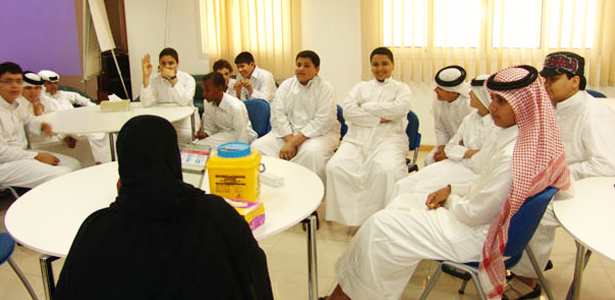
This Connecticut-sized nation, sticking out like a loose tooth in the Persian Gulf, is one of the most obese nations in the world, with residents fatter, on average, than even those of the United States, which often takes the cake in such competitions.
According to recent studies, roughly half of adults and a third of children in Qatar are obese, and almost 17 percent of the native population suffers from diabetes. By comparison, about a third of Americans are obese, and eight percent are diabetic. Qatar also has very high rates of birth defects and genetic disorders — problems that, along with the prevalence of obesity (PDF) and diabetes, have worsened in recent decades, according to local and international health experts.
So what’s going wrong in little Qatar?
Qatar also has very high rates of birth defects and genetic disorders — problems that have worsened in recent decades.
To misappropriate a well-worn phrase: It’s the economy, stupid. In September, Qatar officially became the richest nation in the world, as measured by per capita gross domestic product. It also recently became the world’s biggest exporter of natural gas, and earned the title of fastest growing economy in the world. By international development standards, all this growth has happened virtually overnight, making Qataris’ lifestyles much more unhealthy, and at the same time leading many to hang on resolutely to what’s left of their fleeting tribal traditions — practices that include inter-marriage between close family members and cousins.
“They’re concentrating the gene pool, and at the same time, they’re facing rapid affluence,” said Sharoud Al-Jundi Matthis, the program manager at the Qatar Diabetes Association, a government funded health center in Doha, the capital. As a result of these factors, Qataris are becoming obese, passing on genetic disorders at an alarming rate, and getting diabetes much more often than others around the world. They’re also getting diabetes a decade younger than the average age of onset, which is pushing up rates of related illnesses and complications, like hypertension, blindness, partial paralysis, heart disease, and loss of productivity. “It’s a very, very serious problem facing the future of Qatar,” Matthis said.
It’s a fascinating read, not too long, little more than double what you have already read. You can read the entire article by clicking HERE: The Atlantic
Thank you, John, for the recomendation.
6 Things a Marriage Counselor Would Tell You
We have celebrated 38 years of marriage, and we still read these articles. 🙂 It’s all true – marriage takes work. I found this today on AOL Everyday Health
6 Things a Marriage Counselor Would Tell You
Every relationship has its bumps — but these expert tips can help feuding duos smooth things out again.
By Jennifer Acosta ScottMedically reviewed by Lindsey Marcellin, MD, MPH
A relationship free of spats, scrapes, and squabbles? That’s a thing of fairy tales (though we’re willing to bet that even Cinderella and Prince Charming had their problems).
Real-life matrimony — that has its ups and down. And while it’s certainly not fun to clash with your sweetheart, disagreements don’t signal the demise of your relationship. “There are always ways to resolve issues, overcome obstacles, and build a stronger bond because of it,” says Lori Bizzoco, a relationship expert and founder of Cupid’s Pulse, a Web site that provides relationship advice to couples.
What’s more? Each relationship (even the best of the best) has room to grow. But not everyone can afford to see a professional marriage counselor — and some marriages simply need a quick tune-up. That’s why we went to top relationship experts to find out the best ways to resolve disagreements, keep things fun, and ensure an emotionally health partnership for the both of you.
Here’s your at-home guide to boosting your marriage or long-term partnership (you may be surprised how well these work!).
1. Fight. It may sound contradictory, but arguments between couples can actually be a sign that the relationship still has a good foundation. “Indifference to each other tells me a marriage is in big trouble,” says Susan Fletcher, PhD, a psychologist in the Dallas area. “Couples who care enough to fight still care about each other.” Next time you find yourself in a war of words with your partner, don’t give up and walk away: Use the disagreement as a jumping-off point for coming to a resolution — and then kiss and make up!
2. If you love her, let her grow. Most people develop and change as they get older — but according to Bizzoco, this often comes as a surprise to a spouse. “Often we get so wrapped up in the relationship and think we know someone so well that we don’t allow them the freedom to be anything more than the person they were when we met them,” Bizzoco says. But embracing these changes can be extremely beneficial to a relationship. So if your husband wants to take up golf or your wife wants to return to school for another degree, encourage them to follow these interests (your spouse will appreciate the support).
3. Be the A-Team. It may sound cheesy, but the phrase is an apt term for the “us first” attitude that couples should have when it comes to their relationship. “This means that they consult, discuss, and make decisions as a couple and do not put other relationships, children, or extended family before this primary relationship,” says Karol Ward, LCSW, a psychotherapist in New York. If you put your partner first, he will feel cherished and valued — an important emotion for your marriage.
4. Add some oomph to your “Hello!” When you’ve been separated from your spouse for some time (even if it was just for the work day), greeting him enthusiastically, rather than just glancing up, can be a great way to show you care. “It sounds silly, but think about the feeling that it creates when you give them just a few moments of attention,” Bizzoco says. Your special greeting can be anything from a simple hug to a sexy dance move. Coming home will be even sweeter than before.
5. Don’t forget your manners: Say “Thanks.” It’s easy to get wrapped up in what your partner does wrong — and too often, we lose sight of what they’re doing right. Every night, get in the habit of writing down three good things about your spouse — something nice he did (it really was sweet how he DVR’d The Notebook for you), a fond memory you have of her (remember that trip to the Caribbean?), or one of his many good qualities (that cute butt, of course). “This keeps you feeling more positive toward him, which will benefit your relationship,” says Elizabeth Lombardo, PhD, a psychologist and therapist in Wexford, Pa. And it can benefit you, too: When you’re in the middle of a knock-down fight, think back to your list to remember the reasons you’re in the relationship.
6. Get good feedback. Even if your relationship is as old as the hills, it’s never too late to ask your partner this one simple question: “How do you know that I love you?” Listen carefully to the response. If nothing else, Ward says, you’ll discover which of your actions are the most appreciated and which behaviors to maintain moving forward.
Follow these relationship “musts” — and you may never need to call up a marriage counselor.
Last Updated: 10/11/2011
The Rule of the Harvest
I was talking about this with a Mormon friend, who told me they call this ‘The Rule of the Harvest,’ that it is one of life’s great – and most obvious – secrets, that what you give comes back to you ten-fold and more.
Pastor Rick Warren is the pastor of Saddleback Church, and sends out these thoughts on a daily basis. The current theme is generosity in giving, as this is stewardship season.
Financial Fitness: Generosity Reaps Generosity
by Rick Warren
The world of the generous gets larger and larger; the world of the stingy gets smaller and smaller. Proverbs 11:24 (Msg)
If I sow generosity, it’s going to come back to me, and I’m going to reap generosity.
Every farmer knows this. A farmer has sacks of seed in his barn and he looks at his empty field. He doesn’t complain, “There’s no crop! I wish there was a crop!” He just goes out and starts planting seed. When you have a need, plant a seed.
It seems illogical that when I have a need, I should give.
Why did God set it up this way? Because God is a giver. He is the most generous giver in the universe, and God wants you to learn to be like him. He wants to build character in you.
The Bible says, “Honor the Lord with your wealth and with the best part of everything you produce” (Proverbs 3:9 NLT). This is the principle of tithing. It’s the principle that says every time I make $100 — the first $10 goes back to God.
Tithing is an act of worship. We’re giving to God. We’re saying, “All of it came from you anyway.” God says, “Put me first in your life and watch what I do.” You may think you can’t afford to tithe, but the reality is, you can’t afford not to tithe.
If you have an interest in receiving his daily message, you can subscribe here.
Recent Comments
ExpatAlien on What Country am I Living … intlxpatr on Yellowstone: Old Faithful to C… Michelle on Yellowstone: Old Faithful to C… Cathy on No Grown-Ups in Charge intlxpatr on Waiting for Snow Wikipedia Donate Button

Amazina


Early Voting in Florida


 Here There and Everywhere