Walter Palmer, “Tiny-Dick” Hunter
While we lived in Germany and Qatar and Kuwait, we went every year to Africa. On the smaller flights out of Johannesburg to Windhoek or into Zimbabwe or Zambia, we would encounter swaggering men, hanging out in the aisles, talking loudly, usually with big bellies, all decked out in safari gear/ersatz military camo. At first, I thought they were mercenaries of some sort, they seemed to be so full of themselves. Then a stewardess told me they were the “tiny-dick” hunters.
I had never heard the term. These are men, who, to make themselves feel good, pay thousands of dollars to be taken to an animal, like Cecil, the lion below, to kill. They have these hunts in the United States, too, where semi-tamed lions are shot at game farms, trapped, and fed, only to be sacrificed to the egos of the “tiny-dick” men.
Walter Palmer says he was told all the permits were in order. A news article on NPR yesterday tells how this famous lion from a protected game reserve was lured across the boundary so that Walter Palmer could shoot his with is little bow and arrow. Walter Palmer has broken the rules and lied before. He has a history of imagining that the boundaries do not apply to him.
I love it that his shameful behavior has been outed, and that his name and his detestable hobby are now known internationally as a man who would shoot a beloved lion for the sake of his ego. Below is the story from Associated Press via AOL News:

BLOOMINGTON, Minn. (AP) — A Minnesota dentist who went on a guided bow hunting trip for big game in Zimbabwe said that he had no idea the lion he killed was protected and that he relied on the expertise of his local guides to ensure the hunt was legal.
Walter Palmer, who has a felony record in the U.S. related to shooting a black bear in Wisconsin, released a statement Tuesday after Zimbabwean authorities identified him as the American involved in the July hunt. They said Palmer is being sought on poaching charges, but Palmer said he hasn’t heard from U.S. or Zimbabwean authorities.
“I had no idea that the lion I took was a known, local favorite, was collared and part of a study until the end of the hunt,” said Palmer, a dentist who lives in the Minneapolis suburb of Eden Prairie. He said his guides had proper permits, and to his knowledge, everything was handled properly.
“I deeply regret that my pursuit of an activity I love and practice responsibly and legally resulted in the taking of this lion,” he said.
The 55-year-old was identified by the Zimbabwe Conservation Task Force, the Safari Operators Association of Zimbabwe and police as the American facing poaching charges for the crossbow killing of Cecil, a well-known lion. Local authorities allege the lion was lured from a protected area and killed in early July. Zimbabwean conservationists said the American allegedly paid $50,000 for the trip.
The lion’s death has outraged animal conservationists and others, including U.S. Rep. Betty McCollum, a Minnesota Democrat. In a statement late Tuesday, the congresswoman called for an investigation by the U.S. Attorney’s Office and the U.S. Fish and Wildlife Service to see whether any U.S. laws were violated.
Ingrid Newkirk, president of People for the Ethical Treatment of Animals, condemned the lion’s killing in a statement.
“To get a thrill at the cost of a life, this man gunned down a beloved lion, Cecil with a high-powered weapon,” the PETA statement said.
Palmer’s hired spokesman, Jon Austin, said he believed Palmer was in the Minneapolis-St. Paul area Tuesday. No one answered the door at Palmer’s home, and a woman who came out of his dental office in nearby Bloomington said he wasn’t there or taking patients Tuesday. Phone calls to listed home numbers went unanswered.
According to U.S. court records, Palmer pleaded guilty in 2008 to making false statements to the U.S. Fish and Wildlife Service about a black bear he fatally shot in western Wisconsin. Palmer had a permit to hunt but shot the animal outside the authorized zone in 2006, then tried to pass it off as being killed elsewhere, according to court documents. He was given one year probation and fined nearly $3,000.
Doug Kelley, a former federal prosecutor and Palmer’s attorney in the bear case, was unavailable for comment Tuesday, according to his assistant.
Palmer has several hunts on record with the Pope and Young Club, where archers register big game taken in North America for posterity, said Glenn Hisey, the club’s director of records. Hisey said he didn’t have immediate access to records showing the types and number of animals killed by Palmer, but he noted that club records involve legal hunts “taken under our rules of fair chase.”
Although African game wouldn’t be eligible, Hisey said he alerted the group’s board that Palmer’s ethics were being called into question. He said Palmer’s domestic records could be jeopardized if he’s found to have done something illegal abroad.
A Facebook page for Palmer’s Minnesota dental practice was taken offline Tuesday after users flooded it with comments condemning Palmer’s involvement in the hunt. Hundreds of similar comments inundated a page for his dental practice on the review platform Yelp, which prior to Tuesday had only three comments.
Some people left stuffed animals at the door to his shuttered office Tuesday in a sign of protest.
Palmer is properly licensed and able to practice in the state, according to the Minnesota Board of Dentistry. Board records show that Palmer was the subject of a sexual harassment complaint settled in 2006, with Palmer admitting no wrongdoing and agreeing to pay a former receptionist more than $127,000.
Jurassic World Explosive Experience
We’ve been waiting for a free afternoon to see Jurassic World, and yesterday was it. We wanted to see it in 3D, although in retrospect, I am not so sure it makes that big a difference. It was LOUD. We are not hard of hearing, and at the beginning I had to cover my ears, it was so loud.

And, for all the movies I have seen, this one had some twists I didn’t see coming. It was full of exciting moments, and, within its own context, believable. You have to believe that humans let greed overcome their good judgement. You have to believe genetic manipulation is possible. You have to believe that the minute someone says “this is totally safe” you’d better be looking for a life jacket and a way out. All this, I believe.
AdventureMan had some struggles with unexplained things, but I think they were good at covering their bases, if you paid attention when the scientists were talking. I had a really hard time believing velociraptors could be tamed in any way. Trained – maybe if they are bored enough, and the training follows their normal instinctive practices. Tamed? Ummm, I don’t think so.
I loved the homage paid to Jurassic Park. I always love it when the bad guys get their just desserts. I always wonder, if we get curious and clone/create a prehistoric animal, will we be able to foresee all the possible outcomes?
When Cultures Collide
My house guest and I are sitting at my computer, looking at airfares.
“So what do I do?” he asked me.
“This is your decision to make,” I answered. “Only you know what is most important to you.”
“I am looking for a recommendation,” he tells me.
“If it were me, I would take that early flight. It is cheaper, and by leaving at six a.m. you know it is likely to leave on time and arrive on time. Also, I would have booked it about four months ago. It’s summer. The flights are flying full. There are no cheaper tickets left.”
“Month-es?” he asked incredulously. “Month-es?” he repeated.
We decided to wait and book later, after he had given it some thought. He didn’t like my recommendation; he didn’t like the earliness of the flight I recommended, and I had known he wouldn’t.
I think the idea of booking a flight four months in advance was a double-whammy.
A Harsh Ruler
Today’s Gospel reading from The Lectionary brings up so many questions! Jesus gives a parable, a story to help explain what he is saying, but what, exactly, is the parable saying?
Luke 19:11-27
11 As they were listening to this, he went on to tell a parable, because he was near Jerusalem, and because they supposed that the kingdom of God was to appear immediately. 12 So he said, ‘A nobleman went to a distant country to get royal power for himself and then return. 13 He summoned ten of his slaves, and gave them ten pounds,* and said to them, “Do business with these until I come back.” 14 But the citizens of his country hated him and sent a delegation after him, saying, “We do not want this man to rule over us.” 15 When he returned, having received royal power, he ordered these slaves, to whom he had given the money, to be summoned so that he might find out what they had gained by trading. 16 The first came forward and said, “Lord, your pound has made ten more pounds.” 17 He said to him, “Well done, good slave! Because you have been trustworthy in a very small thing, take charge of ten cities.” 18 Then the second came, saying, “Lord, your pound has made five pounds.” 19 He said to him, “And you, rule over five cities.” 20 Then the other came, saying, “Lord, here is your pound. I wrapped it up in a piece of cloth, 21 for I was afraid of you, because you are a harsh man; you take what you did not deposit, and reap what you did not sow.” 22 He said to him, “I will judge you by your own words, you wicked slave! You knew, did you, that I was a harsh man, taking what I did not deposit and reaping what I did not sow? 23 Why then did you not put my money into the bank? Then when I returned, I could have collected it with interest.” 24 He said to the bystanders, “Take the pound from him and give it to the one who has ten pounds.” 25 (And they said to him, “Lord, he has ten pounds!”) 26 “I tell you, to all those who have, more will be given; but from those who have nothing, even what they have will be taken away. 27 But as for these enemies of mine who did not want me to be king over them—bring them here and slaughter them in my presence.” ’
We know, by his own words, this was a harsh man and we know many of his citizens – not slaves – did not want him to rule over them. Why did Jesus use this man to illustrate his point? What about the other seven slaves who were given the money; how did they invest or protect the money? When I look at this parable, I am not so sure I would want to be one who was given more to administer over; the master is harsh. Perhaps those who protected the talent and kept their heads down fared better in the long run under this harsh man’s rule? What if one had taken the money and used it to make the lives of the people better – provided medical care or built a safe-haven for abused women? I shudder to think what the harsh ruler might have done with a slave who used the funds for the good of the people.
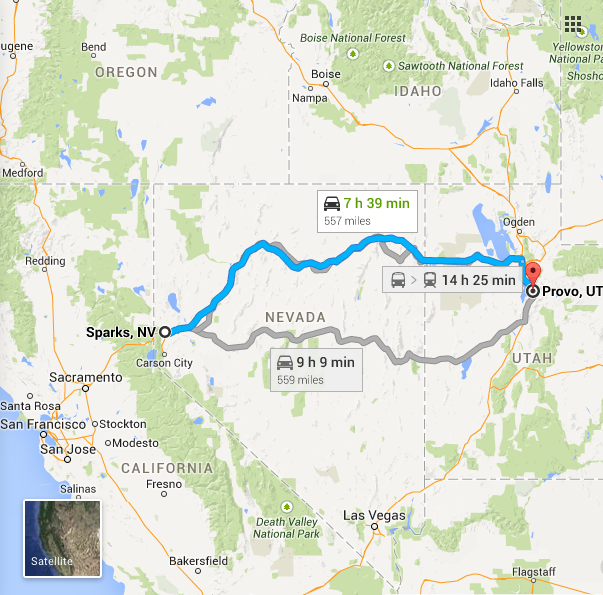
Sparks, NV to Provo, UT, The Worst Day of our Trip (and it wasn’t bad)
AdventureMan is still feeling really bad, so I am going to drive most of the day, until it is time to navigate our way into Provo, UT and he is going to sleep.
About an hour out of Sparks, I feel uneasy, and I ask AdventureMan, who has briefly awakened, to check behind me to see if my purse is there. It isn’t.
I stop, call the hotel, and by the grace of God, the purse was turned in by the breakfast room lady, who found it where I left it.
So on one of the longest driving days, I add two hours driving by forgetting my bag.
It could have been so much worse. The bag could have been not turned in.
I am busy beating myself up and AdventureMan consoles me. I am wondering if this is the beginning of Alzheimer’s, and he laughs and says I had a lot on my plate. He is so kind, just when I need it.
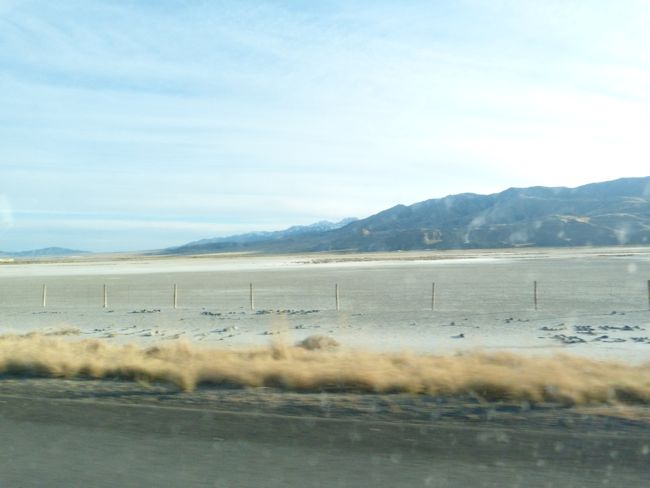
As it turned out, AdventureMan sleeps most of the day, and the drive is quiet, uneventful – and beautiful. There are a lot of hills, and the car eats gas because of all the uphill stretches, and some of those uphills go on for a long time. I think I am doing fine on gas, more than 3/4 of a tank, when we pass Elko, NV, one of the last places to buy gas. It matters because when we get to the salt pans, we are down to 1/2 a tank, and the salt pans go on forever, and there is no gas station. Even past the salt pans, it is a long way to the next gas station, and we are breathing a sigh of relief, even paying outrageous gas prices, when we find the next gas station.
We’re about an hour away from our hotel when AdventureMan takes over the driving, through Salt Lake City, which goes on forever, to Provo and our hotel. As he is driving, we laugh. I have had a gorgeous day for driving, but suddenly, in the midst of the thick traffic, it appears to be starting to snow. Oh aaarrgh!
All AdventureMan wants for dinner is a can of soup from the MarketPlace, and there is an Arby’s next door, so I walk there. It is empty when I enter, and I order, and then, behind me, comes a group of 11 very happy looking people, from teen agers to grandparents.
“We each have $3.49 to spend!” one says breathlessly, “What can we get for $3.49?”
The counter-server is momentarily flummoxed, and one of the eleven says “I’m just going to have a cookie, so you guys can share what is left of mine.”
I couldn’t imagine how this was all going to work out, so I grabbed my order and left. As I walked to the hotel, snow flakes were hitting my head.
ISIS in Mosul Unable to Sustain Economy
From AP via Kuwait Times:
High prices, shortages pressure IS – Black markets abound – Strict social laws bad for business
 BAGHDAD: Saadi Abdul-Rahman was recently forced to pull his three children out of school in the Iraqi city of Mosul, where Islamic State militants have ruled with an iron fist since June. The cost of living has soared there, and the family is barely able to make ends meet, even after putting the kids to work. “We are not able to pay for cooking gas, kerosene and food,” laments the 56-year-old retired government worker. “The situation in Mosul is miserable.”
The economy in the self-styled “caliphate” declared by the Islamic State group bridging Iraq and Syria is starting to show signs of strain. Prices of most staples have more than doubled as coalition airstrikes make it difficult for products to move in and out of militant strongholds, leading to shortages, price-gouging and the creation of black markets.
Resentment has grown among residents under the rule of the extremists, who initially won support with their ability to deliver services. In the early days of its rule, the Islamic State group subsidized food and gas prices through the wealth it accumulated from oil smuggling, extortion and ransom demands. They sold their smuggled oil at a discount – $25 to $60 a barrel for oil that normally cost $100 a barrel or more, according to analysts and government officials.
But in recent weeks, prices have soared in militant-held cities. Items like kerosene, used for heating and cooking, are in short supply, while others, such as alcohol and cigarettes, strictly banned by the group, are making a comeback at higher prices on the black market. Smoking is a punishable offense in militant-held Mosul. But at a warehouse on the outskirts of the city, cigarettes, as well as hard-to-come-by essentials like kerosene, can be found at hugely inflated prices on a black market run by the extremists. There, a pack of cigarettes sells for 30,000 dinars – the equivalent of $26 – more than double the pre-caliphate price, according to residents who spoke on condition of anonymity for fear of reprisals.
‘Unsustainable Economy’
The militants “are developing an unsustainable economy,” said Paul Sullivan, an expert on Middle East economies at the National Defense University in Washington. “Eventually the costs of keeping the subsidies and price controls going will overpower their smuggling funds, which are also used for offensive and defensive actions. They can collect taxes, extort money, and so forth,” he said. “But that will likely not be enough in the long run to keep such an unbalanced economic system going.”
In the Syrian city of Raqqa, the extremists’ so-called capital, the breakdown of security along the border with Iraq in areas under Islamic State control has led to flourishing trade with Mosul. Trucks are also able to access the city from Turkey, allowing for a steady supply of fruit and vegetables, wheat and textiles. However, the cost of living has surged since US-led airstrikes began in September, and power and water cuts grew more frequent, residents said.
In addition, the strict social laws imposed by the group have been very bad for business, said Bari Abdelatif, an activist in the Islamic State-controlled town of al-Bab in Syria’s northern Aleppo province. But, he said, foreign fighters were bringing with them lots of hard currency, making up somewhat for the shortfall. Last month, Abu Bakr Al-Baghdadi, the leader of the Islamic State group, decreed the minting of gold, silver and copper coins for the militants’ own currency the Islamic dinar – to “change the tyrannical monetary system” modelled on Western economies. But trade in most militant-held cities continues to be in Iraqi dinars and US dollars.
The start of winter has led to serious shortages of gasoline and kerosene. The official price for a liter of gas in government-controlled areas of Iraq is 450 dinars (40 cents) – but in Mosul, it sells for four times that. Two hundred-liter barrels of kerosene are now sold in Mosul for 250,000 dinars ($220), versus the official price of 30,000 dinars. In the western Iraqi city of Fallujah, under militant control for almost a year, residents have started cutting trees for firewood because kerosene is in such short supply. The city is surrounded by government troops and near-daily shelling often make parts of town too dangerous to visit.
Food and fuel prices have risen sharply as a result – a 50-kilo sack of rice costs 75,000 dinars ($65), up from 10,000 ($9) three months ago. A cylinder of cooking gas goes for 140,000 dinars ($115). That has put many staples out of reach for Abdul-Rahman and his family in Mosul, even with the additional money brought in by his sons, who left school to drive a taxi and work in a restaurant.
Decline in Business
A number of factors are driving the shortages and price hikes, according to residents in Mosul and Fallujah, the group’s biggest Iraqi strongholds. The militants have imposed a tax on vehicles entering their territory, leading to a decline in business. Deliveries are also subject to militant theft, and coalition airstrikes and military operations make many roads impassable. As a result, the trip from the Turkish border to Mosul took four hours prior to the militant takeover. Now, a delivery truck can spend as much as a week traveling the same road, and will pay a tax of as much as $300 for entry into Mosul, residents said.
According to Luay Al-Khateeb, director of the Iraqi Energy Institute and a visiting fellow at the Brookings Doha Center, the population of the areas under Islamic State control in Iraq and Syria is 6.5 million to 8 million people. “They need 150,000 barrels (of crude) a day just to meet local consumption,” he said. “And that is the bare minimum to meet the demands for transportation, bakeries, power generation. That doesn’t mean they have access to such supply,” he added.
Last month, the militants shut down cell phone service in Mosul, claiming that residents were tipping off US-led airstrikes to their whereabouts. Cell signals have not been restored, causing the city to come to a virtual standstill. Workshops, factories and markets are closed and bitterness is growing among business owners. “Most money-transfer operations are done by mobile calls,” said Osama Abdul-Aziz, the owner of a money-transfer office in Mosul. “We have the option of using the Internet, but this method is very slow and sometimes the Internet does not work at all, which causes big delays to our work.” At Mohammed Abdullah’s shop in Mosul, the pile of cell phone scratch cards is growing higher by the day. “Our business and means for living are in ruins now,” he said. – AP
Protein Tau Alzheimer Key?
This is hopeful news from AOL Healthnews My family has a history of living long; my Mother is 92 and still has all her marbles. Staving off dementia is as key as keeping your body fit if you live to be a ripe old age.
Is a Protein in the Brain Key to Alzheimer’s?
By Dennis Thompson, HealthDay News
The malfunction of a protein, tau, is the likely culprit behind Alzheimer’s. When it malfunctions, brain cells die, a study finds.
Monday, November 03, 2014
Malfunction of a key brain protein called tau is the likely culprit behind Alzheimer’s disease and other forms of dementia, a new study in mice concludes.
Neurons — highly specialized nerve cells in the brain — appear to die when tau malfunctions and fails to clear the cells of unwanted and toxic proteins, explained Charbel Moussa, head of the Laboratory for Dementia and Parkinsonism at Georgetown University School of Medicine, in Washington, D.C.
This means drugs that replace the function of tau in these brain cells are likely to slow the progression of Alzheimer’s, he said.
“A strategy like this will give us hope that we can delay or stabilize the disease progression,” Moussa said.
Tau has long been a prime suspect in the search for the cause of Alzheimer’s disease. The brains of Alzheimer’s patients wind up clogged with twisted protein threads made of tau, particularly in regions important to memory.
But researchers have been at a loss to explain why tau might cause Alzheimer’s, and whether the tangles of tau are more important than another hallmark of Alzheimer’s, plaques made of a protein called amyloid beta that fill the spaces between the brain’s nerve cells.
Moussa said his experiments with mice have shown that tau works to keep neurons naturally free of amyloid beta and other toxic proteins.
When tau malfunctions, the neurons begin to spit amyloid beta out into the space between the brain cells, where the protein sticks together and forms plaques, he said.
“When tau does not function, the cell cannot remove the garbage,” Moussa said. The result is cell death, he explained.
Tests on the brain cells of mice revealed that removing all tau impaired the neurons’ ability to clear out amyloid beta, according to findings published Oct. 31 in the journal Molecular Neurodegeneration. But if researchers reintroduced tau into brain cells, the neurons were better able to remove accumulated amyloid beta from the cells.
Moussa said his study suggests the remaining amyloid beta inside the neuron destroys the cells, not the plaques that build up outside. The mouse experiments also showed that fewer plaques accumulate outside the cell when tau is functioning.
Malfunctioning tau can occur as part of the aging process or due to genetic changes. As people grow older, some tau can malfunction while enough normal tau remains to help clear the garbage and keep neurons alive. “That explains the confusing clinical observations of older people who have plaque buildup, but no dementia,” Moussa explained in a Georgetown University news release.
In this study, Moussa also explored the possible use of a cancer drug called nilotinib to force neurons to keep themselves free of garbage, with the help of some remaining functional tau.
“This drug can work if there is a higher percentage of good to bad tau in the cell,” added Moussa, whose work was funded in part by a grant from Merck & Co., the pharmaceutical company.
Heather Snyder, director of medical and scientific operations for the Alzheimer’s Association, said Moussa’s findings are interesting but not conclusive.
“They’re saying that tau may have an earlier role than we currently know. That’s as far as I would go,” Snyder said. “We still don’t know how all the pieces come together.”
Snyder said new imaging technology that allows doctors to track tau buildup in a person’s brain over time may help solve this question in the future.
Also, experts say, results of animal experiments don’t necessarily apply to humans.
But Dr. Ronald Petersen, director of the Mayo Clinic Alzheimer’s Disease Research Center, said the new study adds to the growing evidence that “the role of tau is fundamental in the disease process.”
“Developing therapeutics for tau is a high priority,” Petersen said. “Not easy, not simple, but it could be very fruitful.”
AOL Termination Scam
I keep getting these; it’s just annoying:

And here is the return address – of course, not AOL at all:

Baton Rouge Strangeness
Baton Rouge was a city we really wanted to like, and there are so many things about Baton Rouge we DO like. While we were there, however, every single day, we experienced a little bit of bad JuJu, a little bit of strangeness. By the grace of God, it was ameliorated by the goodness and kindness of others, but it was just strange.
First, I have to tell you I am not a huge fan of shopping, but every now and then when I find the right thing, I know it and I buy it. When I found Trader Joe’s, I knew just what to buy, quality products we love. Then, I headed out to Macy’s, a store we do not have in Pensacola.
The Mall is huge, but it was early in the morning, I got a great parking spot, and although I had ended up far from Macy’s, I enjoyed the stroll. This is the first thing I saw, and it delighted my heart.


What is not to love about this menagerie of zoo animals for little children to ride through the mall? Children HATE mall shopping, but this is a game changer 🙂
I actually didn’t find anything I loved at Macy’s, but I did find two very classic T-shirts I knew I could use, nicely made, so I went to buy them and the cashier asked if I wanted to use my Macy’s card. I said “sure” but it turns out because I hadn’t used it in a while, I had to re-instate it, and when you do that, you get 20% off all day and the next day, plus a WOW card that gives you more discounts, plus another 20% off when they bill you. Holy mole, sign me up! But even though I looked, I really didn’t see anything else I wanted.
Back at the hotel, I told AdventureMan about this hot deal and talked him into going back to Macy’s with me. He looked, but he also didn’t find anything he liked, and then I found the children’s section, ummmm, errrrr . . . .. grandchildren’s section, and there were all kinds of things I liked a lot, and Christmas is coming, so lets get a little dollar-cost-averaging going. (AdvntureMan is rolling his eyes.)
When I went to pay, the patient salesgirl rang everything up, and then had to call some number because my total was high, and then asked me to show my driver’s license. I knew I had it, because I had it earlier when I re-instated my card. So I dug. It wasn’t there. I dug some more, I looked and looked, but no card. I was so embarrassed. The patient clerk held all the grandchildren clothes while I went downstairs where I had shown my card earlier, and sure enough, there it was. Thank God! What if we hadn’t gone back to the Mall? Months go by where I never show that card, and months from now I wouldn’t have known where to find it. I felt like my guardian angel was sitting on my shoulder. And it still felt like strangeness.
When I went back upstairs to the cashier, I showed the drivers license, and she called the security number again, and he asked me all kinds of questions, places I lived years ago, what cars are associated with my accounts, it was totally strange, and AdventureMan is looking bullish, steam coming out of his nostrils, stamping and huffing and puffing (he is hungry). Finally, he tells the cashier I am OK, and she rings me up, very apologetic. I told her it is just the times we live in, and honestly, I want security to be tough on people who might pretend to be me, so it was just a minor inconvenience. But just another little piece of Baton Rouge strangeness, little things that could eat away at happiness and well being if you let them . . . .

Recent Comments
ExpatAlien on What Country am I Living … intlxpatr on Yellowstone: Old Faithful to C… Michelle on Yellowstone: Old Faithful to C… Cathy on No Grown-Ups in Charge intlxpatr on Waiting for Snow Wikipedia Donate Button

Amazina


Early Voting in Florida


 Here There and Everywhere