Where The Wild Things Are (Apologies to Maurice Sendak)
First thing, early every morning, I get up to water my herbs and vegetables. I could do it later in the day, but later in the day is unbearable for me. It is hot. It is humid. The temperatures are in the 90’s, with humidity that makes you drip with sweat. I feel like a vampire; I try to get everything watered before the first rays of sun rise – directly into my backyard garden – and strike me with their heat.
Things are coming along. This weekend I will pick the first of my Black Krim tomatoes. I can hardly wait. I bought it at a garden club sale, as a little tiny plant. The tomatoes are supposed to have a smokey flavor, and very tomato-y.
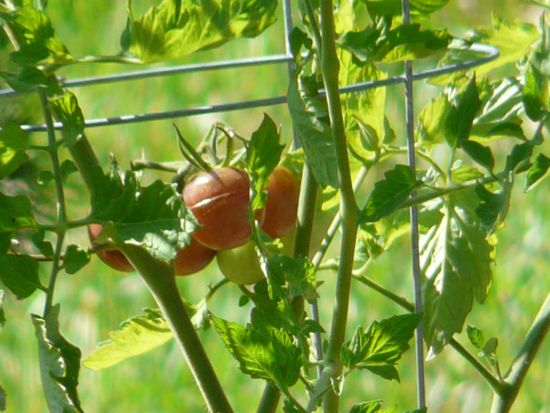
There is a lot going on in our backyard.
We have a bright red cardinal who comes at late afternoon to take a bath in the birdbath. He is very cautious, looking around for maybe five minutes before he feels safe enough to splash. I don’t have a photo of him, yet.
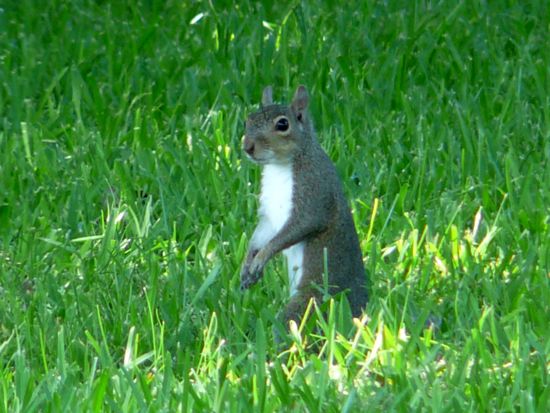
We have all kinds of squirrels, because we have oak trees, and they are busy gathering and saving for the winter. They seem to be finding lots to eat in our backyard.
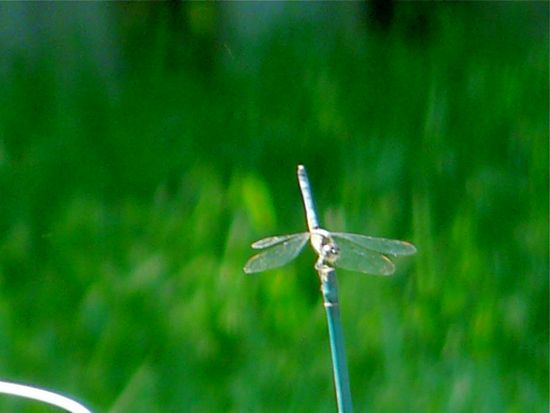
We have a dragonfly who is a regular visitor. He sits atop some of the bamboo stakes in the garden. I don’t know if he is looking for smaller insects to eat, or just enjoying a little perch in the late afternoon sun:


Our house is surrounded by chameleon, fortunately, unlike Qatar, they are not INSIDE my house! I am delighted to have them as neighbors, as they are wonderful for pest control, and in Florida – there are a lot of pests. The dreaded cockroaches, but also ants, and fire ants, and hornets, and wasps, and cutters, and lovebugs – well, you get the picture. I need all the help I can get. Insects love me, the eat me up. 😦
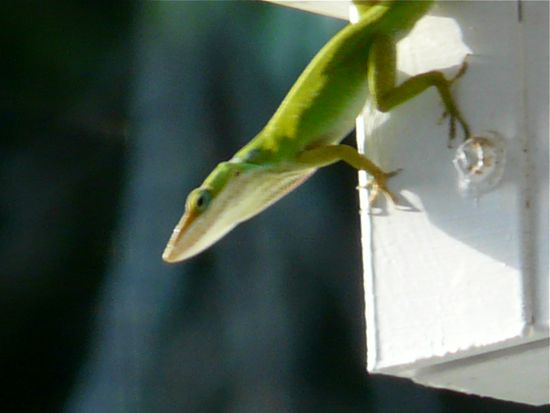

I think this little chameleon is looking for a mate!
(Maurice Sendak is one of my very favorite authors of children’s books, especially books for lively little boys. They have fabulous illustrations. As our son was growing up, one of our favorite lines from a Sendak book was “Let the Wild Rumpus begin!”

Garden Gate Newsletter for June
We love this place!
The Garden Gate
3268 Fordham Pkwy.
Gulf Breeze, Fl. 32563
850-932-9066
thegardengategb@bellsouth.net
June Class Schedule
Cut Flowers
Flowers are used to mark every occasion in our lives — bouquets celebrate the birth of a baby, weddings and engagements, or other special celebrations and even help us mourn the passing of a loved one. Since Victorian times, certain flowers and flower colors have had special meanings and were used to convey tender (or not so tender) sentiments. Many of these meaningful flowers can be grown in our landscapes, either in an area dedicated to cut flowers or incorporated into other plantings. Join us Wed. June 9, from 10:00 until 11:00 A.M. to learn the about the language of these flowers plus how and where to grow them. Cost of the class is $5.00. Please call to register.
Shade Gardening
Even though shady sites can limit the plants that can be used, and are often hard to dig in because of roots, these areas can provide landscaping interest with color and texture. Many plants that grow in shade don’t bloom as long as their sun-loving counterparts but continuous color can be achieved by choosing species that flower in succession. Join us Sat. June 12, at 10:00A.M. Until 11:00A.M. to learn about plants that thrive in shady areas and how to successfully grow them. We will talk about under-story trees, shrubs, perennials, and ground covers to use in shade, how to amend your soil to plant them, plus other ideas to turn you shade into an low-maintenance asset rather than a landscaping problem. Cost of the class is $5.00. Please call to register.
Cooking Demo – Tomatoes!
Tomatoes will be the main ingredient in this cooking demonstration. Beefsteak, heirloom, cherry, grape – no matter the size and shape, they are delicious! Join us Sat. June 12, at 11:30A.M.when Kim Armstrong will demonstrate simple and exciting recipes using these home-grown favorites (we will talk a little bit about growing tomatoes in our area, too). The cost for this cooking demo (and tasting!) is $7.50. Please call to register.
Natural Pest Control
As the heat and humidity rise, so do the number of pest and diseases that attack our gardens and landscapes. Join us Wed. June 16, to learn ways to keep your plants healthy without using manufactured fungicides, pesticides, and other “cides”. We will discuss using organic products, physical barriers, beneficial insects and other wildlife, and companion planting plus other tips and techniques for less toxic gardening. Class will be held from 10:00 A.M. until 11:00 A.M. Cost of the class is $5.00 – please call to register.
Topiary
Join us Sat. June 19 to learn about the craft of topiary — growing plants on forms or by pruning plants to create shapes. This ancient form of gardening is enjoying a resurgence in popularity right now, adding a touch or formality or tradition when used in the landscape or in interior spaces. You will learn which plants to use for topiaries and how to plant and grow them, whether in containers or in the ground. Tips for maintaining topiaries will also be discussed. We will provide all materials for you to make a topiary during the class, to take home. (This is the season to start topiaries to use or to give as gifts during the holiday season.) Class will begin at 9:30 A.M. until approx. 11:00A.M. Cost of the class is $30.00. Space will be limited for these classes, so please call to register.
Summer Containers
This class will teach you tricks to plant and maintain beautiful planters in summer’s high heat and humidity. Choosing the right plants for your growing conditions is only a part of successful summer container gardens. How to select plants for dramatic effect will also be discussed – combining “thrillers, fillers and spillers” (using flowers, herbs, vegetables, or grasses) to make fantastic, functional focal points in your landscape. Learn watering, fertilizing and maintenance techniques in the lecture part of the class. After the class, you are invited to put together a great container garden to take home. We will provide all plants and materials. This class will be held on Wed. June 23, and Sat. June 26, at 10:00A.M. Second session will follow immediately at approx. 11:00 A.M. Cost of the class is $5.00. Cost of the after-session is $25.00. Please call to register and let us know if you will be staying for both sessions.
News and Notes
Hot weather, rainy weather, steamy weather – it must be summer! Spring flowers are beginning to fade but the heat-loving flowers are coming on strong. Annuals such as zinnias, cosmos, and coleus are tried and true for summer color. Unlike in our grandmother’s time, however, coleus can now be grown in the sun and cosmos can be found in dwarf or double forms in a much wider range of colors. The dwarf zinnias are our favorites, blooming from now until frost with a low mounding habit that does not need dead-heading. They are available in pinks, oranges, reds, yellows, and whites. Try the Profusion series or the Narrow-leaf zinnias in hanging baskets or other containers or in the front of a flower bed. Plant breeders have also worked to improve some old-fashioned perennials. For example, there are many new forms and cultivars of rudbeckia (black-eyed Susans) and gaillardia, or blanket flowers. Some of the most recent and interesting breeding breakthroughs have been with Echinacea (or purple-cone flower). By crossing a yellow species with a purple species, a series of orange flowered Echinacea have been developed. These North American native perennials are now available in all the colors of a sunset or a sunrise. They make spectacular and long-lasting cut flowers, blooming from summer well into fall. Purple cone flowers like sunny sites on the dry side, with a little compost or manure to slightly sweeten the soil. Butterflies love them!
We are seeing lots of birds at our feeders right now, mostly hard-working moms and dads feeding their nestlings. The Carolina wrens that have built the nest in the canvas bag on our porch seem especially busy, not only visiting the feeders but also combing the gardens and container plants for insects for their ravenous young. This week, we have seen the wrens, chickadees, house finches, cardinals, sparrows, bluejays, and red-bellied woodpeckers at our feeders. And then we have our “other” birds — for those of you who have not met “the girls”, we now have six chickens (all hens) brought to us by a customer in early April. We have two California Whites (Beatrice and Gertrude), two Rhode Island Reds (Perryia and Katherine Hepburn), and two Americaunas (Betsy Ross and Martha Washington). We are busily preparing to build a new coop for “the girls”. Come by and check our progress.
We are planning a number of new upcoming classes and cooking demos, and we would love to have your input about garden subjects or related crafts that you would like to learn about. Ideas that we are working on include classes on meditation gardens, romantic gardens, gardening on the water, living roofs and walls or vertical gardening. We are always looking for ways to engage children in gardening or the environment, we are always interested in connecting cooks and gardeners, and we are always interested in passing along information that makes gardening easier or more successful. Please let us know your ideas for classes and other activities, by calling, e-mailing, or just stopping by. Thanks!
Pray – then Listen
(Warning – this is religious based musing; if that is offensive to you, skip this post 🙂 )
Jesus often used the phrase “if you have the eyes to see” and “if you have the ears to hear” after telling his listeners a metaphorical story.
Yesterday, AdventureMan and I had another huge surprise. We filed for a tax exemption, and we were told that for this year, the previous exemption would hold, and then next year, our exemption would start. You would think that might be bad news, but in our case, the previous owner had all kinds of wonderful exemptions, and in a year with a lot of expenses, not having a huge property tax bill sounds really good to us.
“Humd’allal!” I said to AdventureMan as we left the building. (Thanks be to God!)
When we knew we wanted to retire this year, we began praying about it together every morning before AdventureMan headed off to work. We specifically asked that God be in every detail of the move – and as you can imagine, a move back to the USA from Qatar has a lot of details. It was more complicated than “just” a move. We had a huge storage shipment which needed to meet up with us in Pensacola, a cat that needed to come with us. We needed to buy a house, and to do that, we had to sell a house, and we needed to buy cars, and basic household appliances; we needed to start up all over again with groceries, and with cleaning supplies, and gardening supplies, and the most basic items you take for granted every day in your well-established lives. There were a LOT of details, an overwhelming amount of detail, and, by the grace of God, every detail was covered.
Some details, like the total rewiring of our house, may not seem like such a blessing, but, by the grace of God, we had the money to cover the need, and we are glad we could get the rewire done before moving in, and we are really really glad not to have to worry about fires happening in our electrical system. If and when we need to sell this house, having had it rewired helps its salability, too.
Some people might call it good luck. We don’t think so. We think it is God, answering prayers, in control of all the details, and blessing us in ways we can’t even begin to imagine. Every now and then, we have “the eyes to see.”
Hurricanes and Oil Spills – How they Mix
Thank you, Enviro-Girl, for forwarding me this information:
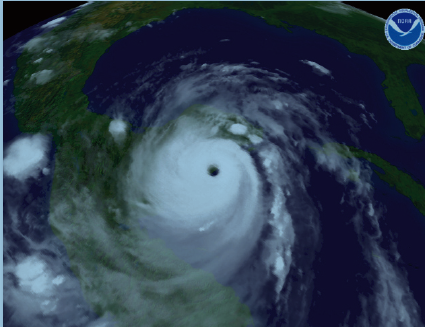
What will happen to a hurricane that runs through
this oil slick?
• Most hurricanes span an enormous area of the
ocean (200-300 miles) — far wider than the
current size of the spill.
• If the slick remains small in comparison to a
typical hurricane’s general environment and size,
the anticipated impact on the hurricane would
be minimal.
• The oil is not expected to appreciably affect either
the intensity or the track of a fully developed
tropical storm or hurricane.
• The oil slick would have little effect on the storm
surge or near-shore wave heights.
What will the hurricane do to the oil slick in
the Gulf?
• The high winds and seas will mix and “weather”
the oil which can help accelerate the
biodegradation process.
• The high winds may distribute oil over a wider
area, but it is difficult to model exactly where the
oil may be transported.
• Movement of oil would depend greatly on the
track of the hurricane.
• Storms’ surges may carry oil into the coastline
and inland as far as the surge reaches. Debris
resulting from the hurricane may be contaminated
by oil from the Deepwater Horizon incident, but
also from other oil releases that may occur during
the storm.
• A hurricane’s winds rotate counter-clockwise.
Thus, in VERY GENERAL TERMS:
o A hurricane passing to the west of the oil slick
could drive oil to the coast.
o A hurricane passing to the east of the slick
could drive the oil away from the coast.
o However, the details of the evolution of the
storm, the track, the wind speed, the size, the
forward motion and the intensity are all
unknowns at this point and may alter this
general statement.
Will the oil slick help or hurt a storm from
developing in the Gulf?
• Evaporation from the sea surface fuels tropical
storms and hurricanes. Over relatively calm water
(such as for a developing tropical depression or
disturbance), in theory, an oil slick could suppress
evaporation if the layer is thick enough, by not
allowing contact of the water to the air.
• With less evaporation one might assume there
would be less moisture available to fuel the
hurricane and thus reduce its strength.
• However, except for immediately near the source,
the slick is very patchy. At moderate wind speeds,
such as those found in approaching tropical
storms and hurricanes, a thin layer of oil such as
is the case with the current slick (except in very
limited areas near the well) would likely break into
pools on the surface or mix as drops in the upper
layers of the ocean. (The heaviest surface slicks,
however, could re-coalesce at the surface after the
storm passes.)
• This would allow much of the water to remain in
touch with the overlying air and greatly reduce
any effect the oil may have on evaporation.
• Therefore, the oil slick is not likely to have a
significant impact on the hurricane.
Will the hurricane pull up
the oil that is below the
surface of the Gulf?
• All of the sampling to date
shows that except near
the leaking well, the
subsurface dispersed oil is in
parts per million levels or less. The hurricane will
mix the waters of the Gulf and disperse the oil
even further.
Have we had experience in the past with
hurricanes and oil spills?
• Yes, but our experience has been primarily with oil
spills that occurred because of the storm, not
from an existing oil slick and an ongoing release
of oil from the seafloor.
• The experience from hurricanes Katrina and Rita
(2005) was that oil released during the storms
became very widely dispersed.
• Dozens of significant spills and hundreds of
smaller spills occurred from offshore facilities,
shoreside facilities, vessel sinkings, etc.
Will there be oil in the rain related to
a hurricane?
• No. Hurricanes draw water vapor from a large
area, much larger than the area covered by oil,
and rain is produced in clouds circulating
the hurricane.
Learn more about NOAA’s response to the BP oil
spill at http://response.restoration.noaa.gov/
deepwaterhorizon.
To learn more about NOAA, visit
http://www.noaa.gov.
Hurricane Season Begins Today
As if the oil spill isn’t enough, today is the first day of hurricane season.

The hurricane guide tells us to have three days worth of food and water stored to get people through a hurricane and its aftermath – loss of electricity, highways blocked with fallen trees, etc. We have a safe room, a large closet next to an outside wall. We have a 7 gallon water storage container, and matches. I’m still working on the rest; I don’t want to be one of those running to the supermarket the day the hurricane might hit.
The good news – for us – is that we did not buy a house in the evacuation zone.

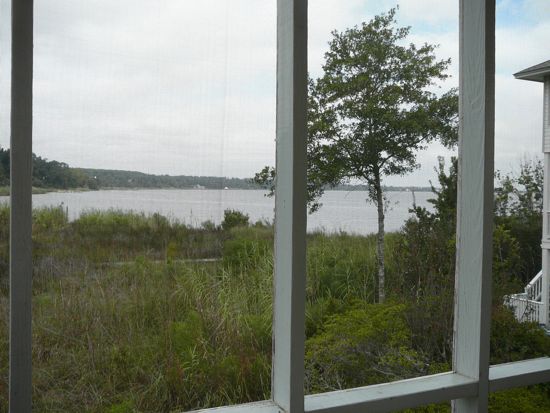
You cannot imagine how seductive some of these houses are. We had assumed we would buy a house on the water. Our beautiful 10th floor apartment on the Arabian Gulf in Kuwait gave us a taste for an endless water view, and that’s what we were looking for:
House 1

House 2
House 3
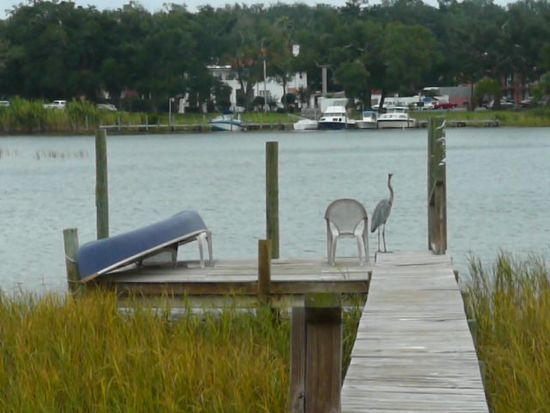
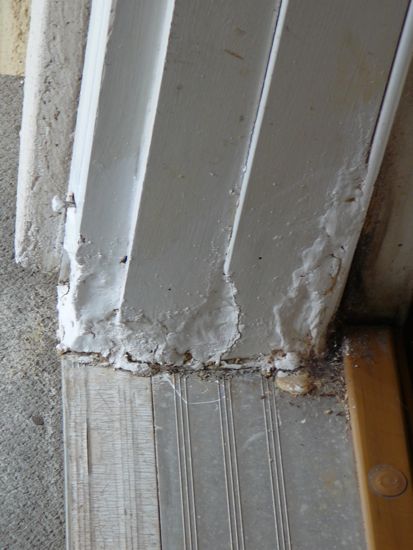
Every house on the water faces the possibility of serious damage in a hurricane. Two of the houses had damage from Ivan, one had ongoing damage from the dampness of being adjacent – well, almost inside – the wetlands. The wetlands are encroaching on two of the properties. One house, we totally loved. We could see ourselves living there, even facing the danger of hurricanes. That is, until we visited the basement, felt the humidity, saw a rotting pillar and realized we would face an unending battle with rot. The doorframe to the outside was rubbery with dampness:
It was a real blow to us giving up our dream.
On the other hand, it is a relief, now, knowing we are not in an evacuation zone.
There are no guarantees against a direct hit by a hurricane. All we have done is improved our odds, somewhat, which is about the best you can do when you live in a hurricane zone.
Grilling at Garden Gate Nurseries
Late Friday, we saw a notice in the paper that there would be a class on grilling vegetables held on Saturday at the Garden Gate Nursery. Any excuse will do; AdventureMan calls and finds there are still a couple slots available and we sign up.
Oh what fun! The teacher, Kim, was clever and entertaining, and best of all, she has a gift for imagining what flavors will go together if fresh ways. We learned how to grill corn-on-the-cob which is plentiful right now in the Florida markets, and how to grill pineapple, with an orange sauce, fabulous over ice cream.
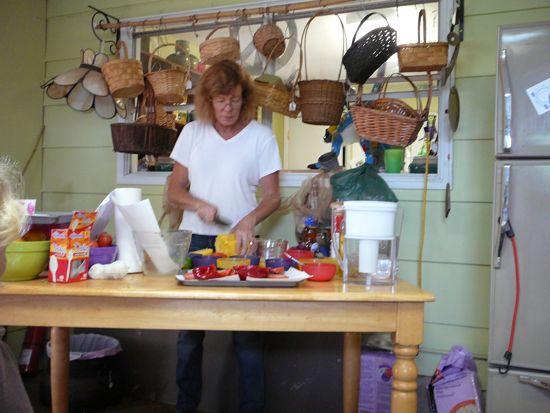
Garden Gate is so clever, combining gardening and growing and grilling, but also, they are coming up with classes on how to manage the vegetables and fruits that you grow – cooking with basil, iced courses made with exotic and unexpected ingredients, new ways to utilize all those zuccini and tomatoes . . . Well worth the drive. 🙂
Memorial Day Weekend Sunday
We hit the early service, had breakfast at the Shiny Diner and were home before 10 a.m. when all hell broke loose. We were glad to spend the day at home, cozy inside:
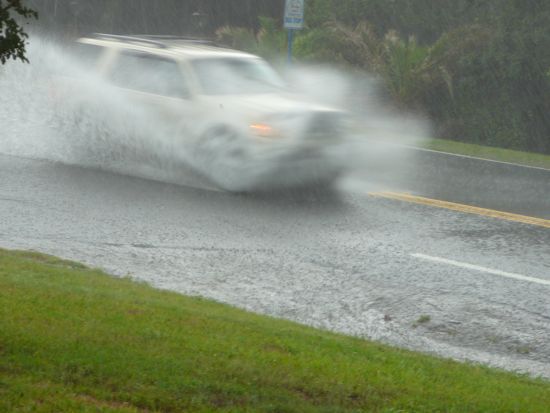
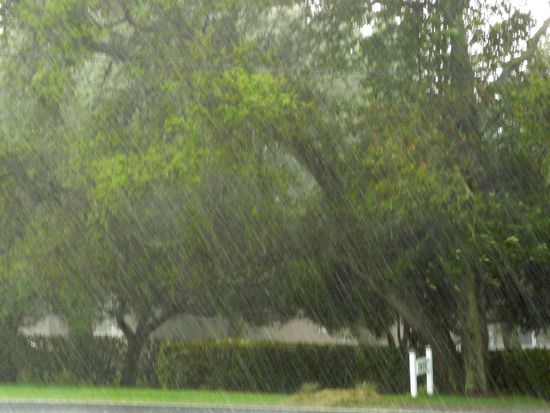
I grew up with cold rain. The rain in Pensacola is warm rain. You might carry an umbrella (umbrellas make me nervous in a thunderstorm; I am afraid they attract lightning) but the rain isn’t that cold, and it dries fairly quickly, unless you get caught in a real downpour. Mostly, you just wait in a store or in a car until the heaviest rain is over.
GMAC Rates American Drivers
This is an excerpt from Worst Drivers in America By State on AOL’s Wallet Pop:
GMAC’s sixth annual survey quizzed more than 5,200 licensed Americans from across the country on their driving knowledge and New York drivers fared the worst for the second year in a row, with an average score of 70 percent. That’s more than six percentage points below the national average score of 76.2 percent. New Jersey residents shouldn’t laugh too loudly at their neighbor’s expense. Garden State drivers finished second to last. Kansas, on the other hand, proved to be the best place to drive with a score of 82.3 percent. Oregon, South Dakota, Minnesota, Iowa and Nebraska drivers were also among the best performers on the survey.
Overall, though, the findings were pretty dismal. The study found that “nearly 1 in 5 licensed drivers — roughly 38 million Americans — would not pass a written drivers test exam if taken today.” A whopping 85 percent could not identify the correct action to take when approaching a steady yellow traffic light (hint: it involves the brake pedal). Many drivers also remained uncertain about safe following distances.
Nationally, the average score slipped from 76.2 percent from 76.6 percent. “When analyzed regionally, the results reveal that drivers in the Northeast may not be as road-rule savvy as their Midwestern counterparts,” according to GMAC’s press release. “The Northeast had the lowest average test scores (74.9 percent) and had the highest failure rate (25.1 percent). The Midwest region had the highest average test scores (77.5 percent) and the lowest failure rates (11.9 percent).”
Some other notable trends: Older drivers outperformed younger ones and men did better on the test than women but also flunked it at a higher rate. One-in-four drivers admitted that they did “distracting behaviors” such as selecting music on their iPhones, applying make-up or reading, though only 5 percent admitted to text-ing while driving.
(See full article from WalletPop: http://srph.it/ahqOZM)
2010 GMAC Insurance Driver’s Test Results
(Ranked in order of worst drivers by state to best drivers by state)
Scoring is from 1 to 100 on a 20 question test.
1. (WORST) New York – 70.0
2. New Jersey – 70.5
3. Dist. of Columbia – 71.9
4. California – 73.3
5. Rhode Island – 73.8
6. Louisiana – 74.1
7. West Virginia – 74.8
7. Hawaii – 74.8
9. New Hampshire – 74.9
9. Kentucky – 74.9
11. Florida – 75.2
12. Mississippi – 75.6
13. Pennsylvania – 75.8
13. Massachusetts – 75.8
15. North Carolina – 75.9
15. Arkansas – 75.9
17. Texas – 76.0
18. Connecticut – 76.3
19. Illinois – 76.6
20. Georgia – 76.7
21. Alabama – 77.1
22. South Carolina – 77.2
23. New Mexico – 77.3
24. Virginia – 77.5
24. Ohio – 77.5
26. Maine – 77.6
26. Delaware – 77.6
28. Colorado – 77.8
29. Utah- 77.9
30. Vermont – 78.1
30. Nevada – 78.1
32. Maryland – 78.2
33. Tennessee – 78.3
34. Wyoming – 78.4
35. Arizona – 78.5
36. Missouri – 78.8
37. Michigan – 79.0
38. North Dakota – 79.1
39. Oklahoma – 79.3
40. Wisconsin – 79.4
40. Washington – 79.4
42. Alaska – 79.8
43. Montana – 80.0
44. Idaho – 80.1
45. Indiana – 80.4
46. Nebraska – 80.5
47. Iowa – 80.8
48. Minnesota – 81.1
49. South Dakota – 81.2
50. Oregon – 82.1
51. (BEST) Kansas 82.3
See full article from WalletPop: http://srph.it/ahqOZM
Florida – where I am living now – is the 11th WORST state in the nation. . . .
BBC and the Oil Spill and Ethiopian Elections
You would think that living here on the Gulf Coast within miles of the huge oil spill spewing out to putrefy the beautiful, sparkling gulf waters, that we would have the best, most comprehensive coverage of the local news.
Not so.
“I love BBC!” I called out from my studio to AdventureMan, in his study next door. “Who else is covering the Ethiopian elections in such detail? And they have the best coverage of the oil spill!”
Here is the latest; and excerpt from the Huffington Post:
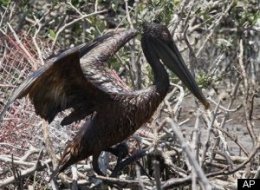
BARATARIA BAY, La. (AP) — As officials approached to survey the damage the Gulf oil spill caused in coastal marshes, some brown pelicans couldn’t fly away Sunday. All they could do was hobble.
Several pelicans were coated in oil on Barataria Bay off Louisiana, their usually brown and white feathers now jet black. Pelican eggs were glazed with rust-colored gunk, and new hatchlings and nests were also coated with crude.
It is unclear if the area can even be cleaned, or if the birds can be saved. It is also unknown how much of the Gulf Coast will end up looking the same way because of a well that has spewed untold millions of gallons of oil since an offshore rig exploded more than a month ago.
“As we talk, a total of more than 65 miles of our shoreline now has been oiled,” said Louisiana Gov. Bobby Jindal, who announced new efforts to keep the spill from spreading.
A mile-long tube operating for about a week has siphoned off more than half a million gallons in the past week, but it began sucking up oil at a slower rate over the weekend. Even at its best the effort did not capture all the oil leaking, and the next attempt to stanch the flow won’t be put into action until at least Tuesday. . . .
In Barataria Bay, orange oil had made its way a good 6 inches onto the shore, coating grasses and the nests of brown pelicans in mangrove trees. Just six months ago, the birds had been removed from the federal endangered species list.
The pelicans struggled to clean the crude from their bodies, splashing in the water and preening themselves. One stood at the edge of the island with its wings lifted slightly, its head drooping — so encrusted in oil it couldn’t fly.
Wildlife officials tried to rescue oil-soaked pelicans Sunday, but they suspended their efforts after spooking the birds. They weren’t sure whether they would try again. U.S. Fish and Wildlife spokeswoman Stacy Shelton said it is sometimes better to leave the animals alone than to disturb their colony.
Pelicans are especially vulnerable to oil. Not only could they eat tainted fish and feed it to their young, but they could die of hypothermia or drowning if they’re soaked in oil.
Globs of oil have soaked through containment booms set up in the area. Plaquemines Parish President Billy Nungesser said BP needed to send more booms. He said it would be up to federal wildlife authorities to decide whether to try to clean the oil that has already washed ashore.
“Is it Spicy?”
AdventureMan and I have wide ranging taste in dining out, as you know if you are a regular reader of this blog. We like Barbecue, we like Mexican, we like Vietnamese, we like Chinese, Japanese, Indian and Seafood. There is one food we do not like – tasteless food. We like TASTE.
Living here in the South, we will often see a group come into a restaurant, and one person – always a lady – will ask the waitress “Is it spicy?”
Spicy doesn’t mean fiery hot, spicy means pretty much anything other than the food’s natural taste plus salt – they do use a lot of salt in food here. At one restaurant, the waitress said “no, it’s not spicy, but there is a little bit of horseradish in the cocktail sauce” and the little lady said “oh, then I had better order something else.”
It’s all a matter of taste, what your palette is used to, and what it craves.
I wonder, too, if it isn’t what we are trained to expect – for example, some Nigerian friends once told us that from the time their children are babies, they give them little bites of hot hot pepper with their food. I think many of our restaurants add sugar, as well as salt, so that we have become more and more addicted to sweetness.
Recent Comments
ExpatAlien on What Country am I Living … intlxpatr on Yellowstone: Old Faithful to C… Michelle on Yellowstone: Old Faithful to C… Cathy on No Grown-Ups in Charge intlxpatr on Waiting for Snow Wikipedia Donate Button

Amazina


Early Voting in Florida


 Here There and Everywhere