Tropical Storm Bonnie On the Horizon
Yesterday Little Diamond and I headed out to Fort Pickens, a long spit of land out on Pensacola Beach where there are old forts and batteries, campgrounds and hiking trails. The campgrounds looked heavily occupied, and there was a heavy surf – not to far from the road. In fact, although I am usually courageous, I felt uncomfortable about how close the surf was to the road. Out on this long, isolated spit, the land isn’t that much above sea level. It wouldn’t take much to wash right over the spit, and were that to happen, there is no place to run.
Personal security sort of becomes a way of life. It becomes second nature; you don’t even know you are constantly surveying your surroundings, looking for escape routes, keeping your back to the wall, facing the door, watching cars around you, etc. You don’t even know you are doing it, until you get that sort of choking sensation, knowing there is one way out and if that way is compromised, you might be sunk – in this case, literally.
On our way out and back, we saw mysterious activity, involving tents, lots of workers, surveyors and GPS systems. We speculated it might be movement of turtle eggs to avoid contamination from the oil spill, but we didn’t stop and ask – they seemed very intent and focused on their task.
We quickly toured and left for a nice lunch at Crabs – We Got ‘Em. DELICIOUS! We had the crab and spinach dip – oh Yummm. I had the crab cake sliders, which were so big I could only eat the crab cakes. Little Diamond had the Crab Ceasar. All in all, we were greatly pleased. Although yesterday was another hot hot hot and humid day, we ate outside in the shaded area, fanned by fans and Gulf breezes. Another day in Paradise. 🙂
(For those of you in the area, here is our review of our first visit to Crabs – We Got ‘Em several months ago.)
This morning, looking at the front page, we had confirmation of our fears – under the headline Bonnie Flies Over the Sea is a sub-headline “Ft. Pickens evacuates campers as storm enters Gulf, regains steam.”
A second article, above the line, is Sea Turtles Changing Shores and you can see a photo of a sea turtle nest full of eggs being moved to avoid damage from the oil spill.
Pensacola is actually just outside the projected path of Bonnie, but those storms are often known to veer from the projections. I have water and candles and matches and blankets, peanut butter and crackers stored in the closet of what Little Diamond calls the Fantasy Guest Suite. She is, as has become tradition, our first visitor. 🙂
Really Bad News for USA Olive Oil Lovers
Horrifying. I read the labels. I thought we could trust the labels. Thank God for independent testing. Bring on the Palestinian Olive oil!
Most ‘extra virgin’ olive oil bottles are actually cheaper mix
(See full article from WalletPop
More than two of every three bottles labeled imported extra virgin olive oil are either a cheaper grade of olive oil or adulterated with another type of oil, a University of California at Davis study found.
Top-selling brands including Bertolli, Filippo Berio, Carapelli, Pompeiian, Colavita, Mazola and Carapelli all had bottles that flunked the test — containing instead a cheaper virgin olive oil, the study by the university’s Olive Center found. Even a brand carrying the name of TV host Rachael Ray — who frequently touts her supposedly extra virgin olive oil — flunked the testing on two of three samples.
The chemical analysis did find that 90% of the California-packaged olive oils were indeed what they claimed to be. Two that were exactly what they claimed to be were Walmart’s Great Value brand and Costco’s Kirkland Organic.
“The intent of the study was to provide consumers and retailers with an accurate picture of the quality of olive oils now being marketed through grocery stores and other retail outlets in California,” Dan Flynn, executive director of the Olive Center, said in statement sent to Consumer Ally. “Our hope is that these findings will lead to improved methods for evaluating extra virgin olive oil, and increased consumer confidence that ‘extra virgin’ on the label means extra virgin in the bottle.”
Flynn said the United States is the world’s third-largest consumer of olive oil.
Consumer Ally contacted several of the largest manufacturers cited in the study, but only one immediately responded to the request to comment on the study. A Colavita official wanted to read the study before discussing.
A history of duping consumers believing they’re buying the rich-flavored and often pricey extra virgin olive oil led the federal government to enact more stringent olive oil standards, scheduled to take effect in October. In 2008, Connecticut became the first state to regulate olive oil after finding that some being sold included nut oils or soy oils, which could cause dangerous allergic reactions.
“Before this study, we had anecdotal reports of poor quality olive oil being sold as extra virgin,” Flynn said. “Now there is empirical proof.”
Some of the tests analyzed for problems that would affect flavor — the very essence of extra virgin olive oil. “Many of these oils just did not taste good,” Flynn said.
He cited the following reasons for the oil flunking the tests:
adulteration with cheaper refined olive oil
oxidation due to elevated temperature, light and or aging;
poor-quality oils made from damaged and overripe olives,
processing flaws or improper oil storage.
See full article from WalletPop: http://srph.it/9Svxpx
Bacteria Makes Me Fat!
It’s not my fault! Bacteria makes me fat! I am so relieved! (But I am still fat 😦 )
This is an excerpt from Newsweek Magazine, part of a much longer article which you can read for yourself by clicking on the blue type, above.
The grapefruit diet, the Atkins diet, low-fat diets, low-carb diets, the cabbage-soup diet: they and all the other fad diets make the health establishment roll its collective eyes. The only way to lose weight, says every reputable textbook and medical society, is to burn more calories than you consume. And if you are adding pounds, the reason is, pure and simple, that you are consuming more calories than you expend. Weight gain is a straightforward matter of calories in minus calories out, they maintain.
But while the basic math is right, the meaning of “calories in” isn’t what we’ve been taught, according to a growing pile of studies of chubby mice, obese people, svelte mice, and slim people. The calories that matter are not simply the number printed on grocery items, fast-food menus, and those guilt-inducing signs next to Starbucks’ brownies.
The calories that count are those extracted by your digestive enzymes and—as more and more research is showing—the trillions of bacteria in your intestine. People whose gut bacteria are better at digesting fats and carbs than their neighbor’s will absorb all 1,500 calories in a Friendly’s Ultimate Grilled Cheese BurgerMelt, while the neighbor will absorb fewer. So even in people with identical metabolisms, the effects of eating identical foods can be different.
No Standards for Virgins or Extra Virgins in USA
I found this today on AOL News/Slashfood and it is a subject – long time readers will know – of interest to me. Ever since I read the article on The Olive Oil Scandal in The New Yorker I have been a religious reader of labels. I have discovered that in most of the US stores, the olive oil, virgin, extra virgin or otherwise is a blend of oils from Turkey, Spain, maybe even a South American country. To get olive oil from one country, I go to specialty shops. I have not seen one single bottle of my very favorite – Palestinian olive oil – and I wonder if it is even exported. I always bought it from my friends overseas; someone would bring in gallons and gallons of it and it was always so fresh tasting, and so tasty. It smelled so good you were tempted to eat a spoonful! No, no, I didn’t. The smell is unforgettable, and nothing I have tried in the US comes close. I can’t even find any California olive oil in the local stores!
Virgin? Extra virgin? Or something else entirely?
You never know what you’re really getting when you open a bottle of “100% extra virgin” olive oil, but the U.S. Department of Agriculture is hoping to change that with new standards for the green-gold oil set to roll out this fall, the Los Angeles Times reported.
The new rules come at a time when olive oil demand is surging. Americans bought 79 million gallons in 2008, up from 47 million gallons a decade earlier, the paper reported.
There are no federal rules that define “virgin” or “extra virgin” olive oil, Vito S. Polito, professor of plant sciences at UC Davis and co-chairman of the school’s Olive Center, a research group, told the Times. As a result, he said, “the U.S. has been a dumping ground for cheap olive oil for years.”
Bob Bauer, president of the North American Olive Oil Assn., said most of the olive oil on U.S. store shelves is legit, but his group alerts the FDA when problems occur.
Bauer told the Times 3 to 4 percent of the 200 to 300 samples his group tests each year are unadulterated or mislabeled, meaning they’re not as pure as they say they are or they’ve been combined with another type of oil.
“We’ve petitioned the FDA to create a standard of identity, which would define in black and white what olive oil is and is not,” Bauer told the Times. “They never acted on the petition.”
A spokesperson for the FDA told the Times that the agency does not regularly test olive oils for “adulteration,” but relies on information from the public or other groups.
The voluntary regulations being rolled out this fall set parameters for freshness and purity, fatty acid levels and ultraviolet light absorption, which can tell how fresh the oil is. USDA experts will also conduct tasting reviews, the Times reported.
Some worry that the regulations will be meaningless until they’re mandatory.
“It’s like saying you have to stop at stop signs, but there are no cops at the corner,” Paul Vossen, a University of California Cooperative Extension farm advisor for Sonoma County, told the paper. “Standards are a good start, but enforcement is important.”
News and Roosters
“How’d you sleep?” I cheerily greeted my sister, Sparkle, newly arrived from Paris to our small farming village in Germany.
“That #*%@ing ROOSTER!” she exclaimed. “He started crowing around 3:00 a.m. and never stopped! You must have heard him! He was right under our window!”

No. No, there was no rooster under our windows. The nearest rooster was up in the next farm, maybe 100 yards away. But I kind of remembered when we first moved in, I think I remember we heard him. We no longer heard him. You just get used to it, I guess.
What brings this to mind is that KUOW in Seattle has a program today on the Seattle City Council vote – they are about to vote to increase the number of chickens allowed by ‘urban farmers’ but to prohibit the roosters.
You can hear the discussion for yourself by going to KUOW. There are some hilarious comments, one by a man who said “Sure, ban roosters, right after you ban boom boxes, and teenagers, and heavy trucks, and garbage pickups. There are a lot worse sounds in the city than roosters!” (I may have paraphrased that quote, I was laughing too hard to write it all down.)
AdventureMan and I love National Public Radio. We support our local NPR station, WUWF in Pensacola, which I listen to while I am driving, but when I am working on a project, I still stream KUOW, which I started doing while I was living in the Gulf. I love the huge variety of opinions and subjects, and I appreciate that there is more news in the world than what they show on TV, after all, on TV they can only show what they have film footage of. There are books to be discussed, and movies, and music, and social situations in Khandahar and Botswana and Sri Lanka and boy soldiers in Liberia . . . things I haven’t a clue about unless I listen to my national public radio station. I read the paper daily. I watch the news once a day – but it doesn’t meet the depth of coverage of NPR.
I think chickens are pretty cool. They are also pretty stupid, but I am all for a chicken or two, fresh eggs, etc. When I needed fresh eggs in Germany, I just walked up the hill and bought them from the chicken lady. When I asked my landlady about recycling, she just laughed, and we walked our food leftovers, peelings, coffee grounds, etc up the hill and threw them over the fence for the chickens. I don’t even mind roosters. Sorry, Sparkle!
Margaritaville on Pensacola Beach
The weather was beautiful in Pensacola, all 4th of July weekend to the fireworks. Early Monday morning, all hell broke loose, the heavens opened and it poured rain.
In spite of the good weather leading up to the Fourth, the droves that usually invade the beaches to celebrate didn’t materialize. One restaurant owner said his business was down 80% from last year at this time. We decided, in spite of the rain, to head over to the beach for lunch, do our small part for the Pensacola Beach economy.
LLLOOOLLLL! The first place we tried, Peg Leg Pete’s, (“Our Latitude Will Change Your Attitude”) had such a crowd that the wait was 25 – 30 minutes, standing out in the rain, so we passed. Our second choice, Crabs – We Got ‘Em was closed until 4 pm. Oh AAARRGH,, but there is still the brand new Jimmy Buffet hotel, Margaritaville and we’ve been eager to take a look so in we go.
Bad news is that you can’t use the underground parking lot, even on a rainy day, unless you are a hotel guest. Good news is that if you are dining in the restaurant, valet parking is free, and when you have a baby and car seat with you, valet parking is very very good. 🙂
Margaritaville is beautiful, and fun. As soon as you walk in, it is beachy; beautiful sand and sea colors, a faux straw mat floor and comfy beach-home furniture. Beach music, too.

The view of Pensacola beach, even on a rainy day, is glorious. Please note that the beaches are CLEAN. Come to Pensacola! Save the economy!
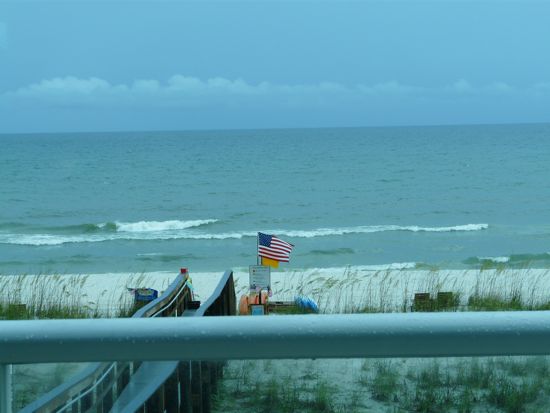
Our original plans had been to find one of the beachy restaurants, you know, family restaurants, full of kids, one more little baby wouldn’t even be noticed. The main demographic in the Margaritaville restaurant was couples, mostly 50-ish, women in sundresses they were a little too big for, and men in big bright flowered shirts, drinking fancy beach drinks (There is a whole page of them 🙂 ). There was one baby, and few other children.
We only had to wait about 15 minutes to get in, and there was a nice lounge where we could wait. We had the popcorn shrimp for starters, and we liked it. The bacon cheeseburger was good, according to my son, and the crab cake sandwich disappeared in a heartbeat. Baby Q was good as gold and had is first taste of dill pickle. He liked it! My seafood salad had macaroni in it. Aargh. Service was good, unobtrusive and friendly.
It’s a nice place. I would stay there. I love the clean lines and the sea colors. There are other places I would rather eat.
Pesticide Exposure Cause of ADHD?
This morning on AOL Health News:
By Mary Beth Sammons
In the United States alone, an estimated 4.5 million children ages 5 to 17 have been diagnosed with attention deficit hyperactivity disorder, according to the Centers for Disease Control and Prevention, and rates of diagnosis have risen 3 percent a year between 1997 and 2006. Yet it is unclear what is causing this increase. New research is investigating many avenues. One of them is environmental factors such as pesticides and allergens.
In a study published in the journal Pediatrics, researchers studied 1,139 children ages 8 to 15. All of the children studied had measurable residue of pesticides commonly used on fruits and vegetables. Diet is a major source of pesticide exposure in children, according to the National Academy of Sciences, and much of this exposure comes from the common kid-friendly fruits and vegetables, such as blueberries, strawberries and celery. In a 2008 government report, detectable concentrations of malathion (a pesticide commonly used in agriculture, residential landscaping and mosquito abatement) were found in 28 percent of frozen blueberry samples, 25 percent of fresh strawberry samples and 19 percent of celery samples.
In the Pediatrics study, researchers found that for every tenfold increase in the urinary concentration of pesticide residue, there was a 35 percent increase in the chance that the child would develop ADHD. The effect was seen even in kids who had a very low level of detectable, above-average pesticide residue.
Unlike other studies of pesticidal impact, this one looked at the average exposure to pesticides in the general population of children and not at a specialized group such as children who live on farms, according to lead author Maryse Bouchard of the University of Montreal.
Because certain pesticides leave the body after three to six days, the presence of residue shows that exposure is likely constant, Bouchard said. The study found that children with the kind of metabolites left in the body after malathion exposure were 55 percent more likely to be diagnosed with ADHD. Almost universally, the study found detectable levels: The compounds turned up in the urine of 94 percent of the children. Children may be especially prone to the health risks of pesticides because they’re still growing and may consume more pesticide residue than adults, relative to their body weight.
More research is needed to confirm the findings, says Bouchard. But the take-home message for parents, she says, is to give kids organic produce as much as you can and to wash fresh fruits and vegetables — organic or not — thoroughly.
An unpublished 2008 study out of Emory University found that in children who switched to organically grown fruits and vegetables, urine levels of pesticide compounds dropped to undetectable or close to undetectable levels.
Denver immunologist Dr. Isaac Melamed is studying another effect that may contribute to ADHD: the inflammation caused by all allergies including food, pollen and dust. In his unpublished study, he found that the inflammation caused by an allergic reaction may contribute to ADHD. Therefore, he says, by controlling a child’s exposure to allergens, parents may be able to better control ADHD. Melamed says that although much more study needs to be done on this, in his private practice, he has controlled his patients’ ADHD by limiting allergic triggers.
Remember that all of this research is in the very early stages and needs to be studied more thoroughly before it can be confirmed.
So the parents who conscientiously feed their children fruits and veggies are at most risk for exposing their children to pesticides which may lead to ADHD? And the recommendation is for eating organic vegetables? Or growing your own?
Lunch at the Tuscan Oven
We took a road we don’t usually take, and suddenly, there it was – The Tuscan Oven! I had eaten there before, and loved it, but had not seen it and had assumed it had disappeared. Restaurants do that, even good ones, it takes so much work and so much effort to run a restaurant, and they run on such a slim margin that we have often been disappointed to see good restaurants close.
We were joyful to see the Tuscan Oven!

The place is packed. People who love good food are here. 🙂 You can tell that many of them are friends with the owner, and they come here often. The menu has too many good things!

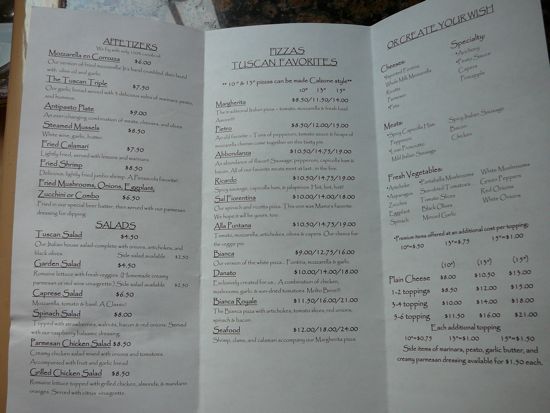
We ordered the Antipasta Plate, with delicious cheeses and sausages, tasty olives and a stuffed artichoke heart. Unfortunately, we dug in before I remembered to take photos 😦

We each also ordered a small pizza, but even small was too big after the antipasta plate, so we ended up bringing more than a full pizza home.


I love the decor – an artist has painted food ingredients for the meals – this is my favorite, the artichoke:

We look forward to coming back here often!
Where The Wild Things Are (Apologies to Maurice Sendak)
First thing, early every morning, I get up to water my herbs and vegetables. I could do it later in the day, but later in the day is unbearable for me. It is hot. It is humid. The temperatures are in the 90’s, with humidity that makes you drip with sweat. I feel like a vampire; I try to get everything watered before the first rays of sun rise – directly into my backyard garden – and strike me with their heat.
Things are coming along. This weekend I will pick the first of my Black Krim tomatoes. I can hardly wait. I bought it at a garden club sale, as a little tiny plant. The tomatoes are supposed to have a smokey flavor, and very tomato-y.
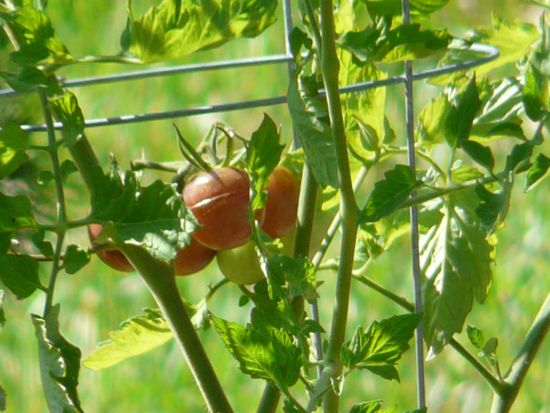
There is a lot going on in our backyard.
We have a bright red cardinal who comes at late afternoon to take a bath in the birdbath. He is very cautious, looking around for maybe five minutes before he feels safe enough to splash. I don’t have a photo of him, yet.
We have all kinds of squirrels, because we have oak trees, and they are busy gathering and saving for the winter. They seem to be finding lots to eat in our backyard.

We have a dragonfly who is a regular visitor. He sits atop some of the bamboo stakes in the garden. I don’t know if he is looking for smaller insects to eat, or just enjoying a little perch in the late afternoon sun:



Our house is surrounded by chameleon, fortunately, unlike Qatar, they are not INSIDE my house! I am delighted to have them as neighbors, as they are wonderful for pest control, and in Florida – there are a lot of pests. The dreaded cockroaches, but also ants, and fire ants, and hornets, and wasps, and cutters, and lovebugs – well, you get the picture. I need all the help I can get. Insects love me, the eat me up. 😦


I think this little chameleon is looking for a mate!
(Maurice Sendak is one of my very favorite authors of children’s books, especially books for lively little boys. They have fabulous illustrations. As our son was growing up, one of our favorite lines from a Sendak book was “Let the Wild Rumpus begin!”

Skinniest People Shop at Whole Foods
This study is hysterical. It tracked who shopped where, and found that the people who shop at Whole Foods had a far smaller probability of being obese. They concluded that the poorer the consumer, the less healthy the foods.
I found this on AOL Health.
Skinniest People Grocery Shop HERE
By AOL Health Editors Jun 8th 2010 10:56AM
The skinniest people shop at Whole Foods where only 4 percent of the shoppers are obese. Why? It’s all about money–or lack thereof.
People who are poor and have less to spend on food try to get the biggest calorie bang for their food buck. That means they not only shop at cheaper stores, but also buy less healthy food.
The study: A University of Washington research team tracked 2,001 Seattle area shoppers between December 2008 and March 2009. They compared their choice of supermarkets to data they collected on the participants’ education, income and obesity rates. Obesity rates were measured by asking consumers to report their height and weight so their body mass index (BMI) could be calculated. People with a BMI higher than 30 were identified as obese.
The results: The percentage of obese shoppers is almost 10 times higher at low-cost grocery stores, compared with more upscale stores. And poverty is the key reason.
Lead study author Adam Drewnowski, an epidemiology professor who studies obesity and social class, says people who can pay $6 for a pound of radicchio at Whole Foods are obviously better able to afford a healthy diet than those who buy $1.88 packs of pizza rolls at Albertson’s to feed their kids. “If people wanted a diet to be cheap, they went to one supermarket,” Drewnowski told MSNBC. “If they wanted their diet to be healthy, they went to another supermarket and spent more.” He found that only 15 percent of shoppers chose a store based on its proximity to their home. Instead, almost all the shoppers chose a store based on price or quality.
Sticker shock: All the stores offered the same type of food, including fresh fruits and vegetables. But the prices were vastly different. The average price for a market basket of food at Whole Foods was between $370 and $420, compared with the same basket of food at Albertson’s for $225 to $280.
“Deep down, obesity is really an economic issue,” Drewnowski told MSNBC. Eating healthy, low-calorie food costs more money and requires more preparation skills and time than consuming processed, high-calorie foods. MSNBC reports that in a separate study in 2008, Drewnowski estimated that a calorie-dense diet costs $3.52 a day, compared with $36.32 a day for a low-calorie diet. “What this says is your social economic status is clearly associated with how overweight you are,” he told MSNBC.
Grocery stores and percentage of obese shoppers:
• Whole Foods Markets: 4 percent
• Metropolitan Market: 8 percent
• Puget Consumers Cooperative (PCC): 12 percent
• Quality Food Centers (QFC): 17 percent
• Fred Meyer: 22 percent
• Safeway: 24 percent
• Albertsons: 38 percent
— From the Editors at Netscape
Recent Comments
intlxpatr on Shampoo Ginger tigerbutterya0c5ff1d… on Shampoo Ginger intlxpatr on British Soldier Kidnapped, Esc… John on British Soldier Kidnapped, Esc… intlxpatr on British Soldier Kidnapped, Esc… Wikipedia Donate Button

Amazina


Early Voting in Florida


 Here There and Everywhere