Souk al Waqif: Soy Restaurant
I’ve heard mixed reviews of Soy, and since I love Chinese, Thai, Japanese, Vietnamese and Korean foods I was eager to give it a try. I’ve been twice, love the menu, love the chairs, and holy smokes, the place is HUGE.

I love the variety of restaurants in the Souk al Waqif, and it is nice to have this alternative. I will never order the Chinese set menu again, however. The main course, grilled shrimp, came with three delicious looking breaded shrimp on skewers. I carefully removed the tail and bit in – there was shell on the shrimp!
Maybe this is really authentic, I thought. Maybe real Chinese people eat the shrimp shell and all, but my lunch-mate scowled and called the waiter over and complained. “These breaded shrimp were deep-fried with their shells still on!”
The waiter disappeared, and we waited. He came back and told us that is the way they were cooked, every time. Well, OK, so we took the shell off and ate the shrimp, but you can bet money that we will never order that set meal again!
The set meals are a nice deal. 49QR takes care of a soft-drink (ironically, you pay for water, but the soft drinks come with the meal), and then your choice of one of three set meals – the Chinese, the Japanese or the Thai.
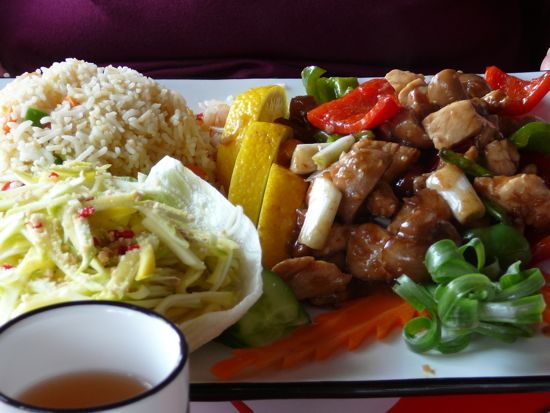
Back another time, I tried the Japanese, which I liked, except the Teriyaki chicken had barely any teriyaki taste. The miso soup was very good, the salad strange, and the green tea ice cream for dessert was good.
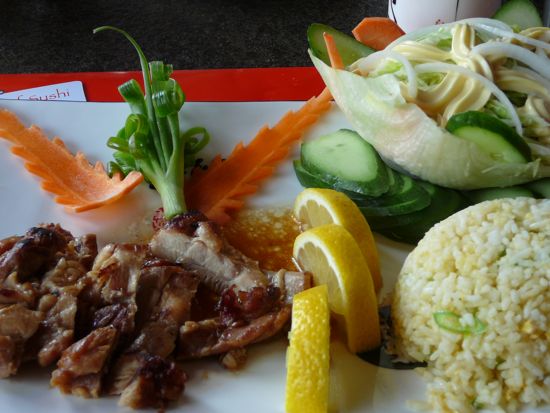
My lunch friend had the Thai, which had a very good soup, a strange salad, a very good main course and a good dessert, I think deep fried ice-cream.
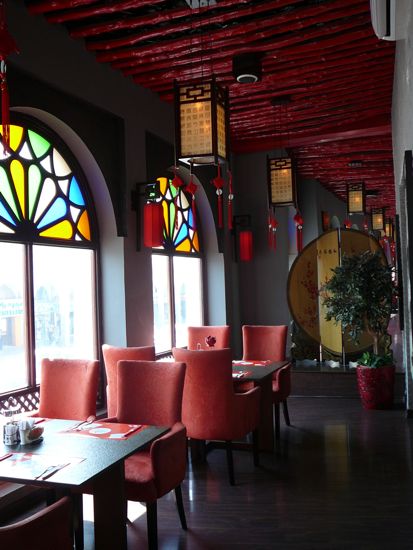
I love the chairs. I love having comfy chairs with arms to eat in. I love it that the restaurant is huge, with lots of different dining areas, tucked away behind the other restaurants.

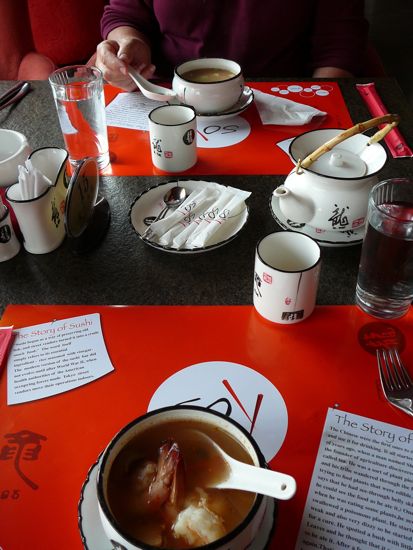
My favorite part of the set meals are the soups and the rice. Both are excellent.
Even after the Chinese shrimp disappointment, I would like to go back again and try ordering a la carte from the menu, to see how we like it. Even if a restaurant is uneven, often there are things they do really well, and if you stick with those things you can have a good dining experience. So my review is mixed, but it’s not like I am saying I will never go back. It was a good experience, and I want to give it another shot.
The Majliss in Doha
When we lived in Doha the last time, we often brought people to The Majliss. Most Americans had never been there, never knew it was there. It is off Al Sadd – if you are going from C Ring to D Ring, you turn right at the Kentucky Fried Chicken and stay on the slip road that goes in front of the stores. At the second possible right, you turn right, and you will see the Royal Tandoor on your left, and The Majliss on your right.
There two really great things about The Majliss. First, the food is really, really good. Second, they have a bunch of individual rooms where you can sit on the floor, majliss style, with cushions and a big, low table. Some rooms are small, some are large enough for maybe 12 – 14 people.
They also have booths, some that have curtains you can pull if you need privacy, like if you are a woman wearing niqab and you want to eat without people seeing your face. They also have booths without curtains, and a more open area where mostly just men eat.
There was a time when soldiers would come here from Iraq, and you could sort of check them out like library books to take out for dinner, or to the malls, or to your house. We often took them to the Majliss, and it always blew them away, it was such a great experience. The Majliss is also where we took our son and his wife when they first came to visit us in Doha. We have so many happy memories at The Majliss.
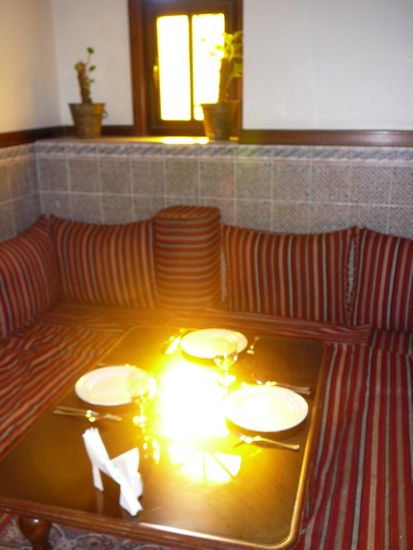
This time, it was our visiting Kuwait friends, and since we all know what it is like to sit in a Majliss, and we all have older knees and hips, we chose to sit in a booth. Here is what is cool – our Kuwait friends loved it as much as our American friends do.
This was our first time back at the Majliss since our return to Doha. We worried that it had changed, deteriorated, that the food would not be so good as we remembered. We had a happy surprise – it is the same, but even better. 🙂


I have to admit, one reason I love the Majliss is because they have Mohammara, made of walnuts and chilis and other good stuff. This one was really good, a little spicy!
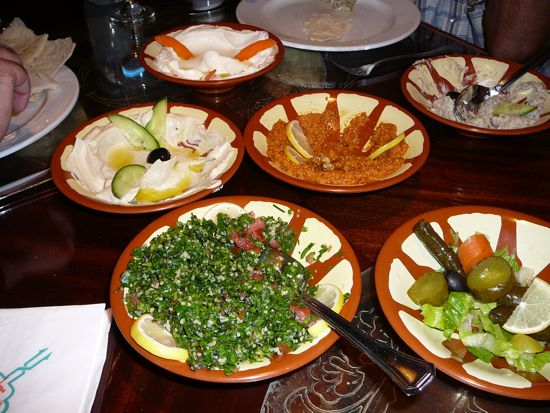
And oh, the fresh, hot bread . . .

Now, I am embarrassed to tell you, when our main dinners came, I forgot to take photos until late . . . so this is where the delicious Majliss hammour used to be – my very particular and discerning Kuwaiti friend ate every bite!
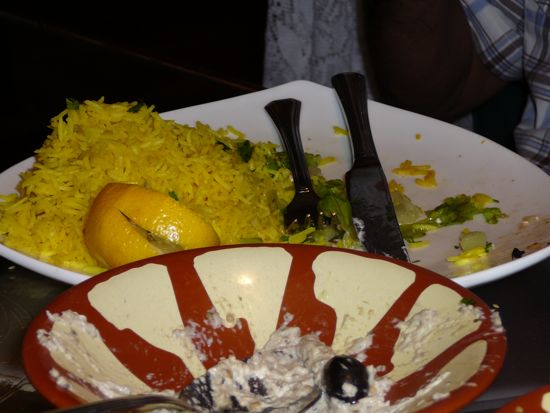
And here is what is left of my Shrimp machboos, before we gobbled the rest of it all up:

And the kabob, just before it disappeared entirely!
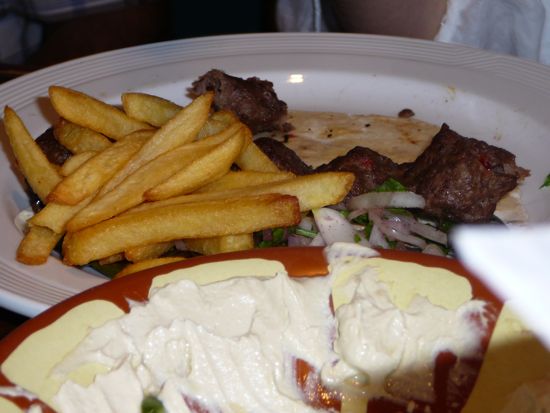
We were all so full, we didn’t even have room to order the creme caramel, which always comes swimming in caramel, yummmm. We had Turkish coffee and rolled ourselves out the door – stuffed!
Prices are reasonable, it is a great place for good local food at reasonable prices – the Michelin red “R” in Doha.

Too Much Food
AdventureMan and I have lived more years outside our own country than inside it. We have lived on-and-off in the Middle East for more than 30 years. You’d think we would know everything by now, but we are still delighted to discover new things and to learn from the culture in which we are living.
Our Kuwaiti friends were good about letting us peek inside the culture, telling us stories of family life “before oil” and Kuwait traditions. Like women aren’t supposed to eat too much when they to to someone’s house for dinner or the people will say “do you think she has never seen food before?”
On the other hand, it is shameful not to provide enough food, so you always prepare way more than the group invited can possibly eat, like in ten years.
Sometimes a lot of the food goes to waste, but I have also discovered these wonderful plastic bags and tin trays found in every supermarket in the Middle East. What doesn’t get eaten now – gets eaten. I admit it, I am a lazy wife. I don’t like cooking big meals when it is just the two of us, so I love being able to pull something out of the freezer and have it all heated up and fresh for dinner.


It also makes me feel very ecological to have food in the freezer, ready to fix, and to know that not a lot went to waste. We are learning from our son and his sweet wife, and all the young adults in our family, who are WAY more ecologically aware than we ever were, and we thought we were pretty good, the generation who invented recycling.
AdventureMan used to bring home people for dinner, mostly guys from out of town in town for a short time who needed a home-cooked meal. We always had food in the freezer, something I could pull out on short notice.
One time, I made beef burgundy. When I went to serve it, I looked for the cheesecloth bundle of spices and couldn’t find it. I looked and looked, and then I figured I must have taken it out earlier and forgot I’d done it. Then, during dinner, one of the men had a very puzzled look on his face – he was chewing on the spices ball! I was SO embarrassed, but they all just laughed, thank God.
Fruit Crisps – Desserts (English: Crumbles)
There are two reasons to make fruit crisps. One, there is no better way to let ripe fruit star, take center stage, just when it hits its peak. Second – oh, it is SO easy.
Here is the original recipe I use:
Apple Crisp
From Mary Cullen’s Northwest Cook Book, 1946
Crisps are wonderful when made with fresh fruit, and not so much trouble as a pie requiring crusts. Here, the topping is delicious, and easy.
5 cups apples
1/2 cup butter
1 cup sugar
3/4 cups all purpose flour
1 teaspoon cinnamon or nutmeg
Peel, core and slice apples and place in a greased baking dish or cassarole. Using a pastry blender, work together the butter, sugar, salt, flour and spices. Pack closely around apples. Bake in 425 degree oven for 45 – 50 minutes. Serve with whipped cream.
Berry Crisp
Substitute berries for apples. If berries are very tart, sprinkle with 1/2 cup sugar mixed with 1/2 cup flour before covering with crumb mixture.
Rhubarb Crisp
Use diced rhubarb in place of apples. Mix 1/2 to 1 cup sugar and 1/2 cup flour with rhubarb before placing in baking dish.
This time I made peach crisp:
You put the fruit in a buttered pie / tart plate:

You sprinkle the topping on, pat it down, and bake. Yes, it is that easy.
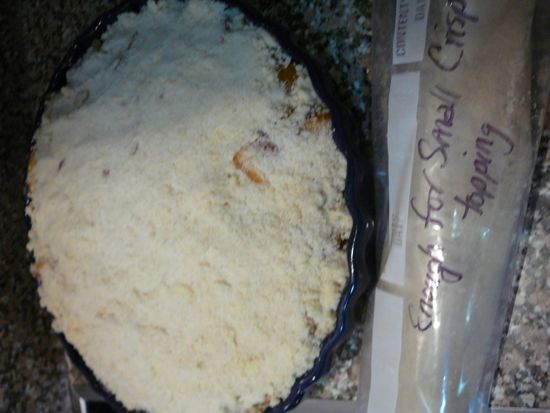
No, no end photo, sorry. It disappeared too quickly!
(In the Pacific Northwest, these are called Crisps. My English friend tells me that in England, they are called Crumbles.) So Easy.
Crab Cakes in Doha
We wanted to have a light dinner at home to welcome our house guests, and then take them on a night-tour of Doha. I remembered the wonderful Crab Cakes my friend and her daughter made in Seattle, and I was determined to have . . . well, I knew it wouldn’t be the same, but something LIKE those crab cakes.
So I found the best crab I could buy in Doha, and made up the crab cakes. Wrong crab. Wrong breading – I couldn’t find any panko (I know there is panko in Doha, I just know it, but I couldn’t find it when I was looking for it!) so I whirled up some lime Tostito chips in the food processor and used those.
They were actually pretty good, when I first made them. Not the same, not Pacific Northwest Dungeness Crab, but not bad.
This is four cans of crab meat – you can find the recipe for Crab Cakes by clicking on the blue type; I already printed it back in August or September.

The crushed tostitos weren’t bad for breading, but you only use a little, on the outside, to help them firm up for cooking:

I served them with Plum Sauce, which also wasn’t as good as the fresh home-made plum sauce my friend’s daughter made:
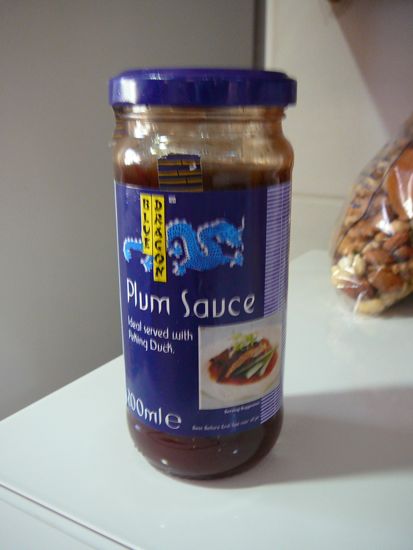
They were OK. If I didn’t know what Pacific Northwest Crab tasted like, fresh out of the ocean and steamed right away, I probably would have thought they were pretty good. I’m not going to make them again here.
Boiled Cole Slaw Dressing
We really do love cole slaw, but we find that there are some cole slaws we love more than others. Neither AdventureMan nor I are big into mayonaiss-y cole slaws, we find we like vinegary cole slaws better. Probably we like vinegary ones better because many many years ago a wonderful friend gave us this recipe for cole slaw dressing, and it is our hands down favorite.
When I first came to Qatar and wanted to make this dressing, I looked everywhere for poppy seeds, only to be told that they are ILLEGAL in Qatar, I guess they think we are all going to get high on poppy seeds or something. I was told poppy seeds are legal in Kuwait, but as hard as I looked, I never found any. I will admit, from time to time I have to bring some back with me, just so I can make this Cole Slaw Dressing.
It is sweet – and tart. I also use it on cucumbers, and I like it even better!
1/2 cup sugar
1/3 cup vinegar
1 teaspoon salt
1 cup oil
1 Tablespoon poppy seed
1 teaspoon dry mustard
1/2 teaspoon onion juice (I use grated onion)
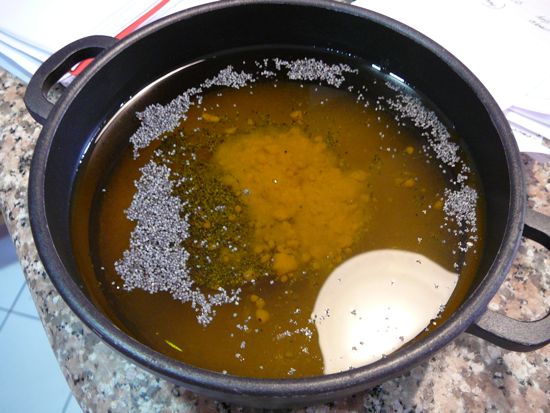
Bring all to a boil. Cool before using. Enough for one medium large head of cabbage. (Slice cabbage into thin shreds.) I also don’t let the dressing get too cool; I like the way it wilts the cabbage a little.
Mexican Rouladen, Recipe and Photos
I had my menu all set, and then, when I went to the butcher, he said “No madam, we never do this. You will not find this in all of Doha.
If I had the time, I would go to “all of Doha” and prove him wrong. And oh-by-the-way, what is wrong with saying “we can do this for you and have it ready for you tomorrow morning at 0900?” something like that?? No, just “you will never see this in Doha.”
So I can spend my time grinding my teeth in anger, or running all over Doha to see if I can find what I need (flank steak) or . . . I can see what is available and do what I can with what is available. Fortunately, I see a familiar cut of meat, and I can work with it.
When I get around a group of people, I can’t concentrate. I am so focused on the conversation and the people, that if I have houseguests, for example, which I did this weekend, I can’t talk and get dinner on the table at the same time (even with help!)
My solution is to do everything possible ahead of time, and make lists, including what dishes I plan to use for serving, what times this needs to happen, and then that, and sequences. That way, the fact that my thinking process goes on hold means I am not facing total disaster.
I needed to have a lot of variety, so that if someone didn’t like something, there would be something else they might like.
I took an old faithful recipe, Rouladen, and reworked it for a Mexican theme dinner. The secret to successful rouladen is long, slow pre-cooking. It can be entirely cooked the day before and then re-warmed to serve when you need it. It takes what might be a tough cut of beef and renders it fork-friendly. You don’t even need a knife; it cuts easily with a fork and melts in your mouth.

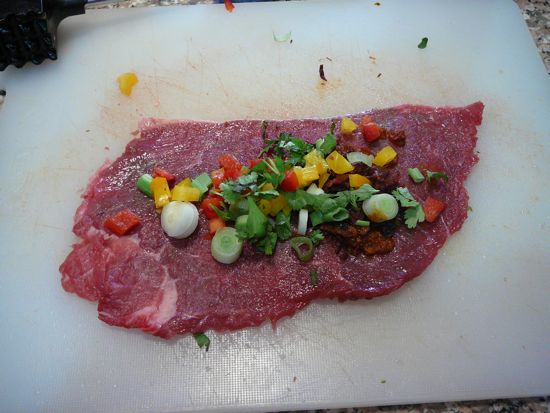
You pound the meat, especially on the edges, to flatten it and to tenderize it.
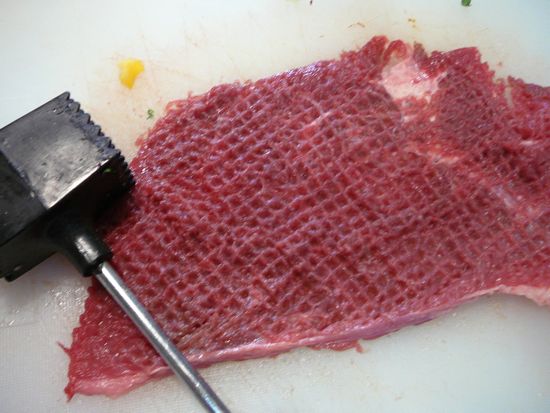
You have the filler ingredients ready to go:

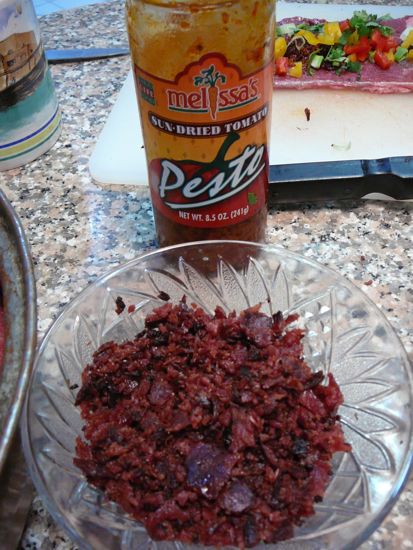
Actually, I forgot to put the jalepenos inside, so I chopped up a few very finely and added them to the sauce – it turned out to be just the right thing. I like to start with just a teaspoon of Pesto, just to give it a little pop, and some already-cooked and crumbled bacon (this is turkey bacon, but any bacon will do.)
You sprinkle the other ingredients lightly over the length of the roll, leaving about an inch all around for rolling and folding:
When they are rolled, you put them closely together in a pot:

This is key – you make up an acidic sauce – tomatoes, for example, are acidic. I use tomato paste, and tomatoes, and then you can add broth, or wine, or lemon juice – something to make it more liquid. You also add spices, in this case, chili and cumin for the Mexican flavor, plus, as I mentioned above, some very finely chopped jalepenos.
Then, you pop it into a slow oven – 350°F/180°C – and slow cook it three or four hours. That’s why you want it very liquid-y, so that the sauce won’t disappear during the long cooking, it will concentrate. Yummm!
No, I don’t have any photos of the finished dish. I was pretty busy. 🙂 The roulades shrink, and brown over the top, but remain fork-tender for eating when you heat them up (30 minutes at 350°F/180°C, until hot!)

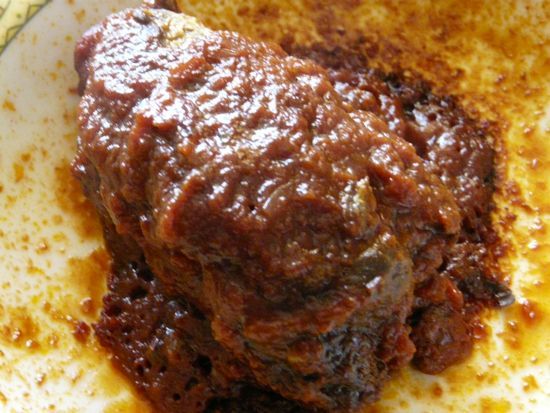
This is what one roulade on a plate looks like. They are much prettier when a bunch are all cooked up in the pan together, and I serve them right out of one of my Damascus copper cooking pots:
10 Riskiest Foods to Eat
Found this on AOL Wallet Pop where you can find amazing research and ideas on how to make your money go a little further. Although this study was conducted in the US, it seems to me that these would be the hardest foods to manage anywhere in the world.
Aimee Picchi
Think you’re safe eating foods regulated by the Food and Drug Administration? Think again, according to the Center for Science in the Public Interest, a non-profit health advocacy group.
What many consumers consider healthy foods — including eggs and leafy greens — are implicated in 40% of food-related outbreaks linked to FDA-regulated food, the Washington, D.C.-based CSPI says in a new study.
The watchdog group, which based its findings on outbreak data collected by the Centers for Disease Control and Prevention between 1990 to 2006, says the list of the 10 foods should sound an alarm to consumers and legislators because of the presence of so many healthy foods, ranging from tomatoes to sprouts.
“Many of the foods that made the list are a part of a healthy and balanced diet,” said CSPI staff attorney Sarah Klein on a conference call to discuss the findings. “Leafy greens are unfortunately no stranger to food-borne illness. The most common path are Norovirus, E. coli and Salmonella.”
The report from the CSPI, known for bringing the public’s attention to food issues such as the health dangers of trans fats, comes days after the New York Times highlighted the dangers of hamburger meat and the flaws in beef inspection. Some readers decided to swear off hamburgers for good after seeing the piece, writes WalletPop sister publication Daily Finance.
More than 1,500 separate outbreaks were linked to the foods on the CSPI’s list, which has led to almost 50,000 reported illnesses. The top 10 riskiest foods regulated by the FDA are, in order of the most outbreaks:
• leafy greens
• eggs
• tuna
• oysters
• potatoes
• cheese
• ice cream
• tomatoes
• sprouts
• berries
The report doesn’t differentiate between organic and non-organic foods, although the CSPI believes the risks are fairly similar, said Caroline Smith DeWaal, the director of the group’s food safety program, on the call. It also didn’t include meat, because the FDA doesn’t regulate the meat industry, she said.
So what should consumers do? Proper food handling and safety measures are important in home kitchens, ranging from cooking eggs thoroughly to taking care potatoes aren’t contaminated by other food. Because potatoes are always cooked, which would eliminate any pathogen, the reason why potatoes are linked to food-borne illnesses is likely from cross-contamination, DeWaal said.
And the report underscores the need for the passage of the Food Safety Enhancement Act, the CSPI said. The Senate should take the lead of the House and pass the legislation, which would give the FDA authority to require food processors to implement food safety plans and increase frequency of inspections.
Despite the call for change, food system in the U.S. remains relatively safe, said Dr. Craig Hedberg, a professor of environmental and occupational health at the University of Minnesota School of Public Health, on the call. Still, food-borne illness is “a major health concern,” he added.
Mediterranean Diet Can Help Fight the Blues
From BBC Health News comes a study that says not only is the Mediterranean diet good for your heart healt – it is also good for your mental health. If you are fighting the seasonal blues, fight back with olives, olive oil and a diet high in veggies and legumes.
The Mediterranean diet, already thought to protect against heart disease and cancer, may also help to prevent depression, Spanish researchers say.
They found depression was more than 30% less likely to develop in people who followed a diet high in vegetables, fruit and cereals, and low in red meat.
They studied 10,094 healthy adults over four years, the Journal of the American Medical Association reports.
However, the team stressed additional, larger-scale studies were required.
Researchers at the Universities of Las Palmas and Navarra recruited university graduates to take part.
Dietary patterns
They completed questionnaires and the researchers calculated their adherence to the Mediterranean dietary pattern (MDP) for an average of four-and-a-half years.
MEDITERRANEAN DIET FEATURES
• A high intake of monounsaturated fatty acids like olive oil
• A moderate intake of alcohol and dairy products
• A low intake of meat
• A high intake of legumes, fruit and nuts, cereals, vegetables and fish
Participants who had a strong adherence to the MDP tended to be male, ex-smokers, married and older individuals.
They were more active physically and showed a higher total energy intake.
The researchers identified 480 new cases of depression during the follow-up period – 156 in men and 324 in women.
They found that those with the highest adherence to the MDP were more than 30% less likely to develop depression.
They took into account marital status, the number of children and factors associated with a healthy lifestyle and found the relationship did not change.
Even taking account of personality traits, such as competitiveness and anxiety, had no effect on the results.
‘More research needed’
Professor Miguel Martinez-Gonzalez, of the University of Navarra, said the results would have to be confirmed in longer trials with more participants but they had found a strong inverse association between the Mediterranean diet and depression.
“Thirty per cent is a large reduction in the risk and this could be very important considering the large burden of disease represented by depression.
“We know how important the Mediterranean diet is in reducing cardiovascular risk factors and the same inflammatory proteins are also raised in patients with depression.”
He said it was likely that the overall dietary pattern was more important than the effect of single components and “may exert a fair degree of protection against depression”.
Dr Cecilia D’Felice, a clinical psychologist, said there was mounting evidence for the importance of diet in treating depression.
She said: “What we do know is that a diet high in olive oil will enhance the amount of serotonin or brain transmitter available to you.
“Most anti-depression drugs work to keep more serotonin available in the brain.”
The New Apple Market
I’ve written before about The Apple Market in Pensacola, but on this trip, I had a thrill – the Apple Market has grown. The aisles are wider now. They still have an incredible variety of things that are available, but their ready-prepared food section has grown, they have a separate coffee section – the whole place is larger and more spacious, but still neighborly and friendly. I love that place.


Recent Comments
Kitchen on Isiais: Winding Down intlxpatr on Shampoo Ginger tigerbutterya0c5ff1d… on Shampoo Ginger intlxpatr on British Soldier Kidnapped, Esc… John on British Soldier Kidnapped, Esc… Wikipedia Donate Button

Amazina


Early Voting in Florida


