Fairhope and Panini Pete’s
‘What are we up to today?” one of the Doha reunion visitors asked as we sat around the breakfast table at the Shiny Diner.
“I was thinking a drive into Alabama,” I threw out, “Or is there anything you have heard of you would like to visit, or re-visit?”
“I’ve never been in Alabama before!” one guest enthused. “I could cross it off my list!”
We dropped one friend off at the airport, said our farewells, and headed into Alabama. For those of you who are thinking it might be a long trip, Pensacola is close to the border; 20 minutes later we were in Alabama.
“Where are we going?” the remaining two visitors asked.
“I’m thinking Fairhope,” I responded, “it’s cute, and there are walks, and shopping, and cute restaurants.”
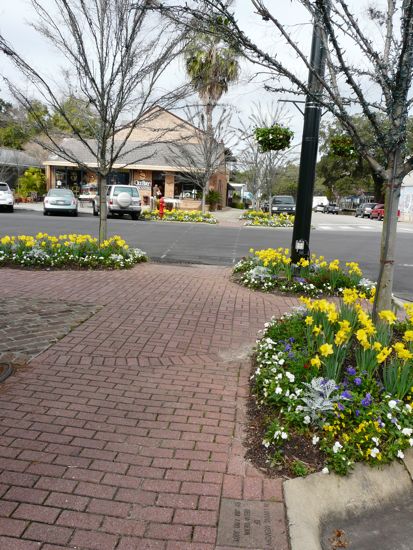
While we are not world-class shoppers, Fairhope is enticing, with it’s small boutiques and specialty shops. It’s not like the same-old same-old in every mall and strip-mall.


As we walked along the Fairhope Pier, we guessed how long it was. We saw several people doing laps of the pier – what a great place to walk, all that fresh air, the view of the Mobile skyline, the wind and the water. One of the walkers strolled along with us and told us the pier was exactly 1/4 mile, so if you walk out and back, you have walked 1/2 mile. She also gave us a recommendation for a place to eat, in Fairhope’s French Quarter, Panini Pete’s. “Be sure to eat outside,” she counseled us.
We found Panini Pete’s, and snagged a place in the gazebo, which I thought was ‘outside’.

It was a lovely location. My friends had the Reuben sandwiches with special homemade chips:

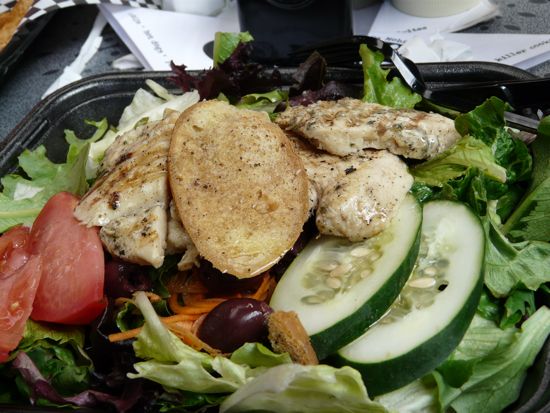
I had the house salad with grilled chicken:
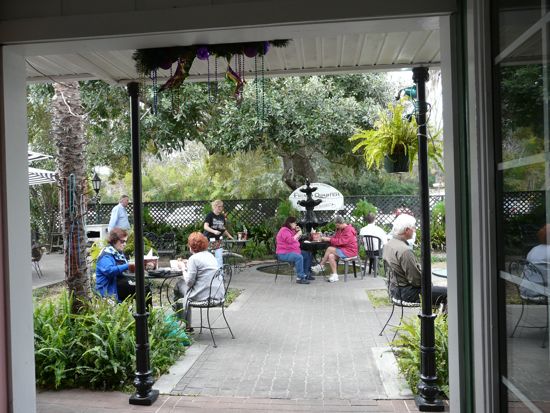
We spent a lovely time dining, only to discover that we were not outside; this is what ‘outside’ is:
I did not take a photo of dessert – we shared an order of beignet. These were the big round fluffy beignets, covered with powdered sugar. So yummy!
It was a great visit, even though we never found an Alabama Starbucks cup for our visiting friend, she did get to spend time in Alabama. Next reunion, maybe we will check off Louisiana and Mississippi, the only other states she has not visited.
Open Faced Crab Sandwiches
Remember Qwon Chi Rolls? No self respecting Alaska girl would eat a roll make with “Crab with a K” which we all know is really Alaskan pollack re-textured to remotely resemble real crab. My friends, don’t eat that pretend stuff. Look for real crab. It’s out there.
When I was a little girl, my parents would go out, and sometimes they would come back, bring their friends, and my mother would make open faced crab sandwiches. To me, they are still special; I get hungry just thinking about them.
They are fun, and easy to make.
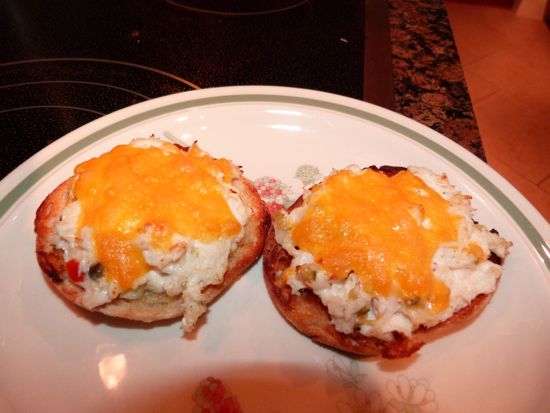
You get Crab – the real thing. I like claw meat, but any crab you prefer, as long as it is REAL crab, will do. You put crab meat in a bowl. You add just a little horseradish, just a little fresh ground pepper and a little fresh ground salt. You add some of the green from green onions, not a lot, just a little, and then you add just a little mayonnaise.
Toast English muffins, and spread crab generously on the muffins.

Top the crab with grated cheddar cheese, and broil in the oven until the cheese is melted.
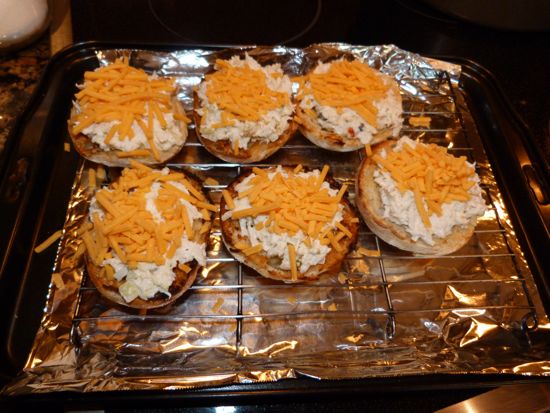
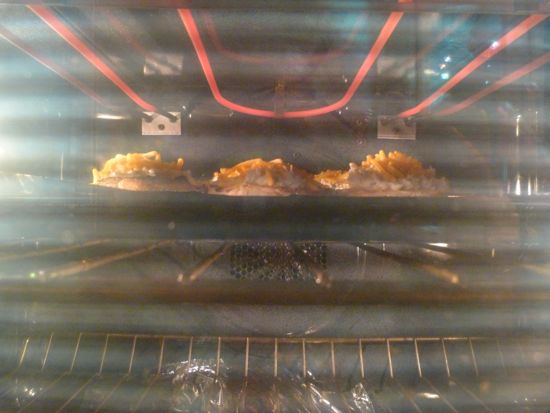
Now, they are ready to eat!
I think I had better go eat dinner . . . . I’m HUNGRY!
Shopping Bust
Most of the time, thanks be to God, I am not much of a shopper. Amazon.com saves me; often I wait too long and rather than run from store to store for what I am looking for, I go to Amazon and with just a few clicks, there it is. I may see it later, for less – or maybe not – but Amazon has saved me the frustration of trying to find it and failing. Like there is this particular filter my refrigerator needs; I can run from store to store looking for it (and failing) or I can order it from Amazon.com, and have it in a couple days. Same with printer ink. If I happen to find that filter or that ink on sale, I buy a bunch, so I don’t have to shop again.
Today, I had a list of six items. I plotted my course. These are not items that are of critical importance, just things I am watching for at the right price, and one item was on sale, a really good sale, with a coupon.
What would those things be? A floor lamp, strong enough to read by at night, and a mirror like the one my daughter-in-law has that makes me look 25 again. A table and chair for Happy Toddler’s room. Some shiny fabric like fingernails, and some that evokes a snake. Hair stuff.
I came home with one thing, actually part of one thing. They were two for $12, but there was only one. I got a rain check, but I went from store to store, and felt increasingly frustrated at not finding exactly what I wanted. I am not often a happy shopper who likes to just roam and look, no, I know what I want and I am trying not to take it personally that I didn’t find it.
Our New Year came in sweetly. We had the Happy Toddler staying overnight with us. He is so calm and so sweet, and it was just easy. We took him to church in the morning, and dropped him off late morning at his parents, who we think enjoyed sleeping in even more than the movie. Lunch with good friends, great conversation, great meal, home for a snooze and a quiet evening. Life is good.
Today we had a really good work out at the water aerobics class, hit Tudos for lunch, and were delighted to see them doing huge business, full of families and large groups still celebrating the holidays. I worked on a quilting project most of the afternoon, except for the shopping fiasco.
Dinner at the Happy Pig
We were all meeting up at the Happy Pig; the mood was meat, specifically BBQ meat, and as it is a family gathering, all tastes had to be considered. Happy Pig is centrally located, great food and, a big plus with the Happy Toddler, family oriented.
Happy Toddler is so much more verbal these days, which is a joy, and gives us many moments of hilarity, but also can be a pain. He believes that “please” means he will be given what he wants when he wants it. He believes that “all done” means he is free not to eat meals when the rest of us are eating. Ah well – he isn’t quite two and has time to learn all these distinctions. Meanwhile, we have to hide our laughter when he exerts his will so unselfconsciously.
What we loved are the Christmas lights:
This is the angel on the top of the Happy Pig Christmas Tree

Outside lights – Christmas gifts

This is a giraffe
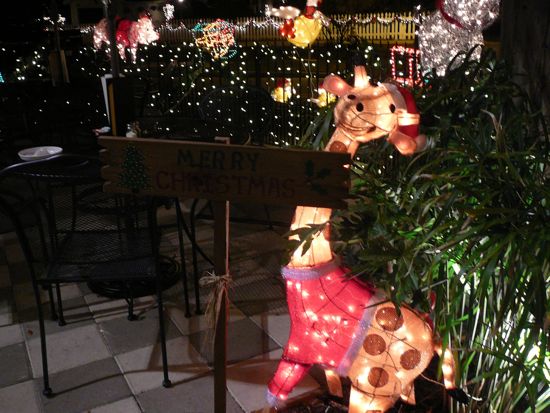
This is a hippo – have you ever seen a hippopotamus in Christmas lights before?

Another Happy Pig pig

A Happy Pig Polar Bear

We are having a particularly good Christmas this year; AdventureMan and I are on the same continent, in the same country, in the same time zone, in the same city, and thanks be to God, in the same house celebrating Christmas. We are so thankful. We are so thankful to be near our son and his wife, and our amazing and darling little Happy Toddler.
He loves the train gifts he got, but, again, this is where almost-two can be hilarious – he got a table and chairs he loves. What he loves is to move those chairs all over the house and to line them up in different ways, often as – a train, LOL. He is so serious, as he is creating, and so focused. You can almost catch a glimpse of him as the adult he will one day be.
The Tiger’s Wife by Tea Obreht
The Tiger’s Wife was the perfect book to get me from Pensacola to Seattle, and through the Atlanta airport, full of bustle on a Sunday, packed flights, no quiet, no privacy. Thank God for a good, engrossing book, that takes you totally out of where you are to a world where things are not always what they seem.

The book is set in an unnamed country in East Europe which has just come out of a war, and the main character and her best friend are en route across a border which did not exist before the war, on an aid mission to immunize children who were once neighbors, and are now in a different country.
The primary relationship in the book is the bond between a young girl and her grandfather, and the stories he tells her as they walk up to the zoo, the Jungle Book he reads to her as they visit the animals, and the stories she finds for herself as she participates in the post-war rebuilding. It is a fascinating book because what she is writing about is not always what she is really writing about; the stories and legends and experiences are metaphors for another reality and a life lesson.
I don’t want you to think that this is one of the mindless airport books I sometimes tell you about. If it were, I would tell you “this is not great literature; this is an airport read.” Not this book. This book is literature. This book has meaning, and events you will think about and talk over with other readers long after you have finished the book.
In the back of The Tiger’s Wife is an interview in which one of my favorite new authors, Jennifer Egan (A Visit From the Good Squad) interviews Tea Obreht about her writing process, her life, her vision, etc. Fascinating reading, too, and also reader’s guide questions help you see things you might need to see and might otherwise miss.
. . . Hurray for the Pumpkin Pie . . .
“You’ve worked HARD!” our water aerobics instructor told us. “You get a free pass tomorrow; you can eat anything!”
I wish she hadn’t said that. We did work hard, but it wasn’t just one day of feasting, it was pretty much four days, and we enjoyed ourselves too much. No matter how hard we had worked Wednesday morning, it wasn’t enough to cover four days.
Arriving at Papa’s and Grammy’s we were welcomed with a bubbling gumbo, a combined effort of Papa and Grammy; Grammy did all the shopping and chopping, and PaPa worked the roux, which is the butter and flour combination that makes that smoky flavored base for the gumbo. They had just finished cleaning and deveining about 40 pounds of shrimp for Thanksgiving, and threw a few in the gumbo. Oh YUM. The next morning was full of preparations, and then, mid-morning, the feasting began, with all the guys shucking oysters and eating boiled shrimp. As you drive up, you can smell smoke from an outdoor fire, and chairs and tables are out everywhere, but the shucking goes on down near the creek:



The house is beautiful, spacious and welcoming for so many people. The happy baby, who is now a happy toddler, was in heaven – he was surrounded by boy toys – tractors and golf carts and a Model A and all sorts of age appropriate toys, as well as cousins, aunts, uncles and a lot of hilarious rough housing. Why is it kids just love the terror of being turned upside-down?
For me, this was the best Thanksgiving with the family; finally I am beginning to figure out who is who from year to year. I still have to ask questions, but they seem more comfortable with me, and I had some really good conversations, sort of beyond the polite-passing-the-time conversations. I’m not that great in big crowds, but now I am beginning to have some good one-on-ones, and for me, that’s a great Thanksgiving.
And on, man, the food. Tables and tables of food. I don’t know how they do it, but I saw the list of cakes, and there must have been twenty cakes on THE LIST. They each have responsibilities, and somehow, it all works.
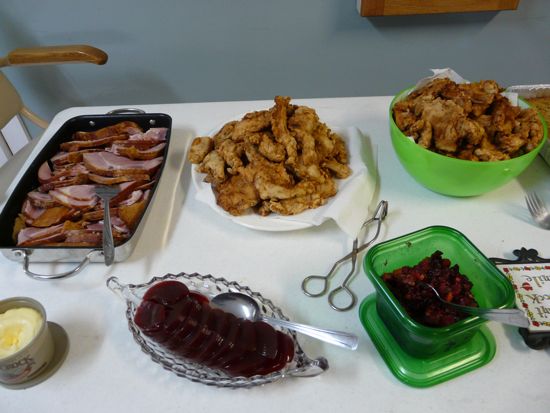
Three turkeys, all carved, and so much dressing (which I grew up calling stuffing, it all depends on where you grew up):
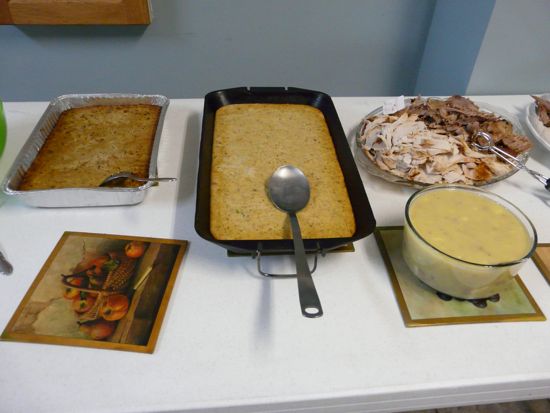

That green container is AdventureMan’s first foray into cranberry chutney. This one was a little tart, but tasty. As are darling daughter in law so diplomatically put it, “I would probably like it more if my taste buds were accustomed to having cranberries without sugar.”


About half of the sides were sweet potato casseroles; you can’t believe how good these are. This year this front dish was one of the favorites, squash cassarole:

This photo doesn’t begin to do justice to the desserts – holy smokes:

So the biggest brother blessed the food and we ate around one, then we visited for a few hours, people going back and grazing a little. Then the next generation cleaned everything up and got all the food packaged up and put away. About an hour later, that broccoli salad started calling me, and I went out to try a little more and discovered it was all put away, but a partner in crime knew where it was, and we pulled it out and had some, which started a whole landslide of second-platers, just when everything had been all put away, LLOOLLL!
It was a great day, a day full of thanks for all the things in life that really matter.
Over the River and Through the Woods
. . . . to the co-grandparents house we go!
This is preparation week, and we are scurrying to get things together for Thanksgiving with the large family group. When we were first invited, one of the aunts told us “You’re not invited, you’re family! You’re expected!” It made us feel so welcome, and the gathering is so much fun we look forward to our time together.
Mom’s Cranberry Salad
Christmas Punch, Rum and Rumless
Rosettes
The world’s cutest grandbaby will be there; we are all having so much fun with him as he is in the steep learning curve phase, and pops out with language which astonishes us daily. While bathing him the other night, I was explaining about washing with soap and he said “I know.” I almost dropped the soap! He adores his BaBa, and whenever he sees me, he gets a big grin – and looks for BaBa to be behind me. LOL!
He loves going to his other PaPa’s house; he has a TRACTOR! And a Boat! The happy baby loves trains and motorcycles and buses; he loves anything that GOES.
We have so much for which we are thankful. God has blessed us mightily with family, and with friends, and with a wide and spacious place in which to live our lives. He has surrounded us with his grace, and we feel blessed, so blessed.
Happy Thanksgiving!
I Wish I’d Hugged Her
The phone rang, late for most of my friends. We rarely talk after nine. It was one of my quilting sisters, calling to tell me one of our members had collapsed and died.
I sat down. Why would my friend say such a thing? On the other hand, when I saw her – just three days ago – she wasn’t looking too good, had one of those allergies or things we all get during this time when the temperatures may be in the 40’s or in the high 70’s. But she did make it to the meeting, and we all have bad days, don’t we?
My friend said she would let me know as soon as she knew the arrangements. I think I was a little dazed, a little in shock. I remember when I got the call my Dad had died, it’s like I can’t integrate things all at once, it takes me a while for things to sink in.
I wish I’d hugged her. She’s a lady I really like, talented, wry, funny. We talked, briefly at the meeting, but then the meeting went into full swing and I didn’t really talk with her again. I wish I’d hugged her.
Secrets to a LONG Marriage
Read this article and weep, and be sure you have a group of wild girlfriends. 🙂
I found it this morning in AOL News Huffpost:
The Fine Line Between Marriage and Divorce
Iris Krasnow, Author, The Secret Lives of Wives: Women Share What It Really Takes To Stay Married
I’m just coming off 200 interviews and two years of listening to mature wives reflect on — or moan about — how they are managing to stick it out in long marriages. Scenes from their relationships that range from 15 to 70 years are woven together in my new book, The Secret Lives of Wives: Women Share What It Really Takes To Stay Married coming out in early October.
I’ve been married for 23 years during which my husband and I have raised four sons, and have had plenty of rocking and rolling in our relationship. From my own experiences, and from the dozens of sagas unloaded into my tape recorder, I am constantly reminded of the eggshell-thin line that separates loving from loathing. I know that staying married can mean plates flying across kitchens, tears soaking pillows and emailing old boyfriends at 3 a.m.
I thought nothing could shock me about what really goes on behind closed doors between two people working hard to make it “til death do us part” — without killing someone first. After all, I have heard every brand of twisted love story — swinging, adultery, spouses coming out as gay after 30 years together, threesomes, fist fights in restaurants, even the tale of a husband discovered to be having sex with a sheep, documented in a photograph discovered by his wife in his nightstand drawer.
But in piecing together this latest book I have been surprised at some of the revelations. I’m not as ruffled by the tawdry tales of farm animals or one I heard from a 55-year-old wife about screwing a perfectly sculpted landscaper while her doctor husband was lecturing on vein surgery in another country. My biggest shock is how many outwardly cheerful women who have been married forever think about divorce if not weekly, at least once a month.
How’s this for a statistic? Of the 200 plus women interviewed and woven into The Secret Lives of Wives, I can count on one hand those who have never considered splitting up. It was no surprise that Beth often considered leaving her husband. He routinely told her she was fat and ugly, and when they fought in the car he would pull over and shove her out the door. Who could blame Shauna for her many consults with a divorce lawyer? She’s the wife of the traveling doctor, a man who hasn’t initiated sex since their honeymoon 30 years ago. Her secret is that she has it both ways: an intact family and a ten-year affair with a hard-bodied lover, who does her landscaping for free.
The biggest shocker is the number of wives in stable unions who frequently contemplate fleeing their marriages. These are not abused wives; they are women with nice husbands who give them orgasms and jewelry and stability. Yet many of these settled midlife women admitted they were slightly jealous of Tipper Gore who gets to have a fresh start after 40 years of matrimony with the same guy. While many speculated about whether one of the Gores fell in love with someone else, my instincts without talking to either of them is that perhaps they are a lot like other couples portrayed in the book. Maybe they were simply sick of being around each other. And maybe one or both of them finally couldn’t take it any more.
Who stays married and who doesn’t is a question not always about commitment or deep abiding love — it’s about endurance.
I have found in my collection of wives who remain in long running marriages that the majority of them share these common traits: They have the guts and determination to stick it out, no matter what. And their laments about their marriages aren’t because of anything serious. It’s the subtle nuances of living with one person in one house for a very long time that grates at the soul, that causes a simmering malaise. It’s the grind of the ordinary that drives people into thinking, “Is this all there is? I want more. I want adventure. I want change.”
Who wouldn’t want changes with the current statistics on lifespan? Women in their 80s and 90s are the fastest growing segment of the aging population which means that many of us wives could easily hit our 50th wedding anniversaries and beyond. That’s a hell of a long time to sustain one love affair, particularly when empty nest hits and it’s only you and the husband with no cushion of kids as a buffer.
There are three strategies that have worked the best with the women I interviewed. The happiest wives have a sense of purpose and passion in work and causes outside of the home. Wives who counted on a spouse for fulfillment and sustenance were often angry and lonely. And the happiest wives don’t spend a whole lot of time with their husbands. My chapter called Separate Summers is filled with women who take their own vacations, take their own summers, take charge of their own lives. Couples who allow each other to grow separately are the ones with the best chance of growing together and staying together.
Finally, the wives with the highest marital satisfaction have a tight circle of wild women friends with whom to drink, travel and vent about their husbands.
Yes, my work on this book has been quite surprising and enlightening. I now know that acceptance of mediocrity in a marriage relationship is more prevalent that you would imagine. I know that sometimes the only reason women stay with a spouse is because they have divorced friends who may have more sex than they do with new husbands but they also have cranky step-kids who hate them. Other women stay in lackluster marriages because they don’t want to give up their swanky lifestyles, and divorce is expensive, really expensive. We know from our friends who are pushed to the edge and do call it quits that the grass isn’t always greener, there are parched patches on both sides of the fence.
But most women told me they stay married simply because they like their marriages more than they dislike them, even if much of the time it’s 51 percent “like” to 49 percent “dislike.”
Iris Krasnow is a bestselling author and an assistant professor in the School of Communication at American University. Connect with her on: http://www.iriskrasnow.com
Ann Patchett: The Patron Saint of Liars
I didn’t expect to like this book as much as I did. The main character is odd, a woman who doesn’t really think things through clearly, and somehow doesn’t even really know what she is feeling.
She gets married, and three years later, pregnant, decides “the marriage isn’t working” and leaves her husband, with a note saying only that the marriage isn’t working. We’ve been with her when she met him and fell in love, and she seemed to love him OK, and their lives together seemed to be OK, but somehow, she had to leave. I didn’t understand it when it happens in the book, and I never did understand it. The author tells us that Rose is a private person.
Rose drives from California to Tennesee, to a home for unwed mothers, where she bears a child, whom she keeps. Most of what she does seems to be on automatic pilot. I never really understand what Rose wants, only that she is aware that this isn’t it.
The story is told from three different points of view, and at no time did I have a clear idea of what motivated the main character, Rose. You can’t help but love her husband, Son, and her daughter, and all the women who love Cecilia, and help raise her.
You do get was a rounded picture of people around her, the good sisters running the home for the unwed women, how the women who arrived changed over the years as our culture changed, and how you may not understand how a person’s mind is working but sometimes you can just find a way to accept that she is what she is, and get on with living your life.
I really liked the book, even though I was not taken with the main character. I can’t tell you too much without giving it all away. Read the book and tell me what you think.
Recent Comments
ExpatAlien on What Country am I Living … intlxpatr on Yellowstone: Old Faithful to C… Michelle on Yellowstone: Old Faithful to C… Cathy on No Grown-Ups in Charge intlxpatr on Waiting for Snow Wikipedia Donate Button

Amazina


Early Voting in Florida


 Here There and Everywhere