Eid Mubarak 2014
To all my Muslim friends, may your celebration be full of family and all good things with which God may bless you!

“Give Me Your Tired, Your Poor . . . “
Who are we?
I’m listening to a heartbreaking discussion on National Public Radio’s Diane Rehm show about the masses of children heading toward the southern border of the United States.

Anti-immigration is nothing new, not in the United States, not in newer countries. It is shocking to me, however, that people who came from somewhere else are so strongly opposed to allowing these desperate children in. If they are running for our border – and they are – they are desperate. They are desperate to escape violent death, and death by starvation, death of the spirit eeking out a living day to day.
“They come here for a hand-out!” is the most common complaint.
Read your American history. Very few immigrants – your ancestors, American citizens – arrived with money. Most relied on friends, family, the immigrant community, social services – whatever they needed to survive until they could get on their feet.
And get on their feet they did. Immigrants to America come here to work hard, believing that working hard will give them a chance at a better life. Your ancestors and mine – they came and worked hard, scraping together the money to build a business and/or to send their kids to schools. If you’ve ever attended a citizenship ceremony, you will love the jubilation. They don’t want a handout. They want a chance at building a decent life.
So now it’s “I’ve got mine, go back where YOU belong?”
When I grew up, not even in the United States proper, but in a U.S. territory, we sang a wonderful song, from a poem by Emma Lazarus, The New Colossus, which is on a plaque on the Statue of Liberty:
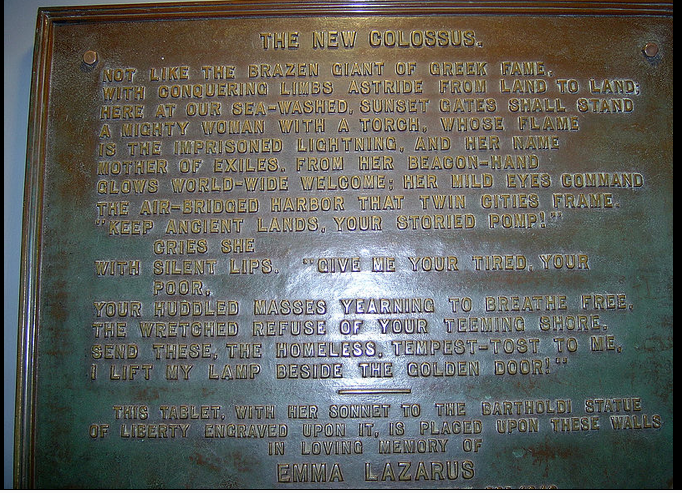
Not like the brazen giant of Greek fame,
With conquering limbs astride from land to land;
Here at our sea-washed, sunset gates shall stand
A mighty woman with a torch, whose flame
Is the imprisoned lightning, and her name
Mother of Exiles. From her beacon-hand
Glows world-wide welcome; her mild eyes command
The air-bridged harbor that twin cities frame.
“Keep, ancient lands, your storied pomp!” cries she
With silent lips. “Give me your tired, your poor,
Your huddled masses yearning to breathe free,
The wretched refuse of your teeming shore.
Send these, the homeless, tempest-tost to me,
I lift my lamp beside the golden door!”
I’ve never forgotten those words we all sang as children. The immigrant flows into America are our life-blood. You can keep your stale traditions and meaningless pomp, she cries, send me those willing to work hard and yearning for freedom.
How can we refuse CHILDREN seeking asylum? Each child we feed, house and educate will have a chance to become contributing citizens. The face of our nation is changing, has already changed greatly and will continue to change, and what we choose today will have a critical effect on what our society will look like tomorrow.
Do we still yearn for liberty for all? Do we want a highly stratified society where some are born to high paying jobs and others relegated to trades (I’ve seen how this works in another country; it’s stultifying.) Restricting access to all that we enjoy will create a wholly different society, a zero-sum-game society, where your loss is my gain, instead of an everyone wins society, where my success lifts you, too. Our country thrives on the creation of wealth; ideas are generated, resources and labor pools are created, they are not finite, they transition. Immigrants fuel the kind of innovation and population flow that keeps the lifeblood of our country flowing.
My family has been in the US a long time. We qualify as daughters-of-just-about-everything. We were immigrants; we were not native-born. The entire United States, other than the First People, are immigrants. We are immigrants, all of us. It makes us strong.
Celebration 2014: Friday Afternoon Dancing
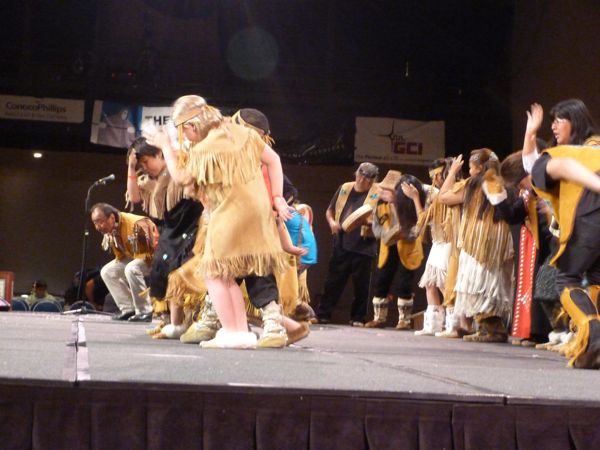
For the first time ever, the announcer tells us, the groups are all ready on time and the dancers ready to go – they are astonishingly ahead of schedule.
We return as a group of mixed dancers, from many Alaskan tribes, and some dancers with roots in classic “lower 48” tribes, so they all respect one another’s traditions, share, and do a little bit of everything. I kind of like this kind of flexibility. Some of the female costumes are a little ummm . . . skimpy . . . for the cold Alaskan climate, LOL, and some of the tattoos a little un-Alaskan and it doesn’t matter, they make it work.
The Celebration Hall is full and brimming over, dancers and their families in the waiting rooms, behind stage, in the halls, in the gift stores, children wailing for their Moms or Dads, it is totally a family affair. Grandma’s step in and help, and the dance goes on.



Heroes At The Dinner Table
“That’s Jollaf rice!” the Nigerian journalist said, a note of delight in her voice. She is famous for her passion and persistence drawing attention to the environmental issues in the Niger delta related to oil extraction and production. I told her that here in the Gulf, it’s called Jambalaya, but we all agreed that it very likely had African roots. She delighted my heart; she had three helpings.
When we have visitors from foreign countries, I try to serve foods they can identify – grilled vegetables, a chicken dish, several salads, a dessert. This time, because we had no Moslems, we used a real Cajun sausage in the jambalaya (pork), and jumbo shrimp.
The award-winning Finnish environmentalist has his own online website and a goal of planting 100 million trees by 1017. He is well on his way, visiting and planting trees in new countries every week. He also has his own band and has a CD out with Finnish music.

Our South African guest manages a large rhino reserve, protecting the rhinos from those who would kill them for their horns, thinking it renews sexual energy. Poor rhinos! He was quiet, but an acute observer, and the highlight of the evening was as he sang the haunting South African national anthem, Nkosi Sikelel’, with the Finnish guest. They did not sing all 11 verses (!) in all the different languages; just one verse, it was very moving:
Our own sweet environmentalist was with us. We think our son and his wife are super heroes; they fight for justice and a clean environment. This evening, our son stayed at home with the grandchildren and his wife, who works with clean water, was able to join and talk shop over dinner with her counterparts from other parts of the world.
It isn’t so easy anymore to get these dinners on the table, off the table, dessert served, etc. I used to be able to do these easily, for more than 20 people, but I also had help, LOL! But these dinners give us so much joy that I can’t imagine giving them up any time soon.
A Stalwart Falls

“Are you catching colds?” our friend asked as the funeral ended.
“No, no, I said, funerals just find us very vulnerable, and we have to deal with losses, past, present . . . and future. We have an ongoing fight over who is going to bury whom.”
We did not know the man well who had died, but we knew him as a stalwart. He was a greeter and usher at our service, and he was only rarely ever not there. He served the church. He was always there. I had asked his wife to help me with tickets, and she had laughed and said “of course, I’ll be there because my husband will be there, and if you need me just holler.”
They weren’t there. It made me uneasy, it nagged at me. I didn’t need her, but I missed her, and as I said – they are ALWAYS there. Sometimes it’s what is missing that catches your attention. It caught mine.
When I learned her husband had died, suddenly and unexpectedly, just as the Antique Fair was starting, it came almost as a physical blow. It’s not that I knew him that well. It’s that his presence at the church was something we took for granted, he was stalwart. You could count on him. We attended out of respect, respect for him, support for his wife.
And I know that the two of them spend (spent) as much time together as AdventureMan and I do. I don’t like to think that it could happen to me, that I could be suddenly left. AdventureMan was a military man, he would often leave, all these years, and he might tell me where he was going but I never knew for sure where he was going. We had a code to use if he was lying, but although he never used the code, I know there are times he lied, all for that bitch, national security. Yes, yes, I know, strong language from Intlxpatr, but strong times call for strong language. We both knew that there were times when there was a risk he wouldn’t come back.
We didn’t have to deal with death a lot in our life abroad. Of course, in the military, everyone is young. In all the countries where we worked in the Gulf, there were upper age limits – people retired and people left; you can’t live out your years in Qatar or Kuwait, there are laws against it. You can’t even be buried there without special permission. We learned to deal with the losses of people coming into our lives and leaving, but we didn’t have to deal with the great finality of death. We’re learning.
AdventureMan insists he is going to go first. I am tough in a lot of ways, but I don’t know that I am tough enough to go through his funeral. The very thought of it makes me sick to my stomach.
He tells me not to worry. He wants a Viking funeral; he wants to be sent out in a kerosene soaked ship and for archers to set it on fire as it sails off, disintegrating in flames. Isn’t going to happen, AdventureMan, but if it did, I might give some thought to pitching myself on the ship as it departs . . . otherwise, I’m afraid I might live the rest of my life as the one of the walking wounded.
Giving Birth to Gun in the South Sudan
This is the newest blog entry from my friend Manyang David Mayar in the South Sudan He visited Pensacola as part of an IVLP program with our Gulf Coast Citizens Diplomacy Council:

Pregnant women fleeing the fighting in Jonglei state, South Sudan.
I was in the town of Bor when fighting broke out last month in South Sudan. I managed to escape the town despite being shot in the arm. But many other people had a far tougher time – people like Nyiel Magot, nine months pregnant and faced with the awful choice of staying in Bor’s hospital or fleeing into the bush.
Against her doctors’ advice, Nyiel decided to escape the immediate danger, and with her five children, took a narrow path out of town which was packed with people also heading to safety.
But, she told me, with every step she took, she grew weaker and more and more people overtook her.
“I was really tired and the pain became really unbearable,” Nyiel said. “I knew the time had come for me to give birth and I had to get out of Bor immediately to escape the attackers.”
Giving birth in the bush
Later that evening, the pain finally forced Nyiel to stop. Instead of a hospital ward, she found an abandoned grass-thatched house.
Luckily, there was a traditional birth attendant nearby who used her bare hands to help Nyiel deliver a healthy baby boy.
But the cold nights and hot days of December in South Sudan soon started to take their toll on the new born and reports of an imminent rebel attack forced Nyiel and her family to leave their hideout.
They walked for days until they crossed the River Nile and came to a large camp for displaced people in Awerial. And then her baby caught diarrhoea and started to vomit.
He was rushed to a hospital in Juba where, after days of treatment, he recovered.
A child of conflict
It was in the hospital in Juba that I met Nyiel and heard her story – and also learned the name of her little baby.
Nyiel had called him Matuor, the Dinka word for ‘gun’, because he was born amid gunfire.
As the conflict continues in South Sudan, I fear he won’t be the last baby born in the bush with such a name.
Kind Mothers Raise Kind Daughters
I’ve lived a lot of places, enough places to know that as women, we are more alike, no matter what our culture, than we are different. And there is one thing about women – sometimes we are our own worst enemies.
Learning to be kind was a life-long journey for me. I can spot the unkind now; they are the ones who hiss in the corners, saying mean things – usually about other women. They are the ones who will point the finger and you know that they are pointing at someone else because they are so afraid someone will look too closely at them.
I choose kind friends; they are pearls without price. (LOL, I actually wrote “pears” without price 😉 ) I look with awe on my sweet daughter-in-law who is both kind, and raising kind children. As the singer Jewell says – “in the end, only kindness matters.”
I did not write this. This is a reprint from a Huffpost News article, reprinting from the original blog, which you can see at the bottom of the article. It is a cold wintery day in Pensacola, and this story warmed my heart.


When my daughter Ella was in fourth grade, she got in the car one day after school and announced her plan to run for student council.
At her school each class has a representative, and I was thrilled she planned to put her name in the hat. Even if she didn’t win, it would be a good experience.
She told me almost every girl in her class was running, as well as one or two boys. As kindly as possible, I mentioned the boys might have an advantage since the girl votes could be split, as that can happen in elections. I told Ella I was proud of her for putting herself out there, and that she’d make a great representative if elected.
The next day after school, Ella mentioned a dilemma she and her friend Annie had “figured out.” On Friday all candidates had to give a speech. Since our family was going to the beach Friday, Ella wouldn’t be there to give hers.
“But Annie had a great idea,” Ella said, referencing one of her best friends, who was in Ella’s class that year. “She suggested that I do a video speech, and she’ll play it for everyone.”
I was very touched by this suggestion from Annie. Why? Because Annie was running against Ella for student council. Yet instead of treating Ella like a competitor, she treated her like a friend.
Ella’s teacher agreed to the video speech, so we made it and sent it on. I didn’t think much more about the election until Friday afternoon around 3 p.m., when I was soaking up an ocean view of the Gulf Coast and received an email from Ella’s teacher. She had great news: Ella had won the election! Her classmates had voted her onto student council.
Our family hugged and congratulated Ella. I could tell by the shy smile on her face what her peers’ vote of confidence meant to her. About ten minutes later, my cell phone rang. It was Annie’s mom (one of my close friends) calling us from her cell.
“We are so thrilled about Ella!” she said, her voice joyful and triumphant. “It was the first thing Annie told me when she got in the car! She’s sooooo excited! We couldn’t be happier if it happened to her!”
The phone call didn’t surprise me, because that was typical for this family. What caught me off-guard was the timing of the call. These were 10-year-olds, after all, and 10-year-old emotions can be fragile. Their automatic instinct isn’t always happiness for a friend who got something they wanted, too. Had the tables been turned, I’m not sure the call would have happened so fast. We may have had to work through a little disappointment — if even for a minute — before focusing on our friend.
But to Annie and her mom, a victory for Annie’s best friend was a victory for Annie. A win for one was a win for both. If you ask me, that’s the perfect illustration of true friendship. It’s how it should work at every level.
All four of my girls have found friends similar to Annie. While no friendship is perfect, I’ve been surprised by some of the kindness I’ve seen at young ages. They know how to look out for a friend. They get it. And can I tell you what their kind friends all have in common? Kind mothers. Time and time again, I’ve become friends with the moms I meet through my children’s beloved friends because they’re good souls. I don’t think it’s a coincidence their children are, too.
We all want to raise kind daughters. We want them to be good friends and have good friends. While I give Annie full credit for supporting Ella — she suggested the video, after all, and was quick to celebrate her win — I know she didn’t pull that mindset out of thin air. She picked it up from her family because that’s how they think.
A win for a friend is a win for both.
Kindness among young girls doesn’t start on the playground or in the locker room — it starts at home. Most notably, it starts with kind mothers raising kind daughters. Our girls see how we treat our friends. They also notice how we treat their friends.
If we treat their friends as competitors, our daughters will, too. If we love their friends like we love our own children, they’re more likely to see them as sisters and part of the family.
Keep in mind it wasn’t just Annie cheering when Ella won student council. It was Annie’s mom, too. She was just as enthusiastic. Can I tell you what that meant to me? Can you imagine the trust that added to our relationship?
Quite honestly, I think it’s rare for both a mother and daughter to instinctively rejoice as these two did. Then again, maybe it just proves the point.
We moms rub off on our girls. Over time our way of thinking becomes their way of thinking. If we want to raise kind daughters, we need to start by being kind mothers.
This post originally appeared on KariKampakis.com.
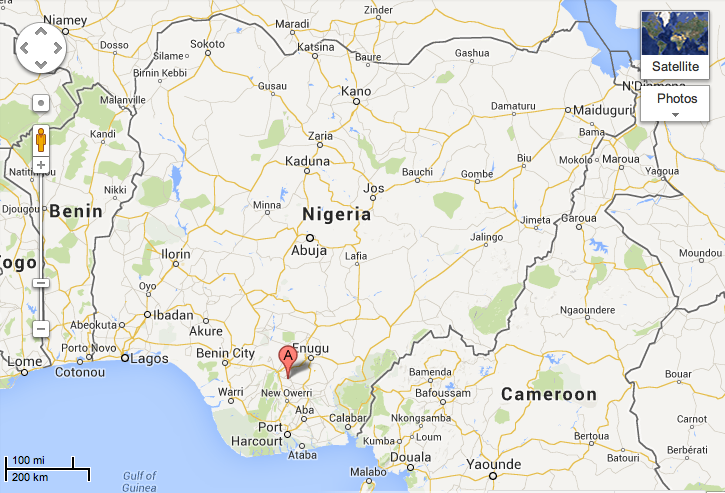
Where is Amichi, Nigeria?
Today the church prays for the diocese of Amichi, in Nigeria:
And we raise our prayers with many for our friend in Texas, hospitalized with a severe bacterial infection.
Pockets of Silence
On Christmas Eve Day, when I attended church, I prayed for ‘pockets of silence.’ I am an introvert. I love my family and our gatherings, and I also find all that interaction exhausting. When you pray for a need, you often get the answer to your prayer; I shared this with AdventureMan and now I am kidded about needing my pockets of silence. It’s OK, I’ll take the kidding, as long as I get my pockets 🙂
I’ve always loved this scripture; I think of the huge desert storms, full of power and fierce winds, I think of the roar of an earthquake, and how it jars you to the bones, and I smile as I think of the Lord’s voice in the ‘pocket of silence.’
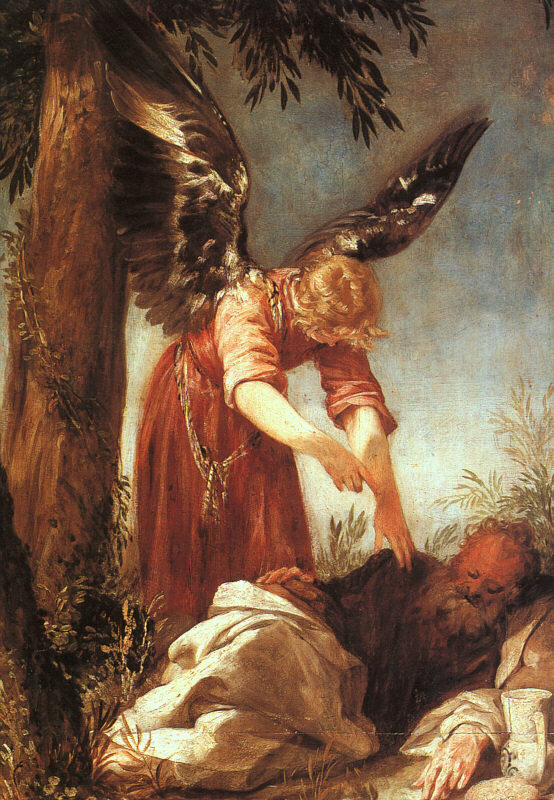
1 Kings 19:9-18
9At that place he came to a cave, and spent the night there.
Then the word of the Lord came to him, saying, ‘What are you doing here, Elijah?’ 10He answered, ‘I have been very zealous for the Lord, the God of hosts; for the Israelites have forsaken your covenant, thrown down your altars, and killed your prophets with the sword. I alone am left, and they are seeking my life, to take it away.’
11 He said, ‘Go out and stand on the mountain before the Lord, for the Lord is about to pass by.’ Now there was a great wind, so strong that it was splitting mountains and breaking rocks in pieces before the Lord, but the Lord was not in the wind; and after the wind an earthquake, but the Lord was not in the earthquake; 12and after the earthquake a fire, but the Lord was not in the fire; and after the fire a sound of sheer silence.
13When Elijah heard it, he wrapped his face in his mantle and went out and stood at the entrance of the cave. Then there came a voice to him that said, ‘What are you doing here, Elijah?’ 14He answered, ‘I have been very zealous for the Lord, the God of hosts; for the Israelites have forsaken your covenant, thrown down your altars, and killed your prophets with the sword. I alone am left, and they are seeking my life, to take it away.’
15Then the Lord said to him, ‘Go, return on your way to the wilderness of Damascus; when you arrive, you shall anoint Hazael as king over Aram. 16Also you shall anoint Jehu son of Nimshi as king over Israel; and you shall anoint Elisha son of Shaphat of Abel-meholah as prophet in your place. 17Whoever escapes from the sword of Hazael, Jehu shall kill; and whoever escapes from the sword of Jehu, Elisha shall kill. 18Yet I will leave seven thousand in Israel, all the knees that have not bowed to Baal, and every mouth that has not kissed him.’
A TCK Wedding (Third Culture Kids)
Several years ago, back in my earlier blogging years, a Kuwaiti friend, Amer al Hilaliya wrote a wonderful post: I Am a Third Culture Kid, Are You? He never anticipated the result – comment after comment, some short, some a little bitter, some longer and insightful. The Third Culture Kids know who they are, and are eager to share their insights and experiences – but mostly with other Third Culture Kids, who understand.
Others . . . don’t get it.
This weekend, we went to a wonderful Third Culture Kids wedding. It wasn’t billed that way, but it was so thoroughly that way that I couldn’t stop seeing it. It doesn’t hurt that we are reading the seminal work on Third Culture Kids by David C. Pollock and Ruth E Van Renken called, yep, you guessed it, Third Culture Kids.

It’s almost like reading a whole new book. It has all the Third Culture Kids stories, but has expanded to include third culture kids cousins, like the adult third culture kids, ATCKs (those who have lived a goodly share of their lives in a non-native culture), cross culture adoptees, cross cultural marriages, etc. One of the points they make is that being third culture kids cuts across a lot of boundaries and makes for odd – odd by normal standards – friendships. Once again, across the boundaries – countries, old, young – friendships are determined by a commonality in experiences outside the native culture. It is a fascinating read.
People don’t think of how LONG Florida is, tip to tip, but from Pensacola to Fort Myers is a fuuur piece, as they say, even if it is on an inside curve. Thank God it wasn’t Key West! We thought it would be an eight hour drive, and it turned into thirteen, with heavy traffic from Lake City to Ft Myer.
The wedding was sweet, simple and heart felt. Both sets of parents had done significant missionary work in foreign countries, and the kids were definitely third culture kids. The groom would speak Turkish in his sotto voce asides to his best man, who grew up with him on the streets of Ankara. The bride’s brother read all the greetings and best wishes to the bride from her friends in Hungary – and he read them all in Hungarian.


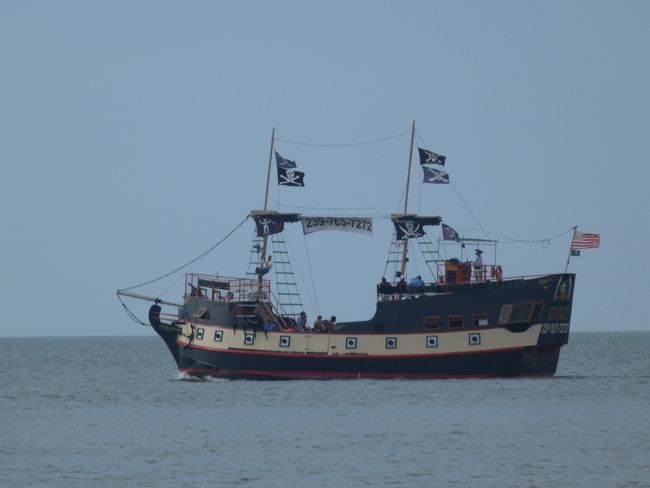
Just as the ceremony started, along came a pirate ship! Some things, you just can’t plan, they just happen.
They all told family stories, and one of them stuck in our hearts because it reflects our own experiences growing up in the Moslem world. The groom, as a young man, came home flustered because a woman on the metro, as he was coming home, noticed he was not wearing an undershirt under his T-shirt, and assumed he was a homeless child. She started talking with all the other passengers, and they marched him off the train to the souks, where they insisted on buying him an undershirt (who knew that you were not properly dressed in Turkey unless you were wearing a sleeveless undershirt?) and also a sweater, to keep him warm on the streets. All this, in spite of the fact that this homeless boy spoke excellent Turkish and kept telling them he had a home! No! No undershirt, he has to be homeless.
Few people in America know the kindnesses we experience living in the Moslem world. It may not always make sense to us – in Tunis, we always wondered if we were getting the annual Eid platter of lamb and couscous showed up because we were thought to be poor or because we were strangers? There has always been a sweetness and generosity to our Moslem neighbors that humbled us. Because of the layering upon layering of these kindnesses, we see Islam, and the Middle East, differently from most of our American friends who have never lived among Moslems. Maybe if we all knew one another a little better, we would have less cause to fear one another, and maybe without all that fear, we could manage a little less hatred.
What is a wedding without babies and children to remind us of the Circle of Life (which AdventureMan calls The Circle of Death). This little one speaks English and Turkish already, and loved the sugar white sands of Ft. Myers Beach and the little seashells, just her size.

As more and more people cross borders, for work, for play, for marriage, for education, as we live in ‘alien’ cultures and learn other ways of thinking, maybe we are growing into an entire world with a larger viewpoint?
Recent Comments
ExpatAlien on What Country am I Living … intlxpatr on Yellowstone: Old Faithful to C… Michelle on Yellowstone: Old Faithful to C… Cathy on No Grown-Ups in Charge intlxpatr on Waiting for Snow Wikipedia Donate Button

Amazina


Early Voting in Florida


 Here There and Everywhere