“So There We Were, Two Naked Guys in the Shower and . . . . “
LOL, no, no, this is not going where you think it might go, but it got my attention, too!
AdventureMan was in the locker room with one of his exercise/aerobics buddies, cooling down from his water aerobics class when this story started, and was sharing the story with me later, at lunch, as we exchangin details of our mornings.
“. . . And he asked ‘do you know what today is?’ and I said ‘Yes! It’s the 63th anniversary of the beginning of the Korean War,” AdventureMan responded.
Guy talk. Guys discuss their combat experience in different wars. Combat is so intense, it imprints memories the way childbirth does in women, or a huge traumatic event, like the Iraqi invasion of Kuwait, or 9-11, or the Kennedy assassination, or the Tsunamis that hit Japan and washed entirely over the Maldives – experiences when the earth beneath your feet shifts, and things you once took for granted are shaken forever.
Who said guys don’t connect? AdventureMan has another old friend he needs to get in touch with today, to tell him he is thinking of him; Korean War veterans are largely forgotten in the tallying of combat in our country.
Pensacola is a wonderful place to be a military veteran. There is a Veteran’s hospital, and veteran-friendly policies at the clinics, commissaries and BX/PXx. Today we had lunch at Mellow Mushroom, where every Tuesday they give 20% off to all active duty and retired servicemen and women. Home Depot and Lowe’s give 10% off on every purchase, even plumbers, electricians, contractors, banks, theaters and many stores often give military discounts. And they thank us for our service. :0
To those of you who served in the Korean conflict: Thank you for your service.
Forty Years Wedding Anniversary

“You’re going to celebrate your anniversary for three days?” my friend asked incredulously.
“No, no, actually, it’s in two parts, we are celebrating the entire weekend, three days, but it’s because it is too hot to walk around New Orleans; so this is just part one, and in December we will celebrate part two with a trip to New Orleans when we can walk around and enjoy all the Christmas decorations and stay somewhere nice.”
It’s what we do.
There have been some years, particularly years with moves, or new positions, or new contracts in them, when anniversaries have sort of fallen by the wayside. We are enjoying making up for all the missed anniversaries, now that we have the great luxury of time.

We have all kinds of fun plans, a hotel stay, a dinner in a fine restaurant, star gazing out at Ft. Pickens, maybe a dolphin cruise, and a trip up in the very large beach ferris wheel, while it is still at Pensacola Beach. We plan a day in several pools with our son and his wife and our little grandson. All. or part, or some of this may really happen, depending on what the weekend weather looks like. Ft. Pickens has already evacuated all the campers with concerns over this Tropical Storm Andrea coming in, and a dolphin cruise or a trip up on the great wheel may not be such a hot idea at 40 – 50 mph winds, LOL.

AdventureMan and I knew when we married that we were in it for the long haul. We also knew it wouldn’t be easy. We come from different cultures, different life styles. We both had independent lives and responsibilities. We moved a lot. It wasn’t always easy, but then whose life is, when you know that life from the inside? We’ve had some great adventures, and some fabulous, astounding experiences. We’ve met extraordinary people and made very special life-long friends.

When I told AdventureMan our weekend might not be as exciting as planned, he laughed and said “we can bring our books.” He always knows how to make me laugh, and taking books is exactly what we did when we first got married, and would take weekend trips to a lakeside resort called Chiemsee; it would be snowing and cold and we would go into this large old lodge with it’s double doors and double shuttered windows, with it’s eiderdown comforters and huge fireplace, and we would pack books. We would sleep and read, and sometimes go eat. If that’s how this anniversary turns out, it’s a very comfortable and familiar way to celebrate.:-)

AdventureMan loves this blog. He always looks for his name. 🙂 Happy Anniversary, dear husband.
League of Women Voters
My friends and I had an animated conversation about Florida politics as we sat around the table having a late breakfast at Adonna’s Bakery, down on Palafox in Pensacola. We were explaining how in the last election, if it were not for the voters handbook the League of Women Voters published, explaining exactly what a yes or no vote would mean for each proposed amendment, Florida would be stuck with constitutional amendments voters never intended to approve.

The League of Women Voters cuts through all the baloney and explains the issues, clearly and objectively. Without their clear, cool voice of reason, voters would be blown to and fro by the turbulent election rhetoric which blows at hurricane force during each election in Florida, obscuring the clearest issues. The League is neither liberal nor conservative, but contains members of all parties. Their goal is getting people to vote, and to understand the issue on which people are voting.
So grown up. So mature. So wise and clear sighted. Way too grown up for me, all these years, until, after that conversation, one of these friends sent me an invitation she had received for an upcoming League of Women Voters annual luncheon. As an added attraction, a local NPR reporter would be the speaker.

I hate meetings. It brings out the ADD child in me; I fidget, I wish I were anywhere but in the meeting.
And yet . . . this is a group I have long admired, and I want to support them. So I agreed, and we attended.
It was so much fun. These women – and men, about a fifth of the attendees were men – are people focused on ISSUES. They have study groups for how juveniles in the local area are arrested and treated in our jails and custodial facilities. They have groups which study the impact on the environment of legislative and local government decisions. They go to civic meetings, speak out, and report back to the League. This is a group of people who take positions and recommend actions! Exciting stuff.
You know I am a believer, so I might see things differently from you, or others, but I met some really cool members, people I believe I was meant to meet. One said wonderful things about my son as he practices his profession. There is no Mother’s Day gift on earth that means as much as the words she spoke, praising his ethics and integrity.
An elderly man sitting next to me was leaving this week to go to Heidelberg.
“Are you going for the closing down?” I asked, and told him I had graduated from Heidelberg American high school, lo, these many years ago. “Yes,” he replied, he has family who have lived there many years, and he has been back many times. It led to a discussion around the table, where I discovered two other women who had been in DoDs schools in Germany. What an unexpected blessing!
Every now and then, as you lead your life, you get the feeling you are exactly where you are meant to be at this very moment, and I had that feeling as I left the meeting. I am so thankful for the serendipity that led me there, and for the rush of blessings the meeting provided.
LOL, the group I thought might be stuffy and staid played this wonderful Lady Gaga video:
AdventureMan and the Box Turtle
“There’s a box turtle in our backyard!” AdventureMan exclaimed, coming in after making his early morning rounds to make sure all was well in the garden, and to bring us up to date on any new developments. I was eating breakfast with our house guests, getting ready to leave for water aerobics class. (If you come to visit, you get to come to water aerobics 🙂 too!)
The two guys went back out to consider the box turtle, but the box turtle had disappeared. Of course we kidded AdventureMan.
“Are you SURE you saw a turtle? How would it get in to the backyard?”
He was mystified, but certain he had seen a box turtle. They searched all the spots they could think of, but could not find any turtle.
This morning, I was up early feeding the Qatari Cat when I saw a movement in the yard, and there he was, the box turtle.
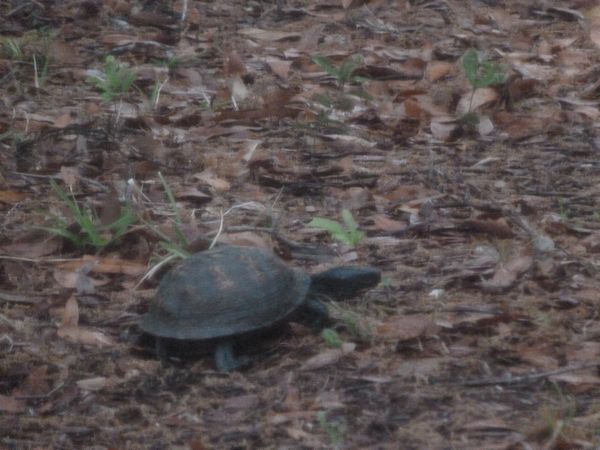

AdventureMan was still sleeping; so I ran and got my camera and took some photos. I think he was aware of me, but couldn’t figure out where I was (I was inside, he was outside). When he got up, AdventureMan was delighted to have his observation verified, and hurried outside to see if he could spot him. Nope! Turtle back in hiding.
The Baboon Coughed
We’ve had three sets of houseguests in a very short time span, and today is our first day of ‘normal.’ We saw our friends off at 0430 (we used to call it oh-dark-hundred) and I couldn’t get back to sleep, so by the grace of God (and I mean that literally) I got up and walked.
I know I need to walk. I’ve always walked. I used to run, but I suffered for it – the knees – and decided I didn’t want to pay that price. But when my sister was here, we decided to take a walk and I said “don’t worry, I walk fast” and she said “I don’t, I am so slow now, my body has to warm up.” Confidently I started – and starting is uphill from my house. Very shortly, I discovered my fast was her slow, and I was HUFFING and puffing, and so embarrassed because I guess it’s been a while since I did this walk . . . but we did it. It felt good. And I was happy for a nice cool morning so I could do it again.
I ran into a neighbor, ignored that she was in her nightgown, we both pretended she was as fully dressed as I, had a brief conversation and she went inside with her newspaper and I carried on. About halfway through my walk, as I puffed along, I heard it.
The baboon coughed.
I could even smell a faint drift of wood burning fire. I could hear the doves. But it was only very briefly, very intangential, and I quickly realized it must have been a dog barking distantly; I could still hear him. For one brief moment I was back in Zambia, and while I love the magic of Zambia, I would not be out for a mile long hike early in the morning while the lions prowl for a last meal before they settle down for their day-long snooze.
We are off this morning to a grand plant sale across the bay in Milton. Symphony tonight. Back to “normal” for Pensacola.
Sunset Dolphin Cruise with Olin Marler in Destin
We did this same cruise with the same house guests two years ago, and . . . we never get tired of it. We don’t do it that often, and it is always fresh and relaxing.
We booked with Olin Marler Charters out of Destin. Fortuitously, we had a Groupon. It was so easy, buy the tickets online, call for a reservation, be at the dock at 5 p.m. for boarding.
Yes, it can be a crowd. Yes, you always have to know where you want to be and head directly there so you will have a good view, although people do wander. Yes, you have to hope that people who take young children aboard will be responsible and watch them like hawks. Other than that, these cruises are fun and easy.
There are other cruises. The others that we saw were all very crowded, people packed like sardines on little barge-like boats. We like a boat with a couple levels and lots of places where you can take photographs without having to crawl over anyone – or having people crawl over us! – to get a photo. This is our second time with Olin Marler, and I expect it will not be our last – it’s just so much fun.
We saw lots of dolphins. Dolphins are not so easy to photograph as they surface and dive, oh aaargh. If you want to see dolphins from our last trip, click on the blue hypertext in the first paragraph.
Also lots of seagulls and lots of sunset 🙂 Great times with special old friends from Germany, our sons have been best of friends for years, too.
This is the boat they took us out on, the yellow one:

Sunset is nearing:

Can’t get a good shot of the dolphins so might as well see if I can get something interesting with the seagulls and sunset:
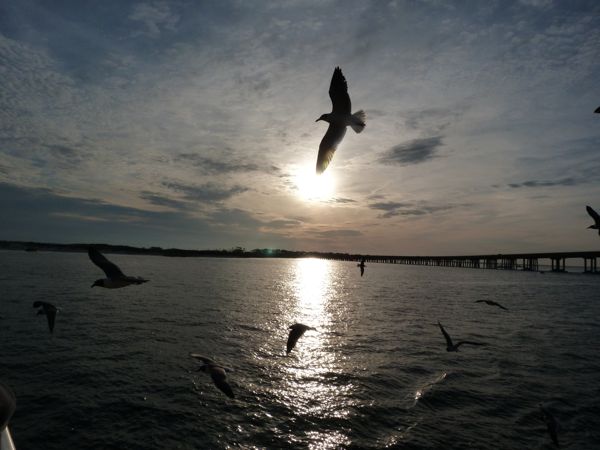
When the sun actually sets, it gets cold quickly. We had a very warm day, maybe 80 degrees F. and it dropped almost immediately by 30 degrees. Fortunately, we knew this happens and came prepared this time 🙂

Great way to end a day, followed by dinner with the same good friends.
PGM: Proud Grandmama Moment
I took a wonderful photo at Easter, wonderful because I have the same exact photo at the same exact age of my son, holding up his Easter Egg exactly (or, oh pardon me, I can’t resist, eggsactly) the same way. There are just some little things that make a Grandmama’s (and Mama’s) heart sing 🙂

Because AdventureMan has worked so hard with him, little Q has been moved up to a more advanced class, and we are all excited about that. I know there are some who prefer to be the BEST in their group, but we always learn and achieve more when surrounded by people a little more accomplished and skilled than we are. We are happy he will be pushing himself to be a really GOOD swimmer!
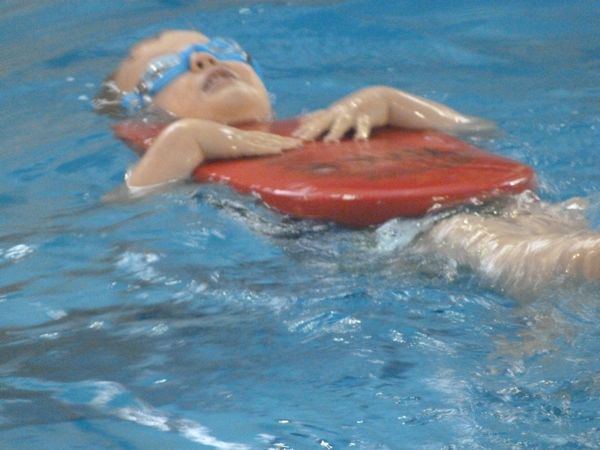
When we pick Q up at school, all his little school friends say “Q – your BaBa is here!” LOL @ all these little kids speaking Arabic!

The Week Flew By
Yesterday when I got home from a day-long seminar on Heirloom Feathers (a follow up to another one earlier in the week on making quilts from Heirloom linens), with Cindy Needham, well-known expert and instructor, (that’s Cindy giving us an extra demo during lunch on how to do beading embellishments while on an airplane)

I found a huge bouquet of flowers from my sister and her husband, who had been house guests this week. It’s one of those gorgeous days we have a few of in Spring, warm and sunny, not too hot, and oh, this bouquet looks like Spring. Arriving home and finding this gorgeous bouquet just made my heart laugh. Can you see the Easter Bunny? We had time to walk and talk, to laugh and share stories, and we were able to take them to Five Sisters. We hope they come back soon 🙂

We’ve had a busy week. AdventureMan is getting ready for the big Expo and garden sale in May, we expect our next set of house guests tomorrow morning, and meanwhile, we have our normal daily busy lives to follow. Tonight we meet up with friends we love, people who spend their lives doing good for others, and with whom we always have great conversations, and tomorrow, early, we pick up the house guests, get them settled in, and share an Easter banquet with them, and with our son, his wife, our sweet little grandson and her mother and her husband.
I found a wonderful new Spring salad recipe to share with you 🙂 Very easy, very good:
Spring Asparagus Salad
Ingredients
1 tablespoon rice vinegar
1 teaspoon red wine vinegar
1 teaspoon soy sauce
1 teaspoon white sugar
1 teaspoon Dijon mustard
2 tablespoons peanut oil
1 tablespoon sesame oil
1 1/2 pounds fresh asparagus, trimmed and cut into 2-inch pieces
1 tablespoon sesame seeds
Directions
1. Whisk together the rice vinegar, red wine vinegar, soy sauce, sugar, and mustard. Drizzle in the peanut oil and sesame oil while whisking vigorously to emulsify. Set aside.
2. Bring a pot of lightly-salted water to a boil. Add the asparagus to the water and cook 3 to 5 minutes until just tender, but still mostly firm. Remove and rinse under cold water to stop from cooking any further.
3. Place the asparagus in a large bowl and drizzle the dressing over the asparagus. Toss until evenly coated. Sprinkle with sesame seeds to serve.
Tomorrow is our happiest of holidays, the day that sin and death are defeated and HOPE for all mankind is welcomed joyfully into the world. Happy Easter, my friends.
Strangers in America; No American Friends
This article is so sad, and I have also seen it the other way around, hoardes of American students abroad, hanging out with other Americans, then other ex-pats, and lastly, the local inhabitants. It IS hard. The differences can seem overwhelming. (That is my very first blog entry, and it had to do with the risks you expose yourself to when you open yourself to a cross cultural relationship 🙂 ) Overcoming those differences makes life so much richer.
Thank you, Professor John Mueller, for forwarding this fascinating article:
Strangers in a Strange Land
March 4, 2013 – 3:00am
By
Elizabeth Redden
In interviews with 40 international students at four research universities, Chris R. Glass was struck by the relative absence of Americans from his subjects’ stories. The interviewees, half undergraduate and half graduate students, described close relationships with their international peers, including those coming from countries other than their own. But while they frequently characterized their American classmates as friendly or helpful, only rarely did they seem to play a significant role in their lives.
“Only one student has described a significant relationship with a U.S. peer and that student was from Western Europe and that peer was her boyfriend,” said Glass, an assistant professor of educational foundations and leadership at Old Dominion University. “That to me is a striking omission from the stories that they’re telling.”
As the number of international students at U.S. colleges continues to rise — and as the mix of international students has shifted in favor of undergraduates — there are increasing concerns as to how well they’re being integrated into campus life. There have been periodic reports of racist incidents and – overt discrimination aside – there is the question of disconnection raised by Glass’s research. Another study authored by Elisabeth Gareis, a communication studies scholar at Baruch College, found that nearly 40 percent of international students reported having no close American friends. In explanation, many of the students cited “internal factors” such as limited language proficiency or shyness, but they also described a perceived lack of interest on the part of American students.
At the recent Association of International Education Administrators annual conference, a roundtable session on the integration of international students (co-moderated by this Inside Higher Edreporter) drew a standing-room only crowd, as attendees discussed the difficulties they’ve encountered in encouraging and equipping American and international students to (productively) interact. Domestic students are not necessarily cross-culturally competent – a point made lucidly when one audience member described the tendency of American study abroad students to request compatriots as roommates. At the same time, international students may not always be interested in initiating contact. An audience member from a Midwestern institution shared his observation that a fair number of students from China – a rapidly growing and by far the biggest group of international undergraduates on U.S. campuses – seem to be more interested in interacting with one another than with their American classmates.
Yet, even those students who are interested may find social structures on campus to be exclusionary or mystifying or both. On American campuses dominated by fraternity and sorority life, or obsession over intercollegiate athletics, or where everyone seems to have gone to the same high school, international students may feel foreign in ways that go beyond their nationality. “The lack of interaction is as much due to individual attributes as it is to social context,” said Glass, who is conducting his qualitative research in collaboration with Rachawan Wongtrirat, the assistant director of Old Dominion’s international initiatives office. Given the natural tendency of people to gravitate toward others who are like them (what social psychologists call the “similarity-attraction effect”), “are universities creating contexts where these interactions can happen?” he asked.
In interviews with Inside Higher Ed, researchers and professionals in international education spoke about the challenges in this regard and their efforts to create opportunities for meaningful interactions between domestic and international students through programming. It seems that many universities have a long way to go in living up to the promise presented by increasing numbers of international undergraduates – the promise being increased opportunities for sustained and meaningful cross-cultural interactions in classrooms, dorm rooms, and so forth.
‘Encounters With Difference That Make a Difference’
“It’s a combination of factors that have made this issue so salient,” said Larry A. Braskamp, the president of the Global Perspective Institute and a professor emeritus at Loyola University Chicago. “One is there are just a lot more international students on campus now, particularly at institutions that have not historically had a lot. The second is that everybody is interested in global learning: we know we need to prepare students to be more globally competent. And the third is that these students represent on some campuses a fairly significant contribution to the bottom line. Most of these students pay full tuition and as a result a lot of institutions see them as one way to balance the budget. So they have to make sure that the retention rate is high; they have to develop a good reputation so that other students will come.”
In Braskamp’s research, he’s found that entering American freshmen do not tend to think complexly, are not comfortable amidst difference and do not typically have friends who are unlike them. “We’ve said, O.K., the implication of all this is we need to create ‘encounters with difference that make a difference,’ ” he said. “I’ve thought of it as students being on a journey: they start with rather simplistic views of themselves, of their social interactions and the ways in which they understand the world around them. So in some ways what we need to do in college is increasingly provide them opportunities for encounters to get them to rethink who they are, how they think, and how they relate to others. In many ways, international students coming on campus is an opportunity for students, faculty members, and international administrators to take advantage of that difference and that diversity. But it’s really hard work.”
Such encounters can be curricular, co-curricular or informal: in fact, Braskamp’s research suggests that informal encounters such as discussion of current events with other students may be the most impactful. Still, he emphasized that there’s much more that can be done in the classroom to facilitate such encounters. In a sample of about 48,000 undergraduates at more than 140 four-year colleges, he found that about one-third report never having taken a course that “focuses on significant global/international issues or problems” or that “included opportunities for intensive dialogue among students with different backgrounds and beliefs.”
As one audience member at the AIEA conference said, unless faculty members are on board, all the student services programs in the world won’t be enough: “Students really look to their professors to give them direction and advice and deepen their conversations, so if faculty were taught to embrace these conversations about ‘difference’ and ‘other’ and ‘cross-cultural competencies’ and international challenges in engineering, then those conversations would take on meaning for the students,” she said. Participants in the session described the value of professional development programs such as Duke University’s Intercultural Skills Development Program for faculty and staff.
Case Western Reserve University is another institution that has begun to offer training designed to help professors better serve international students and integrate them into the classroom: according to Molly Watkins, the university’s director of international affairs, the first two trainings focused on Chinese students and attracted 60 to 70 faculty members each. “There’s obviously a need,” Watkins said.
Opportunities for Meaningful Interaction
At the AIEA session, audience members discussed co-curricular strategies such as peer mentoring or “buddy” programs, living-learning communities and other residence life initiatives, and more robust orientations for international students. Many universities have some iteration of one or all of the above: Mount Holyoke College, for example, has a new “Global Partners” program that pairs returning study abroad students with new international students and holds “re-orientation” events for international students during the academic year. The University of Iowa is launching a new required online orientation program that will begin in the summer before the students arrive and continue with five to eight small-group sessions throughout the fall semester.
The University of Arkansas at Fayetteville, which had 611 international undergraduates last fall, has a host of programs with alliterative names like Campus Cousins, Friendship Families and Global Greeks, which pair international students with American students, local families and fraternity or sorority members, respectively. Wesleyan University is “trying to capitalize on the idea of roommates,” hosting a dinner for first-year international students and their roommates at the beginning of the fall semester, according to Alice Hadler, the associate dean for international student affairs and an instructor of English. St. Norbert College, a Roman Catholic institution in Wisconsin, has a living-learning community with 25 international and domestic students (international students are the resident advisers) and a 10-member interfaith group consisting of Muslim students from Saudi Arabia and domestic Christian students. Initiatives such as these reach only a small number of students, concedes Marcy O’Malley, St. Norbert’s director of international programming, but, she said, “What I’ve seen work is one-on-one.”
“Instead of superficial contact with a lot of people, do more meaningful contact with a smaller number, and let them be your ambassadors to the larger student body,” she said.
Christopher J. Viers, the associate vice president for international services at Indiana University at Bloomington, has used theInternational Student Barometer to survey students about their experiences, and cited the surprising finding that international students rate their relationships with American students as those that are most important to them (as compared to relationships with other students from their home country or international students in general). “In looking at the feedback that came in we thought very critically about what we could do to help facilitate opportunities for international and domestic students to interact in meaningful ways to hopefully have conversations and potentially build relationships,” Viers said.
In talking with colleagues across the country, Viers said he’s come to the conclusion that “too often our programming is limited to the one-time, big, annual event.” This event, which often takes the form of an international student fair or show, can be good in celebrating international students’ contributions to campus and perhaps can help a domestic student learn a bit about another culture or cultures, but, he said, “opportunities for meaningful transformative learning are pretty limited.” As such, he continued, “We work hard to provide the big annual event that helps to showcase the contributions of our students and the diversity of the population with the excitement and food and entertainment, but not a week goes by when we’re not putting together, hand-in-hand with students, small, highly interactive opportunities for domestic and international students to get together. We run a weekly noon concert series, for example, where students from our Jacobs School of Music perform classical music or folk music from their home country and then there’s a free lunch that’s provided. That regularly gets people who have an interest in music together.”
“It’s absolutely essential as colleges are putting in place plans to actively grow international enrollment that appropriate levels of service and support are put in place, and then the students have responsibilities as well,” Viers said. “So much of just about anything in life in terms of what you gain from an experience has much to do with what you put into it yourself. This is where at times perhaps those of us in the field of international education are not vocal about some of the very real, very significant additional hurdles and challenges that students from other countries face while they’re here: the enormous pressures that they’re under to succeed academically and to move as quickly as possible though a program. It’s very expensive to come to the U.S. to pursue an undergraduate degree. There are often major expectations from family members and others; there’s a lot of pressure to succeed and do well.” And then there are the extra academic challenges inherent in pursuing a degree in a non-native language. Is it any wonder that not every student will want to come out for mixers and “cultural coffee hours”?
“I think that sometimes we underestimate that pressure, and apply a different kind of meaning to the experience that we perceive a student is having,” Viers said.
START with Sea of Poppies, by Amitav Ghosh

I recently wrote a book review on River of Smoke, by Amitav Ghosh, which held me spellbound, so riveting that I had to order Sea of Poppies, which is actually the first volume of the trilogy. I had heard a review of River of Smoke on NPR and although it was written as the second volume in a trilogy, it can be read as a stand-alond.
Yes. Yes, it can be read as a stand-alone, but it is so much easier, I can state with authority, if you read them in order. Once I started Sea of Poppies, I also discovered an extensive glossary in the back, several pages, a list of the words, annotated with suggested origins, and it adds so much color to an already brilliantly colored novel. Much of both novels uses words from many cultures, and words that have been formed by another culture’s understanding of the words (some hilarious). If you like Captain Jack Sparrow, you’re going to love the polyglot language spoken by ship’s crews from many nations trying to communicate with one another. It can be intimidating, but if you sort of say the words out loud the way they are written at the beginning, you begin to find the rhythm and the gist of the communication, just as if you were a new recruit to the sea-going vessels of the early 1800’s. I loved it because it captured the difficulties encountered trying to say the simplest things, and the clever ways people in all cultures manage to get around it, and make themselves understood.
Sea of Poppies starts in a small Indian village, with one of the very small poppy gardens, planted on an advance from an opium factory representative, thrust upon the small farmer, with the result that most small Indian farmers converted their entire allotment from subsistence foods to poppies. Ghosh walks us through an opium processing factory, which is a little like walking through the circles of hell. We meet many of the characters we will follow in River of Smoke, and learn how this diverse group bonded into one sort of super-family through their adventures – and misadventures – together.
It is an entirely engrossing work. Sea of Poppies was short listed for the Man Booker award, and was listed as a “Best Book of the Year” by the San Francisco Chronicle, Chicago Tribune, Washington Post and The Economist. The theme is the opium trade, leading to the Opium Wars, with China, and is a chilling indictment of how business interests manipulate a population’s perceptions of national interests to justify . . . well, just about anything, in the name of profit.
The theme is woven through human stories so interesting, so textured, so compelling, that you hardly realize you are reading history and learning about the trade, cultures, travel, clothing, traditions, religions, food, and motivations as you avidly turn the pages.
I can hardly wait for the third volume. Get started now, so you’ll be ready for it when it comes out!
Recent Comments
ExpatAlien on What Country am I Living … intlxpatr on Yellowstone: Old Faithful to C… Michelle on Yellowstone: Old Faithful to C… Cathy on No Grown-Ups in Charge intlxpatr on Waiting for Snow Wikipedia Donate Button

Amazina


Early Voting in Florida


 Here There and Everywhere