Ultrametabolism and Kuwait Diet
I used to be thin. Really thin. Actually, I have been really thin several times in my life, but, *sigh* no longer.
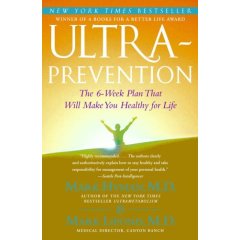
This morning as I was picking up my e-mail, this review on AOL caught my eye. Dr. Mark Hymon is one of the AOL Wellness Coaches, and he has written two books, one called Ultrametabolism, about using your built in genetic strengths to lose weight and maintain the weight loss naturally, and one called Ultraprevention about foods to eat (and not to eat) to contribute to overall wellness and good health.

If you’ve been reading me for a while, you will know that I can be a little cynical.
What I like about Dr. Hymon’s approach is that it makes sense.
Diets that totally eliminate foods you love just aren’t going to work. Give up pasta for the rest of your life? I don’t think so. But what Dr. Hymon asks us to do is to eat mostly non-processed, or minimally processed foods. He says that the processed foods have components that the body doesn’t even recognize as food, and that’s why after eating things like Twinkies, Mars bars, packaged crackers, etc. we still feel hungry – our bodies don’t recognize what we have eaten as food.
Here is what Dr. Hymon suggests (this is from the AOL Health and Fitness section):
How to use what you eat to tell your DNA how to slim you down and live a healthier life.
Day 1. Clean out your cabinets, refrigerator and freezer. Get rid of packaged items filled with processed fats and sugars. Check the lable – if it says “hydrogenated oil” or “high fructose corn syrum” get rid of it.
Day 2. Go shopping for whole foods. Find a farmer’s market in your area for fresh produce and schedule visits in your calendar weekly or biweekly over the next few months. At the grocery, choose items from the “perishable perimeter” of the store, instead of items in the center aisles where processed foods lurk.
Day 3. Change your oil! Throw out old oils, which can become rancid quickly. Replace vegetable oils like safflower and canola with extra-virgin olive oil and make it your primary oil for cooking and salad dressings.
Day 4. Visit a health food sotre. Leave there with 10 new items you’ve never tried before. Bulk-purchase whole grains, legumes and nuts. Look for new whole grain cereals, breads and snacks without processed additives, fats, sugars or preservatives. And remember: just because it’s in a health food store, doesn’t mean it’s good for you. Read the labels of any packaged foods you buy.
Day 5. Choose Eggs! Choose organic eggs farmed with omega-3 fats. Make yourself a spinach omelet for breakfast. Eggs are a good source of protein. You can enjoy as many as eight a week.
Day 6. Become wild about fish. Find a local fishmonger or educate yourself by talking to your local grocer. Or learn more about which fish are best to eat by visiting www. ultrametabolism.com. Print out a primer to bring with you when you shop.
Day 7. Prepare some healthy snacks for when you’re on-the-go. Pack a small zipper bag with a few servings of almonds or walnuts. One handful equals a serving.
Day 8. Don’t go thirsty. By now, you’ve tossed the sodas. Bring out the blender and learn to make high protein, no sugar smoothies. Experiment with crushed ice and fresh fruits. You can even make frozen nut cubes by soaking nuts overnight, blending them and then freezing them with a bit of water or milk in ice cube trays. Your smoothie will be creamy and full of good fats and proteins.
As I did his online mini-seminar, I found myself thinking “everything this Dr. Hymon is recommending is the way Kuwaitis USED TO eat.” And I also found myself thinking what a wealth of opportunity we are living amidst, here in Kuwait, where we can go to any market and buy FRESH fish, really fresh, right off the boats, in the local fish markets. We can buy fresh meats, and fresh vegetables, lots of them grown right here in Kuwait. We can buy fresh eggs. even fresh chicken when not under threat of Avian Flu. Kuwait is a paradise for exactly this kind of diet.
Not only do we have access to fresh, locally grown foods, but the cost is so much less than processed foods on the shelves. He is talking about lentils and grains commonly available here in those big sacks, down in the Souk Mubarakiyya, as well as in the co-ops and the Sultan Centers.
This isn’t anything new, eating low on the food chain, eating fresh, but it does strike me as a diet that particularly works in Kuwait, and a kind of diet that you can live with for the rest of your life, because it doesn’t make changes in your life that you can’t live with. Like he does tell us to give up soda, one of the main contributors to obesity in the world today. As you get older, carbonated beverages aren’t that hard to give up because they also give you heartburn, so just another reason to steer clear of all those unwanted calories the body can’t identify as food.
He didn’t say anything about chocolate . . . but I have ordered both books from Amazon.com hoping that the dark, semi-sweet, barely processed chocolate that I love will also be “just what the doctor ordered.” Meanwhile . . . I hear a spinach omelet calling my name!
Even After All this Time – Latifi
A good book can make your blood race faster. A good book may even require underlines, turned page corners to mark the places you liked the best. A good book may compell you to tell others about it. Above all, a good book is a book you think about long after you have turned the last page.
Some of my best “good books” come to me through Little Diamond, my neice who lives in Beirut. We share a family culture, but even better, we share a wacky sense of humor. There are times we can’t even let our eyes meet in family gatherings, because we are thinking the same thing and can’t afford to laugh out loud.
She recommended this book to me more than three years ago, and I bought it immediately. And then it sat in my “read me soon” pile(s), languishing, unread, until early this year.
Oh, what a treat this book is! Once I picked it up, I could hardly put it down!

The book is autobiographical, and begins in pre-revolutionary Iran, where Afchineh Latifi’s father is a soldier. You see the early years of her life with her sweet, struggling parents, and you feel like you lived in their home with them, the images are so vivid.
As a military officer, though, her father is suspect once the revolutionaries come into power, and her family’s fortunes fail. Her father is arrested. As Latifi’s mother bravely goes from jail to jail, trying to find her husband, her daughters are often with her. Once she finds him, she brings him comfort items – shaving kit, washcloth, etc. so he can maintain a small amount of dignity while he is being beaten and imprisoned. Latifi’s mother was young when this book opens, maybe in her thirties, with two daughters and two sons, and I am totally blown away by the courage it took to persist as her husband was transferred from prison to prison, increasingly brutalized, and then, immediately after the last visit – shot. So immediately that the family heard the shots.
And then the real nightmare begine. The young mother and her family have no income, and her (now dead) husband’s mother claims her house, even though they bought her a house of her own while her husband was alive. Latifi’s Mom never gives up. She gets her daughters visitor’s visas to Austria and puts them in a convent school, and then gets them to America – again on visitor’s visas – where they are forced to camp – for years – with a relative. Literally, years. Their brave mother eventually manages to get herself and her sons out of Iran, and join them in the US.
Their mother is a pistol. She is brave in the face of obstacles that would deter most of us. She never gives up. I am in total awe of her commitment to the survival – and thriving – of her family.
I love this book for two reasons – the first being the strength and courage of this family, and the second being that they immigrated to America. You will hear a lot of Americans who say terrible things about immigrants, and how they take up scarce resources better meant for “real” Americans. Who are they kidding? We are ALL immigrants, in America, except for the Native Americans! This family, their will to succeed, is the story of us all, and what makes the country great. It is still a country where you can work hard, and succeed, and thrive. It’s an every day story in our country, but a story I never get tired of hearing.
Here are some excerpts from the book:
She looked at me as if I were an alien, which in fact I was. “Yes,” she said, “You get a library card and you can borrow as many books as you want.”
“And it doesn’t cost a thing?” I asked.
“Not a penny,” the woman said. “Unless you bring the books back late. Then we charge you a late fee.”
This was news to me. There were libraries in Tehran to be sure, but we had never frequented them. Mom would come home every two or three weeks with armsful of new books, and we would devour them hungrily. We were much too spoiled to share books with anyone.
The librarian processed my card on the spot. I couldn’t believe it. It felt like the biggest gift of my life. . . . . By the end of the summer I discovered a whole new world. Books. Words. Stories. I got in touch with my inner geek. Reading was not only exciting, it offered escape. When I was reading, my other life didn’t exist. There were days when I didn’t even think of Mom.
Her Mother was still in Iran at this time, and she and her sister are living with relatives who have loud arguments wondering how much longer they will be burdened with these girls. Finally, the two sisters find jobs, as well as going to school, and save every penny, and get an apartment where they live while putting themselves through university. And, one day, their mother and brothers arrive. Life changes. They all live together again.
“It’s almost Norouz,” she said. “Or have you forgotten?”
I had indeed forgotten. She was referring to the Persian New Year, which on the Gregorian calendar falls in late March. About two weeks before the start of Norouz, many Persians take part in something called ‘khane tekani,’ which literally means ‘shaking your house.’ You will see people painting their homes, washing their carpets, sweeping out their attics, cleaning their yards. One could say that it is a form of spring cleaning, but that is only a very small part of it. In Persian ‘no’ means new, and ‘rouz’ means day. The last Wednesday of the year is known as ‘chahar shanbeh suri.’ At dusk, with the cleaning over, people light small bonfires and sing traditional songs, and those who can manage it are urged to jump over flames. Fire, too, is seen as a cleansing, purifying agent: it burns away all the negative things in one’s life – the bad habits, the misfortune, the sorrows. It’s all about cleanliness: clean house, clean soul, new beginnings.
On the “new day” itself, people focus on family and friends, and for the next two weeks there will be much visiting back and forth. In each house, one finds a ‘sofreh eid,’ . . . Laid out on this garment, one will find the ‘Haft Seen’ (Seven S’s) comprised of seven items that begin with the letter S. These are ‘sabzeh’ or sprouts (representing rebirth); samanu, a pudding (for sweetness in life); ‘senjed,’ the sweet, dry fruit of the lotus tree (representing love); ‘serkeh’ or vinegar (for patience); ‘seer’ or garlic (for its medicinal qualities); ‘somaq’ or sumak berries (for the color of sunrise); and ‘seeb’ or red apples (symbols of health and beauty. In addition there are candles laid out on the ‘sofreh eid” one for each member of the household. The lit candles represent the goodness and warmth that enter life with the coming of spring.
(For the first time, this year we are invited to a new year’s celebration, and I thank God that I read this book just at the right time, so I will know even just a little of what this is all about. I am excited to see the ‘haft seen.’ )
Something else happened that November that I will never forget: Our family celebrated Thanksgiving for the first time. We loved the whole idea behind the celebration. It wasn’t about religion, and it wasn’t about gifts; it was about people sitting down to enjoy a meal together and acknowledging everything that they had to be thankful for. And we had a lot to be thankful for.
By the end of the book, all four children have graduated from university with professional degrees. This isn’t a spoiler. The book is about the sacrifice, the hard work and the commitment it took to get them there. Even After All This Time is an inspirational book, a book you won’t soon forget, and a book you will want to share with your friends.
Amazon offers it used from $4.67 and in hardcover around $25.
And Happy New Year to my Persian friends.
Shrimp New Orleans
Mom’s Shrimp New Orleans
Mom used to make this a lot when we were in university. Then, twenty years later, I served it to them when they were visiting us in Florida. Mom said “This is delicious! I want the recipe!” It was HER recipe I was using!
It is quick and very easy – it will make you LOOK like a good cook. And – every ingredient is available in Kuwait.
1 medium onion, chopped
1 cup chopped celery
1 cup uncooked regular rice
2 Tablespoons butter
Melt butter, add other ingredients above and cook, stirring in large skillet for 5 minutes.
1 can Tomatoes (28 oz)
1 package Spaghetti sauce mix
Stir above into skillet, heat to boiling. Reduce heat and simmer about 25 minutes, until rice is tender.
1 can artichoke hearts (14 oz)
1 lb shrimp
Stir into rice mixture and cook for 5 minutes.
You can spice this up a little more if it is too bland for you. It easily feeds 6 people with a salad and garlic bread or dinner rolls.
Kiss the Kuwaiti Police
In the middle of the night last night, I was wide awake. The Qatteri Cat and I watched a police stop outside our window for about an hour.
I am guessing it was a combination traffic stop and training session. There was one guy who would gather the rest together when there were no cars and give additional techniques to the less-experienced traffic policemen. I am guessing, because there is no way on earth I would go out and ask!
Policeing in Kuwait is SO different. These young men are very professional. They were looking for people without driver’s licenses and / or without registrations. They had very cleverly positioned themselves so once the car was on the road, there was no way out but to go through them. Very strategic, very professional.
“So what is so different?” you might wonder, if you live in France, or Germany, or China or the US. “Isn’t that what police do?”
Yes. And no. One of the last people caught in the web was an old man traditionally dressed in thobe and gutra and egal, and he tried to get through by pretending he didn’t see the police. He didn’t have the right papers.
In my country, just trying to get through would get him into trouble.
He had to park, and get out of the car. Then, he went to each policeman and reached out with his right hand to take the policeman’s left arm, then he kissed them, on the nose or on the right cheek, and greeted them, still holding their arm or hand.
And the police treated the old man with deference, and kindness – and firmness. He still didn’t have the right papers. At one point, he pushed a policeman lightly, and the policeman didn’t go ballistic, but he gently pushed the old man back, out of his face. Finally, it was time to move the traffic stop, and they let him go, but I am guessing that, as the Kuwait Times always says “a case will be filed.” It did not look like he was getting off scot-free; the old man looked very unhappy.
I went back to bed happily, thinking how shocked our police would be, how they would react to someone holding their hand and kissing their nose, and drifted back to sleep with a big grin on my face.
Party Busted
Wouldn’t you love to know the rest of this story? I sure would! From today’s Kuwait Times:
Detectives arrested a group of over 40 Kuwaiti and Western students of private school who were enjoying themselves at a private party in a very luxurious apartment in Salmiya, said security sources. Officials added that some neighbors heard them arguing in the building’s parking area about who would be allowed in and who would not be; for not contributing in the party’s expenses. An hour later, the apartment was busted and the strangely dressed young people (in devilish costumes) were arrested along with the building’s security officer who rented them the apartment.
My comment: Sounds to me like these kids have too much money, and too little sense, a la Risky Business. These are school kids??? And what were the costumes?
Who Knew? Skimmed Milk Affects Fertility
Today’s Kuwait Times 1 March 2007 has a front page on women who drink skimmed milk having reduced fertility, inspiring a whole new category for my blog entries: Who Knew?
Skim milk as been a mainstay for women trying to maintain desired weight, along with non-fat yoghurt, low fat cheeses, and tofu – all which help women maintain bone density by providing calcium in our diets. The study, done in the United States between 1991 and 1999 concluded that non-fat dairy products may well be contra-indicated for women desiring to become pregnant.
When I was pregnant, I got nervous. I’m normally NOT nervous, but the new hormones bombarding my system made me really nervous and a little anxious, and it had a spiral effect. When I talked to the doctor – in Germany, where I was living – she just laughed and patted me and said “drink a little wine, my dear, and you will feel better! Have a glass at lunch and a glass at dinner.”
I followed her instructions. I felt better. I had my glasses of wine religiously. Thank God, my son turned out just fine, because now people react with horror to the very idea of a woman having anything to drink during pregnancy. But then – Who Knew???
The truth about the world as we know it changes daily. Our assumptions are challenged, and we have to be flexible, and move with the times and with the newest information. But I’m happy not to have to give up skimmed milk.
I have an apology to the Kuwait Times, too. I thought they had misused “affect” and should have used “effect”. I was wrong. They were right. I looked it up, and here is the information:
* Note on affect and effect from answers.com: USAGE NOTE Affect and effect have no senses in common. As a verb affect is most commonly used in the sense of “to influence” (how smoking affects health). Effect means “to bring about or execute”: layoffs designed to effect savings. Thus the sentence These measures may affect savings could imply that the measures may reduce savings that have already been realized, whereas These measures may effect savings implies that the measures will cause new savings to come about.
Women in Pakistan
Last but not least from today’s Kuwait Times are two articles from recent news in Pakistan, both involving women and the men who (seem to) own them:
Police Seek Pakistanis Pressing Woman to Hand Over Her Daughter
Karachi: Police are seeking ten men, including several tribal elders, accused of pressuring a Pakistani woman to hand over her teenage daughter as payment for a 16 year old poker debt, officials said yesterday.
In the latest case highlighting how conservative customs threaten women’s rights in Pakistan, Nooran Umrani alleges that despite paying off her late husband’s debt of 10,000 Pakistani rupees, she was threatened with harm if she failed to hand over her daughter, Rasheeda. The 17 year old was to be surrendered as a bride for the son of Lal Haider, the man who won the card game years before, Umrani told reporters . . . Police said yesterday that the mother and daughter were in their protection and that an investigation was opened against Haider, his son, and eight others. . .
Nooran said her husband was a gambler who ran up the debt at a poker game when Rasheeda was 1 year old. He promised Haider that he would get Rasheeda in lieu of payment when she grew up, Nooran said. . . .
President General Pervez Musharraf has vowed to give women more rights in line with his policy to project Pakistan as a moderate, progressive Islamic nation. In December, Musharraf signed into law a bill that makes it easier to prosecute rape cases in the courts, and the country’s ruling party recently introduced a bill to outlaw forced marriages, including under tribal custom in which woman are married off in order to settle disputes.
My comment: The debt was paid. And what was the father thinking?? giving away his daughter to cover his debts? I can’t wrap my mind around it.
Pakistani Sells Wife’s Kidney to Buy Tractor
Karachi: Pakistani police have arrested two men after a village woman complained that her husband and relatives had sold one of her kidneys in order to buy a tractor, police said yesterday. Although her kidney had been removed 18 months earlier, the woman named Safia only learnt it was missing after seeking treatment for a urinary tract problem in January. “She had said she was three months pregnant when her husband, Shakeel Ahmed beat her and then took her to the hospital for treatment,” said Mohammad Akram, duty officer at Noushera Jadeed police station in Punjab province. “But at the hospital, her husband, in connivance with three other people, sold her kidney to buy the tractor,” he said. Unlike many other parts of the world, including neighboring India, there is no law in Pakistan banning the trade in organs. Poverty-ridden Pakistanis living in rural areas sell their kidneys to pay off debts or raise money for their families. Sick but wealthy Pakistanis, and foreigners from the Gulf, Britain and Canada flock to private hospitals in Pakistan for kidney transplants, made possible by these donors.
My comment: Seems his wife is just another revenue-raising resource to Shakeel Ahmed. If asked, she might have even agreed, but it would be nice to be asked, not to discover it 18 months later. The news article says he was arrested. I wonder if he committed a crime under Pakistani law?
Donna Leon: Read and Savor
When I tell you about Donna Leon, I am really introducing you to a friend. I can’t remember when we met, but I can tell you that I seek her out whenever I can. Just listing her books, I realized there were several I hadn’t seen and I ordered them immediately, from the Amazon re-sellers.
“Why the resellers?” you are asking. Donna Leon is not that easy to find, in the United States. Some of the books in her series seem to have been printed only in the UK, which is a pity, because The Donna Leon books really need to be read in order.
While they can be a quick read, they are better read slowly and savored. It’s not that hard. Her humor is subtle, sometimes even sly. Commissario Guido Brunetti, her main character, lives in Venice. He has a family, a sweet wife – Paola, and a daughter and a son. He eats Venetian meals, he lives in an illegal Venetian apartment, he has a glass of wine or two with his lunch. It helps to read the books in order, as his children grow from childhood to teen-agers, and to grow older with him as he solves his cases.
But in Donna Leon’s books, solving the cases is not the goal. As often as not, even while Brunetti solves the case, justice is not served. The books are about the living conditions and social realities of life in Venice, and in Italy. The books are about painful subjects – child prostitution, traffic in women, blood diamonds and African immigrants, and about art fraud and Mafia crime and big business. And the book is about Venetian and Italian interconnections, so that some crimes just disappear, some evidence just disappears, and Brunetti’s dunderhead of a boss tells him to just look the other way.
While each book is deceptively short, and written in clear, simple language, the books are richly complex, weaving a myriad of details into each page.
Thanks to Donna Leon, I know what it is like on a cold, rainy day in Venice, when the water rises and you have to try to walk on raised boards to get where you are going. I know what it is like to have a family emergency and the police vaporetto is in use elsewhere and to try to figure out the fastest way to run home, crossing bridges, grabbing a taxi, complicated by the canal system and tourist infestations in Venice. I know when policement get together for lunch in Venice, you don’t talk business until AFTER you have finished your exquisite pasta with truffles, accompanied by a glass or two of the fabulous house wine. Donna Leon has taken me there.
In Death and Judgement, the book I just finished, Brunetti is called by a police sergeant who has arrested a former police sergeant and wants Brunetti to come to the station. Brunetti’s conversations with the arresting sergeant always require a lot of patience:
(Brunetti) “Did the people in Mestre tell you to make out an arrest report?”
“Well, no, sir,” Alvise said after a particularly long pause. “They told Topa to come back here and make a report about what happened. The only form I saw on the desk was an arrest report, so I thought I should use that.”
“Why didn’t you let him call me, officer?”
“Oh, he’d already called his wife, and I know they’re supposed to get one phone call.”
“That’s on television, officer, on American television,” Brunetti said, straining towards patience.
We’ve all been there. Dealing with those who think they understand, and their understanding is . . . imperfect.
In another part of this book, in which the major issue is the big business of trafficking in women for prostitution, Brunetti is having a conversation with his wife:
Paula pulled gently on his hand. “Why do you use them?”
“Hum?” Brunetti asked, not really paying attention.
“Why do you use whores?” Then, before he could misunderstand, she clarified the question. “Men, that is. Not you. Men.”
He picked up their joined hands and waved them in the air, a vague, aimless gesture. “Guiltless sex, I guess. No strings, no obligations. No need to be polite.”
“Doesn’t sound very appealing,” Paola said, and then added “But I suppose women always want to sentimentalize sex.”
“Yes, you do.” Brunetti said.
Paola freed her hand from his hand and got to her feet. She glanced down at her husband for a moment, then went into the kitchen to begin dinner.
If you are reading that interchange too quickly, too superficially, you will totally miss the significance of the last sentence. If you have been married a long time, you will totally understand that a whole lot happened. This is one of the things I love about Donna Leon.
Death at La Fenice
Death in a Strange Country
Dressed for Death
A Venetian Reckoning
Acqua Alta
The Death of Faith
A Noble Radiance
Fatal Remedies
Friends in High Places
A Sea of Trouble
Willful Behavior
Uniform Justice
Doctored Evidence
Blood From a Stone
Through a Glass Darkly

Breakfast at Paul’s
It’s a great thing, being a grown-up. A lot of the things that were hard and fast rules as you are raising children get thrown out the window once it is just you and your husband once again.
When I was little, I remember Saturday nights. We would have hamburgers with all the trimmings, and watch a favorite TV show while we ate. It was the only night of the week we could eat in front of the TV.
There was a price to be paid, though. My mother would never allow a bottle on the table. There were special small bowls for the mustard, ketchup, relish, sliced onions, tomatoes, lettuce, etc. Putting condiments IN the bowls was no big deal, but I hated spooning the ketchup back into the narrow necked ketchup jar.
I will never forget my horror visiting my parents home with my son, and seeing a ketchup bottle on the table. I couldn’t believe it! I said “we were never allowed to put a ketchup bottle on the table when we were growing up!” and my Mom just laughed and said “now that we have raised you correctly we can do as we please!”
I totally get it. Now that it is just my husband and me, we also break the rules. We go out to eat more often. Sometimes we stay up late, even on a work night. Sometimes we leave a mess in our project room. I heard my husband tell the cat “Mom is going on a trip and we won’t even have to make the bed!” We’re easier on ourselves and we are easier on one another.
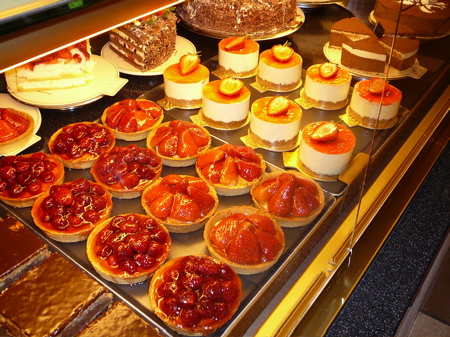
But best of all, when my husband wants a strawberry tart, even for breakfast, he can have a strawberry tart. He loves the ones from Paul’s. We don’t have breakfast there often, but we always enjoy it when we do.
Germany’s culture of shopping slowly changing
Little Diamond forwarded this to me from the Chicago Tribune. The battle to extend shopping hours in Germany has been going on for years. As the hours increase, the annual birthday celebrations described in the preceding blog entry will pass into “olden day traditions.”
By Tom Hundley
BERLIN – Unlike America, Germany has not yet adopted the shop-till-you-drop lifestyle, but things are starting to change.
Even in bustling cities like Berlin and Frankfurt, retailers used to roll up the sidewalks at 6:30 p.m. On weekends, Germans had to scramble to get their shopping done by 2 p.m. on Saturday. Sunday shopping was strictly verboten.
But a long battle over longer store hours is slowly being won by retailers who believe that more hours mean more money in the cash register. They are opposed by Germany’s powerful trade unions whose leaders say workers’ rights must be protected.
The gradual loosening of strict rules governing store hours also reflects a larger battle to loosen up a German economy that suffers from sluggish growth and 9.6 percent unemployment. Chancellor Angela Merkel’s government says it is eager for reform, but it has decided to leave the issue of store hours to local governments.
These days, the Galeria Kaufhof, a newly renovated department store in the heart of the former East Berlin’s shopping district, is crowded with customers until 10 p.m.
“Seven years ago we started a small revolution here in Berlin when we said we are opening on Sundays,” said Detlef Steffens, the store manager.
“We discovered a loophole: according to the law, you could open on Sunday if you were selling souvenirs, so we put stickers that said `souvenirs’ on all the merchandise,” he said.
“We were sued by other store owners. But that started an avalanche.”
Steffens’ store took its case to Germany’s federal constitutional court. The court rejected its arguments but said the particulars of Sunday shopping hours should be regulated by local authorities.
The Berlin city government decided to allow stores to open on six Sundays a year. Last year, it extended the number to 10, plus three extra Sundays during the World Cup soccer tournament.
Last November, Berlin threw caution to the wind and adopted a modified version of America’s 24/7 consumer ethos. Call it 24/6 – non-stop shopping for six days of the week and 10 Sundays.
The Galeria has opted to stay open until 8 p.m. Monday through Wednesday and until 10 p.m. Thursday through Saturday. The extra hours have increased revenue and enabled the store to hire 50 more employees, for a total of 1,080.
Steffens says his employees have generally been supportive of the longer hours.
“It’s an East-West thing,” he said, referring to the lingering psychological divide that still separates Germans who grew up in prosperous West Germany from those who experienced communist East Germany.
Almost all of Steffens’ employees are from the East. Those from the West, he said, are more likely to resist changes proposed by management.
“The trade unions are not so different from East to West, but worker councils in the East are more realistic. Here there’s more of a collective mentality: We are one team; it means our jobs,” he said.
Cornelia Hass, a spokeswoman for Ver.di, a large trade union that represents service employees, says the union’s position is that “everyone should have the liberty to work (non-traditional hours), but nobody has to work these hours.”
Hass disputes the argument that more hours mean more revenue and more jobs.
“People don’t buy more just because they can do it 24 hours a day. You can only spend the euro in your pocket once,” she said.
While acknowledging that store hours have to reflect people’s changing lifestyles, she said Germany already has “more square meters of shopping opportunity per consumer than Europe or the United States” and that fierce competition among retailers was forcing them to trim personnel.
There’s also a quality-of-life issue.
“I really believe that Sunday is the day when everyone who doesn’t need to work, shouldn’t work,” Hass said. “Society needs to lay back for one day, to find time for friends and family.” She also noted that of the 3 million retail workers represented by Ver.di, 80 percent were women, and most had families.
“They need their Sundays,” she said.
The union is supporting three retail workers who have filed a lawsuit challenging Berlin’s new Sunday opening hours.
But most of Germany’s 16 federal states appear to be following Berlin’s example and extending store hours.
Some small merchants are worried, fearing that extended hours by large retailers will force them to attempt the same.
“It’s a problem for us,” said Michael Turberg, who owns a Berlin toy store famous for model trains.
“We are rather specialized and we need staff of high quality. When you are open longer, you need more staff of high quality. It’s not easy to find staff, and it’s not easy to pay them.”
That’s not a problem for Mohamed Wehbe and his family. Immigrants from Lebanon, they run a small shop that sells snacks, groceries, cigarettes and newspapers. It’s open 365 days a year.
When they started their business a few years ago, and kept it open until midnight, they got a polite letter from Berlin authorities advising them to observe the legal opening hours.
“We didn’t know about such laws,” said Wehbe.
Under the new law, the shop is open from 6 a.m. until midnight.
For Wehbe and many other immigrant entrepreneurs, there are scarcely enough hours in a day for earning money.
“This summer,” he said, “we’re going 24/7.”
Recent Comments
intlxpatr on Yellowstone: Old Faithful to C… Michelle on Yellowstone: Old Faithful to C… Cathy on No Grown-Ups in Charge intlxpatr on Waiting for Snow intlxpatr on Waiting for Snow Wikipedia Donate Button

Amazina


Early Voting in Florida


 Here There and Everywhere