Colorado Springs to Wichita Falls, TX
AdventureMan and I have looked at the map and figured out that the drive to Pensacola is another 1500 miles, more or less, and so we want to drive about 550 miles per day or more. We leave Colorado Springs early, enjoying the scenery along the way:


For my desert buddies, when you see piles like these (often covered by tarps or sheds) this is also for snowy roads, the dark dirt helps the snow to melt and gives the wheels more traction:

Hitting an elk is about like hitting a camel – it isn’t going to do anyone any good. We saw a lot of dead deer along the road; a dead deer is always sad, and hitting a deer is a bad way to start a day:
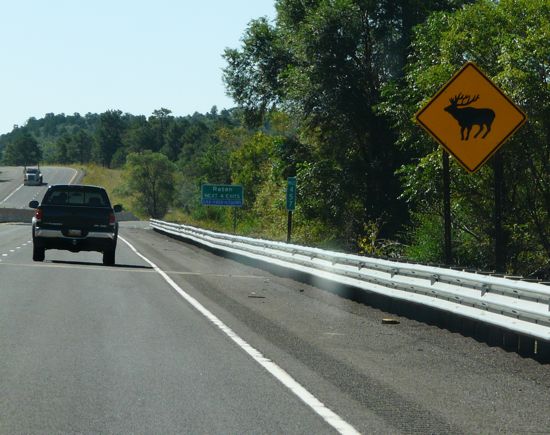
Very soon, we are entering New Mexico:

Soon after entering New Mexico, we come to the Capulin Volcano. AdventureMan has been by once before, and we always wanted to climb this volcano – so we did!


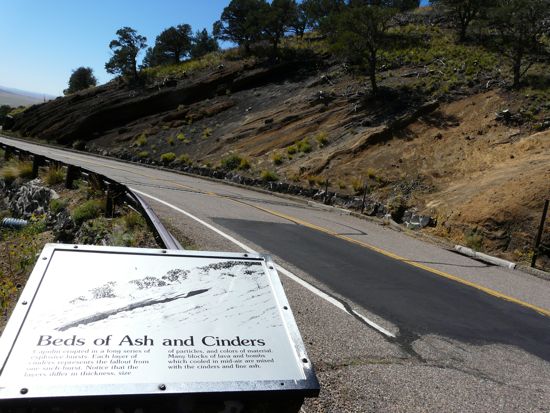
You can drive up to an observation post, and then hike to the top of the volcano.

I am fit, and I did fine – like for the first twenty meters, after which I was huffing and puffing in the thin air. The path was a steady incline, straight up the rim of the old volcano – this is the path:
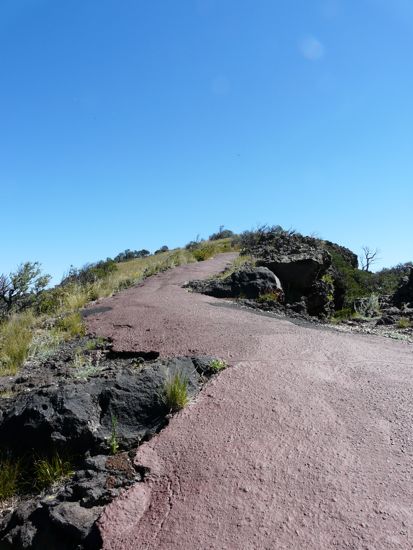
Getting to the top – ahhhhh. That was great:

Hiking to the top put a little pressure on us the rest of the day to hit our mileage goals, but it was worth it, every step. 🙂
The Great Divide
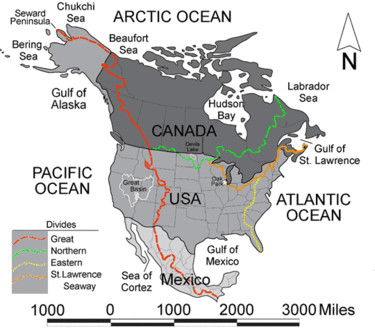
Several times going toward Seattle and driving back from Seattle through the Rockies, we came to signs proclaiming ‘The Great Divide’. I knew it had to do with rivers running either to the Pacific or to the Atlantic, but if I ever knew it, I’ve forgotten the specifics. Fortunately, Wikipedia to the rescue:
The Continental Divide of the Americas, or merely the Continental Divide or Great Divide, is the name given to the principal, and largely mountainous, hydrological divide of the Americas that separates the watersheds that drain into the Pacific Ocean from (1) those river systems that drain into the Atlantic Ocean (including those that drain via the Gulf of Mexico or the Caribbean Sea), and (2) along the northernmost reaches of the Divide, those river systems that drain into the Arctic Ocean.
There are other continental divides on the North American continent, however the Great Divide is by far the most prominent of these because it tends to follow a line of high peaks along the main ranges of both the American and Canadian Rocky Mountains, at a generally much higher elevation than the other divides.
They even have a diagram on Wikipedia:
Play Day in South Dakota
Here it is, our reward for zooming across the US, we gave ourself a break – one day to play, and we are right where we want to be, in Wall, South Dakota, from where we will go straight into some of the most dramatic scenery the world has to offer, the South Dakota Badlands.

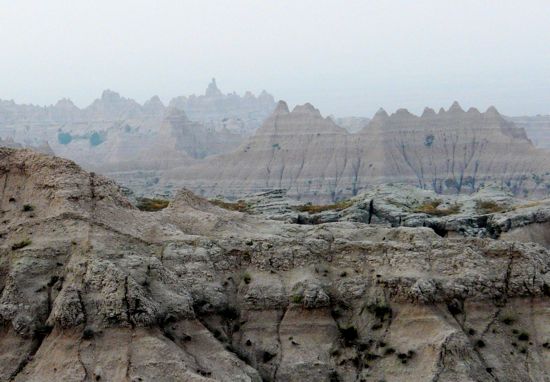


The Badlands Loop was amazing. Few other tourists, but all blown away by the scenery and the displays. It probably took us longer than it needed to, but we were having such a good time. Many people were camping, and pulling long campers- there are many many spots for any kind of camper.
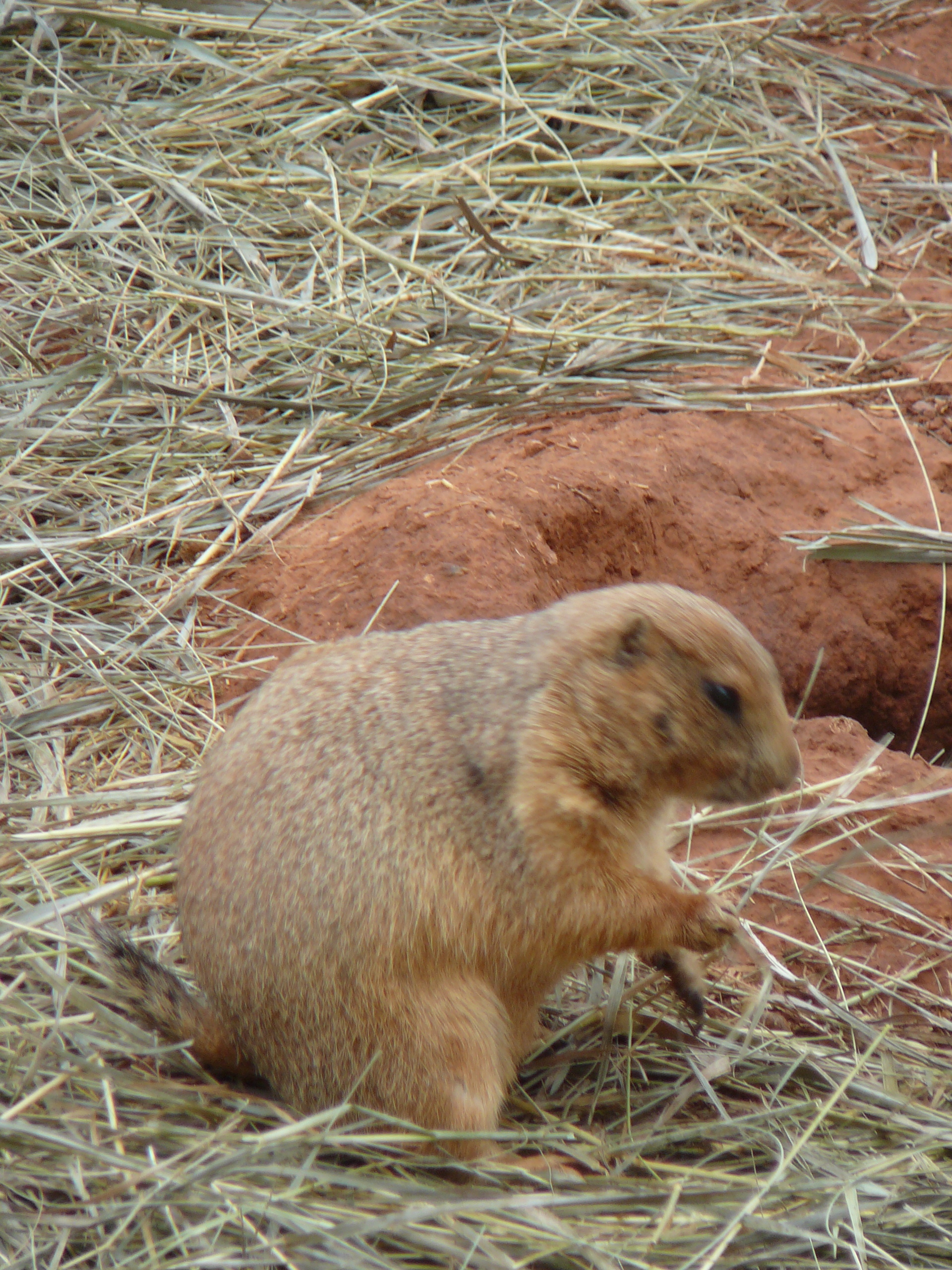
Then on to Hot Springs, with a few stops on the way, starting with Reptile Gardens, for AdventureMan. They have amazing displays, some very expert shows, and some of the fattest snakes I have ever seen. Here are some of the fat prairie dogs:
Then on to Mt. Rushmore, which is very impressive:

Then we took winding scenic highway 16 south, through the forests, and meadows full of amazing game; pronghorns, buffalo, and deer.
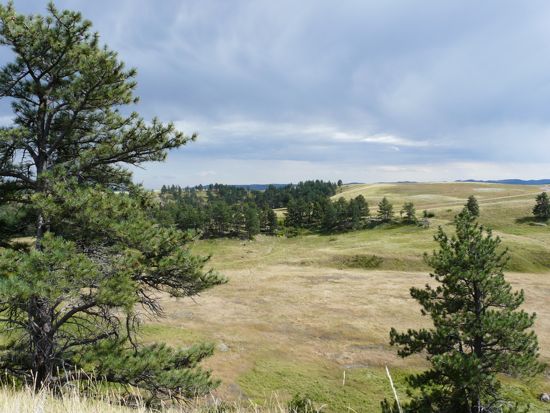

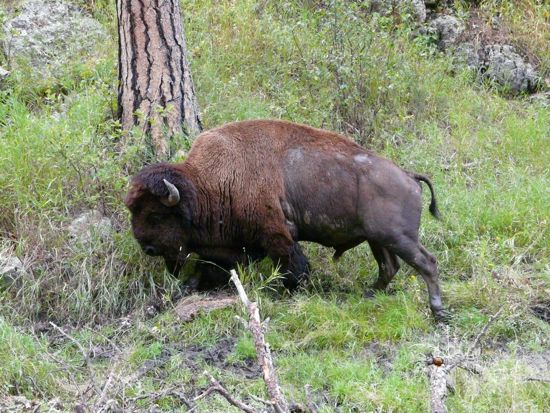
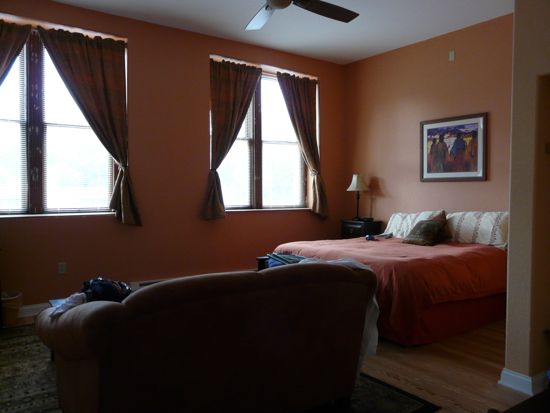
We took our time, stopping to watch the buffalo roam, enjoying the wonderful scenery. When we got to Hot Springs, we checked into the Red River Rock Resort and Spa, found our beautiful room, but still had time for one more special thing before our early evening massages – so we hurried to the Mammoth Museum, Wooo HOOOOO!
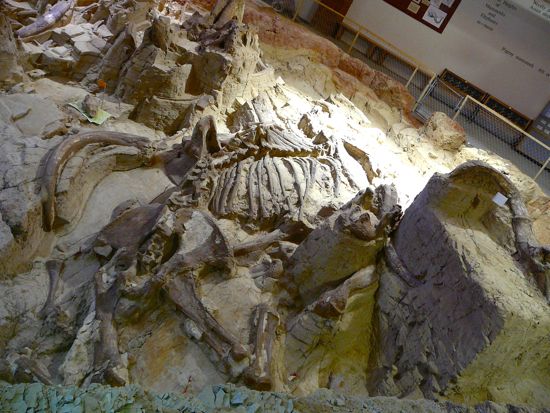
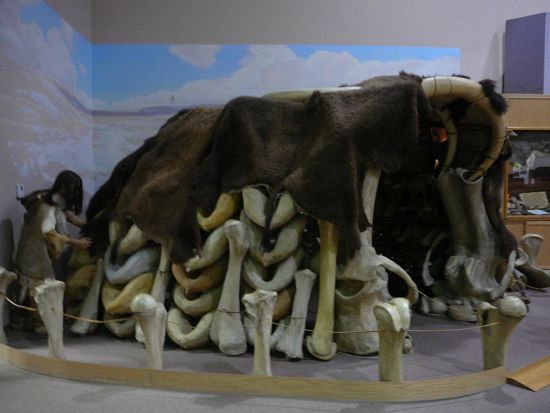
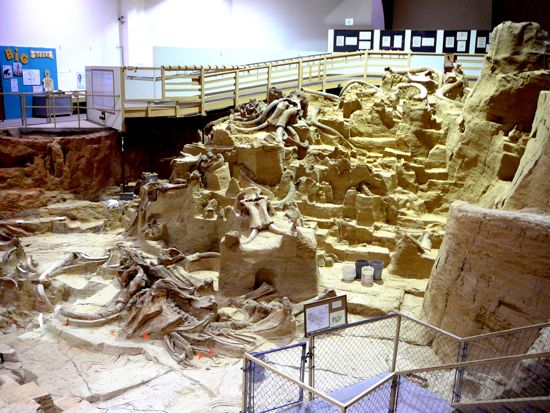
We had a great guide, Kelly, who kept the group informed and entertained, and my friends, this museum is totally awesome. Several years ago a developer began bulldozing this site for a housing development, but stopped immediately when he started unearthing these huge bones. With amazing vision, the city constructed a building to protect the site, which continues to be excavated, a little more every year. The museum is huge, and all the bones are still in their original locations, just partially excavated so we can see how they lay.
Kelly explained how mammoths used to come for the sweet grass growing around the edge of this sinkhole, then they would fall in and couldn’t get out. They have found many many skeletons of mammoths – and other animals – going down as far as they have been able to measure.
This museum is worth a trip – to South Dakota, and to Hot Springs. Our hotel and our massages were just a bonus, but this museum – this museum was the prize.

Then back to our room for our wonderful massages, getting rid of the stresses and strains of four straight days of driving, and a quiet evening as relaxed as limp noodles.
Change of Plans
When we were planning this trip, it all sounded so simple . . . greet the grandbaby, buy a house, quick, fly to Seattle, fly back to Pensacola, kiss the grandbaby and fly to Doha to pack.
Not quite the way it turned out. When we got here, the grandbaby was 11 days overdue. We got to be here for the birth. While our son and his wife labored, we went out with the world’s most wonderful real estate lady and actually, we did find a house.
Three years ago, we found a house. When I talked with the mortgage people, I said “We just finished paying off a mortgage with you; isn’t there some kind of short-cut you could do with me?” and they did something called “fast track” with me, and it was so easy I can’t even remember the paperwork; I think I filled it out on my computer – online – and that was it. My son handled the closing. It was so easy.
Things have really changed. This will be our third mortgage with the same company, but you would think we are potential deadbeats. We have high credit scores, an impeccable payment record – I would think they would want to have us as customers! It’s like pulling teeth. Papers don’t get to us. Additional verifications are required. Appraisers actually enter the house and verify square footage.
Between chasing paper and soothing the newborn, my life has been very full. It doesn’t sound very exciting, when I tell you about it, but here is the truth – I know I am exactly where I am supposed to be right now. It’s an amazing feeling.
Today, I spent a lot of time with the baby. At some point, I realized I wasn’t going to make it to Seattle this trip, and it’s OK. I can go to Seattle later. For right now, I have enough on my plate.
I had forgotten, too, how chaotic life with a newborn can be. His needs take precedence, and sometimes we all run around trying to guess what those needs might be, simple as they are . . . clean diaper? swaddling / soothing to sleep? Mother’s milk? Today was a really good day, where he took the diaper changes with grace, dropped right off to sleep after every meal, and was keenly alert for maybe a half hour after feeding before napping. He loves patterns and fabrics. I am having SO MUCH FUN!
A part of our life is ending, the nomadic part. AdventureMan and I have had a lot of fun, once our son got through college and law school, we were on our own again, living in Europe, living in Saudi Arabia, Kuwait and Qatar – we have had a great adventure. We travelled to Botswana, Namibia, Zambia (several times), South Africa, Kenya, Tanzania and spent a wonderful week on Mnemba Island off the coast of Zanzibar. We have wonderful friends, mostly from churches and interest groups. I would think, knowing us, that we would be sad leaving all this, but instead, we are racing toward our new future, being more settled, being near our son and his family, and his wife’s great big family. 🙂
For one thing, the world has changed. With e-mail and VOIP phones and people who jump on a plane at the drop of a hat, we expect to stay in touch with those we love and treasure. We expect they will come see us. It’s kind of fun settling in a place with white sandy beaches that everyone wants to come visit. 🙂 Cooler than Kuwait and Qatar in the summer time, too! Nice warm winters, well, not this winter, brrrrrrrrrrrr!
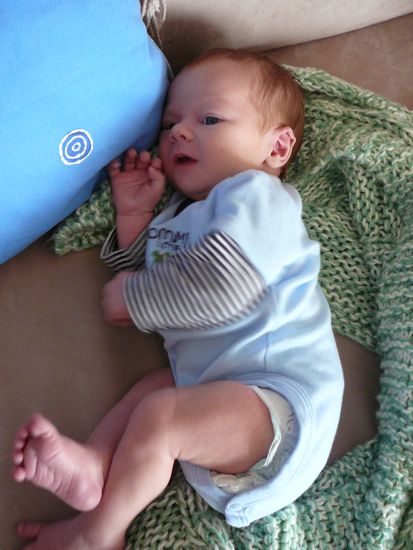
Thought you might want to see a photo of my little darling grandson:
Arab Gulf? Persian Gulf? Games Cancelled
Islamic Solidarity Games cancelled over Gulf dispute
From BBC News
The first Islamic Solidarity Games were held in Jeddah in 2005
The Islamic Solidarity Games, due to be held in Iran in April, have been called off because of a dispute with Arab countries over what to call the Gulf.
The games federation in Saudi Arabia said the Iranian organisers had failed to address its concerns, particularly about the planned logo and medals.
These bear the words “Persian Gulf”, but Arab countries, who call it the Arabian Gulf, reject the term.
The games had been postponed in October in the hope of striking a deal.
The Islamic Solidarity Sports Federation (ISSF) in Riyadh said, after an emergency board meeting, Iran’s local organising committee “unilaterally took some decisions without asking the federation by writing some slogans on the medals and pamphlets of the games”.
Iran “did not abide by the rules of the Islamic Solidarity Sports Federation” and “did not follow the decisions taken by the general assembly of the federation at a previous meeting in Riyadh”, it said in a statement.
But Iran’s committee for the games disputed the decision.
“In spite of convincing arguments made to the ISSF executive committee, regrettably and without presenting any logical reasons, the ISSF committee decided not to hold the games with Iran as the host,” it said.
The games – which are meant to strengthen ties among Islamic countries – were first held in the Saudi city of Jeddah in 2005.
Iran has campaigned to ensure the body of water between Iran and the Arabian peninsula is known as the Persian, not the Arabian, Gulf.
Where Al Rayyan Used to Begin
Leaving the Suq al Waqif, we got a shock – where you could once go straight ahead onto Al Rayyan, you can’t!

There is a left turn, a shaky bridge, and then you can go right to access Al Rayyan. It all appears temporary, and when the fix is accomplished, it will probably be a better intersection.
But this is Doha. When you think you know the route, suddenly, and often without notice, your traffic pattern makes a sudden change. The temporary diversion may last for weeks, or months, or . . .
I’m a map person, I remember once discovering that the road I intended to take, the road on the map, wasn’t there yet! In Doha, a map is only an overview, it is not reality based, the roads you see may or may not be open. In the end, I am sure there is going to be a smooth traffic pattern, but oh, in the meantime!
This is a relatively small change, with a relatively easy fix.
Casper’s A Taste of the South
We had decided on one restaurant, an Italian restaurant we both like, and were on our way, when Mom thought of another restaurant we might like to try, but it was on the way, so we could look at it and decide whether we wanted to eat there or go on to the Italian one.
This is very normal for our family. Our son used to call it “bait and switch” because we would say “Hey! Do you want to go to Tortilla Gonzales?” and he would say “Yeah!” and we would all jump in the car and then on the causeway, AdventureMan would say “You know I really have a taste for Chinese . . . would anyone prefer Chinese?” and I would jump in and say “We’re really close to that sushi place we all love!” and then our son would have to rein us in “NO! You said we were going to Tortilla Gonzales!”
Once he went away to college, we switched all the time. Later, we learned that now he and his wife do the old switch-a-roo, too – family culture is a hard thing to shake.
So we are en route and Mom suddenly shouts “RIBS!” and I say “What??” and she said “We just passed a rib place!” We were at a stop light. “Mom,” I asked, “Do you want to go to that rib place?”
Silence.
Silence.
I pull into the U-turn lane and complain “You’ve got to start dealing with me directly; if you want to go to the rib place, you have to say so!” The complete irony being that I was already making the U-turn, which is what she wanted me to do. . . . Family culture being a hard thing to shake . . .
But as we pulled into the already crowded parking lot, the smell was absolutely divine. There was already a line. Good thing, too, it gave us time to read the menu and decide what we wanted.

We both ordered ribs. We are both forbidden to eat ribs. I eat ribs maybe one time each year, like once, at a buffet, I ate one small rib. It is so rare that I allow myself to eat a rib that I can remember even that one tiny rib. But this time, I ordered ribs, because my Mom did. She ordered Sweet Potato Fries and Cole Slaw and I ordered Hush Puppies and Cole Slaw.
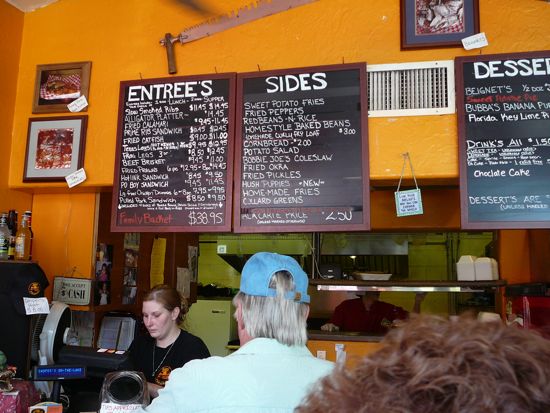
You are going to be so so proud of me. I took pictures before we ate the food this time, well, except for one tiny bite I took out of the hushpuppies, but that was to show you what they look like on the inside. (My Mom has NEVER had a hushpuppy in her life before having one of mine.)
We sat down in the large outside sitting place – I can’t help but wonder what they do in the winter time, because it can get really really cold and damp in Seattle, but I am guessing that they do a huge take-out business.

They have a map that they want people to put push-pins in to say where they are from:
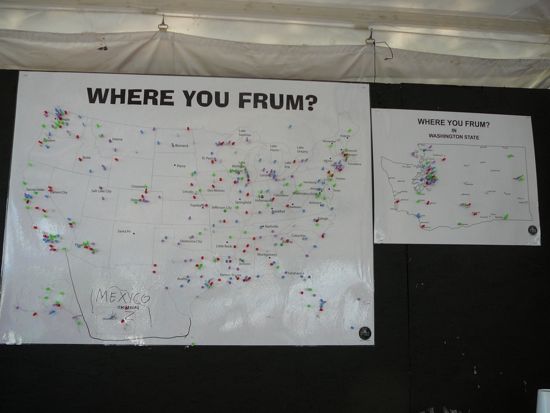
I made a little addition:

And, as I promised, here is the food. Actually, they gave Mom this HUGE portion, about double my portion, but since I got four ribs and only ate two, Mom took home a huge box of leftover ribs to package up and freeze and have a little at a time.

Did you know sweet potatoes are really really healthy for you?

(I think sweet potatoes are healthier for you when they have a lower surface/interior ratio and have absorbed less fat, but these are totally, incredibly delicious. That’s sugar on the sweet potato fries, not salt.) Mom took leftover sweet potato fries home, too.

I can’t even pretend that there is anything healthy about deep fried cornbread. I ate them all, except the one Mom ate. They . . . they were really really good. Yes, I am so ashamed, but I would do it again.
And no, I didn’t take a photo of the sweet potato pie, generously seasoned with fresh nutmeg, it was divine, or the key lime pie we couldn’t eat and Mom took that home, too.
Oh, this food was good. As we left, the line stretched way out to door and into the parking lot.
Casper’s Taste of the South
15030 Bothell Way
Lake Forest Park, WA
(206)268-0202
Their slogan is:
Put a Little South in Your Mouth. LLLOOOLLLL!
In Xanadu: A Quest by William Dalrymple
This book was on my (huge) “Read Me” stack, and I picked it up for a change of pace. As I started reading, I wondered “how did this get there?” My first instinct was it was a recommendation from Little Diamond. As I was reading, however, I came across a segment that was what our priest had read in church around the Feast of the Epiphany about the birthplace of the wise men who came seeking the Christ Child after his birth. I wrote down the title and ordered it from amazon.com (which has some copies used from 72 cents).

William Dalrymple wrote this book when he was a mere 22 years old. He and a travelling companion took off to trace Marco Polo’s journey from Jerusalem to Xanadu, where he was taking oil from the sanctuary lamp to Kubla Khan.
In a world where we have all been taught to be so careful, they take incredible risks. They travel on the cheap – staying in fleabag hotels, sometimes sleeping “rough”, i.e. out in the open. They travel any way they can – an occasional train, but more often a truck, a bus, whatever is going their way. One very long segment they travelled on top of a pile of coal.
They travel from Jerusalem up through Syria and into Turkey, then turn east and cross Iran, Pakistan and Afghanistan to China. They have some amazing adventures, see some astounding scenery and because of their mode of travel, have a lot of time to talk with their travelling companions or people in the cities where they are staying.
I am blown away that an unmarried couple would cross Iran, Pakistan and Afghanistan. I guess they told people they were married to share a room (they were on a budget) and they were only friends, not a couple, but what a risk. I am astonished that they were never asked to produce a marriage license or any proof of marriage when they stayed in hotels. I am astonished at the girls (one left in Lahore and another joined him, but these are girls who are friends, not anything more) would travel on the backs of trucks full of men, and never blink an eye.
The book is occasionally hilarious. Most of the hilarity results from foods they have to eat – sometimes it is the only food available – or from misunderstandings because of lack of a common language, or due to their frequent bouts of diarrhea, what I really liked about the author was that he was rarely pompous, and when he is funny, it is usually about some conversation he has had, or some mistake he has made.
One of my favorite parts of the book happens in Iran:
As we sat waiting for the bus to Tabriz, the next town on Marco Polo’s itinerary, we watched the mullahs speeding past in their sporty Renault 5s. Iran was proving far more complex than we had expected. A religious revolution in the twentieth century was a unique occurence, resulting in the first theocracy since the fall of the Dalai Lama in Tibet. Yet this revolution took place not in a poor banana republic, but in the richest and most sophisticated country in Asia. A group of clerics was trying to graft a mediaeval system of government and a pre-medieval way of thinking upon a country with a prosperous modern economy and a large and highly educated middle class. The posters in the bus station seemed to embody these contradictions. A frieze over the back wall of the shelter spoke out, in the name of Allah, against littering. On another wall two monumental pictures of the Ayatollah were capped with the inscriptions in both Persian and English:
BEING HYGENIC IS DIRECTLY RELATED ON THE MAN’S PERSONALITY
and:
ALLAH COMMANDS THE RE-USE OF RENEWABLE RESOURCES.
We had expected anything of the Ayatollah. But hardly that he would turn out to be an enthusiastic ecologist.
The challenge of this journey is to follow as closely as possible the path Marco Polo took, but two segments of the journey go through off-limits areas. They find a way into one, to discover later it is an atomic testing area, and the second, at the very end, around Xanadu, they find receptive Chinese officers who take them to have a brief glimpse of the ruins of Xanadu while booting them out of the area. As they stand in Xanadu, they repeat a poem that every American child grows up with in English Literature:
In Zanadu did Kubla Khan
A stately pleasure-dome decree:
Where Alph, the sacred river, ran
Through caverns measureless to man
Down to a sunless sea.
So twice five miles of gertile ground
With walls and twoers were girdled round:
And there were gardens bright with sinuous rills.
Where blossom’d many an incense-bearing tree:
And here were forests ancient as the hills,
Enfolding sunny spots of greenery.
(Coleridge)
I liked this book. Dalrymple is a history major, and often quotes from historical – even obscure – texts to illuminate what he observes. I think I may look at a couple more he has written since.
Shop and Eat Locally
I’m fascinated with the concept of trying to eat “local” and there is an article in Wired: How to Shop and Eat Locally that tells us more about it. Below is an excerpt:
Innumerable books and other media extol the virtues of eating food that’s grown and processed near you: it benefits the planet, it benefits the farmers, it tastes better, it’s better for you. ReadMichael Pollan or Barbara Kingsolver for examples.
But piecing together a local menu isn’t as easy as going to the Local aisle of your supermarket. Here are some tips for bringing your meals closer to home.
Start small. Shopping locally goes against the grain (pun intended) of our globalized economy, so it’s not the easiest thing to do. Even if you live in a region that’s rich in vegetables and meats, chances are you won’t have easy access to staples like sugar, salt, oil, and flour. Just focus on what you can get, and keep an eye out for sources and/or substitutes for what you can’t.
Personalize. If you want to try the classic 100-mile diet, you can find your personal 100-mile radius at 100milediet.org.
Get a supplier. You can find farms, greenmarkets, and locally oriented stores in your area using web tools offered atEatwellguide.org and Localharvest.org. If you live in a city, investigate CSA — Community-Supported Agriculture. Citydwellers pay a fee to subscribe to a farm, and get a share of its output delivered in weekly boxes of joy. Just Food offers a listing for New Yorkers.
Travel Nerds
We are a bunch of travel and geography nerds in my family. Nothing makes us happier than jumping in a airplane, reaching an exotic location and driving, getting our feet on new ground, seeing new things, learning new ways. We all have cameras glued to our hands and laptops stuffed in backpacks.
All my married life, people have looked at me with pity and tole me how they can’t believe I live with such uncertainty, never knowing where I will be in the next year – even the next few months. What I tell them is this – the truth is, we ALL never know. We ALL never know when something will happen that will change our lives dramatically, forever. We live day to day, not thinking about all the things that can happen. If we think too much about them, we might go crazy.
I consider myself blessed. I was created with a restless spirit, a spirit for new experiences and new ways of thinking. I was given a life where all those things became my daily bread.
What is fun for me is watching the next generation of young adults discovering their own lives, who they are meant to be.
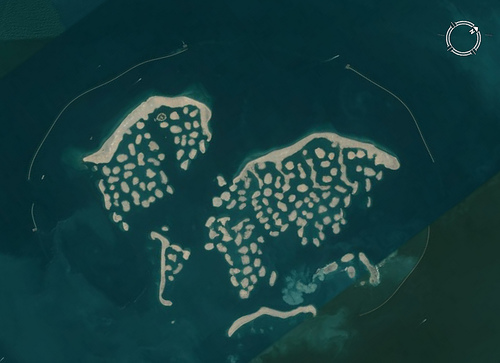
My nephew, at Google Earth took his love of geography to new heights. He works in a place he loves, doing work he loves. He wrote to me yesterday, to tell me about a new game being played, a grown-up version of the old “Where in the World is Carmen Sandiego.” (one of the earliest computer games for kids) He has published a really really hard one on the Google team LatLong blog (as he says, he has the home court advantage in this game!) and he refers us to another blog, Where on GoogleEarth? where there are a series of contests to see if you can identify landmarks, special places, from the sky.
Here, for example, is the photo from contest #22 – and people have to write in telling what it is. Can YOU tell what it is? 🙂
Recent Comments
intlxpatr on Shampoo Ginger tigerbutterya0c5ff1d… on Shampoo Ginger intlxpatr on British Soldier Kidnapped, Esc… John on British Soldier Kidnapped, Esc… intlxpatr on British Soldier Kidnapped, Esc… Wikipedia Donate Button

Amazina


Early Voting in Florida


