New Google Earth Hi Res
New high resolution:
Canada:
Whistler, BC; Waterloo & Toronto, Ontario; Nanaimo, BC; and Fort Saskatchewan, AB
England: Base 50cm coverage of nearly entire country, and Avon
Germany: Cities/Regions of Greifswald, Trier, Köln, Stuttgart, Bonn, Oldenburg, Rostock, Saarbrücken, Hamburg, Hannover, and Ritterhude
Austria: Villach region
France: Cities of Caen, Dijon, Metz, St Etienne, Toulouse and Rouen
Spain: Valencia Andorra
US: Imperial County (CA); Yellowstone National Park (WY); Galveston/Houston (TX); Peterborough (NH); Cheyenne (WY); Burke, Wake, and Cabarrus Counties (NC); Racine and Kenosha Counties (WI); Washington, DC; St Paul (MN); and the State of Alabama
Japan: City/Regions of Kochi, Asahikawa, Koriyama, Miyazaki, Nagano, Utsunomiya, Akita, and Toyama
Large Digital Globe (60cm) update includes areas in Sudan, expanded Africa, Australia, Mexico coverage and smaller areas of coverage in Asia, Polynesia, South America, Canada, Europe, Middle East plus some interesting islands in Antarctica and Greenland.
Updated Imagery:
Americas:
Bogotá, Columbia; Mission Viejo (CA, US); Hillsborough County (FL, US)
EU: Dublin, Ireland
Middle East/Africa: Beirut, Lebanon and Tripoli, Libya
Asia: Hong Kong and Manila, Philippine
Updated Terrain:
Western US 10m, Canary Islands 10m
Anya Seaton and Avalon
Avalon, by Anya Seaton, is an amazing book, a book I almost didn’t read, but once I picked it up, I could hardly stop reading until I had reached the end. It took me to a whole new world.

It opens in England, around the turn of the first millenium, when people had names like Aethelred and Aelfrhryth which is enough to make me NOT want to read the book. But I read another book by Anya Seaton, Katherine, and I really liked it. It, too, took place in very early English history, and had such an authentic feel. It wasn’t like you pick up the book and all the lords and ladies are in gorgeous clothes, Seaton captures the primitive life many lived in “castles”, freezing cold most of the winter, no plumbing – many of the poorest laborers in Kuwait live better, in terms of food, a roof over their head, toilet facilities – that these early nobles. And the life of villagers was even more basic, a true scrabble for survival, and under filthy conditions, not a lot of time of opportunity for bathing, so people had quite an odor most of the time.
Avalon begins with a chance meeting of a young man and a young woman, a tragedy, and a journey. Their story, as first one love and the other doesn’t, then the other does and misses the opportunity – takes us from the southernmost part of England to Iceland, to Ireland, to Greenland and to the new world, all in the space of these two intertwined lives. They never marry, and yet the book, and their relationship, is a romance.
As you can see, once I got into the book, I couldn’t put it down until the last page. These people are so real, so genuine and so human – and Seaton makes you care about them. She manages to throw in enough detail that I could almost swear I visited these places – a thousand years ago. I have spun wool to buy necessities for our sod house in Iceland, I have embroidered tapestries in the Bower of my husband’s castle, I have sent my son off to settle with his Irish bride in the new world – yes, I think I have done.
The political situation in England at this time is chaotic, with Vikings raiding their coastal cities, and deep up the rivers into the interior, feuding over who will wear the crown, and problems with the capabilities of rulers to rule. There is a constant friction between the church and state, for land, for power, for wealth. The majority of the novel takes place during the reign of – I am not kidding – Ethelred the Unready.
At the very end, I found to my astonishment, that this book also concerned the ramifications of a big lie, just as my previous book reviewed. This is a total co-incidence, something that surprised me, and this book ends in a totally different way, as the main character comes to grips with her deception, owns up to it, willing to suffer the consequences.
Is this what I want? Merwyn thought, and at once came the answer. Yes, it is. There would be boring days ahead, but never again the depressions and miseries of before . . . She felt cleansed, peaceful, and there was much gratitude. . .
That totally cracked me up, but this is a romance of a different nature, a very real romance, with the real kinds of choices that real-life romances entail, and the real life consequences. The hand of God is a major player here, and the beliefs of the characters shape events in a way consistent with the times. Dreams are taken very seriously, and the power of curses, and sorceries, which I never give two thoughts in my daily life in the 21st century.
The main characters have their own nobility, based on their choices, their growth, and their coming to terms with their lives and situations. I learned a lot reading Avalon, and I also had a great time while learning.
All in all, a fascinating read.
“Who Am I?”
As DNA testing becomes more and more common, surprises are popping up everywhere. This article from BBC is about two Englishwomen who discover they have Native American blood when they send their DNA in for testing.
It’s fascinating to think that migration and trade has left it’s traces generations later. I love the work that is being done with bloodlines these days.
Native American DNA found in UK
DNA testing has uncovered British descendents of Native Americans brought to the UK centuries ago as slaves, translators or tribal representatives.
Genetic analysis turned up two white British women with a DNA signature characteristic of American Indians.
An Oxford scientist said it was extremely unusual to find these DNA lineages in Britons with no previous knowledge of Native American ancestry.
Indigenous Americans were brought over to the UK as early as the 1500s.
It rocked me completely. It made think: who am I?
Doreen Isherwood
Many were brought over as curiosities; but others travelled here in delegations during the 18th Century to petition the British imperial government over trade or protection from other tribes.
Experts say it is probable that some stayed in Britain and married into local communities.
Doreen Isherwood, 64, from Putney, and Anne Hall, 53, of Huddersfield, only found out about their New World heritage after paying for commercial DNA ancestry tests.
Mrs Isherwood told BBC News: “I was expecting the results to say I belonged to one of the common European tribes, but when I got them back, my first thought was that they were a mistake.
“It rocked me completely. It made think: who am I?”
You can read the rest of the article at BBC Science/Nature News, here.
Welcome, Earthling!
The commenter on this blog known as Earthling, now has his own blog under his own name. A geographer with GoogleEarth, he has frequently given info and tips on Google Earth which I have passed along to you.
His blog is a hoot. Matt is a picky eater, surrounded at Google by free, high quality food in huge abundance and variety, and that is what he is blogging about. Maybe he will also show their on-site laundry and gym facilities 😉
In spite of his self-proclaimed picky eating habits, Matt is a very good cook, a creative cook, and I always loved it when I could hear him puttering around in the kitchen because something good was going to come out of it all. His one food addiction is hot peppery sauces, and his Jambalaya is so fiery I can’t eat but a bite or two.
Here is a Matt story (every family has these stories):
One day Matt’s Mom was making dinner when Matt, about fifteen at the time, walked in and asked “what’s for dinner?” She told him. Twenty minutes later the delivery man from a local restaurant pulled up and rang the doorbell – Matt’s dinner had arrived. Matt’s Mom was dumbfounded, and then laid down the law – if she was going to all the trouble of fixing dinner, her family would eat it! No delivery!
You can find him HERE at Google-Food-Spot.
Check in and give him a big welcome, please.
Google Earth Fantasy Flight
The same good friend who shared the quotes with me, sent this connection yesterday to an 8 minute video compiled with music by a GoogleEarth fan who takes you to some of the oddities you can see with the high resolution of GoogleEarth, including sunbathers and what I can only describe as EarthArt.
Dire Predictions on Earth Day
This is from AOL Top News compiled for Earth Day 2007.
Scientists Offer Frightening Forecast
By Ker Than and Andrea Thompson
LiveScience.com
(April 22) — Our planet’s prospects for environmental stability are bleaker than ever as the world celebrates Earth Day on Sunday. Global warming is widely accepted as a reality by scientists and even by previously doubtful government and industrial leaders. And according to a recent report by the Intergovernmental Panel on Climate Change (IPCC), there is a 90 percent likelihood that humans are contributing to the change.
The international panel of scientists predicts the global average temperature could increase by 2 to 11 degrees Fahrenheit by 2100 and that sea levels could rise by up to 2 feet.
Scientists have even speculated that a slight increase in Earth’s rotation rate could result, along with other changes. Glaciers, already receding, will disappear. Epic floods will hit some areas while intense drought will strike others. Humans will face widespread water shortages. Famine and disease will increase. Earth’s landscape will transform radically, with a quarter of plants and animals at risk of extinction.
While putting specific dates on these traumatic potential events is challenging, this timeline paints the big picture and details Earth’s future based on several recent studies and the longer scientific version of the IPCC report, which was made available to LiveScience.
2007
More of the world’s population now lives in cities than in rural areas, changing patterns of land use. The world population surpasses 6.6 billion. (Peter Crane, Royal Botanic Gardens, UK, Science; UN World Urbanization Prospectus: The 2003 Revision; U.S. Census Bureau)
2008
Global oil production peaks sometime between 2008 and 2018, according to a model by one Swedish physicist. Others say this turning point, known as “Hubbert’s Peak,” won’t occur until after 2020. Once Hubbert’s Peak is reached, global oil production will begin an irreversible decline, possibly triggering a global recession, food shortages and conflict between nations over dwindling oil supplies. (doctoral dissertation of Frederik Robelius, University of Uppsala, Sweden; report by Robert Hirsch of the Science Applications International Corporation)
2020
Flash floods will very likely increase across all parts of Europe. (IPCC)
Less rainfall could reduce agriculture yields by up to 50 percent in some parts of the world. (IPCC)
World population will reach 7.6 billion people. (U.S. Census Bureau)
2030
Diarrhea-related diseases will likely increase by up to 5 percent in low-income parts of the world. (IPCC)
Up to 18 percent of the world’s coral reefs will likely be lost as a result of climate change and other environmental stresses. In Asian coastal waters, the coral loss could reach 30 percent. (IPCC)
World population will reach 8.3 billion people. (U.S. Census Bureau)
Warming temperatures will cause temperate glaciers on equatorial mountains in Africa to disappear. (Richard Taylor, University College London, Geophysical Research Letters:)
In developing countries, the urban population will more than double to about 4 billion people, packing more people onto a given city’s land area. The urban populations of developed countries may also increase by as much as 20 percent. (World Bank: The Dynamics of Global Urban Expansion)
2040
The Arctic Sea could be ice-free in the summer, and winter ice depth may shrink drastically. Other scientists say the region will still have summer ice up to 2060 and 2105. (Marika Holland, NCAR, Geophysical Research Letters)
2050
Small alpine glaciers will very likely disappear completely, and large glaciers will shrink by 30 to 70 percent. Austrian scientist Roland Psenner of the University of Innsbruck says this is a conservative estimate, and the small alpine glaciers could be gone as soon as 2037. (IPCC)
In Australia, there will likely be an additional 3,200 to 5,200 heat-related deaths per year. The hardest hit will be people over the age of 65. An extra 500 to 1,000 people will die of heat-related deaths in New York City per year. In the United Kingdom, the opposite will occur, and cold-related deaths will outpace heat-related ones. (IPCC)
World population reaches 9.4 billion people. (U.S. Census Bureau)
Crop yields could increase by up to 20 percent in East and Southeast Asia, while decreasing by up to 30 percent in Central and South Asia. Similar shifts in crop yields could occur on other continents. (IPCC)
As biodiversity hotspots are more threatened, a quarter of the world’s plant and vertebrate animal species could face extinction. (Jay Malcolm, University of Toronto, Conservation Biology)
2070
As glaciers disappear and areas affected by drought increase, electricity production for the world’s existing hydropower stations will decrease. Hardest hit will be Europe, where hydropower potential is expected to decline on average by 6 percent; around the Mediterranean, the decrease could be up to 50 percent. (IPCC)
Warmer, drier conditions will lead to more frequent and longer droughts, as well as longer fire-seasons, increased fire risks, and more frequent heat waves, especially in Mediterranean regions. (IPCC)
2080
While some parts of the world dry out, others will be inundated. Scientists predict up to 20 percent of the world’s populations live in river basins likely to be affected by increased flood hazards. Up to 100 million people could experience coastal flooding each year. Most at risk are densely populated and low-lying areas that are less able to adapt to rising sea levels and areas which already face other challenges such as tropical storms. (IPCC)
Coastal population could balloon to 5 billion people, up from 1.2 billion in 1990. (IPCC)
Between 1.1 and 3.2 billion people will experience water shortages and up to 600 million will go hungry. (IPCC)
Sea levels could rise around New York City by more than three feet, potentially flooding the Rockaways, Coney Island, much of southern Brooklyn and Queens, portions of Long Island City, Astoria, Flushing Meadows-Corona Park, Queens, lower Manhattan and eastern Staten Island from Great Kills Harbor north to the Verrazano-Narrows Bridge. (NASA GISS)
2085
The risk of dengue fever from climate change is estimated to increase to 3.5 billion people. (IPCC)
2100
A combination of global warming and other factors will push many ecosystems to the limit, forcing them to exceed their natural ability to adapt to climate change. (IPCC)
Atmospheric carbon dioxide levels will be much higher than anytime during the past 650,000 years. (IPCC)
Ocean pH levels will very likely decrease by as much as 0.5 pH units, the lowest it’s been in the last 20 million years. The ability of marine organisms such as corals, crabs and oysters to form shells or exoskeletons could be impaired. (IPCC)
Thawing permafrost and other factors will make Earth’s land a net source of carbon emissions, meaning it will emit more carbon dioxide into the atmosphere than it absorbs. (IPCC)
Roughly 20 to 30 percent of species assessed as of 2007 could be extinct by 2100 if global mean temperatures exceed 2 to 3 degrees of pre-industrial levels. (IPCC)
New climate zones appear on up to 39 percent of the world’s land surface, radically transforming the planet. (Jack Williams, University of Wisconsin-Madison, Proceedings of the National Academy of Sciences)
A quarter of all species of plants and land animals—more than a million total—could be driven to extinction. The IPCC reports warn that current “conservation practices are generally ill-prepared for climate change and effective adaptation responses are likely to be costly to implement.” (IPCC)
Increased droughts could significantly reduce moisture levels in the American Southwest, northern Mexico and possibly parts of Europe, Africa and the Middle East, effectively recreating the “Dust Bowl” environments of the 1930s in the United States. (Richard Seager, Lamont Doherty Earth Observatory, Science)
2200
An Earth day will be 0.12 milliseconds shorter, as rising temperatures cause oceans to expand away from the equator and toward the poles, one model predicts. One reason water will be shifted toward the poles is most of the expansion will take place in the North Atlantic Ocean, near the North Pole. The poles are closer to the Earth’s axis of rotation, so having more mass there should speed up the planet’s rotation. (Felix Landerer, Max Planck Institute for Meteorology, Geophysical Research Letters)
Amazing Dubai
Today AOL’s Money section has an article on “Amazing Dubai. It starts off:
The Wonders of Dubai
“As one of the seven emirates that make up the oil-rich United Arab Emirates, Dubai has attracted world-wide attention through some mind-boggling, innovative real estate projects.
Sit back and peruse our photo gallery of some of the most amazing construction being done in the world today.”
You can access the article and the fabulous photos by clicking HERE.
Google Earth Adds New Layers
Google earth, according to OogleEarth has just added some new layers, one in particular of which highlights what is going on in Dharfur, and ties it to the United States Holocaust Memorial Museum, which tracks deaths, attacks, and refugees in the Dharfur region.
Many thanks to my source at GoogleEarth and greetings, Earthling! (I love saying that!)
Mediawatch: Covering the new Darfur default layer in Google Earth
Wednesday, April 11, 2007 (10:38 UTC)
Hundreds of media organizations carried news about the new Darfur layers in Google Earth — and that’s just in English. In Sweden alone, over 40 papers ran the news (an example). In the US, many local news organizations and papers ran the AP or Reuters story. Here’s a rundown of links to some of the larger and/or more interesting ones, with some observations at the end:
Using their own correspondents: The Los Angeles Times (business), BBC (front page feature), CNET (front page, and as a top headline for media 2.0), CNN (technology), Washington Times (business), PC World, ABC News (world news) and a good article/blog in Wired.
Reuters: Australia’s The Age (under technology), New Zealand Herald (world news), The Australian (world news) and Scientific American (science news).
AP: Seattle Post Intelligencer (business), MSNBC (technology), The Guardian (world news), Sydney Morning Herald (technology), the Houston Chronicle (markets), Seattle Times (world news), CBS News (technology), Baltimore Sun (world news), Washington Post (technology), San Jose Mercury News (breaking news), San Francisco Chronicle (business), Denver Post (world news), International Herald Tribune (Americas??) and the Sudan Tribune (which is a great resource for Darfur news, it turns out — pity they don’t have RSS).
AFP: Times of India (world news), iAfrica (technology) and Baku Today (technology).
IDG News service: IT World and InfoWorld.
What’s interesting is that there is no consensus among news editors as to where such a story belongs: Is the story’s most important news component the fact that there is a genocide being perpetrated in Darfur (world news), that new technologies are being employed to educate people about Darfur (technology), or that Google is involved (business)? In a sense, the situation in Darfur is not itself a “news” story, in that we all already (should) know what’s going on there. (If anything, the news is that it’s getting worse at the moment, and people I know who work there are doing so without much hope of a resolution anytime soon.) But putting the story in the technology section relegates it to a spot not followed by the people that the technology is most aiming to reach.
I think this is above all a story about how new technology is letting us all be witnesses to a genocide in progress, and how that raises our own responsibilities — so perhaps this is a story best also told in the glossy Sunday newspaper magazines, read when people have more time to play with Google Earth and where there is more room for long-form stories about larger technology trends coupled to humanitarian crises such as Darfur, but also Katrina/New Orleans and the Pakistan quake from 2005. How about it, New York Times?
My opinion: This has got to be one of the greatest blogs on earth. And he emphasis added in the above paragraph is mine.
Google Earth Update
My nephew, Earthling, who works for GoogleEarth, makes the following recommendation:
“there are a lot more panoramio photos now. . . “
“Spain and France are both completely covered in 2.5 meter imagery or better now. Switzerland is now 100% high res and has new improved terrain. I highly recommend turning on terrain and flying through the alps. Highly recommend it!”
Have fun!
(If you don’t have Google Earth yet, you can download it here. It’s FREE.)
Google Earth for Dummies!
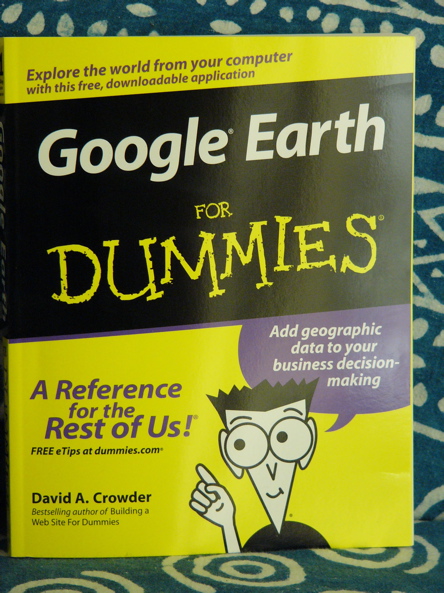
I’ve been on the waiting list at Amazon for months, ever since my nephew, Earthling, wrote me that this book was in the works. (thanks, Earthling!) It arrived this week. Wooooo Hooooo!
Yes, I love GoogleEarth. I soar and swoop, look at my house in Seattle, look at different places in Qatar and Kuwait, go to Florida and visit my son – all via Google Earth. With Google Earth for Dummies, I can now do even more. Like all the Dummy books, the writing is simple, there are a lot of illustrations, and it tells me things I would never otherwise know.
It’s $16.49 through Amazon.com, plus shipping, of course, and you can find it here.
Recent Comments
ExpatAlien on What Country am I Living … intlxpatr on Yellowstone: Old Faithful to C… Michelle on Yellowstone: Old Faithful to C… Cathy on No Grown-Ups in Charge intlxpatr on Waiting for Snow Wikipedia Donate Button

Amazina


Early Voting in Florida


 Here There and Everywhere