Germany’s culture of shopping slowly changing
Little Diamond forwarded this to me from the Chicago Tribune. The battle to extend shopping hours in Germany has been going on for years. As the hours increase, the annual birthday celebrations described in the preceding blog entry will pass into “olden day traditions.”
By Tom Hundley
BERLIN – Unlike America, Germany has not yet adopted the shop-till-you-drop lifestyle, but things are starting to change.
Even in bustling cities like Berlin and Frankfurt, retailers used to roll up the sidewalks at 6:30 p.m. On weekends, Germans had to scramble to get their shopping done by 2 p.m. on Saturday. Sunday shopping was strictly verboten.
But a long battle over longer store hours is slowly being won by retailers who believe that more hours mean more money in the cash register. They are opposed by Germany’s powerful trade unions whose leaders say workers’ rights must be protected.
The gradual loosening of strict rules governing store hours also reflects a larger battle to loosen up a German economy that suffers from sluggish growth and 9.6 percent unemployment. Chancellor Angela Merkel’s government says it is eager for reform, but it has decided to leave the issue of store hours to local governments.
These days, the Galeria Kaufhof, a newly renovated department store in the heart of the former East Berlin’s shopping district, is crowded with customers until 10 p.m.
“Seven years ago we started a small revolution here in Berlin when we said we are opening on Sundays,” said Detlef Steffens, the store manager.
“We discovered a loophole: according to the law, you could open on Sunday if you were selling souvenirs, so we put stickers that said `souvenirs’ on all the merchandise,” he said.
“We were sued by other store owners. But that started an avalanche.”
Steffens’ store took its case to Germany’s federal constitutional court. The court rejected its arguments but said the particulars of Sunday shopping hours should be regulated by local authorities.
The Berlin city government decided to allow stores to open on six Sundays a year. Last year, it extended the number to 10, plus three extra Sundays during the World Cup soccer tournament.
Last November, Berlin threw caution to the wind and adopted a modified version of America’s 24/7 consumer ethos. Call it 24/6 – non-stop shopping for six days of the week and 10 Sundays.
The Galeria has opted to stay open until 8 p.m. Monday through Wednesday and until 10 p.m. Thursday through Saturday. The extra hours have increased revenue and enabled the store to hire 50 more employees, for a total of 1,080.
Steffens says his employees have generally been supportive of the longer hours.
“It’s an East-West thing,” he said, referring to the lingering psychological divide that still separates Germans who grew up in prosperous West Germany from those who experienced communist East Germany.
Almost all of Steffens’ employees are from the East. Those from the West, he said, are more likely to resist changes proposed by management.
“The trade unions are not so different from East to West, but worker councils in the East are more realistic. Here there’s more of a collective mentality: We are one team; it means our jobs,” he said.
Cornelia Hass, a spokeswoman for Ver.di, a large trade union that represents service employees, says the union’s position is that “everyone should have the liberty to work (non-traditional hours), but nobody has to work these hours.”
Hass disputes the argument that more hours mean more revenue and more jobs.
“People don’t buy more just because they can do it 24 hours a day. You can only spend the euro in your pocket once,” she said.
While acknowledging that store hours have to reflect people’s changing lifestyles, she said Germany already has “more square meters of shopping opportunity per consumer than Europe or the United States” and that fierce competition among retailers was forcing them to trim personnel.
There’s also a quality-of-life issue.
“I really believe that Sunday is the day when everyone who doesn’t need to work, shouldn’t work,” Hass said. “Society needs to lay back for one day, to find time for friends and family.” She also noted that of the 3 million retail workers represented by Ver.di, 80 percent were women, and most had families.
“They need their Sundays,” she said.
The union is supporting three retail workers who have filed a lawsuit challenging Berlin’s new Sunday opening hours.
But most of Germany’s 16 federal states appear to be following Berlin’s example and extending store hours.
Some small merchants are worried, fearing that extended hours by large retailers will force them to attempt the same.
“It’s a problem for us,” said Michael Turberg, who owns a Berlin toy store famous for model trains.
“We are rather specialized and we need staff of high quality. When you are open longer, you need more staff of high quality. It’s not easy to find staff, and it’s not easy to pay them.”
That’s not a problem for Mohamed Wehbe and his family. Immigrants from Lebanon, they run a small shop that sells snacks, groceries, cigarettes and newspapers. It’s open 365 days a year.
When they started their business a few years ago, and kept it open until midnight, they got a polite letter from Berlin authorities advising them to observe the legal opening hours.
“We didn’t know about such laws,” said Wehbe.
Under the new law, the shop is open from 6 a.m. until midnight.
For Wehbe and many other immigrant entrepreneurs, there are scarcely enough hours in a day for earning money.
“This summer,” he said, “we’re going 24/7.”
A Special Birthday in Germany
Birthdays aren’t my favorite days, and in spite of that, I’ve had some really good ones. The best birthday I can remember, ever, came as a gift of sharing that totally blew me away.
I was living in a small German village. Little by little, I mastered enough German to be able to interact with the villagers, who were very kind to me. They included my husband and I in the village events, including private birthday parties, which in Germany, are a BIG deal.
Birthdays are YOUR day. Every woman in the village brings a cake – or two. Competition to provide the fanciest, most lucious cake is keen. The cakes are not overly sweet, but are incredibly full of fresh cream. And of course, it is rude not to try a little of everyone’s cakes . . . all eyes are all watching.
The two women in the village who took care of me were my landlady and her mother-in-law, who lived in a house just across the courtyard. My landlady sang in the village choir, which performed at a variety of locations throughout the year – festivals, local events, schools – and at 50th birthday parties. The 50th Birthday Party was very special. The whole choir would sing JUST for the birthday girl.
It was a very small village. Everyone knew everyone. Some people didn’t speak because their grandmother didn’t speak to someone else’s grandmother. People carried grudges for a long time. Memories were long, and tongues were longer. My landlady’s protection was very valuable to me, an outsider in the village, who might, from time to time, violate customs without even knowing about it.
My husband and I were leaving Germany, after four years in the village. It was around this time of the year, the cold cold of winter in Germany. One evening my landlady came down and asked us to come to her birthday party the next night – our birthdays are only two days apart, and we had often celebrated together. We were delighted for the invitation, as we knew the choir would be seranading our landlady.
There was a lovely catered sit-down dinner. Everyone was in dress-up clothing, and the wine and beer were flowing. We knew it would be our last dinner in the village, and we felt so honored to be included.
And then the choir arrived. The choir master made a speech to our landlady, congratulating her on her special birthday and giving her a long list of good wishes. And then he turned to us, and said that tonight our landlady was sharing her birthday with me, and they would sing two songs for us on our departure.
This was her special day. Her 50th birthday is the day the whole village would honor her. It only happens once in your lifetime. And she shared it with me.
The choir sang “The Gypsy Wanderers”, and truly, it was appropriate for my husband and I, departing for our next life in Doha. From the first notes, I cried. I’ve never minded my vagabond life, but for that brief moment, I regretted not having the kind of deep roots that kept me anchored in one place. I would never have a village singing for my 50th birthday; I had never earned that honor. And my landlady gave it to me, simply, without fanfare, sharing the honors she had earned day by day, living in the village. She gave it expecting nothing in return for it, sheerly for the joy of sharing.
Protestors for Hire
Fresh in from this morning’s BBC News:
Germans put price on protesting
They refuse to rally for neo-Nazis, but as long as the price is right a new type of German mercenary will take to the streets and protest for you.
Young, good-looking, and available for around 150 euros (£100), more than 300 would-be protesters are marketing themselves on a German rental website.
They feature next to cars, DVDs, office furniture and holiday homes.
For some, these protesters show how soulless life has become. For others, they breathe new life into old causes.
Staging a protest
Their descriptions read like those on a dating site.
I would like to point out that not all protests will tally with my own point of view and I would like to distance myself from these
Demonstrators’ disclaimer
Next to a black and white posed picture, Melanie lists her details from her jeans size to her shoe size and tells potential protest organisers that she is willing to be deployed up to 100km around Berlin.
Six hours of Melanie bearing your banner or shouting your slogan will set you back 145 euros.
A spokesperson for erento.com was unable to say how many demonstrators had been booked since the service was launched earlier this month, but that there had certainly been demand.
Organisations using the service are unlikely to reveal themselves, keen to pass off their protesters as genuine supporters of the cause. But German media reported a Munich march had hired protesters because its own adherents were too old to stand for hours waving banners.
Erento.com stresses that no protester needs to offer their services to a cause they object to, and therefore many may genuinely believe in the protest they are joining.
But the fact they are paid has perturbed a number of commentators in Germany, especially those who remember the passion-fuelled protests of 1968.
“It seems to confirm the increasingly common assumption,” wrote one, “that democracy is for sale”.
My Comment:
What would such a service look like in Kuwait?
“Will protest for Gucci?”
“Available for the right cell phone?”
“Protestors available in designer abayas?”
Or would they all be brought in from the Phillipines, Nepal, Indonesia, Bangladesh, contracted in multiples of 100?
Two Photos
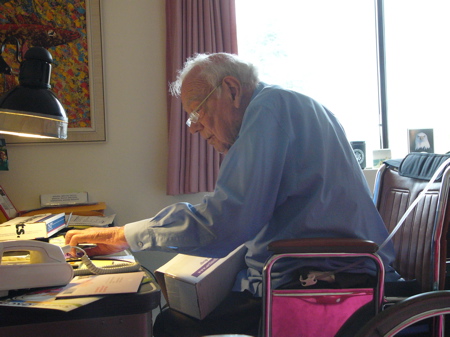
I have a photo of my Dad and me when I was only five or six months old. I am in my snow suit, with a big hat on my head. My dad has lifted me high on his right hand, high above his head, and I am oblivious to the danger, and out of my mind with delight – you know how babies are. I have a look on my face of delerious happiness. I am almost as high as the mountain in the background. I am – almost literally – on top of the world. My Dad is young and thin and strong. He was a great skiier in those days.
The second photo is of my Dad and my Mom, on a visit to Germany, only eight years ago. Dad was 80. They flew to Germany and rented a car to visit us, and to tour some of their old haunts from their own ten years of living in Heidelberg. He and Mom crawled up on the fountain at Deidesheim to stand behind the bronze costumes for a photo. Their faces are effused in smiles; they are still young in spirit if not in body, and having a wonderful time.
In recent years, my Dad was less and less able. His big project every week was to program the video recorder to record two tapes a week of prime time American television for my husband and I – we would watch it whenever we wanted and had time. He was known at the post office as the man who came in twice a week mailing these videotapes to us, and he loved it that he was so well known by the folks at the post office.
Dad died last night. He was 88. I’ll be going back for a short time. Dad, I know you’ve gone to a better place. Alhamdallah.
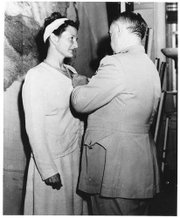
Virginia Hall: A Modest Heroine
The Good Shepherd, a new movie with Angelina Jolie, and Matt Damon, directed by Robert DeNiro (!), will open Friday, a story of the beginnings of the American intelligence services, the OSS and the CIA. I can hardly wait.
Earlier this week, there were some small news articles about Virginia Hall, who served her country risking her life time and time again, fighting the Nazis in the allied clandestine services, facing the possibility of torture and death if she were caught. Hall didn’t let anything hold her back. She believed that what she was doing was worth doing, and when WWII ended, she continued working quietly for the greater good. I would have loved to meet this woman. What a pistol!
Here is what Wikipedia has to say about her:
Virginia Hall MBE DSC (April 6, 1906 – July 14, 1982) was an American spy during World War II. She was also known by many aliases: “Marie Monin,” “Germaine,” “Diane,” and “Camille.”[1]
She was born in Baltimore, Maryland and attended the best schools and colleges, but wanted to finish her studies in Europe. With help from her parents, she traveled the Continent and studied in France, Germany, and Austria, finally landing an appointment as a Consular Service clerk at the American Embassy in Warsaw, Poland in 1931. Hall hoped to join the Foreign Service, but the loss of her lower leg was a terrible setback. Around 1932 she accidentally shot herself in the left leg when hunting in Turkey, it was later amputed from the knee down, which caused her a limp.[2]
The injury foreclosed whatever chance she might have had for a diplomatic career, and she resigned from the Department of State in 1939.
The coming of war that year found Hall in Paris. She joined the Ambulance Service before the fall of France and ended up in Vichy-controlled territory when the fighting stopped in the summer of 1940. Hall made her way to London and volunteered for Britain’s newly formed Special Operations Executive, which sent her back to Vichy in August 1941. She spent the next 15 months there, helping to coordinate the activities of the French Underground in Vichy and the occupied zone of France. When the Germans suddenly seized all of France in November 1942, Hall barely escaped to Spain.[3]
Journeying back to London (after working for SOE for a time in Madrid), in July 1943 she was quietly made a Member of the Order of the British Empire. The British had wanted to recognize her contribution with a higher honor but were afraid it might compromise her identity as she was then still active as an operative.
Virginia Hall joined the U.S. Office of Strategic Services (OSS) Special Operations Branch in March 1944 and asked to return to occupied France. She hardly needed training in clandestine work behind enemy lines, and OSS promptly granted her request and landed her from a British MTB in Brittany (her artificial leg kept her from parachuting in).
Code named “Diane,” she eluded the Gestapo and contacted the French Resistance in central France. She mapped drop zones for supplies and commandos from England, found safe houses, and linked up with a Jedburgh team after the Allied Forces landed at Normandy. Hall helped train three battalions of Resistance forces to wage guerrilla warfare against the Germans and kept up a stream of valuable reporting until Allied troops overtook her small band in September.
For her efforts in France, General William Joseph Donovan in September 1945 personally awarded Virginia Hall a Distinguished Service Cross — the only one awarded to a civilian woman in World War II. (emphasis mine)
In 1950, she married OSS agent Paul Goillot. In 1951, she joined the Central Intelligence Agency working as an intelligence analyst on French parliamentary affairs. She retired in 1966 to a farm in Barnesville, Maryland.
Virginia Hall Goillot died at the Shady Grove Adventist Hospital in Rockville, MD in 1982.
Her story was told in “The Wolves at the Door : The True Story of America’s Greatest Female Spy” by Judith L. Pearson (2005) The Lyons Press, ISBN 1-59228-762-X
She was honoured in 2006 again, at the French and British embassies for her courageous work.[4]
St. Nicklaus Day
In Germany, where we have lived, off and on, many years, December 6th is the day that St. Nicklaus comes, not Christmas. Saint Nicklaus, as opposed to Santa Clause, wears a long red robe with white trim, more like a coat, and it comes down past his knees. He often has a shepherd’s crook in one hand, and is sometimes pictured riding on a horse.

I got this wonderful print – one of many from The St. Nicholas Center where you can find many beautiful old postcards portraying the old European precursor to the modern Santa Claus.
Children put out their shoes, and hope that St. Nicholas will come by and fill them with candy, oranges, small goodies, and not with branches (to be used as switches) and coal, which are for bad children. Germans have such a sense of humor that you can also find branches with candies tied to them, and candies that are wrapped to look like coal. Kind of a mixed message, I guess.
The original St. Nicholas, so the legend goes, was a Bishop in Myra, then in Greece, now a part of Turkey near Demre. He threw bags of gold through the window of a poor family with three daughters, who would not marry without dowry. This is the bare bones of the St. Nicholas legend – I learned a lot more from the same site where I got the photo Who Is Saint Nicholas? You can learn so much more by clicking there. He is, to me, so much more lovable than Santa Claus, who commits house invasion on a grand scale once a year!
In the tiny village where we lived in Germany, I would get up early in the morning and put small cakes and candies on the doorsteps of the three women who were particularly good to me. Oh! The looks on their faces later when they spoke to me.
The grandmother would say “What? you think we are children, that St. Nicholas comes to us?” but you could see from the grin that it tickled her.
Aren’t we all still children, deep inside, thrilled when some unexpected blessing comes our way? Isn’t it always fun, child or not, to be surprised by something good?
We Never Saw it Coming
Tomorrow, November 9th, is a very special anniversary for me. The night of November 9, 1989, I was in a car with three other women, escaping from our cold-warrior duties. We were on our way to the border towns of West Germany for some shopping in the crystal factories. We really needed the get-away.

We had a drive of several hours, and on the way, we noticed the strangest thing – an unusually heavy numbers of cars coming FROM the border, and most of these cars were POS – old, slow, rusty, spewing black smoke, made of fiberglass – but full of people. The West Germans only drive new, shiny cars – where were these cars coming from?
We turned on the radio, and learned that the Czechoslovakian border had opened. When we got to our little gasthaus, we sat in the common room and watched, spellbound, as young people danced on the Berlin Wall. It was the most amazing, stunning sight you could imagine.
There were signs this was coming. No one seriously believed it really would happen, and happen so fast and so dramatically. The American government was pouring millions of dollars into Germany to renovate housing and offices and services, assuming the status quo would endure for the forseeable future, and American forces would be there a long long time. A mere fifteen years later, American presence had decreased dramatically, entire bases have closed, those renovated offices and houses turned back over to the Germans. Whoda thunk?
The reunification of Germany has been painful, continues painful. The integration of the former Soviet states into the European community moves at a snail’s pace, but it moves. It’s a new Europe, one currency, goods traded freely, young people from all countries free to move and work in other European countries. It’s an amazing new world.
The frustrations of getting the political system to work are mitigated by the occasional tipping point when the world changes in a heartbeat, and the people dance on the Wall.

Thanks to Wikipedia for sharing appropriate photos!
The Fraud Syndrome
When I finally got to graduate school, I was in shock. There was me, one other woman, and a classroom full of men. It might sound like heaven, but it was testosterone-city. We were studying national security affairs, a sub-group of International Relations, and most of my classmates were in different branches of the military.
My professor, a former military intelligence colonel, was knowledgable, and good at presenting his lessons. He was very professional, very businesslike. Not exactly cold, but neither was he collegial.
In any graduate courses, there is a whole new vocabulary to master. I felt like I had grabbed onto a train that was leaving the station; I was holding on for dear life. I read all my assignments, made sure I copies all my notes, and . . . never said a word in class for the first two weeks. I was too scared. All the guys were blah blah blah and I just hoped they wouldn’t figure out that I barely had a clue.
One of my fellow students came up to me on break. He was nice. He asked if I had seen a recent article in the paper on The Fraud Syndrome, and I said “no” that I hadn’t. He just happened to have a copy of it with him, which he gave to me.
Here is what Wikipedia has to say about the Fraud Syndrome:
The Impostor Syndrome, or Impostor Phenomenon, sometimes called Fraud Syndrome, is not an officially recognized psychological disorder, but has been the subject of a number of books and articles by psychologists and educators. Individuals experiencing this syndrome seem unable to internalize their accomplishments. Regardless of what level of success they may have achieved in their chosen field of work or study, or what external proof they may have of their competence, they remain convinced internally that they do not deserve the success they have achieved and are really frauds. Proofs of success are dismissed as luck, timing, or otherwise having deceived others into thinking they were more intelligent and competent than they believe themselves to be. This syndrome is thought to be particularly common among women, particularly women who are successful in careers typically associated with men, and among academics.
When time came to take our first test, I studied and studied. I knew I wasn’t getting any credit for participating in class, so I really needed a good grade on the test. I did my best. I hoped to pass.
When the professor gave us back our tests, he put the scale on the board. The lowest grade was a C-. I had passed! Even if I got the C-, I had passed! Then he started talking about all the mistakes, including one really bad one – a person who had used a quote, and the quote was not accurate.
My heart fell. I had quoted George Kennan on deterrence, quote marks and everything. I thought I had it word perfect, but I must have screwed it up. I was so embarrassed.
One paper, he said, had no red marks on it. He said he has never had a paper before on which he didn’t make a single correction, that this was a first in his history of teaching. I barely paid attention – I had passed, even if I blew the Kennan quote.
Yeh – the paper with NO red marks was mine. I thought there must have been some mistake, but the professor held me after class, and told me that for my next homework, he wanted me to speak up in class. And he congratulated me on the test. Only one guy guessed it was my paper with no corrections – the same guy who had told me about the fraud syndrome. Through our two years in grad school, we became good friends, and would share notes with one another if one of us had to be out of town on assignments.
It was October. I remember there was fog on the road, and a great big full round white moon glowing through the fog on my drive home. I had so much adreneline pumping through me that I howled “Wooooooooo Hoooooooooo!” at the moon that night.
Recent Comments
intlxpatr on Yellowstone: Old Faithful to C… Michelle on Yellowstone: Old Faithful to C… Cathy on No Grown-Ups in Charge intlxpatr on Waiting for Snow intlxpatr on Waiting for Snow Wikipedia Donate Button

Amazina


Early Voting in Florida


 Here There and Everywhere