Male on Male Sexual Abuse on Law and Order
AdventureMan teases me about my loyalty to the Law and Order Series . . . “Ripped from the headlines!” he will taunt me, when I flip the channel. We often watch separate TV’s when he wants to watch one of his droning military history channels and I want to watch Law and Order re-runs. But tonight’s L&O will tackle a topic no-one talks about – male on male rape and abuse.
I was so naive. I thought it only happened in prisons. While I was living in Qatar, I started hearing horrific stories about young men abducted and taken to the desert, often gang raped. Most of them lived, but had to deal with the aftermath of the violence and humiliation. In Kuwait, it was reported almost weekly in the papers, it was so common. I had a friend whose son was abducted, and walked with her through the horrors of the aftermath. Her greatest fear was that her son would commit suicide. He overcame his abduction, and is happy now, but the path was long, and full of perils along the way.
Male on male rape, like male on female rape, or any kind of rape, is not about sex. It’s about power. It’s about humiliation. It’s bullying taken to the extreme. It’s just wrong.
From AOL TV:
The second episode of ‘Law & Order: SVU’ Season 13 is one for the TV history books. Not only does it feature guest stars Dan Lauria, Mechad Brooks, Carmelo Anthony and Chris Bosh, but it’ll also tackle the taboo issue of male-on-male sexual violence.
In ‘Personal Fouls,’ a basketball coach known as a trusted mentor and figure in the community comes under suspicion of molesting a number of his players.
“This script was very exciting and I think the cast felt honored and excited to be able to talk about this issue because obviously sexual violence is something people are scared to talk about,” series star Mariska Hargitay said at a recent press event on the ‘SVU’ set.
Hargitay’s The Joyful Heart Foundation, Wolf Films, NBC, 1in6 and A Call to Men are partnering in an effort to raise awareness about male-on-male sexual abuse.
“It takes so much courage to come forward and male-on-male sexual violence is even more swept under the carpet,” she said. “The statistics are frightening.”
According to statistics from 1in6, an organization that seeks to help male sexual abuse survivors, 19 million men in the United States are victims of sexual abuse.
“It’s exciting to do a show about it because obviously when things are on TV somehow they’re made OK to talk about and that’s been exciting.”
The partnerships between the organizations hope to spread awareness about the subject. Hargitay said one of the objectives is to “let male survivors know they’re not alone and there are so many people that want to help them.”
“It’s not a shameful secret that you should keep to yourself, that the blame belongs with the perpetrator, not the survivor,” she said.
Naman: Cured or Pride?
Today’s Old Testament reading is from 2Kings. I like this story. Although it happened so long ago, it still applies to me today – do I want to be right or do I want to be cured?
2 Kings 5:1-19
5Naaman, commander of the army of the king of Aram, was a great man and in high favour with his master, because by him the Lord had given victory to Aram. The man, though a mighty warrior, suffered from leprosy.* 2Now the Arameans on one of their raids had taken a young girl captive from the land of Israel, and she served Naaman’s wife. 3She said to her mistress, ‘If only my lord were with the prophet who is in Samaria! He would cure him of his leprosy.’* 4So Naaman* went in and told his lord just what the girl from the land of Israel had said. 5And the king of Aram said, ‘Go then, and I will send along a letter to the king of Israel.’
He went, taking with him ten talents of silver, six thousand shekels of gold, and ten sets of garments. 6He brought the letter to the king of Israel, which read, ‘When this letter reaches you, know that I have sent to you my servant Naaman, that you may cure him of his leprosy.’* 7When the king of Israel read the letter, he tore his clothes and said, ‘Am I God, to give death or life, that this man sends word to me to cure a man of his leprosy?* Just look and see how he is trying to pick a quarrel with me.’
8 But when Elisha the man of God heard that the king of Israel had torn his clothes, he sent a message to the king, ‘Why have you torn your clothes? Let him come to me, that he may learn that there is a prophet in Israel.’ 9So Naaman came with his horses and chariots, and halted at the entrance of Elisha’s house. 10Elisha sent a messenger to him, saying, ‘Go, wash in the Jordan seven times, and your flesh shall be restored and you shall be clean.’
11But Naaman became angry and went away, saying, ‘I thought that for me he would surely come out, and stand and call on the name of the Lord his God, and would wave his hand over the spot, and cure the leprosy!* 12Are not Abana* and Pharpar, the rivers of Damascus, better than all the waters of Israel? Could I not wash in them, and be clean?’ He turned and went away in a rage. 13But his servants approached and said to him, ‘Father, if the prophet had commanded you to do something difficult, would you not have done it? How much more, when all he said to you was, “Wash, and be clean”?’ 14So he went down and immersed himself seven times in the Jordan, according to the word of the man of God; his flesh was restored like the flesh of a young boy, and he was clean.
15 Then he returned to the man of God, he and all his company; he came and stood before him and said, ‘Now I know that there is no God in all the earth except in Israel; please accept a present from your servant.’ 16But he said, ‘As the Lord lives, whom I serve, I will accept nothing!’ He urged him to accept, but he refused. 17Then Naaman said, ‘If not, please let two mule-loads of earth be given to your servant; for your servant will no longer offer burnt-offering or sacrifice to any god except the Lord. 18But may the Lord pardon your servant on one count: when my master goes into the house of Rimmon to worship there, leaning on my arm, and I bow down in the house of Rimmon, when I do bow down in the house of Rimmon, may the Lord pardon your servant on this one count.’ 19He said to him, ‘Go in peace.’
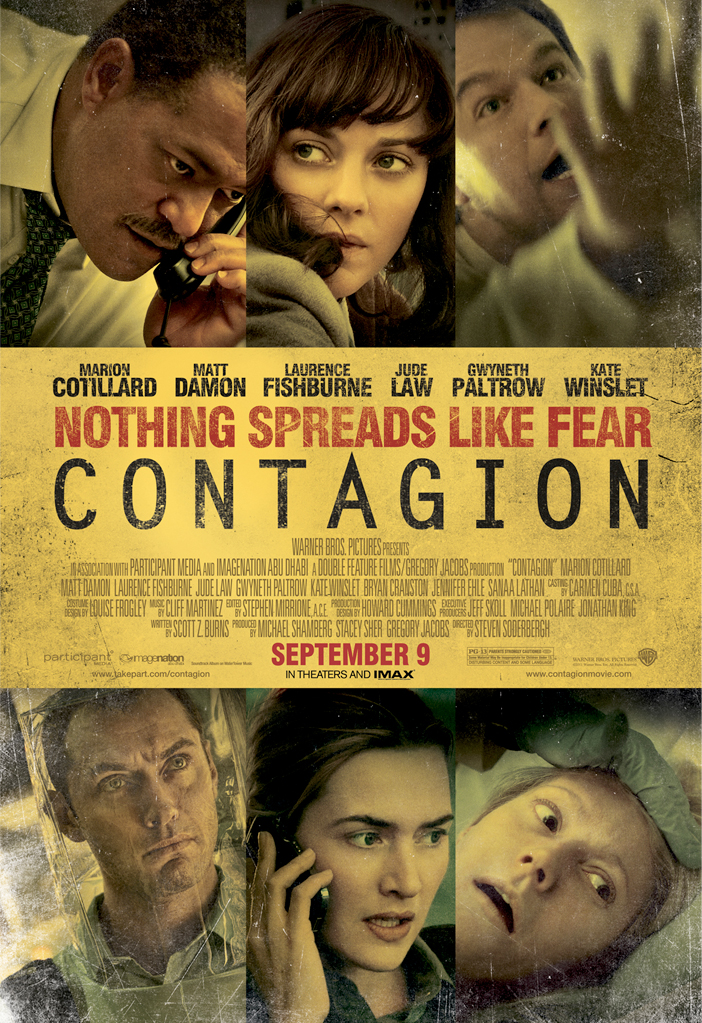
Contagion
As we rushed into the house, we both headed immediately to our bathrooms to wash our hands. Twice. And I also washed my face.
Contagion is a very intelligent movie. It is scary, but not in the Friday the 13th kind of scary, or in the Night of the Living Dead kind of scary, although come to think of it, there were some elements in common with the original Night of the Living Dead. No, what makes Contagion scary is that it could happen so easily.
I had no idea that we touch our faces, on the average, of three to five times a minute, more than 3,000 times a day, and that with every surface we touch, we transfer (germs) (bacteria) (things that could make you sick) close to an entry to your body, like your nostrils and your mouth. Once you start thinking about NOT touching your face, you become aware of how often you touch your own face, unaware. Like flipping hair out of your eyes, or covering your mouth when you laugh, or a million other things like that. You become aware of all the things you touch between the time you wash your hands and touch your food. You think about who may have touched your fork, and how well it was washed.
For me, the scariest part of the movie, beyond how quickly the virus mutated and spread, was how quickly civil society broke down when cities were quarantined, when people were concerned food was growing scarce, when people thought they had to fight for survival. The rules for avoiding spreading the virus were not to meet, not to touch, to stay apart. It’s hard to help one another when those rules are in play, but those rules make it easier for those without rules to attack and take what they can.
I liked the music in the movie, too, very edgy.
Before I ever saw this movie, I heard an interview with the author on NPR. She was saying that when they came to her wanting to make this movie, she said “it cannot start in Africa. . . (there were a whole bunch of rules, which were hilarious because they were like every plot for a movie like this ever made) I knew I needed to see this movie, to see how it could be done and still be dramatic, and follow her rules.
There is one hilarious quote. A blogger in this movie gains enormous following. As he is tracking down one of the scientists for information, the scientist says to him:
Blogging is not writing. It’s just graffiti with punctuation.
Excuse me, gotta go wash my hands again.
Jennifer Egan: A Visit From the Goon Squad

Amazon.com kept telling me I needed to read this book, so finally, I ordered it and waited a couple months before I was ready. I just finished a major project AND I caught a miserable cold, so what better time?
I loved this book. It had a lot going against it; you know irrational factors like how you feel when you have a cold and your sinuses are all stuffed up and your chest is tight? A Visit From the Goon Squad took me out of my misery. While it appears random, it is tightly plotted, and I loved seeing how different strands intertwined. I also loved the effects of the goon squad (no, I am not going to tell you anything specific) and I loved how technology drove differences in how different generations thought and acted.
The last act takes place in a future where (this makes total sense) there is a high value placed on “pure”, no tattoos, no swearing – it is truly hilarious, the lengths to which we will go to NOT be our parents. Babies have their own hand-helds, which is already happening. My eyes have been opened, watching our own 18 month old grandson working an iPad and iPhone. It’s amazing to me the aps that are created to entertain, divert and teach our little ones.
This is not a straight line book, so there are times I had to go back and read a section again to remind myself where I met this character before, and how he tied into the plot earlier. It is a fascinating creation, this book, and I would love to sit down for coffee with this author, and her outside-the-box kind of thinking.
Making My Doctor Happy
“You can cheat, you know,” my younger sister told me. “Just don’t eat meat for the week before your blood test.”
No, I didn’t know that! But I forgot, so I put off my appointment and blood test for another week, but I forgot again. Oh well. I took the test, cataloging all my mistakes (too much sugar, too much salt, too much meat, too much processed food) and went to my appointment with a sinking heart.
My doctor looked happy. He was kind of bouncing up and down with a big smile.
“Look at these readings!” he crowed! “We don’t often see turnarounds like this! Have you been exercising?”
“Yep! Three days a week!” I responded.
“Your blood pressure has dropped substantially.”
He is right. I am supposed to take it daily, and I’ve watched it fall back to where it was in my twenties.
“And your cholesterol dropped to 166! That’s 45 below your last reading!”
Holy cow! And I didn’t even cheat!
Even better, my triglycerides level has improved to optimal.
What surprises me is I haven’t had any side-effects, or not much. I had been concerned I would have a reaction, but I don’t feel any different, I don’t feel more health conscious or virtuous or like I’m being careful. It’s kind of amazing to me that small doses of medications can make such a difference.
I am switching my sources, however. The last refill I got (free) from the Navy Pharmacy disintegrated in the bottle. Maybe it’s the humidity in summer in Pensacola, but I ended up sort of estimating how much powder would equal a pill and licking it off my palm rather than go back there – again – and have to negotiate for a replacement. They make me feel like some kind of cheat or druggie when I ask to get a refill early because I am traveling. The last time, I had to show my airplane ticket to prove I was refilling early because I had to travel. (!) Is there a big black market for blood pressure medication???
I’m still dancing on air to have my readings come back so good . . . without cheating, LOL. 🙂
HIV Epidemic Emerging in Middle East and North Africa
Recently published on National Public Radio is a study showing that governments are quietly gathering statistics on the rising tide of HIV infections in the Middle East and North Africa, but they don’t want those statistics published:
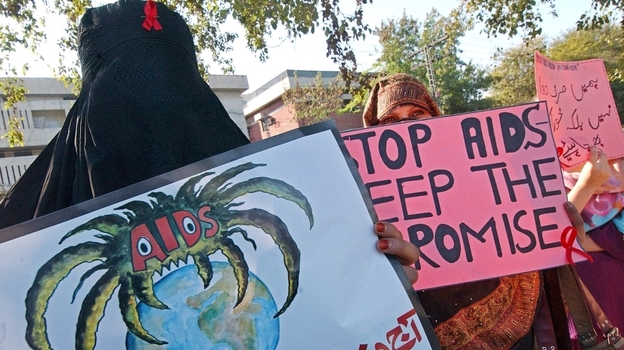
HIV epidemics are emerging among men who have sex with men in the Middle East and North Africa, researchers say. It’s a region where HIV/AIDS isn’t well understood, or studied.
More than 5 percent of men who have sex with men are infected by HIV in countries including Egypt, Iran, Lebanon, Morocco, Sudan and Tunisia, according to a recent study in PLoS Medicine. In one group of men in Pakistan, the rate of infection was about 28 percent. (For reference, in 2008, rates of HIV infection among men who have sex with men in the U.S. ranged from 16 percent among white men up to 28 percent of black men, according to the CDC.)
Risky behavior, low condom use, injectable drug use and male sex workers are some of the factors that could cause HIV rates to rise in the region, the researchers say. On average, the men who have sex with men group had between four and 14 sexual partners within the past six months, with consistent condom use falling below 25 percent.
Lack of HIV surveillance and low access to treatment and prevention are a concern for researchers, who believe the window of opportunity to prevent the epidemic from spreading across the region is growing smaller.
Shots had a chance to speak with one of the study’s authors, Dr. Laith Abu-Raddad, assistant professor of public health at the Weill Cornell Medical College in Qatar, to discuss the challenges of researching such a taboo topic.
What made you decide to pursue this study?
There are some political and community leaders who believe that our region is not affected by the epidemic. While others, such as HIV activists, believe that men having sex with men behavior is hidden, so HIV data must be hidden. They have called it the “HIV epidemic behind the veil.” It occurred to me that these are very contrasting views, and the truth must be out there somewhere.
I started this work eight years ago, to get every piece of evidence that we have on HIV. Turns out that there are more data than we think. The regions are not hiding the data, it’s just a sensitive issue. These issues aren’t discussed like in the western media. But it doesn’t mean that the government isn’t dealing with it. Governments do have programs such as active non-government organizations, NGOs, working with groups that are infected.
What surprised you about the findings?
Certain countries did surprise us with the work they’ve done. In Iran, they target the population of drug users. When Iran discovered HIV among drug users, they created programs that offered drug users access to treatment, and gave them free clean needles and syringes.
Many governments don’t want to provide HIV treatment or counseling directly. They support NGOs financially and logistically to help treat communities affected. It’s a way for them to protect people without raising sensitive issues of sexual and drug use behaviors that are often controversial.
What challenges did you face while gathering evidence?
There were some governments that gave us their data on the condition that we didn’t publish it. They want to deal with this issue, but they see no reason to raise it to the public. There were governments who did not want to release data. I can’t tell you which countries, since we have long-standing relationships with them. But we managed to convince some of them that the data would be used purely for scientific research and not used against them by the media.
What do you hope to accomplish from this study?
To raise awareness among policy makers. Hopefully, governments will make changes to policy. Surprisingly, the No. 1 barrier is poor research capacity in this region. If we don’t have the scientific data, we can’t have effective policy. We need to have an effective surveillance program, so we can help prevent further HIV transmission.
This part of the world is seen as not addressing the epidemic. Countries like Iran, Morocco and Egypt are developing programs and working with NGOs. But other countries haven’t yet improved their services to the public. But we hope they will.
“We Have Lost Our Moral Compass”
There is something I need to confess, as I print my friend Amer’s most recent editorial from the Arab Times in Kuwait.
Amer is writing about the great loss of civility in Kuwait, a country where trade routes crossed, merchants ruled and differences were tolerated. While I lived in Kuwait, I was horrified at the flaunting of traffic rules and the reckless endangerment of the population because some people believed the laws did not apply to them.
Amer, with a few differences specific to Islam, your editorial, sadly, could be equally well applied many places in the United States today, where some people believe they should not have to patiently stand in line, or obey the traffic rules, or protect the quality of the food supplies or water sources that provide for the communities.
When we fail to restrain ourselves and our selfish greediness, we harm others – but we also harm ourselves. We damage the fabric of society that protects us from the chaos of anarchy. Well said, Amer.
We Have Lost Our Moral Compass
EVERY Ramadan we are inundated by articles and features highlighting the proper means of fasting, alms-giving, praying and other essential pillars of Islam. I am not going to do that.
Most citizens are decent, God-fearing individuals trying to improve their lot and the lives of their loved ones. I believe the Kuwaiti character in essence is one of integrity and generosity — we are a charitable people, evident by the Ramadan dinners we sponsor and the alms we pay (Zakat) — indeed we are almost always the first to rush in aid of others, local or internationally. We should be proud of this trait.
We are, however, far from perfect. Praying, fasting and spending alms on the needful are not enough to qualify us or other societies as superior Muslims.
Our Prophet (Peace Be Upon Him) stated, ‘The best amongst you are those who have the best manners and character.’
Recently, we have all been witness to a drastic deterioration in the way people treat one another and conduct their lives — a certain segment lack the proper traits, either due to absence of decent rearing, non-implementation of laws (which they view as ‘toothless’) or the gradual radicalism in society which encourages gender segregation, intolerance of foreigners and non-Islamic ideals and views.
Our society seems to have lost its moral compass; gaze around you, materialism and power is valued over integrity and honesty; harshness in tone is embraced, over humility and etiquette. An individual’s caliber is immaterial; what matters is how one can ‘benefit’ another, the extent of personal influence and how many laws one can break with impunity.
On the behavioral level, this is evident all around us, nothing is respected; people don’t wait their turn, they drive erratically, they walk into elevators without waiting for others to exit, they are rude to foreign workers, they disturb women in malls and public places, they cause a ruckus in movie theatres, road and traffic signs are ignored, municipality laws are ignored, smoking signs are ignored. The list goes on…
This personal methodology is poisoning society — we are all victims of and responsible for this collective, ethical Achilles’ heel.
Follow the law, pay your bills on time, stand in a queue, follow road signs and you’re regarded as a dimwit.
These days you get a taste of good manners when you travel to countries like the United States and the European Union where parents educate their children ‘not to point at others’, ‘scream’ and wait patiently for their turn in a queue, saying ‘please’ and ‘thank you.’
Even progressive GCC states such as the UAE — eager to attract foreigners and investment — do not tolerate any law breaking: speeding tickets affect the validity of your car license and insurance premiums; if unruly youths disturb or sexually harass women in public, security arrests them, shaves their heads, splashes their mugs in the papers, for example. People think twice before embarking on any moves which might offend the personal space or respect of others.
It’s the atmosphere of tolerance, openness and the implementation of laws that truly make an Islamic society, not the number of mosques built or how many foreigners converted to Islam. Where is Islam if society deems Expired Food Merchants and MPs and their ‘state benefactors’ — who dabble in tens of millions of corrupt money — for example, as ‘untouchables’?
People’s behavior forces one to ditch the law because the law is not really on one’s side, it’s not really being enforced — it’s an illusion. Additionally, we need to start embarking on ‘naming and shaming’ lawbreakers and criminals instead of shielding their identities from the public, who have a right to know.
The state apparatus — traditionally infatuated with forming committees, hosting seminars and running bloated campaigns — needs to execute them properly, namely by implementing a two-track initiative: On the one hand formulating an awareness campaign on ‘Islamic Moderation And Tolerance’ by highlighting the work of groundbreaking pioneers and world-renowned Moderate Islamic voices such as our very own Dr Naif Al-Mutawa (creator of the comic book series ‘The 99’) and Dr Reza Aslan, author of ‘No God But God,’ among other accomplished intellectual luminaries — so that younger generations may be able to benefit from their stimulating, refreshing views. Simultaneously, on the other track enforcing Civic and Constitutional Laws preaching freedom of speech, equality and appropriate justice — so individuals may learn to respect state laws and tolerate differing views – they need to realize grave repercussions are incoming, leading to imprisonment or worse, if they indulge in any lawbreaking or negative antisocial behavior. Ultimately, the State needs to step up to the plate and protect society, lest individuals take the law into their own hands and mob rule surfaces.
Islam without proper laws, justice for all and proper education is abridged, toothless — as a society we need to instill the values amongst ourselves and future generations, not just censure ‘external influences,’ the media or the West for our ills (many which are self created). Moreover, we need as a community to re-examine the way we conduct ourselves and treat others — to realize that no good can come from a society that obliquely persuades fraud, dishonesty and ill-treatment of others.
By: Amer Al-Hilal
Culture of Honor Shortens Lives
As I read this article, I thought about life growing up in a small town in Alaska, and how similar it was to life in Qatar and Kuwait, where you live all your life in one community and reputations, once ruined, are never lived down.
HealthDay News
For Men, ‘Culture of Honor’ Can Be Deadly
Mindset spurs risky behaviors and is most prevalent in U.S. South and West, study shows.
By Kathleen Doheny, HealthDay News
MONDAY, Aug. 15 (HealthDay News) — Psychologists call it the “culture of honor,” a mostly male mindset that places a high value on defending one’s reputation at any cost. But new research confirms that it’s linked with high rates of accidental deaths.
“People who embrace these values also report more risk-taking,” explained study author Dr. Ryan Brown, an associate professor of psychology at the University of Oklahoma, in Norman.
This dangerous male mindset is also more prevalent among those living in the South and West, in such states as South Carolina, Texas and Wyoming, he added.
In two studies published in the current issue of the journal Social Psychological and Personality Science, Brown looked at the consequences of such thinking.
First, he compared rates of accidental deaths (car accidents, drowning, over-exertion and so on) in all U.S. states. He found the so-called “honor states” had higher rates than non-honor states (such as New York, Ohio, Wisconsin).
More than 7,000 deaths a year can be blamed on risk-taking linked with the “culture of honor,” he said.
The behavior was most common in more rural areas of the honor states, he found. In the cities of honor states, he found a 14 percent higher accidental death rate than in the cities of non-honor states. He found a 19 percent higher rate in the smaller towns of honor states compared to non-honor states.
“In a smaller town, your reputation is much more important,” he said. It’s likely that everyone knows your business, and that could be good or bad for your reputation, he explained.
In a second study, Brown surveyed 103 college students from his university, including 79 women.
The participants completed tests measuring how much they subscribed to the culture of honor, finished a self-esteem test and answered questions about their tendencies toward risk-taking behavior. A sample statement to which they agreed or not was: “A real man doesn’t let other people push him around.”
The more the person subscribed to a culture of honor, the more likely they were to engage in risky behaviors, the findings showed.
The effect was there for women, too, Brown said.
He and others have previously noted that this culture of honor originated with the Ulster Scots (mistakenly sometimes called the Scotch-Irish) who came to the United States during the 18th century.
In their homeland, he said, they were herders and were always being invaded by someone. They learned to protect and defend themselves, not always in ideal ways. A typical statement, Brown noted: “You take one of our cows, we will take your whole herd.”
The culture of honor behavior persists, he said, despite the disappearance of the herds.
It has staying power, Brown added, and is fostered through norms and values about masculinity and femininity. It’s the stuff of country songs, he explained.
That makes sense to Richard Nisbett, the Theodore M. Newcomb Distinguished Professor of Psychology at the University of Michigan. He is the author of Culture of Honor: The Psychology of Violence in the South.
In the past, Nisbett explained, “if you kept animals for a living, you ran the risk of having your entire livelihood taken away [if someone opens the pasture gate, for instance].”
In modern times, “if you stand the risk of losing your livelihood easily and the state is not around to protect you, you are going to develop this kind of culture of honor,” Nisbett said.
There’s more to it than showing off for women, although that is part of it, he added. It is also, for a man, showing other guys your toughness.
While Brown’s research and that of others clearly shows that some states aren’t honor states, Nisbett said that the behavior is kept going partly by the false belief that everyone else subscribes to the same mindset.
“We tend to think of the culture of honor as historical,” said Joe Vandello, an associate professor of psychology at the University of South Florida. But, “elements of this culture of honor still exist today.”
Simply becoming aware of the phenomenon might help reduce the behavior, Brown noted. Even though it can become “part of your programming,” he said, “we have a will, we have a choice.”
Learn more in the Everyday Health Emotional Health Center.
The Sandpiper
Thank you, KitKat, for sending me this great story to share with my readers:
The Sandpiper
by Robert Peterson
She was six years old when I first met her on the beach near where I live.
I drive to this beach, a distance of three or four miles, whenever the world begins to close in on me. She was building a sand castle or something and looked up, her eyes as blue as the sea.
“Hello,” she said.
I answered with a nod, not really in the mood to bother with a small child.
“I’m building,” she said.
“I see that. What is it?” I asked, not really caring.
“Oh, I don’t know, I just like the feel of sand.”
That sounds good, I thought, and slipped off my shoes.
A sandpiper glided by.
“That’s a joy,” the child said.
“It’s a what?”
“It’s a joy. My mama says sandpipers come to bring us joy.”
The bird went gliding down the beach. Good-bye joy, I muttered to myself, hello pain, and turned to walk on. I was depressed, my life seemed completely out of balance.
“What’s your name?” She wouldn’t give up.
“Robert,” I answered. “I’m Robert Peterson.”
“Mine’s Wendy… I’m six.”
“Hi, Wendy.”
She giggled. “You’re funny,” she said.
In spite of my gloom, I laughed too and walked on.
Her musical giggle followed me.
“Come again, Mr.. P,” she called. “We’ll have another happy day.”
The next few days consisted of a group of unruly Boy Scouts, PTA meetings, and an ailing mother. The sun was shining one morning as I took my hands out of the dishwater. I need a sandpiper, I said to myself, gathering up my coat.
The ever-changing balm of the seashore awaited me.. The breeze was chilly but I strode along, trying to recapture the serenity I needed.
“Hello, Mr. P,” she said. “Do you want to play?”
“What did you have in mind?” I asked, with a twinge of annoyance.
“I don’t know. You say.”
“How about charades?” I asked sarcastically.
The tinkling laughter burst forth again. “I don’t know what that is.”
“Then let’s just walk.”
Looking at her, I noticed the delicate fairness of her face.
“Where do you live?” I asked.
“Over there.” She pointed toward a row of summer cottages.
Strange, I thought, in winter.
“Where do you go to school?”
“I don’t go to school. Mommy says we’re on vacation”
She chattered little girl talk as we strolled up the beach, but my mind was on other things. When I left for home, Wendy said it had been a happy day. Feeling surprisingly better, I smiled at her and agreed.
Three weeks later, I rushed to my beach in a state of near panic. I was in no mood to even greet Wendy. I thought I saw her mother on the porch and felt like demanding she keep her child at home.
“Look, if you don’t mind,” I said crossly when Wendy caught up with me, “I’d rather be alone today.” She seemed unusually pale and out of breath.
“Why?” she asked.
I turned to her and shouted, “Because my mother died!” and thought, My God, why was I saying this to a little child?
“Oh,” she said quietly, “then this is a bad day.”
“Yes,” I said, “and yesterday and the day before and — oh, go away!”
“Did it hurt?” she inquired.
“Did what hurt?” I was exasperated with her, with myself.
“When she died?”
“Of course it hurt!” I snapped, misunderstanding,
wrapped up in myself. I strode off.
A month or so after that, when I next went to the beach, she wasn’t there. Feeling guilty, ashamed, and admitting to myself I missed her, I went up to the cottage after my walk and knocked at the door. A drawn looking young woman with honey-colored hair opened the door.
“Hello,” I said, “I’m Robert Peterson. I missed your little girl today and wondered where she was.”
“Oh yes, Mr. Peterson, please come in. Wendy spoke of you so much. I’m afraid I allowed her to bother you. If she was a nuisance, please, accept my apologies.”
“Not at all! she’s a delightful child.” I said, suddenly realizing
that I meant what I had just said.
“Wendy died last week, Mr. Peterson. She had leukemia
Maybe she didn’t tell you.”
Struck dumb, I groped for a chair. I had to catch my breath.
“She loved this beach, so when she asked to come, we couldn’t say no. She seemed so much better here and had a lot of what she called happy days. But the last few weeks, she declined rapidly…” Her voice faltered, “She left something for you, if only I can find it. Could you wait a moment while I look?”
I nodded stupidly, my mind racing for something to say to this lovely young woman. She handed me a smeared envelope with “MR. P” printed in bold childish letters.. Inside was a drawing in bright crayon hues — a yellow beach, a blue sea, and a brown bird. Underneath was carefully printed:
A SANDPIPER TO BRING YOU JOY.
Tears welled up in my eyes, and a heart that had almost forgotten to love opened wide. I took Wendy’s mother in my arms. “I’m so sorry, I’m so sorry, I’m so sorry,” I uttered over and over, and we wept together. The precious little picture is framed now and hangs in my study. Six words — one for each year of her life — that speak to me of harmony, courage, and undemanding love.
A gift from a child with sea blue eyes and hair the color of sand
— who taught me the gift of love.
NOTE: This is a true story sent out by Robert Peterson. It happened over 20 years ago and the incident changed his life forever. It serves as a reminder to all of us that we need to take time to enjoy living and life and each other. The price of hating other human beings is loving oneself less.
Life is so complicated, the hustle and bustle of everyday traumas can make us lose focus about what is truly important
or what is only a momentary setback or crisis..
This week, be sure to give your loved ones an extra hug, and by all means, take a moment… even if it is only ten seconds, to stop and smell the roses.
This comes from someone’s heart, and is read by many
and now I share it with you..
;
May God Bless everyone who receives this! There are NO coincidences!
Everything that happens to us happens for a reason. Never brush aside anyone as insignificant. Who knows what they can teach us?
I wish for you, a sandpiper.
Lightning Strikes
It’s thunderstorm time in Pensacola, and what surprises me is how the sky can look relatively clear and blue, and then a big bolt of lightning strikes.
This is from today’s Bottom Line Health News:

WHEN LIGHTNING STRIKES
The weather outside is frightful, inside it’s so delightful… it’s awfully early in the year to sing this song, but it’s what came to mind as I was researching this story on a particular hazard of summertime weather — lightning. It’s far more “frightful” than snow or ice — lightning can kill you instantly. While some of us may already know exactly what to do when there’s lightning around, it’s remarkable how many people don’t know or simple don’t take lightning seriously enough. I decided to seek out the latest information on staying safe.
A BOLT FROM THE BLUE
In the summer months, lightning is predictably unpredictable — there’s lots of it and you don’t always see it coming. You’ve heard the term “a bolt from the blue”… it derives from the fact that lightning has been known to light up a bright blue sky (though not so often as a dark and stormy one), and it can travel as far as 10 miles, not only vertically but horizontally as well. Hot summer weather raises the likelihood of thunderstorms, which always bring lightning (whether you see it or not).
According to the National Weather Service, lightning strikes ground some 25 million times a year here in the US, hitting an estimated 400 people and killing about 40, who typically die from severe burns, cardiac arrest and/or respiratory arrest. While 90% of those who have been hit by lightning survive, they often suffer serious side effects that can include paralysis, internal and external burns, deafness, ringing in ears, amnesia and/or confusion, personality change, depression, sleep disturbances, memory dysfunction, headache, fatigue, joint stiffness and muscle spasms.
To learn how to stay safe and what to do if you’re ever with someone struck by lightning, I consulted our contributing medical editor Richard O’Brien, MD, an emergency physician in Scranton, Pennsylvania, who told me he sees lightning victims every summer.
While everyone seems to understand that lightning is dangerous, many are unclear on what they need to do to protect themselves. So, one by one, we went through the facts that are most important to know…
ARE YOU GROUNDED?
The most important thing to understand about lightning, said Dr. O’Brien, is that it wants to find a way to get into the earth — it’s called “grounding.” The human body, water and metal all are excellent conductors of electricity and will get it to ground very effectively. Rubber, concrete and wood, on the other hand, are protective.
“When thunder roars, go indoors.” This is the catchy phrase that the National Weather Service uses to educate people on the most important thing you can do to stay safe from lightning — get out of its way. Get inside a safe building (one that is fully enclosed with a roof, walls, electricity and plumbing) or seek shelter in a car with a metal roof and the windows up (not a convertible, even with the roof up). “There is no such thing as being safe outdoors in a thunderstorm,” said Dr. O’Brien. Even if you are inside, remember that lightning has been known to strike through glass. Stay as far away as possible from windows and skylights. Lightning also has been known to strike through electrical outlets. If it hits an outside wire (phone/cable/electric), it can conduct into the jacks in the house, Dr. O’Brien explains.
Stay dry and disconnected. You can use a cell or cordless phone safely during a thunderstorm as long as the handset is not plugged in or attached to the base. Note that by using a cordless phone you still risk drawing an electrical surge to the base and destroying it. Under no circumstances should you talk on a landline. Any electrical device, handheld or otherwise including an electric stove, is a magnet for lightning, especially when it is using power. Stay out of the shower or bath and don’t use the sinks. “Lightning can come through the plumbing,” notes Dr. O’Brien. “If it hits the house, it looks for ground (your metal pipes) and if you’re in the shower, naked and wet, you’ve had it.” If you must go outdoors, remember there is no such thing as safe phone use — even a cell or cordless.
Be patient. Wait to go outdoors until you’ve heard no thunder for 30 minutes.
IF LIGHTNING STRIKES …
If you or someone near to you is struck by lightning, get help immediately. Call 9-1-1 (from a safe location if there is one!). If the person is unconscious and without a pulse, perform CPR. The 911 operator can help with advice as well. As a quick guide to CPR, the American Heart Association says to use both hands and push on the chest “hard and fast” to the tempo of the old Bee Gees song Stayin’ Alive.
There’s no need to fear being electrocuted yourself if you touch a person who has been struck by lightning, said Dr. O’Brien — but you do need to protect yourself from another bolt of lightning. Take whatever measures you can to get yourself and the victim out of danger as fast as possible.
During these summer months, it’s important to be aware that lightning is a clear and present danger — take it seriously!
Source(s):
Richard O’Brien, MD, attending emergency physician at Moses Taylor Hospital, and associate professor of emergency medicine at The Commonwealth Medical College of Pennsylvania, both in Scranton.
Recent Comments
ExpatAlien on What Country am I Living … intlxpatr on Yellowstone: Old Faithful to C… Michelle on Yellowstone: Old Faithful to C… Cathy on No Grown-Ups in Charge intlxpatr on Waiting for Snow Wikipedia Donate Button

Amazina


Early Voting in Florida


 Here There and Everywhere