Cold Virus Hotspots
This is from BBC Health News:
Warning over cold virus hotspots
TV remote controls, bathroom taps and refrigerator doors are hotspots for the common cold virus, experts have warned.
Researchers at the University of Virginia swabbed these common household surfaces in 30 homes and found traces of rhinovirus 42% of the time.
While coughs and sneezes do spread the disease, everyday objects in the home are another important source and should be cleaner regularly, they say.
Each week in winter, a fifth of the UK population suffers from a cold.
As the virus can survive on household surfaces for up to two days, a single family member or visitor can spread the virus to other members through touching such things as door handles and taps, the researchers told a US infectious diseases conference.
Infectious rhinovirus was detected on almost a quarter of subjects’ fingertips one hour after touching household surfaces contaminated with the virus.
And genetic material from the virus was still transferred to the finger tips of more than half of the 30 people studied 48 hours after the surfaces were contaminated.
Lead researcher Dr Birgit Winther said the public needed to be aware of this route of transmission.
“Some people still spray the air with disinfectants, but rhinovirus doesn’t fly through the air. I think that the message from this research is that we need to focus more wisely on cleaning commonly touched surfaces in the home.”
Professor John Oxford, virologist at St Bartholemew’s and the Royal London Hospital and chair of the UK Hygiene Council, said: “The cold virus is a hardy one because it survives on surfaces for so long and can then be passed on, putting the whole family at risk of infection. Home hygiene is key in the fight against colds.
“Recent government recommendations mean that doctors can no longer prescribe antibiotics to alleviate colds – so it’s vital that families target these key surfaces in the home to protect themselves from colds this winter.”
Warning Triangles, Flares, and Traffic Control
There was another accident outside my house last night, and I almost didn’t even call the police, but then . . . I did. I thought “It’s useless to call.” And then I thought “But at lease it’s SOMETHING I can do to help.” I am guessing people would have thought I was crazy if I had gone out and started trying to direct traffic (LOL; isn’t that a funny thought?) This time the polite man on duty took all my information and the police didn’t call back. A road warrior (traffic police) arrived nearly an hour later, but with the slick roads in my area, I can imagine they were very busy, and there didn’t appear to be any injuries to people, only to cars.
What is scary to me is how easy it would be for another car to come plowing into the accident. It’s night, it’s dark, people are in a hurry to get home and they have their route down pat, so they are on automatic pilot. Most of the time, they go past at a fairly fast speed.
Aren’t people required to carry warning triangles and flares here? Even just setting up a warning triangle a hundred feet back would have helped last night. A flare would have gotten attention and slowed traffic. People directing traffic around the accident would have helped. For an hour, those involved in the accident just stood around, so vulnerable. It’s a small thing, but it might help, in Kuwait, where even these very basic precautions are ignored.
New Buses, Mixed Blessing
As many of you may remember, I am a supporter of public transportation. I would SO much rather have the time to read a book or magazine than to be stuck in traffic. When I saw the bright, modern, fast new buses hit the streets recently in Kuwait – during the last year – instead of the clunky slow, old buses they had, my heart rejoiced.
Hmm. Not so fast.
I drive on a major local road regularly. The buses have become a menace. They drive way fast. They halt, and then merge back into traffic as if they have the right of way, which as we all know, in Kuwait there is no right of way. I guess they figure that because they are big, and faster, they are king of the road. I can tell you for a fact, they don’t like being passed by a woman. Imagine, being chased down by a bus!
Buses cause accidents on Sixth Ring Road
KUWAIT: Sixth Ring Road was the scene of two accidents caused by public buses.
A man driving a small car suffered serious injuries when he hit a public bus after the bus driver lost control of his vehicle and hit the barrier and then stopped at the middle of the road. The man was taken to the hospital by a fellow citizen to seek medical assistance.
Ten minutes later, another bus driver repeated the same scenario of the first accident except as he hit the barrier he also hit a small car. The car driver suffered serious injuries and was taken to hospital to seek medical assistance. The two buses caused serious traffic congestion but police officers managed to move them to the side of the road and continue the traffic flow.
I don’t know what training the drivers receive before they head out in their buses. I have a suspicion that it isn’t much. I think they need to be trained in safe driving practices, and warned against aggression on the roads. I think they need to use their rear view mirrors, their signals, and they need to be an example of proper driving, because they are a visible, public model of state policy.
Interesting Twist on Hijab
From today’s Al Watan:
”Policewomen must comply with Islamic attire”
Al Watan staff
KUWAIT: In reaction to a statement by the Director General of Sheikh Saad AlـAbdullah Academy on policewomen”s uniforms, MP Mohammed Hayef noted that the current uniform requirements for female police contravene with the spirit of Islamic law as well as the Constitution, which guarantees personal freedom.
According to him, the announced uniform will ban policewomen for wearing a veil, even if they chose to do so.
The lawmaker reiterated his resolve to stand against the uniform to ensure that Islamic law is observed.
He also criticized the period during which policewomen will undergo training, arguing that 12 hours is too long for the female conscripts, considering their physical abilities.
Describing the training period as similar to hard labor, he called on the relevant authorities to reconsider their decision on this particular matter.
Last updated on Tuesday 28/10/2008
What do you think? I think that there are ways of covering your hair that are not inconsistent with being a policewoman. If the uniform forbids hijab, in my mind, that is as bad as the parliament requiring hijab, for the same reason – wearing hijab or not wearing hijab is a personal decision between a woman and her God. It is not to be mandated by state or mankind. Instead of getting into a big fracas about it, why not have a fashion-design contest to design a professional headgear that a covered woman could CHOOSE to wear as part of her uniform?
As to the 12 hours – well LLLLOOOLLLL! How many hours of hard labor per day do women put in with taking care of children, cleaning, shopping and meal preparation, not to mention family obligations? Working a 12 hour day training to be a policewoman? Piece of cake!
Women in all parts of the world are working as soldiers, police, fire protection, etc. They train as hard as the men, and they get the job done. Think of the female doctors in Kuwait, and the hours they work! Think of their sacrifice! Our estrogen issues are no more diverting and/or debilitating than male testosterone issues!
(thank you, thank you, I’ll get off my soapbox now)
An Insult – and 3 Dead Kuwaitis
From today’s Arab Times. How many hearts are breaking in Kuwait over one young man’s lack of self-control? I know, I know, this is Kuwait, and things are different. Because of an insult, three brothers are dead, and one in intensive care. Two families devastated, one with dead sons, one with a son who is a murderer. Three crashed vehicles, one from an innocent man who only stopped to see if he could help, and ended up with his car stolen and crashed, too. . . the whole thing is tragedy, from beginning to end.
Three brothers dead: Three Kuwaiti brothers in the age group of 25-30 years died in a road rage accident in Mina Abdullah while their fourth brother is currently confined to the intensive care unit of Adan Hospital, reports Al-Anba daily.
According to a security source, a Kuwaiti youth’s car broke down on King Fahd Expressway. The youth reportedly called his father to inform about the breakdown and told that four Kuwaiti youngsters had insulted him. When his father went to help the youth, the latter took his father’s vehicle, drove at full speed and crashed into the Jeep of the four brothers. The Jeep overturned due to the impact and one of the brothers died on the spot. Two others died in Adan Hospital and the fourth one is confined to the intensive care unit.
Meanwhile, the youth, who appeared disoriented, left his father’s car at the site of the accident and drove away with an Asian’s car who stopped to check what happened. He was eventually arrested after crashing into another car.
How does the law work in a case like this?
It says the young man was arrested. Is he still in jail? Can you get bail after killing three people in an act of rage?
Is his driving license taken away?
is an insult considered justification for a crime of rage?
Does he go to prison, or if he pays blood money, does he walk away free?
If he is convicted of murder, what is the likely sentence?
Will he also go on trial for stealing the Asian’s car and crashing it?
Not a legal question:
Does this cause an unending feud between two families? Or is this just another chapter in an already ongoing feud?
How many drivers am I sharing the road with who have killed?
Barely There Sunrise
This morning, I was up, looking out my window-on-the-world, hanging on to my coffee for dear live at 0600 in the morning, Qatteri Cat was with me, purring and making those little kitten noises that mean “Hiya, Mom, any chance you’ll pour me some fresh cat food?” and I have my camera . . . but there is no sunrise. There is light, but whatever is hanging over Kuwait is SO thick that the sun can’t break through, not for half an hour after sunrise.
This is what it looks like when you can finally see the sun:

What is really scary – we are BREATHING that stuff!
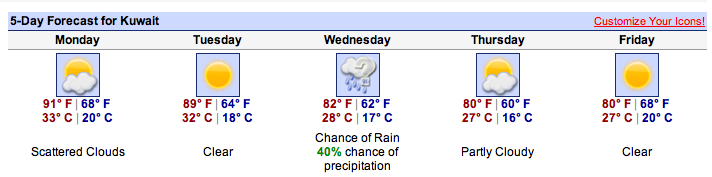
It is 72°F / 22°C at 0700 (Wooo Hoooo!) and althought it doesn’t feel so humid today, we have the possibility of rain later on this week. And look at those temperatures! Get out the long underwear!
Indian Drivers the Worst
When it came time to get a driver’s license, it wasn’t important to me. I was living in a place with great public transportation. When I finally decided to learn to drive, I took driving lessons. My best friend, still my friend to this very day, would take me out driving. One time my car stalled in the middle of a crowded intersection, the light changed, and I was almost out of my mind with panic.
My friend calmly said “You’re doing just fine. Take a breath. You have time. Start the car, and complete the turn.” She didn’t sound worried at all – only later did I discover how terrified she was. She held it together. I will owe her to the end of my life for her loyalty to me and for her patience with me.
This is from the Arab Times. My mistake – I thought Kuwait was the deadliest spot on earth to drive. Not so – the Indians take that cake:
Good luck needed as Indians drive themselves to death
MUMBAI, Oct 23, 2008 (AFP) – The Good Luck Motor Training School in Mumbai is aptly named, according to its owner, Sohail ‘Raja’ Kappadia, who says luck is exactly what you need to drive on India’s roads.
Kappadia knows it only too well: a friend recently became another of the country’s shocking fatal road accident statistics, while one of his pupils has just rammed into the back of another car during a lesson.
‘Sometimes you just don’t know if the guy in front is going to brake,’ he told AFP with a shrug. ‘Presence of mind is a must here. Most of the accidents in Mumbai are due to rash negligence.’
India has the dubious distinction of being the deadliest place in the world to drive.
The country has 10 percent of the estimated 1.2 million road deaths worldwide, according to the International Road Federation in Geneva.
Mortality rates on Indian roads are 14 per 10,000 vehicles, compared to less than two per 10,000 in developed countries, the World Bank has said.
And by the end of the next decade, the organisation predicted that road deaths will overtake those from deadly diseases and most of the fatalities will be pedestrians.
It is not difficult to see why.
Drivers here run the gauntlet of speeding taxis, weaving auto-rickshaws, trucks and buses as well as hand-carts and cows on congested, pot-holed roads, some of which have remained largely unchanged since the end of the colonial era more than 60 years ago.
At the same time they have to be on their guard against stray dogs and jaywalking pedestrians, forced into the road by the clutter of street vendors, crumbling pavements or crossings.
Meanwhile laws governing the wearing of seatbelts and a ban on using mobile phones at the wheel are frequently flouted, indicators are seldom used and at night drivers often fail to switch on their headlights.
Motorcyclists riding without helmets with pillion passengers perched behind are a common sight.
For a learner driver, Shahik Arqam looks unfazed by such experiences.
‘It’s a little bit difficult but I know how other drivers work,’ the 24-year-old architect said.
During an hour-long lesson in a battered right-hand drive Hyundai Santro, Arqam has had to be alert.
Other drivers made no allowance for the red L-plates and warning triangle displayed prominently on the car.
Instead he was treated like any other road user and blasted by a chorus of car horns for driving too slowly, failing to pull away quickly enough from traffic lights or for stalling.
Filtering vehicles from the left failed to give way as he headed down the main road to Churchgate railway station, and he had to hold his nerve as cars swerved in and out of lanes in the tussle for pole position.
Mohsin Ali, an instructor for 12 years, takes Mumbai’s chaotic roads in his stride, gently issuing either verbal instructions or hand signals to his pupil as the car picked its way through the heavy mid-afternoon traffic.
‘If you follow the traffic rules then it’s very easy,’ the 39-year-old said afterwards. ‘Compared to Calcutta (Kolkata) and Madras (Chennai) the traffic is better here.’
To be sure, the Mumbai authorities have been trying to make the roads safer.
Roadsigns reminding drivers to belt up, only use the horn when necessary — rather than in constant cacophony, as encouraged by the ‘horn please’ request painted on the rear of many vehicles — and not use their mobile phones have appeared across the city.
Signs also remind motorcyclists to wear helmets and there has been a crackdown on drink-driving.
Some 632 people died in what the Indian media calls road traffic ‘mishaps’ in Mumbai in 2007, but by the end of August that had fallen to 377, according to police figures.
Kappadia agrees that better driver training is a must if safety is to be improved on India’s roads, particularly as private car ownership increases on the back of the country’s strong economic growth.
The 33-year-old said he would ban heavy goods vehicles from cities during the day, toughen sentences for drink-drivers, improve road infrastructure and spread the message that speed kills, especially among the young.
Some welcome measures have been taken, such as raising entry standards and lowering age limits for truck drivers, but more needs to be done, he said.
In the meantime, the Indian driving mantra of ‘good brakes, good horn, good luck’ will have to do.
Operation Hope Needs Shoes, Blankets and Men’s Clothing
Thanks for getting the word out! Seems we’ll be getting the shoe drive going as of November 1st with AUK as our drop point. Bazaar will be featuring an article with the details in their November issue so to plug in I encourage you to pick up a copy of the magazine.
Blankets & trousers are also high on the “need” list. Serious donors should email us on operationhopekuwait@yahoo.com for details on where to drop your new or gently used items.
Blessings,
Sheryll Mairza
OPERATION HOPE – KUWAIT
Founder & Director
90 Year Old Kuwaiti Overdoses on Heroin?
This is very hard for me to imagine:
Citizen dies of heroin overdose
Al Watan staff
KUWAIT: A citizen in 90s died on Wednesday at his house in Jabriya due to an overdose of heroin. After the Operation Room received a phone call from the family informing them that the Kuwaiti man suddenly fainted, police officers and medical teams rushed to the house. The man was taken to the hospital by paramedics but passed away. Forensic police examined the corpse and confirmed that a drug overdose was the main cause of death.
Eat Fast, Get Fat
This is from BBC Health News and it reminds me of all the times our parents told us to chew our food and eat more slowly! I hate to say it – they were right.
Speed of eating ‘key to obesity’
Slow down!
Wolfing down meals may be enough to nearly double a person’s risk of being overweight, Japanese research suggests.
Osaka University scientists looked at the eating habits of 3,000 people and reported their findings in the British Medical Journal.
Problems in signalling systems which tell the body when to stop eating may be partly responsible, said a UK nutrition expert.
He said deliberately slowing down at mealtimes might impact on weight.
The latest study looked at the relationship between eating speed, feelings of “fullness” and being overweight.
Just under half of the 3,000 volunteers told researchers they tended to eat quickly.
Compared with those who did not eat quickly, fast-eating men were 84% more likely to be overweight, and women were just over twice as likely.
Those, who, in addition to wolfing down their meals, tended to eat until they felt full, were more than three times more likely to be overweight.
Stomach signals
Professor Ian McDonald, from the University of Nottingham, said that there were a number of reasons why eating fast could be bad for your weight.
He said it could interfere with a signalling system which tells your brain to stop eating because your stomach is swelling up.
He said: “If you eat quickly you basically fill your stomach before your gastric feedback has a chance to start developing – you can overfill the thing.”
He said that rushing meals was a behaviour that might have been learned in infancy, and could be reversed, although this might not be easy.
“The old wives’ tale about chewing everything 20 times might be true – if you did take a bit more time eating, it could have an impact.”
‘Biological imperative
In an accompanying editorial, Australian researchers Dr Elizabeth Denney-Wilson and Dr Karen Campbell, said that a mechanism that helps make us fat today may, until relatively recently, have been an evolutionary advantage, helping us grab more food when resources were scarce.
They said that, if possible, children should be encouraged to eat slowly, and allowed to stop when they felt full up at mealtimes.
Dr Jason Halford, Director of the Kissileff Human Ingestive Behaviour Laboratory at the University of Liverpool, said that the way we eat was slowly being seen as a key area in obesity research, especially since the publication of studies highlighting a genetic variant linked to “feelings of fullness”.
His own work, recently published in the Journal of Psychopharmacology, found that anti-obesity drug sibutramine worked by slowing down the rate at which obese patients ate.
He said: “What the Japanese research shows is that individual differences in eating behaviour underlie over-consumption of food and are linked to obesity.
“Other research has found evidence of this in childhood, suggesting that it could be inherited or learned at a very early age.”
He said that there was no evidence yet that trying to slow down mealtimes for children would have an impact on future obesity rates.
I am also guessing that when we were out hunting for our food and gathering our food, we got a lot more exercise than we are getting today, and we burned more calories. We drank coffee black, without 1,000 hidden calories from flavorings and whipped cream. We walked, instead of jumping in our cars. . . Spent less time sitting at our computers, and more time moving around.
Recent Comments
ExpatAlien on What Country am I Living … intlxpatr on Yellowstone: Old Faithful to C… Michelle on Yellowstone: Old Faithful to C… Cathy on No Grown-Ups in Charge intlxpatr on Waiting for Snow Wikipedia Donate Button

Amazina


Early Voting in Florida


 Here There and Everywhere