Arches National Park

Almost every day of this trip, we would look at each other at the end of the day and say “This was the best day of our trip!” Arches National Park was one of the very best.
We got up early to grab a quick breakfast and then go to get in line to be in Arches as the sun rose. We had a map, and we had a plan – to see the famous Delicate Arch, then drive to the far end of the park and work our way back. We had our hiking shoes on. Big surprise – there is road work going on in the park and we can’t even get on the road to get in line – we have to wait until the park opens at 0700.
We watch carefully, and as soon as the guard starts letting cars in, we are there. We are car number seven.

There are three ways to see Delicate Arch. One is a long hike across a marsh and then up a rock mountain. We didn’t do that. Another is a short, easy walk to a viewpoint where you can see Delicate Arch way off in the distance. The third way is a hike up a steep path, mostly rock. We took the third way, and by the time we reached the top, I was gasping. I stay pretty fit, but the altitude kicked me; and I felt like a fish, gasping for air. I would love to say that it was so beautiful, it was worth it, but actually, the light was flat, we had early morning clouds and no sunlight, so it was a little disappointing.
We drove to the end of the park, and hiked to the end of the path, about a mile, to Landscape Arch. The air was crisp and cool. Everywhere we looked was another beautiful sight. Arches National Park was a thrill to the senses. And we had logged 10,000 steps before nine in the morning.

We kept meeting up with interesting people, people our own ages, people who have done a lot of traveling. One couple gave us a hint about a trip up the Irrawaddy, another man talked about the mess in Washington. These were all really fun people.
Forgive me for putting in so any photos, but this park was inspirational, so beautiful.
And, just as we started to leave, it started snowing. Just a few flakes, and then that cloud passed, but we laughed, so far – we’ve had snow every day.









We took the walking path, which ends here. The path continues, and as you can see here, it goes straight up steep rock. You can see people who are willing to tackle the rocks climbing.

There are a lot of port-a-potties at the entrance to the walk into the valley. This sign was in the bathroom. It cracked me up.





What to Tell Your Senator About Health Care
God bless the League of Women Voters! They register new voters, and they keep a sharp eye on issues, and how they will effect us, the people. They do their homework, and they share what they learn with others. Today I received a notification about telling our US Senators how we feel about health care, and that we want protection for the poor, those with pre-existing conditions, and for women.
Remember – the promise was that any replacement was going to be even better, and cheaper, and that all would have access. The bill passed by the house penalizes women, the poor, the elderly and those with pre-existing conditions.
The League shares words we can use:
|
LWV FLORIDA SUGGESTED LETTER TEMPLATES
Dear Senator ____, I join many Americans to oppose the Senate from adopting a health care bill that was not good enough for the Congress that passed it and not good enough for Congressional staffers who work for Congress as the newly passed bill, American Health Care Act (AHCA) exempts these two groups of people from its coverage. They get to keep Obamacare for themselves while they force an inadequate product on the rest of us.
Perhaps Congress gave itself preferential treatment because it wanted the better, broader, and less expensive health care overage that Obamacare or the Affordable Care Act (ACA) provided.
Perhaps Congress and their staffers did not want to be threatened by the new bill’s potential for skyrocketing costs for pre-existing conditions, and for the elderly who are often on fixed incomes.
Perhaps Congress wanted to shield themselves from the new bill’s threat that their state may seek a waiver and choose not to keep costs for pre-existing conditions within the reach of most Americans.
Or, perhaps Congress and their staffers did not want to be part of the 14 million Americans who would lose insurance in 2018 due to President Trump’s new health care bill.
I know my__________ who has diabetes, high blood pressure, or cancer and these family members and friends will suffer dire consequences and may not survive if their health insurance or Medicaid is taken away.
Bottom line, if the newly passed AHCA is not good enough for Congress, then it is not good enough for me and other Americans. Vote no on the new health care bill.
|
|
I usually paraphrase a little, but these are really good guidelines. So now, get busy.
Remember Resistbot, too – text Resist to 50409.
|
What Successful People (Who Are Actually Happy) Do Differently
The outcome of the recent election has not been a positive thing for everyone. Fuzzy headed liberal thinkers like me have some hard work to do in the next four years, feeding the hungry, making sure the homeless have a warm place on a cold night, protecting our drinking water, our drugs, protecting the air we breathe (what? you didn’t think all that regulation was for you?) and protecting against the removal of financial protections against those shenanigans by banks and financial institutions which brought us the great recession that peaked during the last year of the second Bush administration.
We will be the guard-dogs against gerrymandering, and against the stripping of human rights, reproductive rights, voting rights, protection against child abuse, spousal abuse and animal abuse. We will insist that the laws are enforced, equally, and do our best to protect against bad legislation.
Meanwhile, this wonderful article appeared in the HuffPost, well worth a read. Successful people have some really healthy habits and attitudes.
What Successful People (Who Are Actually Happy) Do Differently
Achievement rarely produces the sense of lasting happiness that you think it will. Once you finally accomplish the goal you’ve been chasing, two new goals tend to pop up unexpectedly.
We long for new achievements because we quickly habituate to what we’ve already accomplished. This habituation to success is as inevitable as it is frustrating, and it’s more powerful than you realize.
The key to beating habituation is to pursue, what researchers call, enduring accomplishments. Unlike run-of-the-mill accomplishments that produce fleeting happiness, the pleasure from enduring accomplishments lasts long after that initial buzz. Enduring accomplishments are so critical that they separate those who are successful and happy from those who are always left wanting more.
Researchers from the Harvard Business School studied this phenomenon by interviewing and assessing professionals who had attained great success. The aim was to break down what these exceptional professionals did differently to achieve both long-lasting and fulfilling success.
The researchers found that people who were both successful and happy over the long term intentionally structured their activities around four major needs:
Happiness: They pursued activities that produced pleasure and satisfaction.
Achievement: They pursued activities that got tangible results.
Significance: They pursued activities that made a positive impact on the people who matter most.
Legacy: They pursued activities through which they could pass their values and knowledge on to others.
Lasting fulfillment comes when you pursue activities that address all four of these needs. When any one of them is missing, you get a nagging sense that you should be doing more (or something different).
The behaviors that follow are the hallmarks of people who are successful and happy because they address these four needs. Try them out and see what they do for you.
1. They are passionate. Jane Goodall left her home in England and moved to Tanzania at age 26 to begin studying chimpanzees. It became her life’s work, and Goodall has devoted herself fully to her cause while inspiring many others to do the same. Successful, happy people don’t just have interests; they have passions, and they devote themselves completely to them.
2. They swim against the current. There’s a reason that successful and happy people tend to be a little, well, different. To be truly successful and happy, you have to follow your passions and values no matter the costs. Just think what the world would have missed out on if Bill Gates or Richard Branson had played it safe and stayed in school or if Stephen King hadn’t spent every free second he had as teacher writing novels. To swim against the current, you have to be willing to take risks.
“To be normal is the ideal aim of the unsuccessful.”
– Carl Jung
3. They finish what they start. Coming up with a great idea means absolutely nothing if you don’t execute that idea. The most successful and happy people bring their ideas to fruition, deriving just as much satisfaction from working through the complications and daily grind as they do from coming up with the initial idea. They know that a vision remains a meaningless thought until it is acted upon. Only then does it begin to grow.
4. They are resilient. To be successful and happy in the long term, you have to learn to make mistakes, look like an idiot, and try again, all without flinching. In a recent study at the College of William and Mary, researchers interviewed over 800 entrepreneurs and found that the most successful among them tended to have two critical things in common: they were terrible at imagining failure, and they tended not to care what other people thought of them. In other words, the most successful entrepreneurs put no time or energy into stressing about their failures as they see failure as a small and necessary step in the process of reaching their goals.
5. They make their health a priority. There are an absurd number of links between your health, happiness, and success. I’ve beaten them to death over the years, but the absolute essential health habits that successful and happy people practice consistently are good sleep hygiene (fights stress, improves focus, and is great for your mood), eating healthy food (helps you to focus), and exercise (great for energy levels and confidence).
6. They don’t dwell on problems. Where you focus your attention determines your emotional state. By fixating on your problems, you create and prolong negative emotions and stress, which hinder performance. However, by focusing on actions to better yourself and your circumstances, you can create a sense of personal efficacy that produces positive emotions and improves performance. Successful, happy people don’t dwell on problems because they know that they’re most effective when they focus on solutions.
7. They celebrate other people’s successes. Insecure people constantly doubt their relevance, and because of this, they try to steal the spotlight and criticize others in order to prove their worth. Confident people, on the other hand, aren’t worried about their relevance because they draw their self-worth from within. Instead of insecurely focusing inward, confident people focus outward, which allows them to see all the wonderful things that other people bring to the table. Praising people for their contributions is a natural result of this.
8. They live outside the box. Successful and happy people haven’t arrived at where they are by thinking in the same way as everyone else. While others stay in their comfort-zone prisons and invest all their energy in reinforcing their existing beliefs, successful people are out challenging the status quo and exposing themselves to new ideas.
9. They keep an open mind. Exposing yourself to a variety of people is useless if you spend that time disagreeing with them and comforting yourself with your own opinions. Successful, happy people recognize that every perspective provides an opportunity for growth. You need to practice empathy by putting yourself in the other person’s shoes so that you can understand how their perspective makes sense (at least, to them). A great way to keep an open mind is to try to glean at least one interesting or useful thing from every conversation you have.
10. They don’t let anyone limit their joy. When your sense of pleasure and satisfaction are derived from comparing yourself to others, you are no longer the master of your own happiness. When successful, happy people feel good about something that they’ve done, they don’t let anyone’s opinions or accomplishments take that away from them. While it’s impossible to turn off your reactions to what others think of you, you don’t have to compare yourself to others, and you can always take people’s opinions with a grain of salt. That way, no matter what other people are thinking or doing, your self-worth comes from within. Regardless of what people think of you at any particular moment, one thing is certain — you’re never as good or bad as they say you are.
Bringing It All Together
People who are successful and happy focus on activities that address a variety of needs, not just immediate achievements.
What other habits can make you happy and successful in the long term? Please share your thoughts in the comments section below, as I learn just as much from you as you do from me.
Peaceful Transfer of Power: It’s What We Do

President Obama acted with his customary graciousness, quick to invite the new President-Elect to the White House to discuss the transition. Once the election is over, we do the right thing. It doesn’t matter what your feelings are, or the words spoken in the heat of the election, the vote has been taken, and the winner becomes President. We pride ourselves in an orderly transition.
It is not, however, a mandate, no matter how many times the Republicans say it. In most states where Trump won, it was by one tenth of one percent – or less. He lost the popular vote; Hillary Clinton won that by about 200,000 votes. So while more people voted for Hillary overall (this has happened before, with the George Bush v Al Gore election), Trump won the electoral college. No one expected this, not even Trump supporters. A mandate requires a substantial victory. This was a squeaky victory.
But a victory. On. On. Those of us who did not support Trump have a lot of work to do in the following months, shoring up agencies who support immigrants, reproductive rights, gender issues, regulations of air quality, water quality, food quality and restraint of corrupt financial practices by banks and lending organizations. We will need to truly be Stronger Together to combat the onslaught against the common citizen.
On Being a Sick Person
You really don’t want to be around me. Not because I’m still contagious, I don’t know whether I am or not. You don’t want to be around me because I am really grumpy.
I’m supposed to be in Seattle. We had a plan, and we had all the pieces in place. We had tickets, hotel reservations and a rental car waiting for us.
A couple days before the trip, I felt a tickle in the back of my throat. “Oh, allergies!” I said, because everyone has allergies at this time of the year. While in other parts of the country, things may start to die off in late August, in Pensacola, even in the middle of daily 90 degree temperatures, the light begins to change, and the plants send forth new growth. I had a grand new crop of hydrangeas, thanks to s week of daily thunderstorms and deluges, and our tomatoes are beginning to set once again.
The tickle progressed to a sore throat, and the day before we were set to leave, I awoke truly, totally sick. The full spectrum of unlovely symptoms. AdventureMan and I looked at each other and he said “Sweetie, we really can’t go,” (he knows that I tend to ignore illness and soldier on if I can) and I surprised him by saying “I know.”
My Father was raised Christian Scientist, an increasingly obscure subset of peculiarly American Christian sects. Christian Scientists (I may get this a little wrong) believe in Truth and Error, and illness is seen as an Error in thinking. We didn’t practice Christian Science as I was growing up, but it left an influence; illness in my mind is something to be ignored when possible and overcome as quickly as possible.
So when I am really really sick, I take it very personally. This respiratory whatever flattened me, the deep coughing leaves me aching and weak, and even when the thick head and constant sleeping part left me, I am not able to resume my active life, I am tired.
I am feeling better, and I am not yet well. I am well enough to be grumpy. My attention level is low and my energy level is lower. Poor AdventureMan! I am a terrible patient! I am an IMPatient!
10 Science Proven Ways to be Happier
Happy – or happier – Saturday. Doesn’t everyone want to be happy? Happier? As it turns out, the science of being happy is studied, and there are ways proven to improve your feelings of happiness. I found this on a website called Motto, through AOL News:
10 Science-Proven Ways to Be Happier
Science continues to find ever more specific and idiosyncratic ways we can bring just a bit more of happiness into our lives
We never get tired of thinking about happiness, do we? Life is so much nicer when you’re able to couple it with joy and gratitude.
We’ve published posts before about simple ways to be happy and retraining your brain for more gratitude, and Buffer’s CEO Joel has even shared his own daily to-do list for happiness. (There’s also our popular list of things to stop doing to be happier.)
Meanwhile, science continues to study happiness, finding ever more specific and idiosyncratic ways we can bring just a bit more of this elusive quality into our lives.
I love keeping an eye on these studies, and thought I would share the latest batch with you here to see if any of them might resonate with you and make you just a bit happier.
Here are 10 truly unique ways to be happier that you can start today!
1. Do cultural activities
Need a boost of joy? Trying seeing a play or heading to a museum.
A study that collected data on the activities, mood and health of 50,000 adults in Norway found that people who participated in more cultural activities reported higher happiness levels and lower anxiety and depression.
“Participation in receptive and creative cultural activities was significantly associated with good health, good satisfaction with life, low anxiety and depression scores in both genders,” the researchers write.
Curiously, men saw stronger benefits from receptive, or passive, cultural activities (like visiting museums, art exhibitions, concerts or theaters) while women more enjoyed active participation events (like club meetings, singing, outdoor activities and dance).
2. Keep a diary: Rereading it brings joy
To learn to find more gratitude and joy in every day—not just special occasions, the boring days, too—try keeping a diary and re-reading it from time to time.
Researchers who did a variety of experiments involving keeping a journal discovered that “ordinary events came to be perceived as more extraordinary over time” as participants rediscovered them through their older writings.
In other words, simply writing down our ordinary, regular-day experiences is a way of banking up some happiness down the line, when the activities we describe could bring us unexpected joy.
3. Make small talk with a stranger
Chatting up your barista or cashier? Good for your health!
Behavioral scientists gave a group of Chicago train commuters a $5 Starbucks gift card in exchange for striking up a conversation with a stranger during their ride. (While another group kept to themselves.)
Those who started conversations reported a more positive experience than those who had stayed quiet—even though they had predicted they would feel happier being solitary.
Another study saw similar results from giving Starbucks visitors a $5 gift card in exchange for having a “genuine interaction with the cashier.”
It seems that connecting with another person—no matter how briefly—increases our happiness.
4. But have meaningful conversations, too
While positive small talk is great, more substantial conversations could up our happiness quotient even higher.
A study that tracked the conversations of 80 people for 4 days found that, in keeping with the small-talk study, higher well-being is associated with spending less time alone and more time talking to others.
But researchers also discovered that even higher well-being was associated with having less small talk and more substantive conversations.
“Together, the findings demonstrate that the happy life is social rather than solitary and conversationally deep rather than superficial,” the researchers write.
So dive deep in your conversations with friends and loved ones—it’s great for you.
5. Live in the suburbs and get involved
This one seems to apply to the U.S. A. only, but I still found it quite interesting.
I would have guessed that city dwellers might be the most satisfied with where they live, but in a poll of 1,600 U.S. adults, the highest rate of happiness was found in the suburbs.
84 percent of suburbanites rated the communities where they live as overall excellent or good, compared to 75 percent of urban dwellers and 78 percent of rural residents.
Another study on city happiness found that residents are happier if they feel connected to their cities and neighborhoods and feel positively about the state of city services.
So wherever you live, make sure to get involved in your community for maximum happiness.
6. Listen to sad songs: They provide emotional release
How could sad songs make us happy? And why do we seek them out?
That’s the question researchers wanted to answer with a survey of 722 people from around the world.
They discovered that there are 4 main reasons we take comfort in melancholy songs:
- They allow us to drift off into imagination
- They might provide us catharsis (emotion regulation)
- They allow us to relate to a common emotion (empathy), and
- They’re divorced from our actual problems (no “real-life” implications)
Researchers determined that “listening to sad music can lead to beneficial emotional effects such as regulation of negative emotion and mood as well as consolation.”
7. Spend money on experiences, not items
Here’s one that’s easy to understand but might be tougher to fix.
We know that spending money on life experiences will make us happier than spending money on material things (and it does!) but we can’t seem to stop ourselves from choosing the wrong option.
That’s what a study in The Journal of Positive Psychology found as they surveyed people before and after they made purchases.
The series of studies concluded that we’re more likely to spend on items than experiences because we can quantify them more easily and we want to see the best value for our dollars.
However, they found that the study subjects reported that after they spent, experiences brought them greater well-being and they considered them to be a better use of money.
So if we can keep that in mind, it’s possible to have our cake and eat it, too—definitely something to be happy about!
8. Set tiny, attainable goals: Make someone smile
It might be cliché, but making someone happy will make you happy, too.
And science says the more specific you can be with your goal, the better.
University of Houston professor Melanie Rudd found that a group of people who were told to make someone smile felt both happier and more confident that they’d actually achieved their goal than a similar group who’d been told simply to make someone else happy.
Even more interesting: In a separate experiment, people wrongly predicted that going for the bigger goal would make them happier.
“If you can meet or exceed your expectations of achieving a goal, you will be happier than if you fall short of your expectations,” Rudd explained.
9. Look at beautiful things: Design makes us happy
Could looking at a beautiful object make you feel happier?
The smartphone company HTC conducted a study that says yes.
In a series of laboratory and online experiments, volunteers looked at and interacted with objects that fell into 3 categories: beautiful, functional, or both beautiful and functional.
Their reactions uncovered some interesting findings, like:
- Well-designed objects that are both beautiful and functional trigger positive emotions like calmness and contentment, reducing negative feelings like anger and annoyance by almost a third.
- Purely beautiful objects (not functional) reduce negative emotions by 29%, increasing a sense of calmness and ease.
Objects that were both beautiful and functional created an especially high level of emotional arousal:
In general, people feel happier looking at and using beautiful objects that work well.
10. Eat more fruits and veggies
We know being healthier makes us happy, but can carrots give you purpose?
I have to admit I didn’t expect such a direct link between happiness and eating a lot of fruits and vegetables as researchers in New Zealand report.
Their 13-day study of 405 people who kept food diaries showed that people who ate more fruits and vegetables reported higher than average levels of curiosity, creativity, and positive emotions, as well as engagement, meaning, and purpose.
Even more interestingly, participants often scored higher on all of those scales on days when they ate more fruits and vegetables.
“These findings suggest that fruit and vegetable intake is related to other aspects of human flourishing, beyond just feeling happy,” writes the research team.
Grenada, Spain; One of the Most Beautiful Cities on Earth
Did you know the Spanish word for pomegranate is “grenade?” I didn’t know that either, but pomegranate is one of my favorite fruits. When I was a little girl, my mother would buy me a pomegranate now and again (these were not common where I grew up) because of the legend of Persephone. I was heavy into Greek and Roman mythology and she encouraged my explorations.
Grenada in named for the pomegranates. They grow everywhere in Grenada, and were in full fruit when we visited. After some of the rainy touring days we had, Grenada shone forth in warm sunshine and blue skies with perfect clouds for photo-taking. We toured the town, and then (dramatic pause) (hushed voice) we visited the Alhambra.
What I have loved about this journey is the intermingling of Arabic in the Spanish; Guadalquivir River “wadi al kebir”, Alhambra “al hamra”, and it really is very red. And it really is very beautiful, so very beautiful in glorious detail. I’m going to bore you with more photos than you ever wished to see because . . . well, I hate to be rude, but . . . it’s my blog. I love each and every photo.

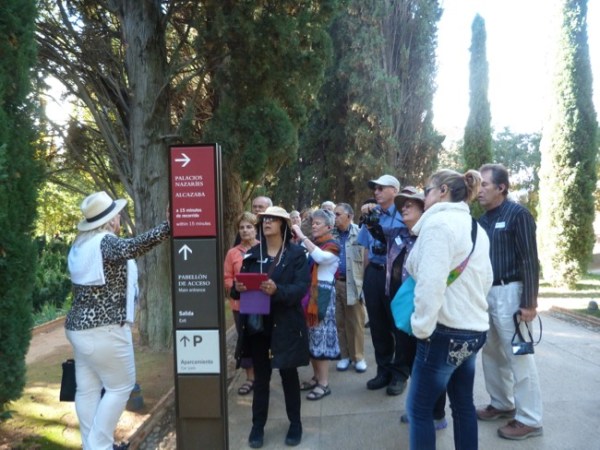
This is our group, gathering around our guide to enter the Alhambra.















If this were a fabric, I would have a dress made of it. I loved the intricate intersection, and the blending of the blue and cream and brown.


This is my favorite photo, for any number of reasons, cats, light and shadow, intricate tracery on columns, etc. but it is also a reminder of a very strange occurrence. I had just finished taking this shot, hunched down for a low angle, when a young woman in a group of four came along and shoved others, and then me, out of the way. Literally, she took my arm and started to move me and said “we’re taking a group photo now.”
Normally, I tend to defer, but her arrogance, and her disregard for the feeling of others prickled me, and so I pulled my arm away and looked at her cooly, and said “as soon as I am done with my photo, I will move and you can take your shot. Or you can shoot it from another angle.” I don’t know why I did that, I am surprised at myself. I don’t like to cause trouble. But who has the right to shove others out of the way???
That is the memory this photo brings back.

Please look at this photo, not that it is anything special but because there are people in it. I want you to appreciate how really, really, very hard it was to take some of these photos without people in them. I had to wait and wait, sometimes, (gasp!) I even got separated from my group for a short time, in the interest of getting an unimpeded shot. We were there at a lovely time of the year, perfect weather, and we thought there would not be too many tourists. We were astonished, in Seville, in Cordoba, in Grenada just how many tourists there were.




And here is where AHI Travel did something really right. This is the last day of the tour, tomorrow we all disembark and head for the Malaga airport and from there, to places scattered around the world. Just a short walk from the Alhambra is a beautiful hotel, beautifully situated, the Alhambra Palace. We’ve made note of it because we intend to come back to Grenada, and we want to stay in this hotel. This is where we ate lunch.


Our group had a closed in verandah with a beautiful view. Lunch was served in courses, and each was carefully prepared, and delicious. Very very clever way to end the tours on a high note 🙂

The room was beautiful. The table service was beautiful.

The view was beautiful.


After the meal, we got back on the bus to head back for the ship. Once on board, we had a Smithsonian meeting and then another lecture and then dinner, and something happened that has not happened to me for a long time, I had to pack at the last minute. Our suitcases had to be outside our door before we went to bed so they could be loaded to go, very early the next morning, to the airport.
I was coming down with something. I felt hot and feverish, and my nose was running. All my life, I have had nightmares about last minute packing. I hate doing last-minute anything, I am a planner, I like having a certain amount of control over my life, even though it is an illusion, it is an illusion I work hard to maintain. How did this happen to me? How is it that I am packing at the last minute, feverish and anxious?
It all got done. Fortunately, there are a limited number of places you can put things. For some reason, I am not able to download all our boarding passes, so we have only the first ones and will have to get the rest at the airport. I know where my passport is (I never have found the one I lost somewhere in my office) and my tickets and somehow we are finished and all is well by bedtime. I just hate that feeling of being rushed; when I am rushed, I make mistakes.
Every now and then something good happens. There is a huge line in Malaga, but our new friends also have tickets that put us in another line, and we get through quickly, with no problems. We say goodbye, we’ve exchanged e-mail addresses, and we go our separate ways. We have time to relax.
We arrive in Paris barely on time, and it is a Sunday morning with long lines at security, and there is no way out, we have to stand in line. We watch one very elderly man, unsteady, but with a great sense of humor, cope as he has to go through the full-body scan. Even though it is a few days before the bombing, security is tight. The airport is a nightmare. We have no idea where our next gate is, and we are almost running, as it is already our boarding time and we are not there. We have to go down this hall and that, then down to some gate where we catch a bus, then from that bus to somewhere else where we get to our plane with five or ten minutes to spare. That is cutting it way to close for me, but I know by now that I am coming down with one of the world’s worst colds and I sleep all the way from Paris to Atlanta, waking up now and ten to drink some Pomegranate Pizazz with honey to make the cold go away.
Not only does the cold not go away – I very generously shared it with AdventureMan. We both felt so bad we were sleeping all the time and didn’t even notice the jet lag 🙂 so by the time we were well again, we were also sleeping on Pensacola time. As soon as we were well, we got the super-strong flu shots to protect ourselves from anything worse than we’ve just had. 🙂
Science and Entanglements
It’s been so long since I’ve last talked with you. I’ve been off on a great adventure, and I want to tell you all about it, but I’ve been recovering from a bug I caught the last day of our trip (I was so generous; I shared it with AdventureMan). Today is the first day I could really face blogging, and I was inspired by a reading I received this morning from Richard Rohr, whose religion and spirituality seem to hit me where I live.
Quantum Entanglement
Thursday, November 12, 2015
Just as different ways of interpreting scripture and various types of truth (e.g., literal vs. mythic) are valuable for different purposes, so scientific theories have different applications while seeming to be paradoxical and irreconcilable. For example, we have the Newtonian theory of gravity, Einstein’s theory of relativity, and quantum theory. Physicists know that each of them is true, yet they don’t fit together and each is limited and partial. Newtonian mechanics can’t model or predict the behavior of massive or quickly moving objects. Relativity does this well, but doesn’t apply to very, very small things. Quantum mechanics succeeds on the micro level. But we don’t yet have an adequate theory for understanding very small, very energetic, very massive phenomenon, such as black holes. Scientists are still in search of a unified theory of the universe.
Perhaps the term “quantum entanglement” names something that we have long intuited, but science has only recently observed. Here is the principle in layperson’s terms: in the world of quantum physics, it appears that one particle of any entangled pair “knows” what is happening to another paired particle–even though there is no known means for such information to be communicated between the particles, which are separated by sometimes very large distances. Could this be what is happening when we “pray” for somebody?
Scientists don’t know how far this phenomenon applies beyond very rare particles, but quantum entanglement hints at a universe where everything is in relationship, in communion, and also where that communion can be resisted (“sin”). Both negative and positive entanglement in the universe matter, maybe even ultimately matter. Prayer, intercession, healing, love and hate, heaven and hell, all make sense on a whole new level. Almost all religions have long pointed to this entanglement. In Paul’s letter to the Romans (14:7) he says quite clearly “the life and death of each of us has its influence on others.” The Apostles’ Creed states that we believe in “the communion of saints.” There is apparently a positive inner connectedness that we can draw upon if we wish.
Ilia Delio says, “If reality is nonlocal, that is, if things can affect one another despite distance or space-time coordinates, then nature is not composed of material substances but deeply entangled fields of energy; the nature of the universe is undivided wholeness.” [1] I’ve often described this phenomenon as an experiential “force field” or the Holy Spirit. In Trinitarian theology, the Holy Spirit is foundationally described as the field of love between the Father and the Son. One stays in this positive force field whenever one loves, cares, or serves with positive energy. I know that when people stand in this place, when they rest in love as their home base, they become quite usable by God, and their lives are filled with “quantum entanglements” that result in very real healings, forgiveness, answered prayers, and new freedom for those whom they include in the force field with them. I have too many examples here to list or to even remember. Jung called these events “synchronicities”; secular folks call them coincidences; the Sisters of Charity of Leavenworth, who taught me, called them Divine Providence.
On the other end of the spectrum there are people who carry death wherever they go, toward all those they can pull into their negative force field. (Is this hell?) I know that when I regress into any kind of intentional negativity toward anything or anybody, even in my mind, I am actually hurting and harming them. Etty Hillesum, a young imprisoned Jew in Nazi-occupied Amsterdam, says straightforwardly, “Each of us moves things along in the direction of war every time we fail to love.” And if so, it would surely follow that each of us moves things along in the direction of healing each time we choose to love. Each time it is a conscious choice and a decision, at least to some degree. Grace and guilt both glide on such waves of desire and intention.
Consciousness, desire, and intentionality matter. Maybe they even create and destroy worlds. We cannot afford to harbor hate or hurt or negativity in any form. We must deliberately choose to be instruments of peace–first of all in our minds and hearts. Such daring simplicity is quantum entanglement with the life and death of all things. We largely create both heaven and hell. God is not “in” heaven nearly as much as God is the force field that allows us to create heaven through our intentions and actions. Once quantumly entangled, it seems we are entangled forever, which is why we gave such finality and urgency to our choices for life (heaven) or death (hell).
This is such a “WOW” for me; I feel I can feed and nourish myself on this meditation for a long time. Google Richard Rohr’s Daily Meditation to sign up to receive his daily e-mail meditation.
Skinny and Scarred No More
Yesterday, as Zakat was sitting on my desk in the sunlight, watching cars go by, butterflies in the garden, whatever catches a cat’s eye, a ray of sunlight caught his skull and I saw tiny hairs covering his scars. I whooped for joy! Coming to us, one of his most distinguishing features was his scars, almost entirely circling his face.
We have had many cats through the years, most of which have stayed with us for 11 – 14 years. We have loved them all, but AdventureMan and I agree that this is the sweetest cat we have ever owned. There isn’t a mean bone in his body. He exists to love and be loved. Best of all, he is truly AdventureMan’s cat. He follows him around like a dog, sleeps touching him at night, and yearns, always, to be in his lap. I don’t mind. It is so adorable how much he loves AdventureMan.
The veterinarian, who treated him before we ever knew him, had told us it might happen. He said Zakat was in such poor condition that he hesitated to treat him, it almost felt as if it would be kinder to just put him down. His face was so infected, it was huge, distorted and swollen. But as painful as it must have been, Zakat was always a sweet cat. By the time we got him, his face was healed, the infection gone, but the scars were still fresh and raw.
We continue to go to the same vet. He has become an important member of our community of friends. He sees us often. Zakat is also FiV positive, which means he has the cat equivalent of AIDs. He is immuno-deficient, susceptible to infections other cats could easily fight off. In contrast to our sweet Pete, the Qatari Cat, we have to make sure Zakat eats; he needs good body weight to help him through the fevers and infections.

We got him through a good friend, who rescues abandoned and stray cats, neuters them, gets their shots and houses them while they search for a good home for these cats. We give thanks for their mission on a daily basis; one of the things they did was teach Zakat to take pills. It’s a good thing. He takes pills almost every day.
He pretty much stays on anti-biotics, so we also give him pro-biotics, to help his digestive system. He gets fevers. His skin breaks out in huge patches of itchy oozing pustules, which drive him crazy. He looses teeth. Sometimes one eye gets red.
Two weeks ago, the vet gave him a shot of cortisone to help with the itching, and a new course of antibiotics and pro-biotics. It was like a miracle. Within a week, there was no compulsive licking, no more outbreaks, no teeth loss, and this scars are starting to fuzz over. His coat is gorgeous. We are learning to dance for joy for every small gain, but this gain is monumental. For all appearances and behavior, he is a perfectly normal, healthy cat. We’ve had five wonderful days. It’s amazing just how good “normal” can be.
We know it won’t last, but for five days he has been totally well, thanks be to God.
Recent Comments
ExpatAlien on What Country am I Living … intlxpatr on Yellowstone: Old Faithful to C… Michelle on Yellowstone: Old Faithful to C… Cathy on No Grown-Ups in Charge intlxpatr on Waiting for Snow Wikipedia Donate Button

Amazina


Early Voting in Florida


 Here There and Everywhere