Halloween Warning
When you eat too much candy, bad things happen.
This is so gross, and too funny.
Not for people with a weak stomach.

Olive Oil Scandal Comment
This is a response to my recent post on The Olive Oil Scandal. I am so delighted when I get a thoughtful and enlightening response like this that I want to give it a separate entry so that it won’t be overlooked by all you bloggers with little time and short attention spans. 😉
It certainly is disgusting. One might note that, though, that none of the above named diluters of olive oil come from Spain, by far the largest producer and exporter of the product.
Currently, in fact, the Andalucian regional government (Andalucía, in which I am an olive grower, produces over 30% of the world’s olive oil) is currently funding a project intended to identify through mass spectometry analysis the molecular ‘signature’ of all the different regional denominations of extra virgin olive oil, enabling bottlers to include this information on barcode-like labels on every bottle marketed and against which the contents could be tested. The systematic adoption of this system, when it is completed, would go along way to protect consumers from the present situation, brought on partly through the fraudulent business practices of various Italian and American producers and sellers.
Also, considering that IOOC olive oil standards have no legal force in the United States, effectively permitting virgin or lampante oil to be sold as EVOO (but not diluted with other oils), the seemingly imminent adoption of international nomenclature by the USDA would be a very positive move. It can’t come soon enough.
Charles Butler’s website, The Olive Oil Gazette, is an absolutely fascinating resource, with all kinds of listings for Olive Oil sites and all kinds of olive oil information, including an article on October 21 about the proposal for the DNA “fingerprinting” of olive oil. Here is what it says about author Charles Butler McKay:
The Olive Oil Gazette is published in Cazorla, Jaén, Spain by Charles Butler Mackay, whose Spanish birth certificate states, correctly, that he was born in Toronto, Canada. Aside from editing this news source, he owns and oversees an olive plantation that has been in his family for a century and a half.
Thank you for your input!
Meanwhile, I don’t want to be sceptical. For a very good price, I found the below olive oil at the Sultan Center, and the lable says all the right things:
Cholesterol Free
Less than 1% acidity
Cold Pressed
It even has an expiration date
And it says it is a product of Syria. Because I am sceptical, I bought it because I thought it had a pretty label:

The Olive Oil Scandal

A good friend gave me a subscription several years ago to The New Yorker, and at the time I didn’t know how lucky I was. First, I loved the cartoons. A couple magazines later, I got pulled in by some of their excellent travel and political writing. Later, the fiction issues pulled me in and introduced me to authors I had never read before. In no time at all, I was totally addicted.
Now, when The New Yorker arrives, Adventure Man and I fight to see who gets to read it first! Often he wins; he skims it. He knows I will take too long getting through it.
It was the New Yorker magazine who informed me about the great olive oil scandal.
I love olive oil. I only use other oils in baked goods, where the olive oil might give an odd taste, we use olive oil almost exclusively. Or so I thought.
In the August 13 Issue of the New Yorker, Tom Meuller starts like this:
On August 10, 1991, a rusty tanker called the Mazal I docked at the industrial port of Ordu, in Turkey, and pumped twenty-two hundred tons of hazelnut oil into its hold. The ship then embarked on a meandering voyage through the Mediterranean and the North Sea. By September 21st, when the Mazal II reached Barletta, a port in Puglia, in southern Italy, its cargo had become, on the ship’s official documents, Greek olive oil. It slipped through customs, possibly with the connivance of an official, was piped into tanker trucks, and was delivered to the refinery of Riolio, an Italian olive-oil produce based in Barletta. There it was sold—in some instances blended with real olive oil—to Riolio customers
Between August and November of 1991, the Mazal II and another tanker, the Katerina T., delivered nearly ten thousand tons of Turkish hazelnut oil and Argentinean sunflower-seed oil to Riolio, all identified as Greek olive oil.
Riolio’s owner, Domenico Ribatti, grew rich from the bogus oil, assembling substantial real-estate holdings, including a former department store in Bari. He bribed two officials, one with cash, the other with cartons of olive oil, and made trips to Rome, where he stayed at the Grand Hotel, and met with other unscrupulous olive-oil producers from Italy and abroad. As one of Italy’s leading importers of olive oil, Ribatti’s company was a member of ASSITOL, the country’s powerful olive-oil trade association, and Ribatti had enough clout in Rome to ask a favor—preferential treatment of an associate’s nephew, who was seeking admission to a military officers’ school—of a high-ranking official at the Finance Ministry, a fellow-pugliese.
However, by early 1992 Ribatti and his associates were under investigation by the Guardia di Finanza, the Finance Ministry’s military-police force. One officer, wearing a miniature video camera on his tie, posed as a waiter at a lunch hosted by Ribatti at the Grand Hotel. Others, eavesdropping on telephone calls among Riolio executives, heard the rustle of bribe money being counted out. During the next two years, the Guardia di Finanza team, working closely with agents of the European Union’s anti-fraud office, pieced together the details of Ribatti’s crime, identifying Swiss bank accounts and Caribbean shell companies that Ribatti had used to buy the ersatz olive oil.
The investigators discovered that seed and hazelnut oil had reached Riolio’s refinery by tanker truck and by train, as well as by ship, and they found stocks of hazelnut oil waiting in Rotterdam for delivery to Riolio and other olive-oil companies.
The investigators also discovered where Ribatti’s adulterated oil had gone: to some of the largest producers of Italian olive oil, among them Nestlé, Unilever, Bertolli, and Oleifici Fasanesi, who sold it to consumers as olive oil, and collected about twelve million dollars in E.U. subsidies intended to support the olive-oil industry. (These companies claimed that they had been swindled by Ribatti, and prosecutors were unable to prove complicity on their part.)
You can read this entire fascinating article here: Tom Meuller: Slippery BusinessGive yourself plenty of time. It is an article well worth reading.
There is another good reference here: The Great Olive Oil Scandal from PalestinianOliveOil.org
Investigators have gathered evidence indicating that the biggest olive oil brands in Italy — Bertolli, Sasso, and Cirio — have for years been systematically diluting their extra-virgin olive oil with cheap, highly-refined hazelnut oil imported from Turkey. [1]
A 1996 study by the FDA found that 96 percent of the olive oils they tested, while being labeled 100 percent olive oil, had been diluted with other oils. A study in Italy found that only 40 percent of the olive oil brands labeled “extra-virgin” actually met those standards. Italy produces 400,000 tons of olive oil for domestic consumption, but 750,000 tons are sold. The difference is made up with highly refined nut and seed oils. [2]
EVEN THE BIGGEST OF THEM WILL MISLEAD THE PUBLIC…
“In 1998, the New York law firm Rabin and Peckel, LLP, took on the olive oil labeling misnomer and filed a class action suit in the New York Supreme Court against Unilever, the English-Dutch manufacturer of Bertolli olive oil. The firm argued that Bertolli’s labels, which read “Imported from Italy,” did not meet full disclosure laws because, even though the oil had passed through Italian ports, most of it had originated in Tunisia, Turkey, Spain or Greece. “Bertolli olive oil is imported from Italy, but contains no measurable quantity of Italian oil,” according to court documents.”
Curezone lists manufacturers of adulterated olive oil and marketers of the same oil. It is disgusting. We pay high prices for junk-olive oil. From Curezone.com/forums
The Guilty
Below is a list of known adulterated brands and dishonest distributors with links to information about their cases.
Adulterated brands of extra virgin olive oil
with country of origin
Andy’s Pure Olive Oil (Italy)
Bertolli (Italy)
Castel Tiziano (Italy)
Cirio (Italy)
Cornelia (Italy)
Italico (Italy)
Ligaro (Italy)
Olivio (Greece)
Petrou Bros. Olive Oil (California)
Primi (Italy)
Regale (Italy)
Ricetta Antica (Italy)
Rubino (Italy)
San Paolo (Italy)
Sasso (Italy)
Terra Mia (Italy)
Distributors caught selling adulterated olive oil
Altapac Trading
AMT Fine Foods
Bella International Food Brokers
Cher-Mor Foods International
D&G Foods
Deluca Brothers International
Gestion Trorico Inc.
Itaical Trading
Kalamata Foods
Les Ailments MIA Food Distributing
Lonath International
Mario Sardo Sales, Inc.
Petrou Foods, Inc.
Rubino USA Inc.
Siena Foods Ltd.
Vernon Foods
So who do we trust? How do we know that we are getting a quality, unadulterated product? This is fraud in an international scale!
Accident Aftermath
This time the crunch was different. This time, the initial BLAM crunch was followed by a heart-sickening series of crunches. I was on the phone dialing 777 even before I got to the window.
They have lovely women working for emergency services now, women who can stay calm and switch languages easily. Just hearing her voice calms me down as I report the accident, tell them to send an ambulance. The upside down car door is flipping open, and people are running to help the victim out. It’s a woman, and she is beautiful. She is also bleeding, and once they get her out, she is very still, too still.
The traffic police call me back and I tell them where the accident is, but thank God the woman is still on the phone and when he doesn’t understand, she fills in efficiently and accurately.
It takes them 21 minutes to arrive. The traffic police send one car, and on a busy street, they all gather around the woman and stare. The MOI also send a car. Not one of these police set up any kind of traffic control, cars on both sides of the road are stopping, people come running, just to look.
The ambulances take 22 minutes. When they leave, there are no sirens. I don’t think she survived. The medics appeared knowledgeable and efficient.
It’s the aftermath that bothers me now. On the ground, they left all the medical waste.

The last thing the medic did as he got into the ambulance was to throw his bloodied gloves on the ground:
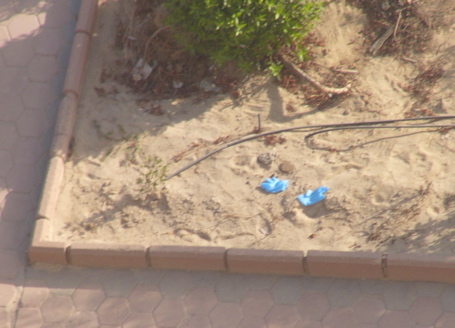
And then . . .the traffic cops left! There are two wrecks on one of the busiest thoroughfares in town, and no protection from the next speeding car! The wrecks are in the fast lane!
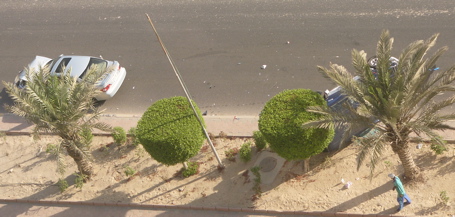
Don’t get me wrong. You know how I feel – police, ambulance medics, firemen – they are all heroes in my book. They risk their lives every day for the common good. The save lives, and they take pride in what they do.
They need a little training in accident management. When there is an accident, there needs to be a priority on getting there fast, and controlling the crowd, and routing traffic by efficiently. The medics need to pick up their waste.
There needs to be after-accident care, ensuring that someone stays until the wreckage is removed.
I had a house guest once who sat in my window and said “Oh my God. Oh my God! Oh! Oh! Oh!”
There are three separate u-turns we can see. Each one is another accident just waiting to happen. When the turn lanes back up, sometimes some people start honking, putting pressure on the lead person to make an unsafe turn. Please – resist the pressure. Take your time. Wait for a safe, truly safe interval.
Please, my friends, do one thing for me. Please, buckle your seat belts. And please, buckle up your children, put them in car-seats made to protect them, teach them from an early age to buckle-up, help it become so automatic they don’t even think about it.
Older Brother Stunts Your Growth
Scientists just think differently. Who woulda thunk to study how having older siblings affects height? This is from BBC Health.
Having an older sibling, particularly a brother, can stunt growth, work suggests.
Experts said the condition of the womb after the first pregnancy may be a factor.
The study of 14,000 families was presented at the BA Festival of Science.
The research, by David Lawson, of University College London, also showed children in larger families were likely to be shorter than average.
Researchers found that children with three siblings were 2.5cm or one inch shorter than the average height for their age.
If you are one of the younger ones, then you can expect to be shorter than your older siblings
Dr Lawson
It was suggested siblings may dilute resources – time, money or love – that parents are able to invest in children.
The researchers followed children born in the 1990s and who were enrolled on the Avon Longitudinal Study of Parents and Children, one of the largest public health studies to be set up in Britain.
Each year, the children’s height was recorded, along with other details of their development.
While having older siblings of either sex affected a younger child’s development, the effect of older sisters was more mild.
You can read the rest of the article HERE.
Staph Fatalities Alarming
This is from AOL Health News but it is also featured on Good Morning America today. The government says there has been “an alarming increase” in staph infections, and the number of deaths due to these common infections could soon be overtake death from AIDs infection.
My own father spent a year dying, fighting of MRSA, which is common in many hospitals – even here in Kuwait. The old are particularly vulnerable, but so are all those with open wounds, recent hospitalizations, and compromised immune systems.
CHICAGO (Oct. 17) – More than 90,000 Americans get potentially deadly infections each year from a drug-resistant staph “superbug,” the government reported in its first overall estimate of invasive disease caused by the germ.
Deaths tied to these infections may exceed those caused by AIDS, said one public health expert commenting on the new study. Tuesdays report shows just how far one form of the staph germ has spread beyond its traditional hospital setting.
The overall incidence rate was about 32 invasive infections per 100,000 people. That’s an “astounding” figure, said an editorial in Wednesday’s Journal of the American Medical Association, which published the study.
Most drug-resistant staph cases are mild skin infections. But this study focused on invasive infections – those that enter the bloodstream or destroy flesh and can turn deadly.
Researchers found that only about one-quarter involved hospitalized patients. However, more than half were in the health care system – people who had recently had surgery or were on kidney dialysis, for example. Open wounds and exposure to medical equipment are major ways the bug spreads.
In recent years, the resistant germ has become more common in hospitals and it has been spreading through prisons, gyms and locker rooms, and in poor urban neighborhoods.
The new study offers the broadest look yet at the pervasiveness of the most severe infections caused by the bug, called methicillin-resistant Staphylococcus aureus, or MRSA. These bacteria can be carried by healthy people, living on their skin or in their noses.
Your best protection? Wash your hands frequently, and stay out of hospitals.
You can read the rest of the article HERE.
EnviroGirl on Tap Water
Welcome, EnviroGirl, our Guest Blogger on Blog Action Day, and thank you for being our Guest Blogger!
Thanks, Intlxpatr, for inviting me to be your guest blogger.
Intlxpatr knows that I am passionate about drinking tap water, as well as encouraging others to do the same. I’ve almost always chosen to drink tap water over bottled water, primarily because it’s cheaper that bottled water, and it’s readily available (just turn on the faucet!).
Over the last year I’ve learned that there are even more reasons to drink tap water (at least in the U.S.). So I’ll quickly share with you a few reasons why you should save your money and drink tap water. If you want to do more research on the topic, I’ve included a few links below.
Why you should choose tap water over bottled…
1) Tap water is tested stringently for chemical and microbiological contaminants. It is regulated by the Environmental Protection Agency (EPA) and must comply with the Safe Drinking Water Act. Bottled Water is often regulated by the Food and Drug Administration (FDA), and does not fall under the Safe Drinking Water Act. (All water in the U.S. falls under the Safe Drinking Water Act.) This means that it is not tested as rigorously as tap water. In addition, your community water provider is required to send you a Consumer Confidence Report (CCR) every year. The CCR should inform you of the quality of your tap water and if any contaminants have been detected. Try finding this information on the label of a bottle of water.
2) Bottled water is not only more expensive to purchase, the environment costs are greater too. Bottled water must be shipped to your location, which means more fossil-fuel emissions into the air. After the water is consumed, the plastic bottle must be disposed of. If the bottle is not recycled, it will be tossed in a landfill where it will take about 700 years (plastic bottle recycling facts) to decompose.
3) Clean drinking water is a valuable resource. Recently, droughts and pressures from population growth have created water shortages. In communities experiencing water shortages, bottling water has become a hot topic because it depletes local drinking water supplies. Water use restrictions may be imposed on the community, while the bottled water company is still packaging and selling the amount of water it was permitted to use (For example – http://www.orlandosentinel.com/orl-bottledwater1307oct13,0,6642058.story). This also leads into the importance of conserving drinking water resources and implementing creative strategies such as water reuse (Info on water reuse – http://www.epa.gov/region09/water/recycling/index.html ).
Again, the information above regarding water quality is for tap water in the U.S. In countries that do not have adequate sanitation it is not advisable to drink tap water. If you live outside of the U.S., the World Health Organization (WHO) and the European Commission are two organizations that have water quality standards that many countries choose to adopt. You can search online to determine if your country follows any of these standards and if your tap water is safe to drink.
Links:
U.S. Safe Drinking Water Act:
http://www.epa.gov/safewater/sdwa/basicinformation.html
U.S. Environmental Protection Agency – Drinking Water:
http://www.epa.gov/safewater/
World Health Organization – Drinking Water:
http://www.who.int/water_sanitation_health/dwq/en/
European Commission – Drinking Water:
http://ec.europa.eu/environment/water/water-drink/index_en.html
Website for Water in the Middle East:
http://www.al-bab.com/arab/env/water.htm
National Resource Defense Council – Bottled Water Q & A:
http://www.nrdc.org/water/drinking/qbw.asp
Plastic bottle recycling facts (U.S.):
http://earth911.org/recycling/plastic-bottle-recycling/plastic-bottle-recycling-facts/
Need for Vigorous Exercise
From BBC Health News.
“Misleading” government guidelines have led to many Britons wrongly believing that moderate exercise is as beneficial as a vigorous workout, a study alleges.
In a survey of nearly 1,200 people, around half of men and three quarters of women thought moderate exercise conferred the greatest health benefits.
Guidelines urge 30 minutes of moderate exercise each day five days per week.
But the authors of the study, published in Preventive Medicine, said vigorous exercise was best for averting disease.
The NHS guidelines say “taking a brisk walk, spending some time doing the gardening or doing a few laps of the local swimming pool on the way home from work” can all improve health.
But the researchers from Exeter and Brunel Universities said these activities were unlikely to do much for them.
“It’s extremely worrying that British adults now believe that a brief stroll and a bit of gardening is enough to make them fit and healthy,” said Dr Gary O’Donovan, lead author.
“Brisk walking offers some health benefits, but jogging, running and other vigorous activities offer maximal protection from disease.”
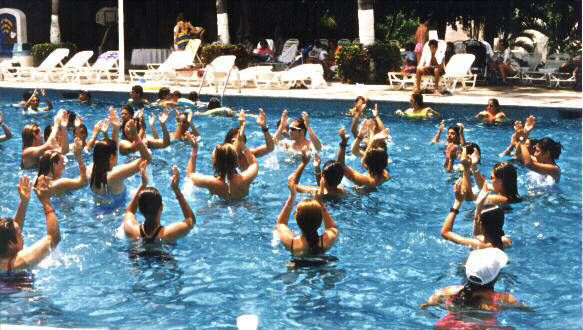
The article goes on to say that part of the problem is a series of studies with conflicting results. While any exercise is better than no exercise, vigorous exercise provides the maximum health benefits. You can read the rest of the article HERE.
Ride Home Wreckage
I found myself driving home from a meeting during prime traffic time today, and it was all very mellow. Mellow until I got near my home, and saw a huge wreck by the side of the road. I don’t know how many times you need to turn over to land on the top with so much damage, but I think it must be a lot.
And on my other side is a man with his hazard lights on. I’m in the middle lane, there is traffic on the right, and this guy, in his late 50’s – 60’s maybe, on my left has his hazard lights on and is drifting all over the road. He moves into me suddenly, I quickly turn the wheel, so fast my rear wheels skid on the oil slick road and my rear end jumps, which sends bolts of adrenelin pumping through my system as I am trying to control my car, honk at him to say “pay attention” (zero reaction) and I try to stay out of the way of the guy on my left and not cause any problems for traffic on my right.
I honk again at the guy on the left, and honestly, this guy is so out of it, he is drifting three lanes across the road, my honk doesn’t even phase him. I don’t know if he is so sleepy he can’t control the car, he is on drugs or he is drunk out of his mind, but he just drifts from lane to lane with his hazard lights on – as if that is enough: “Hey, you guys, I have my hazard lights on – stay out of my way.” He wasn’t driving fast, just all over the road. It might have been comical if there wasn’t so much traffic.
Safely home, I intend to stay here!
Why The Appendix?
A few years ago, Adventure Man was getting all set to cross the Sahara with a camel caravan, until he read the disclaimers and warnings, including a small item that in one of the previous crossings, a traveller had a sudden bout of appendicitus and was left, alone in the desert, to die, because there was nothing else that could be done. He chose not to go!
CNN News has published an article on scientist’s discovering the use of the appendix:
WASHINGTON (AP) — Some scientists think they have figured out the real job of the troublesome and seemingly useless appendix: It produces and protects good germs for your gut.
That’s the theory from surgeons and immunologists at Duke University Medical School, published online in a scientific journal this week.
For generations the appendix has been dismissed as superfluous. Doctors figured it had no function. Surgeons removed them routinely. People live fine without them.
And when infected the appendix can turn deadly. It gets inflamed quickly and some people die if it isn’t removed in time. Two years ago, 321,000 Americans were hospitalized with appendicitis, according to the Centers for Disease Control and Prevention.
The function of the appendix seems related to the massive amount of bacteria populating the human digestive system, according to the study in the Journal of Theoretical Biology. There are more bacteria than human cells in the typical body. Most are good and help digest food.
But sometimes the flora of bacteria in the intestines die or are purged. Diseases such as cholera or amoebic dysentery would clear the gut of useful bacteria. The appendix’s job is to reboot the digestive system in that case.
You can read the rest of the article Here.
Recent Comments
ExpatAlien on What Country am I Living … intlxpatr on Yellowstone: Old Faithful to C… Michelle on Yellowstone: Old Faithful to C… Cathy on No Grown-Ups in Charge intlxpatr on Waiting for Snow Wikipedia Donate Button

Amazina


Early Voting in Florida


 Here There and Everywhere