FitBit Sleep
One of the reasons I wanted to try the FitBit when I started, over a year ago, was to be able to keep a record of my sleep. What is startling to me is that I sleep a lot better than I think I do – most nights. I thought I slept great last night, woke up feeling rested, only to discover that FitBit tells me that I was restless and awake several times last night. I don’t remember that at all:

There is a part of me that tells myself FitBit is only a machine and can be wrong, and another part of myself that tells me we don’t always perceive ourselves and our actions impartially.
Hot Springs in Glenwood Springs, CO
Today is a short day, and AdventureMan gets to sleep in. We’ve hit the road hard for two days, and today we have a rainbow at the end of the day, we get to hit the hot springs and we have massages scheduled, just the ticket for a man with a bad cold. Coughing makes his back ache, and he loves a good massage.
There is also no point starting too early because . . . it’s still snowing.


We hit the road around nine-thirty, following our GoogleMap instructions. Neither of us say anything when we end up in a mountainous area, very snowy, and the temperature keeps dropping. It is snowy. And icy.

Fortunately, we aren’t in the mountain pass more than half an hour, although it seems like forever, and then we are once again on flatlands, heading for I-70. We land in Colorado Junction for a quick lunch – which, due to extremely slow service, turned out to be a much longer lunch than we had intended – and then on to Glenwood Springs, a sweet resort town with a natural hot spring, very sulphuric, lots of mountains, lots of restaurants, and, as it turns out, lots of tourists.
We checked in, and headed to Splendor Mountain for a couple’s massage (wonderful) and then to the springs. The Glenwood Springs has several pools, and it is $20 per person entry during the day, less if you go at night. The $20 gives you all day coming and going, but we found that half an hour was enough for us – there were too many people! There is a ledge around the largest pool where people sit, and most of the seats were taken. People walked up and down the length of the pool. Too many people!


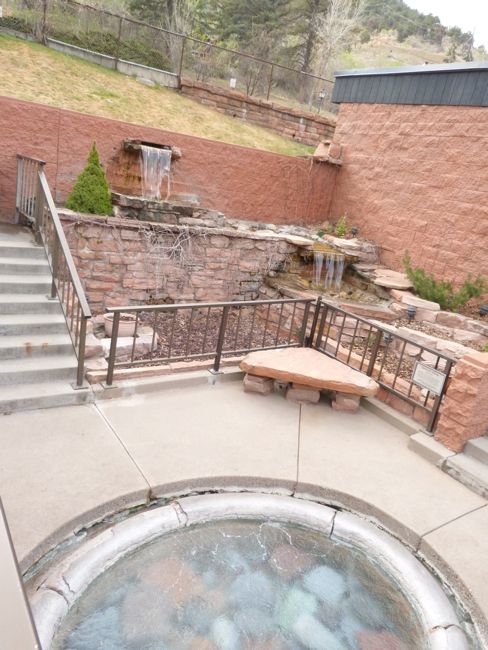
The sulphuric water comes into this pool and is mixed with more water for the pools – this water, pure from the springs, also has a very strong smell that many people can’t stomach, although it is supposed to be very good for your health.

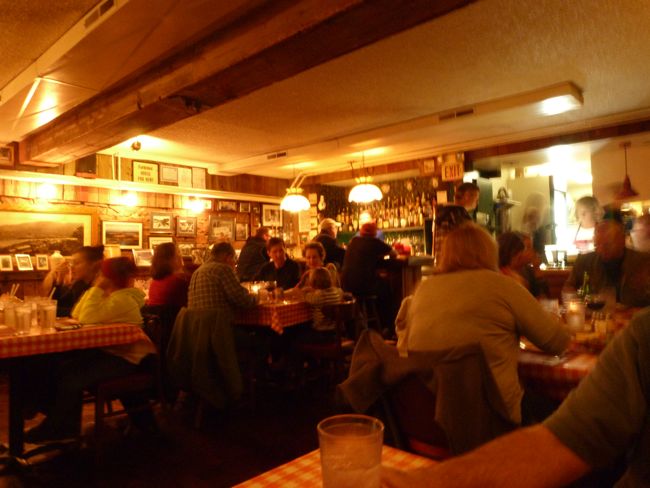
We found a wonderful restaurant for dinner, the Italian Underground, thanks to our masseuses who told us how good the food was:
Our beds at the Best Western Antler Lodge were lodge-y, I love a lodge look:

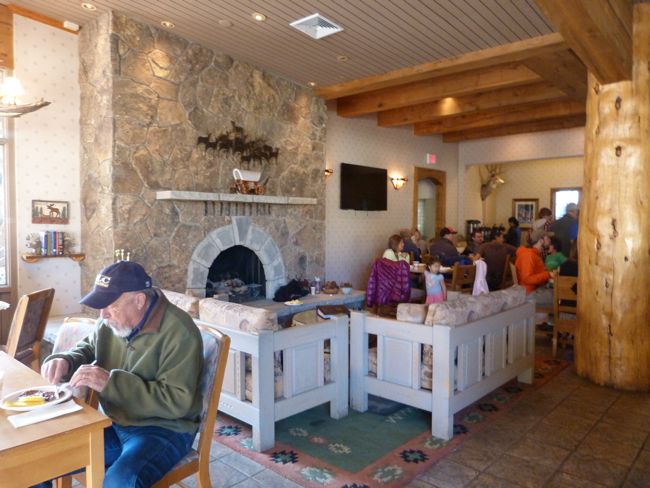
This hotel is within walking distance of the Splendor Mountain Spa, the Glenwood Springs pools and surrounded by many restaurants. This is the breakfast room:
Obesity Linked to Lower Risk for Dementia
From today’s AOL news, surprising and counter-intuitive findings:
Obesity is linked to a whole slew of illnesses like cancer, type 2 diabetes, and heart disease, just to name a few.
However, new research surprisingly finds that obesity can actually reduce your risk of a devastating and fatal condition: dementia.
A study out of the UK found the link after analyzing data from nearly 2 million people over the course of decades.
According to the research by Oxon Epidemiology and the London School of Hygiene and Tropical Medicine, underweight people had a 39 percent higher risk of dementia versus people of average weight. The shocking part is that overweight people had an 18 percent reduction in risk and those who are clinically obese, a 24 percent reduction.
The lead researcher told BBC News, “The controversial side is the observation that overweight and obese people have a lower risk of dementia than people with a normal, healthy body mass index. That’s contrary to most if not all studies that have been done, but if you collect them all together our study overwhelms them in terms of size and precision.”
It is important to note that while this study is certainly controversial, it’s not the be all and end all in determining how weight correlates to risk of dementia. If nothing else, though, it certainly opens the door for further research.
The Hunting Ground: Campus Rape Victims Speak Out in New Movie
From AOL News via Sports Illustrated
When I lived in Kuwait and Qatar, I was appalled by the way rapes were treated, it was like this huge wave of abductions and violations, and nothing was done. As it turns out, things are changing a lot slower in my own country than I thought. This new film, The Hunting Ground, is by the same person who documented violence and rape in the US military, spurring then Secretary of Defense Leon Panetta, a truly decent man, to put the fear of God into the military leaders who were covering up the many rapes and blaming the victims. We have the same problem on college campuses.
There is only one cure. We have to raise our sons to respect women. We have to continue raising the bar for equality in our country until women have equal access to jobs, health treatment, legal proceedings, etc. Films like The Hunting Ground are painful, and at the same time, help us to face, and to overcome our societal short comings.
I love it that this film is “giving voice to those who have no voices;” that these courageous women speaking out have bravely named their rapists and described their circumstances. It can’t be comfortable, but it is their right. I am proud that they are not intimidated by fear of the ‘blame the victim’ mentality they have endured on their college campuses. When did colleges and universities begin placing money-making and winning teams before the well-being of their students?
New film gives chilling account of sexual assault on college campuses
Sexual assaults on college campuses have reached alarming levels and the issue has drawn the attention of Congress and even President Obama himself. The latest research indicates that one in five college women will be sexually assaulted and as many as 90% of reported assaults are acquaintance rapes. It is believed that more than 100,000 college students will be sexually assaulted during the current school year. Nowhere is the deck stacked more against sexual assault victims than in college athletics. In just the last few years alone there have been cases at Florida State, Michigan, Oregon, Vanderbilt andMissouri.
All of this is a backdrop to a harrowing new film that premiers in theaters on Friday in New York City and Los Angeles. The Hunting Ground is a jarring exposé that shines a bright light on the epidemic number of sexual assaults taking place on college campuses each year.
The Hunting Ground features a group of survivors who faced harsh retaliation and harassment for reporting that they had been raped. The film focuses on institutional cover-ups and the brutal backlash against survivors at campuses such as Harvard, Yale,Dartmouth, the University of North Carolina at Chapel Hill, USC and the University ofCalifornia-Berkeley, among others.
Some of the most vexing stories featured in the film involve women who were assaulted by athletes. While The Hunting Ground isn’t all about sports, the most dramatic moment in the film occurs two-thirds of the way through when the woman who accused former Florida State quarterback Jameis Winston—who after a strong showing in last week’s Combine is projected by many to be the No. 1 pick in this spring’s NFL draft—appears and tells her story publicly for the first time. The woman, who is named in the film but SI.com has chosen to protect her identity, is shown on camera and gives her life-changing account of what she says happened the night in December 2012 she left a Tallahassee bar with Winston.

A high school honor student who planned to attend medical school, the woman is articulate and attractive. She looks like the girl next door, a person you would trust to babysit your children. It is uncomfortable to watch—yet impossible to look away—when she describes being beneath Winston on his bathroom floor, repeatedly telling him “no” before being physically overpowered.
“We’re grateful it’s the first time people will get to hear [her] story,” said The Hunting Ground director Kirby Dick. “It’s her first-hand testimony. Up to this point it hasn’t been in a public space.”
The woman’s parents also appear in the film. Her father talks about driving to Tallahassee Memorial Hospital with his wife to be with their daughter hours after the incident.
There is nothing easy about retelling these stories for the world to see. But the attorney for the woman who says she was raped by Winston, John Clune, said his client decided to break her silence in the film because she felt it was the right venue to tell her story.
“The film was a once-in-a-lifetime opportunity,” Clune said. “The work by these filmmakers is nothing less than groundbreaking. It took tremendous courage, but our client and all of the incredibly brave women in the film have advanced the cause of rape survivors everywhere.”
The Hunting Ground also examines a sexual assault accusation against a Notre Damefootball player in 2010. Tom Seeberg, whose daughter committed suicide after she says she was sexually assaulted by a Fighting Irish starter, tells a heartbreaking account of school officials thwarting the investigation into his daughter’s complaint. A former Notre Dame police officer reveals that he and his colleagues were not allowed to approach or question an athlete on athletic properties.
The film also mentions rape cases involving football players at Missouri and Vanderbilt, as well as basketball players at Oregon.
The testimonials of rape survivors are wrapped between raw footage that is both gut-wrenching and disturbing. A small mob of unruly fraternity pledges at Yale are captured on film outside a freshman dorm for women, chanting: “No means yes. Yes means anal.” All the while a guy with a bullhorn is shouting: “Louder.”
In another scene we see drunken frat boys spilling out of a house where there is a sign out front that says: “THANKS FOR YOUR DAUGHTERS.” It’s enough to outrage any parent with a daughter heading off to college.
The film is directed by Dick and produced by Amy Ziering, the team behind the Oscar-nominated film The Invisible War, which revealed systemic sexual assaults and cover-ups within the U.S. military. That movie prompted Secretary of Defense Leon Panetta to announce significant policy changes and inspired the passage of the Military Justice Improvement Act.
Dick and Ziering started looking into the situation on college campuses shortly after the release of The Invisible War. “We were astonished that the problem was as serious in higher education as it was in the military,” Dick said.
Full disclosure: I appear in The Hunting Ground as an expert. Two of the cases in the film—Lizzy Seeberg’s alleged assault at Notre Dame and running back Derrick Washington’s sexual assault of a student at the University of Missouri—are featured in my book The System: The Glory and Scandal of Big-Time College Football, which I wrote with 60 Minutes correspondent Armen Keteyian.
Some of my research is also featured in the film, including the statistic that student-athletes are responsible for 19% of the reported sexual assaults on campus, despite the fact that they comprise just 3.3% of the male student population. Those figures arose from a first-of-its-kind study I conducted with researchers at the University of Massachusetts in the mid-90s when we were granted access to judicial affairs records and police reports at colleges across the country.

Over the past 20 years I have researched hundreds of cases of sexual assault involving athletes. During that time I’ve interviewed countless sexual assault victims. The thing I found most telling was what prosecutor Willie Meggs did not say in the film. Meggs was asked if he thought a rape took place in Winston’s apartment. It was a perfect opportunity for the man who chose not to prosecute Winston to say no. Instead, he said something “bad” happened in that apartment that night. He just didn’t have sufficient evidence to prove it.
That’s not unusual. That’s typical. Only about 20% of rapes reported to the police in the U.S. are prosecuted. Yet at least 92% of reported sexual assault claims are found to be true. The problem is that date rape cases are very difficult to prove beyond a reasonable doubt, especially when alcohol is involved and the incident occurs in the perpetrator’s apartment, dorm or hotel room. The doubts raised by those factors are amplified when the accused is a star athlete.
The greatest achievement of The Hunting Ground is that it empowers rape victims to team up with each other and come forward. It’s fair to say that for the first time in many years, women like Jameis Winston’s alleged victim have powerful allies.
By the time the NFL draft takes place in May, the film will be in theaters around the country, the name of Winston’s accuser will be everywhere and more details about the night in question will likely come out. All of this brings to mind the legal maxim caveat emptor, which essentially is a warning that means let the buyer beware.
Jason Licht, the general manager for the Tampa Bay Buccaneers, ultimately has to decide whether to use the first pick on Winston. He’s on record saying: “This is the most important pick, potentially, in the history of the franchise.”
Memo to Licht: Watch The Hunting Ground.
The ramifications in this instance are equally big for the NFL, whose image took a beating over the last year after Ray Rice was caught on tape knocking out his then-fiancé in an elevator. The controversy erupted after Commissioner Roger Goodell imposed a two-game suspension without bothering to obtain and watch the video.
Memo to the Commissioner: Watch The Hunting Ground.
No matter what happens with Winston, the film succeeds in its main goal: to shine a light on sexual assault on college campuses. It’s an important issue that isn’t going away, and if something drastic isn’t done immediately, it will only get worse.
Jeff Benedict is a lawyer and has written five books on athletes and violence against women, including Public Heroes, Private Felons: Athletes and Violence Against Women, and Out of Bounds: Inside the NBA’s Culture of Rape, Violence and Crime.
When Attacked
I think you have to be careful when seeking spiritual advisors, and Rick Warren has never led me down a wrong path. In his own life, he sets a fine example of what a walk with Christ looks like. He is humble, compassionate, and full of encouraging and challenging scriptural advice. Today’s Daily Hope devotional is below – what great advice; it keeps you safe and it keeps you on the right path.
Jan 6, 2015
When You’re Under Attack, Just Rest
by Rick Warren
“You prepare a table before me in the presence of my enemies. You anoint my head with oil; my cup overflows.” Psalm 23:5 (NIV)
Our civilization is losing its civility. The world is getting ruder! One of the things that’s causing that is the Internet, because it allows people to hide behind the screen and say things online that they would never have the courage to say to others face to face.
All those people are doing is revealing the smallness of their hearts. Great people make people feel great, but small people belittle people. People who belittle others have a little knot for a heart, and they make fun of others because they think it will make them feel better.
How do you handle rude people? You don’t. You let God handle them. You let God be your defender.
King David was a pro at this. He knew what it meant to be attacked emotionally, verbally, and physically. As a young man, he was anointed by Samuel to be the next king of Israel, but he spent two years running from his predecessor, who wanted to kill him. He hid in caves while being criticized constantly behind his back.
Yet David never said a bad word against the king. He never retaliated, because God was preparing him to be the king after his own heart.
David says in Psalm 23:5, “You prepare a table before me in the presence of my enemies. You anoint my head with oil; my cup overflows” (NIV).
David was recognizing God’s goodness to him. God would anoint his head with oil, which says to the world, “This is my guy! Back off! This is going to be the next leader.” David’s cup overflowed, which meant God kept blessing him and blessing him, even when others attacked him.
Does it sound like David was stressed out? No! He didn’t have to use up all his energy defending himself because he trusted God to be his defender.
It takes a lot of faith and humility to rest and trust God when you’re under attack, when you’re misunderstood, when rumors are spreading about you and people are saying things about you online. When that happens, everything in you wants to rise up and do something about it.
But you are most like Christ when you remain silent under attack. Jesus was constantly attacked, yet he never retaliated, even on his way to the cross. He remained silent before his accusers because he had entrusted himself to the care of the Father.
“So if you are suffering in a manner that pleases God, keep on doing what is right, and trust your lives to the God who created you, for he will never fail you” (1 Peter 4:19).
Talk It Over
Why is it important to you to have the last word?
What is the physical result of entrusting your defense to God? How does it affect your health?
If you have to speak to your attackers, what do you think God wants you to say?
Middle East Map of Deadliest Infectious Diseases

This is from AOL News/Upworthy, where you can view the deadliest infectious diseases in all parts of the world.
*A note from GlobalPost on how these maps are set up: The numbers in black boxes show how many thousands of people died from the dominant infectious disease in that country in 2012. Keep in mind that these are absolute numbers, so they’re not scaled to account for a country’s population. They also don’t convey the total number of deaths from all infectious diseases in each country, just the number of deaths from the deadliest disease. You’ll also notice that many countries in the maps are grayed out (like the USA). That indicates the deadliest infectious disease wasn’t among the ones monitored by the WHO.
Protein Tau Alzheimer Key?
This is hopeful news from AOL Healthnews My family has a history of living long; my Mother is 92 and still has all her marbles. Staving off dementia is as key as keeping your body fit if you live to be a ripe old age.
Is a Protein in the Brain Key to Alzheimer’s?
By Dennis Thompson, HealthDay News
The malfunction of a protein, tau, is the likely culprit behind Alzheimer’s. When it malfunctions, brain cells die, a study finds.
Monday, November 03, 2014
Malfunction of a key brain protein called tau is the likely culprit behind Alzheimer’s disease and other forms of dementia, a new study in mice concludes.
Neurons — highly specialized nerve cells in the brain — appear to die when tau malfunctions and fails to clear the cells of unwanted and toxic proteins, explained Charbel Moussa, head of the Laboratory for Dementia and Parkinsonism at Georgetown University School of Medicine, in Washington, D.C.
This means drugs that replace the function of tau in these brain cells are likely to slow the progression of Alzheimer’s, he said.
“A strategy like this will give us hope that we can delay or stabilize the disease progression,” Moussa said.
Tau has long been a prime suspect in the search for the cause of Alzheimer’s disease. The brains of Alzheimer’s patients wind up clogged with twisted protein threads made of tau, particularly in regions important to memory.
But researchers have been at a loss to explain why tau might cause Alzheimer’s, and whether the tangles of tau are more important than another hallmark of Alzheimer’s, plaques made of a protein called amyloid beta that fill the spaces between the brain’s nerve cells.
Moussa said his experiments with mice have shown that tau works to keep neurons naturally free of amyloid beta and other toxic proteins.
When tau malfunctions, the neurons begin to spit amyloid beta out into the space between the brain cells, where the protein sticks together and forms plaques, he said.
“When tau does not function, the cell cannot remove the garbage,” Moussa said. The result is cell death, he explained.
Tests on the brain cells of mice revealed that removing all tau impaired the neurons’ ability to clear out amyloid beta, according to findings published Oct. 31 in the journal Molecular Neurodegeneration. But if researchers reintroduced tau into brain cells, the neurons were better able to remove accumulated amyloid beta from the cells.
Moussa said his study suggests the remaining amyloid beta inside the neuron destroys the cells, not the plaques that build up outside. The mouse experiments also showed that fewer plaques accumulate outside the cell when tau is functioning.
Malfunctioning tau can occur as part of the aging process or due to genetic changes. As people grow older, some tau can malfunction while enough normal tau remains to help clear the garbage and keep neurons alive. “That explains the confusing clinical observations of older people who have plaque buildup, but no dementia,” Moussa explained in a Georgetown University news release.
In this study, Moussa also explored the possible use of a cancer drug called nilotinib to force neurons to keep themselves free of garbage, with the help of some remaining functional tau.
“This drug can work if there is a higher percentage of good to bad tau in the cell,” added Moussa, whose work was funded in part by a grant from Merck & Co., the pharmaceutical company.
Heather Snyder, director of medical and scientific operations for the Alzheimer’s Association, said Moussa’s findings are interesting but not conclusive.
“They’re saying that tau may have an earlier role than we currently know. That’s as far as I would go,” Snyder said. “We still don’t know how all the pieces come together.”
Snyder said new imaging technology that allows doctors to track tau buildup in a person’s brain over time may help solve this question in the future.
Also, experts say, results of animal experiments don’t necessarily apply to humans.
But Dr. Ronald Petersen, director of the Mayo Clinic Alzheimer’s Disease Research Center, said the new study adds to the growing evidence that “the role of tau is fundamental in the disease process.”
“Developing therapeutics for tau is a high priority,” Petersen said. “Not easy, not simple, but it could be very fruitful.”
Gigi’s in Cameron, Louisiana
Our friend at the Wildlife Center, Sarah, highly recommended Gigi’s, and we were really really hungry when we got there, so it should have been a really good experience, and besides, Cameron is small and I didn’t see any other options.

Interior:

View out towards Gulf:

Have I mentioned, only a thousand times, how fabulous the weather is? It’s seventy-something and like zero humidity. It doesn’t even matter that we are eating outdoors; the weather is perfect.
We order.
Honestly, when did I become a squeamish woman? Certainly not my early years in Tunis, and Amman, when we had to strain the weevils out of our flour and pasta. But as I watched a fly try to get into the ketchup through the tip of the dispenser, I sort of lost my appetite. The other problem is that AdventureMan and I really try to eat sensibly; we’re not extreme, every now and then we have something fried, but the food in Louisiana is rich, we haven’t seen a lot of vegetables, and when our food arrived – so much food – I couldn’t begin to eat it all. I ate about half my shrimp and an onion ring. The shrimp was really fresh.

AdventureMan had fried shrimp and catfish. He said it was really good. He also couldn’t eat it all.

Cameron isn’t very big.

But this is really fun. A $1. ferry!

And guess which parking space we got? And when we got into the space, there were dolphins, lots and lots of dolphins, no, porpoises, and oh, they were having such a good time in the sunlight.

Dolphins are not that easy to photograph . . . .

We keep seeing these wonderful signs to tell us we are still on the right trail 🙂 This ferry ride was a Louisiana Lagniappe (a little something extra!)

Good2Go for Consensual Sex
Go figure. In spite of admonitions to the contrary, young people have sex. Problems arise when someone isn’t old enough to consent, isn’t coherent enough to have sex or is forced to have sex or participate in a sex act they don’t consent to.
I love this idea. It takes a little of the “he says – she says” out of the classic dilemma of who did what to whom and who should be held accountable? Was it consensual? Was it rape? Were both parties in a sober enough state to make that decision?
This is from SLATE Online magazine
Consensual Sex: There’s an App for That

Courtesy of Good2Go
Last June, Reason’s Robby Soave called for an iPhone app that would clear up pesky he-said, she-said rape cases by recording “mutual consent” to engage in sexual activity before two people do the deed: “Maybe they would have to input a password and then touch phones, or something?” he proposed. Last week, his prayers were answered: The Good2Gosexual consent app isn’t as touch-and-go as the app of Soave’s dreams, but it does encourage sex partners to assess their mutual interest in sex and record their intoxication levels before getting busy.
Here’s how it works: After deciding that you would like to have sex with someone, launch the Good2Go app (free on iTunes and Google Play), hand the phone off to your potential partner, and allow him or her to navigate the process to determine if he or she is ready and willing. “Are We Good2Go?” the first screen asks, prompting the partner to answer “No, Thanks,” “Yes, but … we need to talk,” or “I’m Good2Go.” If the partner chooses door No. 1, a black screen pops up that reads “Remember! No means No! Only Yes means Yes, BUT can be changed to NO at anytime!” If he or she opts instead to have a conversation before deciding—imagine, verbally communicating with someone with whom you may imminently engage in sexual intercourse—the app pauses to allow both parties to discuss.
If the partner—let’s assume for the purposes of this blog post, partner is a she—indicates that she is “Good2Go,” she’s sent to a second screen that asks if she is “Sober,” “Mildly Intoxicated,” “Intoxicated but Good2Go,” or “Pretty Wasted.” If she chooses “Pretty Wasted,” the app informs her that she “cannot consent” and she’s instructed to return the phone back to its owner (and presumably, not have sex under any circumstances, young lady). All other choices lead to a third screen, which asks the partner if she is an existing Good2Go user or a new one. If she’s a new user, she’s prompted to enter her phone number and a password, confirm that she is 18 years old, and press submit. (Minors are out of luck—the app is only for consentingadults.) Then, she’ll fill out a fourth prompt, which asks her to input a six-digit code that’s just been texted to her own cellphone to verify her identity with that app. (Previous users can just type in their phone number—which serves as their Good2Go username—and password.) Once that level is complete, she returns the phone to its owner, who can view a message explaining the terms of the partner’s consent. (For example, the “Partner is intoxicated but is Good2Go.”) Then, the instigator presses a button marked “Ok,” which reminds him again that yes can be changed to “NO at anytime!”
Then you get to have sex.
Easy, right? When I tried this process out with a partner, it took us four minutes to navigate through all the screens, mostly because he kept asking, “Why are we using an app for this?” and “Why do I have to give them my phone number?” (More on that later.) I was confused, too: As the instigator, I wasn’t asked to confirm that I wanted to have sex or to state my own intoxication level for my partner’s consideration. (A promotional video modeling the process begins by announcing how “simple” it is, then snaps out instructions for three minutes, but questions remain.) Perhaps the process is deliberately time-consuming: The app provides the “opportunity for two people to pause and reflect on what they really want to do, rather than entering an encounter that might lead to something one or both will later regret,” the app’s FAQ reads. Or maybe I’m just old: At 29, I find it much easier to just talk about sex than to use an app for that.
Lee Ann Allman, a creator of the app, says she was inspired to make it after talking with her college-aged kids about sexual assault on campuses across the country. They “are very aware of what’s happening, and they’re worried about it, but they’re confused about what to do. They don’t know how they should be approaching somebody they’re interested in,” she told me. Meanwhile, “kids are so used to having technology that helps them with issues in their lives” that Allman believes the app will help facilitate necessary conversations, encourage them to consider their level of intoxication, and remind young people that consent to sex should be affirmatively given and can be revoked at any time.
“Good2Go” is obviously a euphemism for sexual activity, but it’s not clear what that means exactly—is it making out, oral sex, vaginal intercourse, or anal sex, and with protection or not? (I guess you could always pause, grab phones, and start the process over to consent to another specific sexual activity—but at some point, you’d actually have to verbally explain what you’re agreeing to be Good2Go4.) The message that people need to consent to sex, and that they can withdraw consent, and they probably shouldn’t be totally wasted while they do it is one that college campuses are already administering to their students upon orientation. It may not always be getting though, but it’s not clear how the app (which is now being promoted through campus ambassadors) advances the cause.
In fact, Good2Go could contribute a dangerous new element to those he-said she-said rape cases. What Good2Go doesn’t tell users is that it keeps a private record of every “I’m Good2Go” agreement logged in its system, tied to both users’ personal phone numbers and Good2Go accounts. (Records of interactions where users say “No” or just want to talk are not logged in this way.) Allman says that regular users aren’t permitted access to those records, but a government official with a subpoena could. “It wouldn’t be released except under legal circumstances,” Allman told me. “But it does create a data point that there was an occasion where one party asked the other for affirmative consent, that could be useful in the future … there are cases, of course, as we know, where the accused is an innocent party, so in that case, it could be beneficial to him.”
That record may help the falsely accused, but it’s unlikely to aid a real victim. Good2Go may remind its users that consent can be revoked at any time, but there are still judges and juries that will take evidence that a person said “yes” to sex at one point, and conclude that they were asking for whatever happened later that night (or the next). Compared to that scenario, talking about sex doesn’t seem so scary.
Red Robins: We Were So Bad
I told you how I wasted my hamburger and cholesterol calories on the burger at Tin Cow, but the problem was, it didn’t solve the yearning problem. I yearned for a totally tasty burger like . . . Red Robins.
Red Robin and I go way back – back to the dive on Lake Union, a bar that sold great burgers. You could walk to the Red Robin from campus, and the place was always full of hungry, thirsty students from the UW campus. I think the only food they sold was a burger and fries; probably you could have a cheeseburger if you wanted something extra. It wasn’t a restaurant. It was a bar.
Today’s Red Robin is so much more a restaurant, and holy smoke, the selections. At least fifteen kinds of burgers, and then also chicken, veggy burgers and fish. Salads. You can get anything.
But what I wanted was a hamburger. I settled on a new one, the Smoke N’ Pepper. It was as good as my normal favorite the A1 Burger, maybe a little better.
This is what the Red Robin photo online looks like:

This is what mine looked like, and yes, sadly, we also ordered the onion rings – look at those onions! And the batter is crisp and thin! (I only ate two and a half.)

AdventureMan had the Whiskey River Burger, another old favorite, with a delicious BBQ Sauce.

It was SO good. The other good thing is that when we left, we were on total beef overload. We don’t eat a lot of red meat, and it just clogs your system. We still felt full at dinner time, and just had a half sandwich when we were hungry enough. Even the next day, I thought I would never be hungry again; beef takes a long time to digest. But oh, while we were so bad, those hamburgers were so GOOD.
Recent Comments
ExpatAlien on What Country am I Living … intlxpatr on Yellowstone: Old Faithful to C… Michelle on Yellowstone: Old Faithful to C… Cathy on No Grown-Ups in Charge intlxpatr on Waiting for Snow Wikipedia Donate Button

Amazina


Early Voting in Florida


 Here There and Everywhere