Isn’t Sodomy Considered Perversion?
Two articles from the Kuwait Times crime pages, but a daily occurrence:
February 27, 2007
Kuwaiti boy Sodomized
A Kuwaiti living in the Jaber Al-Ali area recently filed a complaint that a man offered his younger brother a lift while he was walking in the Mubarak Al-Kabeer area. He said the man then drove into the desert where he sodomized the boy after threatening him with a knife and also shot nude pictures of him.
February 28, 2007
Bedoons, Kuwaitis scuffle over attempted ‘sodomy’
Kuwait: Two bedoons travelling in a car in Riqqa spotten an eleven-year-old Kuwaiti boy standing in front of his house, and decided to kidnap and sodomize him. One of them alighted and tried to force the boy to get inside the car, but the boy started screaming; alerting other boys in the neighborhood who wrestled with the bedoons and managed to pin them down until the police arrived. However, the boy’s father when informed on the situation along with his relatives rushed to the police station where they encountered the bedoons’ relatives. Both groups were then involved in a scuffle. The boy’s father then stabbed one of the bedoons several times. The victim had to be admitted to the intensive care unit at Adan hospital. Police arrested the boy’s father and referred him to the relevant authorities.
My comment and question: In our holy book, Jesus says that the very worst punishment in the afterlife is for anyone who harms one of the little ones, one of the “innocents,” who damages that innocence in any way. I am betting the Qu’ran says something similar. (I welcome your feedback on this, because I would like to know the sura’a.)
And aren’t Bedoon’s MORE religiously conservative than other Kuwaitis? How does this track?
In western culture, men who ‘bugger’ other men are considered less than manly. Is this not also true in Islam?
Is sodomy not considered a perversion in Islam?
What is the penalty for sodomy in Kuwait, and how is the penalty enforced?
Winter Cold Punch
We’re so romantic. Valentine’s Day found us sniffing and snorting, and coughing great big (highly unattractive) coughs. We did manage a great Valentine’s Dinner at a nearby restaurant. As we dined, we saw at least four young couples with tiny babies enjoying a romantic, candlelit dinner – it warmed our hearts. But we skipped date night, watched a movie and this morning I fixed up some hot punch to give us a psychological boost.
This is very much the same as the Christmas Rum Punch, but no rum, and lighter on the spices. It is full of vitamin C, goes down easy, and permeated even the stuffiest nose with the sweet smells of cinnamon and clove.
1 jar Cranberry Juice (Can be Cran-Rasberry, or Cran Grape, or what the Sultan Center has!)
1 quart/litre Pineapple Juice (Sultan Center has FRESH pineapple juice!)
1/4 cup brown sugar
12 inches cinnamon stick (4 sticks of the small Ceylon cinnamon sticks)
1 Tablespoons whole cloves
1 orange peel
Bring to a simmer, and quickly scoop out the cinnamon and clove pieces, or it will get too spicy. When cool, if there is any left, pour back into empty cranberry juice jar, refrigerate until the next time, and microwave until hot. It’s the combination of heat and Vitamin C that knocks out the cold/flu going around, and even better, it smells yummy.
Better Faster Smarter Solution
My husband jokes that when I have a sore throat, it is the beginning of a common cold, but when he has a sore throat, it is a rare tropical disease and he should be babied and coddled and have tea and soup brought to him, and warm washcloths, and we should speak in sweet soft voices in case he is breathing his last.
Last night I had a tickle. My husband, God bless him, knows that what makes me all better is miso soup, so I had miso soup for dinner last night.
Today, I think I have the rare tropical disease kind of sore throat. It was just a tickle yesterday, but by night I was in the grips of a no-kidding, no sleeping sore throat and stuffed nose, coughing, and feeling rotten. I feel like something the Qatteri Cat dragged in.
I rarely get sick. I don’t have time to get sick now. Please, dear readers, share your top “get rid of a cold” solutions, and do it NOW! I need your help!
Japanese Breakfast
This is for my husband. I know he reads my blog now and then, and I wonder how long it will be before he sees this?
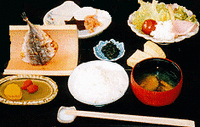
The other night, we were out for our favorite “fast” food, which is Japanese food. Not just sushi, we love miso soup. When I am sick, miso soup makes my throat feel better. I feel like I am eating good health, with all those little tofu squares and that seaweed, I feel like the miso soup will make me better. I also love salmon teriyaki, and chawan moushi, and a variety of lesser known Japanese foods.
And my husband said “isn’t miso soup what Japanese people have for breakfast?” and I didn’t know. He though miso soup and rice, so today I looked it up on Google, “Japanese breakfast”, and here is what I found:
Japanese breakfast consists of steamed rice, miso (soy bean paste) soup, and side dishes. Common side dishes are grilled fish, rolled omelet, pickles, dried seaweed, natto, salad, and more. Actually, you can make any dishes to go with rice and miso soup in Japanese breakfast. As you see in the photo, it’s an etiquette to place a bowl of rice on your left and to place a bowl of miso soup on your right side at the table.
It was on Japanese Breakfast About.com, along with ads for Japanese condoms (they are different from others?), a sushi making robot, a Samurai hotel and recipes for steamed rice, miso soup, natto (fermented soy beans), Nori (dried seaweed), Tamagoyaki (rolled omelet), grilled fish and pickles.
It seems to me that Japanese food is going through an internationalization process – sushi used to be all about rice and fish, and main dishes were simple, often stir fried, but all in all, very healthy. Now, I am seeing sushis with fried stuff in them, mayonnaise (?????), and we were offered a green tea ice-cream for dessert . . . that just doesn’t strike me as Japanese. Is it?
But this is for my husband – in case you really read all the way down – YOU WERE RIGHT. (I am obligated by family law to say that.)
Please Be Careful Out There
In Seattle, rain is common. Just a little rain, like today, is no big deal. In Seattle, we don’t have air full of sand, and then just a little rain, so it’s a whole new ball game.
I didn’t think it would be dangerous out driving today. I had two meetings; I had no idea I would see so many accidents. This one scares me. I hope the people got to the hospital OK.
Please, friends, be careful out there today. Get home safely.

Sebille Collection: New Addition
My husband and I are delighted by the variety of sebilles in Kuwait. I probably didn’t spell it right, and I am probably going to give some semi-erroneous information to my non-Kuwaiti, non-Muslim readers.
Sebilles are places where you can get sweet fresh water to drink or to wash yourself with before prayer. In some places, the government may provide them as a public service, and in other places you find organizations or individuals who will provide them as a charitable work, the way nobles in France would build a cathedral, or we might contribute a pew or a stained glass window to a church, or build a library for a city. In a hot country, sweet fresh water is a blessing to anyone who needs it.
My husband is really good at stopping when I want to take another photo, and even at spotting those we don’t already have. We love the creativity involved. There are some very utilitarian places, all stainless steel and refrigeration. But here are two of our favorite, more creative models. (Please, if I didn’t get this quite right, correct me in the comments section!)
The first is in near the Heritage Souks, back near the gold souks. It is a representation of the famous Kuwaiti Water Towers, which survived the invasion of 1990.

This one was in a residential area, but I have also seen a couple elsewhere. I think it represents the Liberation Tower. I understand that at night, the red light on top really lights up!

Mayonnaise, Aioli and Rouille
Home Made Mayonnaise – The BEST!
You are in Concarneau, a beautiful fishing village in the Breton part of France, and you are waiting for your frites. But it is not the frites that are taking so much time – the frites vendor is out of mayonnaise, and he is whipping up a fresh batch.
He uses a wire whisk, and starts dropping just tiny tiny drops of olive oil into the egg yolks, adding a little more, a little more, until it becomes a thin stream, and then a thicker stream, but the whisk never stops. The end result? Pure magic. Not quite so solid, but nothing like the mayonnaise we know.

We all know that mayonnaise substance that comes out of jars we buy at the grocery store. White to pale yellow, taste varying from fairly tasteless to a little vinegar-y. It’s best for helping wash sandwich meat down, but doesn’t really have a lot to recommend it.
French mayonnaise is totally different. It has TASTE! It’s hard to say which tastes better, the hot fresh French frites (fries) or the homemade mayonnaise, but as a combination – oh man, it is unbeatable. It’s fresh, it’s made with the best ingredients. And because it’s olive oil, well the fat calories aren’t quite so unhealthy. Right.
Here is the best news of all – you can have that same great tasting mayonnaise. With the advent of the blender, you don’t even have to separate the eggs from the yolks – the whipping motion of the blades emulsifies the oil and the eggs and acid (and flavorings)
Basic Mayonnaise
2 eggs
2 Tablespoons lemon juice (or vinegar, or balsamic vinegar)
1 Teaspoon prepared mustard (not powder)
1 Teaspoon salt
1 1/2 cups olive oil
(The very most important ingredient is the olive oil; use a very good olive oil, one with lots of taste. In my heart, I think French mustard {not French’s} is the best, and Sel de mer – French salt. If you’re going to make good mayonnaise, go all the way. Do it right. And have fun.)
Break eggs into blender container, add the acid (lemon juice or vinegar), mustard and salt. Turn blender on low. Let the blender blend about 30 seconds before adding tiny drops of olive oil. Add drops very slowly, letting the blender do its thing.
Take your time. From tiny drops, let the olive oil stream into the blender container in a tiny thin stream, and then a slightly thicker stream. The secret to success here is always taking it slow and easy, letting the eggs and acid emulsify the oil. About 3/4 way through the process, the mixture will suddenly thicken. Keep adding the olive oil slowly, until it is all incorporated.
At this point the mixture may still be pourable. Homemade mayonnaise is a little runnier than the kind you buy in the store. Pour it into clean jars and store it in the refrigerator immediately – it will thicken up as it refrigerates.
Disaster: It happens, even if you’ve been making mayonnaise for years. The solution is SO simple. Pour the mixture – it will look like salad dressing with pieces in it – into another container and wash the blender container thoroughly, with soapy water. Break another egg into the container – that’s all. Nothing else. Start the blender, and this time, go a little slower. The secret to making this work is going very very slowly, especially at the beginning. Trust me, the process itself is so fast that you can afford to pour slowly. And oh! the results! You are going to be addicted to your own mayonnaise.
Advanced Mayonnaise
Before you go any further, I want you to successfully make mayonnaise three times. You can put it in pretty jars and give it away; people will love it.
Aioli
The French in Provence, particularly in Marseilles, have a dish that I think was created just to eat mayonnaise. It is called “Aioli”, the same name as the name of the mayonnaise sauce served with it. The entire meal is cooked salt cod, and a variety of cooked vegetables, all served with liberal dippings into the aioli sauce.
To make Aioli, you pop four or five (peeled!) cloves of garlic in with the eggs and acid before you start adding the oil. It’s that simple. (Some people add breadcrumbs. I don’t.) Aioli is also good – GREAT – with turkey, on sandwiches, as a dip for vegetables, oh any excuse will do . . . it is SOOOO good.
Most sources say aioli can be kept about two weeks, refrigerated. Mine never lasts that long.
Rouille
Rouille is served atop a big bowl of Bouillabaisse (French fish soup with whole fish pieces). It is a fiery spicy hot mayonnaise.
Start as if for aioli, then add two teaspoons cayenne pepper. If your family likes things hot hot hot, you can add some of the ground red pepper pieces like you find in the spice markets, or you put on pizza slices in Italian restaurants – it gives it a little more texture. You can also add a piece or two of roasted red peppers, for more intense color. Add the pepper BEFORE you start adding the oil.
Again, some people add breadcrumbs. I don’t.
Fixing a Mayonnaise Failure
A very humid day can make mayonnaise problematic. The heavy atmosphere of an impending thunderstorm can make good emulsification impossible. Accidentally adding too much oil or having the eggs too cold can make a mayonnaise curdle. It doesn’t happen often, but don’t despair. It’s fixable. Just start over, with one egg, and slowly, slowly adding that curdled mixture. You will be amazed at how easy this is.
Even your first time, when you are nervous, it won’t take an hour, start to finish. By the time you’ve done it a time or two, it won’t take half an hour, from getting out the blender to putting the jars of fresh, delicious homemade mayonnaise into the refrigerator. And you will be ridiculously proud of yourself.
There are no preservatives, no added chemicals. I don’t know how long it will last, kept refrigerated – it just doesn’t last long enough to become an issue. C’mon. I dare you. Give it a try.
(Ooops – I just remembered, there is danger to some people from the use of raw eggs. Making mayonnaise with raw eggs isn’t right for everyone. You could get really sick.)
Cosmetic Danger: Repeated Usage
Women are always looking for cosmetic magic – I call it “Hope in a Bottle”. We are promised wrinkle-free skin, wonderful large lucious lips that never lose their color, potions that will make blemishes disappear, and fragrances that will get our man. Right.
Just before leaving Seattle, I hit the Lancome center at the local Nordstroms and stocked up. The dear woman there always gives me some little sample sizes to use on my long flights. I was telling my good friend about picking up some “hope in a bottle” and she said “oh, that sounds like something I need to try! Where do you get it?” We had a good laugh about that.
In the AOL section on Money and Finance today is a report about chemicals in your cosmetics. What shocked me is that the US uses many chemicals that the European Union has banned in their cosmetics. The article tells about how loosely the US is monitoring chemical additives in cosmetics – nail polishes, skin cremes, deodorants – chemicals that we are putting on our bodies every day, and no one knows the consequences of long term usage.

The report is from Consumer Reports.org, a highly regarded watchdog of American consumer products. Their magazine reports monthly on cars, appliances, drugs, children’s toys, and deceptive packaging.
What You Should Know About Chemicals in Your Cosmetics
You slather, spray, and paint them on and rub them in. Cosmetics are so much a part of your daily regimen that you probably never think twice about them. If they’re on store shelves, it seems reasonable to figure that they’re safe to use, despite those unpronounceable ingredient lists.
But at least some of what’s in your cosmetics might not be so good for you. One example is the family of chemicals known as phthalates (pronounced THAL-ates), which may be linked to developmental and reproductive health risks. The industry says phthalates are safe, but some companies have dropped them in response to public concern. Essie, OPI, and Sally Hansen, for example, are removing dibutyl phthalate (DBP), which is used to prevent chipping, from nail polishes. Other big-name brands that have reformulated products to remove some phthalates include Avon, Cover Girl, Estée Lauder, L’Oréal, Max Factor, Orly, and Revlon.
Take a Whiff of This
If you’re trying to cut back on phthalates, however, sticking with these brands may not make much of a difference. You’ll find phthalates in too many other personal-care products, including body lotions, hair sprays, perfumes, and deodorants. The chemicals are used to help fragrances linger and take the stiffness out of hair spray, among other reasons. They’re also in detergents, food packaging, pharmaceuticals, and plastic toys. And they have turned up in our bodies.
Although phthalates show up in so many places, they’re often absent from labels because disclosure is not always required. That’s the case with fragrances. We tested eight fragrances and although none of the products included phthalates in its ingredient list, they all contained the chemicals. Some were made by companies that specifically told us their products were free of phthalates, and two even say as much on their Web sites.
Getting your nails done or spritzing on your favorite perfume obviously isn’t going to kill you. But the health effects of regular long-term exposure, even to small amounts, are still unknown.
Makeup wakeup call
Phthalates, a family of chemicals used in cosmetics, may pose significant health risks but:
· They’re found in perfumes, nail polishes, and other products we use every day.
· Scientists say they’re found in our bodies as well.
· In many cases, they’re not listed on labels, so they can be difficult to avoid.
· Some manufacturers are removing them from their products, but the FDA has not restricted their use.
Companies that have eliminated phthalates are no doubt getting the message that people are paying more attention to ingredients. But public concern isn’t the only factor driving the reformulations. Another reason is a European ban. Although the U.S. has outlawed just eight cosmetic ingredients, the European Union has banned more than 1,000. (emphasis mine) For companies that make cosmetics, complying with E.U. rules makes good business sense. It’s more efficient to sell the same product worldwide. It’s also good PR. About 380 U.S. companies have publicly pledged their allegiance to cosmetic safety by signing the Compact for Global Production of Safe Health & Beauty Products, under which they voluntarily pledged to reformulate globally to meet E.U. standards.
The reformulation trend is likely to gain further momentum from the California Safe Cosmetics Act of 2005, which took effect only this year. Manufacturers that sell over $1 million a year in personal-care products in the state must report any products containing a chemical that is either a carcinogen or a reproductive or developmental toxic agent. Among those that must be disclosed are the phthalates DBP and di(2-ethylhexyl) phthalate (DEHP). California plans make this information public, possibly on the Web, so some companies may choose to remove rather than report the ingredients.
Guinea pig nation
Despite the laws, pacts, and reformulations, questions about safety remain. Cosmetic industry critics argue that the Food and Drug Administration has not told companies what “safe” means, leaving them to make their own decisions. In fact, with cosmetics, the government generally takes action only after safety issues crop up.
Take the case of Rio hair relaxers. In December 1994, the FDA warned against two products sold through infomercials after consumers complained about hair loss, scalp irritation, and hair turning green. Rio announced that it would stop sales but there were reports that it continued to take orders. The California Department of Health then stepped in to halt sales and in January 1995, the U.S. Attorney’s Office in Los Angeles filed a seizure action. By then, the FDA had received more than 3,000 complaints. Rio later reformulated and renamed its products.
The Rio case illustrates how holes in the government’s cosmetic regulatory system can hurt consumers. The industry essentially regulates itself. The Cosmetic Ingredient Review panel, made up of physicians and toxicologists and funded by the industry’s leading trade group–the Cosmetic, Toiletry, and Fragrance Association (CTFA)–assesses ingredient safety. Another industry group reviews fragrances and helps create safety standards. But manufacturers aren’t obligated to do anything with this information.
“We’re working on the honor system when it comes to cosmetics safety,” says Jane Houlihan, vice president for research at the Environmental Working Group (EWG), a research and advocacy group. “In the absence of federal standards, we have a huge range of safety in the products we buy every day.”
The FDA has made efforts to improve its ability to spot problems and issue warnings. The agency now has a computerized database, called CAERS, that collects reports of problems such as allergic reactions. Complaints can be sent via the FDA Web site or by calling a district office. But Amy Newburger, a dermatologist at St. Luke’s-Roosevelt Hospital Center in New York City and a former member of the FDA’s General and Plastic Surgery Devices Panel, says her experiences make her wonder about the system’s effectiveness. In one case, she filed a report by phone and on the CAERS system after she and several of her patients got a rash with blisters after using an anti-aging treatment. It wasn’t until a year later, in November 2006, that the FDA sent an e-mail asking her to complete some forms, she says. The FDA responds that it doesn’t provide information or feedback to people who file complaints. It simply routes them to the appropriate office for evaluation. The FDA says it may also send reports to companies.
So what are the risks?
Scientists know very little about how repeated exposure to small amounts of phthalates in cosmetics may affect your health, if at all. But some studies suggest that the chemicals are present in our bodies.
In 2005, the federal Centers for Disease Control and Prevention reported that it had found breakdown chemicals from two of the most common cosmetic phthalates in almost every member of a group of 2,782 people it examined. A separate study published in the journal Environmental Health Perspectives (EHP) in 2005 showed that men who used the most personal-care products, such as after-shave and cologne, had the highest urinary levels of a breakdown product of diethyl phthalate (DEP).
In rodent studies, phthalates have caused testicular injury, liver injury, and liver cancer. We found no such clear hazards in human research. But we did find studies suggesting that phthalates may be associated with other health issues, including the following four examples from one source alone, EHP, which is a leading journal published by the National Institutes of Health. In 2000, EHP published a small study that said elevated blood levels of phthalates were associated with premature breast development in young girls. Another report in 2003 found that men with higher concentrations of two phthalate breakdown products in their urine were more likely to have a low sperm count or low sperm motility. A study published in 2005 said women with higher levels of four phthalate compounds in their urine during pregnancy were likelier to give birth to boys with smaller scrotums. And a 2006 report cited low testosterone levels in male newborns exposed to higher levels of phthalates in breast milk.
Experts in the industry and the government are aware of such reports but say there is no cause for alarm. The FDA, for instance, concluded after a thorough review of the literature that “it’s not clear what effect, if any, phthalates have on health.” And the CTFA, the industry trade group, notes that government and scientific bodies in the U.S. and Canada have examined phthalates without restricting their use in cosmetics. After the 2005 report linking phthalate exposure to smaller scrotum size, in particular, the trade group said, “The sensational and alarming conclusions being drawn from this single study are completely speculative and scientifically unwarranted.”
Even companies that have dropped phthalates from products say they are safe. “This policy is driven by a wish to allay public concern and does not reflect concern with the safe use of the ingredients,” Avon said after announcing that it would cut DBP from its product line. John Bailey, the CTFA’s executive vice president for science, says ingredients like DBP in nail polish are simply not a hazard in such small amounts.
On the other side are some environmental and public-health advocates who say possible carcinogens and reproductive toxins do not belong in cosmetics, no matter how small the amount. “We take issue with the idea that a little bit of poison doesn’t matter, because safer alternatives are available,” says Stacy Malkan, communications director of Health Care Without Harm. “Companies should be making the safest products possible, instead of trying to convince us that a little bit of toxic chemicals are OK.” While the scientific jury is still out, we at ShopSmart believe it makes sense to reduce your exposure to phthalates, especially if you’re nursing, pregnant, or trying to become pregnant.
BBC: Dog Owners Lead Healthier Lives
(See Statistics: “Lies, Damn Lies and Statistics” below for perspective. Ask “who did the study? What was the purpose of the study? Who profits?”)
This article is from today’s BBC News online. You can read the whole report here.
Dogs can provide companionship
If you want to live a healthier life get a dog, research suggests.
The companionship offered by many pets is thought to be good for you, but the benefits of owning a dog outstrip those of cat owners, the study says.
A psychologist from Queen’s University, Belfast, said dog owners tended to have lower blood pressure and cholesterol.
Writing in the British Journal of Health Psychology, she says that regular ‘walkies’ may partly explain the difference.
Dr Deborah Wells reviewed dozens of earlier research papers which looked at the health benefits of pet ownership.
In some cases, the social support offered by an animal is greater than the support than another human could offer
Dr June McNicholas
Health psychologist
She confirmed that pet owners tended in general to be healthier than the average member of the population.
However, her research suggested that dog ownership produced more positive influence than cat ownership.
As well as lower blood pressure and cholesterol, she said dog-owners suffered fewer minor ailments and serious medical problems.
There was also the suggestion that dogs could aid recovery from serious illnesses such as heart attacks, and act as ‘early warning’ to detect an approaching epileptic seizure.
Stress-busting
Dr Wells said the precise reason for the benefits was not totally clear.
“It is possible that dogs can directly promote our well-being by buffering us from stress, one of the major risk factors associated with ill-health.
read the rest here.
My comment: I hate a study that says dog owners are healthier than cat owners, but they say that the regular walking might be a factor. Have to admit, that is true. I have a leash for my cat. When I tried to put the body harness on him, some primitive switch deep inside switched on, and the Qatteri Cat went bat-crazy, clawing, biting, twisting, hissing . . . never tried it again.
We tried walking a cat once – we’ve been told it can be done. Our experience we called “taking the cat for a drag.” I’ve never met a cat who would happily take to a leash.
And I never met a dog who wouldn’t go for a walk with great enthusiasm. They wiggle with uncontrollable delight when they see the leash, wiggle so hard you can barely get the leash attached. They bolt out the door, sniff the air, and prance as you race to keep up.
You see life differently when you walk a dog. It’s all “go! go! go!” and then all of a sudden it’s “Hey! What’s this? Some dog peed here! Woooof!” You really do see the world in a blade of grass, when you are a dog, or a hedge, or a pile of cat poop. (“No! No! You can’t eat that!! No!”) Their love of life is infectious, and probably even the stop and go kind of walking you do with a dog is better than no walking at all.
Taking “Normal” for Granted
Today a good friend sent a story about a guy driving a very expensive car and a kid hitting the car by throwing a brick. The guy stops his car, ready to kill, and the kid cries and says it was the only way he had to get his attention, he needs help getting his brother back into his wheelchair. The guy instantly goes from raging anger to compassion, and keeps the dent in the side of his car to remind himself that it shouldn’t take a brick to get his attention.
In the story, it says sometimes God uses a brick to get our attention.
I know, I know, you wonder where I am going with this.
It brings two very simple things to my mind. First, I have bored you more than once with my woes of jet lagging. Right now, I am sleeping great, although I am still falling asleep around nine at night, I am sleeping through the night. Thanks be to God! I wake up in the morning thankful for something so simple – a good night’s sleep.
Sleep isn’t so simple for those who suffer sleep deprivation – and their name is legion. My heart especially goes out to young mothers with their first baby . . . no one tells you how sleep deprivation can change your life. You think you can handle anything. Sleep deprivation is a big brick thrown into your life – it really gets your attention. Without adequate high quality sleep, life loses its lustre, and the simplest thing can be overwhelming.
Second, this is the time of year when many blogs feature colds and flu and lingering illnesses. I rarely get sick, but when I do – oh, I am such a baby. I don’t want concerned people around, I just want to be left alone to suffer. I just want the sickness to be OVER. And then, one day when it is gone – oh! how good it feels, just to be NOT sick! And I thank God for the every day blessing of good health!
We take so much for granted as we go through our daily lives. We forget how really good just being “normal” can be.
But maybe these are the bricks being thrown into our lives to get our attention, to help us to be thankful for our blessings?
Maybe slowing us down helps us to see things we might otherwise speed right by in the busy-ness of our active lives?
Maybe this is all a part of being thankful for the bad things that come into our lives, as well as the good? Alhamd’allah!
I think this is the first day of the Islamic New Year. If so, wishing my Moslem friends all the blessings of a new and, God willing, abundant and peaceful year.
Recent Comments
ExpatAlien on What Country am I Living … intlxpatr on Yellowstone: Old Faithful to C… Michelle on Yellowstone: Old Faithful to C… Cathy on No Grown-Ups in Charge intlxpatr on Waiting for Snow Wikipedia Donate Button

Amazina


Early Voting in Florida


 Here There and Everywhere