Blinded by the Light . . .
Yesterday I had my annual eye exam. This is the South. I could hear them all talking in the back, talking about personal things, and OTHER PEOPLE! I used to run a library, and one of the very very first things I would tell my library workers was NO PERSONAL CONVERSATIONS when we had the library open. Keep your private life private! I’m not all about the library being quiet, but I am about it being not-annoying. Hearing gossip, hearing details of your last medical procedure, hearing about Maizie, bless her heart, who just lost another husband – these things are not my business, nor the library customer and are not appropriate for a discussion where the public may be listening in, even when they don’t want to be.
OK, OK, I know these are dated professional standards, but I can’t help it. Please. Do not burden me with overhearing your latest disaster unless we are friends and sitting down together over a cup of coffee.
At 30 minutes past my appointment time, I went back to see if my paperwork had been misplaced only to be told they were just a little behind and I would be taken soon. Fifteen minutes later I was in the office.
Now, when they dilate your eyes, you can still drive yourself home. It was a little bright, but I managed. Things are a little blurry.
Fast forward to last night, driving home, WOW. Every streetlight, every headlight, even the beautiful thin crescent moon had a spiky halo. It was like I had that sparkle lens you can put on your camera, only this was on my eyes.

This morning when I got up, I thought it would be all over, but my eyes are still dilated, and still sensitive. They must have given me a wallop of a dose.
But for the drive home, it was all Lucy in the Sky with Diamonds . . . it was so incredibly beautiful, it felt sort of surreal.

Swapnil Chaturvedi: Private Excretion
There really are everyday heros, if you have the eyes to see. This man is bringing dignity to the poor, who have no place to pee and poop privately. He left a fine job in the United States to start a campaign to provide private toilets for the countless poor in India who live without any toilets at all, and are forced to perform their daily functions in public.
Swapnil Chaturvedi’s life had all the trappings of the American dream — a college degree, prestigious engineer job, wife and daughter.
But when he returned home to India in 2007 after four years of living comfortably in the U.S., he was horrified by the country’s lack of basic sanitation, and decided to leave his cushy life behind to help, Mental Floss reported.
Fifty-three percent of Indian households defecate in the open, because they don’t have access to working toilets — a practice that leads to malnutrition, stunted growth, poor cognition, disease and other hampering conditions, according to the World Bank.
Even when there are toilets available, many locals decline to use them because they’re not vented properly. Women and girls often choose to defecate outside because the communal restrooms aren’t secure — leaving users vulnerable to getting harassed and attacked by onlookers.
“Men often gather around toilets and if we ignore them they try to touch and feel us,” Afsana, a young resident of Bawana, told CNN-IBN.
Women like Afsana are the reason that Chaturvedi has committed to his work.
“If somebody asked me why I started this business, there is only one reason: for women’s dignity,” Chaturvedi said in an interview about his company.
In 2011, he launched Samagra Sanitation –- a program based in Pune that works with existing communal restrooms and incentivizes locals to change their hygiene habits.
The company improves ventilation, accessibility and cleanliness in communal bathrooms. It also turns locations into community centers that offer rewards program for users, among other perks, to inspire people to take advantage of the facility, according to the company’s website.
Samagra, which is a Gates Foundation grantee, dubbed its program the “LooRewards Model.” It has already gotten involved in three slums in Pune, providing services to more than 3,300 people daily.
But Chaturvedi says he’s just getting started. He wants to see his program expand to help more than 50,000 people daily, which is why he launched an IndieGoGo campaign in the hopes of raising $50,000 to achieve his goal.
“We can live without Facebook, we can live without smartphones,” he said. “But we cannot live without relieving ourselves.”
Six Foods Healthy Eaters Won’t Touch
I love this article from AOL Everyday Health News because they make some great suggestions – like if you really love salted nuts, mix them half and half with unsalted nuts to cut the amount of sodium you take in. We do this with breakfast cereal; we mix Bare Naked Nuts and Fruits with Quaker Old Fashioned Oats; it still has enough sweetness, and we add a little cinnamon and sunflower seeds to pump it up.
Thursday, March 27, 2014
Most of us are familiar with the typical no-no foods like sugared soda or anything deep-fried, but have you ever wondered what the experts steer clear of? Everyday Health’s nutrition mavens dish on the foods they won’t eat, and share tips for making healthier swaps.
1. Hot dogs, bacon, and sausages. Bonnie Taub-Dix, MA, RDN, CDN, Everyday Health columnist and author of Read it Before You Eat It, said she would never eat these processed meats, and for good reason: A diet high in processed meats like bacon and sausage can increase your risk of dying from cancer or cardiovascular disease, according to recent research.
Processed meats, like pepperoni, hot dogs, sausage, bacon, and deli meats, are best left for special or rare occasions like a trip to the ballpark or a family event. If beef or pork hot dogs and sausages are staples in your diet, Taub-Dix suggests chicken dogs or sausages may be healthier bets. But beware the health halo of a food like chicken sausage, she said. Just because food items have some healthy qualities — like baked chips or 100-calorie snack packs — doesn’t mean they’re really good for you.
As with any processed food, watch out for sodium content. The Dietary Guidelines for Americans recommend limiting sodium to less than 2,300 mg a day — or 1,500 mg if you’re age 51 or older, or if you are African American, or if you have high blood pressure, diabetes, or chronic kidney disease.
Love bacon but hate the health repercussions? Use seasonings and spices like paprika and chipotle to add that smoky flavor to your cooking, suggested Taub-Dix.
2. Sugary coffee creations. “Those fancy blended drinks at coffee shops can have upwards of 400 calories and 15 teaspoons of sugar…yikes!” said Johannah Sakimura, MS, the writer behind the Everyday Health column, Nutrition Sleuth.
Unlike naturally-occurring sugars like those found in fruits (fructose), added sugars — syrups or sugars added to food items during preparation — can be harmful to your health. In fact, the added sugar Americans consume on a daily basis can more than double the risk of death from heart disease. The American Heart Association recommends no more than six teaspoons or 100 calories a day of added sugar for women, and no more than nine teaspoons or 150 calories a day for men.
If you can’t live without your favorite sweet coffee drink, Sakimura recommends indulging less often. “If you want to enjoy one occasionally as a dessert, that’s totally fine…but they definitely shouldn’t be a daily or even weekly order,” she said.
3. Stick margarines. Both Sakimura and Taub-Dix said they avoid trans-fat foods, which can raise your heart disease risk by boosting levels of bad cholesterol (low-density lipoprotein — LDL) and lowering levels of good cholesterol (high-density lipoprotein — HDL).
Sakimura avoids stick margarines because most are still made with partially hydrogenated oils, meaning they’re loaded with trans fat. The American Heart Association recommends limiting the amount of trans fats you eat to less than one percent of your daily total calories. So, if you’re eating 2,000 calories a day, that’s just 20 calories. And since small amounts of trans fats occur naturally in some animal products, like meat and dairy, you’re probably meeting the 20-calorie threshold without reaching for factory-produced trans fats like those found in some margarines.
“When I occasionally make a baked good that requires solid fat, such as certain cookie or cake recipes, I always use butter. Butter does contain a large amount of saturated fat, but trans fats are far worse for your health,” she said.
4. Processed pastries. Everyday Health’s nutrition expert Maureen Namkoong, MS, RD, said she never eats processed pastries like Pop-Tarts, Twinkies, Devil Dogs, HoHos, or Hostess Cupcakes.
“The shelf life makes me nervous, too many preservatives, too many chemicals, too little taste,” said Namkoong. She prefers “real” desserts instead of these sugary snacks.
While the jury is out on the long-term effects and risks of preservatives in shelf-stable foods, a good rule of thumb is to eat fewer packaged, processed foods and more whole, fresh foods like fruits, vegetables, healthy fats and oils, and lean meats and fish.
Pay attention to frequency and quantity when you indulge in an unhealthy food.
5. Canned frosting. This is another trans fat offender that Sakimura avoids. When she wants to enjoy a nicely-iced dessert, she makes the icing from scratch.
“Hopefully, the proposed FDA ban on artificial trans fat will be finalized soon and we won’t have to worry about trans fat-laden products any longer,” Sakimura added.
Always read the product label for trans fat info. Why? Because right now, the FDA allows companies to round trans fat down to zero grams if the product contains less than 0.5 grams per serving.
“You have to turn it over and take a look at the label for hydrogenated fat or partially hydrogenated fat – that means trans fat,” Taub-Dix noted. There are bound to be similar products that aren’t loaded with trans fats, so opt for those instead, she suggested.
6. Sugar-packed cereals. Namkoong said she never eats sugary cereals because they’re not filling enough and have too little fiber. “The way I see it, the calories and sugar budget are better spent on a yummy dessert that I’ll enjoy more,” Namkoong said.
Sugary cereals your go-to guilty snack? Lower your sugar intake with this tip: “If you really like sugary cereals, and you know that they aren’t good for you, then mix them in a bowl with a cereal that is very low in sugar,” Taub-Dix recommended, so at least you’re getting less sugar per serving.
How to Change Your Taste for ‘Bad’ Foods
A registered dietitian or nutritionist can create a diet geared to your specific needs, but if that’s not an option then tailor your taste on your own by diluting your favorite foods, said Taub-Dix.
How do you dilute your foods? Basically, as noted above with sugary cereals, mix half of the bad stuff with half of the good stuff.
“If you have high blood pressure, and you know salted nuts aren’t great for you, take a handful of salted nuts and mix in unsalted nuts, too,” recommended Taub-Dix.
By diluting unhealthy snacks, you’re tailoring your tastes and gradually getting used to food that’s healthier. Another tip from our experts: Pay attention to frequency and quantity when you indulge in an unhealthy food.
“It’s not just about the food. It’s about how often you’re having it and how much of it you’re having,” said Taub-Dix.
MERS Virus Found to be Widespread
Thank you, John Mueller, for this fascinating article from Science NOW:
Middle Eastern Virus More Widespread Than Thought
 Bernard Gagnon/Wikimedia CommonsTrail of infection. Scientists have found MERS virus in camels from Sudan and Ethiopia, suggesting the virus is more widespread than previously thought.
It’s called Middle East respiratory syndrome, or MERS, after the region where almost all the patients have been reported. But the name may turn out to be a misnomer. A new study has found the virus in camels from Sudan and Ethiopia, suggesting that Africa, too, harbors the pathogen. That means MERS may sicken more humans than previously thought—and perhaps be more likely to trigger a pandemic.
MERS has sickened 183 people and killed 80, most of them in Saudi Arabia. A couple of cases have occurred in countries outside the region, such as France and the United Kingdom, but those clusters all started with a patient who had traveled to the Middle East before falling ill.
Scientists have uncovered more and more evidence implicating camels in the spread of the disease. They found that a large percentage of camels in the Middle East have antibodies against MERS in their blood, while other animals, such as goats and sheep, do not. Researchers have also isolated MERS virus RNA from nose swabs of camels in Qatar, and earlier this week, they showed that the virus has circulated in Saudi Arabian camels for at least 2 decades.
Malik Peiris, an infectious disease researcher at the University of Hong Kong, and colleagues expanded the search to Africa. In a paper published last year, they showed that camels in Egypt carried antibodies against MERS. For the new study, they took samples from four abattoirs around Egypt; again they found antibodies against MERS in the blood of 48 out of 52 camels they tested. But the most interesting results came from taking nose swabs from 110 camels: They found MERS RNA in four animals that had been shipped in from Sudan and Ethiopia.
Peiris cautions that it is unclear whether the infected camels picked up the virus in Sudan and Ethiopia or on their final journey in Egypt. Abattoirs could help spread MERS just like live poultry markets do for influenza, he says. “You cannot point the finger exactly at where those viruses came from,” he says. “But I would be very surprised if you do not find the virus in large parts of Africa.”
If so, that changes the picture of MERS considerably. No human MERS cases have been reported from Egypt or anywhere else in Africa, but if camels are infected, they may well occur, says Marion Koopmans, an infectious disease researcher at Erasmus MC in Rotterdam, the Netherlands. “It would be important to look systematically into that,” she writes in an e-mail. “Health authorities really need to test patients with severe pneumonia all across Africa for MERS,” Peiris says.
The researchers were able to sequence the virus of one of the camels almost completely, and it is more than 99% identical with viruses found in people. “I would be very surprised if this virus cannot infect humans,” says Christian Drosten, a virologist at the University of Bonn in Germany. But the virus also shows a few intriguing differences from known camel samples, he says. “We have to analyze this carefully in the next few days, but it looks like this sequence broadens the viral repertoire found in camels,” he says. If the viruses found in camels show more genetic variation than those isolated from humans, that is further strong evidence that camels are infecting humans and not the other way around.
Anthony Mounts, the point person for MERS at the World Health Organization in Geneva, Switzerland, says that it is very likely that human MERS cases occur in Africa. “Wherever we find [infected] camels, there is a good chance we’ll find [human] cases if we look closely,” he says. And humans may be exposed to camels in Africa much more often than in the Middle East: There were about 260,000 camels in Saudi Arabia in 2012, but almost a million in Ethiopia and 4.8 million in Sudan, according to the U.N. Food and Agriculture Organization. The more human cases there are, the higher the risk that the virus will one day learn how to become easily transmissible between people, which could set off a pandemic.
The researchers also looked at the blood of 179 people working at the camel abattoirs for antibodies against MERS virus, but found none. That shows that the virus is only rarely successful in infecting human beings, Peiris says. “What we need to find out now is the reason for these rare transmissions.”
Sugar Eight Times More Addictive than Cocaine
This is from AOL News: “The rats go for the sugar and it is eight times more addictive than cocaine” in studies done on sugary foods.
A U.S. doctor is making it his mission to publicly highlight some scary effects sugar has on the body. The chairman of the Institute for Functional Medicine says we’re becoming more dependent on sugary foods and drinks – saying they’re even more addictive than cocaine.
On”CBS This Morning,” Dr. Mark Hyman said, “In animal studies, they find that the rats go for the sugar and that it’s eight times as addictive as cocaine. Small amounts of sugar can be part of a normal diet, but most of us are addicted to sugar and don’t know it.”
Hyman himself has gone as far as calling sugar and sugary foods “deadly.”
He told the New York Daily News that “sugar is the new nicotine. And worse, sugar actually causes diabetes and obesity.”
The doctor’s trying to help people find ways to lessen their dependence on sugar with tips from his book, “The Blood Sugar Solution 10-Day Detox Diet.”
On the book’s website, Dr. Hyman says 600 people took part in the diet, which encourages healthier eating habits. Together, they lost more than 4,000 pounds, and their average blood pressure fell by about 10 points.
Dr. Hyman told New York Daily News the average American eats 152 pounds of sugar a year. Whoa.
My New Closest Friend: FitBit One
My sister was bouncing around as I stayed at her house in August, and showed me the reason: she was wearing a FitBit. It is tiny, it clips right on to your clothing, and it syncs with your computer – or your smart phone – and helps you see your daily activity level.

You remember the 10,000 Steps program? I wrote about it in 2008? The FitBit counts your steps. It tells you how many flights of stairs you have gone up. (We bought a two story house on purpose, and today my FitBit tells me I am a CHAMP on the stairs. I guess it doesn’t know that going up and down the stairs is just what you do when you have a two story house, but hey, I get credit!) It is so much better than the pedometer, it counts better. It can also monitor my sleep, if I figure it out.
My sister loved this device; claims it keeps her motivated to keep moving, and all the latest studies show that we really, really need to keep moving. It is, literally, a matter of life or death. You move it – or you lose it.
I finally got one. I was kind of reluctant to have this little fitness nanny prodding me all the time, but actually, it is turning out to be more fun than annoying.
Thanks, Sis. Great recommendation.
Saudis Protest Female Death While Paramedics Barred from Campus
191 Nepali Laborers Died in Qatar in 2013
From Agence France, a report that 191 Nepali laborers died in Qatar in ONE year:

Nearly 200 Nepali migrant workers died in Qatar last year, many of them from heart failure, officials said Monday, figures that highlight the grim plight of labourers in the Gulf nation.
Tens of thousands of impoverished Nepalis head every year to Qatar, where a construction boom is gathering pace as it prepares to host the 2022 football World Cup.
The Nepal embassy in Doha said it registered 191 deaths last year compared with 169 the year before, with a foreign ministry official describing many of the deaths as “unnatural”.
“In the year 2013, a total of 191 Nepali migrant workers died in Qatar,” Harikanta Paudel, a senior embassy official, told AFP by telephone.
“The highest number of deaths occurred in July when 32 workers died,” Paudel said.
Qatar is under mounting pressure over poor conditions for migrant labourers, particularly during the blisteringly hot summer, in the gas-rich nation’s booming construction industry.
A Kathmandu-based foreign ministry official told AFP that a third of the deaths recorded were due to “unnatural” heart failure.
“Young and healthy men in their twenties and thirties have died… it is unnatural,” said official Subhanga Parajuli.
“Cardiac arrest is followed by traffic accidents as another main cause of death. The third cause of death is injuries during work,” Parajuli said.
An Amnesty International report released last November said migrant workers in Qatar endured a series of abuses including “non-payment of wages, harsh and dangerous working conditions, and shocking standards of accommodation”.
The rights group said its researchers overheard one construction firm manager use the term “animals” to describe migrant workers, while a labourer told the watchdog that “Nepalis are treated like cattle”.
Qatari authorities last October said allegations of abuse of labourers working on World Cup facilities were exaggerated but insisted they took such claims seriously.
More than one million Nepali migrant workers toil in the Gulf region and Southeast Asia. Qatar alone hosts around 400,000 Nepalis as part of its two-million strong migrant workforce.
Chilly Pensacola Sunrise
Today is the annual homeless services day, and homeless count day when hundreds of Pensacolians leave their beds at o-dark-thirty to serve our brothers and sisters who don’t have beds to sleep in, don’t have a roof over their head, don’t always have something to eat.
The homeless love Pensacola because it in so temperate, but even the temperate climate of Pensacola can be occasionally brutal, as it is right now. The Waterfront Mission has said it will take in anyone who comes, to shelter them from the harsh mid-freezing temperatures.
It’s not like Pensacola loves the homeless. The city has passed ordinances preventing them from begging, and from soliciting at the traffic stops. On the other hand, it’s not like they are going away, so charitable organizations in Pensacola do their best to care for the homeless population, providing cold weather shelter, meals, toiletries, places to collect mail and to bathe. There is a free health clinic. There is occasional dental screening. There are veteran services, who try to house and take care of our walking wounded. There is even a service for the pets of the homeless, in case of hurricane or similar emergency.These things make me very proud of Pensacola.
This morning dawned very cold:


AdventureMan crawled out of bed into the cold and chill, donned several layers of clothing and headed out to help with the count, and with serving around 500 people a hot meal. He does it because he loves doing it and I smile thinking how “The Lord loves a cheerful giver.”
Manyang: Our Friend in South Sudan
God willing, in life, people cross paths and share their stories. I told you about Manyang, how he visited us near Christmas in 2012 and how his story changed our lives. Now, when we hear stories of the South Sudan, it is immediate, it is real, because we know the story of a young boy grown to be a very fine man, who survived the chaos and horrors of the janjaweed invasions and tribal conflicts before his country attained nationhood.
I recently wrote to Manyang, hoping he is still alive. It was that basic. I asked him, if he could, just to let us know he was alive, and that whether he could respond or not, our prayers were with him, for him, his family and his country.
This morning, by the grace of God, I received this wonderful response. Please, join your prayers with ours for Manyang/David, and his country, South Sudan, for peace, safety and prosperity, for justice and equitable distribution of resources.
I am glad to hear from you again. I have been talking of the nice people I was able to meet in Pensacola. Whenever, I talk about these people you are the first people I talk about. I still remember the nice dinner we had in your house.
I think God touched you to worry about my safety. You might have heard from news report the critical condition my country – South Sudan is going through. It is just like the story of my childhood to many other children now.
A political row in the ruling party here, turned violent in Juba, the capital of this country on December 15, 2013. Heavy artillary were fired and sporadic gunfire broke out in most part of the city. it was a genesis of another war which is now going on. Thousands of people were killed only in Juba.
I was in Bor, the captal of Jonglei State, about 125 miles north of Juba. The violent in Juba quickly spread to us in Bor and I was forced to flee to the bush with my family and the rest of the civil population as the town was quickly seized by anti-government forces. I carried my back on my head, walk long distant and drink dirty water again and eat grains when I was in the bush for seven days.
(This is a screenshot from Google Maps; Bor is the “A” north of Juba)

(These are photos from Manyang’s BBC blog, referenced below. Please go there to read more in his own words about the terrors of the South Sudan chaos.)

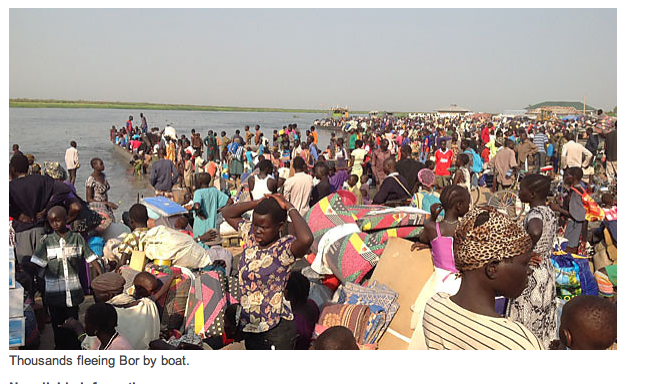
The government forces recaptured the town and we returned to the town. Many more people were killed and bodies were lying everywhere and there was a terrible smell. The rebels killed everyone they found in the town including old women, lame, deaf and all vulnerable people. And I was wounded in the upper left arm by a stray bullet of soldiers celebrating. The wound has healed and I am fine now.
It did not take long for the rebel to recaptured the town of goverment forces for a second time. And I was force to flee, this time cross the River Nile by boat to a makeshift camp across the river. This was where I got an access to go to Juba which was abit calm at the time. I am now in Juba staying in fear, not knowing where else to go.
God was speaking to you those conditions I was in in December and part of January. We spent Christmas and New Year Day on the run. I am glad for your prayers were able to lead me out of that mess. I still have hope that your prayers will continue to press political leaders to reach a peaceful solution to this crisis.
I have a live blog where I am sharing my bush experiences. You may have a look.
http://www.bbc.co.uk/blogs/bbcmediaaction/posts/Pens-down-in-South-Sudan
Share my message with the rest of the great people of Pensacola. My heart is always there with you.
Blessings
Manyang
Recent Comments
ExpatAlien on What Country am I Living … intlxpatr on Yellowstone: Old Faithful to C… Michelle on Yellowstone: Old Faithful to C… Cathy on No Grown-Ups in Charge intlxpatr on Waiting for Snow Wikipedia Donate Button

Amazina


Early Voting in Florida


 Here There and Everywhere