A Drive to Atlanta; Cars on their Last Legs
We decided to take a quick trip to to Atlanta, and unfortunately for me, we are not staying anywhere near the Queen of Sheba Ethiopian Restaurant we tried the last time we came through.
We got a later start than usual; we had lunch at one of our favorite lunch stops in Pensacola, The Bangkok Garden, then got on the road. AdventureMan had a full and physically active morning, so after the first thirty minutes, I drove and he snoozed.
I love to drive while he is snoozing. It makes me feel so competent and protective, and like a full partner. He sleeps so deeply and happily, it makes me feel trusted. He sleeps like all is well with the world. He sleeps like that for two hours; fortunately I took a good look at the map and directions and managed the right turns onto the right roads.
Driving keeps me alert, and it also gives me time to think. As I am driving this time, I am thinking that I have never before seen so many cars abandoned along the highway. I know cars get a ticket, and then if they are not towed within a certain time the state confiscates them, and probably junks them. It’s not unusual to see an abandoned car now and then, but there are so many this time, so many that it catches my attention.
I worked for a while with the homeless, the less visible homeless, the ones who are not out begging on the streets or carrying their lives with them in a backpack. The homeless I worked with were those who had lost homes, and were staying with people or living out of their cars. Their situation was desperate, and their car, usually old and faltering, was critical to them working whatever small job they could find to keep going. What they earned was not enough to pay rent on any decent place, and they never earned enough to be able to save up for that first and last month’s rent required by most renters. They didn’t have a rental history or a credit history, which made them unlikely to get into housing that screened.
The cars I saw abandoned along the road looked a lot like the cars my homeless people drove. Cars on their last legs. I wondered about the people who were forced to abandon their cars, I wish them well, I hope they are able to claim and fix their car and to go on with their lives.
Or maybe, I think, maybe it is the heat. There has been a huge heat wave, following on a deluge of rain. The temperatures are in the 100’s, hotter than in Pensacola where when it gets hot – and humid – we usually have breezes coming in off the Gulf to help us cope. I remember Kuwait, where cars littered the sides of the major highways, and how heat just wore the cars out. In a country with a desperate need for air conditioning (welll, in my perception, remember I am an Alaska girl) the wiring in the cars was a constant fire hazard.
AdventureMan woke up a little outside Montgomery and we had some of our great road-trip conversations. He took over driving as we neared Atlanta; it was time for my trip-reward, I got to have a Wild Berry Smoothie from McDonalds. Yes, we have McDonalds in Pensacola. No, I do not allow myself to have a Wild Berry Smoothie often. Yes, I know they are made with “real fruit.” No, I have not checked the sugar content, I don’t want to know, but it is why I do not allow myself to have more than one every couple months. And only a small one. It keeps it special.
So I am using the iPhone and directions to navigate us through Atlanta and on to GA 400 going north, and if you know Atlanta, you will know what I am talking about. First, coming into Atlanta, we saw huge signs telling us downtown was congested – and it is drive time home, around dinner time, but fools rush in and we decided everyone else could take the ring road and our directions showed us going through central Atlanta would be the fastest.
We saw billowing flames, and smoke made it hard to see, and there was a huge, uncontained brush fire along the side of the road – the other side, thank God. Traffic on the other side was backed up and more than congested; it was at a stand still. Another mile, and now there is billowing black smoke, and I see a sight I haven’t seen since Kuwait, a big black SUV on the side of the road, totally consumed by fire, and three police cars trying to get through the backed up, bumper-to-bumper traffic, and a fire truck and an ambulance, but they can’t get through – again, on the leaving town going south side of the road, not the going north side we were on.
Then we get to a place where one major road becomes two different roads. The iPhone isn’t helping, I can’t figure out the number of the road it is that we are supposed to take, and when I try to make it bigger, nothing happens, we are underneath an overpass and I think there is a problem with reception. As soon as I tell him we are supposed to go right, we go right and then our road goes under the other road and we are going left, and the little blue ball has left the road. Fortunately, we need gas, so we get to a station and I have reception again and show AdventureMan how we have to get back on 75, to a short distance, get in the lane for 85, make a loop and end up going North again.
Thank God he had a nap! Sometimes, if it is nearing dinnertime, and we hit rush hour traffic, and I make a navigational error, we can have hurtful words, and end up not speaking for a while. He was very forgiving. We got back on 85; it was actually very exciting trying to navigate into the right lanes in a strange city where we have little experience and it’s hot and all the cars are full of people who only want to get home. Then, I also miss the right exit to get us on to GA-400 once again, but there is an alternate route showing which may actually be faster than if I had gotten it right. It takes us to the ring road and then north where we can easily get on GA-400. From there, it is easy sailing; the exits are well market and my little iPhone is performing reliably.
We found the hotel easily. I’m not going to tell you the hotel, because when we got here, we found it under renovation and the temporary lobby was full of people in all states of dress – and undress, and while the receptionist was very professional and courteous, I was not wildly happy to be staying here.
And then again . . . there are no hippos outside my window. No immense river, no Fish Eagle. It is hot, and crowded, and I don’t have Steve-the-butler soothing my spirits with a Compari and Bitter Lemon, or Victor suggesting a nice river cruise. AdventureMan kids me a little about my high expectations. It’s true. It’s true. I am missing my African adventure; I am missing Zambia.
First Full Day at Chongwe River Camp
Have you ever thought you might like to be a safari guide in Africa? It sounds so romantic, doesn’t it? What a great life, you take people on drives a couple times a day, tell them about the wildlife, eat meals with them, it’s all fun . . . right?
These guides work hard. First, in order to qualify as a guide, you have to take – and pass – a national exam, an exam in three parts. If you don’t pass any one section, you have to take it again. You have to know the common name for animals, birds, trees, bushes and flowers, and you also have to know the Latin names.
If you are a guide, people will ask you the craziest questions, and expect you to answer. If someone gets sick on the drive, you have to know basic First Aid. If something goes wrong with the car, as a guide, it is your responsibility to fix it, or to get the people you are responsible for back to camp.
If you are a guide, you can go back to where the leopard ALWAYS hangs out, or to where another guide spotted mating lions, and today, with your guests, they won’t be there, and you won’t see any sign of them. If you show them two prides of lion, they will be elated until they hear that the other guests saw mating leopard, and they will be mad at YOU, the guide, because they didn’t see them. If the day is too hot or too cold, you have to find a way to make your guests comfortable.
At the end of a long day driving and trying to make people happy, you have to sit with the same people at dinner, making polite conversation, answering their questions, and you’d be surprised how often it is the same question.
We really admire the guides. They work hard. They can make or break a guest’s perception of a camp. It’s hard work.
Our guide at Chongwe River Camp, Victor, knocks himself out. Although we didn’t show up until after four the day we arrived, he had us out on the river by five 🙂
Early the next morning, we have a campfire by the river, with a pot of porridge, home made hot muffins and a glorious sunrise:

We head out on a game drive, passing the waterbuck once again, and spot a stork fishing for his breakfast:
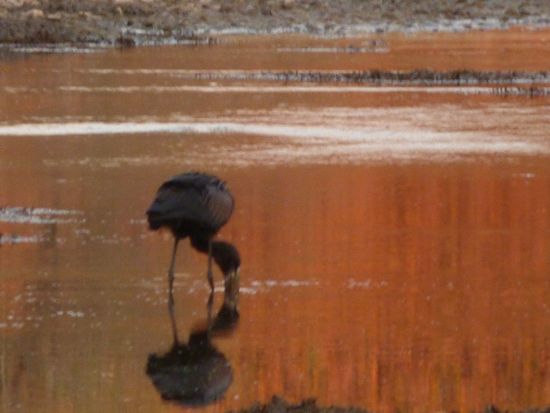
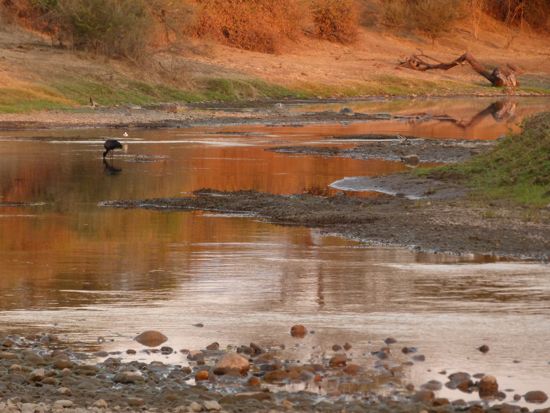
The morning light is achingly beautiful; we can’t stop taking pictures:
Victor is leaning over the side of the car; that is always good news. He’s spotted a lion print:

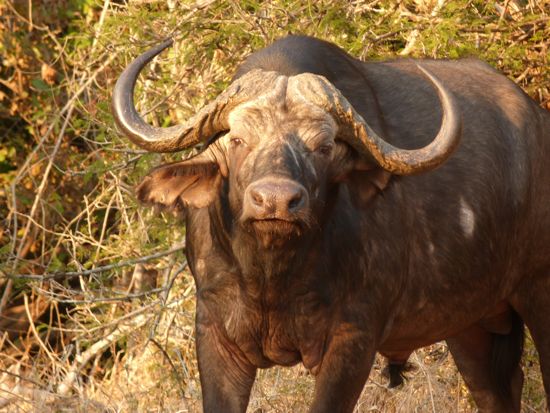
The Cape Buffalo are still sleepy and a little slow, so we get some good photos:
We get to the entrance to the Lower Zambezi National Park:

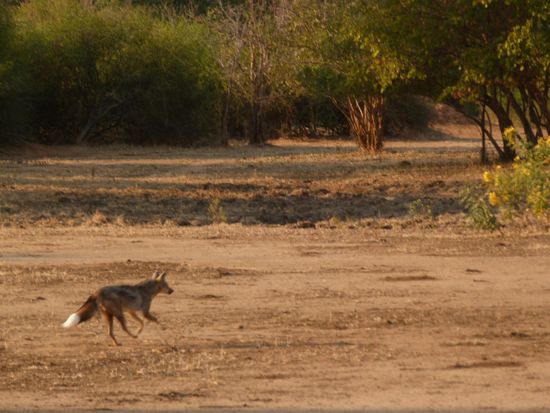
And we see a jackal! The only other jackal we saw as at the salt pan, and that at a distance!
We are driving around looking for lion when suddenly Victor stops the car and backs up. There, on the grass, under a tree, is a leopard, just waiting for us!

Now here’s the thing – I probably took about fifty shots of this leopard, but I am not happy, and this is normal for trying to shoot leopard, or lion – many times they are in grass. Sometimes it can confuse your camera, you think you are shooting the leopard, but your camera focused on the shoot of grass just in front. Or you think you’ve taken the perfect shot, and there is this leaf, or grass, just marring the perfection of your shot. Or the leopard is facing away from you. Or the leopard is walking into the brush! Oh no!

This nice little female leopard put up with us for about half an hour, then leisurely walked away, all of us still snapping, snapping, snapping . . .
I love this elephant, I love this elephant’s ear. We’ve taken a lot of elephant photos, but I really love this elephant:
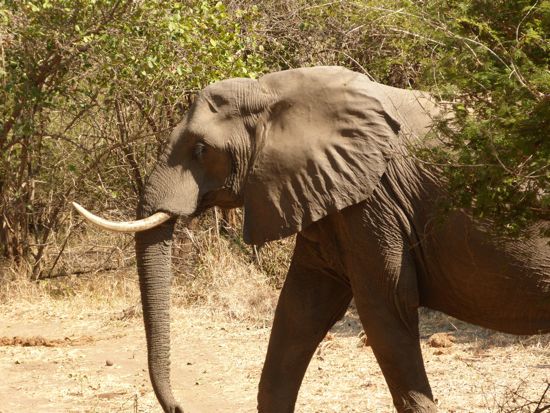
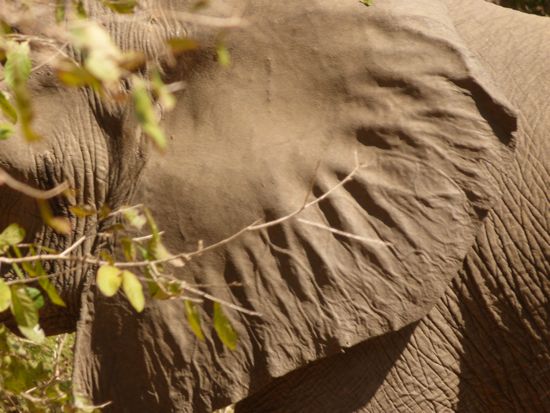
We can’t believe what a wonderful morning we are having, and just as we are feeling life can’t get much better, Victor spots two young lions. He says they are part of a larger group, but the larger lions have gone off hunting and these have been left tagging behind:


Just after the young lions have wandered off stage, we see this big boy coming down the road, and he is terrifying. He has one thought on his mind, find that lady elephant, and we do NOT want to get in his way:

I know, I know, this is a family blog . . .
It’s been quite a morning, and we head back to camp, but we are all too excited to sleep after lunch. I intended to wash my hair, but there is a cold breeze blowing in off the river, and our wonderful open air shower is just a little too shivery for me today.
We take a walk into the main camp – here is the main camp lounge:

And the dining table overlooking the Chongwe River:

And overlooking a huge pod of sunning hippo:

We run into Chris, one of the Chongwe River Camp owners, with whom we flew from Lusaka to Royal, the airstrip for Chongwe River camp. He talked about the new direct flight from Dubai to Lusaka and how he wants to market to expats in Dubai, Qatar, Kuwait, etc. to get them to come down to Chongwe for their holidays. We tell him we did most of our Africa travel from Kuwait and Qatar, that it was a piece of cake with a time zone change of only an hour, not 8 hours, and travel time usually just overnight, and the price is a lot cheaper from there, too. It’s a great trip out of the Middle East, and we think he has the right idea, to market the camp to expats and locals there.
After tea, we head back out on the river, three of us, while one goes fishing. What we love about Chongwe is that there are so many things to do, and so much fun!
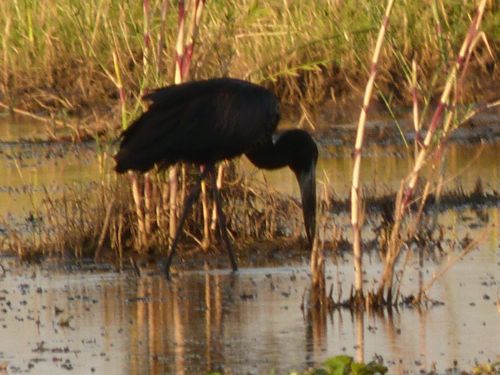

Victor finds a spot near the White Fronted Bee Eaters for sundowners, and we meet up with the fishermen, who, alas, did not catch anything:


Back at the AlBida Suite (the Family Suite) Steve-the-Butler has laid out a beautiful campfire to welcome us back.

It has been a perfect day. Victor joins us for an early dinner, and as we finish up a chilly breeze starts blowing and we all say goodnight, knowing morning will be coming early once again.

Nsefu, Day Two, Salt Pans and A Pink Hippo Sunset
We are up only half an hour earlier, but it feels lime the middle of the night. We dress quickly, although it seems a little warmer this morning, and head directly for the game tracker, where we meet up with Jonah, our guide. Jonah was up early yesterday, taking our friends to Kawazaa, got back in time for tea, and then took us out for an evening drive. When does he sleep?
This morning, our goal is to head out to the salt pans before it gets too hot, and thank goodness there are nice thick blankets, because once we get going, it feels a lot colder, and we are all bundled up.

We are on the road before sunrise!

On the way into the huge, flat plain, Johah stops to pick up some leadwood to use for a fire. As we near the hot spring, we spot a jackal! He is cold, and shy, and the light is dim, so no jackal photos, not this time . . .
We arrive at the hot springs just as the sun is coming up, we all help unload and set up the chairs, and our two German lion-hunters from the last time we were there drive up and we exchange greetings and information. The hot springs area has its own unique kind of beauty, and we are all busy taking photographs while Jonah builds a fire.
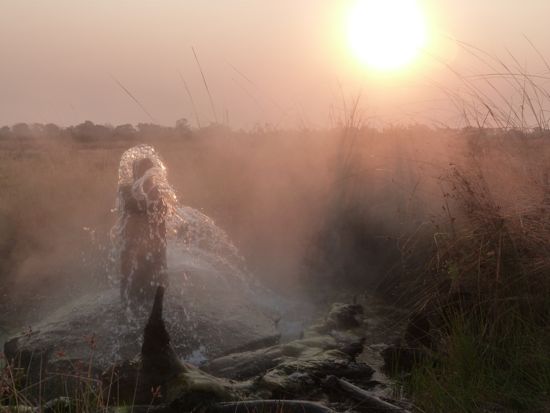

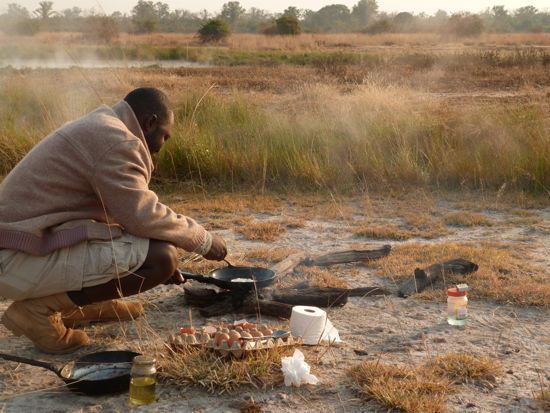
The cooks have pre-cooked the bacon and sausages, which is a good thing when for a hearty, delicious, totally non-healthy breakfast out on the salt pan where there may be hungry lion hanging about. 🙂
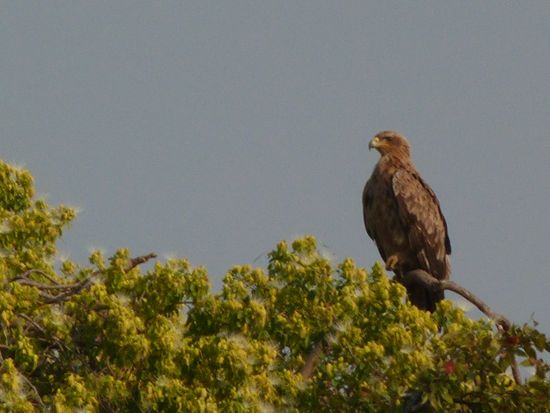
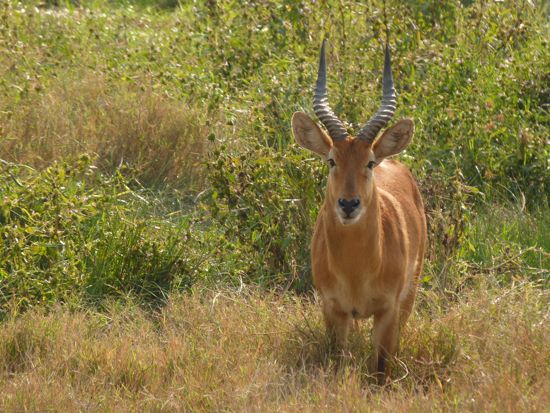
On the way back, we stop now and then for some heartstoppingly beautiful photos – pukus and zebra against a lush green grassy background, eagles and fabulous birds, and it is one of those wonderful mornings altogether, nothing spectacular, but a series of lovely moments. No lions. Not every day can have a lion. But every day has its wonderful moments, and this morning, we had several. 🙂
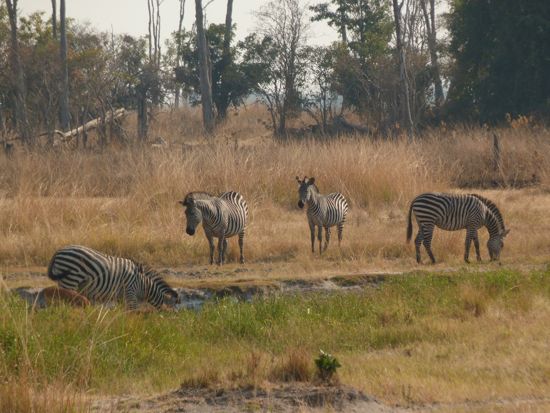

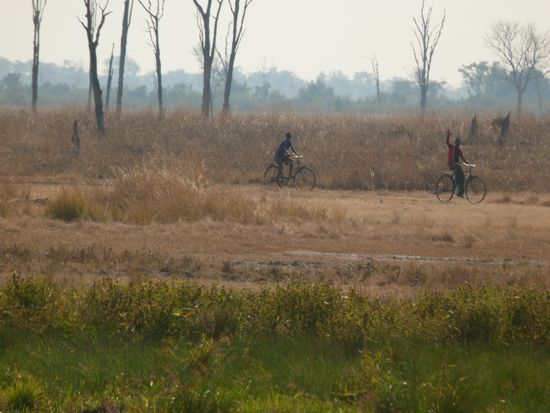
Men from the village ride by, but there are no lions, no elephants, and nothing we have seen to warn them about:
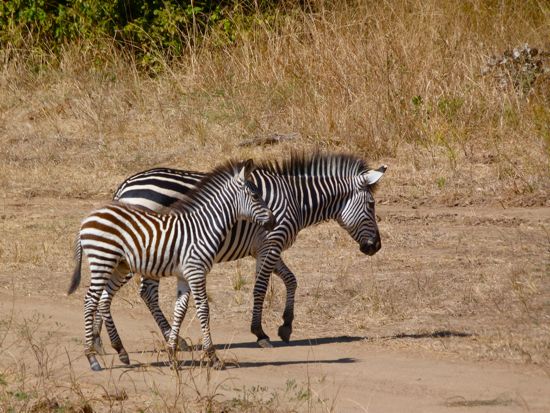
I couldn’t help it, I love the way these two zebra seem to join at the hip:

The camp is full when we arrive back, three tour agents here to learn about the Robin Pope culture, take a drive, take a guided hike – and it is a warm afternoon. We have lunch, and we all head to our cabins; no elephants crossing today, maybe it’s a Saturday thing. I wash my hair; I need to do it in the afternoon because there are no hair dryers, and I have a lot of hair. It dries in the warm afternoon breezes, and is fully dry by tea, before we leave on our afternoon game drive.
This is a Wydah and its tail gives it a loopy up-and-down kind of rhythm:

We stop for sun-downers by the river, our last sundown on the Luangwa, and what a gloriously pink sunrise it is. The hippos are getting ready to leave the river to forage for supper, and are busy yawning in the pink twilight, but every time I look away to answer a question, one chooses to yawn and I miss it. It happened so often, with such regularity that I figured I simply wasn’t meant to get that hippo-yawning-in-the-pink-sunset photo, at least not here, but it’s been a great lovely sunset, a magnificent sunset, and a lovely way to say farewelll to the Luangwa.


Of all our trips to the Robin Pope Camps in the South Luangwa Valley, this has been one of the very best.
I’m tired when we get back, it’s been such a lovely day. I beg off going to dinner; I need some quiet time. The cook sends me a poached egg on toast, just what I need. Every meal has been so good, so filling, but occasionally, like a tired child, I need quiet, and a simple meal. I plan my packing for the next day in serene peace.
A Chat With Daudi En Route to Nsefu
“Happy Anniversary to You! Happy Anniversary to You! I Love You! I love you! Happy Anniversary to you! Happy Anniversary to you!” AdventureMan sings me awake to the tune of the Superman theme. He always knows how to make me laugh, and after 39 years, he can still surprise me. We are so delighted to wake up here, in Tena Tena, on our anniversary. Life is sweet.
Morning at TenaTena Camp:

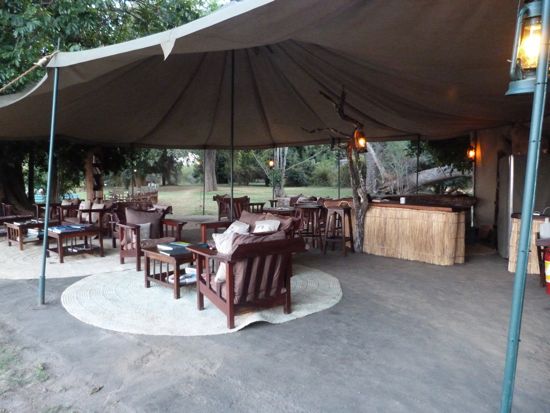

AdventureMan is walking to the next camp, and I am spending the morning catching up on notes, organization, small things, charging up my iPad, etc.
As I was saying earlier, you’d think this would all be very restful, and everything is done for us, but it all revolves around our game drive schedule, and any necessary re-charging depends on the generator schedule (unless you are in Nkwali, where you can re-charge everything in your own rooms; there are lots of electrical outlets) and at the same time, why on earth are we bringing all these electronic devices to the bush???
I’ve discovered a program on the iPad called Notes, and it allows me to write so much more than I would if I were writing by hand. I forget a lot of the smaller details and some of those small details are what makes camping life here so much fun.
The Robin Pope camps pay a lot of attention to detail. One of the things they provide is an insect repellant that is also lotion; it goes on easily, it smells good, and it really seems to keep the insects away, so I gladly use it instead of the Deet we brought with us which melts plastic if it leaks. How can that be good for our cameras?? How can that be good for us? And it is oily, and it smells so bad, and the tsetse flies just ignore it altogether. The insect repellant lotion, on the other hand, seems to work . . . and it smells like lemons.
We are all discovering new ways to use our cameras. I have discovered a program called Night Scenery, which allows me to take spectacular sunsets, and even photograph the essence of a night drive with some clarity – how cool is that? We are a good group in that we can sit patiently and shoot twenty or thirty shots of the lilac breasted roller, experimenting with various shutter speeds, aperatures, and compare them to the automatic function.
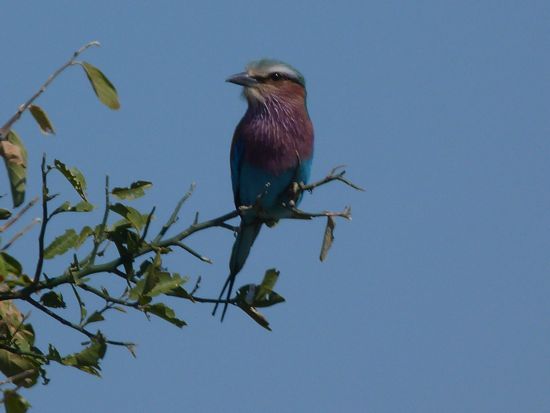
(I love my Lumix. I get great shots, and it takes me close to get the finest detail of a bird feather. It is lightweight, easy to handle, and doesn’t need as much light as many of the longer interchangable lenses on other cameras. I have two batteries, so I can be charging one and using another. I have another, smaller Lumix also with me as a back-up in case the unthinkable happens and something goes wrong with the bigger Lumix. My one gripe – the back-up battery is not a Panasonic battery; it works, but it doesn’t show how much battery is left, so just at the worst moment, my camera can just die if I don’t remember to change the battery out when I think it might be time.)
Our new Scottish friends, Mark and Madolyn, show us photos they took at the salt pan and they saw lion with a big huge bushy dark mane, and she took a photo – are you sitting down? – with her iPhone, that I would have killed to take. It is close, it is detailed, it is every bit as good as a photo taken with a camera. So much for all the control we are trying to develop.
They also ran a rescue mission for all the village men passing on bicycles, telling them of the lion ahead, loading bikes into the Land Cruiser, ferrying them past the lion and dropping them off past the danger zone. Some of the pride of lions have 10 – 20 members. Most avoid humans, but . . . would you want to bet on that, riding by a pride of lion, say . . . hungry lion . . .on a bicycle? (shiver) Not me!
It is approaching deep winter here, so it can be cold, not bitterly cold, but cold enough to make you stupid when you get up in the morning, cold enough that you want a fleece and a scarf for the first few hours of the morning drive. Around mid-morning you start stripping off layers, until around noon when it is very hot and you know the sunscreen won’t be enough; you have to put on some kind of cover against the strong African sun, even approaching mid-winter.
On my way to Nsefu, our last camp in the South Luangwa, I am with our old friend Daoudi, whom we first met twelve years ago, on our first trip to the South Luangwa. We talked of our families, and changes, and I thought to ask him about a conversation I had had the night before, with our Tena Tena guide, Julius. I had asked him how his wife coped with him gone guiding several weeks each month, and he began his response with “She is a well-mannered girl . . . ” going on to discuss how they problem-solve and work with the situation. It’s of interest to me, as a former military wife; military wives also spend time apart from their husbands.
So I pondered this, it was the first thing he said, “she is a well-mannered girl . . . ” and that tells me being well mannered is the most important thing, but well-mannered behavior differs, I have learned, sometimes painfully, from culture to culture.
“Daoudi, when a Zambian girl is said to be well-mannered, what does it mean?” and he explained it meant from her earliest days, her parents had instructed her on proper behavior.
“OK. I understand that. But I might not understand well-mannered the same way you do. Like when we lived in the Middle East, you know I learned to wear clothes that covered me to the elbow and to the knees, and did not have a low necklline . . . ”
“Yes, modest . . .” he said, thoughtfully.
“Yes, exactly,” I affirmed, “but also things very un-American . . . I learned to keep my eyes down, or at least not to look directly at a man and smile – that for us it might be friendly, but there it might seem forward. And I learned to use my quiet voice in public, and not to laugh out loud in the souks. Things like that, things I would not have even known if I had not been told.”
“Ah, yes!” he agreed, “these are also what it is to be a well-mannered Zambian woman. To speak softly with your husband, not to be shouting at him when you disagree, but to talk softly so you can come to agreement. Like that.”
We rode together in a comfortable silence, then I had another question.
“Would it be OK for a Zambian woman to be sitting here in the car with you when she is not your wife or your sister or a closely related woman?” and he laughed and said “Yes, it is helpful! Like you give someone a lift to help her get where she is going, there is nothing improper in that.”
So while some of the manners are like the manners of the Middle East, there are differences, too, and a person could spend a lifetime learning all these little distinctions and still not get it all right. Learning another culture is a never ending task, and it makes you envy those children who are born of two cultures (or more) and can pass fluently from one to another, knowing the subtleties of each.
We have American nieces and nephews who have lived most of their entire lives in a foreign country, and while they are not born of different cultures, they played on the streets, attended social functions, the local culture seeped into them by their daily lives. They are idiomatically fluent and inter-culturally fluent, but it takes a lifetime of bi-cultural living to attain their level without a dual-culture mother and father.
Nsefu Camp, the original Norm Carr camp, has little round plastered bandas set right on the river, where you can watch the elephant families cross the river, entirely lovely.
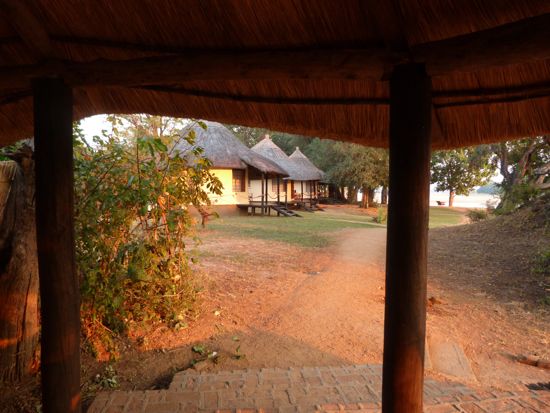

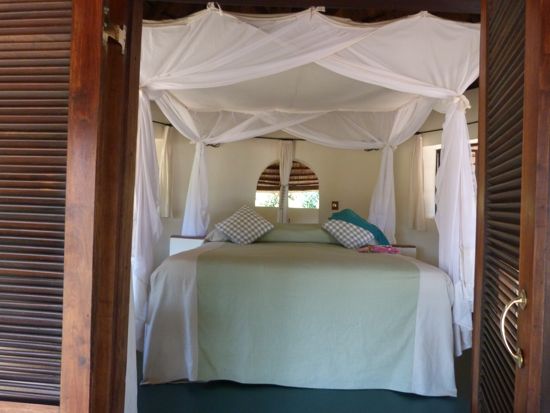


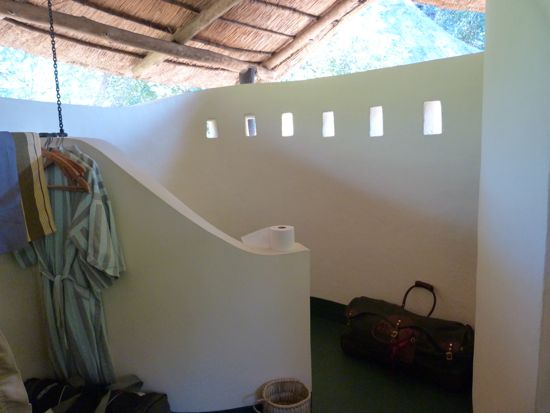
Everyone arrives hot and tired from the walk, and delighted with all they have learned. We have a lovely lunch, and AdventureMan sleeps soundly for an hour before afternoon tea.
Afternoon tea is a lot of fun; the chef has baked a beautiful chocolate cake for our birthday girl, and seven men enter singing “Happy Birthday” with the birthday cake for tea. 🙂


On the afternoon game drive we spot a civet cat, which we have never seen so clearly before,

and we see a porcupine family. When we first spotted them, it looked like the big porcupine was dragging something, but no, it was a little tiny baby porcupine sticking to Mom’s heelslike glue.
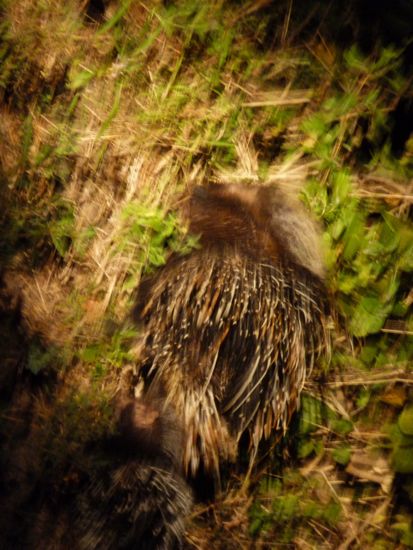
(Sorry, it’s just hard to get good clear sharp shots at night)
Again, a gorgeous night sky and a lot of fun trying to find constellations. Dinner was a Mongolian barbecue, with sparkling wine provided by the Australian honeymooners, who had a true honey moon – the moon rose huge and red in the sky as we were eating our dinner.
Nkwali Camp, Day 2
We’ve booked three nights at each camp, so we get at least two full days at each, and additional drives or hikes for the transfer days – there is never a dull moment.
The drums, the drums, and we are ready and out the door in no time. Today, as we are walking down to catch the boat, my toe catches on a root and I almost fall into the river. Even though the Luangwa is shallow, it would still be humiliating, and I would have to go back and change clothes, and then (gulp) there are those crocodiles . . . . The path is rough and I am a little unbalanced by my backpack, and by the grace of God, the guide, Keyala, steels himself, I hit him and he doesn’t fall in the water when I hit. He holds steady. Thanks be to God! (By evening, there was a new set of stairs, and no roots.)
Our day starts with leopard. We are once again at a green lagoon, watching ducks and cranes, when Keyala says “look, there is a leopard!” and about two hundred yards back, he is at a pond, drinking, then quietly, slowly, turns and walks back into the forest. What a great way to start!

Sorry, the leopard is in the distance and you learn to shoot fast. It doesn’t always make for the sharpest shot, but by the time you get all the settings right and the focus set, the leopard is gone and you have a photo of the lagoon where the leopard was, who wants to see that?
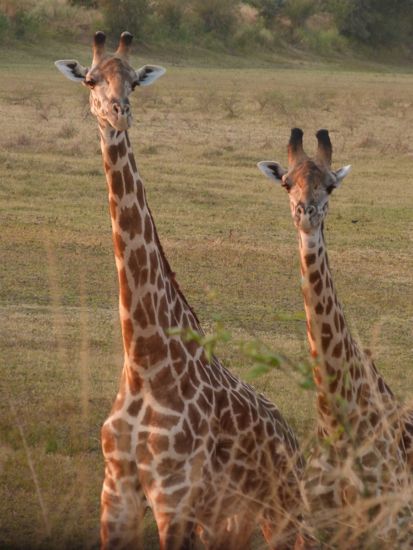
We have a lively morning, full of birds and more elephant and giraffe:

These giraffe are young males, and they are fighting with their necks, sort of comical to watch, but they can seriously hurt one another. I think these ones are more playing at fighting:

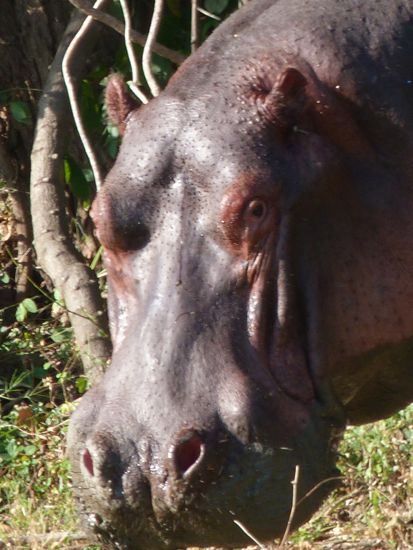
This hippo has gotten tired of the fighting for a spot in the river and has found a lovely isolated spot in the lagoon. You can tell he is a weathered old soul by the scars on his body.

We also get a chance to photograph that glorious fish eagle in a tree – this is how you usually see them; the one I shot in the previous post on Nkwali was actually catching a fish. You don’t get that shot often:

Many stops later, we are driving along and we smell sausages. Keyala says it must be a nearby lodge, but there is no lodge near by. . . We turn a corner and there is a crew, with a fire, and camp chairs all set up, and we realize we are about to experience one of the infamous Nkwali BBQ cook-outs, oh what fun. We are overlooking another great lagoon, full of hippo, Cape Buffalo, baboons, and all kinds of wildlife. Robert, the stellar camp cook, is there asking us how we like our eggs, and with our eggs are sausage, bacon, corn fritters, fried onion, baked beans and toast from loaves of bread made in camp, big thick slices.

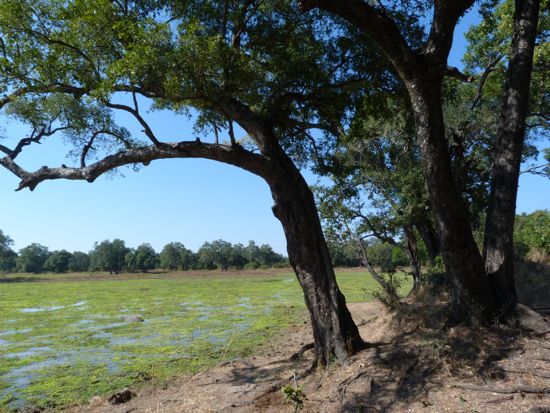

On our way back to camp, we will cross the river again:

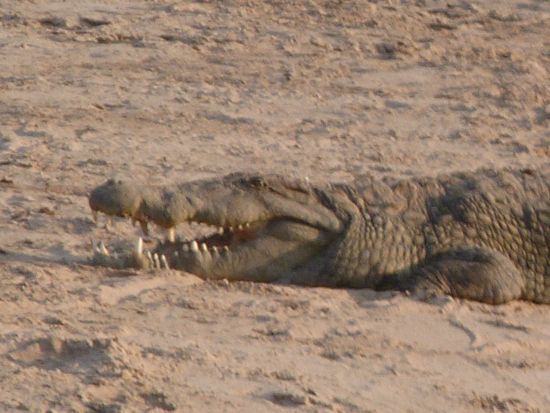
And here is one of many of the crocodiles sunning on the river sand:
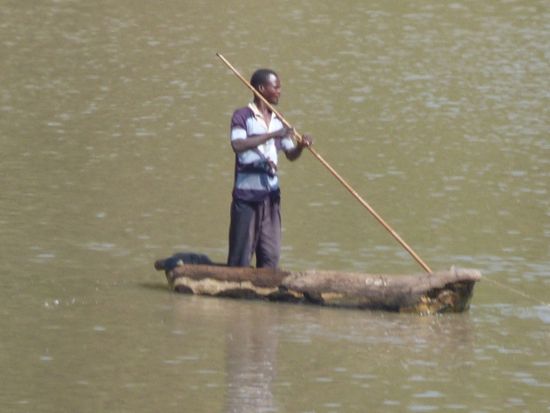
Just before we get back to camp, we see a Zambian local, fishing in the river. Look closely at the canoe – we used to see canoes like this in Alaska, too, dugouts. Imagine the hours it takes to hollow out a tree so that you can use it as a boat, and imagine that if you have very little, the man who has created for himself a boat can be a man with an enhanced opportunity to feed his family . . .
Once again, we arrive back at camp, and snooze a little until dinner. Bumping around in the Toyota trucks wears us out, and we are still jet lagging, some times we think we’ve beat it, and then when we least expect it, it beats us. I really need to wash my hair, it gets so dusty from the trails, but I really really need a nap and a nap almost always trumps washing hair.
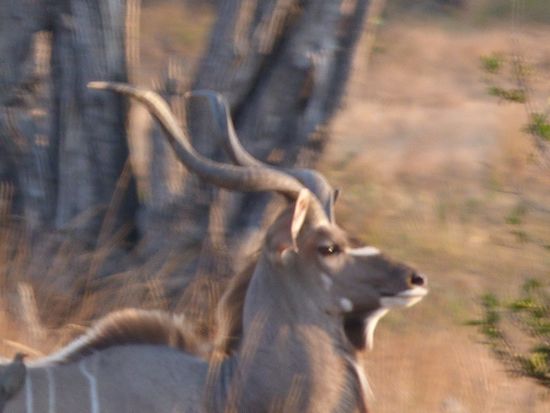
As we head out on our last Nkwali game drive, there is an air of excitement. We find the noble-looking kudu, so shy, and he astonishes us by walking across the road so we can get a clear shot of those amazing curled antlers.

You’d think there would come a time when we might think “Oh, it’s just another elephant family,” but for us, that time never comes. We always watch them with fascination, thinking how very smart they are, how far they range, how they communicate, and how they mourn the deaths of their group. Elephant are huge, and they have their own agenda, they are not there for our entertainment but for their own survival, so we watch them with great respect.

Keyala takes us across the river and we head up to the highest hill for sundowners, half-searching for lion and leopard on the way. The highest hill has a 180 degree view of the land all the way to the escarpment, and the sun sets at just about 90 degrees – right in front of us. Behind us, about the same time, the full moon rises. It is awesome.
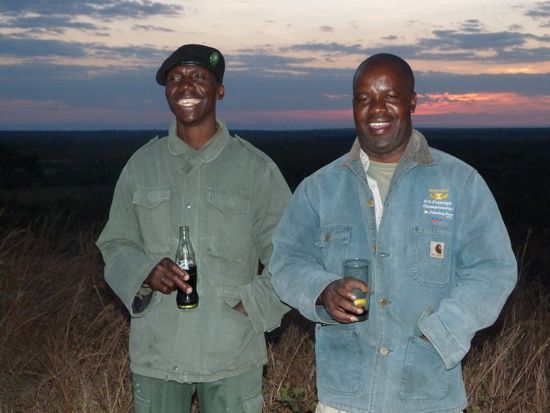
This is Keyala and Keyfus. Keyfus (Kay-fus), on the left, is the same as Cephus in Greek, meaning rock – Saint Peter’s name. Keyala is our guide, and recently marketed for Robin Pope Safaris in Seattle. 🙂
On this high hill I spot a tree, Sterculia quinqueloba, a tree I have never seen before, and Keyala tells us the name. It is such an unusual tree:

Sunset from the high hill in the Chongwe Game Park:
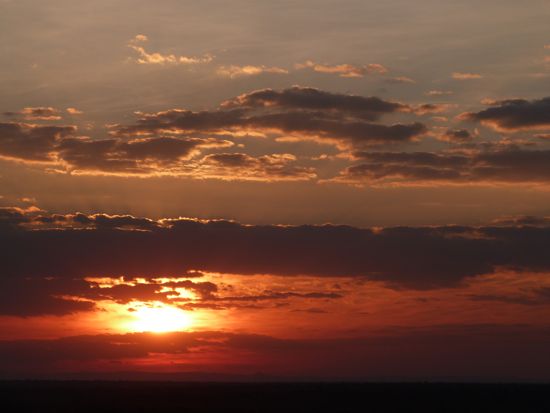
Moonrise in the east, magical:
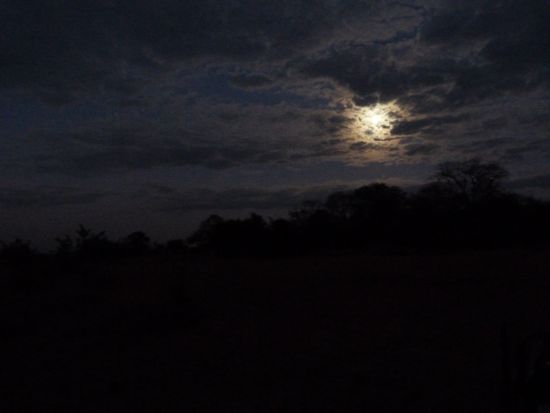
Dinner conversation is fast and furious back at camp, and we excuse ourselves to make sure we are packed up and ready for departure the next day for Tena Tena. We say a sad farewell to Chris, and Tina, and Keyala, who have taken such good care of us and gotten our Zambia safari off to such a great and happy start.
Lusaka, and the Taj Pamodzi
The first two times we stayed in Lusaka, we stayed at the Holiday Inn, or was it the Hilton? I can’t remember, all I remember is that it was very basic, and I don’t think it is there anymore. The first time we stayed there, it was alright, not great, but alright. It had a free shuttle to and from the airport, and a good dining room. Our first time, we had also arrived without luggage, and needed to pick up some things, quickly, to get us through until our luggage arrived.
The hotel recommended a taxi driver who drove us to two locations, the ShopRite and the Arcades. We found what we needed, basics, pants, socks, sweaters – it was winter, and it was cold. We had read the warnings about Lusaka, the high crime rate, the violent crime, so we didn’t venture far, and returned to our hotel when we were finished. I still have the sweater/sweatshirt I bought then, it was made in Cambodia and I still use it when we go to the bush.
The second time we were there, we were on the same floor with all the soccer teams (football if you are not American) in Zambia, a floor full of 11 – 18 year old males. It was very noisy, and they all hung out in the halls the way traveling kids do, so we had to negotiate through them to get to our room. It wasn’t an experience I wanted to repeat.
We had seen the Taj Pamodzi, it was nearby, so when we were meeting up with our son and his wife we reserved there. The hotel is nice enough, the rooms are basic, but the hotel is quiet and clean, and the best we can tell, about as good as it gets in Lusaka. (We can see a new Radisson being built near the shopping center The Arcades, so it might be a good bet to try in the future.)

The room we stayed in this time was almost identical. We had arranged for a transfer; the driver was waiting for us. That’s good. On the way to the hotel, we were NOT stopped this time by armed thugs wanting a donation. That is great. There were still a lot of people on the streets vending, but they were not aggressive.
When we arrived at the hotel, check in was smooth and we arranged to meet up for dinner. I snoozed a little, AdventureMan explored, then he, too, snoozed a little. There was a magnificent sunset.

We met our companions for dinner and had a great time, service was superb and the food was pretty good.
We got a good night’s sleep. The next day we spotted a large mosque nearby, but we couldn’t hear the call to prayer. In the morning’s paper there is a large article about churches in Zambia, and that Zambia has been declared “a Christian nation.” I wonder how well religious tolerance is working out here. When we have visited Zambia before, we have been so impressed with the culture of mutual respect they cultivate, this nation of multiple tribal affiliations and languages. Is that mutual respect and tolerance stretched to include religious respect and tolerance?
Here is the view from our room:
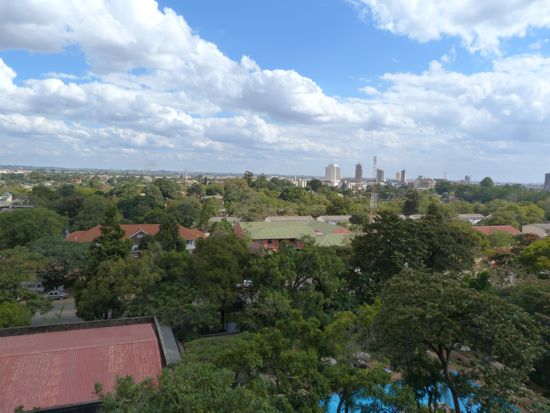
One of the very cool things we noticed is that there has definitely been an upgrade in the electrical system; they now have hairdryers that work AND this great receptacle system so that just about anyone can plug in their electronic device that needs charging:

I don’t know if all the rooms are like this, but one very odd feature is that as you walk into the room, you are a step higher than the rest of the room. The bathroom is on this upper level, and then you step down into the bedroom. We didn’t have a problem with it, but if you are jet lagging, and up in the middle of the night, and disoriented and sleepy, you could forget that step and take a tumble.
The Westcliff, Johannesburg, A Haven
“It’s dark, we might as well have chosen a hotel near the airport,” I thought to myself.
Early in the planning stages for the trip, we discovered, due to airline connections, we would have to spend a night in Johannesburg and a night in Lusaka en route to the bush. We looked at several websites, and narrowed it down to three on TripAdvisor, then we all decided on the Westcliff. It just looked like a nice place, with a view of Johannesburg. But . . . it’s dark. It’s dark, we can’t see a thing, and it’s about a half hour from the airport.
But to be met at the airport after a 15 hour flight is very nice, to have all our bags taken care of, to have people to take us to the hotel . . . and then to arrive, and to discover it is a really, REALLY nice hotel. It used to be townhouses, our concierge tells us, but they turned them into a hotel, so it is a series of buildings, not one. They tell us they have upgraded us and put us at the top of the hill, but we have no idea what that means. They load us up on a golf cart and tell us our bags will follow, and zip us up a winding narrow road to the top, and then up to our rooms.
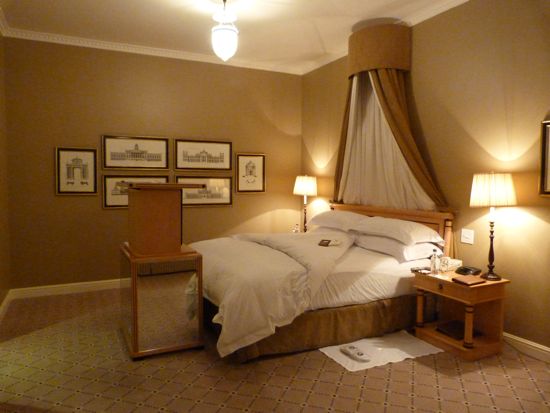
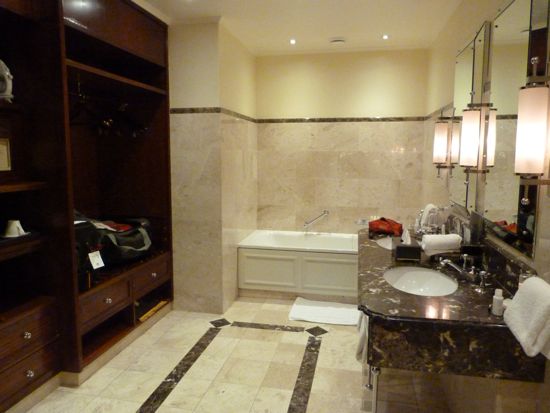
We are next door to one another, but our rooms are totally different. We have a large bedroom and living room – and a balcony. They have a separate bedroom, and a longer, narrow room, but a bathroom to die for. Well, both bathrooms are heaven. The whole suite is a little bit of heaven. The fifteen hour flight is behind us, and the Westcliff is our reward. It is heaven.

And while it is dark, there IS a lovely view:
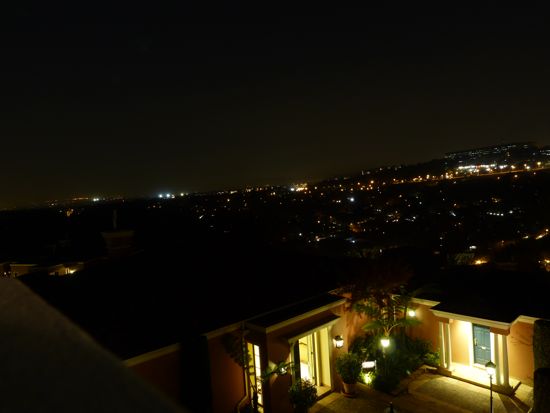
We know we need to eat, and we all want to get to bed. We don’t want to go sit in the restaurant, no matter how lovely, and the room service menu sounds so inviting . . . Three of us order the Salmon Nicoise, and AdventureMan orders tomato soup and the Cheese Plate. While we are waiting – a very short time – we open the bottles of complimentary wine left for us. The food arrives, quickly, and still hot, and we enjoy every bite before falling into bed.


We don’t have to get up until seven, but we have another flight to catch, heading up to Lusaka. We can hear the lion roaring, next door in the Johannesburg Zoo, welcoming in the new day. We get up in time to grab some coffee, and watch the sun rise over Johannesburg from the balcony:
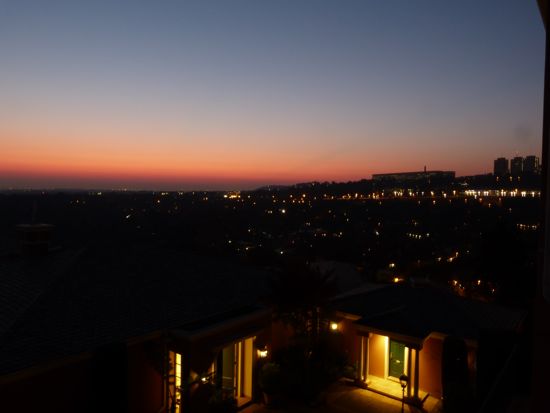
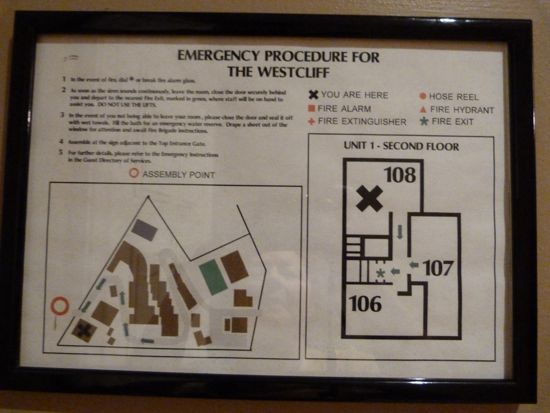
This is room 108, at the top of the hill, and one of the loveliest rooms we have ever stayed in. We would really love to stay there again, our next layover in Johannesburg. 🙂
Recent Comments
intlxpatr on Shampoo Ginger tigerbutterya0c5ff1d… on Shampoo Ginger intlxpatr on British Soldier Kidnapped, Esc… John on British Soldier Kidnapped, Esc… intlxpatr on British Soldier Kidnapped, Esc… Wikipedia Donate Button

Amazina


Early Voting in Florida


