Over 45’s Risking Sexual Infections
This is from BBC News but similar news is coming out of the USA – one of the fastest rising rates of STD’s is in the nursing homes and rehabilitation facilities, among the elderly.
Many over-45s ‘ignore STI risks’
STI rates have been increasing among people over 45
Many middle-aged people are continuing to take an irresponsible attitude to their sexual health, say experts.
The Royal Pharmaceutical Society of Great Britain polled over 2,000 adults.
Nearly a fifth of those polled aged 45 to 54 said they had had unprotected sex with someone other than a long-term partner in the past five years.
There is a misconception that their risk of catching a sexually transmitted infection (STI) is “next to nothing”, says the RPSGB.
Sexually transmitted infections have doubled in under a decade in people over 45 and have been rising at a faster rate than in the young, recent figures from the Health Protection Agency show.
Older people are increasingly likely to be single or undergoing relationship changes and are less likely to consistently use condoms, perhaps because the risk of pregnancy no longer exists, experts have observed.
The RPSGB’s survey of 2,258 UK adults – half who were aged 45 plus – found older generations were flippant about the risks of catching an STI.
Kuwait imposes fee on public toilets?
LOL – there are public toilets in Kuwait? Where? Women always memorize which buildings have public restrooms, but aren’t those owned by the buildings? And holy smokes, what do we do if we don’t have small change left after all our shopping??? Men are more . . . umm. . . err. . . flexible, but women need privacy, i.e. restrooms!
TRAIN your cleaners! Give them proper supplies! Hold their supervisors responsible for their inspection and maintenance of standards! This is called ACCOUNTABILITY.
Charging for use of public restrooms will impose, at the very least, inconvenience for women, and most likely, embarrassment for those who don’t have the money, at the very worst times, like when you have seven children with you and three of them need to use the toilets. Charging fees for usage? Bad idea.
Municipality to impose fees on public toilets
Staff Writer From this morning’s Al Watan
KUWAIT: Kuwait is seriously mulling over the notion of imposing nominal fees for using public toilets.
Mohammad AlـAmri, the Convener of the Cleansing Committee at Kuwait Municipality, stated that the fee is aimed at providing better sanitary services along the lines that are implemented in certain neighboring countries. The official also noted that the current cleaning contracts are scheduled to expire in November 2010.
In a related development, the outgoing Minister of State for Municipal Affairs and Minister of Public Works Dr Fadhil Safar disclosed that Kuwait Municipality is currently working on a proposal to implement a new mechanism in keeping track with the performance of cleaning companies to ensure that the garbage is disposed off at the assigned dumpsites. He added that the system has been already implemented in the Kuwait City Governorate and is expected to be applied in all other governorates soon.
Last updated on Thursday 26/3/2009
Painful Sight
Everytime I go to Fehaheel – not all that often, but maybe two times a month – I see water overflowing from two manholes. Sometimes, it is a LOT of water. It makes a terrible hazard along Gulf Road, where traffic is chaotic at best, and worse – in a dry and thirsty land, it is a terrible thing to waste water.

Sometimes the water stinks like sewage. It makes me wonder where this water is coming from? It also makes me nervous because if it is sewage water, it comes up, it dries on the ground, a wind comes along and blows it on to my salad as I sit outside with AdventureMan having lunch – and I haven’t a clue what I have just ingested. Not good!
This isn’t something that happens rarely. It happens often, often enough that I think it is every time I am in Fehaheel. This isn’t just bad for the environment, it is also very bad for our health. Whatever is going wrong here needs a permanent fix.
”ICU at Contagious Diseases Hospital isolated”
From today’s “” Al Watan:
KUWAIT: The Intensive Care Unit (ICU) at the Hospital of Contagious Diseases is completely isolated from the other wards in line with international regulations pertaining to this matter, said the hospital”s director Dr. Jamal AlـDuaij on Wednesday.
In a statement to Kuwait News Agency (KUNA), the director refuted local newspaper reports claiming that the ICU did not fall within the international standards, describing these claims as “baseless.”
He also said that patients that had been transferred to AlـRashed Allergies” Center were ones whose condition had stabilized, and this transfer was not because of shortage in bed space in the hospital”s ICU. ـKUNA
I get nervous when I see denials that use language like “these claims are baseless.”
Don’t Trash My Kuwait
You know how ideas are . . . they some in flashes sometimes, and other times they trickle through a lot of material before appearing . . . you catch glimpses, and then one day the idea is complete.
Kuwaitis are proud people, and they love their country deeply.
That’s why I can’t understand how they can allow Kuwait to be so covered in trash and filth. I don’t understand why people just inches away from a trash can will toss a tissue on the ground. I don’t understand why there are plastic bags blowing around in the desert.
So here is a public service campaign idea. It puts Kuwaitis at the center. I would love to see a series of magazine ads, billboards, bus ads, etc. with real Kuwaitis who are making a difference, with the theme Don’t trash my Kuwait.
I know there is a new recycle group in Kuwait, who pick up recyclables – for free. I don’t know their name, but my heart was so happy when I heard about this group. Start with them, one photo, showing them holding things like plastic milk jugs and bags, newspapers, and give them a little free publicity, and get the campaign started. Their information is small print, big campaign slogan Don’t Trash My Kuwait.
Second photo, the volunteer group that goes underwater and rids the gulf of abandoned nets and trash, still in the water, holding the kinds of trash they collect, trying to rescue the Gulf: Don’t Trash My Kuwait.
Third photo, one of the volunteer beach clean-up groups with their bags and bags of litter: Don’t Trash My Kuwait.
Fourth photo – guy in traditional Kuwaiti dress with a falcon on his arm, trite, yes, but I still love it. I just don’t know how to tie it in to the campaign, LOL.
Fifth photo: 3baid, holding up handsfull of flyers, computer in the immediate background with PaperDump on the screen: Don’t Trash My Kuwait.
Don’t you just love it?
Your turn: additional photos/ groups / ideas for the Don’t Trash My Kuwait campaign.
Here’s how it started. At the top of an exit ramp the other day, we saw a man unbuckle his seatbelt, exit his car and place a bag in the trash receptacle. We clapped; he pumped his arms in the Rocky-esque victory signal. It was a glorious moment. I’d love to have more of them.
Yes, I’m an ex-pat, but I live here. Don’t Trash My Kuwait!
“We Didn’t Have a Refrigerator”
We were eating breakfast together, my Mom and I, when she dropped a bomb. I had no idea she could catch me by surprise that way. We’d been talking about fresh peaches, and preserves.
“When your Dad and I got married, we didn’t even have a refrigerator,” she said.
Not have a refrigerator? You can get married and not have a refrigerator?
“How did you get one?” I asked, still reeling from astonishment.
“Your Dad inherited $100 from some very distant relative,” she related, “he got like 1/32nd, which came to $100. We used it to buy a refrigerator.”

“What did you do before you had it?” I asked, still a little disoriented.
“Well, it was Alaska,” she said. “We had these sort of pantries that had shelves with little holes opening to the outside, covered with screen to keep out insects and mosquitos, but it would let in the cool air. It didn’t get that hot, even in the summer. In the winter, we had shelves on the outside porches, too.”
Holy smokes, I thought to myself. How would I function without a refrigerator? We would have to go back to shopping every day. If there weren’t refrigerators, maybe stores wouldn’t have frozen sections, too? Maybe we would have to be buying meat just as it was slaughtered, only vegetables that could travel from not too far without refrigeration, we would be using a lot more grains and things that didn’t need refrigeration to preserve them.
Maybe we would be drying more foods? We would probably, in Kuwait, be eating more dates and rice, eating more locally raised foods – what, sheep? camel meat? We would probably be eating a lot more fish. We would probably go back to canning foods while they were abundant – tomatoes, fruit jams, maybe we would even pickle some fish and/or shrimp for out-of-season eating. Our food might be saltier, as salt is also a preservative. Maybe we would eat more rice, more pomegranate . . . maybe occasionally a boat would come in from Ethiopia or Kenya bringing rare coffee beans, and only very special, very lucky people would have access to the little luxury we all take for granted.
Ooops. Well, I am getting carried away. I was so amazed to hear my mother had initially kept house without a refrigerator that I sort of spaced out.
She went on to tell me that as she was growing up, her family had an ice box, and they would put out a special piece of paper when they needed ice from the ice man, who would drive by every day to provide ice for the cool-boxes. The ice came in different sizes, depending on the size of the ice box.
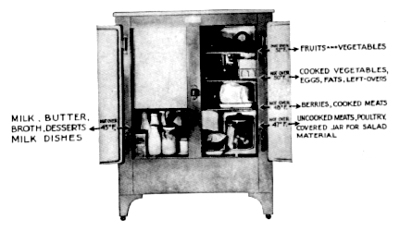
(I found this picture and a fairly clear explanation of ice boxes on on Wikipedia.)
It gets better. As I was reading the Wikipedia information, I came across the Pot in Pot refrigerator , known in Arabic as a “zeer” for which Mohammed Bah Abba was awarded a Rolex Laureate (Rolex Awards for Enterprise) in 2000. You can read about Mohammed Bah Abba, the Nigerian teacher who developed this simple, but effective refrigeration technique, by clicking on the blue type above. You can read more about the Zeer pot, and see a photo of how they work, by clicking here: Science in Africa.
Travel Mercies
Every morning, before we leave the house, my husband and I pray together. We give thanks for all the blessings we receive, we pray for people and their needs, we pray for God to guide us in every thing we do, great and small.
Before a recent trip, we prayed for travel mercies. Most of these trips are long, endurance tests really. About the best I can do is to bury myself in a book or magazine or puzzle.
I remember when travel used to be fun. I remember when there were ladies lounges on board, and even bars (not that I ever hung out in bars). I remember the thrill of adventure.
Praying for travel mercies helps me to see blessings when they appear. And this last trip, they did appear. Every line I entered, I ended up at the front, or almost. I was able to shower in Amsterdam, and to be the first one, so (I’m a little compulsive here) the bathroom had been thoroughly cleaned overnight and I worried less about foot fungus and other invisible threats to my well-being.)
I had one very funny travel mercy – this has to be the hand of God.
It was what I call a high testosterone flight – mostly men, heading back home for a few weeks before coming back to Kuwait, or Iraq. When I found my seat, the buy behind me had his foot up on my armrest, at the very back of the armrest. The truth is, it doesn’t bother me, it is not the part of the armrest I use, but when I sat down, I smelled the most awful odor. . . sweaty feet.
In one book about life in the Gulf, I read that it is wise to wear sandals so that your feet can breathe, that wearing closed shoes makes your feet sweat. I can tell you, it isn’t just the Gulf – any hot climate, even cold climates, and track / tennis shoes will cause smelly feet. Hot weather just accelerates the process and accentuates the results.
What to do? It’s a full flight, and I don’t want an angry, insulted man behind me kicking my seat all night because I had the audacity to mention his smelly feet were invading my nostrils. If I keep my head turned away, I can bear it, but the flight is getting longer and longer with the thought of having to bear smelly feet all the way. This was a first for me.
I had a plan. As soon as the plane would take off, I would cover the guys foot with my blanket, and hope that would take care of the odor. I was just waiting for the right time.
Instead, I heard him complain to the flight attendant that his head set wasn’t working. The flight attendant brought him another head set, and that didn’t work. When the third one didn’t work – he changed his seat! Woooo HOOOOOOO, how is that for a travel mercy? I slept like a baby.
The Cat and the Table

see more crazy cat pics
When I saw this today, on ICHC, I just had to laugh.
Our son has a cat. Our son has a sprayer. The cat gets on the table, where he knows he is not supposed to be. Our son yells “Gordon! Get off the table!” and Gordon settles down. Our son jumps up and gets the sprayer, and Gordon watches. Our son sprays. And sprays. And sprays. If you get right up close to Gordon and spray under his tail, he will get up slowly, annoyed, and saunter off the table. He takes his time. He wants you to know you are annoying, but you don’t scare him. He wants you to know that you are NOT the boss of him.
Normally, Gordon is just the nicest cat you could ever hope to meet. He just has a thing about the dining room table.

Inheritance of Loss

Most of the time, if I don’t like a book, I won’t even bother telling you about it. This book, The Inheritance of Loss, by Kiran Desai, is an exception for one reason – it IS worth reading.
Inheiritance of Loss showed up on the book club reading list for the year, and I ordered it. I read the cover when the book came, and it didn’t sound that good to me, so I read other books instead. The next time it came to mind was when a friend, reading the book, said she was having trouble with it, and asked me if I had started it. This friend is a READER, and a thinker. It caught my attention that she would have problems reading a book, so I decided to give it a try.
This is a very uncomfortable book. The characters live in the shadow of the Himalayan mountains. The most sympathetic character is a young orphaned girl, sent to live with her grandfather. With each chapter, we learn more about all the characters, how they came to be here, what they think, what their lives have looked like.
The author of this book has a very sour look on life. She has snotty things to say about every character. You can almost feel her peering around the corner, eyes slit with evil intent. She is that vicious neighbor who comes by and never says anything nice about anybody, and when you see her talking with your neighbor, you get the uneasy feeling she could be saying something mean about you, and she probably is.
The book covers a wide range of topics – Indian politics, Ghurka revolts, English colonization, Indian emigration to the US and UK, everyday vanities and pride in petty things, how people destroy their own lives, how people can be cruel to one another, oh it’s a great read (yes, that is sarcasm).
At the same time, this vicious unwelcome neighbor has a sharp eye for detail. You may not like what she is telling you, but you keep listening, because you can learn important tidbits of information from her. In my case, I learned a lot about how life is lived in a small mountain village in India, the struggles of illegals in America and how class lines are drawn, ever so finely, when people live together. I learned a lot about the legacy of colonialism, and the creep of globalization. This unwelcome neighbor has a sharp tongue, always complaining, and yet . . . some of her complaints have merit.
I don’t believe there was a single redeeming episode in the book. There was not a paragraph to feel good about. I am glad to be finished with the book – but, yes, I finished it, I didn’t just set it aside in disgust, or give it away without finishing.
Here is the reason I am telling you about this book – as uncomfortable as this book is to read, I have the feeling, upon finishing, that ideas and images from this book will stick with me for a long time. I have the feeling that it contributes to my greater understanding of how things work, how people think differently from other people, and on what levels we are very much the same.
Here is an excerpt from the book, at a time during which the Judge is a young Indian, studying in England:
The new boarding house boasted several rooms for rent, and here, among the other lodgers, he was to find his only friend in England: Bose.
They had similar inadequate clothes, similar forlornly empty rooms, similar poor native’s trunks. A look of recognition had passed between them at first sight, but also the assurance that they wouldn’t reveal one another’s secrets, not even to each other.
. . . Together they punted clumsily down the glaceed river to Grantchester and had tea among the jam sozzled wasps just as you were supposed to, enjoying themselves (but not really) as the heavy wasps fell from flight into their laps with a low battery buzz.
They had better luck in London, where they watched the changing of the guard at Buckingham Palace, avoided the other Indian students at Veeraswamy’s, ate shepherd’s pie instead, and agreed on the train home that Trafalgar Square was not quite up to British standards of hygiene – all those defecating pigeons, one of which had done a masala-colored doodle on Bose. It was Bose who showed Jemubhai what records to buy for his new gramophone: Caruso and Gigli. He also corrected his pronunciation: Jheelee, not Giggly. . . .
This it was that the judge eventually took revenge on his early confusions, his embarrassments gloved in something called “keeping up standards,” his accent behind a mask of a quiet. He found he began to be mistaken for something he wasn’t – a man of dignity. This accidental poise became more important than any other thing. He envied the English. He loathed Indians. He worked at being English with the passion of hatred and for what he would become, he would be despised by absolutely everyone, English and Indians both.
I consider this a review, and not particularly a recommendation. I read the book, I finished the book and I learned from the book. I didn’t like the book. I recommend it only as a challenge, for people who like to read and stretch their minds in new directions.
Hotel Glasses “Sanitized”
A good friend sent me the following link. If you stay in hotels regularly, this video will change the way you do things, trust me! It is GROSSSSSSSS!
Recent Comments
ExpatAlien on What Country am I Living … intlxpatr on Yellowstone: Old Faithful to C… Michelle on Yellowstone: Old Faithful to C… Cathy on No Grown-Ups in Charge intlxpatr on Waiting for Snow Wikipedia Donate Button

Amazina


Early Voting in Florida


 Here There and Everywhere