Offices Full of Germs: Women the Worst
From – I am not kidding – The Nigerian Tribune.
(A recent) study pointed out that for a woman, her office desk may harbour far more bacteria than the workplace restroom and the office desk of men. In fact, women have three to four times the number of bacteria in, on and around their desks, phones, computers, keyboards, drawers and personal items than men do, the study by University of Arizona Professor Charles Gerba found. Gerba, a Professor of Soil, Water and Environmental sciences, tested more than 100 offices on the UA campus and in New York, Los Angeles, San Francisco, Oregon and Washington, D.C. in a study commissioned by the Clorox Co.
The researchers swabbed the offices of 59 women and 54 men in New York City, Los Angeles, San Francisco, Oregon, and Washington, D.C. They sampled eight sites in each office: the phone, desktop, computer mouse, computer keyboard, exclamation key on the computer keyboard, pen, bottom of desk drawer, and handle of desk drawer. The researchers also swabbed workers’ personal items at the office, including personal digital assistants (PDAs), women’s purses and makeup cases, and men’s wallets and found women have more germs on their office desks than men.
“I thought for sure men would be germier,” Gerba said. “But women have more interactions with small children and keep food in their desks. The other problem is makeup.” The tendency is high to doubt this statement. But much as a woman’s desks may typically look cleaner, the germs are likely to be more abundant. Cosmetics and hand lotions make prime germ-transfer agents, Gerba said. Makeup cases also make fine germ homes, along with phones, purses and desk drawers. Food in desk drawers also harbour lots of microorganisms, and it is more abundant among female office workers to have food in their desks and munch while on an assignment, on the computer or even picking a call.
Then, they tend to be around children more often than men, and we all know how easily kids transmit germs. And finally, they use makeup, which tends to absorb germs. Then it rubs off the face or gets scattered by brushes and sponges. The news was not all negative for females though. Gerba in the study found the worst office germ offender is men’s wallets. The back pocket is nice and warm; it’s a great incubator for bacteria. Another hot spot for bacteria in men’s offices: the personal digital assistant.” Men tend to play with their palm pilots more, thinking they’re playing video games or something,” Gerba said.
The top three bacteria hot spots in women’s offices, in order of germs amount : Makeup case, phone, and purse and in men’s offices starting from the highest to the least: Wallet, personal digital assistant and phone. Though a similar study by the Clorox Company, a manufacturer of disinfectant in February 2006, reported that in a study of nine office-based jobs, teachers had the work space with the highest amount of germs and lawyers had the least, Gerba said everyone should arm their office with a germ arsenal that includes: disinfectant wipes, disinfectant spray, paper towels and fruit (for drawer).
According to Gerba, people should clean cell phones and desk phones to get rid of bacteria. “You need to use a disinfectant wipe, or spray disinfectant on a paper towel, and clean the phone off. Never directly spray disinfectant cleaner on phone,” he said. “Do not use soap and water — that just pushes the germs around.” “We recommend that you use a wallet or purse that can be easily wiped off — like leather. A fabric bag is harder to clean and just holds more germs.”
Finally, Gerba said office knickknacks and accessories should be given the same thorough cleaning as everything else , explaining that “people tend to touch and pick up the germs on their desks. It’s a vicious cycle of germs transferring from hands to objects to desks. Hand sanitizers are great in eliminating the transfer of germs from your hands.” The level of germs on office desktops and telephones came in gender neutral; women had three to four times more germs on their keyboards and computer mice than their male counterparts. Desk drawers at women’s desks contained seven times more germs than men’s. Surprisingly, the research showed that the average office desktop has 400 times more bacteria than the average office toilet seat.
What Gerba found among the bacteria was coliform — intestinal bacteria generally found in human waste — on the restroom handles and faucets, in the kitchen sink and sponge, and even in candy basket. That “indicates to me somebody’s not washing his or her hands after coming back from the bathroom,” Gerba said.
That’s why Gerba found hundreds of thousands of bacteria on hot spots like a printer button and the button for the first floor in the elevator, touched by hundreds of fingers each day. Even though none of the bacteria Gerba found was life-threatening, they could lead to more colds and flu.
Prof Oluwole Adebo, a cardiothoracic surgeon commenting said this is a study Clorox, maker of a disinfectant commissioned and is motivated at helping them sell more of their products.” Without being in an office, the surface of our hand picks up germs throughout the day, but you don’t get infected by them because the skin is a barrier against germs. Some of the germs are not in a state to infect, especially in places that are dry and hot, but where humid, it can incubate bacteria. So when you are to eat, wash your hands because there are bacteria on your hands. These bacteria are not in a position to harm us and therefore these is no reason to clean with disinfectants.
“America is full of studies like that. They study everything and make money out of it. The fact is this, in the air you breathe in, there are bacteria in it. Do you sterilize it? No, the body is sufficient to keep the germs at bay. It is all out to pursue people to buy their product”, he concluded.
My Comment: Remember Lies, Damn Lies and Statistics where we talked about who structures the survey? It works the same for studies. The sponsor of this study is Clorox, who make Clorox bleach and multiple cleaning disinfectants. It is in their interest for Professor Gerba to find a very germy environment. The more disinfectants we buy, the higher their profits soar. Prof Oluwole Adebo is right! Germs are everywhere, and we survive, and even develop immunities to them. This study is purely to sell more Clorox products by convincing us we have an epidemic of uncleanliness.
On the other hand . . . it may be time to clean out the make up case and throw away that candy bar . . . 🙂
Bringing in the Harvest, Kuwaiti Style
Fresh seafood is one of the great blessings of living in Kuwait. Visiting Fehaheel with a friend one morning, I was delighted to see a boat docked, and fish being loaded into trucks.
You have this old old style boat, and everything they are doing is state-of-the-art in terms of hygiene. The fish are all iced as soon as they are caught, and transported with more ice. Some of the fish is delivered straight to the fish market in Fehaheel, where auctions are held almost daily.
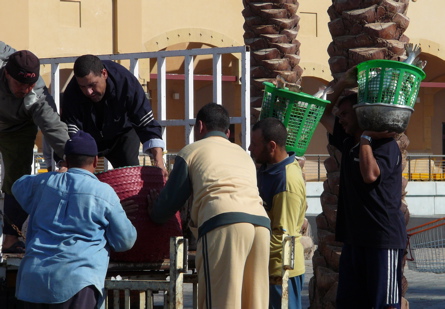
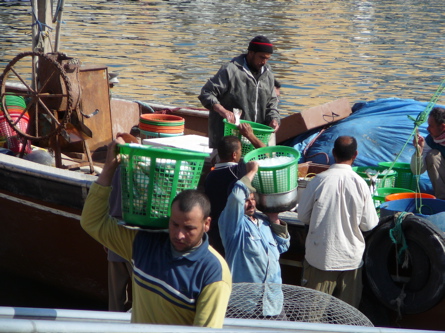

I am only missing Kuwaiti shrimp, which is now out-of-season, to protect the shrimp production for future needs. I am willing to sacrifice for the long-term greater good, and besides, I can still find fresh-frozen Kuwaiti shrimp in my local co-op.
Yesterday I had a new treat – hammour kufte. Have you tried it? I saw it at the Sultan Center, and decided to try it. I sauteed it gently, not sure how it would respond, until it was cooked almost through, then flipped it and cooked the other side. Total WOW. I am a believer! If you haven’t tried it, you are in for a treat. How can anything taste that good AND be good for you?
(Segue) Have you visited the Al Kout Mall in Fehaheel recently? I often take visitors there – it is SO different from Marina Mall and Sharq Mall. There aren’t the bands of teenage marauders there, children are kept under control by their caring parents, and the cafes and restaurants along the fountains are busy day and night, mostly with families and quiet people, not the people who are more concerned with being seen. The stores often have things that are already shopped out at the other malls. There is a serenity in the architecture, and the way it incorporates the waterfront location, and a feeling of everything coming together as it ought.
Sometimes I am the only Westerner I see, outside the Sultan Center.
I took a friend there who had lived in Kuwait a long time ago. She was astounded when I took her there. “This is FEHAHEEL?” she exclaimed. She was in wonder and in shock. She remembered Fehaheel as being at the end of the earth, and a dangerous place to be.
It can still be a dangerous place to be, on a Thursday or Friday night, in competition for a parking place. It will get worse, once the Rotana Hotel opens in the Manshar complex. And the signs for the Villa Moda at the Al Manshar Mall are now disappeared – is Villa Moda NOT coming to the Manshar Mall?
Women in Pakistan
Last but not least from today’s Kuwait Times are two articles from recent news in Pakistan, both involving women and the men who (seem to) own them:
Police Seek Pakistanis Pressing Woman to Hand Over Her Daughter
Karachi: Police are seeking ten men, including several tribal elders, accused of pressuring a Pakistani woman to hand over her teenage daughter as payment for a 16 year old poker debt, officials said yesterday.
In the latest case highlighting how conservative customs threaten women’s rights in Pakistan, Nooran Umrani alleges that despite paying off her late husband’s debt of 10,000 Pakistani rupees, she was threatened with harm if she failed to hand over her daughter, Rasheeda. The 17 year old was to be surrendered as a bride for the son of Lal Haider, the man who won the card game years before, Umrani told reporters . . . Police said yesterday that the mother and daughter were in their protection and that an investigation was opened against Haider, his son, and eight others. . .
Nooran said her husband was a gambler who ran up the debt at a poker game when Rasheeda was 1 year old. He promised Haider that he would get Rasheeda in lieu of payment when she grew up, Nooran said. . . .
President General Pervez Musharraf has vowed to give women more rights in line with his policy to project Pakistan as a moderate, progressive Islamic nation. In December, Musharraf signed into law a bill that makes it easier to prosecute rape cases in the courts, and the country’s ruling party recently introduced a bill to outlaw forced marriages, including under tribal custom in which woman are married off in order to settle disputes.
My comment: The debt was paid. And what was the father thinking?? giving away his daughter to cover his debts? I can’t wrap my mind around it.
Pakistani Sells Wife’s Kidney to Buy Tractor
Karachi: Pakistani police have arrested two men after a village woman complained that her husband and relatives had sold one of her kidneys in order to buy a tractor, police said yesterday. Although her kidney had been removed 18 months earlier, the woman named Safia only learnt it was missing after seeking treatment for a urinary tract problem in January. “She had said she was three months pregnant when her husband, Shakeel Ahmed beat her and then took her to the hospital for treatment,” said Mohammad Akram, duty officer at Noushera Jadeed police station in Punjab province. “But at the hospital, her husband, in connivance with three other people, sold her kidney to buy the tractor,” he said. Unlike many other parts of the world, including neighboring India, there is no law in Pakistan banning the trade in organs. Poverty-ridden Pakistanis living in rural areas sell their kidneys to pay off debts or raise money for their families. Sick but wealthy Pakistanis, and foreigners from the Gulf, Britain and Canada flock to private hospitals in Pakistan for kidney transplants, made possible by these donors.
My comment: Seems his wife is just another revenue-raising resource to Shakeel Ahmed. If asked, she might have even agreed, but it would be nice to be asked, not to discover it 18 months later. The news article says he was arrested. I wonder if he committed a crime under Pakistani law?
Isn’t Sodomy Considered Perversion?
Two articles from the Kuwait Times crime pages, but a daily occurrence:
February 27, 2007
Kuwaiti boy Sodomized
A Kuwaiti living in the Jaber Al-Ali area recently filed a complaint that a man offered his younger brother a lift while he was walking in the Mubarak Al-Kabeer area. He said the man then drove into the desert where he sodomized the boy after threatening him with a knife and also shot nude pictures of him.
February 28, 2007
Bedoons, Kuwaitis scuffle over attempted ‘sodomy’
Kuwait: Two bedoons travelling in a car in Riqqa spotten an eleven-year-old Kuwaiti boy standing in front of his house, and decided to kidnap and sodomize him. One of them alighted and tried to force the boy to get inside the car, but the boy started screaming; alerting other boys in the neighborhood who wrestled with the bedoons and managed to pin them down until the police arrived. However, the boy’s father when informed on the situation along with his relatives rushed to the police station where they encountered the bedoons’ relatives. Both groups were then involved in a scuffle. The boy’s father then stabbed one of the bedoons several times. The victim had to be admitted to the intensive care unit at Adan hospital. Police arrested the boy’s father and referred him to the relevant authorities.
My comment and question: In our holy book, Jesus says that the very worst punishment in the afterlife is for anyone who harms one of the little ones, one of the “innocents,” who damages that innocence in any way. I am betting the Qu’ran says something similar. (I welcome your feedback on this, because I would like to know the sura’a.)
And aren’t Bedoon’s MORE religiously conservative than other Kuwaitis? How does this track?
In western culture, men who ‘bugger’ other men are considered less than manly. Is this not also true in Islam?
Is sodomy not considered a perversion in Islam?
What is the penalty for sodomy in Kuwait, and how is the penalty enforced?
Sebille Collection: New Addition
My husband and I are delighted by the variety of sebilles in Kuwait. I probably didn’t spell it right, and I am probably going to give some semi-erroneous information to my non-Kuwaiti, non-Muslim readers.
Sebilles are places where you can get sweet fresh water to drink or to wash yourself with before prayer. In some places, the government may provide them as a public service, and in other places you find organizations or individuals who will provide them as a charitable work, the way nobles in France would build a cathedral, or we might contribute a pew or a stained glass window to a church, or build a library for a city. In a hot country, sweet fresh water is a blessing to anyone who needs it.
My husband is really good at stopping when I want to take another photo, and even at spotting those we don’t already have. We love the creativity involved. There are some very utilitarian places, all stainless steel and refrigeration. But here are two of our favorite, more creative models. (Please, if I didn’t get this quite right, correct me in the comments section!)
The first is in near the Heritage Souks, back near the gold souks. It is a representation of the famous Kuwaiti Water Towers, which survived the invasion of 1990.

This one was in a residential area, but I have also seen a couple elsewhere. I think it represents the Liberation Tower. I understand that at night, the red light on top really lights up!

Cosmetic Danger: Repeated Usage
Women are always looking for cosmetic magic – I call it “Hope in a Bottle”. We are promised wrinkle-free skin, wonderful large lucious lips that never lose their color, potions that will make blemishes disappear, and fragrances that will get our man. Right.
Just before leaving Seattle, I hit the Lancome center at the local Nordstroms and stocked up. The dear woman there always gives me some little sample sizes to use on my long flights. I was telling my good friend about picking up some “hope in a bottle” and she said “oh, that sounds like something I need to try! Where do you get it?” We had a good laugh about that.
In the AOL section on Money and Finance today is a report about chemicals in your cosmetics. What shocked me is that the US uses many chemicals that the European Union has banned in their cosmetics. The article tells about how loosely the US is monitoring chemical additives in cosmetics – nail polishes, skin cremes, deodorants – chemicals that we are putting on our bodies every day, and no one knows the consequences of long term usage.

The report is from Consumer Reports.org, a highly regarded watchdog of American consumer products. Their magazine reports monthly on cars, appliances, drugs, children’s toys, and deceptive packaging.
What You Should Know About Chemicals in Your Cosmetics
You slather, spray, and paint them on and rub them in. Cosmetics are so much a part of your daily regimen that you probably never think twice about them. If they’re on store shelves, it seems reasonable to figure that they’re safe to use, despite those unpronounceable ingredient lists.
But at least some of what’s in your cosmetics might not be so good for you. One example is the family of chemicals known as phthalates (pronounced THAL-ates), which may be linked to developmental and reproductive health risks. The industry says phthalates are safe, but some companies have dropped them in response to public concern. Essie, OPI, and Sally Hansen, for example, are removing dibutyl phthalate (DBP), which is used to prevent chipping, from nail polishes. Other big-name brands that have reformulated products to remove some phthalates include Avon, Cover Girl, Estée Lauder, L’Oréal, Max Factor, Orly, and Revlon.
Take a Whiff of This
If you’re trying to cut back on phthalates, however, sticking with these brands may not make much of a difference. You’ll find phthalates in too many other personal-care products, including body lotions, hair sprays, perfumes, and deodorants. The chemicals are used to help fragrances linger and take the stiffness out of hair spray, among other reasons. They’re also in detergents, food packaging, pharmaceuticals, and plastic toys. And they have turned up in our bodies.
Although phthalates show up in so many places, they’re often absent from labels because disclosure is not always required. That’s the case with fragrances. We tested eight fragrances and although none of the products included phthalates in its ingredient list, they all contained the chemicals. Some were made by companies that specifically told us their products were free of phthalates, and two even say as much on their Web sites.
Getting your nails done or spritzing on your favorite perfume obviously isn’t going to kill you. But the health effects of regular long-term exposure, even to small amounts, are still unknown.
Makeup wakeup call
Phthalates, a family of chemicals used in cosmetics, may pose significant health risks but:
· They’re found in perfumes, nail polishes, and other products we use every day.
· Scientists say they’re found in our bodies as well.
· In many cases, they’re not listed on labels, so they can be difficult to avoid.
· Some manufacturers are removing them from their products, but the FDA has not restricted their use.
Companies that have eliminated phthalates are no doubt getting the message that people are paying more attention to ingredients. But public concern isn’t the only factor driving the reformulations. Another reason is a European ban. Although the U.S. has outlawed just eight cosmetic ingredients, the European Union has banned more than 1,000. (emphasis mine) For companies that make cosmetics, complying with E.U. rules makes good business sense. It’s more efficient to sell the same product worldwide. It’s also good PR. About 380 U.S. companies have publicly pledged their allegiance to cosmetic safety by signing the Compact for Global Production of Safe Health & Beauty Products, under which they voluntarily pledged to reformulate globally to meet E.U. standards.
The reformulation trend is likely to gain further momentum from the California Safe Cosmetics Act of 2005, which took effect only this year. Manufacturers that sell over $1 million a year in personal-care products in the state must report any products containing a chemical that is either a carcinogen or a reproductive or developmental toxic agent. Among those that must be disclosed are the phthalates DBP and di(2-ethylhexyl) phthalate (DEHP). California plans make this information public, possibly on the Web, so some companies may choose to remove rather than report the ingredients.
Guinea pig nation
Despite the laws, pacts, and reformulations, questions about safety remain. Cosmetic industry critics argue that the Food and Drug Administration has not told companies what “safe” means, leaving them to make their own decisions. In fact, with cosmetics, the government generally takes action only after safety issues crop up.
Take the case of Rio hair relaxers. In December 1994, the FDA warned against two products sold through infomercials after consumers complained about hair loss, scalp irritation, and hair turning green. Rio announced that it would stop sales but there were reports that it continued to take orders. The California Department of Health then stepped in to halt sales and in January 1995, the U.S. Attorney’s Office in Los Angeles filed a seizure action. By then, the FDA had received more than 3,000 complaints. Rio later reformulated and renamed its products.
The Rio case illustrates how holes in the government’s cosmetic regulatory system can hurt consumers. The industry essentially regulates itself. The Cosmetic Ingredient Review panel, made up of physicians and toxicologists and funded by the industry’s leading trade group–the Cosmetic, Toiletry, and Fragrance Association (CTFA)–assesses ingredient safety. Another industry group reviews fragrances and helps create safety standards. But manufacturers aren’t obligated to do anything with this information.
“We’re working on the honor system when it comes to cosmetics safety,” says Jane Houlihan, vice president for research at the Environmental Working Group (EWG), a research and advocacy group. “In the absence of federal standards, we have a huge range of safety in the products we buy every day.”
The FDA has made efforts to improve its ability to spot problems and issue warnings. The agency now has a computerized database, called CAERS, that collects reports of problems such as allergic reactions. Complaints can be sent via the FDA Web site or by calling a district office. But Amy Newburger, a dermatologist at St. Luke’s-Roosevelt Hospital Center in New York City and a former member of the FDA’s General and Plastic Surgery Devices Panel, says her experiences make her wonder about the system’s effectiveness. In one case, she filed a report by phone and on the CAERS system after she and several of her patients got a rash with blisters after using an anti-aging treatment. It wasn’t until a year later, in November 2006, that the FDA sent an e-mail asking her to complete some forms, she says. The FDA responds that it doesn’t provide information or feedback to people who file complaints. It simply routes them to the appropriate office for evaluation. The FDA says it may also send reports to companies.
So what are the risks?
Scientists know very little about how repeated exposure to small amounts of phthalates in cosmetics may affect your health, if at all. But some studies suggest that the chemicals are present in our bodies.
In 2005, the federal Centers for Disease Control and Prevention reported that it had found breakdown chemicals from two of the most common cosmetic phthalates in almost every member of a group of 2,782 people it examined. A separate study published in the journal Environmental Health Perspectives (EHP) in 2005 showed that men who used the most personal-care products, such as after-shave and cologne, had the highest urinary levels of a breakdown product of diethyl phthalate (DEP).
In rodent studies, phthalates have caused testicular injury, liver injury, and liver cancer. We found no such clear hazards in human research. But we did find studies suggesting that phthalates may be associated with other health issues, including the following four examples from one source alone, EHP, which is a leading journal published by the National Institutes of Health. In 2000, EHP published a small study that said elevated blood levels of phthalates were associated with premature breast development in young girls. Another report in 2003 found that men with higher concentrations of two phthalate breakdown products in their urine were more likely to have a low sperm count or low sperm motility. A study published in 2005 said women with higher levels of four phthalate compounds in their urine during pregnancy were likelier to give birth to boys with smaller scrotums. And a 2006 report cited low testosterone levels in male newborns exposed to higher levels of phthalates in breast milk.
Experts in the industry and the government are aware of such reports but say there is no cause for alarm. The FDA, for instance, concluded after a thorough review of the literature that “it’s not clear what effect, if any, phthalates have on health.” And the CTFA, the industry trade group, notes that government and scientific bodies in the U.S. and Canada have examined phthalates without restricting their use in cosmetics. After the 2005 report linking phthalate exposure to smaller scrotum size, in particular, the trade group said, “The sensational and alarming conclusions being drawn from this single study are completely speculative and scientifically unwarranted.”
Even companies that have dropped phthalates from products say they are safe. “This policy is driven by a wish to allay public concern and does not reflect concern with the safe use of the ingredients,” Avon said after announcing that it would cut DBP from its product line. John Bailey, the CTFA’s executive vice president for science, says ingredients like DBP in nail polish are simply not a hazard in such small amounts.
On the other side are some environmental and public-health advocates who say possible carcinogens and reproductive toxins do not belong in cosmetics, no matter how small the amount. “We take issue with the idea that a little bit of poison doesn’t matter, because safer alternatives are available,” says Stacy Malkan, communications director of Health Care Without Harm. “Companies should be making the safest products possible, instead of trying to convince us that a little bit of toxic chemicals are OK.” While the scientific jury is still out, we at ShopSmart believe it makes sense to reduce your exposure to phthalates, especially if you’re nursing, pregnant, or trying to become pregnant.
Where Has Your Purse Been?
I received this forward from a friend. The Shauna Lake referred to is a news anchor with KUTV in Salt Lake City, Utah.
Purse Hygiene
A friend sent me this, I really never thought about how dirty my purse could be until I read this.
Have you ever noticed gals who sit their purses on public rest room floors that then go directly back to their dining tables?
It happens a lot!
It’s not always the ‘restaurant food’ that causes stomach distress.
Sometimes “what you don’t know ‘will’ hurt you”!
Read on…
Mom got so upset when a guest came in the door and plopped their purses down on the counter where she was cooking or setting up the buffet. She always said that purses are really dirty, because of where they’ve been.
Smart Momma!!!
It’s something just about every woman carries with them. While we may know
what’s inside our purses, do you have any idea what’s on the outside?
Shauna Lake put purses to the test – for bacteria – with surprising results. You may think twice about where you put your purse next time.
Women carry purses everywhere; from the office to public rest rooms to the floor of the car.
Most women won’t be caught without their purses, but did you ever stop to think about where your purse goes during the day?
“I drive a school bus, so my purse has been on the floor of the bus a lot,” says one woman. “On the floor of my car, probably in rest rooms.” “I put my purse in grocery shopping carts, on the floor of bathroom stalls while changing a diaper,” says another woman “and of course in my home which should be clean.”
We decided to find out if purses harbour a lot of bacteria. We learned how to test them at Nelson Laboratories in Salt Lake, then we set out to test the average woman’s purse.
Most women told us they didn’t stop to think about what was on the bottom of their purse.
Most said they usually set their purses on top of kitchen tables and counters where food is prepared.
Most of the ladies we talked to told us they wouldn’t be surprised if their purses were at least a little bit dirty. It turns out purses are so surprisingly dirty, even the microbiologist who tested them was shocked.
Microbiologist Amy Karren of Nelson Labs says nearly all of the purses tested were not only high in bacteria, but high in harmful kinds of bacteria. Pseudomonas can cause eye infections, staphylococcus aurous can cause serious skin infections, and salmonella and e-coli found on the purses could make people very sick. In one sampling, four of five purses tested positive for salmonella, and that’s not the worst of it.
“There is fecal contamination on the purses,” says Amy.
Leather or vinyl purses tended to be cleaner than cloth purses, and lifestyle seemed to play a role. People with kids tended to have dirtier purses than those without, with one exception.
The purse of one single woman who frequented nightclubs had one of the worst contaminations of all.
“Some type of feces, or even possibly vomit or something like that,” says
Amy.
So the moral of this story – your purse won’t kill you, but it does have the potential to make you very sick if you keep it on places where you eat.
Use hooks to hang your purse at home and in rest rooms, and don’t put it on your desk, a restaurant table, or on your kitchen countertop. Experts say you should think of your purse the same way you would a pair of shoes.
“If you think about putting a pair of shoes onto your countertops, that’s the same thing you’re doing when you put your purse on the countertops.”
Your purse has gone where every individual before you has spat, coughed, urinated, emptied bowels, etc.!
Do you really want to bring that home with you?
The microbiologists at Nelson also said cleaning a purse will help. Wash cloth purses and use leather cleaner to clean the bottom of leather purses.
My comments: I was shocked and disgusted reading this article. I know that when I bring groceries home, I put my purse on the counter or even (gasp) on the kitchen table. I vow, here an now, to change my ways!
Having said that, I rarely ever get sick. My theory is that I have lived and travelled in so many places with questionable hygeine that I have developed resistance to many of the bacteria that bedevil us. I would guess that eating out puts me more at risk for food borne problems than any other behavior.
While I am a sushi supporter, I have to warn my fellow aficianados that raw fish is one of the WORST carriers of bad bacteria, microbes, and parasites. Sushi eating is a risky behavior! Sushi on a buffet is even worse because it has been exposed to more microbes, sneezes, contamination. So if you choose to eat sushi, use protection! Know your sushi maker and practice safe sushi eating.;-)
Recent Comments
ExpatAlien on What Country am I Living … intlxpatr on Yellowstone: Old Faithful to C… Michelle on Yellowstone: Old Faithful to C… Cathy on No Grown-Ups in Charge intlxpatr on Waiting for Snow Wikipedia Donate Button

Amazina


Early Voting in Florida


 Here There and Everywhere