Indian Gang Rape Case Goes to Trial
From today’s Huffpost

India Gang Rape Trial Begins In New Delhi
By ASHOK SHARMA
NEW DELHI — The trial of five men charged with the gang rape and murder of a 23-year-old student on a New Delhi bus began in a closed courtroom Thursday with opening arguments by the prosecution lawyers in a special fast-track court set up just weeks ago to handle sexual assault cases.
The brutal attack last month set off protests across India and opened a national debate about the epidemic of violence against women. A government committee established in the wake of the attack has called for a complete overhaul of the way the criminal justice system deals with rape, sexual assaults and crimes against women in general.
The five men on trial – who face a maximum sentence of death by hanging if convicted – covered their faces with woolen caps as they walked into the courtroom Thursday surrounded by a phalanx of armed police. Two hours later, after proceedings were over, they were whisked away by the police.
Details of the day’s proceedings were not available. The courtroom was closed to the public and the media – a routine move in Indian rape cases – even though defense lawyers had argued that since the victim is dead, the proceedings should be opened. There was also a gag order on the lawyers to not reveal what happened inside the court.
Judge Yogesh Khanna turned down requests by journalists Thursday that they be briefed on the day’s proceedings and said the gag order would remain.
Since Friday is a public holiday in India, the next hearing in the case was set for Monday, when the defense will present its opening arguments.
A sixth suspect in the case has claimed he is a juvenile and is expected to be tried in a juvenile court.
On Thursday, a magistrate separately rejected a petition by Subramanian Swamy, a prominent politician, that no leniency be shown toward the accused who claims to be a juvenile because of the brutal nature of the crime, said Jagdish Shetty, an aide to Swamy.
Documents presented by prosecution last week to the Juvenile Justice Board indicated that the defendant was a juvenile at the time of the attack, which would make him ineligible for the death penalty.
Magistrate Geetanjali Goel is expected to rule on the suspect’s age on Jan.28.
The suspect, who is not being identified by The Associated Press because he says he is 17, would face three years in a reform facility if convicted as a juvenile.
After the fast-track court hearing, M.L. Sharma, a defense lawyer for Mukesh Singh, one of the accused, said he had withdrawn from the case. V.K. Anand, who represents Mukesh’s brother Ram Singh, will now defend both brothers. The two lawyers had been arguing over who was Mukesh Singh’s real lawyer.
Sharma said he left the case to save his client from being tortured to fire him. He has long maintained that the other defense lawyers were planted by the police to ensure guilty verdicts.
Dozens of police were outside the sprawling court complex in south New Delhi where the trial is taking place. Inside the court, about 30 policemen blocked access to the room where Khanna heard the prosecution’s case.
Outside the courtroom scores of journalists and curious onlookers crowded the hallway.
Prosecutor Dayan Krishnan warned defense lawyers that if they spoke to journalists he would slap contempt of court notices on them, said V.K. Anand, a defense lawyer.
Police say the victim and a male friend were attacked after boarding a bus Dec. 16 as they tried to return home after an evening showing of the movie “Life of Pi.” The six men, the only occupants of the private bus, allegedly beat the man with a metal bar and raped the woman with it, inflicting massive internal injuries to her, police said. The victims were dumped naked on the roadside, and the woman died two weeks later in a Singapore hospital.
Abhilasha Kumari, a New Delhi-based sociologist, said the attack could end up having a large impact on the country.
`’This case has brought the violence against women center stage and it has, out of sheer public pressure, forced the government to sensitize itself to crimes against women,” she said.
The trial began a day after a government panel recommended India strictly enforce sexual assault laws, commit to holding speedy rape trials and change the antiquated penal code to protect women.
The panel appointed to examine the criminal justice system’s handling of violence against women, received a staggering 80,000 suggestions from women’s groups and thousands of ordinary citizens.
Among the panel’s suggestions were a ban on a traumatic vaginal exam of rape victims and an end to political interference in sex crime cases. It has also suggested the appointment of more judges to help speed up India’s sluggish judicial process and clear millions of pending cases.
Law Minister Ashwani Kumar said the government would take the recommendations to the Cabinet and Parliament.
“Procedural inadequacies that lead to inordinate delays need to be addressed,” he told reporters.
Although I have marked this with “Women’s Issues,” it is only a women’s issue when violence is directed against women and women have a limited access to justice in the system. Rape is a crime of power, inflicting unwanted and uninvited invasion of the very most personal nature. It happens to men, too. Men are far less likely to come forward. They live with the shame; many commit suicide or turn to drugs and alcohol to escape the pain. One day, with women leading the way, men, too, will be able to come forward and claim justice against those who violate them.
Chole (Chickpea Curry
It’s amazing how much more energy I have when the weather cools; yesterday was nearly 80°F and I had to force myself to work through my list of to-do’s, but as the temperatures dropped once again, we slept well, we awoke rested and energetic, and I ended up adding things to my list, for the sheer joy of feeling like doing things.
A new recipe – for me, for us – Chole – is bubbling in our crock pot. It sounded so good! I found the recipe – I think on allrecipes.com – several months ago, but today is the perfect day to put it all together. It has so many things in it which are good for us, but especially chick peas, tomatoes, ginger and turmeric.
I had no idea what it would look like, but it looks like things we used to eat at the vegetarian restaurant Greenland, down in Souk Mubarakiyya, in Kuwait. I think it is missing a few spices, probably things we have a hard time getting here. It wasn’t even easy just finding mustard seeds, if I had needed those dried lemons or other spices exotic to Pensacola, I couldn’t have attempted it. This Chole won’t be the same as the delicious, spicy, complex dishes our Indian quilters would bring to the weekly stitch meetings, but it will be a good tasty dinner on a rainy night. I wish we had the fried Indian breads that Wikipedia says are traditionally served with it.

Chole (Chickpea Stew)
• 2 cups of chickpeas soaked overnight
• 3 cloves garlic, minced
• 1 large onion, minced
• 1 red bell pepper, minced
• 2 14 oz can of diced tomatoes
• 1-inch piece ginger, minced
• 1 14 oz can of coconut milk
• 1/2 tsp cayenne pepper
• 1 tsp coriander powder
• 1/2 tsp turmeric
• 1/2 tsp ground cardamom
• 1/2 tsp ground cloves
• 1 tbsp vegetable oil
• 1 tsp garam masala
• 1.5 tsp mustard seeds
• 1/2 tsp salt
DIRECTIONS:
Blend all the ingredients but chickpeas in a food processor or a blender until liquid. Wash and drain chickpeas, place them in a slow cooker, pour the blended mixture over and cook on low for 6-7 hours or on high for 4-5.
Make ahead: we usually make double or triple of this recipe, since we love it. Let it cool, and store chole in freezer-safe zip-lock bags in the freezer for up to 6 months.
Just for fun, I am going to share with you the Wikipedia version. I laugh to think how intimidated I would be –
Preparation
preparation time=45mins cooking time=1hour serves=4
Ingredients For the chole 1 cup kabuli chana (white chick peas), soaked overnight 1 tea bag or tsp tea leaves, tied in a muslin cloth (optional) 1/2 tsp cumin seeds (jeera) 1 onion, finely chopped 12 mm (1/2″) piece of ginger (adrak), grated 2 cloves of garlic (lehsun), grated 2 tsp chole masala 2 tsp chilli powder 2 tsp dried mango powder (amchur) 1/4 tsp turmeric powder (haldi) 1 tbsp coriander (dhania) powder 1 tsp cumin seeds (jeera) powder 2 tbsp oil salt to taste
For the bhature 1/2 cup plain flour (maida) 1/2 cup potatoes, boiled and grated 1 1/2 tsp oil salt to taste oil for deep-frying
For serving 1 onion, sliced 4 lemon wedge
Recipe For the chole Pressure cook the Kabuli chana with the tea bag for 3 whistles until they are soft . Drain and keep aside. Discard the tea bag. Heat the oil in a pan, add the cumin seeds. When the seeds crackle, add the onion, ginger and garlic and sauté till the onion is golden brown. Add the chole masala, chilli powder, amchur, turmeric powder, coriander powder, cumin seed powder and salt and sauté for another minute. Add the Kabuli chana and 1 cup of water and mix well. Simmer for 10 to 15 minutes. Keep aside
For the bhature Combine the flour, potato, 1½ teaspoons of oil and salt and knead into a firm dough without using any water. Knead the dough very well till it is smooth Cover with a wet muslin cloth and rest the dough for 10 minutes Divide the dough into 4 equal parts and roll out into circles of 125 mm. (5″) diameter. Deep fry in hot oil till the bhaturas puff up and both sides are golden brown. Serve hot with the chole, sliced onion and lemon wedges. Tips While frying the bhature, press the centre lightly with a frying spoon so as to help it to puff up. Chole masala is a blend of spices which is readily available at most grocery stores. [2]
LOL, cook with a tea bag for three whistles??? I am already way out of my league! And “Chole masala is a blend of spices which is readily available at most grocery stores” does not apply to Pensacola, Florida!
Manohar Lal Sharma: “Until today I have not seen a single incident or example of rape with a respected lady”
If you are a follower of my blog, you know I am not a person of violent tendencies. This morning, however, I am so thankful to be half a world away from the scum lawyer who would make these statements about a woman so brutally raped by six men that she died of horrendous internal injuries.
I am fighting instincts which would wish him ill. When he accuses rape victims of being responsible for their attacks, it pushes me over the line.
A person should be free to take a bus without fear of assault. And I suspect that there are also male victims, too ashamed to come forward.

Manohar Lal Sharma, lawyer for one of the accused, speaks to journalists outside the Saket district court complex in New Delhi, India, on Jan. 10. Police badly beat the five suspects arrested in the brutal gang rape and killing of a young woman on a New Delhi bus, Sharma said Thursday, accusing authorities of tampering with evidence in the case that has transfixed India. (AP Photo/Saurabh Das)
As the trial of the men charged with the brutal gang rape and murder of a woman in New Delhi last month gets under way this week, a lawyer for some of the accused suggests the victim was partly to blame for the attack.
Lawyer Manohar Lal Sharma said his clients were innocent and implied that the 23-year-old student must have been in some way responsible for the horrific crime, Bloomberg reports.
“Until today I have not seen a single incident or example of rape with a respected lady,” Sharma said. “Even an underworld don would not like to touch a girl with respect.”
The lawyer’s controversial comments are sure to anger victim’s advocates, especially in light of somewhat similar sentiments proclaimed by Indian guru Asaram Bapu.
Last week Bapu said the victim should have “taken God’s name and could have held the hand of one of the men and said I consider you as my brother and should have said to the other two ‘Brother I am helpless, you are my brother, my religious brother,'” according to the Hindustan Times.
It is worth noting, however, that a representative for Bapu later said the media distorted the guru’s remarks.
“[He] never made such statements. He just asked his women followers to avoid such situation anyhow,” the rep told Asian News International. “He was only suggesting that women should try their level-best to come out from such situation by using diplomatic ways.”
News outlet The Week compiled a list of several other statements that seem to place blame on the rape victim. The compilation includes a comment from Andhra Pradesh Congress Committee president Botsa Satyanarayana, who suggested the victim stayed out too late.
“Do we roam in streets at midnight as we got Independence at midnight?” Satyanarayana said. “She should have assessed the situation before getting into the bus.”
The attack, which occurred on the evening of Dec. 16, has shocked Indian residents and prompted violent protests in cities across the country, CNN notes.
Sharma, who stepped in to help defend the suspects when many other lawyers refused to represent them, also claimed his clients had been tortured by police while in jail, Time reports.
The main suspect in the trial, the bus driver, will plead not guilty according to Reuters, as will the driver and a third suspect he represents.
“We will plead not guilty. We want this to go to trial,” Sharma said. “We are only hearing what the police are saying. This is manipulated evidence. It’s all on the basis of hearsay and presumption.
Six Arrested in Second Indian Gang Rape Case
This was on AOL News / Huffpost this morning. The author makes an interesting point, not only are societal mores at fault, blaming the victim and implying the rape was her fault, but also the problem is exacerbated by the growing imbalance between males and females in the population. Where are potential mates for the excess of men?
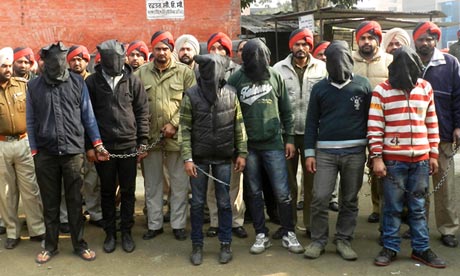
India Gang Rape: Woman Assaulted By Bus Driver, Conducter
By ASHOK SHARMA 01/13/13 07:49 AM ET EST
NEW DELHI — Police said Sunday they have arrested six suspects in another gang rape of a bus passenger in India, four weeks after a brutal attack on a student on a moving bus in the capital outraged Indians and led to calls for tougher rape laws.
Police officer Raj Jeet Singh said a 29-year-old woman was the only passenger on a bus as she was traveling to her village in northern Punjab state on Friday night. The driver refused to stop at her village despite her repeated pleas and drove her to a desolate location, he said.
There, the driver and the conductor took her to a building where they were joined by five friends and took turns raping her throughout the night, Singh said.
The driver dropped the woman off at her village early Saturday, he said.
Singh said police arrested six suspects on Saturday and were searching for another.
Gurmej Singh, deputy superintendent of police, said all six admitted involvement in the rape. He said the victim was recovering at home.
Also on Saturday, police arrested a 32-year-old man for allegedly raping and killing a 9-year-old girl two weeks ago in Ahmednagar district in western India, the Press Trust of India news agency reported. Her decomposed body was found Friday.
Police officer Sunita Thakare said the suspect committed the crime seven months after his release from prison after serving nine years for raping and murdering a girl in 2003, PTI reported Sunday.
The deadly rape of a 23-year-old student on a New Delhi bus in December led to the woman’s death and set off an impassioned debate about what India needs to do to prevent such tragedies. Protesters and politicians have called for tougher rape laws, police reforms and a transformation in the way the country treats women.
“It’s a very deep malaise. This aspect of gender justice hasn’t been dealt with in our nation-building task,” Seema Mustafa, a writer on social issues who heads the Center for Policy Analysis think tank, said Sunday.
“Police haven’t dealt with the issue severely in the past. The message that goes out is that the punishment doesn’t match the crime. Criminals think they can get away it,” she said.
In her first published comments, the mother of the deceased student in the New Delhi attack said Sunday that all six suspects in that case, including one believed to be a juvenile, deserve to die.
She was quoted by The Times of India newspaper as saying that her daughter, who died from massive internal injuries two weeks after the attack, told her that the youngest suspect had participated in the most brutal aspects of the rape.
Five men have been charged with the physiotherapy student’s rape and murder and face a possible death penalty if convicted. The sixth suspect, who says he is 17 years old, is likely to be tried in a juvenile court if medical tests confirm he is a minor. His maximum sentence would be three years in a reform facility.
“Now the only thing that will satisfy us is to see them punished. For what they did to her, they deserve to die,” the newspaper quoted the mother as saying.
Some activists have demanded a change in Indian laws so that juveniles committing heinous crimes can face the death penalty.
The names of the victim of the Dec. 16 attack and her family have not been released.
What is also troubling in these two cases is that the women were on public transportation, and the rapes were arranged and carried out by the bus drivers and bus personnel, people who should have been there to keep her safe. They treated the victims like pieces of meat; it seems excessively hostile and brutal – you have to wonder what is driving them.
You can read more on this in an article from The Guardian, from where I found the photo above of the perpetrators.
Indian Village Bans Cell Phones – For Women
LOL – what about those cheating, eloping MEN? Ban only women from using cell phones? What about calls from mothers who need you to run an errand? What about calls from the children’s school? Women – and man – who are going to cheat are going to cheat, whether or not you take their cell phone away. Found this on AOL/Huffpost via Reuters:
PATNA, India – (Reuters) – A village council in the eastern Indian state of Bihar has banned the use of mobile phones by women, saying the phones were “debasing the social atmosphere” by leading to elopements – a move that set off outraged protests from activists.
In addition to the ban, the Sunderbari village council in a Muslim-dominated area some 385 kilometers (239 miles) east of Patna, the capital of Bihar, has also imposed a fine of 10,000 rupees ($180) if a girl is caught using a mobile phone on the streets.
Married women would have to pay 2,000 rupees ($36.60).
“It always gives us a lot of embarrassment when someone asks who has eloped this time,” said Manuwar Alam, who heads a newly-formed committee tasked with enforcing the ban, referring to queries from neighboring villages.
He said the number of elopements and extramarital love affairs had risen in the past few months, with at least six girls and women fleeing their homes.
“Even married women were deserting their husbands to elope with lovers. That was shameful for us,” Alam said. “So, we decided to tackle it firmly. Mobile phones are debasing the social atmosphere”.
Local officials have begun investigations, saying that such bans cannot be allowed in a healthy society, while women’s rights activists called it an assault on freedom that could potentially end up harming women by stripping them of one source of protection from trouble, such as unwanted advances by men.
“Girls and women are capable enough to protect themselves,” said activist Suman Lal during a debate on local television. “Technology is meant to be used, not to be banned…The order is nauseating.”
Fellow activist Mohammad Islam said it was “disappointing” that the village council ignored the many advantages of mobile phones before placing a ban on them for one reason.
“I want every girl to be given a mobile phone so that she could call up family members if she has a problem”, he said. ($1 = 54.6400 Indian rupees)
(Reporting by New Delhi newsroom, editing by Elaine Lies)
Celebrating Diwali in Pensacola
A friend shared a flyer with us and said “I thought you might be interested in this.” He was right – it was a celebration of Diwali, and it would take place in a nearby Presbyterian church.
First, though, we had to buy tickets, which meant finding the Indian grocery store. This was a really good thing, as AdventureMan wanted some good hot chutneys, and I was hoping I could find some of the dark chana dal that I used to buy so inexpensively in Doha and Kuwait, but found myself ordering from Amazon.com because I couldn’t fine them in Pensacola. I knew it! I just wasn’t looking in the right place!
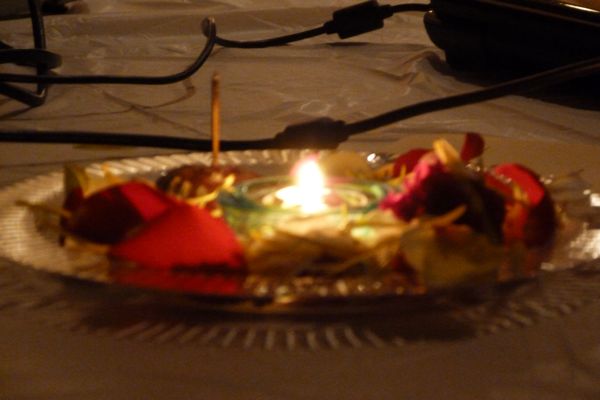
My first Diwali was magical. It was held on Al Fardan Gardens, in Doha, and all the Indian families strung thousands of white lights and lined the sidewalks with votives, so it was like a fairy land. By this late in the year, it can cool down enough to make the thought of walking inviting. To walk among the lights and to stop here and there for some truly divine cooking was delightful.
Diwali in Pensacola? Whoda thunk it?
As it turns out, Pensacola has a substantial Indian population, tightly woven together and cooperating in times of celebration and times of sorrow. Last night was a little of both – the Diwali celebration had been planned and organized for several months, but a sudden death of one of the long time members on the day of the Diwali celebration saddened the day somewhat.
While all grieved, the show went on. Lots and lots of lively traditional dances, a few Bollywood numbers, and a wonderful sword dance that reminded us of similar sword dances we had seen in the Gulf, performed only by men, while these were performed by women.


After all that energetic dancing, we were ready to eat. Butter Chicken, chicken korma, dal, rice, all kinds of good things provided by one of the newer Indian restaurants in town, the India Palace.

I never dreamed when we came to Pensacola that there would be an opportunity to celebrate Diwali. 🙂
Not the Day We Expected – Even Better
LOL, as our Friday dawned with thunder and lightning, our day totally changed. We had thought we would rush to our water aerobics class, rush home, hand up our clothes, head out to meet friends for Italian food near Destin, and then come home.
With the thunder and lightning, however, we knew there couldn’t be a class, and so we had an unexpected holiday from exercise, sort of puttered around the house taking care of things that needed taking care of, and headed off to meet up with our friends. We had a great time, great conversations, and they mentioned – as have other friends – how much they enjoyed The Best Exotic Marigold Hotel, and that we really needed to see it. After long, fond farewells, we headed home, via the beach, which we always love. So far, it was a much cooler day, only reaching the 80’s as we drove along, due to the cloud cover.
AdventureMan suggested we look at the GulfBreeze4, a really fun little theatre we love to go to where they show a lot of foreign movies or quirky movies that didn’t make it to the big screen, and there it was, the Best Exotic Marigold Hotel, and we were just in time for the afternoon showing.

It is a delightful movie. It has a lot of fun moments, some sad moments, many very human moments. You know me, I especially love the cross-cultural moments, and the thought that people can grow and adapt – no matter what age. We really enjoyed the movie.
And, when we left, we just had to have Indian food. We stopped at Taste of India on the way home and had Talli. It was one of those nights when almost every table was taken, but they had room for us.
“How spicy?” our favorite waitress asked.
“Spicy,” we stated emphatically.
“Oh!” she exclaimed, “Indian spicy!” and we said “Yes!”
When it came, it tasted like being back in Kuwait, eating food my friends had prepared. Not dumbed down food. Good, strong spicy food. We couldn’t even eat it all; but we know how good it will taste tomorrow. We brought a lot of it home 🙂
So it wasn’t the day we expected, but we feel blessed by the day we had. Good friends, good conversation, lots of laughing, good movie and a good time at Taste of India. A great day altogether.
Angry Father Beheads Daughter with Sword
I am embarrassed to tell you that my source for this story is Fox News:
JAIPUR, India – Police say a man upset over his daughter’s lifestyle chopped her head off with a sword and then paraded it through his village before surrendering to authorities in western India.
Marble miner Ogad Singh’s 20-year-old daughter had been living with her parents in the Rajasthani village of Dungarji after leaving her husband two years ago.
Police Superintendent Umesh Ojha says Singh was upset by his daughter having affairs with men, and became enraged when she eloped with one of them two weeks ago.
Ojha says Singh forced her to return home Sunday, and beheaded her Monday with a sword.
Rapidly modernizing India faces increasing social clashes as youths resist traditions like arranged marriage or limits on women venturing outside their parents’ or husbands’ homes.
On the Road
See Why You Should Always Carry Your Camera in Doha – and then the below from I Can Haz Cheeseburgers

see more Lolcats and funny pictures
Maggie O’Farrell and The Vanishing Act of Esme Lennox
Maggie O’Farrel’s The Vanishing Act of Esme Lennox is also a book club pick, but oh, what a pick! I remember somewhere reading a review; I might never have picked this book up if I hadn’t needed to read it for the club. And oh, what I might have missed!

It’s like the scariest book ever written, scary in a Margaret Atwood kind of way, a reminder that women have not had rights for very long, and that those rights are still very fragile. When economies go bottoms-up, when unemployment begins rising, women are often the first to suffer, and women’s rights the first to go. In hard times, men will be preferred hirings, because they have families to support, laws to “protect” women are passed, especially laws which “protect” her finances, meaning gives the power of the money management to some man to do for her, or “protect” her person by requiring that some man accompany her to keep her from dangers. Protection = control. It keeps some smart, thinking women submissive to men who are in every way their inferior.
In Vanishing, Maggie O’Farrel writes of such a woman, Esme Lennox, who is a fey spirit, born in India, with the eyes of an artist. While her “good” sister Kitty obeys the rules, walks the straight and narrow path, Esme is messier. As she grows to adolescence, her eccentricity and her rebellion against the constricts of the life in turn-of-the-century Scotland chafe, she yearns for more room to breathe, intellectually, socially, as her family, her community and her society continues to pressure her to conform.
One of the key events in the book is the death of Esme’s baby brother, of typhoid fever. Abandoned, Esme sits holding her dead brother’s body for three days until her family returns (the baby-keeper also died and the other employees deserted while Esme’s family was away). Esme is devastated, but the focus is on her mother, who is wrought with guilt and isolates herself, and Esme, only a little girl, is forbidden to even say her beloved baby brother’s name. Part of what plays a huge role in this book is society, expectations, and all that is hidden and unspoken – as Esme becomes, a family secret, locked away for sixty years.
Their grandmother swept into the room ‘Kitty,’ there was an unaccustomed smile on her face, ‘stir yourself. You have a visitor.’
Kitty put down her needle. ‘Who?’
Their mother appeared behind the grandmother. ‘Kitty,’ she said ‘quickly put that away. He’s here, he’s downstairs . . . ‘
. . . .
Esme watched from the window-seat as her mother started fiddling with Kitty’s hari, tucking it behind her ears, then releasing it. . . . . Ishbel turned and, catching sight of Esme at the window, said ‘You, too. Quickly now.’
Esme took the stairs slowly. She had no desire to meet one of Kitty’s suitors. They all seemed the same to her – nervous men with over-combed hair, scrubbed hands and pressed shirts. They came and drank tea, and she and Kitty were expected to talk to them while their mother sat like an umpire in a chair across the room. The whole thing made Esme want to burst into honesty, to say, let’s forget this charade, do you want to marry her or not?
She dawdled on the landing, looking at a grim, grey-skied watercolour of the Fife coast. But her grandmother appeared in the hall below. ‘Esme!’ she hissed, and Esme clattered down the stairs.
In the drawing room, she plumped down in a chair with high arms in the corner. She wound her ankles round its polished legs and eyed the suitor. The same as ever. Perhaps a little more good-looking than some of the others. Blond hair, an arrogant forehead, fastidious cuffs. He was asking Ishbel something about the roses in a bowl on the table. Esme had to repress the urge to roll her eyes. Kitty was sitting bolt upright on the sofa, pouring tea into a cup, a blush creeping up her neck.
Esme began playing the game she often played with herself at times like this, looking over the room and working out how she might get round it without touching the floor. She could climb from the sofa to the low table and, from there, to the fender stool. Along that, and then –
She realized her mother was loooking at her, saying something.
‘What was that?” Esme said.
‘James was addressing you.’ her mother said, and the slight flare of her nostrils meant, Esme knew, that she’d better behave or there would be trouble later.
As with many inconvenient women, Esme ends up committed at a loony-bin, and sixty years later, is released into the custody of a grand-niece who never even knew Esme existed.
The thoughts, trials and escapades of three women, Esme, her sister Kitty, and Iris, the grand-niece, intertwine through out the book, and the picture is cloudy at first, blurry, shifting, fragmented The pattern becomes more and more clear as the three threads of thought are woven – ever more tightly – together.
I could not put this book down. Finding out how the picture came together became more important than checking my messages, my blog, or fixing dinner. It was compelling, and resulted in a quick and unforgettable read.
Recent Comments
intlxpatr on Yellowstone: Old Faithful to C… Michelle on Yellowstone: Old Faithful to C… Cathy on No Grown-Ups in Charge intlxpatr on Waiting for Snow intlxpatr on Waiting for Snow Wikipedia Donate Button

Amazina


Early Voting in Florida


 Here There and Everywhere