My Problem With ICE

I have a long history with Immigration and Customs Enforcement. I’ve been in and out of the USA since I was a little girl. We have filled out countless forms for passports, and many times more those forms telling what we are bringing back into the country. The only time I ever had a problem with ICE was on returning from one of our African trips when I was bringing in wildebeest jerky from South Africa. I laugh now, it was me and a lot of African nationals shunted off. They were opening suitcases full of vegetables they were bringing back for family, and I was told my package of jerky was illegal in the United States. AdventureMan was annoyed with me, and I was ashamed I didn’t know. But they let me off with a mild scolding about infecting disease free animal life in the USA. I’ve never forgotten.

I’ve never minded the tiresome lines for immigration, always manned by sturdy, polite young people wanting to know where we’ve been and how did we like our trip; they were doing their job and they had been trained how to deal with people. In all my times going through those lines, I never saw any kind of incident.
They had a mission.
With the new administration, that mission changed, enlarged. They were given different, even SECRET orders, orders that encouraged them to commit the sorts of acts we saw in Minnesota. It always looked to me like those acts, committed on US Citizens, committed on resident citizens, smacked of incitement to violence. Why else would these customs and immigration officers be asked to violate the US Constitution in pursuing their mission?
I applaud those stoic and humor-filled Minnesotans who protested with restraint, who did not invite violent responses. Even if the Department of Justice will not cooperate in the investigations you are conducting into the murders of Minneapolis citizens, you are gathering witness from street cameras and witnesses against the illegal actions, and the lies and accusations, unjust, of the ICE officials and the Department of Justice. I applaud the restraint that forestalled any illusion of reason for a “national emergency” and activation of a military presence. The militaristic costumes of the immigration and customs officials did not fool nor intimadate you. Your patient, evidence based investigations will be embarrassment enough to those who thought to prevail by intimidation and brutality.
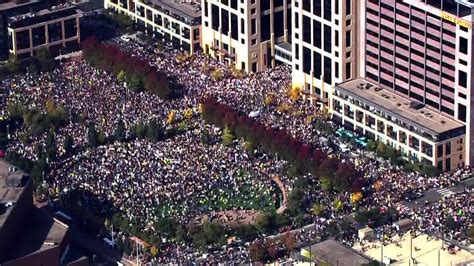
So we have to look at why the ICE men and women sent by our leader to Democratic states felt so empowered to misbehave?
Many ICE hirees have law enforcement backgrounds. Many of them have served in the armed forces. They know the basics. They know the law. They must have had second thoughts, many of them, while conducting these unrestrained acts of violence characterized as arrests of “rapists, thieves and the mentally ill,” as they arrested family men, women – and children, with no criminal records.
As well as knowing the law, and the legal use of power, those who are Christian would know Christ’s admonition to love our neighbor as ourself. Those who are Jewish would know the Old Testament verses about welcoming the stranger. Those who were raised without religion might be familiar with Spiderman, who teaches us that with great power comes great responsibility.
These $50K hires are as expendable as Pam Bondi and Kristi Noem. Once they have served their purpose, they can be scapegoated for excessive zeal in pursuit of the mission, or charged with murder while their superiors, who put the secret policies into effect, escape blame and punishment.
Again, I applaud the Minnesotans, who with restraint, humor, and humanity, protected the weakest, the families and children, while EFFECTIVELY resisting the provocation they faced. Well done, Minnesota!
And lets take a minute to grieve the effects of the violence upon those who inflicted it, mere pawns in a greater game of thrones.
Slight of Hand and Wires and Mirrors; No Accountability
Our leader announced a speech to the nation, which turned out to be nothing but repeats of “Truth” social posts and comments previously made. A boring, disjointed 19 minutes of nothing credible. Credibility is stating a mission and following through. Chaos is changing the mission and its achievements every ten minutes or so. If you don’t believe me, watch the stock market.
Meanwhile, behind the curtain, The Great Oz and his handlers are changing how our democracy operates. The failed military officer, Pete Hegseth is examining and removing African Americans, females, and especially African American Females from promotion lists. He is firing the top general who questions his judgement in toying with a time honored system where the military chooses its leaders based on performance and leadership abilities, not their gender nor their color.
Does Hegseth understand demographics? Does he understand that military recruitment is problematic these days days, that the pool of recruits has shrunk dramatically? Does he understand that brawn no longer wins wars, but fighter planes, drones, new ideas and weapon development are fighting a new kind of war, where every gender and color contributes the the nuances of creative strategies available to a commander in chief who genuinely understands how to function in the fog of war?
Today Heather Cox Richardson alerts us to another slight of hand, the kind of small change the controllers hope will go unnoticed: The challenge of ACCOUNTABILITY and how it impedes a sitting President. She quotes the following, and it quite takes my breath away:
Yesterday Assistant Attorney General T. Elliot Gaiser, of the Office of Legal Counsel, published an opinion for the White House that claims the Presidential Records Act, which requires that presidents keep records of their official business and turn them over at the end of their term, is unconstitutional. Gaiser clerked for Supreme Court Justice Samuel Alito.
“The PRA is not a valid exercise of Congress’s Article I authority and unconstitutionally intrudes on the independence and autonomy of the President guaranteed by Article II. The Act establishes a permanent and burdensome regime of congressional regulation of the Presidency untethered from any valid and identifiable legislative purpose,” the memo reads. “For these reasons, the PRA is unconstitutional, and the President need not further comply with its dictates.”
(taking a moment to catch my breath)
We burden our elected president with the requirement that we know what he does and why he is doing it?
How can anyone believe this lunacy? Any person in a position of responsibility has to answer to his polity! Elected politicians all the more. He answers to us, the voters.
Our leader has a lot to answer for. We can’t trust anything he says, from minute to minute. Our treasury has been declared insolvent. He is sending our children off to war with unclear orders and insufficient leadership.
He has hired a confederacy of ignorant, greedy sycophants. He has gutted our diplomatic service. He has gutted Consumer Oversight. He has gutted the Environmental Protection Agency. He has corrupted the Department of Education.
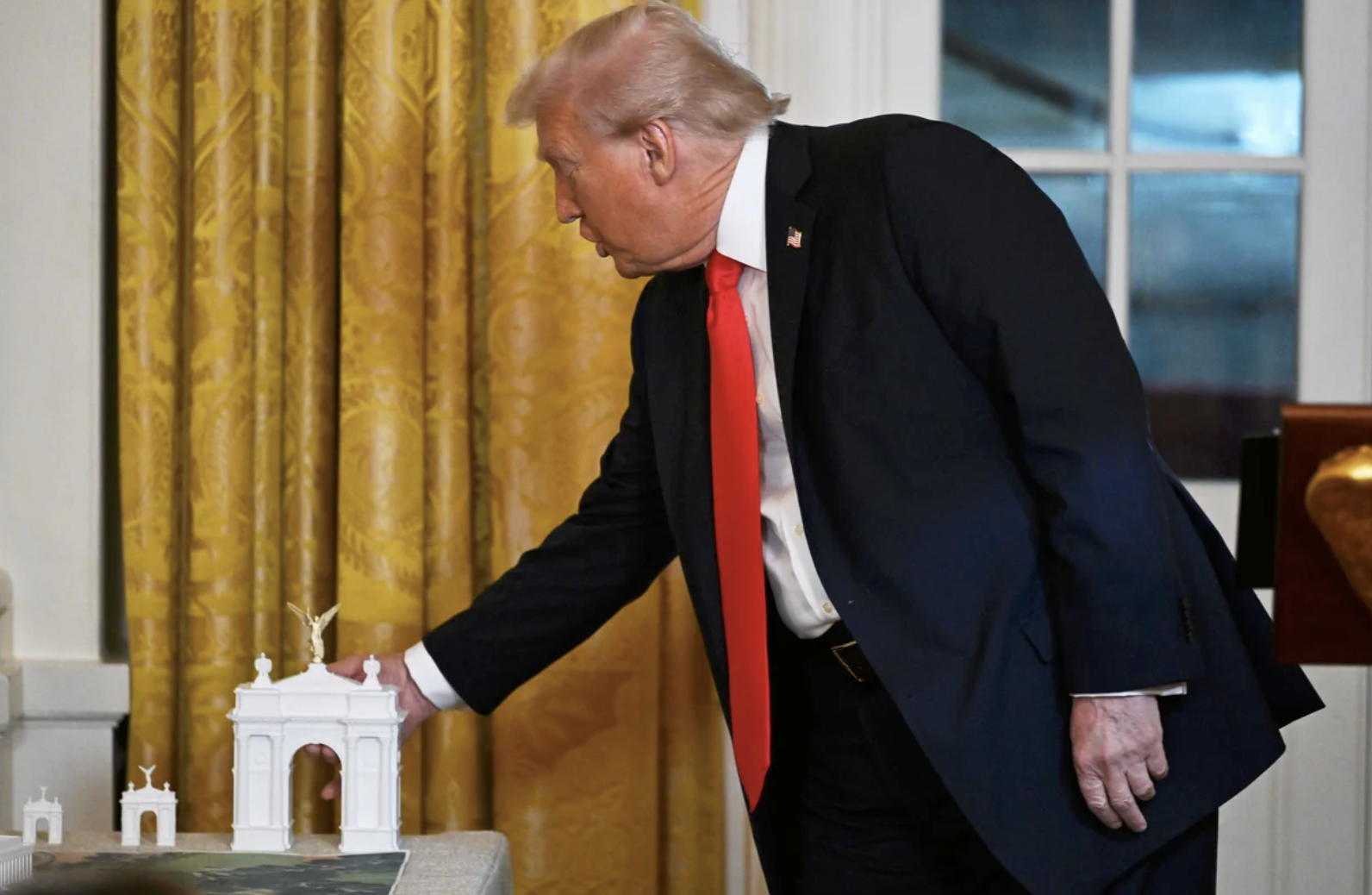
He is terrified he cannot win and is attempting to take over national elections. Meanwhile, he is bankrupting our country with garish monuments and wars we never agreed to fight.
He is subjecting women to outdated standards and taken away their rights to make decisions for their own bodies.
He is corrupting our social system, taking medical care away from those who need it most, and callously neglecting the veterans who have served our country so loyally.
He has made agreements with other countries that we only learn about by accidental comments.
This can’t go on. Give us Accountability. Oversight. Congressional Approval. Fair and Free Elections. Constitutional Restraints!
Oscar Romero, Patron Saint of The Americas and El Salvador
My friends, when you hear that the immigrants seeking a new life in our country are rapists, thieves, the mentally ill and very bad people, please think of Oscar Romero, and all those who have fought the evil forces of thuggery and dictatorship to find a life of freedom for themselves, and for their families, especially, hope for their children.
I urge you to read a much criticized book, American Dirt, by Jeanine Cummins. Here is what Wikipedia says. My experience was that the struggles exposed in American Dirt are very typical of people seeking to escape the violence of their societies.
American Dirt is a 2020 novel by American author Jeanine Cummins, published by Flatiron Books. The book is about a Mexican bookseller who is forced to flee as an undocumented immigrant to the United States, along with her son, after her journalist husband exposes a local drug kingpin.
ÓSCAR ROMERO
ARCHBISHOP OF SAN SALVADOR, AND THE MARTYRS OF EL SALVADOR
(24 March 1980)
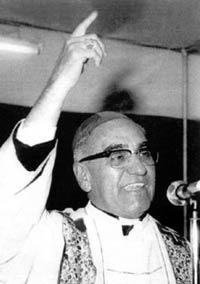
Óscar Arnulfo Romero y Galdámez (August 15, 1917 – March 24, 1980), commonly known as Monseñor Romero, was a priest of the Roman Catholic Church in El Salvador. He later became prelate archbishop of San Salvador.
As an archbishop, he witnessed numerous violations of human rights and began a ministry speaking out on behalf of the poor and victims of the country’s civil war. His brand of political activism was denounced by the hierarchy of the Roman Catholic Church and the government of El Salvador. In 1980, he was assassinated by gunshot while consecrating the Eucharist during mass. His death finally provoked international outcry for human rights reform in El Salvador.
In 1997, a cause for beatification and canonization into sainthood was opened for Romero and Pope John Paul II bestowed upon him the title of Servant of God. Pope Francis canonized Romero as a saint on 14 October 2018. He is considered the unofficial patron saint of the Americas and El Salvador and is often referred to as “San Romero” in El Salvador. Outside of Catholicism Romero is honored by other religious denominations of Christendom, like the Church of England through its Common Worship. He is one of the ten 20th-century martyrs from across the world who are depicted in statues above the Great West Door of Westminster Abbey, London.
from Wikipedia
Also commemorated on this day are three Maryknoll nuns and a woman lay missionary killed by a Salvadoran army death squad on 2 Dec, 1980, and additionally six Jesuits, their housekeeper and her daughter, who were also murdered by the Salvadoran army on 16 Nov. 1989.
“I Have No Need of You”
From this morning’s Lectionary Readings:
1 Corinthians 12:12-26
12 For just as the body is one and has many members, and all the members of the body, though many, are one body, so it is with Christ.13For in the one Spirit we were all baptized into one body—Jews or Greeks, slaves or free—and we were all made to drink of one Spirit.
14 Indeed, the body does not consist of one member but of many. 15If the foot were to say, ‘Because I am not a hand, I do not belong to the body’, that would not make it any less a part of the body. 16And if the ear were to say, ‘Because I am not an eye, I do not belong to the body’, that would not make it any less a part of the body. 17If the whole body were an eye, where would the hearing be? If the whole body were hearing, where would the sense of smell be?
18But as it is, God arranged the members in the body, each one of them, as he chose. 19If all were a single member, where would the body be? 20As it is, there are many members, yet one body. 2
1The eye cannot say to the hand, ‘I have no need of you’, nor again the head to the feet, ‘I have no need of you.’ 22On the contrary, the members of the body that seem to be weaker are indispensable, 23and those members of the body that we think less honourable we clothe with greater honour, and our less respectable members are treated with greater respect; 24whereas our more respectable members do not need this. But God has so arranged the body, giving the greater honour to the inferior member, 25that there may be no dissension within the body, but the members may have the same care for one another. 26If one member suffers, all suffer together with it; if one member is honoured, all rejoice together with it.
What Country am I Living In?
As an American, I’ve lived in a lot of countries, often countries that controlled news coverage and punished those who reported news the leaders found embarrassing.
Many experienced people found ways around it. They phrased their reports carefully, leaving the reader to read behind the lines.
It’s not what you expect in a Democratic Republic. It’s not what I expect in the United States of America, where the very first amendment to our Constitution verified our right to have our own opinions and our freedom to state them (given that they were not, of course, a threat against someone else, or shouting “Fire” in a crowded theatre.)

And now the elected leader of the United States is trying to control any negative reporting about his War, a war that surprised his own country, his own people. A War which has not been supported by Congress, which has the right to declare War. As billions go up, literally, in smoke, or down in flames, Trump and Hegseth want the FCC to pull the broadcasting license of anyone reporting the events that are really happening. Trump has a long history of calling reality “false news” and claiming his big fat lies are truth. Like his endless whining about the election he lost to Joe Biden by more than 8 million votes. And he claims it was a fraudulent loss, a rigged election.
How on earth could that ever be a secret if it were to have happened? Crazy, delusional, whoppers!
And now he wants people whose reputations are on the line, newsmakers, journalists, photographers, soldiers, sailors – people who can see what is happening with their own eyes, hear the blasts and report the damages, and hold those accountable for their actions – he wants them to toe the party line? He wants the TRUTH to be what he pretends it is?
George Orwell got it right, he just got the year wrong. With this administration, we no longer have guarantees of personal privacy. We no longer have guarantees guaranteed by our Constitution. The Police are no longer our friends.
The president believes the truth is what he says it is and that the rights of the people are those he says they have. How have we allowed this to happen?
He CREATES situations, or makes them up, and then creates an oppressive measure to deal with it – look at what ICE, once respectable, has become. An entity protecting our entry points has become a gang of thugs who operate outside the law. When courts rule against them, they ignore the rulings.
When Trump looks at the polls and sees that he cannot win an election, he creates the “SAVE” act to deter, discourage and delete voter’s rights. Both ICE and “SAVE” address problems which do not exist, other than as avenues to giving this monster greater and greater power to feed his endless greed.
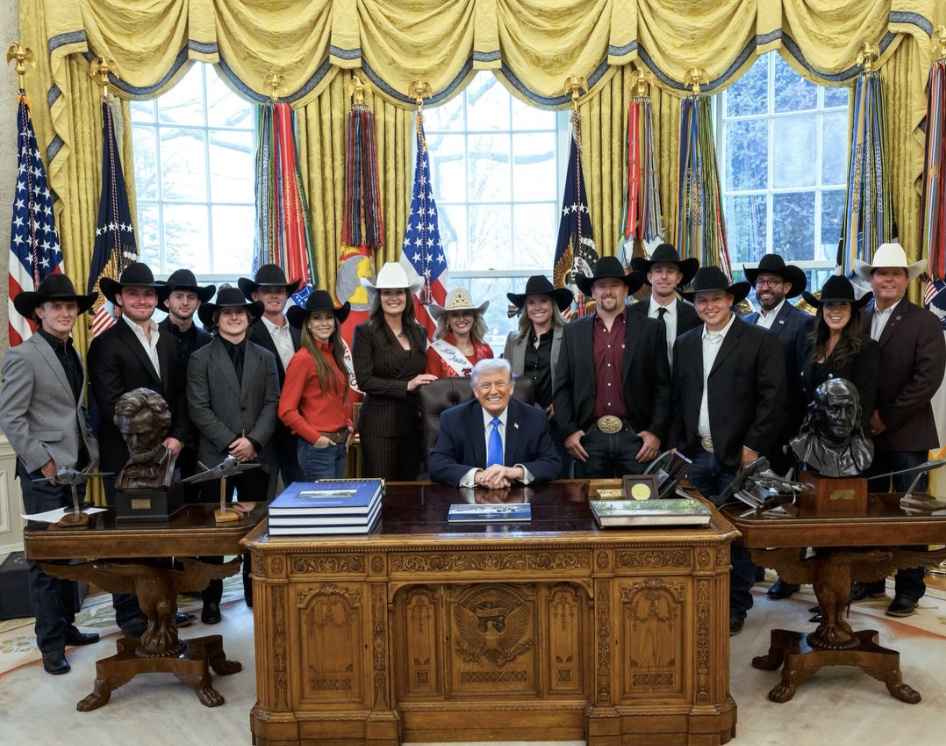
Do not listen to this man. Do not believe a word he says. Look, instead, at his actions. He fires the watchdogs. He fires those who would limit his power. He is what he always has been, a fraud, a con man, a liar, and altogether a very flawed man. He piles up wealth by making agreements that fill his pockets, his family’s pockets, and his cronies’. He bullies those who stand up to him. This is not a man of strong character; this is a human wrecking ball.
Unintended Consequences
It is rare that I am stunned into silence.
This is not the world I grew up in. This is not the country I served. These are not the values we were taught as children, in a United States full of post WWII optimism, as we allied with other nations for the greater good.
I am a blessed woman. I have what I need, and my son married a woman with deeply perceptive insights. An environmental specialist, she taught me the concept of Unanticipated Consequences. We are witnessing a host of unanticipated consequence unrolling by the minute, consequences which will have reverberations far into the future – not forseeable consequences but lasting.
Our current Administration is whacko. They command the mightiest military on earth, and they hold the keys to nuclear weapons. I have a friend who says “We’re Doomed,” only he uses a stronger, vulgar word I don’t want to use here.
League of Women Voters: State of Union Bingo Cards
Gotta love those ladies in pearls, although lately the League has been attracting a much younger group of activists. An amazingly non-political group, the League looks at issues and candidates, and encourages INFORMED voters. All people are welcome; in spite of the name, the league also includes men. This is a group that makes a difference.

With their wicked sense of humor, the National League encourages all Americans to watch the dreaded State of the Union speech tonight, and has published a set of Bingo Cards to keep you engaged. You can download them for yourself and your family members at League of Women Voters: State of the Union Bingo or you can print these, which I downloaded from their website.
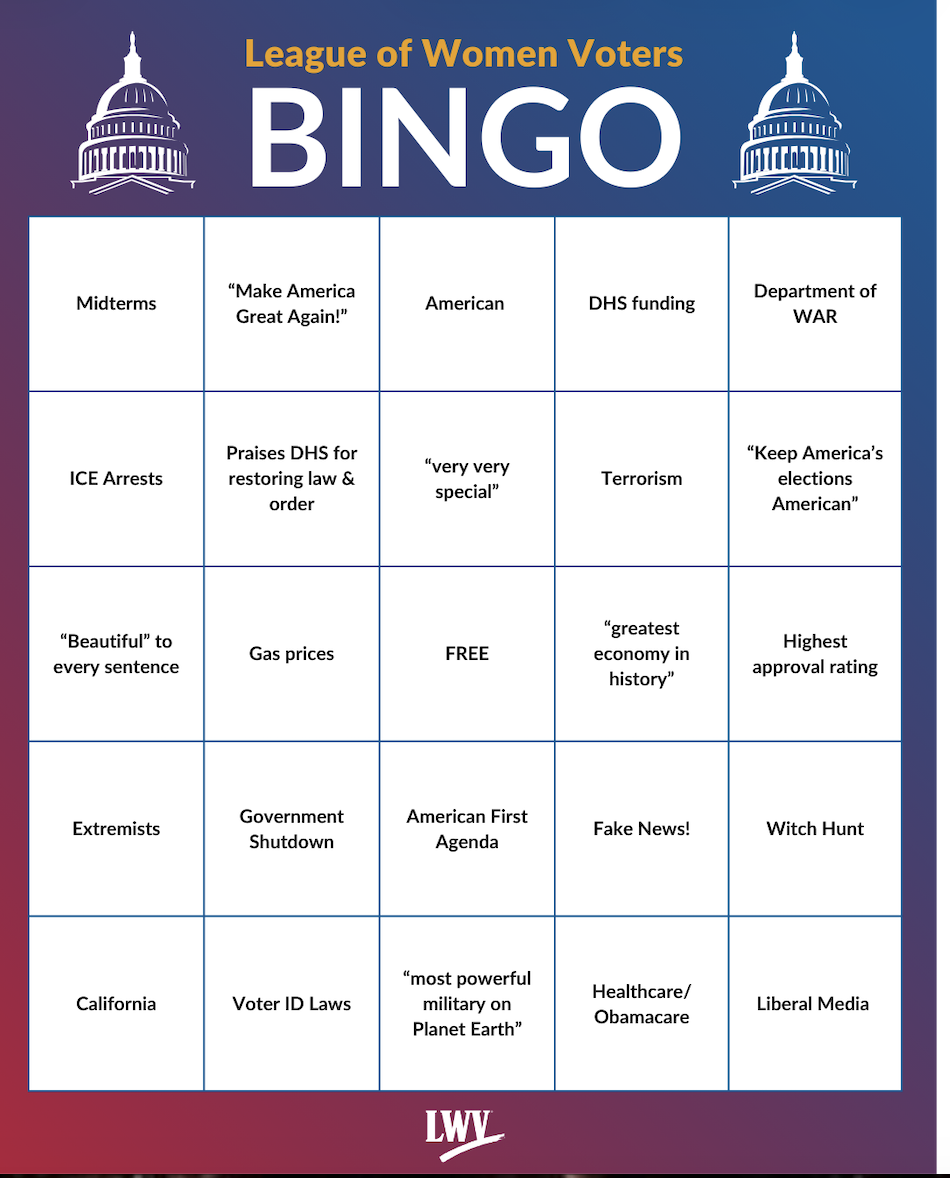
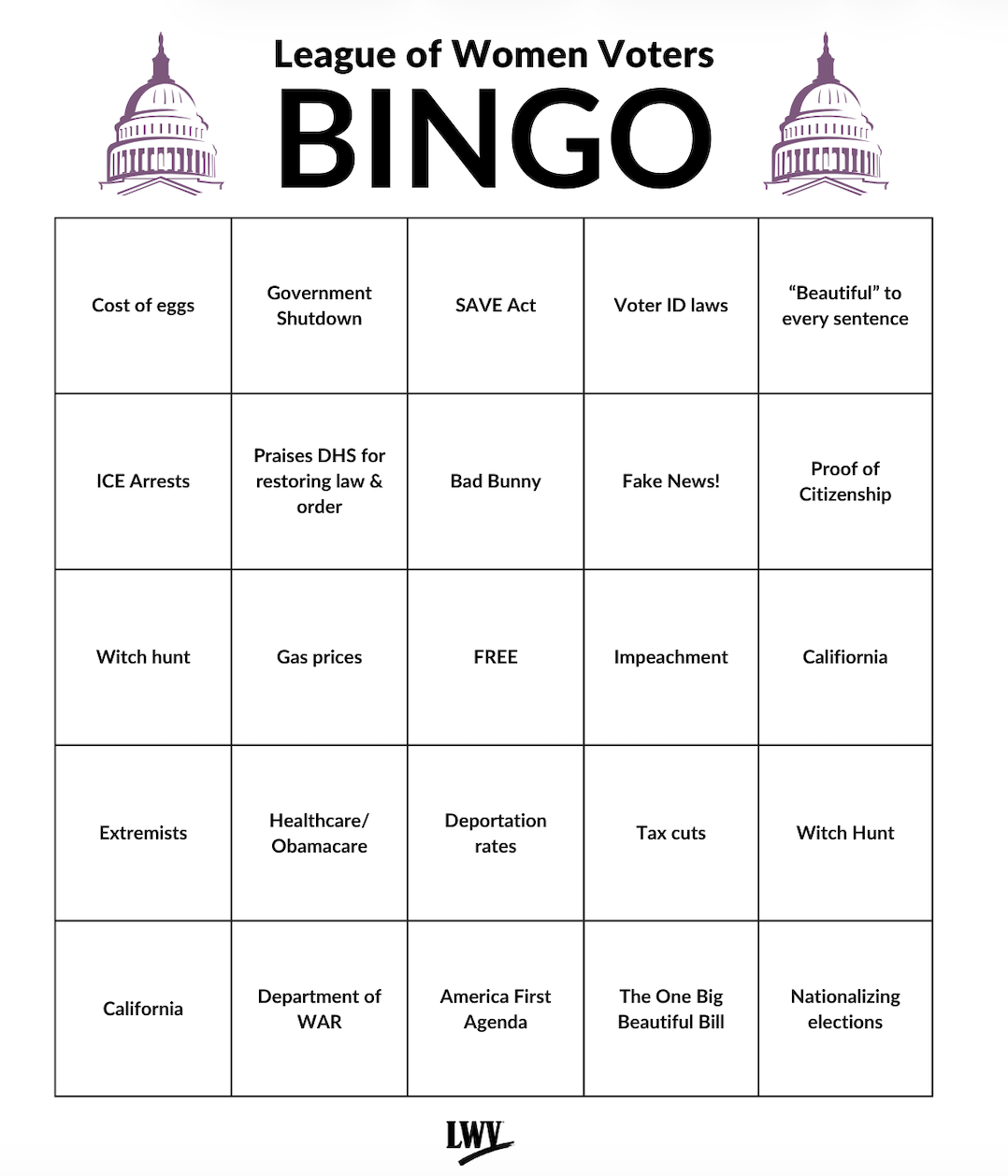
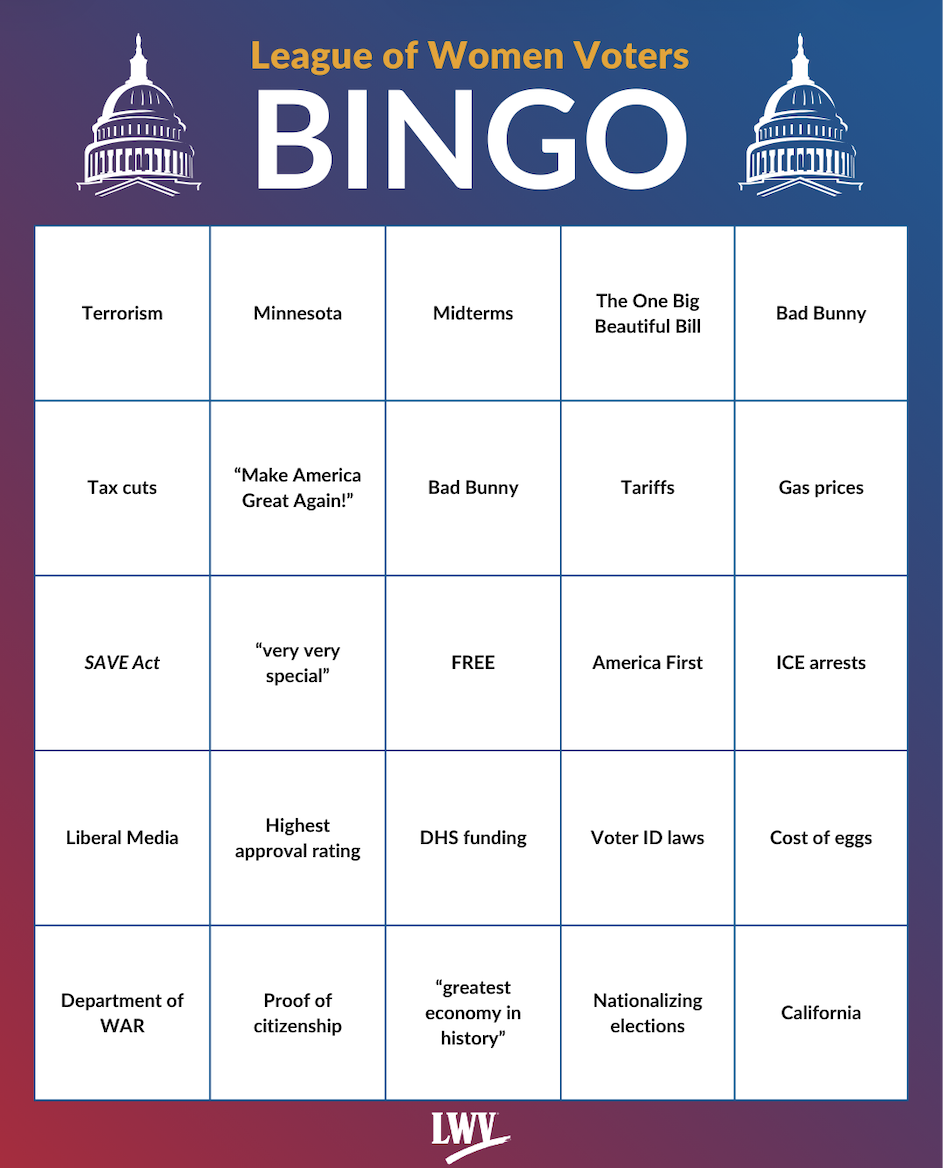
Yes, I am a member of this group. They keep up with the important issues, and they invite speakers to meetings to explain the substance to the public. They educate people about voting rights without bias.
They help with elections, and, where allowed, they help register new voters – people turning 18, new citizens, people who haven’t voted before. The current stereotype of this group as elderly educated women in pearls is quickly changing as super-charged young people seek to exert their rights in an orderly, lawful fashion.
By uniting women from all parties and all walks of life, they have a big voice and have effectively challenged unjust and unconstitutional laws at the local, state, and national levels. They take their commitment voting rights, issues, and impartiality very seriously.
And, they have a wonderful sense of humor 😄.
Bored of Peace

The man who mercilessly called Joe Biden “Sleepy Joe” dozes through his own “Peace” meeting. Pony up a billion dollars and anyone can join. Maybe his son-in-law gets in for free.
What will greed and corruption contribute to the Palestinian situation in Israel? When Trump talks of villas and high rises facing a Mediterranean basin, is he talking about housing for Palestinians? Is he talking about establishing a beautiful Palestinian state on the Gaza strip?
Or is he seeking to monetize and take advantage of a political void to eliminate the Palestinian inhabitants and create a sleazy nouveau riche community a la Mar-a-Lago?
A Tale of Grace
For perspective, this is the legendary acquisition by Father Abraham of the first Jewish purchase of land. It is a tale of grace, hospitality, and sharing between two cultures:
Genesis 23:1-20
23
Sarah lived for one hundred and twenty-seven years; this was the length of Sarah’s life. 2And Sarah died at Kiriath-arba (that is, Hebron) in the land of Canaan; and Abraham went in to mourn for Sarah and to weep for her.
3Abraham rose up from beside his dead, and said to the Hittites, 4‘I am a stranger and an alien residing among you; give me property among you for a burying-place, so that I may bury my dead out of my sight.’
5The Hittites answered Abraham, 6‘Hear us, my lord; you are a mighty prince among us. Bury your dead in the choicest of our burial places; none of us will withhold from you any burial ground for burying your dead.’
7Abraham rose and bowed to the Hittites, the people of the land. 8He said to them, ‘If you are willing that I should bury my dead out of my sight, hear me, and entreat for me Ephron son of Zohar, 9so that he may give me the cave of Machpelah, which he owns; it is at the end of his field. For the full price let him give it to me in your presence as a possession for a burying-place.’ 10Now Ephron was sitting among the Hittites; and Ephron the Hittite answered Abraham in the hearing of the Hittites, of all who went in at the gate of his city,
11‘No, my lord, hear me; I give you the field, and I give you the cave that is in it; in the presence of my people I give it to you; bury your dead.’ 12Then Abraham bowed down before the people of the land. 13He said to Ephron in the hearing of the people of the land, ‘If you only will listen to me! I will give the price of the field; accept it from me, so that I may bury my dead there.’ 14Ephron answered Abraham,
15‘My lord, listen to me; a piece of land worth four hundred shekels of silver—what is that between you and me? Bury your dead.’ 16Abraham agreed with Ephron; and Abraham weighed out for Ephron the silver that he had named in the hearing of the Hittites, four hundred shekels of silver, according to the weights current among the merchants.
17 So the field of Ephron in Machpelah, which was to the east of Mamre, the field with the cave that was in it and all the trees that were in the field, throughout its whole area, passed 18to Abraham as a possession in the presence of the Hittites, in the presence of all who went in at the gate of his city. 19After this, Abraham buried Sarah his wife in the cave of the field of Machpelah facing Mamre (that is, Hebron) in the land of Canaan. 20The field and the cave that is in it passed from the Hittites into Abraham’s possession as a burying-place.
No Grown-Ups in Charge
We thought we would change the world, my generation. How on earth did we end up with a President who has the self-control, self-restraint, self-discipline, and dignity of a two-year-old?
How did we end up with a President who supports COAL, flying in the face of science, and wants to roll back protections against climate change, air pollution, water pollution, vaccinations, human rights, and stewardship of earthly resources?
What happened to the dawning of the Age of Aquarius, where we worked on harmony and understanding, and the dignity of ALL human beings?
How did we get stuck with a government of morons, whose first move was to remove all the bureaucratics who knew what they were doing? How did we allow all the oversights to be abolished?
How do we continue to allow the oligarchs to forbid the completion of a bridge between Canada and Michigan because of a conflict with a rich man who owns a competing bridge? How do we allow a Presidency which makes private deals to enrich his sons and son-in-law with opaque deals outside the public view?
How do we accept a new army of MERCENARIES, attracted by a $50K bonus for signing on, who have paltry training, disobey standard policing standards and who act with disregard to our national constitution?
I may be old, but I am not blind, nor am I stupid. I see, to my horror. I witness, and I document. I am part of a large and growing crowd of witnesses, (dead and alive!) who will call this administration to account for their grave injustices.
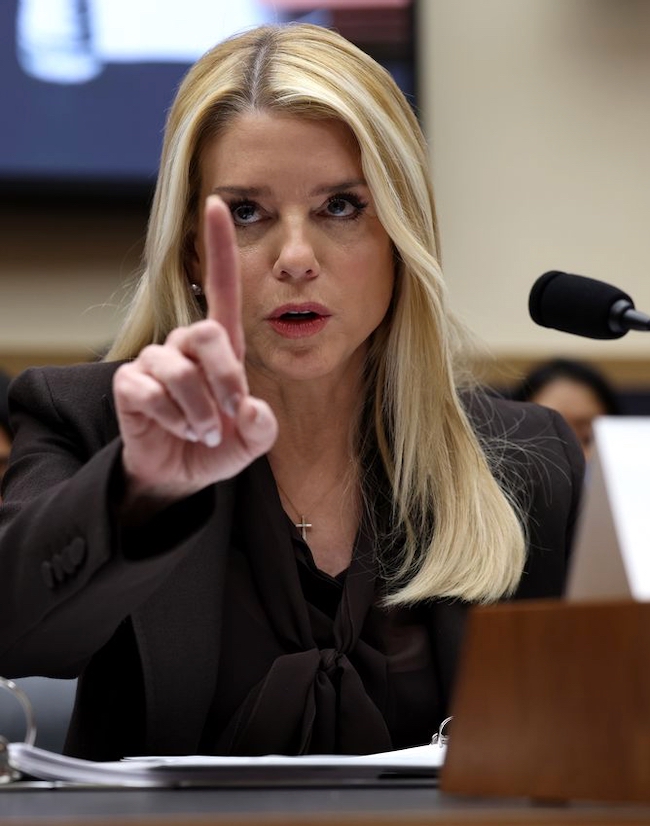
Pam Bondi, who cannot answer questions, who is protecting her boss, mentioned over one million times in the Epstein files, pointing her finger.
This week I attended a school service at our church, and the Old Testament reading was from Isaiah. It heartened me; this is what we are teaching our children
ISAIAH 58: 6-10
“Is not this the kind of fasting I have chosen:
to loose the chains of injustice
and untie the cords of the yoke,
to set the oppressed free
and break every yoke?
7 Is it not to share your food with the hungry
and to provide the poor wanderer with shelter—
when you see the naked, to clothe them,
and not to turn away from your own flesh and blood?
8 Then your light will break forth like the dawn,
and your healing will quickly appear;
then your righteousness will go before you,
and the glory of the Lord will be your rear guard.
9 Then you will call, and the Lord will answer;
you will cry for help, and he will say: Here am I.
“If you do away with the yoke of oppression,
with the pointing finger and malicious talk,
10 and if you spend yourselves in behalf of the hungry
and satisfy the needs of the oppressed,
then your light will rise in the darkness,
and your night will become like the noonday.”
Let us shine. Let us seek to shine.
Recent Comments
ExpatAlien on What Country am I Living … intlxpatr on Yellowstone: Old Faithful to C… Michelle on Yellowstone: Old Faithful to C… Cathy on No Grown-Ups in Charge intlxpatr on Waiting for Snow Wikipedia Donate Button

Amazina


Early Voting in Florida


 Here There and Everywhere