One of the most painful criticisms I would hear of Americans as I lived overseas was that we were all happy, friendly people, but we didn’t really care about people. We didn’t maintain relationships. While painful, it was also, as I looked deeper, true. Our lives are fast-paced, and we move from place to place, person to person, job to job and rarely develop the deep relationships that come from building a long, deep friendship. Today’s lesson from Rick Warren talks about how we can do better in our relationships:
“All of you should be of one mind. Sympathize with each other. Love each other as brothers and sisters. Be tenderhearted, and keep a humble attitude.” (1 Peter 3:8 NIV)
You’re never going to live in harmony with your wife, your husband, your friends, or anybody else without empathy. You can’t have a team without being aware of what’s happening in each other’s lives. That’s why when people work together in an office, they may do work together, but they’re not a team unless they know what’s going on in each other’s lives.
Empathy is so important because it meets two of our deepest needs: the fundamental need to be understood and a deep need to have our feelings validated.
If you’re going to build a team of friends or at work or in your small group, you have to build empathy into the structure. So how do you become an empathetic person?
Slow down. Because our culture teaches us to move fast, we end up relationally skimming. That means you’re hitting the high points and missing all kinds of details in the lives of people you care about most. James 1:19 says, “Be quick to listen, slow to speak, and slow to get angry” (NLT, second edition).
Ask questions. Proverbs 20:5 says, “A person’s thoughts are like water in a deep well, but someone with insight can draw them out” (GNT). Most people hold their emotions pretty close, and they don’t automatically share how they’re doing. “I’m fine” is the standard answer, but that doesn’t really tell you how they feel. If you ask, “””How are you doing?” and the other person says, “I’m fine,” here’s how you draw out a more telling response: Learn to ask the question twice. That’s how you develop empathy. Pause and say, “No. How are you really doing?” The other thing you do is learn to linger. That means don’t be afraid of silence. Just be in the moment, ask the question, and don’t be afraid to sit there and wait. Don’t immediately go into your agenda. Just listen and learn.
Show emotions. The Bible says in Romans 12:15, “Rejoice with those who rejoice, and weep with those who weep” (NASB). Empathy is more than saying, “I’m sorry you hurt.” It’s saying, “I hurt with you.” You’re willing to cry with them, and you’re willing to rejoice with them. There’s only one way you’re going to be that empathetic — stay filled up with God. If your tank gets low on God, you’re not going to be empathetic at all. You’ve got to stay filled up with God.
“All of you should be of one mind. Sympathize with each other. Love each other as brothers and sisters. Be tenderhearted, and keep a humble attitude” (1 Peter 3:8 NIV).
We have guests in town from another country who are living with Americans and visiting many others.
One of them asked her host “Do all Americans worship idols?” and the host was flummoxed.
We have been in private houses of the most religious Muslims, and their houses look very different from ours. They have nothing on the walls, except perhaps a picture of the Kaaba in Mecca, or a beautiful calligraphy in Arabic with one of the Surahs. To us, the houses look very plain, but they are being careful to observe carefully the word of the Lord.
We don’t consider the objects in our homes idols because we don’t worship them. When I read today’s Lectionary reading from Deuteronomy, I have to rethink what God might thing idols are.
Deuteronomy 4:15-24
15 Since you saw no form when the Lord spoke to you at Horeb out of the fire, take care and watch yourselves closely, 16 so that you do not act corruptly by making an idol for yourselves, in the form of any figure—the likeness of male or female, 17 the likeness of any animal that is on the earth, the likeness of any winged bird that flies in the air, 18 the likeness of anything that creeps on the ground, the likeness of any fish that is in the water under the earth. 19 And when you look up to the heavens and see the sun, the moon, and the stars, all the host of heaven, do not be led astray and bow down to them and serve them, things that the Lord your God has allotted to all the peoples everywhere under heaven. 20 But the Lord has taken you and brought you out of the iron-smelter, out of Egypt, to become a people of his very own possession, as you are now.
21 The Lord was angry with me because of you, and he vowed that I should not cross the Jordan and that I should not enter the good land that the Lord your God is giving for your possession. 22 For I am going to die in this land without crossing over the Jordan, but you are going to cross over to take possession of that good land. 23 So be careful not to forget the covenant that the Lord your God made with you, and not to make for yourselves an idol in the form of anything that the Lord your God has forbidden you. 24 For the Lord your God is a devouring fire, a jealous God.
“As Sallam wa alaikum!” I smiled at the Sudanese women coming in to their jobs in our hotel.
They stopped still in their tracks.
“You speak Arabic!” they said, astonishment clear on their faces.
“Only a little!” I smiled back.
I had a whole squad of new friends.
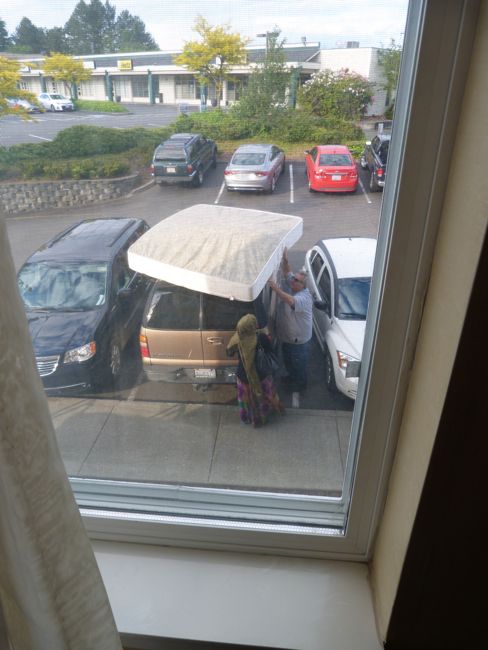
Now that financial times are easing, many hotels we have visited over the last few months are renovating and getting new mattresses. This was a real bonus for our Sudanese friends, and all of their friends.
Have you ever tied a mattress on the top of your car and tried to drive? It is a wild and dangerous adventure; the wind lifts and pushes the mattress toward the back as you drive. Unless the mattress if firmly and thoroughly tied down, you are in for a wild ride.
And then again, if you are new in a country, and in need of a mattress, a wild ride is a small price to pay.
On our way back to the hotel, we see protestors in red shirts at every corner. This is not protestors Ferguson style, these are Seattle style protestors, making a big demonstration for fully funding public education, and all the signs are grammatical 🙂
We are so full from lunch that we just want a small dinner. We find a good Ethiopian restaurant listed near our hotel, and head there, but when we arrive, there is plywood over two windows and a sign saying “Sorry, dear customers, but due to car accident our restaurant is closed until it is fixed.”
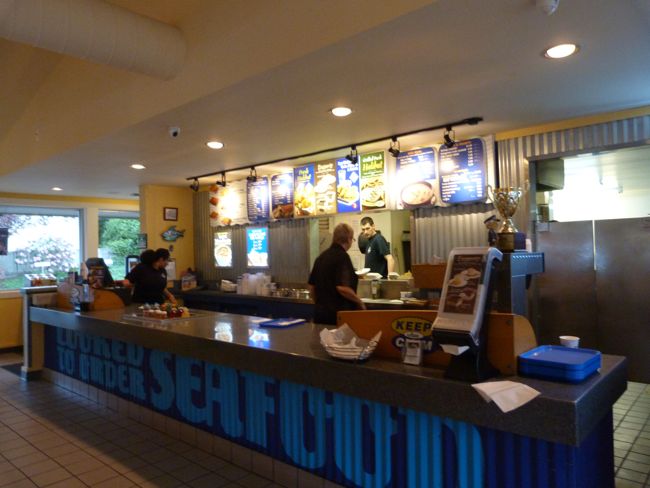
We end up at Ivar’s Seafood Bar, which is quick food, but not cheap food, and very very good food. We are greeted by an older man as we enter, he says “Welcome to Ivars! I hope you have a great meal.” We thought he might be an official greeter, but no, he was a customer like us. We ended up sitting in a booth next to his, so he stopped on his way out to see what we had ordered (halibut and chips, smoked salmon chowder, Dungeness crab cocktail) and just to chat. It’s an Edmonds kind of thing, neighborliness and civility.
It’s taken us a long time to get over the loss of our sweet Qatari Cat, sweet Pete. He was so special to us. For one thing, he was pretty. For another, he had some very winning ways. So many reasons to love that sweet cat and to regret his loss.
On our trip, we agreed that we are still not over Pete, and at the same time, it is time to bring another cat into our lives.
I had one in mind.
I have a friend. She has a ministry; she rescues abandoned animals, particularly cats. She tends to their wounds, she has them neutered, she gets them shots. She gives them boundless love, and teaches them to love and trust again.
She had put a photo of a cat on FaceBook. It was before our trip, and I couldn’t see adopting a cat and then putting him into a cat hotel, so I didn’t do anything. But my friend called while I was traveling, and I asked her during our conversation if that orange cat had found a home, and she said no.
So when we got back, we unpacked, we did laundry, we started to get back to our normal lives.
And we adopted Zakat.
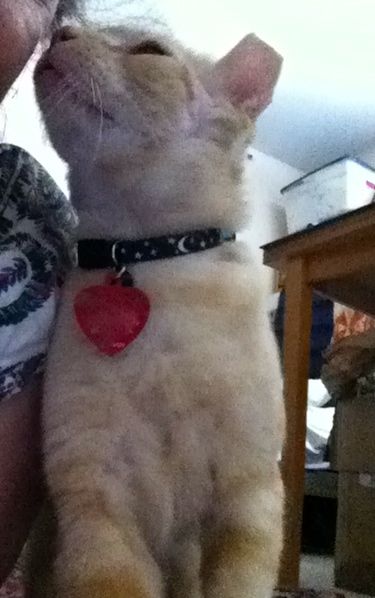
Our friend brought him over. He was small, he was scrawny, he had a clipped ear, which I learned means he’s been taken from the streets and neutered, and . . . he had a huge circular scar around his face. He loved my friend, but AdventureMan and I totally freaked him out, and he ran into the cat room and hid (we have a lot of great hiding places.)
A couple days later, our grandson was staying overnight, with his Explorer’s tool (it has a flashlight, compass, magnifying glass, mirror, thermometer and whistle) and asked if he could see the cat. He’s a good boy, and he has three cats at home, so we took him to Zakat’s cupboard, and opened. Zakat didn’t run, and our grandson shone his flashlight and exclaimed softly in delight “Oh, I like his face! He has a sweet face!”
He didn’t even see the scars. All he could see was the sweetness of this cat. And I thought what a blessing grandchildren are, to help us see with the eyes of Jesus, to see sweetness where other see only scars.
Zakat has now discovered he is safe with us, and follows us around like a little shadow. He loves to sit in AdventureMan’s office with him, he loves to curl up with me while I am reading. He is fresh, and funny, and a sweet hearted little cat.
Zakat means tithe or alms in Arabic, but the truth is, we just love the double entendre, and love saying “Where’s Zakat?” We must be five years old, it takes so little to make us laugh.
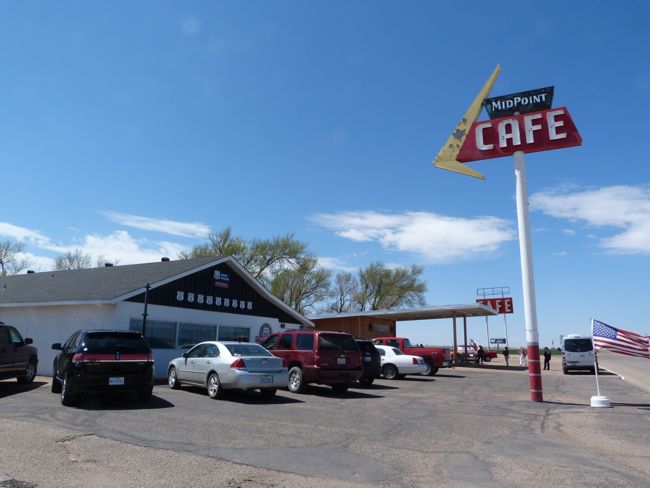
It’s one of those long lonely Texas roads, one with few stops along the way and it is time to eat. It is also Easter, and who knows what will be open and if there is any room at the inn, so to speak.
I spot a large CAFE sign near a gas station in an otherwise unpromising tiny strip of town. It is surrounded by cars, so we exit and head over to where the signs are.
Great choice.
There was a large chain-foods-with-greasy-selections at one of the gas stations, but the cafe was one of those home-cookin’ kinds of places, and full of tables of folk just out of church and looking to have an Easter meal out.
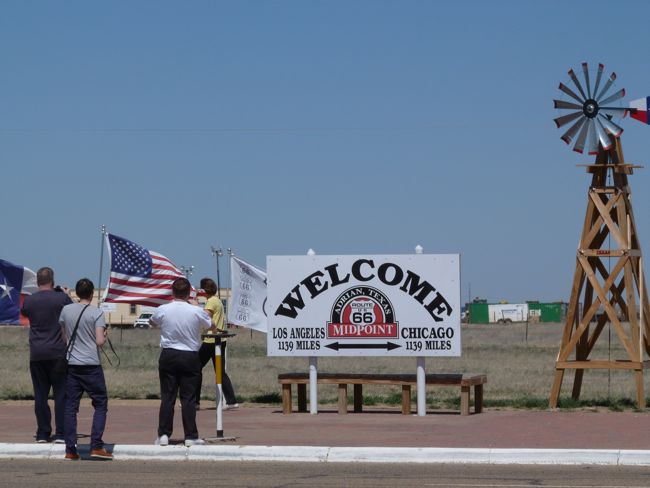
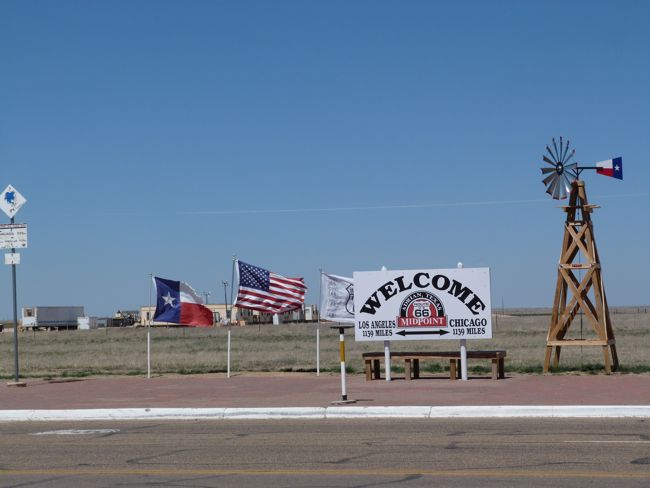
The Mid Point Cafe is exactly halfway from the beginning of Route 66 to its end.
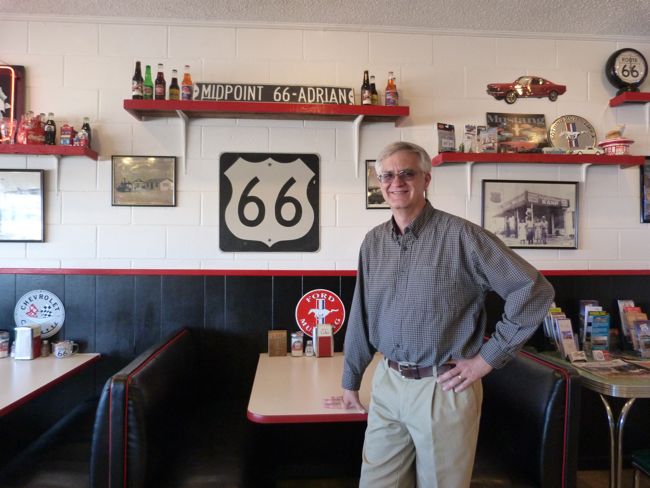
After two large groups (the Baptists and the Methodists, I think) departed, the owner, Dennis Purschwitz, had some time to talk with us. He had recently bought the MidPoint, talked officials into helping update the MidPoint signs, got all kinds of people to donate labor and supplies to make an interest point happen.
And he wasn’t even from around there. Now, he has retired (mostly) from engineering and is living his dream, running the MidPoint Cafe. He brought life back to a town with no dining out places, and gave people a place to gather. He is busy helping a community remain viable.
The food was excellent; the home made pies even better. A couple were already sold out, so AdventureMan reserved a piece of Coconut Creme before we even ordered lunch. This was one of those great stops that happen on a road trip; we didn’t know it was there and now, we are so glad it is.
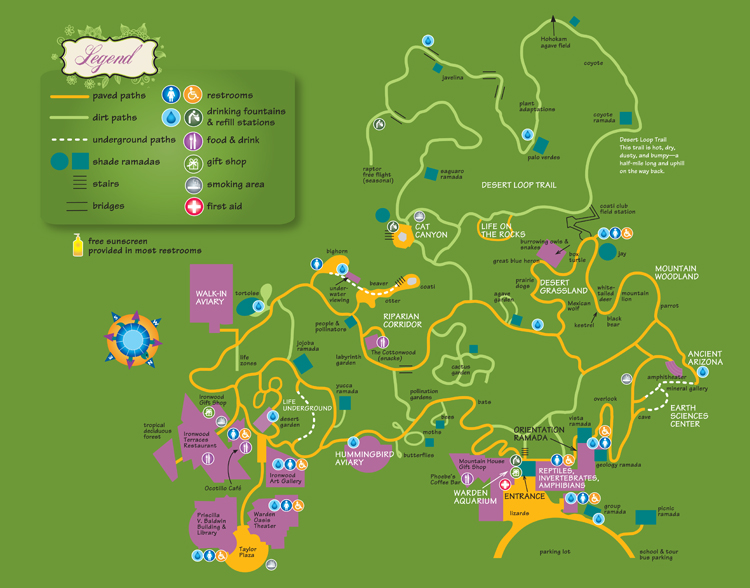
There is nothing so lovely as the American Southwest in the Spring. This is a glorious day, and we are on our way to an amazing park, the Arizona Sonoran Desert Museum, with is a huge indoor and outdoor park and museum. It is one of the best stops on our trip.
There is a huge parking lot, and we got there around the time it opens. We were still in the third row away, but the rows go on and on forever, and we wondered why so much parking? As we left, we understood. We had been there about three or four hours, and the parking lot was filling up fast, buses, travelers from every state and many nations, coming to this beautifully thought-through museum.
One of the things we are picking up on is that everywhere we go, there are people our age, physically fit, volunteering. We saw this at the Benson – Rio Grande Valley Park in Texas, where I thought they were the happiest volunteers I had ever seen, and then again, at Tombstone, AZ, participating as characters in the daily dramas. People our age are living their dreams, and we met a lot of really happy people, working for various parks and volunteer agencies.
I volunteer in several areas, and one of my favorite is with the Gulf Coast Citizen Diplomacy Council. The Department of State sends delegates here to meet with counterparts in specialized areas – environment, juvenile justice, fair election processes, women entrepreneurs – it can be anything. You never know what comes next, which I love. Another part of it that I love is introducing our foreign delegates to the volunteer experience, whether it be dishing out hot meals for the homeless or packaging food for the food bank. For most, it is a new experience, and the idea of giving your time voluntarily to work to help others is a revelation. They are so often surprised at how good it feels.
This is what we are coming across again and again. At this museum, there is a volunteer passing out maps, and others selling entrance tickets. There are volunteer rangers, volunteer guides, and volunteers answering questions. They are happy, they are fit and tanned (LOL, yes, this is Arizona!) and they work for free. They are doing what they want to be doing. It is a joyful experience to find all these happy volunteers, and to benefit from their expertise. It is a joy to us; I feel so proud and humble to be a part of this kind of community.
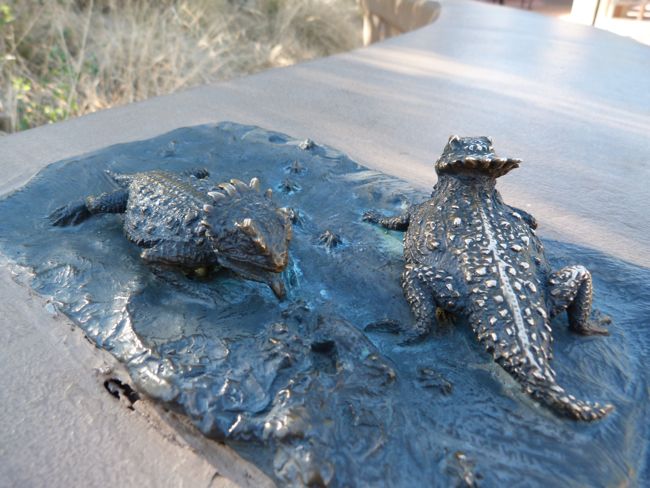
This museum is so first rate. These are the bronze sculptures at the entry:
Museum entrance:
There are all kinds of walking trails, and every exhibit is also reachable by wheelchair.
The museum cactus display is gorgeous along the wonderful walking paths:
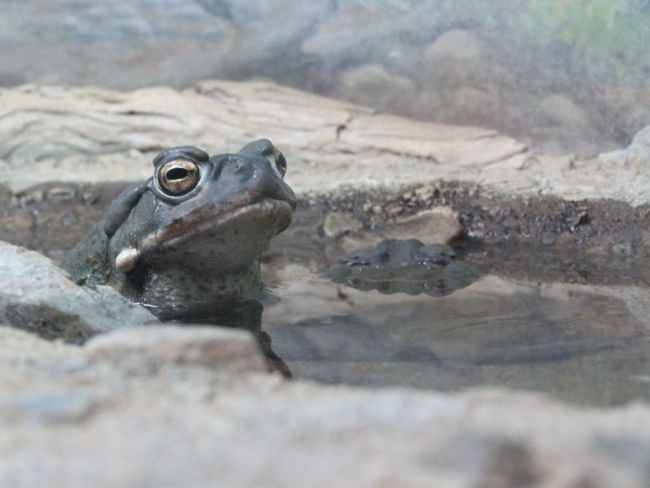
They have a wildlife display with all kinds of snakes and frogs. This is a poisonous frog:
AdventureMan and I separate; he has a mission, he wants to see the Butterfly garden and what is planted there. I take a few trails, and then head for the gift shop. I also have an agenda 🙂
In the wonderful gift shop, where I found unique and really fun gifts for grandchildren, grand-nieces and grand-nephews, I also saw two of Mary Doria Russel’s books about this area, about the legendary Doc Holliday and Wyatt Earp. There were also books and puzzles about bugs and desert creatures, and wonderful edibles, hot sauces, salsas, BBQ rubs. Great gifts.
It is a wonderful visit, but even this early in the season, by noon, it is getting very warm. We decide to head on for Sedona, and because we are not so fond of big city traffic, we skirt Phoenix and stop for lunch at one of our favorite places, Whole Foods. What a treat!
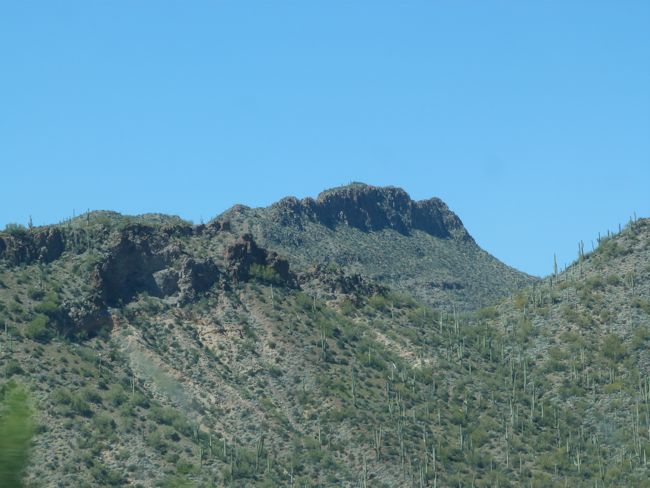
We wanted to take the scenic route to Sedona, so we went through the Tonto National Forest. At the beginning, I started laughing and said to AdventureMan, “It’s a Saguaro Forest!” Later, the Saguaros stopped, and small scrubby pines began, and then taller pines, and taller, thicker pines until we were in a truly dark forest with a lot of trees. Driving was a lot of twisting and turning on this road, and we were glad when we headed out towards Sedons.
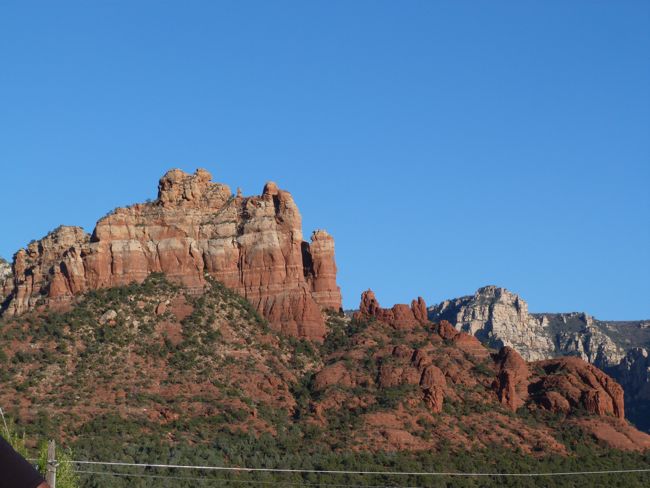
We knew we were getting close when we saw the beginning of the famous red rocks. This is the view from our hotel balcony:
When I lived in Kuwait and Qatar, I was appalled by the way rapes were treated, it was like this huge wave of abductions and violations, and nothing was done. As it turns out, things are changing a lot slower in my own country than I thought. This new film, The Hunting Ground, is by the same person who documented violence and rape in the US military, spurring then Secretary of Defense Leon Panetta, a truly decent man, to put the fear of God into the military leaders who were covering up the many rapes and blaming the victims. We have the same problem on college campuses.
There is only one cure. We have to raise our sons to respect women. We have to continue raising the bar for equality in our country until women have equal access to jobs, health treatment, legal proceedings, etc. Films like The Hunting Ground are painful, and at the same time, help us to face, and to overcome our societal short comings.
I love it that this film is “giving voice to those who have no voices;” that these courageous women speaking out have bravely named their rapists and described their circumstances. It can’t be comfortable, but it is their right. I am proud that they are not intimidated by fear of the ‘blame the victim’ mentality they have endured on their college campuses. When did colleges and universities begin placing money-making and winning teams before the well-being of their students?
New film gives chilling account of sexual assault on college campuses
Sexual assaults on college campuses have reached alarming levels and the issue has drawn the attention of Congress and even President Obama himself. The latest research indicates that one in five college women will be sexually assaulted and as many as 90% of reported assaults are acquaintance rapes. It is believed that more than 100,000 college students will be sexually assaulted during the current school year. Nowhere is the deck stacked more against sexual assault victims than in college athletics. In just the last few years alone there have been cases at Florida State, Michigan, Oregon, Vanderbilt andMissouri.
All of this is a backdrop to a harrowing new film that premiers in theaters on Friday in New York City and Los Angeles. The Hunting Ground is a jarring exposé that shines a bright light on the epidemic number of sexual assaults taking place on college campuses each year.
The Hunting Ground features a group of survivors who faced harsh retaliation and harassment for reporting that they had been raped. The film focuses on institutional cover-ups and the brutal backlash against survivors at campuses such as Harvard, Yale,Dartmouth, the University of North Carolina at Chapel Hill, USC and the University ofCalifornia-Berkeley, among others.
Some of the most vexing stories featured in the film involve women who were assaulted by athletes. While The Hunting Ground isn’t all about sports, the most dramatic moment in the film occurs two-thirds of the way through when the woman who accused former Florida State quarterback Jameis Winston—who after a strong showing in last week’s Combine is projected by many to be the No. 1 pick in this spring’s NFL draft—appears and tells her story publicly for the first time. The woman, who is named in the film but SI.com has chosen to protect her identity, is shown on camera and gives her life-changing account of what she says happened the night in December 2012 she left a Tallahassee bar with Winston.
Photo: Getty Images
A high school honor student who planned to attend medical school, the woman is articulate and attractive. She looks like the girl next door, a person you would trust to babysit your children. It is uncomfortable to watch—yet impossible to look away—when she describes being beneath Winston on his bathroom floor, repeatedly telling him “no” before being physically overpowered.
“We’re grateful it’s the first time people will get to hear [her] story,” said The Hunting Ground director Kirby Dick. “It’s her first-hand testimony. Up to this point it hasn’t been in a public space.”
The woman’s parents also appear in the film. Her father talks about driving to Tallahassee Memorial Hospital with his wife to be with their daughter hours after the incident.
There is nothing easy about retelling these stories for the world to see. But the attorney for the woman who says she was raped by Winston, John Clune, said his client decided to break her silence in the film because she felt it was the right venue to tell her story.
“The film was a once-in-a-lifetime opportunity,” Clune said. “The work by these filmmakers is nothing less than groundbreaking. It took tremendous courage, but our client and all of the incredibly brave women in the film have advanced the cause of rape survivors everywhere.”
The Hunting Ground also examines a sexual assault accusation against a Notre Damefootball player in 2010. Tom Seeberg, whose daughter committed suicide after she says she was sexually assaulted by a Fighting Irish starter, tells a heartbreaking account of school officials thwarting the investigation into his daughter’s complaint. A former Notre Dame police officer reveals that he and his colleagues were not allowed to approach or question an athlete on athletic properties.
The film also mentions rape cases involving football players at Missouri and Vanderbilt, as well as basketball players at Oregon.
The testimonials of rape survivors are wrapped between raw footage that is both gut-wrenching and disturbing. A small mob of unruly fraternity pledges at Yale are captured on film outside a freshman dorm for women, chanting: “No means yes. Yes means anal.” All the while a guy with a bullhorn is shouting: “Louder.”
In another scene we see drunken frat boys spilling out of a house where there is a sign out front that says: “THANKS FOR YOUR DAUGHTERS.” It’s enough to outrage any parent with a daughter heading off to college.
The film is directed by Dick and produced by Amy Ziering, the team behind the Oscar-nominated film The Invisible War, which revealed systemic sexual assaults and cover-ups within the U.S. military. That movie prompted Secretary of Defense Leon Panetta to announce significant policy changes and inspired the passage of the Military Justice Improvement Act.
Dick and Ziering started looking into the situation on college campuses shortly after the release of The Invisible War. “We were astonished that the problem was as serious in higher education as it was in the military,” Dick said.
Full disclosure: I appear in The Hunting Ground as an expert. Two of the cases in the film—Lizzy Seeberg’s alleged assault at Notre Dame and running back Derrick Washington’s sexual assault of a student at the University of Missouri—are featured in my book The System: The Glory and Scandal of Big-Time College Football, which I wrote with 60 Minutes correspondent Armen Keteyian.
Some of my research is also featured in the film, including the statistic that student-athletes are responsible for 19% of the reported sexual assaults on campus, despite the fact that they comprise just 3.3% of the male student population. Those figures arose from a first-of-its-kind study I conducted with researchers at the University of Massachusetts in the mid-90s when we were granted access to judicial affairs records and police reports at colleges across the country.
Photo: Don Juan Moore/Getty Images
Over the past 20 years I have researched hundreds of cases of sexual assault involving athletes. During that time I’ve interviewed countless sexual assault victims. The thing I found most telling was what prosecutor Willie Meggs did not say in the film. Meggs was asked if he thought a rape took place in Winston’s apartment. It was a perfect opportunity for the man who chose not to prosecute Winston to say no. Instead, he said something “bad” happened in that apartment that night. He just didn’t have sufficient evidence to prove it.
That’s not unusual. That’s typical. Only about 20% of rapes reported to the police in the U.S. are prosecuted. Yet at least 92% of reported sexual assault claims are found to be true. The problem is that date rape cases are very difficult to prove beyond a reasonable doubt, especially when alcohol is involved and the incident occurs in the perpetrator’s apartment, dorm or hotel room. The doubts raised by those factors are amplified when the accused is a star athlete.
The greatest achievement of The Hunting Ground is that it empowers rape victims to team up with each other and come forward. It’s fair to say that for the first time in many years, women like Jameis Winston’s alleged victim have powerful allies.
By the time the NFL draft takes place in May, the film will be in theaters around the country, the name of Winston’s accuser will be everywhere and more details about the night in question will likely come out. All of this brings to mind the legal maxim caveat emptor, which essentially is a warning that means let the buyer beware.
Jason Licht, the general manager for the Tampa Bay Buccaneers, ultimately has to decide whether to use the first pick on Winston. He’s on record saying: “This is the most important pick, potentially, in the history of the franchise.”
Memo to Licht: Watch The Hunting Ground.
The ramifications in this instance are equally big for the NFL, whose image took a beating over the last year after Ray Rice was caught on tape knocking out his then-fiancé in an elevator. The controversy erupted after Commissioner Roger Goodell imposed a two-game suspension without bothering to obtain and watch the video.
Memo to the Commissioner: Watch The Hunting Ground.
No matter what happens with Winston, the film succeeds in its main goal: to shine a light on sexual assault on college campuses. It’s an important issue that isn’t going away, and if something drastic isn’t done immediately, it will only get worse.
Jeff Benedict is a lawyer and has written five books on athletes and violence against women, including Public Heroes, Private Felons: Athletes and Violence Against Women, and Out of Bounds: Inside the NBA’s Culture of Rape, Violence and Crime.
Last week, we were in Atlanta, and stayed near a small town called Smyrna. We wondered several times where ancient Smyrna was, guessing Greece or Turkey. We were both right.
Today, the church remembers Polycarp, Bishop and Martyr of Smyrna. It is timely. There is a saying, the more things change, the more they stay the same (“plus ça change, plus c’est la même chose” – Alphonse Kerr) – and today, too, we are seeing people killed for what they believe, when they do not fall into step with the specific style of belief of the crowd. Oh, the things we do in God’s name!
The Liturgical Calendar: The Church Remembers
Today the church remembers Polycarp, Bishop and Martyr of Smyrna, 156.
Polycarp, Bishop of Smyrna in what is now called Turkey, did not seek martyrdom and did not encourage others to do so. When persecution broke out, Polycarp made every honorable effort to protect his flock and himself. He even hid in the country but, eventually, the authorities found him.Since Christians worshiped Jesus Christ, an “unauthorized god,” and since they refused to worship the Roman gods or the “Divine Caesar,” they were considered atheists and subversives.
At a great public festival in the arena in Smyrna, Polycarp was presented to the governor amid cries of “Kill the atheist!” from the excited and unruly mob. The governor admonished Polycarp to swear by Caesar and to revile Christ and thereby save himself. The old bishop’s famous reply was, “For eighty-six years I have been his servant and he has done me no wrong; how can I blaspheme my King who has saved me? . . . You pretend not to know who I am; let me tell you plainly, I am a Christian. If you want to learn the doctrine of Christianity, set a day and hear me.”
Polycarp was publicly burned to death.The Christians in Smyrna who escaped death in this wave of persecution wrote a letter describing the execution of their great bishop and sent it to other churches. We still have this famous letter, “The Martyrdom of Polycarp.”May we always share the tidings of the King who has saved us. Amen.Read the Wikipedia article here.O God, the maker of heaven and earth, you gave your venerable servant, the holy and gentle Polycarp, boldness to confess Jesus Christ as King and Savior, and steadfastness to die for his faith: Give us grace, following his example, to share the cup of Christ and to rise to eternal life; through Jesus Christ our Lord, who lives and reigns with you and the Holy Spirit, one God, now and for ever. Amen.
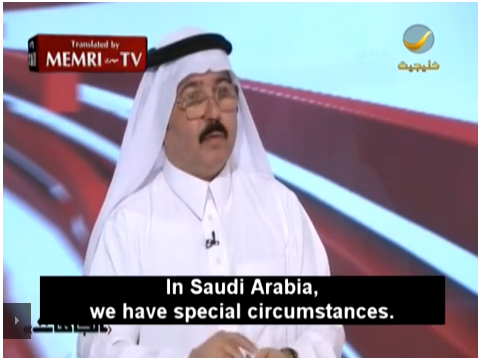
The good news is that Saudi women know better. They don’t buy this line any more than we do. They visit America, they go to school in America. And oh yes, they DRIVE in America. The second part of the good news is that the younger generation buys this line a whole lot less than our parent’s generation, and change is coming. It’s coming faster than this historian thinks.
Saudi Historian Says U.S. Women Drive Because They Don’t Care If They’re Raped
Saleh al-Saadoon claimed in a recent TV interview that women can be raped when a car breaks down, but unlike other countries, Saudi Arabia protects its women from that risk by not allowing them to drive in the first place, according to a translation posted online by the Middle East Media Research Institute.
“They don’t care if they are raped on the roadside, but we do,” al-Saadoon said on Saudi Rotana Khalijiyya TV.
“Hold on. Who told you they don’t care about getting raped on the roadside?” asked the host, a woman who is not named in the transcript.
“It’s no big deal for them beyond the damage to their morale,” al-Saadoon replied. “In our case, however, the problem is of a social and religious nature.”
Two other guests on the show — a man and a woman — appeared to be in shock over his comments. Al-Saadoon said they were out of touch.
“They should listen to me and get used to what society thinks,” al-Saadoon said.
Since the rape argument didn’t seem to be convincing anyone, al-Saadoon tried another approach, claiming that women are treated “like queens” in Saudi Arabia because they are driven around by the men of the family and male chauffeurs. That led the host to ask if he wasn’t afraid that women might be raped by their chauffeurs.
Al-Saadoon agreed.
“There is a solution, but the government officials and the clerics refuse to hear of it,” he said. “The solution is to bring in female foreign chauffeurs to drive our wives.”
That caused the female host to laugh and cover her face with her palm.
“Female foreign chauffeurs?” she said. “Seriously?”

















 Here There and Everywhere