Sunset on Sunset Avenue
I arrived in Seattle just in time. My dearest, oldest friend’s father died as I was en route, and the service was this week. On a cold and dreary day, fortunately I had a dark dress with me, and I quickly ran and bought stockings, which are so irrelevant in the heat and humidity of August in Doha, and so necessary for a relatively formal occasion in Seattle.
Last night, we got together and walked, something we have done through the years, and then grabbed a bite to eat. We walked along Sunset Avenue, in Edmonds, just as the sun was setting.
In one of the yards, we saw this wonderful tarted-up piece of driftwood:
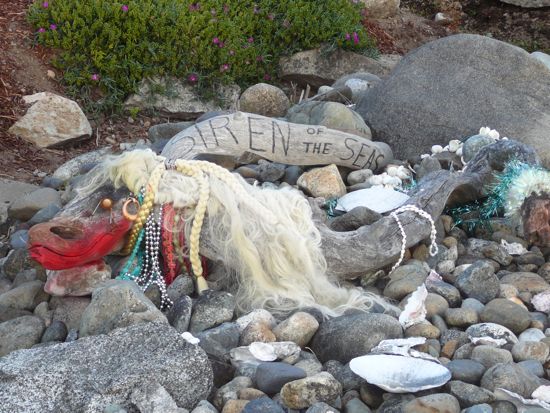
The light was glorious:

Irrelevant Clothing, Shoes and Scissors
It doesn’t matter how long I have been living in the Middle East, it doesn’t matter how many times I have made the trip back and forth, I never seem to get it quite right.
I knew it was going to be less hot in Seattle. I knew it. And still, I didn’t pack a single pair of closed toe shoes, a single pair of nylon stockings, and only a couple long sleeved things. It doesn’t matter that I have lived in Seattle, that I know Seattle, when I am in the middle of the heat and humidity of August in Doha, I lack the imagination to think clearly about the coolness of August in Seattle. I have a lot of lightweight cotton dresses . . . hmmm, so irrelevant in Seattle.
I keep a storage locker here. It started when we moved our parents from their big house to a 2 BR condo (with a water view 🙂 ) and Mom had separated out some of her treasures to divide among us movers. The problem was, I didn’t really want to take them with me (bulky and I would have to bring them back) and I have already imposed on the sister who lives here with a bunch of my stuff, so I finally decided to rent a storage locker. I discovered as a landlord, it actually comes off my taxes. I still have to pay for it, but it isn’t a total loss. I keep Seattle supplies in the locker, too.
When I went to the locker yesterday to pick up some more long sleeved stuff, and my Seattle hairdryer, and my Seattle make-up and living supplies (dishwashing soap, coffee filters, paper towels, laundry soap, etc.) yesterday, with my Mom in the car, nothing went right. My code didn’t work. I had to go inside, leaving my Mom sitting in the car, and it took them a while to work out what was wrong.
(“We don’t have seven number codes! . . . .Hmmm, , mmm, , , yeh, it says you have a seven number code all right, . . .. so here is your new code . . . )
And the new code didn’t work either.
They opened the gate for me, I went to my locker, and with my Mom sitting in the car, discovered my laundry soap had leaked during the time between visits, and with my Mom sitting in the car, I had to clean it all up AND dig out some relevant clothing, and some wrapping paper for gifts I need to send, and scotch tape and scissors (yes, I keep all the things that I frequently use in the locker so I don’t have to buy them again and again and again.) I also grabbed the bag of cosmetic items – like shampoo, toothpaste, my Seattle toothbrush, etc.)
My poor Mom! Remember her? She is still out there sitting in the car!
(The code didn’t work on the way out, either.)
So after all that sitting in the car, I treated Mom to a trip to Trader Joe’s, a place we both love. I picked up sugar snap peas; I just eat them like candy, instead of candy, they are SO good, and some sushi for later on, and Mom picked up things that were really bad, like triple gingersnaps and a wonderfully fragrant new Rosemary Tree.
On the way home, she said “you know you have some stuff in the guest bathroom” and I assured her that I did not, that it was all my middle sister’s stuff, and she said “No, Little Diamond looked at it while she was staying here and said it was yours, that it was stuff you use.” Hmmm. Little Diamond said that?
So when we got back to Mom’s house, I checked the cupboard, and there was one of those zipper bags like (ahem) I always use, and inside was . . . yep. Another hairbrush. Another Seattle toothbrush. Scotch tape. Scissors. My particular make-up back-ups. Shampoo. I brought it with me, and I had two almost identical zipper bags full of Seattle supplies. I can only imagine that sometimes when I get here after all those hours of traveling that my mind is just so addled I am not thinking.

It also makes me feel a little weird that Little Diamond knows me so well that she can identify MY things with just a glance at the contents of the plastic bag, LLOOLLLL! I am that predictable?
On my way over to my Mom’s, I had stopped at the local Fred Meyer’s, a Target-like local store I just love. Now that I am in Seattle, I see things differently. I see things I can hardly resist, like something in me feels like getting ready for the winter, but then, Thank God, my sterner self jerks me back just as I am reaching for:

Look at those socks! Look at those colors! I can barely resist, they are such a hoot! but then . . . where would I wear them? Even if I were abaya’d, people could see my bright polka-dot chartreused ankles and it would draw unwanted attention . . . . maybe just around the house . . .
But no . . . around the house – look at these!
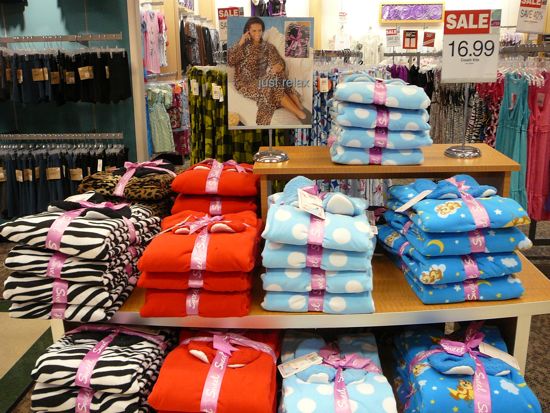
Thick, fuzzy sleepers, only $16.99, like we wore when we were kids, only these are for grownups, and oh! look at that zebra print! The cheetah! They are almost irresistable!
And so irrelevant in Doha!
Maggie O’Farrell and The Vanishing Act of Esme Lennox
Maggie O’Farrel’s The Vanishing Act of Esme Lennox is also a book club pick, but oh, what a pick! I remember somewhere reading a review; I might never have picked this book up if I hadn’t needed to read it for the club. And oh, what I might have missed!

It’s like the scariest book ever written, scary in a Margaret Atwood kind of way, a reminder that women have not had rights for very long, and that those rights are still very fragile. When economies go bottoms-up, when unemployment begins rising, women are often the first to suffer, and women’s rights the first to go. In hard times, men will be preferred hirings, because they have families to support, laws to “protect” women are passed, especially laws which “protect” her finances, meaning gives the power of the money management to some man to do for her, or “protect” her person by requiring that some man accompany her to keep her from dangers. Protection = control. It keeps some smart, thinking women submissive to men who are in every way their inferior.
In Vanishing, Maggie O’Farrel writes of such a woman, Esme Lennox, who is a fey spirit, born in India, with the eyes of an artist. While her “good” sister Kitty obeys the rules, walks the straight and narrow path, Esme is messier. As she grows to adolescence, her eccentricity and her rebellion against the constricts of the life in turn-of-the-century Scotland chafe, she yearns for more room to breathe, intellectually, socially, as her family, her community and her society continues to pressure her to conform.
One of the key events in the book is the death of Esme’s baby brother, of typhoid fever. Abandoned, Esme sits holding her dead brother’s body for three days until her family returns (the baby-keeper also died and the other employees deserted while Esme’s family was away). Esme is devastated, but the focus is on her mother, who is wrought with guilt and isolates herself, and Esme, only a little girl, is forbidden to even say her beloved baby brother’s name. Part of what plays a huge role in this book is society, expectations, and all that is hidden and unspoken – as Esme becomes, a family secret, locked away for sixty years.
Their grandmother swept into the room ‘Kitty,’ there was an unaccustomed smile on her face, ‘stir yourself. You have a visitor.’
Kitty put down her needle. ‘Who?’
Their mother appeared behind the grandmother. ‘Kitty,’ she said ‘quickly put that away. He’s here, he’s downstairs . . . ‘
. . . .
Esme watched from the window-seat as her mother started fiddling with Kitty’s hari, tucking it behind her ears, then releasing it. . . . . Ishbel turned and, catching sight of Esme at the window, said ‘You, too. Quickly now.’
Esme took the stairs slowly. She had no desire to meet one of Kitty’s suitors. They all seemed the same to her – nervous men with over-combed hair, scrubbed hands and pressed shirts. They came and drank tea, and she and Kitty were expected to talk to them while their mother sat like an umpire in a chair across the room. The whole thing made Esme want to burst into honesty, to say, let’s forget this charade, do you want to marry her or not?
She dawdled on the landing, looking at a grim, grey-skied watercolour of the Fife coast. But her grandmother appeared in the hall below. ‘Esme!’ she hissed, and Esme clattered down the stairs.
In the drawing room, she plumped down in a chair with high arms in the corner. She wound her ankles round its polished legs and eyed the suitor. The same as ever. Perhaps a little more good-looking than some of the others. Blond hair, an arrogant forehead, fastidious cuffs. He was asking Ishbel something about the roses in a bowl on the table. Esme had to repress the urge to roll her eyes. Kitty was sitting bolt upright on the sofa, pouring tea into a cup, a blush creeping up her neck.
Esme began playing the game she often played with herself at times like this, looking over the room and working out how she might get round it without touching the floor. She could climb from the sofa to the low table and, from there, to the fender stool. Along that, and then –
She realized her mother was loooking at her, saying something.
‘What was that?” Esme said.
‘James was addressing you.’ her mother said, and the slight flare of her nostrils meant, Esme knew, that she’d better behave or there would be trouble later.
As with many inconvenient women, Esme ends up committed at a loony-bin, and sixty years later, is released into the custody of a grand-niece who never even knew Esme existed.
The thoughts, trials and escapades of three women, Esme, her sister Kitty, and Iris, the grand-niece, intertwine through out the book, and the picture is cloudy at first, blurry, shifting, fragmented The pattern becomes more and more clear as the three threads of thought are woven – ever more tightly – together.
I could not put this book down. Finding out how the picture came together became more important than checking my messages, my blog, or fixing dinner. It was compelling, and resulted in a quick and unforgettable read.
Obama and Dreams From My Father
It took me 20 days, but I finished Barack Obama’s Dreams From My Father. I didn’t read it because he is President of the United States, although that would be a good reason, but I read it because our book club is reading it, and I know how busy the next few months are going to be, so I read ahead during the slower times of summer.
And the trick to finishing it was not allowing myself to read anything else until I had finished – I had a stack of really intriguing books to urge me on. “As soon as I finish, I can read . . . ” Even with all that incentive, Obama’s book is a slog.

He is a gifted orator. He is a plodding writer. There is also a problem I find with autobiographies by anyone – we all fool ourselves, we all position ourselves in a better light, and we have no idea how transparent we are when we do so. Fellow bloggers, do you ever read anything you have written a couple years ago and squirm with embarrassment, or even delete? To be an author is a very very brave thing, when you have a book published, there is no going back, your transgressions are all right out there, and the public can be cruelly critical.
What I liked about the book is Obama-as-Third-Culture-Kid, a man of mixed identity. Most kids who have grown up moving or grown up in different countries from their own, or who have immigrated, can tell you, being an alien is no fun. Obama learns how to adapt, how to look for clues to fitting in, how to pass. It’s a common theme in Third-Culture-Kids.
My favorite part of the book was his return to Kenya, his openness to his African roots, the open-armed love with which his Kenyan half-brothers and sisters welcome him and his response. He had some truly extraordinary adventures, working out just who his father had been as a person. He was blessed to recognize the richness of his inheritance.
The book plods along, but it was worth the time. For all it’s flaws, I find I like that man, and I understand more about where he is coming from. (for grammarians, I understand more about from where the man is coming.) 🙂
Not Good News: More Foreclosures in USA
U.S. home foreclosures set another record in July
Thu Aug 13, 2009 12:11am Reuters

By Lynn Adler
NEW YORK (Reuters) – U.S. home loans failed at a record pace in July despite ongoing federal and state programs to avoid foreclosures, which have severely strained housing and the economy.
Foreclosure activity jumped 7 percent in July from June and 32 percent from a year earlier as one in every 355 households with a loan got a foreclosure filing, RealtyTrac said on Thursday.
Filings — including notices of default, auction and bank repossession — have escalated with unemployment.
“July marks the third time in the last five months where we’ve seen a new record set for foreclosure activity,” James J. Saccacio, RealtyTrac’s chief executive, said in a statement.
“Despite continued efforts by the federal government and state governments to patch together a safety net for distressed homeowners, we’re seeing significant growth in both the initial notices of default and in the bank repossessions.”
More than 360,000 households with loans drew a foreclosure filing in July, a record dating back to January 2005, when RealtyTrac started tracking monthly activity.
Notices of default, auction or repossession have reached nearly 2.3 million in the first seven months of the year — with more than half a million bank repossessions, the Irvine, California-based company said.
Making timely payments keeps getting more harder for borrowers who have lost their jobs or seen their wages cut.
The unemployment rate is 9.4 percent and President Barack Obama has said he expects it will hit 10 percent.
Obama’s housing rescue is gaining traction in altering terms of loans for struggling borrowers, but slowly.
Earlier this month the U.S. Treasury Department detailed the progress of the top servicers in modifying loans and prodded them to step up efforts to stem foreclosures.
SUN BELT STILL SUFFERING
States where sales and prices surged most in the five-year housing boom early this decade remain hardest hit.
California, Florida, Arizona, Nevada accounted for almost 57 percent of total U.S. foreclosure activity in July.
Illinois had the fifth-highest total filings, spiking nearly 35 percent from June, in an example of how moratoriums often delay rather than cure an inevitable loan failure.
Default notices spiked by 86 percent in July, from artificially low levels the prior two months. A state law enacted on April 5 gave delinquent borrowers up to 90 extra days before foreclosure started, RealtyTrac said.
Michigan’s foreclosure activity fell 39 percent in July from June, mostly due to a 66 percent drop in scheduled auctions. A state law that took effect July 6 freezes foreclosure proceedings an extra 90 days for homeowners who commit to work on a loan modification plan.
Other states with the highest foreclosure filing totals last month included Texas, Georgia, Ohio and New Jersey.
Nevada had the highest state foreclosure rate for the 31st straight month, with one in every 56 properties getting a filing, or more than six times the national average.
Initial notices of default fell 18 percent in the month, with a new Nevada law taking effect on July 1 requiring lenders to offer mediation to homeowners facing foreclosure. Scheduled auctions and bank repossessions each jumped more than 20 percent, however, boosting overall foreclosure activity in the state by 4 percent from June.
California, Arizona, Florida, Utah, Idaho, Georgia, Illinois, Colorado and Oregon were the other states with the highest foreclosure rates.
(Editing by Kenneth Barry)
Things are turning around in the USA, but these foreclosures were already in the pipeline, and more are coming due principally to people borrowing more money than they could really afford, and people who have lost jobs and can no longer pay their mortgage.
Now I am going to sound like your MOTHER: Do not take an adjustable rate mortgage. Fix your credit, get a good score, and take the very best 15 or 30 year FIXED mortgage you can get, and before you buy, make sure that you figure taxes and insurance as well as the monthly mortgage and interest when figuring your monthly payment. Make sure you can still eat, and have a little left over for emergency car repairs. It is so much better to live in a house that you can afford than to lose everything you have invested in a house you can’t afford.
If you get into trouble, talk to your lender right away. Lenders do not want to foreclose; it is in their interest as well as your own to find a way to allow you to reduce payments for a while to keep the relationship on track. There is some flexibility. Negotiate.
Where to Find the Perseids in 2009
I’m getting so many hits on my Perseids article today, that I thought I would tell you how to spot them. This is from earthsky.org, where you can learn a lot more about the night sky.
What is WAY cool is that they suggest a camp out as the best way to watch the Perseid showers. 🙂 No better place than the desert, so pack those tents and head out of town, away from the ambient light. One problem – moonlight.
With the 2009 Perseid meteor shower due to peak on the mornings of August 12 and 13, people are asking, How can I find this constellation in the night sky, so that I can see the meteors?
One note before the excitement starts to build. This year, there will be a waning moon in the sky during the peak hours for the Perseids. So 2009 is not the best possible year to see this shower. You might try watching for meteors in the early part of the night. Or you might see some Perseids in bright moonlight – in the peak hours between midnight and dawn – on the mornings of August 12 and 13.
Moonlight is just a local problem. The meteors will be raining down as always, even if moonlight drowns them from view. The Perseid meteor shower is named for the constellation Perseus the Hero. It’s from this part of the sky that the meteors will appear to radiate. Today’s chart shows Perseus ascending over the northeastern horizon around midnight. That’s why this meteor shower is better after midnight: because after midnight, the radiant point for the shower is above the horizon. Just remember, the glare of the waning gibbous moon will wash out some Perseid meteors during the peak hours of 2009.
Notice the W-shaped constellation Cassiopeia just above Perseus. The constellation Perseus is faint, but Cassiopeia is noticeable and can help you find it. If you do see a Perseid meteor in 2009, and trace its path backward, you will find that it radiated from a point in the sky within the boundaries of the constellation Perseus. When the moon is out of the way, a meteors are raining down in all parts of the sky, you don’t need to know the whereabouts of a shower’s radiant to enjoy the shower. But people always ask! So here you are.
Many people look forward each summer to the Perseids. This shower always peaks at this time of year, and it reliably produces 60 or more meteors per hour at its peak, or an average of about one a minute. It’s great fun to give meteor-watching a try! It’s a chance to go to a dark site with friends and family – a chance to see some stars and enjoy the night air – and see some meteors. The 2009 shower will be troubled by the moon, but there’s still fun to be had, if you and your friends and family want to try a camp-out on the peak nights.
WeatherUnderground has an entire section devoted to the night sky specific to YOUR area; this is what the one looks like for Doha, Qatar:

How cool is that?
You will see Perseus on this map in the bottom left sector.
I thought there was a night sky thingy on Google Earth, too, but I can’t find it. Anyone know how to do that?
Written Communication, Plusses and Minuses
I was e-mailing back and forth this morning with a dear friend who is traveling. She was about to visit an old school friend, and before visiting, dug out all the letters she had received from the friend – an enormous collection – and read through them all. She said it was a very moving experience, and I could tell that even before visiting her friend, she was feeling close from having read all those letters.
When was the last time you got a letter?
I have some letters my husband has written, saved away. 🙂 Most of my written communications these days are done by e-mail, instant-message, or texting. I used to have files of e-mails, but as they grew bigger and bigger, I sort of stopped saving them, except for important ones, or business-related ones.
These blogs are also written communication, but more like books, less personal and you never really know who is reading on any given day, and who isn’t, so like it is not the most reliable way to communicate something important, especially to one person or a small group of people; e-mail just makes more sense. Or picking up the telephone, which I don’t do all that often as I am not so much of a telephone person and many people I would call are in different time zones.
But it makes me wonder what record we will have of these times? I told my friend when I was in college, I worked part time in the university xerox department, and most things in the Northwest Collection came to me. I could read them as I copied them – diaries, letters, to-do lists, shopping lists – ephemeral things, but written on paper, and they give us a tiny peephole into the daily lives of people who lived a couple hundred years ago.
Think of your life, and how things have changed, even if you are in your twenties. Two hundred years from now, people will have so many questions about our lives, how we lived, why we did the things we did. With fewer lasting pieces of paper, will the record be so complete?
Think of our electronic storage devices – remember floppy disks? My computer wouldn’t even be able to read a floppy disk! Think of the tiny little USB devices we are saving onto now – how long will that technology last? In another generation, it will be as opaque and accessible as the ancient inscribes stones buried in the deserts.
As we go more and more paperless, how are we saving the ephemera?
As I upload a couple years worth of photos to be printed, I think of the scrap booking craze, how you take a few photos and decorate all around them, but do the resulting albums give you truth, or do they give you a fantasy of the truth?
I think of the photographs from a hundred years ago – people with somber faces. Serious faces. No one ever smiled for the photos. There are photos of my earliest relatives in Seattle, they are truly a grim looking bunch, I think it was the style then, and I have a feeling that they didn’t look like that most of the time; our family culture is pretty jokey. So I am also wondering about family lore, family history and realities. Like most of us expunge the photos of us that are unflattering – and destroy letters we would never want anyone to read. In so doing, we don’t change the real history, but we do change the transmission of history! Much of what gets transmitted ends up being censored, by us!
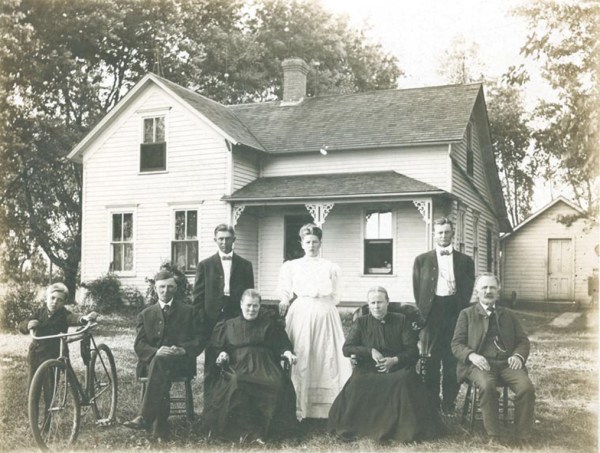
(This is not my family, just a photo from the early 1900’s from rootsweb.ancestry.com)
For years, I have taken my photos and put them in books – and they are heavy. But we actually take them out and look at the photos from time to time, whereas now, most of my photos are stored on the computer, and rarely do I take the time to upload them to be printed. I wonder what the photographic record will be, if there will be a downturn in photos showing what was going on because so few are printed in a relatively lasting format.
I have so much on the internet – photos, writing, etc. What is something happens to the internet. I haven’t even been saving back ups of the blogs. I used to, like the first six months, but, frankly, so much of it is trivial that I stopped backing it up. And if I lost everything, would it be a tragedy – or a huge relief? I think of friends who have lived through terrible events and who live their lives more lightly now – fewer purchases, fewer emotional turmoils – going through something horrible can truly streamline your life.
I guess I am just babbling.
Sharing Your Faith in Qatar Gets Leader Deported
I heard a very strange tale and while there is nothing in the paper about it, I wonder where the truth lies. This week, the leader of the local Phillipine evangelical church (I don’t know the exact name) and his wife and three daughters and grandson were visited by the CID one morning and told that they had to be out of the country by night, that they needed to go back to the Phillipines. The person who told me could not imagine what might have caused this.
These are good people, she told me, and we are just about to do a performance about Joseph and his dreams, and his wife was making the costumes.
I thought about it, and said that well, it is an evangelical church, meaning you seek actively to bring souls to Jesus, and it is forbidden by law, in Qatar, to share our faith with Moslems. Is there any chance he was trying to convert Moslems?
She told me that people attending the church were expected to bring visitors, and that when visitors came, they were welcomed to the front of the church, where they were baptized.
I was horrorified. “Do they have any understanding of what is happening?” I asked her, and she replied no, and that most of the baptized visitors never come back. But, she added, the director still gets credit for all those baptisms, and his statistics look pretty good when he reports back to the church in the Phillipines.
In addition to her tithe (Christians are supposed to give 10% of their income to the church and charities) she said members of the congretation were tasked extra monies to pay the rent on the villa, to pay for food and travel of visitors who stayed there, etc, and she said it put a great burden on those who didn’t have sufficient income to contribute the extra. She said it wasn’t a voluntary contribution; if you didn’t contribute the extra, it was like you weren’t really a part of the church.
Last weekend, among those baptized, was a new Nigerian Moslem family who had been invited to visit. I can only imagine how I would feel, visiting a church, invited to the front to be welcomed, and then receiving a baptism I neither asked for nor wanted. I would never come back, but if I were Moslem, I might be horrified enough – and angry enough – to report it to the authorities. To me, at the very least, it is disrespectful.
There may be more to this story than the few details I was given. I expect the entire story is fascinating.
Parents Don’t Want Raped 8-Year-Old, Says She Shamed Them
This very sad, very strange story is from today’s BBC News. Parents of the girl, living in Phoenix, say she brought shame on them (eight years old) and they don’t want her back. People all over the US are sending money and offers to adopt her. Eight years old – all she wanted was a stick of gum.
Offers of help are pouring in for an eight-year-old Liberian girl disowned by her own family in Phoenix, Arizona, after being raped by four boys.
The girl is under the care of the Arizona Child Protective Service (CPS) because her parents said she had shamed them, and they did not want her back.
Phoenix police said calls had come in from all over the US offering money, or even to adopt the young girl.
The boys, Liberian immigrants aged nine to 14, have been charged with rape.
The case has sparked outrage across the US and even drawn condemnation from Liberian President Ellen Johnson-Sirleaf, an outspoken anti-rape campaigner.
“I think that family is wrong. They should help that child who has been traumatised,” Mrs Johnson-Sirleaf told CNN.
“They too need serious counselling because clearly they are doing something, something that is no longer acceptable in our society here,” she added.
Brutal attack
Media reports said the girl was lured into a shed on 16 July with promises of chewing gum by the four young boys. There, they held her down and took turns assaulting her for 10 to 15 minutes, before her screams alerted officers nearby.
The oldest suspect, a 14-year-old boy, will be tried as an adult on charges of kidnapping and sexual assault, police said on Friday. He is being held in police custody until trial.
The other three – aged 9, 10, and 13 – are charged as juveniles with sexual assault and kidnapping.
But the police said no charges will be filed against the parents.
“They didn’t abandon the child,” Phoenix police sergeant Andy Hill told AFP news agency. “They committed no crime. They just didn’t support the child, which led to CPS coming over there.”
Sgt Hill said people from eight or nine US states had called wanting to adopt the girl or donate money.
“It has been unbelievably fantastic in terms of support for the child,” he said.
I’m hoping that this traumatized little girl gets a new family who treasures her, helps her overcome this attack, sends her to school through university and helps her to prevail.
Recent Comments
ExpatAlien on What Country am I Living … intlxpatr on Yellowstone: Old Faithful to C… Michelle on Yellowstone: Old Faithful to C… Cathy on No Grown-Ups in Charge intlxpatr on Waiting for Snow Wikipedia Donate Button

Amazina


Early Voting in Florida


 Here There and Everywhere