Stieg Larsson and The Girl With the Dragon Tattoo
I needed some escape time, so I started The Girl With the Dragon Tattoo, a mystery by Stieg Larsson, set in Sweden. I love these detective stories set in other countries; I can learn something as I pass the time reading an exciting mystery. And part of my heritage is Swedish, so I thought this should really be fun.

It wasn’t, at least not at the beginning. At the beginning, I didn’t like any of the characters, and they were always eating sandwiches that sounded awful, like liverwurst and egg. I felt like the characters didn’t have any moral center, like they drifted from day to day without neither conscience nor a plan. The main character, Mikael Blomkvist, is about to go to prison for libel; he printed a story about a major industrialist which turned out to be false, and he protected his source. We don’t really know the whole story, not until the end, which makes it hard to evoke a lot of sympathy for Blomkvist.
He is contacted by another industrialist, and asked to solve a mystery, if possible, about the disappearance, 40 years ago, of his niece, Harriet Vanger. Blomkvist would investigate under the cover of writing an autobiography of his employer and his family. There are members of the family who object. In many ways, it isn’t a very nice family.
Blomkvist gets an assistant, a deeply troubled and flawed young woman, Lisbeth Salander, with a gift for investigation. There is a lot of violence, sexual violence, and mutilation of animals. One of the points I credit Larsson with making is the amount of violence against women in Sweden, which goes on under a seemingly civilized veneer. The truth, as I see it, is that there is violence against women in every society; in some it is better documented than in others. In some, it is better punished that others. It exists in all societies, in all countries.
Another think I ended up liking about the book was that the main character, Blomkvist, who writes financial analysis, takes the press to task for printing what passes for financial news without critically reading and evaluating, which he feels is a responsibility of the press. At one point, as people quail with fear that the stock exchange will drop dramatically, he is interviewed and explains that the stock market is based on perceptions, while the Swedish economy is based on production and services; that while the markets may fail, the economy can still be going strong.
Slowly, the book tightens up. Actually, by the end, I was hooked. The only question in my mind is – did I like it enough to read another?
The book is available, new, from Amazon.com at $6.00 plus shipping.
New Qatar Traffic Violations and Fines
Update: LLOOLL, I went to QatarLiving.com and discovered that these “new” laws came out in 2007. These are great laws, deterrents to bad driving and aggressive driving, but the laws mean nothing without enforcement. Do I still see many many children sitting in the front seat? Are people driving while talking on their mobile phones? And not a word about one of the worst offenses these days – texting.
A recent study showed texting is even more dangerous while driving than talking on a mobile phone:
The crash risk attributable to texting is substantial. One possible explanation is that drivers who text tend to decrease their minimum following distance and also experience delayed reaction time. For example, in the Drews et al. study, drivers’ median reaction time increased by 30% when they were texting and 9% when they talked on the phone, compared with their performance in a driving-only condition.
Notwithstanding the safety risk of texting while driving, previous research by Drews and colleagues at the University of Utah — not to mention crash data and widespread legislation — makes clear that using a phone while driving is dangerous.
(To check my source, just click on the blue type, above)
We were talking about people who were saying “Qatar is the most dangerous place to drive in the world” and wondering where this is coming from? Most of us have driven in more dangerous places, but this is the new quote floating around, with no foundation, no statistics, no studies, at least not any I can find with a simple Google.
The topic of new laws came up next over Christmas dinner. New laws? New fines?
“I never saw a word about this in the paper,” I said, peevishly.
“Oh, didn’t I tell you?” said AdventureMan.
People who have been married a long time will understand the urge to kill . . .
Someone else jumped in,
“I think the different companies are passing it around. The Education Foundation has it. Some of the universities have it. That’s the way it is in Qatar, news of new laws filters out.”
LLLOOOLLL. News of new laws “filters out?”
I found it online HERE, at Team BPH and it looks exactly like the copy AdventureMan brought home yesterday, but there is no attribution. Who put this out? There is no kind of official marking on it at all.
IF ENFORCED, these laws would have a serious effect on Qatar traffic.
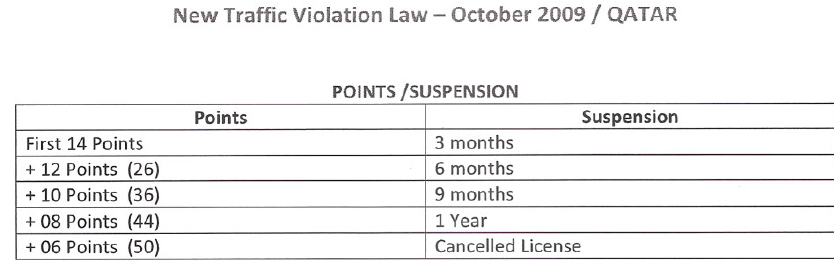

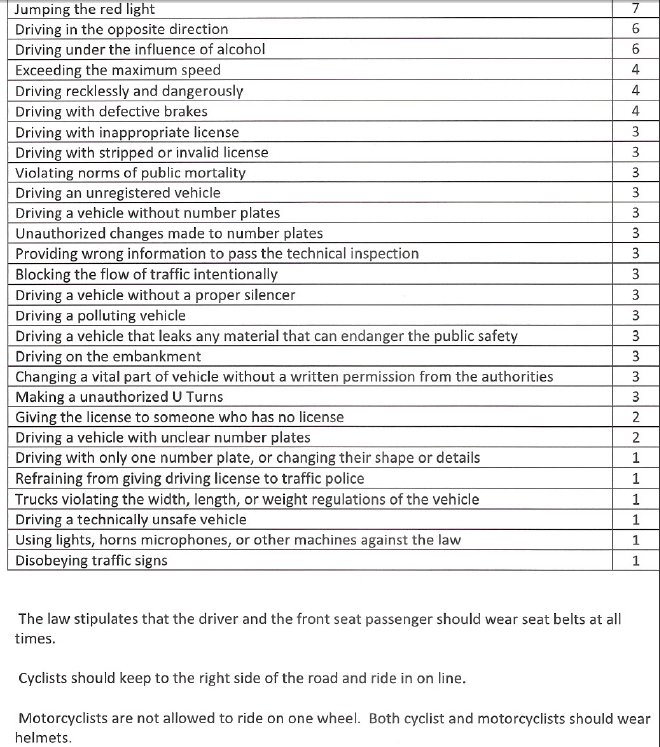
In theory, these went into effect in November 2009, just last month. Who issued these? Has there been any coverage in the newspapers? TV? How can people be held accountable for violating laws of which they are not aware? Or is this something one of the companies printed up, anticipating new laws?
Mixed Forecast
Interesting article from today’s Peninsula Business Section on rising mortgage trends in the United States. The views are so mixed; is the economy recovering? Are there going to be buyers for all those houses on the market? Will they find a way to forestall the next round of foreclosures as ARMs come due and new rates kick in?
US mortgages on upward trend
Web posted at: 12/27/2009 11:52:57
Source ::: LAT-WP
WASHINGTON: After hitting an all-time low in early December, the average rate on a 30-year, fixed-rate mortgage rose to 5.05 percent this week and could climb to 6 percent by the end of 2010, if not sooner, according to giant mortgage financier Freddie Mac.
The results are noteworthy because rates have not topped 5 percent since the last week of October, when they reached 5.03 percent, based on the results of this closely watched survey, which polls lenders during the first three days of every week.
Many firms regularly track interest rates and come up with slightly different numbers because they survey different lenders at different times of the day or week. But several have reported the upward trend in recent weeks. They attribute it in part to the effects of the holiday season, when demand for buying and refinancing homes dies down and financial markets coast through the end of the year.
“However, this is also a glimpse of what we’re going to see in 2010,” said Greg McBride, a senior financial analyst at Bankrate.com, a personal finance Web site.
The key catalyst for interest rates going forward will be the end of a Federal Reserve program that buys a sizable chunk of mortgage-backed securities issued by firms such as Fannie Mae and Freddie Mac. That program succeeded in immediately pushing mortgage rates well below the 6 percent mark when it was announced last year.
But the Fed has committed to winding down the program by March. The central bank is betting that by gradually tapering its purchases, private buyers of mortgage-backed securities, who have largely been absent from the market, will return and rates won’t rise much.
But Amy Crews Cutts, deputy chief economist at Freddie Mac, said interest rates are bound to rise to six percent by the end of 2010 because private buyers will demand a higher rate of return on the securities than the Fed did. Lenders may have to raise the rates they charge to consumers in order to make that happen.
“Extraordinary resources have been put into keeping the rates down and supporting the mortgage markets and it’s hard to imagine that the rates can go much lower than they are,” Crews Cutts said. “Anything we get at or below five percent is a gift at this point.”
This week’s Freddie Mac survey found that the 5.05 percent average on 30-year fixed-rate loans (with an average 0.7 point) was up from 4.94 percent the previous week but down from 5.14 percent at the same time last year. The all-time weekly low since the firm started tracking the numbers in 1971 was in the first week of December, when rates fell to 4.71 percent.
Many borrowers have not been able to secure the best rates because they lack the stellar credit scores and hefty down payments that many lenders now demand. Some who have tried to refinance have not been able to qualify because their home prices have plummeted to the point where they now owe more on their mortgages than their homes are worth.
But anyone who can secure a loan should not wait much longer, especially if they are looking to refinance, McBride said. Homeowners are more sensitive to interest rates when they refinance than when they buy a home. “The difference between 5 percent and 5.5 percent could mean the difference between refinancing or not,” he said.
But the interest rate is less critical to people who want to buy a home, McBride said. In that case, price and affordability should trump interest rates.
Defense: It’s The Cops Fault; He Was Chasing Me!
Court asks motorcycle rider to pay blood money
Web posted at: 12/19/2009 2:30:29
Source ::: THE PENINSULA
DOHA: A young man who rode a motorcycle and killed a pedestrian in a bizarre crash has been asked by the court to pay QR200,000 as blood money to the family of the deceased.
The court fined the convict QR10,000 for violating traffic law. But how the man was caught by the law-enforcement agencies is quite interesting.
It so happened that the Police Patrol saw two men riding motorbikes with tremendous speed. They gave the duo a chase but in vain. They vanished in think air. But soon the police was informed that a pedestrian was hit by a speeding motorbike.
When a police party reached the spot of the crash it saw a motorbike lying near the body of the victim.
The cops were quick to realize that this was one of the two motorbikes they had given a chase sometime ago.
With help from its registration plate they zeroed in on the culprit and referred the matter to the court after investigation.
The defense lawyer argued in the court that the crash occurred because they motorbike was chased by the cops. The court, however, did not buy the argument and convicted the man.
QR 200,000 sounds like a fortune, but it is $55,000 for taking a man’s life. For a young man who was running from the cops and then tries to claim their chasing him as a defense! This case sounds like a perfect opportunity to give a community service penalty in addition to the blood money; expose this young man to the consequences of motorcycle accidents, and accident victims, allow him to see with his own eyes, and serve, the victims. It could change his life, and change his callous attitude.
Peace on Earth, Good Will Towards Men
Today’s reading in Forward Day by Day is a difficult teaching from the prophet Amos, telling us that no, God isn’t on our side. God loves us, and he loves our allies as much as he loves us. And . . . he also loves our enemies – as much as he loves us.

THURSDAY, December 10 International Human Rights Day
Amos 9:1-10. Are you not like the Ethiopians to me, O people of Israel?
Amos is the Bible’s first universalist. Gods in ancient times, including Israel’s god, were seen as localized deities, inhabiting a certain place and exercising power on behalf of the people who lived there, whom they favored over other people. A god’s authority was rather like that of a modern sheriff–one had to pay attention to it, but its jurisdiction was limited by geography.
Then Amos, speaking on behalf of Israel’s god, said the chosen people were no different in God’s eyes than the Ethiopians. If God had done something special for Israel, he had done something special for everyone else, too, including Israel’s sworn enemies. God has no favorites and his authority extends everywhere. In his brusque, in-your-face manner, Amos says one nation is no more precious than another.
In this day of immigration controversy, ethnic suspicion, religious absolutism, xenophobic frenzy, and false patriotism, Amos speaks a sobering word: “You’re no different from anyone else. I love you, but I love your enemy, too, and if you don’t also love your enemy, you are no friend of mine.”
Doha unscathed by downturn: PM
He’s the prime minister. I guess I am wrong. I thought I saw a lot of constructions at a stand still. It looked to me like the population of laborers has dropped. People are slipping away, expat management level workers, being let go, heading home. There are some empty units on our highly-sought after compound. Few people at Villagio are carrying shopping bags; most of the bags leaving City Center appear to be Carrefour groceries or Home Center: on sale. Rents are dropping.
It looks to me like something is dragging on the Qatar economy, it looks to me like there may be some empty seats on flights in and out. But I must be wrong.
You can read the entire article by clicking on the blue type below, which will take you to the article in The Peninsula.
Doha unscathed by downturn: PM
Web posted at: 12/8/2009 2:8:12
Source ::: The Peninsula
By Nasser al Harthy
DOHA: The global economic downturn has not affected any of Qatar’s projects, Prime Minister and Foreign Minister, H E Sheikh Hamad bin Jassem bin Jabor Al Thani, said here yesterday.
Addressing the opening of the fourth edition of the International Petroleum Technology Conference (IPTC), Sheikh Hamad Bin Jassem said: “We, in Qatar have overcome the consequences of the crisis with minimum damages and that the crisis has not affected any of our projects being implemented, whether in the oil sector, gas sector or development and infrastructure projects undertaken by other state sectors.”
“We are moving forward with full determination to implement all our ambitious plans which focus on sustainable development in which oil, gas and industry play a basic role and constitute one of its strong pillars,” he added.
The Prime Minister noted that the world economy passed through a difficult period of recession last year leading to a sharp drop in oil and gas consumption in world markets and energy prices in general.
Qatar Population on Monday is 1,580,050
This gave me a grin – as of a certain date, Qatar has a number, not an approximate number, a fairly fixed number – for its population.
You know what? I believe it. I have seen the way the computers here operate; they seem to have some inter-operability, and quick ways of accessing information back and forth between departments. I can believe they are tallying people leaving, people coming, people being born, people dying, as fast as the data can be entered.
I wouldn’t have believed it six years ago. I believe they have this capability now. They must have made a significant investment in this infrastructure, and it’s continuous upgrade.
From today’s Peninsula
Doha: The population of Qatar till Monday is 1,580,050, according to statistics released by Qatar Statistics Authority (QSA) yesterday. These data represent the number of individuals of all ages (Qataris and non-Qataris) within the state on Monday, excluding Qataris and residents who were outside the borders of the State at the time of the statement monitoring. The total number of males according to these data, is 1, 225,487 compared to 354,563 females.
These figures indicate a decline in population within the state with 86,803 people compared to last October, which recorded the highest rise in population during the year. It is noteworthy that QSA started presenting data on its website showing total population at the end of each month since October last year.
Qatar Train Map
I found the paper with the map! How cool is this?

When I look at this, I think if the money ever runs out in Qatar, they will still have invested in a superior infrastructure – education, transportation, roads, parks, attractive public areas, effective policing and traffic control – way more important than luxury malls.
He turns a desert into pools of water
One of today’s readings in The Lectionary are these verses from a much longer reading, Psalm 107. When I read these lines, I can’t help thinking how this very dull and flat land, Qatar, this little thumb sticking up into the Gulf, has greened, how the oil and gas have served to green this land, to change its face, and how much money is flowing out from this country to many other countries of the world.
All those of us from far away countries who labor here are benefitting from these springs of wealth, sending money home.
33He turns rivers into a desert,
springs of water into thirsty ground,
34a fruitful land into a salty waste,
because of the wickedness of its inhabitants.
35He turns a desert into pools of water,
a parched land into springs of water.
36And there he lets the hungry live,
and they establish a town to live in;
37they sow fields, and plant vineyards,
and get a fruitful yield.
38By his blessing they multiply greatly,
and he does not let their cattle decrease.
39When they are diminished and brought low
through oppression, trouble, and sorrow,
40he pours contempt on princes
and makes them wander in trackless wastes;
41but he raises up the needy out of distress,
and makes their families like flocks.
42The upright see it and are glad;
and all wickedness stops its mouth.
43Let those who are wise give heed to these things,
and consider the steadfast love of the Lord.
For my Christian readers, Muslims also use the Psalms as holy readings –
“The Qur’an (Surah An-Nisa 4:163) states “and to David We gave the Psalms”. Therefore, Islam confirms the Psalms as being inspired of God.”
Did you know that?
Recent Comments
Kitchen on Isiais: Winding Down intlxpatr on Shampoo Ginger tigerbutterya0c5ff1d… on Shampoo Ginger intlxpatr on British Soldier Kidnapped, Esc… John on British Soldier Kidnapped, Esc… Wikipedia Donate Button

Amazina


Early Voting in Florida


