Psalm 37: Do Not Fret Because of Evil Men
I think I have published this Psalm before, but I am going to post it again because it answers that question we all ask – why is it that the evil ones appear to prosper and bad things happen to those who seek to do God’s will?
This is a Psalm of David / Daoud, and something to think about in this Ramadan time of contemplation, and seeking closeness to The Almighty One.
Psalm 37
Of David.
1 [a] Do not fret because of evil men
or be envious of those who do wrong;
2 for like the grass they will soon wither,
like green plants they will soon die away.
3 Trust in the LORD and do good;
dwell in the land and enjoy safe pasture.
4 Delight yourself in the LORD
and he will give you the desires of your heart.
5 Commit your way to the LORD;
trust in him and he will do this:
6 He will make your righteousness shine like the dawn,
the justice of your cause like the noonday sun.
7 Be still before the LORD and wait patiently for him;
do not fret when men succeed in their ways,
when they carry out their wicked schemes.
8 Refrain from anger and turn from wrath;
do not fret—it leads only to evil.
9 For evil men will be cut off,
but those who hope in the LORD will inherit the land.
10 A little while, and the wicked will be no more;
though you look for them, they will not be found.
11 But the meek will inherit the land
and enjoy great peace.
12 The wicked plot against the righteous
and gnash their teeth at them;
13 but the Lord laughs at the wicked,
for he knows their day is coming.
14 The wicked draw the sword
and bend the bow
to bring down the poor and needy,
to slay those whose ways are upright.
15 But their swords will pierce their own hearts,
and their bows will be broken.
16 Better the little that the righteous have
than the wealth of many wicked;
17 for the power of the wicked will be broken,
but the LORD upholds the righteous.
18 The days of the blameless are known to the LORD,
and their inheritance will endure forever.
19 In times of disaster they will not wither;
in days of famine they will enjoy plenty.
20 But the wicked will perish:
The LORD’s enemies will be like the beauty of the fields,
they will vanish—vanish like smoke.
21 The wicked borrow and do not repay,
but the righteous give generously;
22 those the LORD blesses will inherit the land,
but those he curses will be cut off.
23 If the LORD delights in a man’s way,
he makes his steps firm;
24 though he stumble, he will not fall,
for the LORD upholds him with his hand.
25 I was young and now I am old,
yet I have never seen the righteous forsaken
or their children begging bread.
26 They are always generous and lend freely;
their children will be blessed.
27 Turn from evil and do good;
then you will dwell in the land forever.
28 For the LORD loves the just
and will not forsake his faithful ones.
They will be protected forever,
but the offspring of the wicked will be cut off;
29 the righteous will inherit the land
and dwell in it forever.
30 The mouth of the righteous man utters wisdom,
and his tongue speaks what is just.
31 The law of his God is in his heart;
his feet do not slip.
32 The wicked lie in wait for the righteous,
seeking their very lives;
33 but the LORD will not leave them in their power
or let them be condemned when brought to trial.
34 Wait for the LORD
and keep his way.
He will exalt you to inherit the land;
when the wicked are cut off, you will see it.
35 I have seen a wicked and ruthless man
flourishing like a green tree in its native soil,
36 but he soon passed away and was no more;
though I looked for him, he could not be found.
37 Consider the blameless, observe the upright;
there is a future [b] for the man of peace.
38 But all sinners will be destroyed;
the future [c] of the wicked will be cut off.
39 The salvation of the righteous comes from the LORD;
he is their stronghold in time of trouble.
40 The LORD helps them and delivers them;
he delivers them from the wicked and saves them,
because they take refuge in him.
Footnotes:
Psalm 37:1 This psalm is an acrostic poem, the stanzas of which begin with the successive letters of the Hebrew alphabet.
Psalm 37:37 Or there will be posterity
Psalm 37:38 Or posterity
Streets of Gold
Because it is a time to be considering holy things, and because I was sent this in the mail this morning, and because we have been talking about the prophet Job/Ayoub, I will share this morning devotion with you:
Job 22:24-25. Assign your nuggets to the dust, your gold of Ophir to the rocks in the ravines, then the Almighty will be your gold, the choicest silver for you.
A story tells about a rich man who pleaded with God to let him bring into eternity one suitcase full of his most valuable possessions. God finally conceded, and the man packed as much gold as he could into his biggest suitcase. When he arrived at heaven’s gates he was met by St. Peter, who opened the suitcase, curious to see what the man valued most.
“What!” St. Peter was incredulous; “You brought pavement?”
(For my Moslem readers: I don’t know why, it doesn’t say this anywhere in the Bible, except that Peter is given the responsibility for the building of the church and is often shown holding keys – like in the keys to the kingdom. Peter is often pictured in cartoons as the keeper of the gate into Paradise; he is portrayed as an old, bearded man with a long list in front of him, like who is naughty and who is allowed in. I know it might seem strange to you, but this is not considered offensive; it is an affectionate portrayal.)
Building 7 Collapse Solved, No Mystery
Feds Say They’ve Solved 9/11 Mystery
By DEVLIN BARRETT, AP
GAITHERSBURG, Md. (Aug. 21) – Federal investigators said Thursday they have solved a mystery of the Sept. 11, 2001, attacks: the collapse of World Trade Center building 7, a source of long-running conspiracy theories.
The 47-story trapezoid-shaped building sat north of the World Trade Center towers, across Vesey Street in lower Manhattan. On Sept. 11, it was set on fire by falling debris from the burning towers, but skeptics have long argued that fire and debris alone should not have brought down such a big steel-and-concrete structure.
Federal investigators said Thursday they have resolved a lingering question from the Sept. 11, 2001, terror attacks: What caused World Trade Center 7 to collapse? They determined the building, which sat north of the World Trade Center towers, was brought down by fire started by debris from the twin towers.
Scientists with the National Institute of Standards and Technology say their three-year investigation of the collapse determined the demise of WTC 7 was actually the first time in the world a fire caused the total failure of a skyscraper.
“The reason for the collapse of World Trade Center 7 is no longer a mystery,” said Dr. Shyam Sunder, the lead investigator on the NIST team.
Investigators also concluded that the collapse of the nearby towers broke the city water main, leaving the sprinkler system in the bottom half of the building without water.
The building has been the subject of a wide range of conspiracy theories for the last seven years, partly because the collapse occurred about seven hours after the twin towers came down. That fueled suspicion that someone intentionally blew up the building in a controlled demolition.
Critics like Mike Berger of the group 9/11 Truth said he wasn’t buying the government’s explanation.
“Their explanation simply isn’t sufficient. We’re being lied to,” he said, arguing that there is other evidence suggesting explosives were used on the building.
Sunder said his team investigated the possibility that an explosion inside the building brought it down, but found there was no large boom or other noise that would have occurred with such a detonation. Investigators also created a giant computer model of the collapse, based partly on news footage from CBS News, that they say shows internal column failure brought down the building.
Investigators also ruled out the possibility that the collapse was caused by fires from a substantial amount of diesel fuel that was stored in the building, most of it for generators for the city’s emergency operations command center.
The 77-page report concluded that the fatal blow to the building came when the 13th floor collapsed, weakening a critical steel support column that led to catastrophic failure.
“When this critical column buckled due to lack of floor supports, it was the first domino in the chain,” said Sunder.
The NIST investigators issued more than a dozen building recommendations as a result of their inquiry, most of which repeat earlier recommendations from their investigation into the collapse of the two large towers.
In both instances, investigators concluded that extreme heat caused some steel beams to lose strength, causing further failures throughout the buildings until the entire structure succumbed.
The recommendations include building skyscrapers with stronger connections and framing systems to resist the effects of thermal expansion, and structural systems designed to prevent damage to one part of a building from spreading to other parts.
A spokeswoman for the leaseholder of the World Trade Center, developer Larry Silverstein, praised the government’s work.
“Hopefully this thorough report puts to rest the various 9/11 conspiracy theories, which dishonor the men and women who lost their lives on that terrible day,” said Silverstein spokeswoman Dara McQuillen.
In discussing the findings, the investigator Sunder acknowledged that some may still not be convinced, but insisted the science behind their findings is “incredibly conclusive.”
“The public should really recognize the science is really behind what we have said,” he said, adding: “The obvious stares you in the face.”
Copyright 2008 The Associated Press. The information contained in the AP news report may not be published, broadcast, rewritten or otherwise distributed without the prior written authority of The Associated Press. Active hyperlinks have been inserted by AOL.
Disturbing Change
Late yesterday, I was online on AOL checking my e-mails. I often do, Law and Order Man comes online around that time in Pensacola and we can grab a quick chat.
Only Instant Messaging didn’t show up on my screen. I took care of business, and went on to other things. We don’t chat every day, just when we can.
Today, I noticed again – I don’t have AIM. I have a couple other ways to check in online, so I tried them. No AIM. Finally, I tried iChat, which also logs into AIM. It showed me logged in, it also showed no contacts.
My other AOL entry route didn’t show the Buddy Screen, even when I asked it to repeatedly.
I am hoping this is a little AOL glitch, temporary.
You don’t think Instant Messaging is being blocked in Kuwait, do you?
AIDS and Africa
Listening to BBC yesterday, I learned that in Ghana, men forbid their wives to get HIV testing. If the wife tests positive, it makes public his own shame, carrying HIV, and they don’t want people to know they are infected. They will even resist being treated rather than confess to having HIV.
Recently a Ghanian man divorced his wife for testing positive, even denied he was infected. She states he is the only man she has ever been with. He said she is bringing shame on him, going public.
What tragedy. What folly. Life enhancing, life prolonging drug treatments are available. First, you have to acknowledge you are infected. And, of course, if the women do not get tested, the dreaded disease passes along to the babies.
The newspaper recently published an article that 129 Kuwaitis are HIV positive. I imagine the problems here are similar, that people would prefer it all be kept very private. Is that possible? Is confidentiality respected? Do couples have blood tests before getting married?
Khadra and The Swallows of Kabul
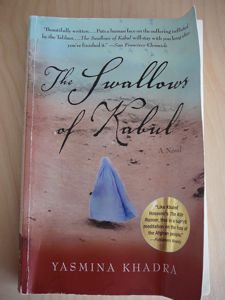
While waiting for our luggage to be offloaded, we were passing time, visiting with our greeter / expediter, asking about his family, his life in Zambia.
“How does this work, travelling with your son and your daughter-in-law?” he asked us. “Do you like her?”
Nothing on earth could disguise the delight on our faces as we both said “Yes!” We truly adore her.
When our son was only seven years old, a Christian speaker passing through said that if you have children, it is likely that their mates have also been born, so to start praying now for the unknown mate your child would choose, and we did.
When our son called us from university, and told us there was someone he wanted us to meet at graduation, and graduation was still months away, we knew, we just knew, that this might be THE ONE.
We were so delighted when we met her, we liked her immediately. What parent isn’t happy to see his/her son/daughter happy, and choosing well?
“But!” our meeter/greeter added, “how do you like her family?”
And we laughed again! We love her family! Her father is smart and very funny, and her mother is kind and practical, and we all share the same values on family and friends and living our lives. She comes from a large rowdy family that gathers when they can, and so do we.
And YOU are thinking “what does all this have to do with The Swallows of Kabul?” but I am getting there.
On the trip, we all had books for our quiet time, and I could see EnviroGirl deeply engrossed in this book. When I asked her, she said she had gotten it from her father’s wife, a woman with whom I often talk books, and that she (EnviroGirl) was trying to finish it so that she could leave it with me.
And thank goodness that she did! I couldn’t put it down!
First, you think it is written by Yasmina Khadra, but that is a pseudonym. The real author, Mohammed Moulessehoul, was Algerian army officer, and he used the pseudonym to avoid having to submit the manuscript for approval by military authorities. That got my attention right away.
The book is about Taleban era Afghanistan, and starts out with utter hopelessness, describing the deterioration in life brought about by the arbitrary imposition of religious rule, as interpreted by men who have memorized the Qur’an, but have a poor understanding of what they have memorized. Women lead a dismal, limited life, at the mercy of men who treat them as detestable if they are seen in public, even totally cloaked.
His language is beautiful, poetic and compelling, even describing despair and desolation.
We meet two couples, Atiq, a jailer, and his wife, Musarrat, who risked her own life to save his life back when he was seriously wounded and left for dead, and Mohsen, former member of a moderately successful merchant family, married to the love of his life, Zunaira, who is beautiful, educated and from a wealthy background. These men love their wives, and have a strong, genuine connection to them. Their ability to maintain that connection, and to stay connected to their own values, withers in the dry, dusty context of fundamentalist rule.
Their lives and relationships have been changing gradually, increasingly limited and undignified under the stress of Taleban rule, and the novel follows a rapid spiral of deterioration and folly. The steady decline of their lives speeds when Mohsen makes a terrible impulsive decision, has to live with the consequences, and confesses to his wife.
Atiq, too, faces dismal consequences. Even though we know he is limited, he becomes a sympathetic character. His hardness of heart covers a genuine grief that his wife is dying, and he can do nothing to stop it, nor to alleviate her pain.
We all face hard times. In our family, when someone lashes out unjustly, we often ask “is it something I have done, or am I just the nearest dog to kick?” It always gets a laugh, and it puts things back in perspective, puts us on the same side. Sometimes we can’t always vent our frustrations against those people or events creating the frustration, so we take it out on those we love – and who love us. It’s not right, it’s not fair or just, but it is very human, and once you get that out on the table, it is easier to discuss the real issue.
When Zunaira ends up in jail, Atiq’s world is shattered as if by an earthquake – the earth moves under his feet, all his understanding of life is shaken.
“As he cleans up, he cautiously lifts his eyes to the roof beam looming over the cell like a bird of evil augury, and his gaze lingers on the anemic little lightbulb, growing steadily dimmer in its ceiling socket. Screwing his courage to the sticking point, he walks back to the lone occupied cell, and there, in the very middle of the cage, the magical vision: the prisoner has removed her burqa! She’s sitting cross-legged on the floor. Her elbows are on her knees, her hands are joined under her chin. She’s praying. Atiq is thunderstruck. Never before has he seen such splendor. With her godess’s profile, her long hair spread across her back, and her enormous eyes, like horizons, the condemned woman is beautiful beyond imagination. She’s like a dawn, gathering brightness in the heart of this poisonour, squalid, fatal dungeon.
Except for his wife’s, Atiq hasn’t seen a woman’s face for many years. He’s even learned to live without such sights. For him, women are only ghosts, voiceless, charmless ghosts that pass practically unnoticed along the streets; flocks of infirm swallows – blue, yellow, often faded, several seasons behind – that make a mournful sound when they come into the proximity of men.
And all at once, a veil falls and a miracle appears. Atiq can’t get over it. A complete, solid woman? A genuine tangible woman’s face, also complete, right here in front of him? He’s been cut off from such a forbidden sight for so long that he believed it had been banished even from people’s imaginations. . . ”
Atiq has a friend, Mirza, who thrives under Taleban rule, as a soldier, and also running illegal businesses highly profitable under the current regime. He encourages Atiq to abandon his cancer-striken wife, to get rid of her and to find a fresh, young wife. He offers Atiq shady business opportunities, and tells him a wise man bends with the wind. Ignorance and chaos benefit Mirza, and he has no wish to see the good old days return.
In spite of the bleakness, the desolation, the crushing arbitrariness and inhumanity, there is hope, love, and compassion in a thin, steady stream throughout the book.
Once I started reading, I had to finish. It was a great book for the long trip back to Kuwait, one I am eager to pass along to the next avid reader.
Even the Dogs
Today’s Gospel reading is one of my very favorites; Jesus was infinitely kind to women.
Here is a desperate woman, shouting for Jesus’ help. She is not a Jew, she is not even one of his followers. She is a mother with a very sick daughter. She will not be put aside. Jesus’ closest followers tell him to “make her go away.” She argues with Jesus, telling him even his smallest crumb of mercy will be enough, and he has mercy on her.
Matthew 15:21-28
21 Jesus left that place and went away to the district of Tyre and Sidon. 22Just then a Canaanite woman from that region came out and started shouting, ‘Have mercy on me, Lord, Son of David; my daughter is tormented by a demon.’ 23 But he did not answer her at all. And his disciples came and urged him, saying, ‘Send her away, for she keeps shouting after us.’ 24 He answered, ‘I was sent only to the lost sheep of the house of Israel.’ 25 But she came and knelt before him, saying, ‘Lord, help me.’ 26 He answered, ‘It is not fair to take the children’s food and throw it to the dogs.’ 27 She said, ‘Yes, Lord, yet even the dogs eat the crumbs that fall from their masters’ table.’ 28 Then Jesus answered her, ‘Woman, great is your faith! Let it be done for you as you wish.’ And her daughter was healed instantly.
Cormac McCarthy and No Country For Old Men
“Did you get a chance to watch the DVD?” I asked my friend, “because I have the book, and the book is SO much better. You understand so much more.”
“No! No! I started, but I could not watch it,” said my friend, “It was too violent!”

No Country For Old Men was a very violent movie, done by the Coen Brothers. I reviewed it HERE. When we finished watching the movie, I called our son and said “what happened? I’m not sure I understood what happened!” and indeed, there was a lot I missed. My son didn’t tell me anything – he bought me the book. On one of those long Seattle – Amsterdam – Kuwait flights I read it, and at the end – WOW.
My friend hit the nail on the head – the movie was violent, because the book is about violence, about violence in our societies, about increasing violence, violence without conscience, violence with no understanding of suffering of the victims, violence for no purpose, violence with no meaning, no goal, violence, literally, at the flip of a coin.
The movie is an indictment of violence, taking a circumstantial event and building an entire plot around it, a drug trade gone bad. There are a lot of deaths in this movie, most of them just for being in the wrong place at the wrong time and tangling with people who have no morals, no scruples, no compass by which they live. Even money matters less to the drug dealers, and their employees, than an arbitrary code that takes tribalism to the limit – us or them.
The main character, a sheriff and grandson of a sheriff, takes on a case that leads him to wonder more and more if his service to his community and fellow human beings is even making a difference. He ponders on the changing character of Texas, of youth, and how we are raising our children. It is thought-provoking and unforgettable.
I understand someone, not the Coens, are currently making a movie of an earlier book I read by Cormac McCarthy, The Road which is another bleak story. There is an elemental relationship between the father and son, the father is all goodness and protection in a world driven to brutality and unimaginable behavior by an apocalyptic event.
In No Country for Old Men there are decent, moral, sweet relationships, faithful marriages, men of honor who serve their fellow-man as law enforcement officers, men who have served their country as soldiers, etc. but the point McCarthy seems to be making is that the decent people in the world have little hope of surviving against those who band together in gangs using brute force to get what they want.
No country For Old Men is available from Amazon.com for $11.20 + shipping or from $6.00 used. Yes, I own stock in Amazon.com. 🙂
Kuwait Driving Laws Enforced in Hawali
AdventureMan and I have a running disagreement. I say more people are pulling over to make calls, or using headsets. He says he sees people using mobile phones all the time. (He would not agree to a spot survey of the cars around us, but we also noticed fewer children in the front seats, very cool.)
I think traffic is improving in Kuwait. I see more people using seatbelts, fewer people weaving around while trying to talk on cell phones, and more people using turn signals. I see less endangering behaviors.
Am I being too optimistic here?
From the Arab Times:
250 citations issued: Hawalli police launched an intensive campaign and issued 250 citations to motorists for not wearing seatbelts and another 50 for using mobile phones while driving, reports Arrouiah daily.
It Gives Me Hope
You know who I am, I’m pretty consistent in what I have to say. I believe we all have a lot more in common than we have differences, and I want us to find ways to get along. We, as a species, spend so much time and energy and resources fighting over the pettiest differences. How will we ever call ourselves civilized until we can treat every fellow creature with respect?
I bet Cupertino has problems, too. I know for one thing it is incredibly expensive. Most of what I saw there, I really liked. Whole Foods. High Tech Engineering. A wide variety of people, all working together in peace.
At our hotel, there were five weddings taking place the same day as “our” wedding. I came down in the elevator with one couple and their parents, and I got a photo of them in the hotel garden area before their wedding:

The groom is from India, and the bride is Chinese. The parents, and all the relatives are gathered, and dressed in gorgeous, flowing silks, and the bride and groom are just amazingly in love with each other and it is so beautiful, they are all so happy.
Cupertino takes a lot of pride in being beautiful, and the buildings they build are beautiful and they have “campuses” where lots of related buildings are connected with winding garden paths and ponds full of ducks.
I particularly love this sculpture:

Which looks totally different from the side:

There were flowers and plants everywhere. Many I couldn’t even recognize. I would have to learn a whole new world of gardening in California:

Recent Comments
ExpatAlien on What Country am I Living … intlxpatr on Yellowstone: Old Faithful to C… Michelle on Yellowstone: Old Faithful to C… Cathy on No Grown-Ups in Charge intlxpatr on Waiting for Snow Wikipedia Donate Button

Amazina


Early Voting in Florida


 Here There and Everywhere