Ft. Bragg . . . where??? (California)
Most people, when they think of Fort Bragg, think of a military post in North Carolina. The Fort Bragg we discovered several years ago in California has little in common with the North Carolina Fort Bragg.
Our first time in Fort Bragg, as we left Cucina Verona, an Italian restaurant where we had eaten dinner, we were startled by the loud sound of hoofbeats, and the sudden appearance of two riders, galloping hell-bent down the middle of the road in Ft. Bragg. It was one of those adrenaline moments, when you wonder if you really saw what you just thing you saw, followed by all the things that could go wrong when you mix horses, highways, automobiles and high speed.
This time, one of the first things we saw was this sign:

But . . . it doesn’t say anything about riding horses, skateboards, or bicycles down the center of the street!
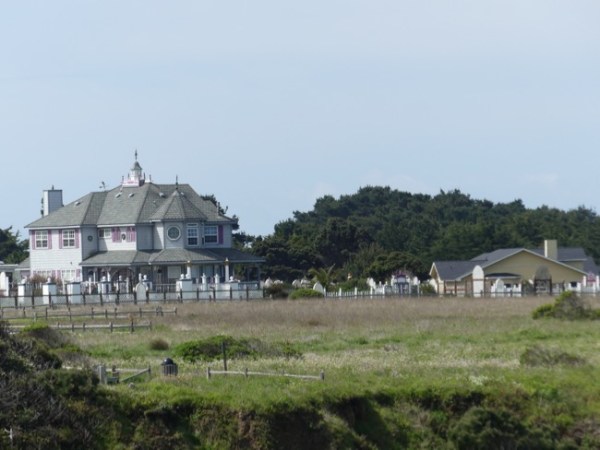
Ft. Bragg has a very laid back vibe. The town is full of couples who look a lot like us, maybe even a little older, maybe a little more hip and less retired military than we look, but relaxed, comfortable in their own skins. We love the vibe. My very favorite activity in Ft. Bragg is at the north end of the town, where they have a place called Glass Beach. Glass beach is where the old town dump used to be, a long time ago, and all the bottles dumped there broke and were washed by the waves, tumbled by the gravel and sand, and became beach glass. Most of what you find is pretty small these days; Glass Beach has been discovered, but if you venture out the the furthest inlets and rocks, you can find some larger pieces, sometimes even a green piece. I found one tiny little blue piece, the grand prize of all beach glass.
We love the North Cliff Hotel, where every room has the same view, looking out over the water at the inlet to the little bay.

We love the hot tub with a view.

We love the view. On the morning we were leaving, we looked out and someone had written a huge message on the sand, “Annie will you marry me?” How cool is that?!
Time is flexible in Ft. Bragg. We get up when we want to, we don’t have to drive to any destination, we can be lazy or we can just meander around, which is what we choose to do.
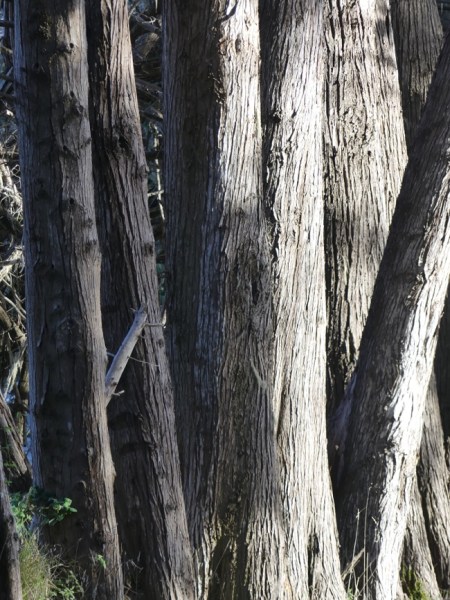
Love this tunnel of eucalyptus trees entering Ft. Bragg from the north:

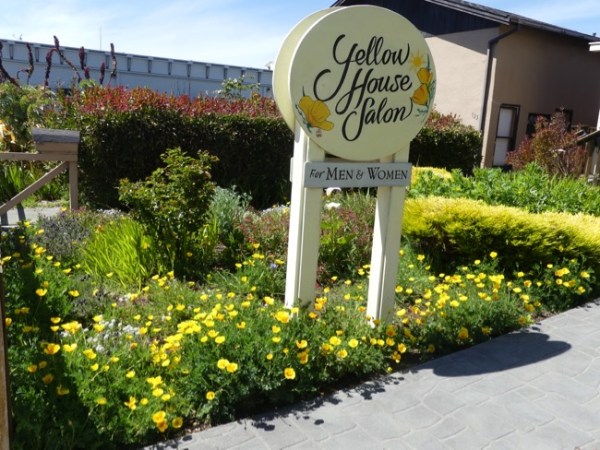
This yard had no flower but yellow flowers, and a LOT of yellow flowers!


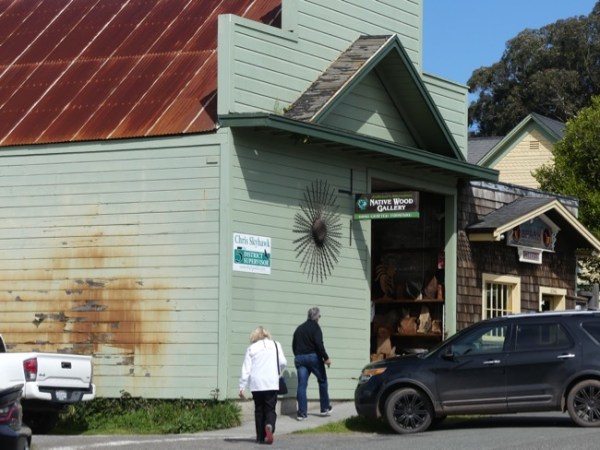
Just a short drive south is Mendocino, one of the most beautiful little California towns you could hope to find. We were looking for special gifts for two special people, and found them, polished carved natural bay laurel bowls, at this shop.
I read a recent article on how California leads the way for the American soul; it gives me hope for the future of our country. California pioneered gay rights, California champions the rights of immigrant children to education and health benefits, and Californians “welcome the stranger,” as all people of the book are supposed to do.
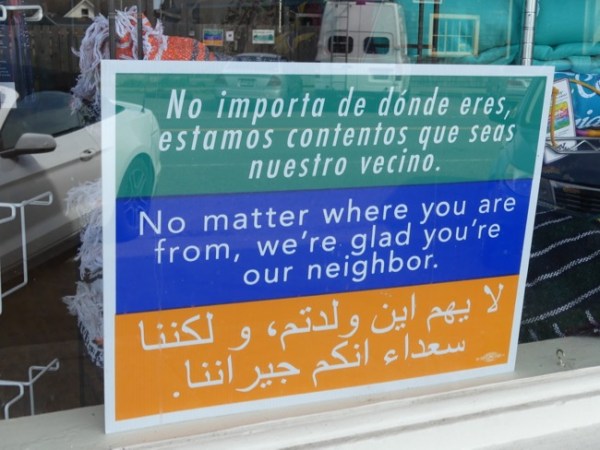
This was in the window of the main grocery/hardware/sundries store in Mendocino. When a woman saw me taking a photo, she asked me why, and I told her, it made me feel welcome and filled my heart with joy to know that it specifically would also make my Arab / Muslim friends feel welcome. She smiled, sternly, and said that they welcome ALL people, that is what California is all about. I was happily chastened. 🙂
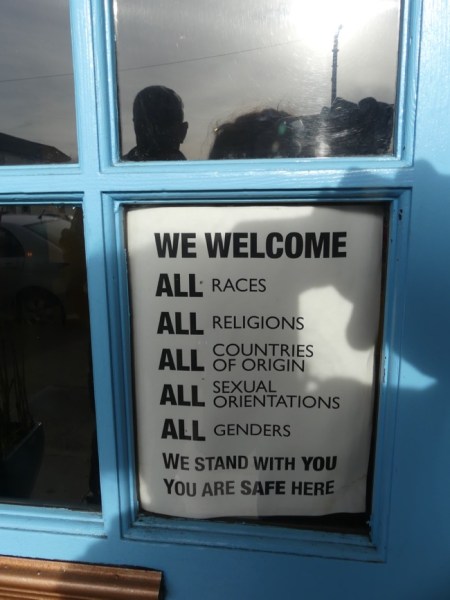
I want the United States of America to be a safe place for all people. No wonder I love California!
Well, there is another reason to love Ft. Bragg – they have one of the world’s best ice creameries right on the major through street in Ft. Bragg. 
Cowlicks Ice Cream is never not busy. On our first trip (we went twice in one day!) I had a scoop of ginger ice cream. It was a huge WOW. On the next trip, I had a chocolate which was really chocolaty, but I wished I had another scoop of ginger.
As we sat, eating our ice cream, I overheard a stylish but somewhat-frail looking 80’ish woman tell her daughter that she didn’t want to be bothered being married again, she was just looking to have a little fun without the complications of a relationship. Such is life in Ft. Bragg. 🙂
You Gotta Love the Mormons
I am not Mormon. Yes, I say good things about the Mormons, and that is because the Mormon people I know are smart, savvy, and hard working. They make time in their life in a structured way, to take care of those around them. They feed the poor, they welcome the stranger, they clothe the naked, they visit the prisoner, they take care of the widow and the orphans – all the things we are told are important to do in order to show the world our love for God and our love for one another. The Mormons have made a science of it, including teaching and learning foreign languages, and sending their young out into the world to spread the word, but also giving them an opportunity to develop a broader perspective, another point of view, living in a foreign country.
AdventureMan and I have a food-truck-turned-settled restaurant we have recently found and love, Taqueria El Asador, on North Davis in a Shell station. You’ll know it by the cars parked all around it as people get to know just how good the food is. My favorite is a burrito Campechano, and AdventureMan loves the Pollo Platter.

It’s outdoors. Mostly we take out. While I was waiting for our order, I saw this among all the ads looking for people to frame, do masonry, or to clean:

We are surrounded by immigrants. Many of the workers are in paint stained clothing, many are in overalls, many in scrubs from the nearby hospital and clinics. The prices are reasonable, and it’s lunchtime. This “ad” is in Spanish, offering free English lessons to those who want to learn English, and how else are you going to get ahead, to fit into your new home, get a better job? The Mormon church is giving exactly the kind of hand-up that will help them find the better life for themselves and their families, and it is offering this tool for free.
Someone more cynical might think they are just trying to convert more Mormons, but anyone who is in the helping business knows that helping doesn’t mean you will get an anticipated response. I would be willing to bet, however, that the kindness doesn’t end there, that the Mormon church has structures in place to help the English learners with clothing, maybe with better jobs, maybe with people who can explain customs, take them to interviews, explain benefits, etc. I would be willing to bet that it isn’t the services offered, but the pure kindness behind those offers that can change hearts. I may not be Mormon, but I can admire the way they do God’s work.
Tough Times in 2017
It’s been a strange year. I fought depression a lot of the year, faced with a political administration that is rolling back everything I believe to be good about my country. I watched our culture degrade, environmental protections roll back, air pollution standards roll back, financial institutions restrictions roll back, oversight disappear, the State Department erode, and truth become astonishingly irrelevant, civility hard to find. I also found friends, who, like me, welcome immigrants, fight against those who would restrict voting rights only to people a whole lot like them, and who support equal rights and the belief that we are called to be better people, and to do what we can to lift people, rather than to stomp on them.
One great wonderful event happened this year, my grandchildren were baptized. It was a private event, with friends and well-wishers, and it was joyful, and very funny. If I want a big smile, I think back on that precious day.
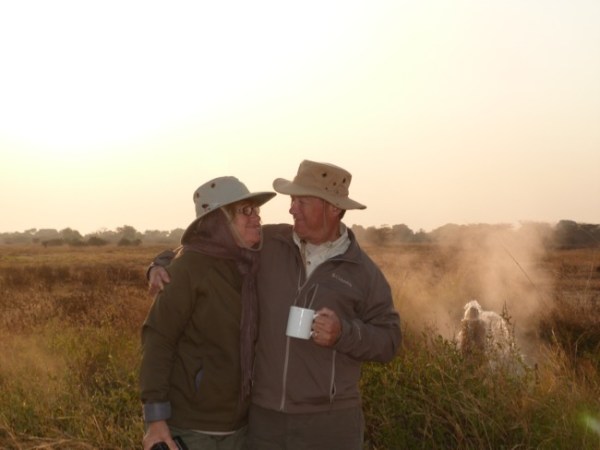
At that same time, two people we know were diagnosed with cancer, diagnosed in the very prime of their lives. One was the father of our dear daughter-in-law. He and his wife welcomed our son, and then us, into his sweet family, a family full of women as wild and wacky as I am. We laugh, my daughter-in-law and I, about how our relationship is “unnatural.” We are supposed to be hostiles, but in truth, we genuinely love one another and we enjoy one another’s company. I admire her, as a wife, a mother and an environmentalist. We enjoy her parents, and we spent two weeks in Zambia traveling with her father and his wife. We had a great time with them.

Her father was a poster boy for chemotherapy. He smiled and laughed his way through it, cheering up those around him who were trying to cheer him on. If he ever had moments of self-pity, we never saw it. He chose to spend his time loving others, and continuing to make this world a better place.
In November, he caught a cold, and then pneumonia. The family gathered, and he rallied for a while, and then sank slowly, unable to get enough oxygen into his lungs. Before Thanksgiving, he was gone.
Yes, I am faithful, and I also have a hard time accepting that it was this man’s time to go. I am guessing that part of it is being unable to accept my own powerless to stop this horrible thing from happening, this good man, cut down in his prime. He was just making plans to retire, to travel. He and his wife were excited. I couldn’t help it, his death made me angry, it was such a waste. Yes, you can be faithful and be really mad at God.
This man loved his grandchildren.


He loved fishing, and spent time teaching his grandchildren, nieces and nephews to love fishing, too. Here he is on the Zambezi, seeing what he might catch.
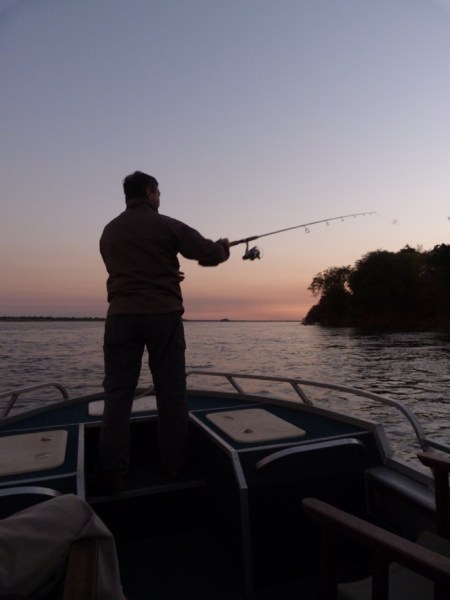
Every life he touched, he left better for it. He was a fine man, and I grieve for my sweet daughter-in-law, for this terrible, painful loss.

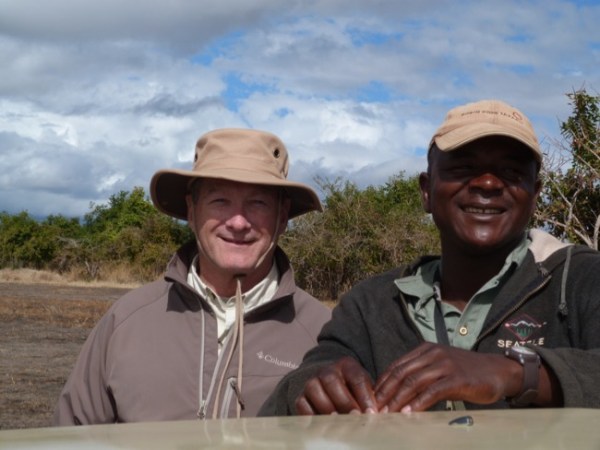


Here is hoping for a better year to come.
Wake of the Vikings: The Saint Lawrence River and New Friends
AdventureMan went to bed as soon as we got back from the spa; he had been chilled and had warmed up in the hot pool and sauna, but he was tired – and sick.
The night before he had been fine. We had gone to dinner with a couple we met at breakfast in Oslo, the day we were all traveling to Bergen. Within three minutes we had a lot in common – as happens in Expat world. They have been to many wonderful places overseas in their academic careers, and especially loved their time in Beirut, Damascus and a wonderful wedding in Amman, Jordan.
How often do you come across people like that? How do you find out so quickly those shared points of enthusiasm?
At dinner, it was more of the same; there are some people that no matter how many topics come up, you know there are still so many to cover.
And they remind me very much of a couple we met last year on Empires of the Mediterranean, outside the Archaeology Museum in Zadar. None of us could believe that there was NO mention of this fabulous museum in the Port Talk or in the City Tours. One thing led to another, but you know me – all roads lead to books. We are still in touch with this couple; she and I are active in book clubs and avid in our e-mails about our latest finds. They are coming to visit us next month!
It’s the same with our new friends from Las Cruces, they are widely read and have a wide range of interests. We laugh a lot. We can’t stop talking.
But the next morning, as we went into L’Anse Aux Meadows, Adventureman said he was tired, and he was coughing a lot, and he had a headache. He slept and slept, only getting up for a little soup at dinner, then going right back to bed.
Today is a day at sea, and started out a little bleak.

I went upstairs to the Explorer Lounge, my favorite quiet place, and had my oatmeal with blueberries and raspberries. Around nine, I went down to the spa pool, and, for a while, had it all to myself. I came back to the room to spend some time with AdventureMan, but when he is sick all my suggestions (“do you think you might want to see the doctor? Can I make you some mint tea?”) just annoy him, so I am quiet until we go to lunch. After lunch, I go back upstairs to read and to leave him in peace, coming back to the room for a couple hours, then heading out for a lecture on the Bayeux Tapestry. The weather has greatly improved, and way way off in the distance, we can even see land.

On our way to Saguenay on the Saint Lawrence River:
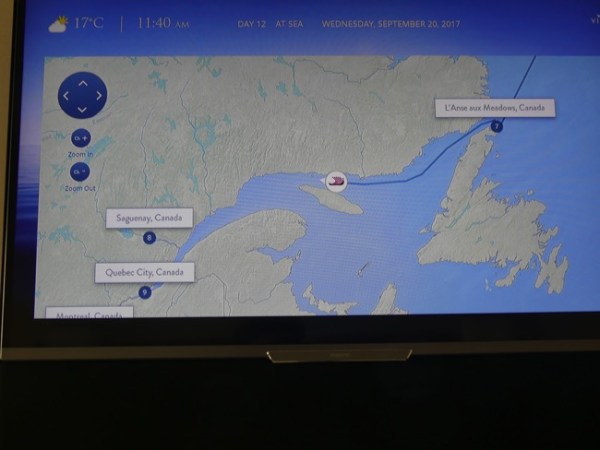
Look at this beautiful weather! It hit 70 degrees F. today, first time we have seen a temperature like that since leaving Pensacola. I am taking it as an omen that AdventureMan is about to make a rapid and full recovery so he can enjoy the end of the trip with me.

At the lecture about the Bayeux Tapestry, our Las Cruces friend asked if I had written about them in my blog, and said he was trying to find it. Aargh. You know, I don’t talk about the blog, in Pensacola maybe one person other that AdventureMan and our son even know about it. I have my faithful friends from Doha and Kuwait who keep up with me here, but honestly, who else really cares? There are so many blogs about exciting things like politics and sex and fashion and they get millions of visitors. I am just trying to remember places I have been and events and experiences, sometimes I am just thinking out loud, or venting therapeutically, and some of you are kind enough to come along for the ride. I am humbled, and thankful, that you are still there.
I miss AdventureMan.
Tomorrow, Saguenay.
Wake of the Vikings: You’ve Got to Be Flexible; Missing Nanortalik, on to Qaqortoq
We got really really close to Nanortaliq. Really close:
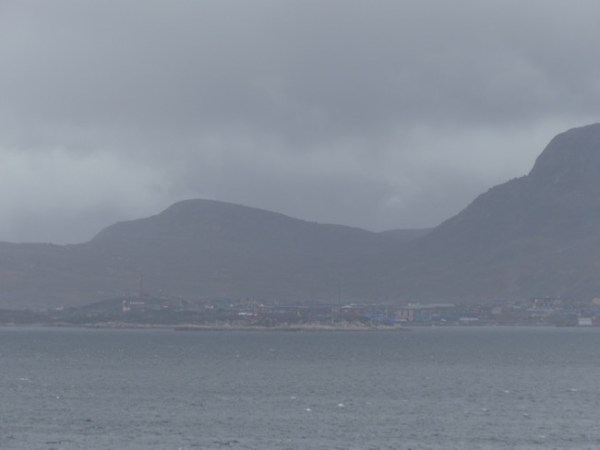

And just when we are all dressed and ready, so ready to go, the Captain comes on and tells us that he and the port authority in Nanortalik have decided that the surf is too rough, the incoming weather too rainy, and the winds too strong to risk transferring us to shore by tender, tenders being the boats that double as our lifeboats if anything happens to the ship. We are disappointed, but not greatly, as we know we have another chance tomorrow with Qaqortoq, and you know how it is, we love places with Q’s in them. Qaqortoq just tickles us, the very idea of a place with three Q’s delights our hearts.
The scenery is also not at all bad; we can just sit in our staterooms and watch gorgeous iceburgs drift by. Actually, we both make a quick trip down to the spa pool, which is quiet, and then spend some time in our room.
Nanortaliq means something like where all the polar bears get together, or the place of the polar bears. We saw some breath-taking scenery, but we never did see a polar bear.

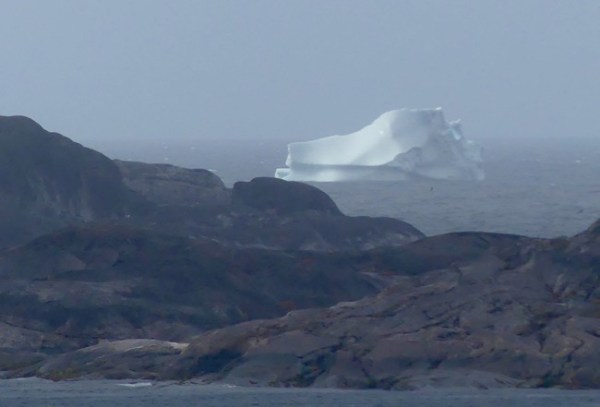

I just love the sculptural quality of these icebergs; hope you don’t mind my showing so many, I actually am only showing you the best.
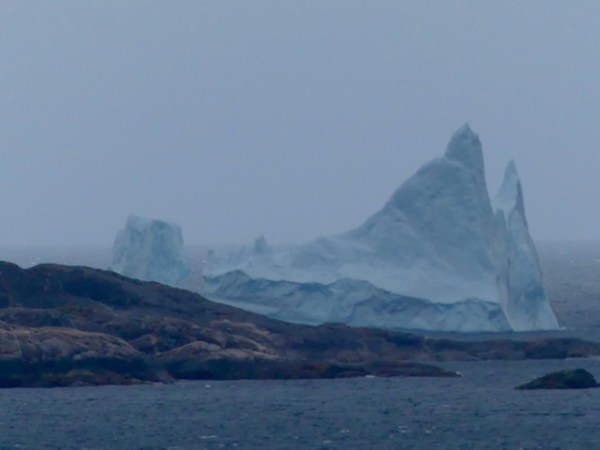
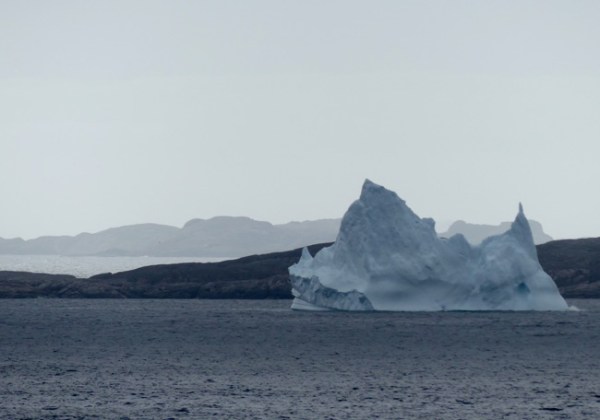


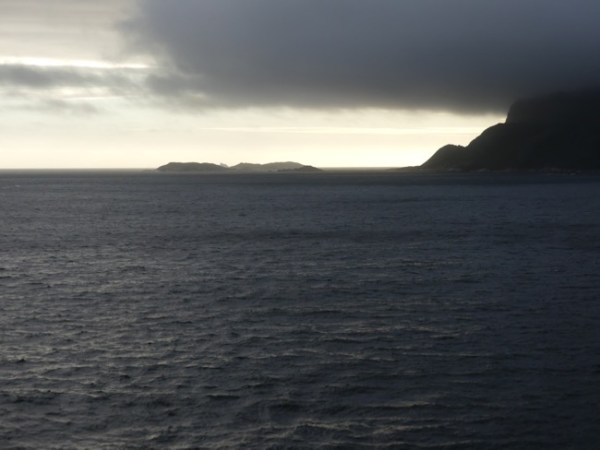
Near sunset, the air went all misty and glowing, and this iceberg looked pink.
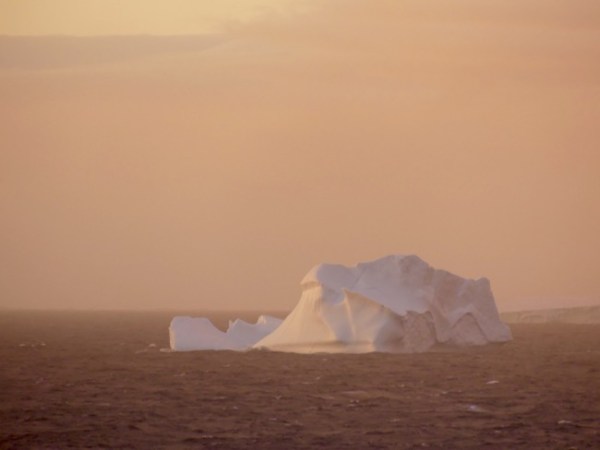
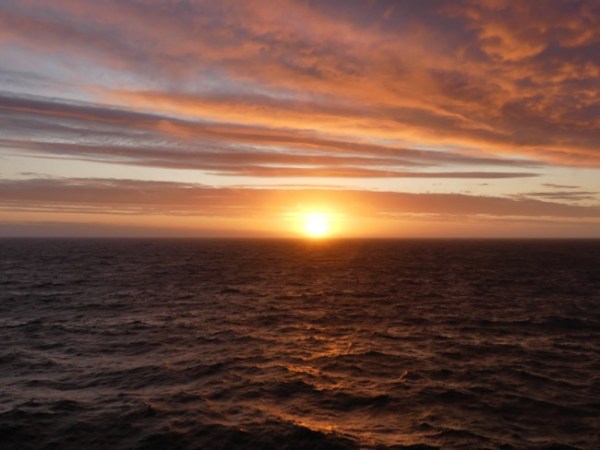
Leaving the Nanortaliq area, a truly glorious sunset:
Wake of the Vikings: Oslo City Tour – Vigeland Park
In the last post, I told you AdventureMan and I are not very good about staying on track with a tour. Sometimes there is too much information, and too much time at a location about which I care little. VIgeland Park was just the opposite, for both AdventureMan and I. Vigeland Park was so extraordinary it made us want to come back to Oslo and to walk the streets and visit all the public art we can, and spend a lot more time with these lovely, terrifying, amazing sculptures.
This gutsy sculptor told the city of Oslo that he would do a series of sculptures for free if the city would pay for materials, provide a location, and provide help for the project. After lengthy debate, astonishingly, the city agreed. Vigeland created the statues, the park was completed and Oslo had a cultural treasure.
Vigeland’s sculptures deal with mankind, in all glory and in all despair, in all conditions. I will show you one of my favorites, because I am one of three sisters, and what I read into this statue is sisterhood:
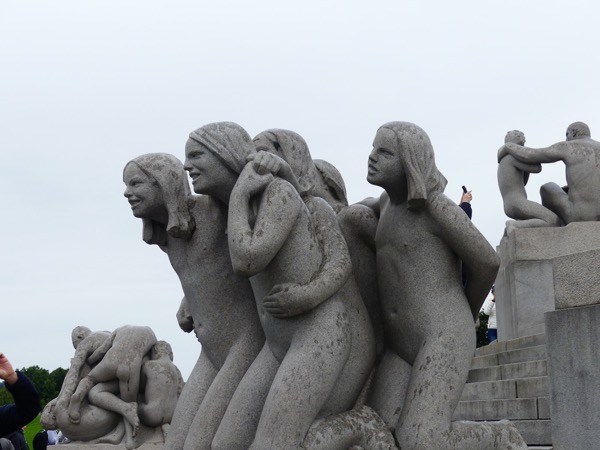
Can you see why I like this statue? You can read so much into his statuary. If I were teaching high school art, I would put out a series of photos of his sculptures and ask each student to choose one and to write about what he or she sees in the sculpture.
There are mothers and fathers with their children:
What do you see? Some saw a man, overwhelmed, careless as he handled his children. I saw a metaphorical balancing act, and don’t children alway find their fathers the most fun because of the risks they take?

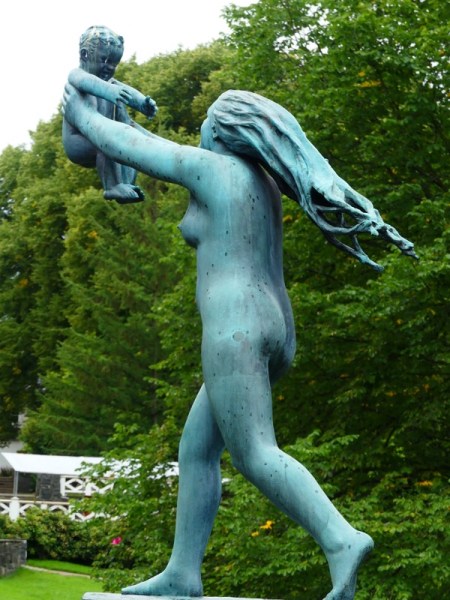
Some saw joy in this mother racing with her child. What do you see?

This column centers the exhibit. It is full of people and children, surrounded by people, men and women, all nude, all naked spiritually and open for our observation and interpretation:
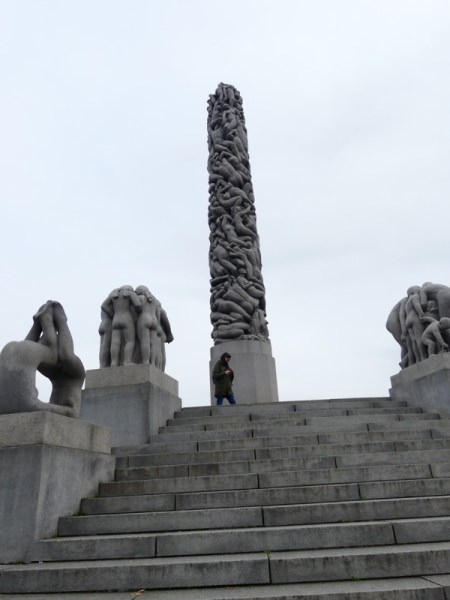
This park is incredibly popular. I would love to go back when there aren’t a lot of people. This is a park where you can spend a lot of time speculating.
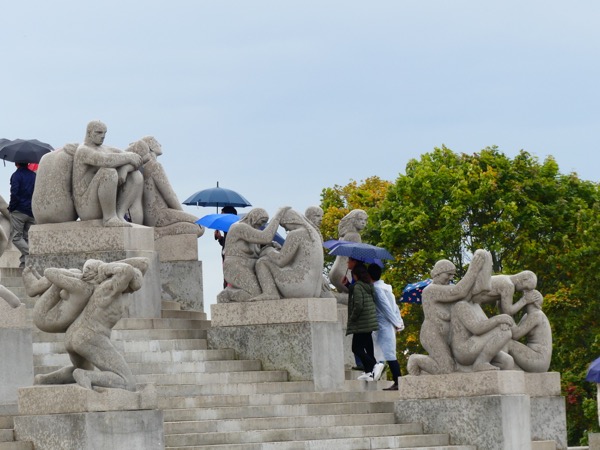

This is a separate pavilion with depictions of the stages of a life, and the transitions back and forth from the “other world” to this world.

I struggle with this series below – I’ve only shown two. It is a woman with a dragon – or is it a demon? Is she fighting with it, or dancing with it? And in the last picture, is he embracing her? Is he devouring her?


These sculptures are like a good book, you can think about them for a long time, and at different times in your life you may come to understand them in different ways.
A Dramatic Beginning to The Wake of the Vikings
It’s not that I am THAT compulsive, but I do like to plan ahead, and things that happen at the last minute that require attention can disturb my sleep.
This is a trip we’ve had planned for over a year and a half. We didn’t plan for Hurricane Harvey, and we are flying out of Houston. We didn’t plan on Hurricane Irma, another all-time historical hurricane, headed toward Florida, and possibly into the Gulf. Possibly into Pensacola.
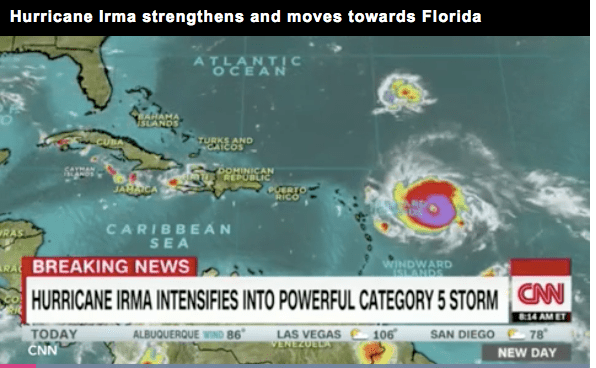
We have a wonderful couple who take care of our house and our cats while we are gone. She called the day before we were leaving to ask if we had any plans for the hurricane she needed to know about. Hmmmm. No, I didn’t. I planned not to worry about it. And . . . at the same time, all around me, people are stocking up on propane, and Sam’s has run out of water, and . . . . some people are preparing to hunker down and some to leave home, heading north.
We got moving. I had an hour before my last meeting, and spent that hour figuring out what really mattered to me (photo albums) and putting photo albums up high and in cupboards, and fragile things, like the crystal candelabra AdventureMan gave me for our first anniversary in the safest place I could think of.
Law and Order Man (our son) said he would take Ragnar and Uhtred, our very young cats, to a safe place, if needed.
AdventureMan braced the garage doors with huge specially made steel beams that bolt into place, and we called our contractor who said if it looked like Irma was heading our way, he would put up all the ballistic window and door covers.
It’s not everything, but it’s something. We all felt a lot better.
And thanks to the ‘net, we know that Houston is up and running, and our flights into Houston and out of Houston will fly.
Around eleven, we hear the front door opening (? ! ? ! ? !) and it is the couple who are coming to stay with the house and cats; they thought we were leaving at night, not the next morning. We all laughed, got them settled, and went to sleep peacefully.
The flight into Houston was the best kind, uneventful. We love uneventful flights. You can still see a lot of standing water, and water damage, but the greatest part of the upswell of waters appears to have subsided.
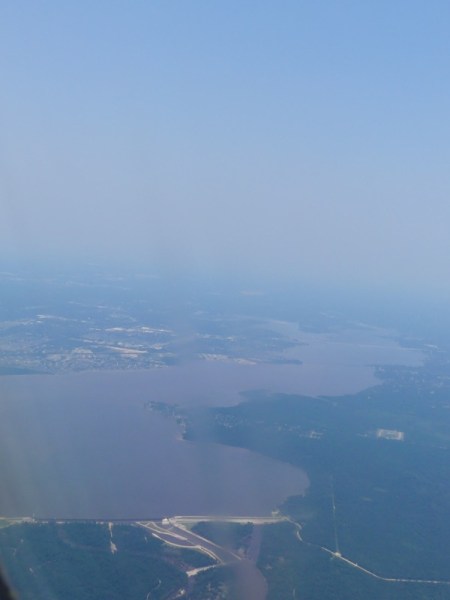


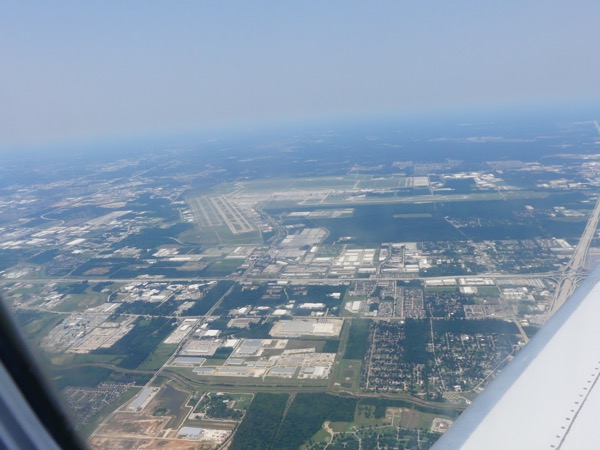
“Today is the first day that the airport is 100% up and running,” a Houstonian tells us. We are good listeners, and he tells us that the worst part of all this drama is that the death count continues to mount as rescue-workers go into places where people thought they could shelter in safety. The mold is also hitting hard and fast, and emergency facilities are strapped. They are functioning, and they are prepared, and some things are beginning to run out.
The best, he followed up with, is that “you know how divided we have all been? Once the storm hit, it didn’t matter if you were black or white or Mexican or Confederate, we were all just people, and we helped our neighbors, we helped each other. In that way, it was one of the best things that has ever happened in Houston.”
Who would have thought? Houston-strong!
The Mockingjay
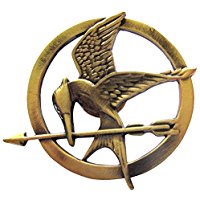
I saw a set of movies a couple years ago, about a post apocalyptic America, where there is a capitol full of fabulously rich, fabulously well-dressed, ornately made-up rulers who entertained themselves with a yearly survival ordeal, the Hunger Games, fueled by “tributes” who were chosen from each of 12 districts to compete to the death, to the last one standing. One woman and one man were chosen from each district to compete.
Upon the inauguration of our current regime, I had to find ways to fight my despair and outrage; I had to find ways to join with others of similar feelings and counter moves which I consider to be against the best interest of my country, and who I have always believed us to be – people who believe in liberty, equality and brotherhood, people who have all arrived here from elsewhere (Immigrated), and people who believe in giving others a fair chance at the American Dream.
My best friend forever (we met in college) and I challenged one another; she added Planned Parenthood to her charitable donations, and I added the ACLU.
I had always thought the ACLU a little nutty, but when the first immigration ban went into effect, and the ACLU had the skill, imagination and resources to mobilize and to man tables offering legal help – FREE – at the airports to stunned arrivals being turned back, I was proud I had supported their efforts.
I live in a conservative area, and because I don’t want my car damaged, or any sort of ugly confrontations in parking lots, I don’t put bumper stickers on my car. There is one I have seen that I love:

I would never dare put this on my car, living where I live.
I did, however, buy a mockingjay pin which I found on Amazon, amazing Amazon. I can safely wear it, knowing it signifies rebellion, and no one here has a clue.
Wear it in Seattle, I learned, and everything changes. My best friend forever and I went to dinner, and I was wearing that pin. The waitress peered, and peered again, and asked “Is that what I think it is?”
I said it was a mockinjay, and a metaphor. She took our order, left, and within seconds another waitress appeared, and then a waiter. Each treated me like royalty, giving salutes, blessing me with “may the odds be ever in your favor.” They asked me questions I couldn’t answer; I kept explaining that it was my metaphor for finding ways to counter a corrupt regime, and I particularly loved it because it connects us all, young and old.
I had seen the movies, but now I am deep into reading the Hunger Games trilogy, so that I can wear the pin again, with deeper knowledge when I run into the people who really know all the lore.
May the odds be ever in your favor 🙂
No Trips To Damascus This Week
AdventureMan and I are currently on an austerity program.
When we say that, we laugh. God blesses us abundantly. We have food to eat, we have a good roof over our head, “two cats in the yard” to quote Neil Young, life is good. We’ve had a full season of unexpected and thoroughly normal repairs, however, including replacing an air conditioning system (expensive) and replacing an irrigation system (expensive) and in our other house, replacing a roof and it’s supports in our other house (expensive.) We have “enough.” We are blessed.
We’ve always had a policy of living below our means, supporting the church, investing and saving, and it has served us well. Even in retirement, we are loathe to touch our savings, even though the savings are for our retirement. We don’t know how long we’re going to live, or what kind of health care system we are going to have, so we keep all those little nuts in case winter is coming :-).

Meanwhile, I wanted to go to Mobile for lunch to day at 7 Spices Mediterranean Grill, one of the most delicious places in this part of the world to eat, and when AdventureMan and I counted out our money, we found that we could – just. AdventureMan looked at me and said “How about we go in August, and I’ll take you over to the beach to eat today” and I said “OK” and he said “No Trips to Damascus this week.”

When we lived in Amman, Jordan, our favorite trip was up to Damascus. It was only about 3 1/2 hours, longer if there was a line at the border, or is someone wanted to screw with us, as they sometimes liked to do with embassy people. We had friends in Damascus; we stayed with them, they knew all the best restaurants, and all the best places in the souks. Damascus was still very French, so I could do just fine there, and it was also Arabic, so AdventureMan could also do just fine.

We were young, we didn’t have a lot of money, but Iranians were fleeing Iran, stopping in Damascus to sell their carpets, and carpet buying was our avid hobby. For all of us, we all loved the beauty of the carpets, and their stories. We learned quickly to buy the carpet, not the story. The carpet sellers knew us all by name, and the foreign population was so small that they took our checks and those checks would go over the border to Lebanon and were cashed quicker than our checks cashed at the embassy. The carpet souks, the gold souks, and the copper souks all welcomed us, and shopping was a leisurely thing, you’d sit and drink a little tea, the shopkeeper would tell you how business was going, and you’d swap stories as you haggled over whatever it was you were purchasing.

Or not. One of my friends, a very funny woman, took a carpet home on approval – it was done all the time. Every time I would visit her, the carpet vendor would remind her she needed to pay for it or bring it back, and they would negotiate. She was a shrewd woman, a devilish bargainer, and the vendor wouldn’t meet her price. At the end of her two year tour, after having the carpet in her house almost the entire time, she returned it because they couldn’t agree on a price! She was a legend in the embassy community.

The 7 Spices restaurant has food that seems very Syrian, and has tapestries with scenes from Damascus on the walls. Sigh. No trips to Damascus this week.
(The photos are from our last trip to Damascus in 2007. Sigh. Ten years ago. Yes, I am feeling nostalgic.)
News Fatigue
I had a group of women delegates from a variety of countries, some were elected officials, all were active in their countries. It was a fast-paced visit, with many meetings at colleges, with groups and with activists, and by the third day, we knew each other well.
At lunch, as I often do, I asked them what surprised them most about their time in this country.
“The news!” the representative from Australia said, without hesitation. “Your news is so exciting! In our country we have news, but nothing so exciting as in your country. Sometimes we don’t even pay any attention, because nothing that exciting is happening. Here, something is happening all the time, and you get glued to your television.”
The others chimed in, stating similar opinions. They talked about how the election had affected women in their own countries, how the shock resonated still.
AdventureMan and I just got back from two weeks visiting a wonderful part of our country, the four corners, Colorado, Utah, Arizona and New Mexico. Much of the time, we had no service on our phones and woeful wifi in our rooms. We were unconnected. It was, frankly, wonderful.
This current president likes attention. He creates drama. Other presidents get down to the hard work of leading and working their agenda through congress, he attempts to unite a diverse population behind him. This president does what he pleases, and says what he will, with no regard for his position. He claims to be a very smart man, and yet he has a pattern of saying very stupid things, and behaving in a disorderly manner. It’s like watching a disaster about to happen. It’s riveting, but you reach a point where you say “enough!” We were relieved to be disconnected.
And now we are back for the busiest and most event-filled news week so far. Arrgh.
(I will write up the trip as soon as I can upload my photos. My computer says I don’t have enough space to store all the photos I took, so we are working a solution . . . )
Yesterday, we saw this bumper sticker: Elect a clown, expect a circus.
This is America. I am legally allowed to say these things about our leader. 🙂
Recent Comments
ExpatAlien on What Country am I Living … intlxpatr on Yellowstone: Old Faithful to C… Michelle on Yellowstone: Old Faithful to C… Cathy on No Grown-Ups in Charge intlxpatr on Waiting for Snow Wikipedia Donate Button

Amazina


Early Voting in Florida


 Here There and Everywhere