“You Shall Also Love the Stranger”
In this morning’s lectionary readings from Deuteronomy, I find words of hope this morning:
Deuteronomy 10: 17 – 18
17For the Lord your God is God of gods and Lord of lords, the great God, mighty and awesome, who is not partial and takes no bribe, 18who executes justice for the orphan and the widow, and who loves the strangers, providing them with food and clothing. 19You shall also love the stranger, for you were strangers in the land of Egypt.
I often tell my friends that I encountered very good Christians as I lived among the Moslems; they believe in Christ, and as we differ among ourselves as Christians, they also differ from us. Some of the differences are significant, and at the same time, I am aware that Christians did not agree – and still do not agree – on Christ’s divinity. So I look at the fruits of the spirit, I look at actions, and I look at being faithful to God’s intentions for us as his creation. I welcome the stranger as the stranger so often welcomed us.
Right now, it shames me that our very Christian country is no longer hospitable to the stranger. We were the shining light of hope in the world. Now we are led by a me-first bully, who will rob the poor even of their access to affordable health care to fill his pickets and those of his cronies. He forgets we are all strangers in a strange land, and will have to answer for our misdeeds.
I take courage in the spiritual renewal of resistance; there are those who continue to welcome, clothe and feed the stranger, who are fighting against injustice in the criminal and legal system, who are fighting for a woman’s equal place in this country, who are protecting the widows and orphans, the very things we are called to do. For the first time in my life, I am a member of the ACLU. I continue to receive training as a spirit warrior. We use our increased investments to fund Planned Parenthood. We strive to feed the hungry and clothe those without clothing.
We laugh, as we discuss issues in our classes, at our activities, over lunch, that at this later stage in life, we could be so reactivated 🙂
Grieving for Damascus
“This is a place I would love to retire,” I once told AdventureMan, as we wandered the streets. “It has all the things I love. Beautiful architecture and a rich history. It’s on a river. It gets cold in the winter. You can walk to local stores.”
Today, with great sadness, I read that Damascus is now rated the #1 Most Unlivable City in the World, beating out Douala, Cameroon; Harare, Zimbabwe; Karachi, Pakistan; Algiers, Algeria; Dhaka, Bangladesh; Lagos, Nigeria; and Tripoli, Libya. This is what the report summarized about Damascus:
Damascus has forgotten more than your city will likely ever know-and it has been a battleground for almost its entire existence. The City of Jasmine is a UNESCO World Heritage Site and, according to The Economist Intelligence Unit, the least livable city in the world-for good reason. More than 13 million Syrians require humanitarian aid, 6.5 million have been displaced, and almost half a million have been killed on all sides of the conflict there-government soldiers, opposition soldiers, and civilians. It’s scores are predictably abysmal, with a 15 (out of 100) for stability at the bottom end and a mere 43.3 for culture and environment at the top end.
This is a city which has been at the crossroads of civilization about as long as civilization has been around. This is a city which was refined, and tolerant, a city which was once full of caravans carrying spices, silks and riches to the West.
We were last there in 2007, and we are so glad we went when we did. Damascus was revitalizing, building up a tourism business with grand hotels, and lovely, intimate boutique hotels.
We stayed at the Talisman. We grieve for the fine people we met there, and for all the losses they have suffered.
AdventureMan said “why don’t you do a photo-share, like you did with Doha?” At first, I didn’t want to, but then, I looked at the photos – and once again, I was smitten. I pray for a miracle for Syria, for new, enlightened, tolerant leadership and opportunities for the good Syrian people. For renewed vigor in churches and mosques and synagogues there. (The Talisman is in the old Jewish quarter, where the Greek Orthodox also have their headquarters.)
This is the majlis – sitting area – at the Talisman.


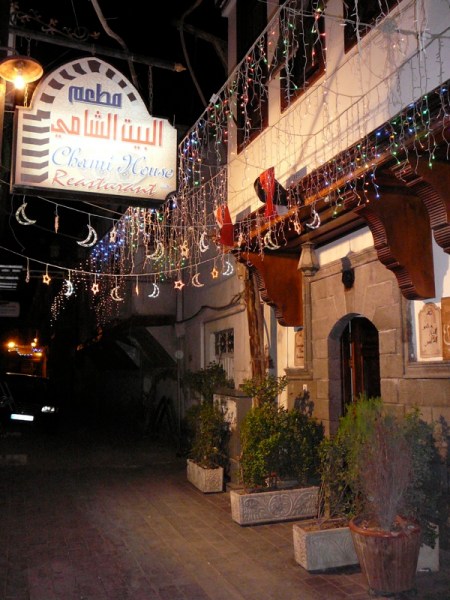
A restaurant nearby the Talisman:
Breakfast at the Talisman:

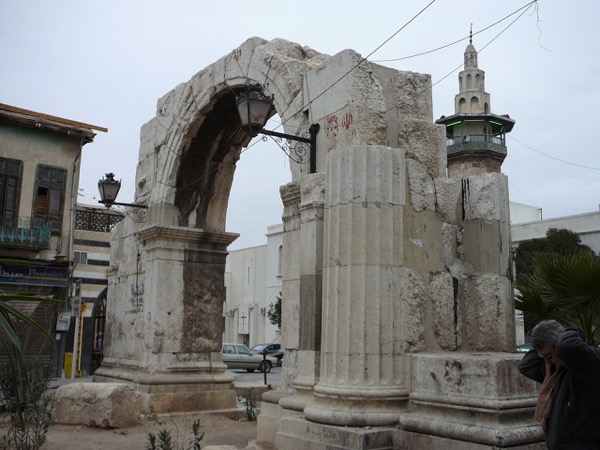
The historical nearby Bab, or gate:
A nearby Tabak and the friendly operator:

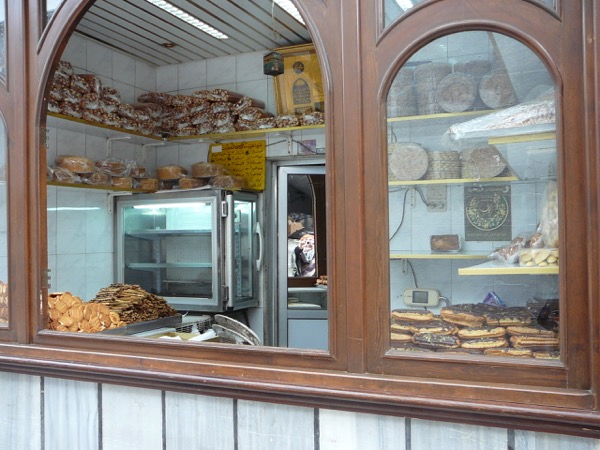
Streetside bakery:
A courtyard restaurant, with lovely dishes. And note the Christmas tree; Christmas decorations and greenery everywhere!

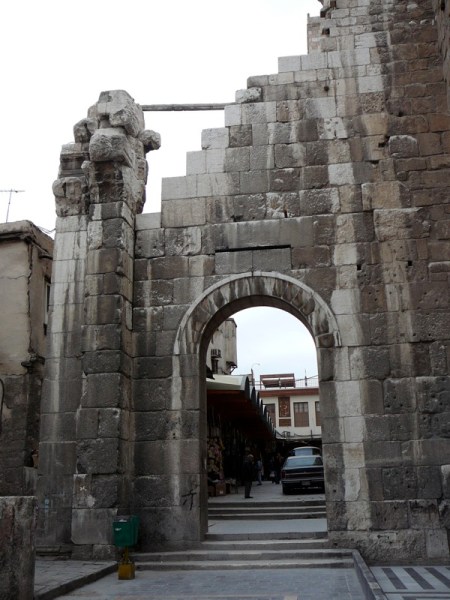
A Christian Shop near Bab Thoma:



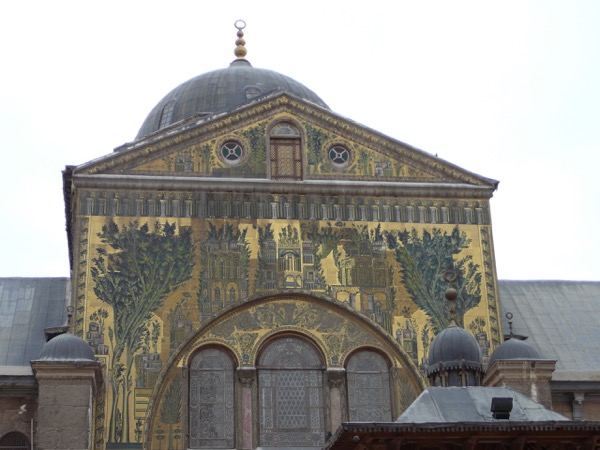
Interior at Umayyad Mosque, all are welcome and abayas provided. You leave your shoes at the door. This is the rear of the Tomb of John the Baptist:






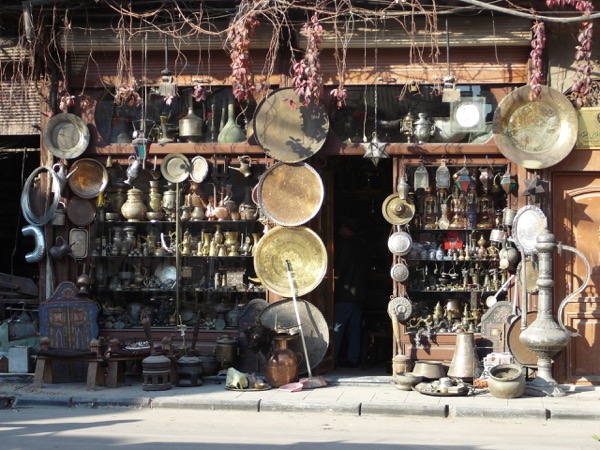
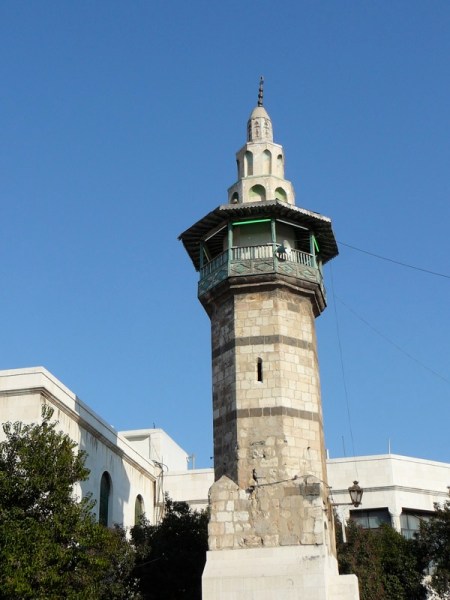
Naranj, our favorite restaurant. I understand branches of Naranj have opened in Gulf Countries, Qatar, Kuwait, as wealthier Syrians take their money out of Syria and wait for more peaceful times. I am betting they will return to Syria as soon as they can.

Inside Naranj



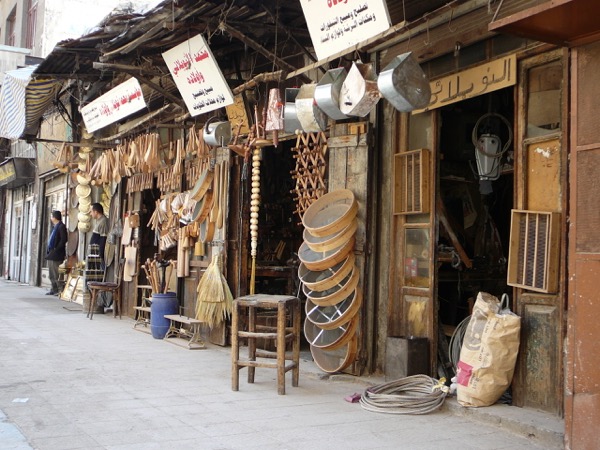
A merchant in the Souk al Hamidiyya

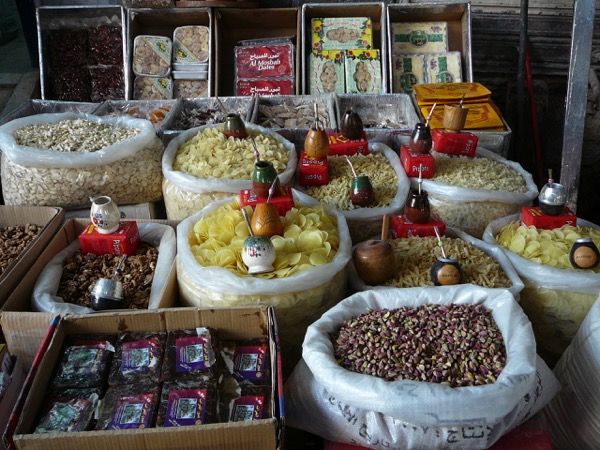


A courtyard restaurant set up for Christmas dinners:


I’ve never met a Syrian who wasn’t educated and working hard to make a good life for his/her family. We wonder if we will ever be able to visit Syria again in our lifetime?
For more photos of Damascus, you can visit my 2007 posts, Walking Old Damascus, by clicking here.
What Successful People (Who Are Actually Happy) Do Differently
The outcome of the recent election has not been a positive thing for everyone. Fuzzy headed liberal thinkers like me have some hard work to do in the next four years, feeding the hungry, making sure the homeless have a warm place on a cold night, protecting our drinking water, our drugs, protecting the air we breathe (what? you didn’t think all that regulation was for you?) and protecting against the removal of financial protections against those shenanigans by banks and financial institutions which brought us the great recession that peaked during the last year of the second Bush administration.
We will be the guard-dogs against gerrymandering, and against the stripping of human rights, reproductive rights, voting rights, protection against child abuse, spousal abuse and animal abuse. We will insist that the laws are enforced, equally, and do our best to protect against bad legislation.
Meanwhile, this wonderful article appeared in the HuffPost, well worth a read. Successful people have some really healthy habits and attitudes.
What Successful People (Who Are Actually Happy) Do Differently
Achievement rarely produces the sense of lasting happiness that you think it will. Once you finally accomplish the goal you’ve been chasing, two new goals tend to pop up unexpectedly.
We long for new achievements because we quickly habituate to what we’ve already accomplished. This habituation to success is as inevitable as it is frustrating, and it’s more powerful than you realize.
The key to beating habituation is to pursue, what researchers call, enduring accomplishments. Unlike run-of-the-mill accomplishments that produce fleeting happiness, the pleasure from enduring accomplishments lasts long after that initial buzz. Enduring accomplishments are so critical that they separate those who are successful and happy from those who are always left wanting more.
Researchers from the Harvard Business School studied this phenomenon by interviewing and assessing professionals who had attained great success. The aim was to break down what these exceptional professionals did differently to achieve both long-lasting and fulfilling success.
The researchers found that people who were both successful and happy over the long term intentionally structured their activities around four major needs:
Happiness: They pursued activities that produced pleasure and satisfaction.
Achievement: They pursued activities that got tangible results.
Significance: They pursued activities that made a positive impact on the people who matter most.
Legacy: They pursued activities through which they could pass their values and knowledge on to others.
Lasting fulfillment comes when you pursue activities that address all four of these needs. When any one of them is missing, you get a nagging sense that you should be doing more (or something different).
The behaviors that follow are the hallmarks of people who are successful and happy because they address these four needs. Try them out and see what they do for you.
1. They are passionate. Jane Goodall left her home in England and moved to Tanzania at age 26 to begin studying chimpanzees. It became her life’s work, and Goodall has devoted herself fully to her cause while inspiring many others to do the same. Successful, happy people don’t just have interests; they have passions, and they devote themselves completely to them.
2. They swim against the current. There’s a reason that successful and happy people tend to be a little, well, different. To be truly successful and happy, you have to follow your passions and values no matter the costs. Just think what the world would have missed out on if Bill Gates or Richard Branson had played it safe and stayed in school or if Stephen King hadn’t spent every free second he had as teacher writing novels. To swim against the current, you have to be willing to take risks.
“To be normal is the ideal aim of the unsuccessful.”
– Carl Jung
3. They finish what they start. Coming up with a great idea means absolutely nothing if you don’t execute that idea. The most successful and happy people bring their ideas to fruition, deriving just as much satisfaction from working through the complications and daily grind as they do from coming up with the initial idea. They know that a vision remains a meaningless thought until it is acted upon. Only then does it begin to grow.
4. They are resilient. To be successful and happy in the long term, you have to learn to make mistakes, look like an idiot, and try again, all without flinching. In a recent study at the College of William and Mary, researchers interviewed over 800 entrepreneurs and found that the most successful among them tended to have two critical things in common: they were terrible at imagining failure, and they tended not to care what other people thought of them. In other words, the most successful entrepreneurs put no time or energy into stressing about their failures as they see failure as a small and necessary step in the process of reaching their goals.
5. They make their health a priority. There are an absurd number of links between your health, happiness, and success. I’ve beaten them to death over the years, but the absolute essential health habits that successful and happy people practice consistently are good sleep hygiene (fights stress, improves focus, and is great for your mood), eating healthy food (helps you to focus), and exercise (great for energy levels and confidence).
6. They don’t dwell on problems. Where you focus your attention determines your emotional state. By fixating on your problems, you create and prolong negative emotions and stress, which hinder performance. However, by focusing on actions to better yourself and your circumstances, you can create a sense of personal efficacy that produces positive emotions and improves performance. Successful, happy people don’t dwell on problems because they know that they’re most effective when they focus on solutions.
7. They celebrate other people’s successes. Insecure people constantly doubt their relevance, and because of this, they try to steal the spotlight and criticize others in order to prove their worth. Confident people, on the other hand, aren’t worried about their relevance because they draw their self-worth from within. Instead of insecurely focusing inward, confident people focus outward, which allows them to see all the wonderful things that other people bring to the table. Praising people for their contributions is a natural result of this.
8. They live outside the box. Successful and happy people haven’t arrived at where they are by thinking in the same way as everyone else. While others stay in their comfort-zone prisons and invest all their energy in reinforcing their existing beliefs, successful people are out challenging the status quo and exposing themselves to new ideas.
9. They keep an open mind. Exposing yourself to a variety of people is useless if you spend that time disagreeing with them and comforting yourself with your own opinions. Successful, happy people recognize that every perspective provides an opportunity for growth. You need to practice empathy by putting yourself in the other person’s shoes so that you can understand how their perspective makes sense (at least, to them). A great way to keep an open mind is to try to glean at least one interesting or useful thing from every conversation you have.
10. They don’t let anyone limit their joy. When your sense of pleasure and satisfaction are derived from comparing yourself to others, you are no longer the master of your own happiness. When successful, happy people feel good about something that they’ve done, they don’t let anyone’s opinions or accomplishments take that away from them. While it’s impossible to turn off your reactions to what others think of you, you don’t have to compare yourself to others, and you can always take people’s opinions with a grain of salt. That way, no matter what other people are thinking or doing, your self-worth comes from within. Regardless of what people think of you at any particular moment, one thing is certain — you’re never as good or bad as they say you are.
Bringing It All Together
People who are successful and happy focus on activities that address a variety of needs, not just immediate achievements.
What other habits can make you happy and successful in the long term? Please share your thoughts in the comments section below, as I learn just as much from you as you do from me.
Viking Sea Disembarcation
Somehow, we go to bed around 8:30 pm and actually sleep. At 0215 we get our wake-up call as requested, and, as ordered, a beautiful breakfast shows up with a cheerful room service waiter, and we have coffee, tea and croissants as we hurriedly dress. We are to be in the terminal by 0300.
We are there by 0245, us and just about everyone else in our timing – Viking seems to attract those sorts, people who show up where they are supposed to be at the time they are supposed to be there. We are astonished to learn that there was a group ahead of us, they are just finishing up, and yes, there are a few pieces of luggage not claimed, so I guess not quite everyone made it on time.
We identified our luggage, which had been picked up outside our rooms the night before, watched as it was loaded into our assigned bus, and drove for about an hour to the airport. At the airport, there were baggage carts waiting, and we were able to check in very quickly for our flight. We are amazed and delighted; Viking truly has this down to a science. That’s not easy with 900 people disembarking on the same day. Kudos to Viking, even the smallest details are thought through.
As we signed in to the lounge, I said “Kalimeri,” which means Good morning, and the lady said to me “You’re Greek!” and I said no, I am not, but I got that a lot in Greece, I must have a Greek look to me. In truth, there is no Southern Mediterranean blood in me; mostly Scandinavian, French and Irish, or so Ancestry.com tells me.
We depart as the sun rises:


Everything is smooth until we get to Paris. We have to get to 2E, hall M. We know this drill; it’s the same as last year. “Oh no problem,” the “helper” tells us and hands us this paper with a map and directions:


You know what? I’m a map reader. I am really good at it. I navigate. We look closely; this map is useless. We start looking for signs and asking as we go, and we go quickly until we find the inner circle of hell, which is the passport line. We have priority passes, so we head to the priority line, but there isn’t even a line, and the real priority line is only for French citizens.
There is one huge shoving, desperate mass of people, all nationalities (except French) and then we find a secondary priority line, and every wheelchair goes to the front, and desperate passengers afraid they are missing their flight go ahead, and those who think they have the right push through, pushing their way in front of others. We are feeling desperate, too, our flight is in a very short time, but we don’t think the scramble to get in front of others is worth the price you pay in karma points.
I will tell you honestly, I have seen similar lines. Laborers in Kuwait lined up to get processed for residence visas. Refugees, desperate to escape violence and poverty, and afraid the gates will close before they get through. It is truly humbling to be a part of this line. Bread lines in which food is running out.
There is no one keeping order. The line inches slowly forward. It is like the end of times, everyone looking after his or her own needs regardless of others. There is little kindness to be seen in this line.
This is shameful. It’s not like this is unexpected. CDG needs to man their passport stations with enough personnel to allow these lines to flow quickly. It’s not rocket science, but it does take a bureaucracy which takes pride in their work.
This is not new; the planes wait, they take off a little later. We make our flight. As much as we love flying Air France, this experience is enough to make us re-think traveling through Paris.
Atlanta is straightforward. Our luggage, by the grace of God, is with us. We fly into Pensacola, and our son is there to meet us and take us home. All is well that ends well.
Venice Does Halloween

We remember while living in Germany, Hallowe’en was celebrated very differently; people would light candles and visit graves, and on All Saints Day, the following day, would take picnics up the the graves of their loved ones. Now, from store windows, it appears some of the American symbols have become accepted in Venice.
Peaceful Transfer of Power: It’s What We Do

President Obama acted with his customary graciousness, quick to invite the new President-Elect to the White House to discuss the transition. Once the election is over, we do the right thing. It doesn’t matter what your feelings are, or the words spoken in the heat of the election, the vote has been taken, and the winner becomes President. We pride ourselves in an orderly transition.
It is not, however, a mandate, no matter how many times the Republicans say it. In most states where Trump won, it was by one tenth of one percent – or less. He lost the popular vote; Hillary Clinton won that by about 200,000 votes. So while more people voted for Hillary overall (this has happened before, with the George Bush v Al Gore election), Trump won the electoral college. No one expected this, not even Trump supporters. A mandate requires a substantial victory. This was a squeaky victory.
But a victory. On. On. Those of us who did not support Trump have a lot of work to do in the following months, shoring up agencies who support immigrants, reproductive rights, gender issues, regulations of air quality, water quality, food quality and restraint of corrupt financial practices by banks and lending organizations. We will need to truly be Stronger Together to combat the onslaught against the common citizen.
It’s My Party! Here There and Everywhere Hits Ten Years
I keep telling you I am quitting, and I am not. Today, September 6th, ten years ago, I was sitting in my aerie in Kuwait, overlooking the Arabian Gulf, when I gathered all my nerve and went public.

I’d always wanted to write.

What better time? While every move was a great adventure, there was a downside. The downside is that it takes a while to gather your “band of brothers” (mine tend to be mostly sisters), your buddies, your protection against the inevitable rudeness of life. I was still reeling from leaving the strong band we had formed in Qatar (and still we are in touch, celebrating and protecting one another), and I was not yet sure where my Kuwait friends would come from.
I was in for a big surprise. I met wonderful friends through blogging. To the best of my knowledge, I am the last one standing of my blogging friends at that time; they were crucial to my investment in Kuwait, and the returns on that investment. I learned from them, I changed a lot of my thinking due to new ideas they introduced, and I profited greatly from our relationships. The friendships I formed in Kuwait rocked my world.

I was so scared, at the beginning, putting myself and my ideas out there. I loved the feedback I got, and get. I wanted a place to tell my stories so I wouldn’t forget them, and to ponder things I still don’t understand well. Your feedback and input are a great gift to me.

I still love sharing our trips with you, and, from time to time, puzzlements from my own culture. I’m still that little girl from Juneau, Alaska, a stranger in a strange land.

Thank you for a wonderful ten years. No, I am not planning to stop. I’ve had to be more patient with myself. Expat lives have spaces in them, time is different outside the United States, less full-all-the-time. I can’t blog the way I used to. I can’t quilt the way I used to. My time is full with AdventureMan, and grandchildren, and family, and church, and volunteer experiences.

We have a wonderful life, and we still get restless. We take two large trips a year now, to satisfy that wanderlust, and smaller trips to Mobile for Syrian food, to New Orleans for the escape and for Ethiopian food, to Atlanta to see friends, to Seattle to see family – and for Chinese food, to Panama City and Apalachicola for family and oysters. LOL, yes, there is a pattern. And meanwhile, we are surrounded by some of the best Gulf seafoods, and some of the best BBQ in the world, but man cannot live on BBQ alone.

Thank you for hanging in there for all these years, and for all the fun we’ve had together. Thank you for helping me learn about and understand the nuances, the deep underbellies of the cultures I otherwise would have skimmed over, never knowing the depth and richness I was missing out on. Thank you for your friendships, and for all the stories you have shared with me in the background that helped me see things differently. It’s you who have rocked my world, with your honesty and your bravery.

And while you are here, have some mint tea – yes, the mint is from our garden – and cake. Those Venetian ones are soaked in liqueurs, but there are some chocolate ones, and a gingered fruit or two . . . You are always welcome.
Cross Culture at the Y: “Don’t Ever Say That to an African American”
I had just finished chatting with Leilani and was getting ready for class to start when my class friend who in in front of me came up to me and put her arm around me. We are always joking around, so I was laughing, and she said “I have something to tell you.”
I pulled back a little because I could see she was serious, and I wanted to see her face.
She said “Last week in the pool you said you were gonna kick my butt. Don’t ever say that to an African-American.”
She is black.
She could see I was confused. I did say it. We joke around, and sometimes there isn’t a lot of space. Her behind was right in front of me, a tempting target. I did say it.
“We never say that in the black community,” she continued. “Our Mama’s never allow that kind of statement. Remember, we were slaves. We’d be on the ground, and people would put their feet on us. People would kick us. To say that to a black person is one of the worst things you could say.”
“I am so sorry. I didn’t know.”
“I know you didn’t. That’s why I’m telling you.” She still had her arm around me. “We hear you people saying that to each other like it’s nothing. It’s something to us.”
I was so thankful she told me, and so embarrassed.
“I was oblivious,” I said. “I had no idea. I am so sorry.”
Later, as we usually do, we talked during class.
“Do you really just say that to each other?” she asked me.
“We do! It’s the kind of thing we say to friends; I would say that to my sister, it’s sort of mock-rivalry sort of talk,” I responded, thinking to myself ‘but I will never never never ever say that again to anyone!’
Later, I thanked her for telling me, and she said she knew I had no idea how offensive it was; it was a cultural thing. I am grateful she trusted that enough to clue me in.
As uncomfortable as that conversation was, I admire her for initiating it, and correcting me in a loving way, for telling me how it feels, and why. I am grateful that she trusts who I am, a person who would never choose to offend, but a person who had, nonetheless, offended, and who would want to know. I feel like it was a genuinely friendly thing to do, and she did it with good will in her heart.
So even in my own country, there are cultural crevasses I can fall into in oblivious unawareness.
And all of that in one morning at the YMCA.
God Shows No Partiality

Who can help but think of “wickedness, evil, covetousness, malice” as we listen to the daily news?
In today’s readings from the Lectionary, the first reading has to do with one of the earliest manifestations of the Holy Spirit, and this second reading ends with how the glory of God is for everyone, the Jew and also the Greek (of you might add, the American, and also the Moslem, or the Republicans, and also the Democrats), that God shows no partiality.
We all seem to shout “Go God!”, our own particular interpretation of God, and think that only we have it right.
What I do love, is that when a demented one kills in the name of God, the one true God rallies his true followers, whether in Syria, or Orlando, or Paris, or Nairobi, he rallies the hearts of his true followers to love one another, and to show that love by helping and serving one another, brother and sister, people of all colors and all nations and all religions and all sexes. God tells us to love him and to serve one another, and to leave all judgement to Him/Her.
Romans 1:28-2:11
28 And since they did not see fit to acknowledge God, God gave them up to a debased mind and to things that should not be done. 29They were filled with every kind of wickedness, evil, covetousness, malice. Full of envy, murder, strife, deceit, craftiness, they are gossips, 30slanderers, God-haters,* insolent, haughty, boastful, inventors of evil, rebellious towards parents, 31foolish, faithless, heartless, ruthless. 32They know God’s decree, that those who practise such things deserve to die—yet they not only do them but even applaud others who practise them.
2Therefore you have no excuse, whoever you are, when you judge others; for in passing judgement on another you condemn yourself, because you, the judge, are doing the very same things. 2You say,* ‘We know that God’s judgement on those who do such things is in accordance with truth.’ 3Do you imagine, whoever you are, that when you judge those who do such things and yet do them yourself, you will escape the judgement of God? 4Or do you despise the riches of his kindness and forbearance and patience? Do you not realize that God’s kindness is meant to lead you to repentance? 5But by your hard and impenitent heart you are storing up wrath for yourself on the day of wrath, when God’s righteous judgement will be revealed. 6For he will repay according to each one’s deeds: 7to those who by patiently doing good seek for glory and honour and immortality, he will give eternal life; 8while for those who are self-seeking and who obey not the truth but wickedness, there will be wrath and fury. 9There will be anguish and distress for everyone who does evil, the Jew first and also the Greek, 10but glory and honour and peace for everyone who does good, the Jew first and also the Greek.11For God shows no partiality.
Enter another bible reference:

biblemail@oremus.org
v 2.2.7
10 February 2011
Recent Comments
ExpatAlien on What Country am I Living … intlxpatr on Yellowstone: Old Faithful to C… Michelle on Yellowstone: Old Faithful to C… Cathy on No Grown-Ups in Charge intlxpatr on Waiting for Snow Wikipedia Donate Button

Amazina


Early Voting in Florida


 Here There and Everywhere