Praying for Ruaha
Today in the Anglican Cycle of Prayer, we pray for the Diocese of Ruaha, in Tanzania.
We have such happy memories of exploring the Ruaha, and Selous. Many people visit the more famous sites in northern Tanzania, but fewer go to the more remote south. Wonderful people, we learned so much there.

Celebration at the Seville
“I think we ended up exactly where we were meant to be,” AdventureMan said as we drove away, and I love him for thinking that, and saying that. I think so, too.

It’s been an amazing week.
I’m tempted to say, about so many of the subjects, “I don’t have a dog in that fight,” and yet, somehow, I do.
Our Supreme Court is been so greatly conservative that I had no hopes that so many decisions would come down on the side of what I consider human dignity.
We have great medical coverage, thanks to what is truly socialized medicine – life time medical care through career military service coupled with the medicare that United States citizens receive when we turn 65. So when people complain about “socialized medicine,” I just laugh and say I love my socialized medicine. It pays almost all my medical bills.
So why does it matter to me that others have affordable health care?
I worked with the homeless for a year, with homeless families. It was a program; we provided housing, some food, and counseling, and guided our residents into degree programs, assistance programs that would lead them to an ability to self-sustain.
What I learned, over and over, was stunning. Many women with children are one man away from homelessness. Women with children are exceedingly vulnerable. When a child gets sick, unless you are protected by family, the child cannot go to day care and Mama has to stay away from work to take care of them. Too many absences and that job disappears. No insurance, and the costs are those hugely exaggerated sums you see on your reconciliation sheets your insurance sends – what the cost is, what insurance pays, what your share is. IF you have insurance, your insurance company has negotiated the costs, and those costs are considerably less than if you don’t have insurance. The least able to pay are charged the most. Is that fair? I thank God for affordable care, so that all people have access to decent health care for themselves, and for their children.
It was teetering on the balance. Which way would the Supreme Court decide on this technicality? By the grace of God, the majority opinion was that law is tough enough to write and often mis-written and corrected before the ultimate wording is finalized. This was no exception; it needed refinement but the intent was clear. Affordable care is the law.
The poor and the minorities are not to be discriminated against in housing, either, the Supreme Court decided. Again, it’s not my fight, no one has ever discriminated against us, except for being military (and the implication was that military was riff raff). The significance here was that even if the discrimination was not clearly intentional, if it was discrimination, it was not allowed. It levels the field; makes life more fair for all of us.
And last. That people who want to marry will have the dignity of that right. That those people will have the same legal rights, rights that guarantee inheritance, rights that guarantee access to the partner that becomes hospitalized, rights to make legal decisions as a legal married couple. Again, AdventureMan and I, one man and one woman, are married, so we don’t have a dog in the fight – except that as human beings, we want the laws to be fair, and humane, and applicable to all. We have no say over how we are wired or who we love, and, as we see it, no right to restrict others from what we have chosen for ourselves.
We’ve had a great day. We went to early service, where Father Goldsborough spoke as a Southerner, and how his views have changed, and how he believes that if the Confederate flag is a cause of grief and horror to those whose family were once enslaved, that that flag should be retired. Yes, keep it as history, display it in museums, but not as a part of a public, governmental display. He is a courageous man.
And while I agree that it is time for the flag to be retired, the flag is just a symbol.
It is a kid that killed the bible study participants in South Carolina. It was a kid with a powerful GUN. So why are we not talking about gun control? I have the feeling that a lot of people are willing to pull down the Confederate flag in hopes that it will keep the attention off the fact that people with problems who have access to guns are the problem. Sure, you can kill with a knife, or a car, or a hundred other ways, but nothing beats a gun for killing efficiently, and no gun beats an automatic weapon for super efficient killing.
I headed straight for the commissary to do some weekly grocery shopping, while AdventureMan spent time in the garden. I got the groceries unloaded, and dinner started. AdventureMan came in and invited me to lunch at my favorite place, Five Sisters.
When we got to Five Sisters, every table was full and lines and groups of people were scattered around waiting. We headed to the Fish House for some fish and grits, but it was the same story. So we headed for Saville, where we found a parking place and while it was crowded, very crowded, we got a place in the Palace Bar, which we like anyway, and we liked that it was away from the music and we could talk.
After we ordered, I said “I think we are in the middle of a celebration,” and he agreed. We were surrounded by a very large group of guys about our age, but we had to guess they were gay, and they were all very celebratory. In fact, much of the restaurant was moving from table to table, hugging and exchanging greetings and congratulations.
The last time I remember feeling this way was in Alaska, last year, for The Celebration, where all the tribes gather to share culture and dances.
On our way out, I leaned over and said “Congratulations! We wish you happiness!” and they thanked us and we left.
Except, LOL, I had dropped my sunglasses, and we had to go back in. “Stop, stop!” our friends at the next table asked us, and thanked us again for our ‘kind words.’ But they needed to talk. It wasn’t about the right to get married, they explained, each jumping over the other in speech in eagerness to explain, “it is about legal rights in hospitals” said one “the right to be who we are” said another. These were men about my age, and they needed to be heard. I told them that I remember Juneau, Alaska, and I don’t remember any gay people. I said there must have been, but I never knew of any, and one man said “that was me! Imagine growing up knowing you are seriously different, that you like boys and not girls, and who do you talk to? There was NO-ONE!”
These guys had been married for varying amounts of time, but this weeks Supreme Court decision eliminated the anxiety that things could change, that a change in president could signal a cascade of change in state laws and the hard-won battles would have to be fought again. “The only person left in my family who would have the right to say whether to take me off life-support or not is a person who would likely say “pull the plug!” and my husband would have no say at all, before this decision!” one said, and the husband added “and she could keep me out of his hospital room, even though we’ve been married for years!”
I would have loved to hear more, but this was their celebration. It was like one huge wedding celebration, so much love, so much happiness, so much joy.
“I can be who I am!” one said to me, with such emotion. “I can be who I am!”
I almost cried with joy for him, for all of them. They have seen such change, from living their lives in hiding to being able to live legally, freely, as who they are. We were moved by their joy, moved beyond words. We felt so honored to have been able to share a little of their joy, even though – this isn’t our dog, this isn’t our fight, it isn’t our win.
Except, except that as human beings, maybe it all IS our dog, and is our fight. Maybe it is our win. Maybe, as Jesus says, we are all connected, we are all meant to love one another, and as weird as we are, as eccentric, as different, maybe we are all meant to love one another and to live in peace with one another. Maybe the dignity of every human being is relevant to my own . . .
It’s a heady thought for a celebratory Sunday.
As Others See Us . . .
“Oh that the wee wee giftie gi’e us, to see ourselves as others see us,” goes an old Scottish proverb which has haunted me my many years of living overseas.
This recent visit by our Saudi friends was one of those times, and yesterday as I was doing laundry, I thought of all the particular ways we do things, and why, and thought about how very difficult it is to be a house guest in a strange culture because on top of the profound cultural differences, there are also family cultures.
I remember visiting my parents, as an adult, and my mother carefully explaining how they do things, and why, and we would try very carefully to do what they were doing, but I often felt I was failing in some unknown way, to meet the standards.
Like us, when we do laundry, I have three drying racks, and I use my dryer only a few minutes with some of AdventureMan’s shirts, tumble drying them to remove wrinkles, then we pull them out and let them finish drying on hangers. I also dry AdventureMan’s towels; he thinks that the ones that are dried on the racks are hard and stiff and he doesn’t like the feel of them on his skin. Just about everything else dries on the racks or on hangers. It’s a result of years of living in Germany, and other places where we had utility bills, and the dryer is a huge electricity hog.
When we lived in a small village in Germany, I remember my landlady bringing my utility bill; her face was white. She said (in essence) “how can this be? You are a wasteful American and I am a frugal German and your electricity bill is half of mine!” (no, she didn’t say wasteful, but that was sort of the gist) but she had a clothes dryer that was going all the time, and I did not. I also had a very small little refrigerator, and she had a larger one. Old habits die hard; I still hang most of my clothes to dry.
We are careful with water use, as water becomes more dear, we try to conserve, so we don’t let water run, we turn it off. We must look very peculiar and very particular to our house guests.
I really only told them the basics – here are these things, here are those, this is the way this operates – more than that would have been overwhelming. Probably they were overwhelmed with the little I did share! Being a houseguest is overwhelming, too!
And I think of my youngest sister, who took me in for weeks at a time through many of the years we spent overseas, clearing out a bedroom and bathroom for my exclusive use, letting me come and go as my schedule dictated, but still, an intruder and an interruption on her own family life, God bless her. I remember one time being in the kitchen with her son, asking him if he knew where his mother kept the emergency emery board, and he looked totally dumbstruck, and said he didn’t know.
“It’s probably here,” I said, opening a drawer and pulling out the emery board. Our mother always kept an emery board in that drawer; I keep a spare emery board in that drawer, and it just seemed likely my sister would, too. I still love the look on his face as I pulled it out. “How did you know??” he asked, and I just laughed.
I wonder what tales our house guests will tell of us, and our strange ways?

On their last day with us, I showed the 10 year old how to make Bird in a Basket, which he loved. It’s so simple, bread with a circle cut out, butter, an egg and a skillet – even a ten year old could do it. What was even better was that he loved it and was going to go home and show his Mama how to do it. One tiny piece of American culture may grow and thrive in Saudi Arabia.
Ramadan Kareem and Pope Francis
“God bless the work of your hands!” was one of the Moslem sayings I most loved as I lived my daily life in various countries in the Middle East. So, Pope Francis, God bless the work of your hands yesterday in your encyclical saying we are all responsible for the price we pay for progress. You are a brave man, and you don’t hesitate to name corruption when you see it, and to do your best to correct us, and straighten the path of the Lord.

“Everything is related, and we human beings are united as brothers and sisters on a wonderful pilgrimage, woven together by the love God has for each of his creatures and which also unites us in fond affection with brother sun, sister moon, brother river and mother earth,” he writes.
It is not entirely a happy message for me. One of the items he castigates is air conditioning, and as Pensacola hits the nineties every day, I hate to think of how I would live without air conditioning. I think I would turn into a slug, swinging in my hammock for hours every day reading a book. My house would be full of dirty dishes and dust. And I remember living in Tunis, and in Jordan, without air conditioning. We managed, by the grace of God.
Meanwhile, during the hottest months of the year, yesterday, our Moslem brothers and sisters began Ramadan, the holy month of fasting and personal purification. Imagine, going all day without water and without food, breaking the fast only as the sun goes down. I wonder if the Pope made his world-changing address on the eve of Ramadan on purpose, as he clearly made it to all mankind, not only to his Catholic followers.
Ramadan Kareem, my Moslem brothers and sisters, whom I cherish, and who taught me so much. May your fasting bring you great insights and purity of spirit.
“Come Back Soon; I Have So Many Questions!”
We wanted our house guests to experience a truly Southern experience, so we took them to Sonny’s BBQ. It doesn’t get much more down-home than Sonny’s. We saw one of my friends from water aerobics, we saw another friend from church and our son’s boss, all sitting nearby.
We all ordered barbecued smoked chicken, and the 10 year old ordered french fries and french fries for his two “sides.” He got frustrated with the knife and fork – it does slow down eating chicken – so he pretty much stuck to the french fries. As my friend from water aerobics left, she came over and hugged AdventureMan, and kept her hand on his shoulder as she met our guests.
To make it all even more bizarre (I am trying to imagine this from the Saudi point of view), we have the car seats for our grandchildren in AdventureMan’s car, so we used my car to drive to the restaurant. I drove.
It was a lot for them to absorb.
As we were leaving, our favorite waitress caught my arm and said “Come back soon! I have so many questions!”
Houseguests and Rabies and Wedding Anniversaries
We’ve had a lot of wedding anniversaries, AdventureMan and I. Some anniversaries we have sacrificed to national security, as AdventureMan would be called to go to the field, or head out on some exercise. There are a few which have been truly memorable. If you’ve been reading this blog for very long, you will know that the ones we remember are probably not those that include roses, or wine and a fine meal and a beautiful gift, although we have had those.
One, we remember because we ate at a very fine restaurant, very snooty, and the waiter made a big deal out of presenting us with chilled forks for our salad course. We could barely keep a straight face, it is so far from anything we would consider a priority.
Another, and we howl with laughter – now – was the wedding anniversary when we had just arrived in Germany from Saudi Arabia, and found a lovely apartment on the top floor of an old mansion in a village I loved. When we got back to the car, AdventureMan said “Did you notice it is not furnished?” and I said we can find what we need at the re-utilization office, which is alway selling off used furniture.
Indeed, two days later there was a huge sale at the re-utilization center and we bought a dining room set, living room chairs, three big cupboards for holding clothes and some lamps, etc – all for $53. We’ve always had great luck that way. I had a lot of fun re-upholstering the chairs, and the landlord threw in a bed for us.
But as we sat in the car, on our anniversary, I said “Now, you probably need to take me to the hospital so we can get my bite looked at.” A few hours before leaving Saudi Arabia, the cat I had been feeding bit me, hard, on the arm. It ws one of those bites where the incisors went deep. I’d have liked to ignore the bite, but rabies is an ugly way to die, and I sure didn’t want to stay in Saudi Arabia to be treated.
So we headed to the hospital, and the next few hours were excruciating. Then we went to a favorite old Mexican restaurant we had known from years before, and that was our anniversary, truly memorable. We still laugh; we remember finding that lovely old apartment, and then having to go to the emergency room.
As an aside, the landlord didn’t tell us he was trying to sell the mansion, and nine months later, we were looking again for an apartment. We became very good friends with the new owners, and are friends with them to this very day.
This wedding anniversary was a non-event, we had houseguests, and their customs and daily lives are so very different that celebrating a wedding anniversary would have been far outside their comfort zone. We had a friend from Saudi Arabia and his 10 year old son.
We received an e-mail from them saying (I will paraphrase a little here) ‘we have reservations to come to Pensacola for 26 days and we want to stay with you.’ There was more, but that was the essence. AdventureMan looked at me and said “I think we need to do this” and I was glad, because I had been thinking the same thing.
I think I have told you about our friends who welcome the stranger, so I think God had been preparing us for this visit, and for us to do it.
How did it go? It was challenging. There were times we just wanted it to be over, and there were times our friends must have found us to be very disappointing. There were continual clashes in expectations, and there was a very large well of good will out of which we continually drew. There were uncomfortable moments regarding meals, and meal times, and getting up times, and where we would go. There were also some fabulous meals and some truly wonderful conversations.
I know they were sorry to go. I know they want to come back again for another visit. We have no regrets; we are glad we did this, and we are also glad to have our very normal American lives back. We like this man very much, and we know this visit was a challenge for him, too.
But as we are hollering back and forth, we are laughing, this is one of those anniversaries we will never forget, the year we had our Saudi house guests.
We are aging, AdventureMan and I. We are no longer truly nomadic, living out of our suitcases. We have everything we own in this one house, except our other house. We no longer have other furniture in storage, and we have trimmed down a lot on the load of things we have collected. Maybe the one thing we truly fear is becoming too settled, and this visit was a wonderful way to shake things up a little bit, to force us out of our comfortable routines, and to force us to see our lives through the eyes of others.
It has given us a lot to think about.
Happy Anniversary, AdventureMan 🙂
Learn to Linger
One of the most painful criticisms I would hear of Americans as I lived overseas was that we were all happy, friendly people, but we didn’t really care about people. We didn’t maintain relationships. While painful, it was also, as I looked deeper, true. Our lives are fast-paced, and we move from place to place, person to person, job to job and rarely develop the deep relationships that come from building a long, deep friendship. Today’s lesson from Rick Warren talks about how we can do better in our relationships:
“All of you should be of one mind. Sympathize with each other. Love each other as brothers and sisters. Be tenderhearted, and keep a humble attitude.” (1 Peter 3:8 NIV)
You’re never going to live in harmony with your wife, your husband, your friends, or anybody else without empathy. You can’t have a team without being aware of what’s happening in each other’s lives. That’s why when people work together in an office, they may do work together, but they’re not a team unless they know what’s going on in each other’s lives.
Empathy is so important because it meets two of our deepest needs: the fundamental need to be understood and a deep need to have our feelings validated.
If you’re going to build a team of friends or at work or in your small group, you have to build empathy into the structure. So how do you become an empathetic person?
Slow down. Because our culture teaches us to move fast, we end up relationally skimming. That means you’re hitting the high points and missing all kinds of details in the lives of people you care about most. James 1:19 says, “Be quick to listen, slow to speak, and slow to get angry” (NLT, second edition).
Ask questions. Proverbs 20:5 says, “A person’s thoughts are like water in a deep well, but someone with insight can draw them out” (GNT). Most people hold their emotions pretty close, and they don’t automatically share how they’re doing. “I’m fine” is the standard answer, but that doesn’t really tell you how they feel. If you ask, “””How are you doing?” and the other person says, “I’m fine,” here’s how you draw out a more telling response: Learn to ask the question twice. That’s how you develop empathy. Pause and say, “No. How are you really doing?” The other thing you do is learn to linger. That means don’t be afraid of silence. Just be in the moment, ask the question, and don’t be afraid to sit there and wait. Don’t immediately go into your agenda. Just listen and learn.
Show emotions. The Bible says in Romans 12:15, “Rejoice with those who rejoice, and weep with those who weep” (NASB). Empathy is more than saying, “I’m sorry you hurt.” It’s saying, “I hurt with you.” You’re willing to cry with them, and you’re willing to rejoice with them. There’s only one way you’re going to be that empathetic — stay filled up with God. If your tank gets low on God, you’re not going to be empathetic at all. You’ve got to stay filled up with God.
“All of you should be of one mind. Sympathize with each other. Love each other as brothers and sisters. Be tenderhearted, and keep a humble attitude” (1 Peter 3:8 NIV).
“Do All Americans Worship Idols?”
We have guests in town from another country who are living with Americans and visiting many others.
One of them asked her host “Do all Americans worship idols?” and the host was flummoxed.
We have been in private houses of the most religious Muslims, and their houses look very different from ours. They have nothing on the walls, except perhaps a picture of the Kaaba in Mecca, or a beautiful calligraphy in Arabic with one of the Surahs. To us, the houses look very plain, but they are being careful to observe carefully the word of the Lord.
We don’t consider the objects in our homes idols because we don’t worship them. When I read today’s Lectionary reading from Deuteronomy, I have to rethink what God might thing idols are.
Deuteronomy 4:15-24
15 Since you saw no form when the Lord spoke to you at Horeb out of the fire, take care and watch yourselves closely, 16 so that you do not act corruptly by making an idol for yourselves, in the form of any figure—the likeness of male or female, 17 the likeness of any animal that is on the earth, the likeness of any winged bird that flies in the air, 18 the likeness of anything that creeps on the ground, the likeness of any fish that is in the water under the earth. 19 And when you look up to the heavens and see the sun, the moon, and the stars, all the host of heaven, do not be led astray and bow down to them and serve them, things that the Lord your God has allotted to all the peoples everywhere under heaven. 20 But the Lord has taken you and brought you out of the iron-smelter, out of Egypt, to become a people of his very own possession, as you are now.
21 The Lord was angry with me because of you, and he vowed that I should not cross the Jordan and that I should not enter the good land that the Lord your God is giving for your possession. 22 For I am going to die in this land without crossing over the Jordan, but you are going to cross over to take possession of that good land. 23 So be careful not to forget the covenant that the Lord your God made with you, and not to make for yourselves an idol in the form of anything that the Lord your God has forbidden you. 24 For the Lord your God is a devouring fire, a jealous God.
Small Glimpses of North Seattle
“As Sallam wa alaikum!” I smiled at the Sudanese women coming in to their jobs in our hotel.
They stopped still in their tracks.
“You speak Arabic!” they said, astonishment clear on their faces.
“Only a little!” I smiled back.
I had a whole squad of new friends.
Now that financial times are easing, many hotels we have visited over the last few months are renovating and getting new mattresses. This was a real bonus for our Sudanese friends, and all of their friends.
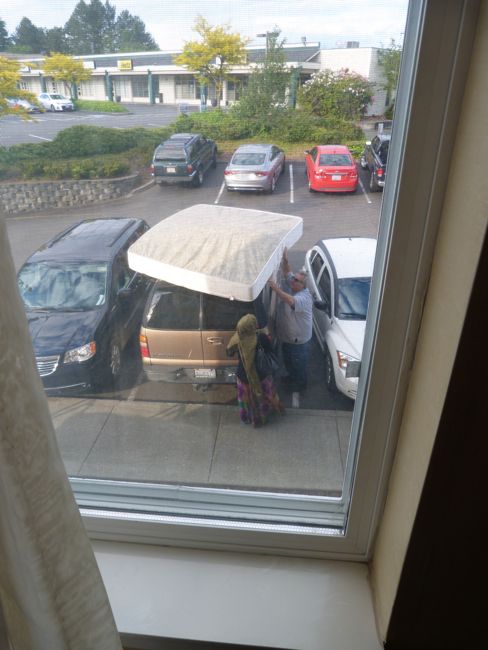

Have you ever tied a mattress on the top of your car and tried to drive? It is a wild and dangerous adventure; the wind lifts and pushes the mattress toward the back as you drive. Unless the mattress if firmly and thoroughly tied down, you are in for a wild ride.
And then again, if you are new in a country, and in need of a mattress, a wild ride is a small price to pay.
On our way back to the hotel, we see protestors in red shirts at every corner. This is not protestors Ferguson style, these are Seattle style protestors, making a big demonstration for fully funding public education, and all the signs are grammatical 🙂

We are so full from lunch that we just want a small dinner. We find a good Ethiopian restaurant listed near our hotel, and head there, but when we arrive, there is plywood over two windows and a sign saying “Sorry, dear customers, but due to car accident our restaurant is closed until it is fixed.”
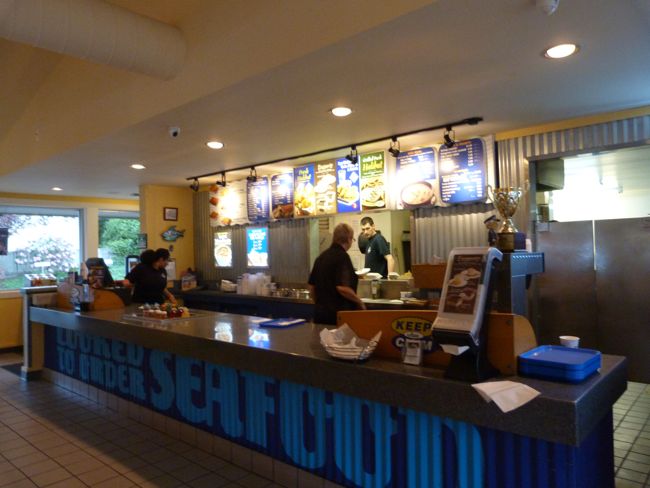
We end up at Ivar’s Seafood Bar, which is quick food, but not cheap food, and very very good food. We are greeted by an older man as we enter, he says “Welcome to Ivars! I hope you have a great meal.” We thought he might be an official greeter, but no, he was a customer like us. We ended up sitting in a booth next to his, so he stopped on his way out to see what we had ordered (halibut and chips, smoked salmon chowder, Dungeness crab cocktail) and just to chat. It’s an Edmonds kind of thing, neighborliness and civility.
“Oh! I Like His Face!”
It’s taken us a long time to get over the loss of our sweet Qatari Cat, sweet Pete. He was so special to us. For one thing, he was pretty. For another, he had some very winning ways. So many reasons to love that sweet cat and to regret his loss.
On our trip, we agreed that we are still not over Pete, and at the same time, it is time to bring another cat into our lives.
I had one in mind.
I have a friend. She has a ministry; she rescues abandoned animals, particularly cats. She tends to their wounds, she has them neutered, she gets them shots. She gives them boundless love, and teaches them to love and trust again.
She had put a photo of a cat on FaceBook. It was before our trip, and I couldn’t see adopting a cat and then putting him into a cat hotel, so I didn’t do anything. But my friend called while I was traveling, and I asked her during our conversation if that orange cat had found a home, and she said no.
So when we got back, we unpacked, we did laundry, we started to get back to our normal lives.
And we adopted Zakat.
Our friend brought him over. He was small, he was scrawny, he had a clipped ear, which I learned means he’s been taken from the streets and neutered, and . . . he had a huge circular scar around his face. He loved my friend, but AdventureMan and I totally freaked him out, and he ran into the cat room and hid (we have a lot of great hiding places.)
A couple days later, our grandson was staying overnight, with his Explorer’s tool (it has a flashlight, compass, magnifying glass, mirror, thermometer and whistle) and asked if he could see the cat. He’s a good boy, and he has three cats at home, so we took him to Zakat’s cupboard, and opened. Zakat didn’t run, and our grandson shone his flashlight and exclaimed softly in delight “Oh, I like his face! He has a sweet face!”
He didn’t even see the scars. All he could see was the sweetness of this cat. And I thought what a blessing grandchildren are, to help us see with the eyes of Jesus, to see sweetness where other see only scars.

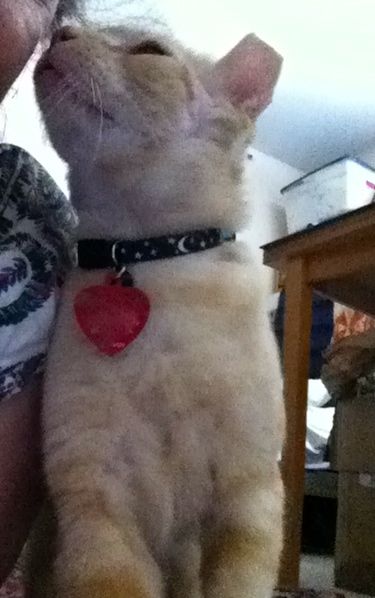

Zakat has now discovered he is safe with us, and follows us around like a little shadow. He loves to sit in AdventureMan’s office with him, he loves to curl up with me while I am reading. He is fresh, and funny, and a sweet hearted little cat.
Zakat means tithe or alms in Arabic, but the truth is, we just love the double entendre, and love saying “Where’s Zakat?” We must be five years old, it takes so little to make us laugh.
Recent Comments
ExpatAlien on What Country am I Living … intlxpatr on Yellowstone: Old Faithful to C… Michelle on Yellowstone: Old Faithful to C… Cathy on No Grown-Ups in Charge intlxpatr on Waiting for Snow Wikipedia Donate Button

Amazina


Early Voting in Florida


 Here There and Everywhere