Donna Leon and Beastly Things Made Me Cry

I can always count on Donna Leon. She gives me a good read, a solid mystery, a social issue, the louche damp atmosphere of Venice and the Venetian aristocracy, and my good friend Guido Brunetti, police commissario, with his lovely wife and dear children and great Italian meals.
This time, she fooled me.
A barrel chested man is found floating in the canals with no identification. When identified, he is found to be a veterinarian, separated from his angry and hostile and broken-hearted wife.
Then Donna Leon pulls me way out of my comfort zone – TWICE. First, there are parts of the book I can scarcely read, as she talks about the meat industry. I’m reading this book, dealing with the meat industry, and I’ve just watched the movie GreY posted on the devastation meat eating causes in your metabolism and blood; the passages in Beastly Things sealed the deal – I don’t think I can eat red meat again. I’m not sure I can even be around red meat. Leon is fearless; she spotlights issues few dare to tackle. There are issues here that are not for the faint-hearted. Read at your own risk.
It’s a tricky mystery, and at the end, Leon catches me by surprise again, as she describes the funeral of the veterinarian, a very unusual funeral, where his patients are also in attendance. It was hard to read. My eyes were blurring. If you like mysteries, if you have pets you adore, this is the sweetest literary funeral you will ever attend.
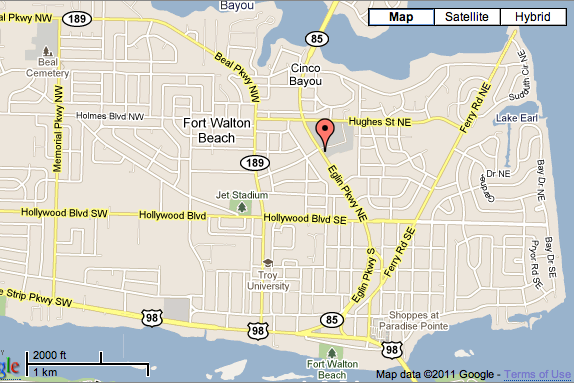
Clemenza’s in Fort Walton Beach
We have friends we have known for a long time who live only an hour away, and while we don’t get together as often as we would like to, we manage about once a month. We try to find places “in between” which there really aren’t very many, but our friends mentioned, if we wouldn’t mind the drive, that they had found a new restaurant they were enjoying and they thought we would, too, Clemenza’s in Fort Walton Beach.
We read the reviews on UrbanSpoon, which I am beginning to think is a big mistake. Some just seem like sour grapes, some seem over the top without being specific, and some seem like hate mail – we pretty much disregard all those. So while a lot of people really enjoyed Clemenza’s, others complained about problems with service, and problems with tasteless food.
Our experience was very different.
For once, we arrived before our friends, and that is not that easy to do. We were seated, and while we were waiting, I had a glass of wine, just a glass of the house Chianti, which was OK, but a little sweet for my taste. AdventureMan asked me how it was, and I said “OK.”
A gentleman at the table next to us asked me how my wine was, and I said “It’s OK. It’s not bad” and he asked what I had ordered. I told him the house Chianti, and repeated that it was OK, did he want to smell it? (I can always tell a lot just from sniffing, and I only bother tasting if it smells really good.) He thanked me and said ‘no.’
Minutes later, AdventureMan said “I think that might have been the owner.”
“Oh no!” I said, but it made sense that it might have been. Mere seconds later, he appeared at the table with a new glass of wine and asked me to taste it. Heaven. A very nice red; he called it the upgrade, and it was truly an upgrade. I felt embarrassed, but also delighted at that kind of attention to detail.
AdventureMan asked one waitress if she had tried the restaurant’s Red Beans and Rice on the blackboard specials, and she laughed and said ‘no’ but she could assure us they were really good because the cook was her stepfather, and he served the best red beans and rice at home and she was sure we would be delighted if we ordered them.
This was all starting off pretty good!
My favorite pasta, so simple but I just adore it, Aglio Oglio was not on the menu, but I asked the waitress if the chef could do it, and off she went to ask, coming back with a big grin and telling me he would be glad to.
Better and better.
Our friends arrived, conversation was lively, the restaurant was almost full, and delicious looking dishes were arriving at other tables. We placed our orders, and told her there was no hurry, and there really isn’t. As much as we like good food, we meet up to enjoy one another’s company, and good food is just icing on the cake.
Oh, What icing.
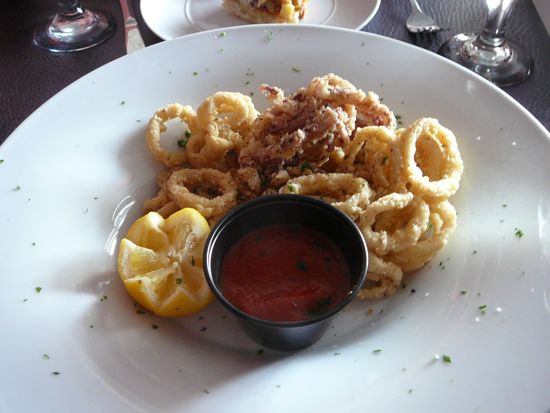
We shared appetizers, an Caponata and Calimari Fritti. YUMMMMM. The Caponata was perfect, and the toast was a little garlicky and well toasted, so the caponata didn’t make it soggy. The Calimari were light and melted in your mouth. Great start.

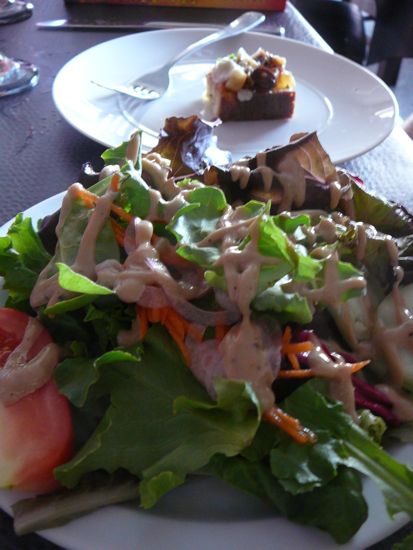
Side salad:
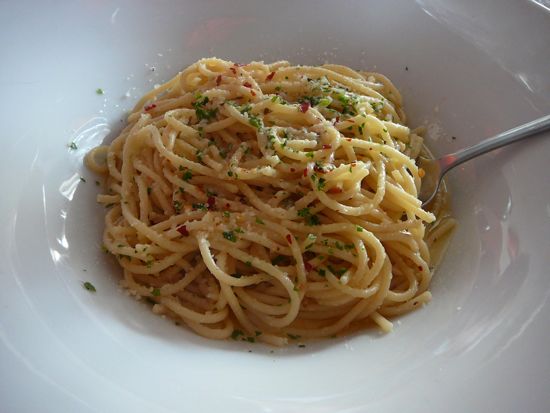
In a short time our main courses arrived. My Aglio Oglio (garlic and oil) was perfect. A little spicy, as I had asked, and a perfect size for lunch, just enough, not too much, just right. Everyone was happy with their entrees.
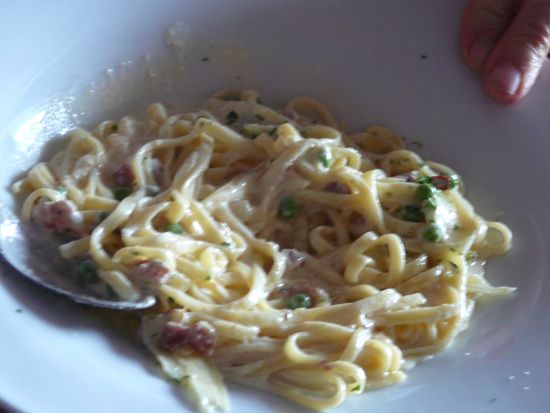
Clemenza’s Carbonara:
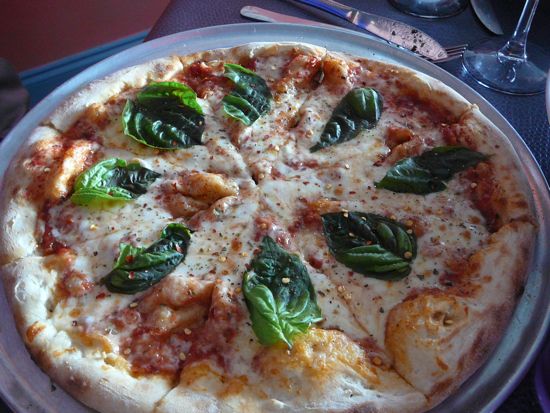
Pizza Margherita (look at that wealth of fresh basil and that thin crust, baked in a wood-burning oven 🙂 :
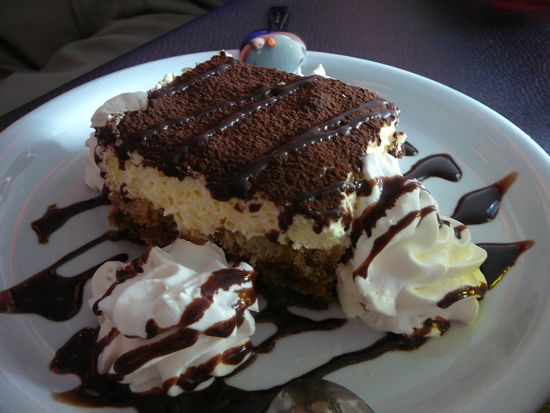
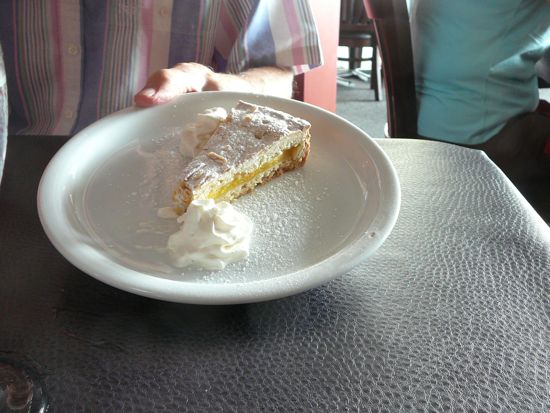
When the food and conversation is this good (and my upgrade Chianti) you just don’t want to stop. We split desserts, Tiramisu and Mama’s Custard Pie, both excellent choices:
We lingered over coffee, and no one was shooing us out. It was a superb experience overall, delicious, tasty food, attentive service without being intrusive, just a great overall experience. We were impressed. We look forward to meeting up here again. 🙂
John Berendt and City of Falling Angels
When AdventureMan brought home City of Falling Angels for me, I thought it was another mystery by the author of the famous Midnight in the Garden of Good and Evil. I had loved that book, full of unforgettable characters living in Savannah, Georgia, so I was a little puzzled with the immediacy and real-life feeling of this new mystery when I started it.
It’s set in Venice. The main “character” observes – much like Midnight in the Garden of Good and Evil – Venice, and its population. He arrives just after the horrendous fire that totally destroys La Fenice, the opera house, and we meet a wide variety of characters right off, experience the fire through their first hand experiences. We smell the smoke, we feel their horror as the fire grows, and spreads. We are depressed when the fireboats cannot quell the flames because the waters in the canal have been emptied, and are too low in the others.
I kept waiting for Commissario Guido Brunetti, Donna Leon’s Venetian detective, to show up.
I was about half way through the book when I realized – this wasn’t fiction. It was John Berendt living in Venice, meeting with and interviewing all these fabulously interesting people. Yeh, sometimes I am so SLOW!
But I was hooked. I kept reading. The mystery is how did the fire at La Fenice start, who started it and why. In the end – and believe me this is not a spoiler, because this book is really only peripherally about the fire at La Fenice – people are convicted, but you are never really sure these are the right people, or if, indeed, there was really a crime, or if the crime was negligence – but how can negligence be a crime if it is part of the culture?
One thing Berent says that Donna Leon also implies – don’t go to Venice during tourist season! Go when tourists are not there – after carnival, when it is cold, when it is raining. Stay in Venice, and walk, off the paths the tourists on their one-day-in-Venice travel. Visit the small markets, drop in for a coffee where the locals are drinking, but most of all – walk. And walk. and walk.
This is not an exciting book. It will not hold you on the edge of your seat like some horror thriller, turning pages because you are afraid to turn out the lights. The horrors in this book are the gossip, the strivings of various people to enter into Venetian society, the cut-throat competition for invitations, and who gets the prime seats at the opening night at La Fenice.
On the other hand, I loved his attention to detail, the ease with which Berendt got people to talk to him, the clarity with which he captures their personalities. I loved his description of the interiors, and how he uses the voices of others to paint in a detailed picture of Venice today. I loved being inside the Venetian community, and hearing their innermost thoughts. This was a book I looked forward to at the end of a long day, it took me to another – and fascinating – world. I just wish Commissario Brunetti had showed up. 🙂
The Olive Oil Scandal

A good friend gave me a subscription several years ago to The New Yorker, and at the time I didn’t know how lucky I was. First, I loved the cartoons. A couple magazines later, I got pulled in by some of their excellent travel and political writing. Later, the fiction issues pulled me in and introduced me to authors I had never read before. In no time at all, I was totally addicted.
Now, when The New Yorker arrives, Adventure Man and I fight to see who gets to read it first! Often he wins; he skims it. He knows I will take too long getting through it.
It was the New Yorker magazine who informed me about the great olive oil scandal.
I love olive oil. I only use other oils in baked goods, where the olive oil might give an odd taste, we use olive oil almost exclusively. Or so I thought.
In the August 13 Issue of the New Yorker, Tom Meuller starts like this:
On August 10, 1991, a rusty tanker called the Mazal I docked at the industrial port of Ordu, in Turkey, and pumped twenty-two hundred tons of hazelnut oil into its hold. The ship then embarked on a meandering voyage through the Mediterranean and the North Sea. By September 21st, when the Mazal II reached Barletta, a port in Puglia, in southern Italy, its cargo had become, on the ship’s official documents, Greek olive oil. It slipped through customs, possibly with the connivance of an official, was piped into tanker trucks, and was delivered to the refinery of Riolio, an Italian olive-oil produce based in Barletta. There it was sold—in some instances blended with real olive oil—to Riolio customers
Between August and November of 1991, the Mazal II and another tanker, the Katerina T., delivered nearly ten thousand tons of Turkish hazelnut oil and Argentinean sunflower-seed oil to Riolio, all identified as Greek olive oil.
Riolio’s owner, Domenico Ribatti, grew rich from the bogus oil, assembling substantial real-estate holdings, including a former department store in Bari. He bribed two officials, one with cash, the other with cartons of olive oil, and made trips to Rome, where he stayed at the Grand Hotel, and met with other unscrupulous olive-oil producers from Italy and abroad. As one of Italy’s leading importers of olive oil, Ribatti’s company was a member of ASSITOL, the country’s powerful olive-oil trade association, and Ribatti had enough clout in Rome to ask a favor—preferential treatment of an associate’s nephew, who was seeking admission to a military officers’ school—of a high-ranking official at the Finance Ministry, a fellow-pugliese.
However, by early 1992 Ribatti and his associates were under investigation by the Guardia di Finanza, the Finance Ministry’s military-police force. One officer, wearing a miniature video camera on his tie, posed as a waiter at a lunch hosted by Ribatti at the Grand Hotel. Others, eavesdropping on telephone calls among Riolio executives, heard the rustle of bribe money being counted out. During the next two years, the Guardia di Finanza team, working closely with agents of the European Union’s anti-fraud office, pieced together the details of Ribatti’s crime, identifying Swiss bank accounts and Caribbean shell companies that Ribatti had used to buy the ersatz olive oil.
The investigators discovered that seed and hazelnut oil had reached Riolio’s refinery by tanker truck and by train, as well as by ship, and they found stocks of hazelnut oil waiting in Rotterdam for delivery to Riolio and other olive-oil companies.
The investigators also discovered where Ribatti’s adulterated oil had gone: to some of the largest producers of Italian olive oil, among them Nestlé, Unilever, Bertolli, and Oleifici Fasanesi, who sold it to consumers as olive oil, and collected about twelve million dollars in E.U. subsidies intended to support the olive-oil industry. (These companies claimed that they had been swindled by Ribatti, and prosecutors were unable to prove complicity on their part.)
You can read this entire fascinating article here: Tom Meuller: Slippery BusinessGive yourself plenty of time. It is an article well worth reading.
There is another good reference here: The Great Olive Oil Scandal from PalestinianOliveOil.org
Investigators have gathered evidence indicating that the biggest olive oil brands in Italy — Bertolli, Sasso, and Cirio — have for years been systematically diluting their extra-virgin olive oil with cheap, highly-refined hazelnut oil imported from Turkey. [1]
A 1996 study by the FDA found that 96 percent of the olive oils they tested, while being labeled 100 percent olive oil, had been diluted with other oils. A study in Italy found that only 40 percent of the olive oil brands labeled “extra-virgin” actually met those standards. Italy produces 400,000 tons of olive oil for domestic consumption, but 750,000 tons are sold. The difference is made up with highly refined nut and seed oils. [2]
EVEN THE BIGGEST OF THEM WILL MISLEAD THE PUBLIC…
“In 1998, the New York law firm Rabin and Peckel, LLP, took on the olive oil labeling misnomer and filed a class action suit in the New York Supreme Court against Unilever, the English-Dutch manufacturer of Bertolli olive oil. The firm argued that Bertolli’s labels, which read “Imported from Italy,” did not meet full disclosure laws because, even though the oil had passed through Italian ports, most of it had originated in Tunisia, Turkey, Spain or Greece. “Bertolli olive oil is imported from Italy, but contains no measurable quantity of Italian oil,” according to court documents.”
Curezone lists manufacturers of adulterated olive oil and marketers of the same oil. It is disgusting. We pay high prices for junk-olive oil. From Curezone.com/forums
The Guilty
Below is a list of known adulterated brands and dishonest distributors with links to information about their cases.
Adulterated brands of extra virgin olive oil
with country of origin
Andy’s Pure Olive Oil (Italy)
Bertolli (Italy)
Castel Tiziano (Italy)
Cirio (Italy)
Cornelia (Italy)
Italico (Italy)
Ligaro (Italy)
Olivio (Greece)
Petrou Bros. Olive Oil (California)
Primi (Italy)
Regale (Italy)
Ricetta Antica (Italy)
Rubino (Italy)
San Paolo (Italy)
Sasso (Italy)
Terra Mia (Italy)
Distributors caught selling adulterated olive oil
Altapac Trading
AMT Fine Foods
Bella International Food Brokers
Cher-Mor Foods International
D&G Foods
Deluca Brothers International
Gestion Trorico Inc.
Itaical Trading
Kalamata Foods
Les Ailments MIA Food Distributing
Lonath International
Mario Sardo Sales, Inc.
Petrou Foods, Inc.
Rubino USA Inc.
Siena Foods Ltd.
Vernon Foods
So who do we trust? How do we know that we are getting a quality, unadulterated product? This is fraud in an international scale!
Donna Leon: Death in a Strange Country
Recently I discovered, to my disgust, that I have purchased two Donna Leon books I have already read. I bought them from England, and now they have been published in the US under different titles. Aaaarrrgh! I hate it when that happens.
I have a good friend I want to pass these books along to, an amazing woman who has no idea how amazing she is. When she talks about her early years as a private detective, she refers to herself, with a perfectly straight face, as a “Dickless Dick.”
After I read this book, I passed it along to Adventure Man, who loved it. He aloud to me from it late at night, and we both laughed. Here is the the excerpt he liked, he could identify with it:
In their bedroom, he saw that she had placed a long red dress across the bed. He didn’t remember the dress, but he seldom did remember them and he thought it best not to mention it. If it turned out to be a new dress and he remarked on it, he would sound like he thought she was buying too many clothes, and if it was something she had worn before, he would sound like he paid no attention to her and hadn’t bothered to notice it before. He sighed at the eternal inequality of marriage, opened the closed, and decided that the grey suit would be better.
He, of course, is Commissario Guido Brunetti, Donna Leon’s chief investigator, consumately Venetian, very married, and fighting a lonely battle against the louche corruption of the Italian bureaucracy.
And this book is about the death of an American military man in Venice, except that of course, it turns out to be about something much much bigger. Leon has several axes grinding in this one, but the biggest is illegal dumping, and the arrogance of countries who dump their toxic wastes on smaller countries, eyes wide open, knowing full well that horrorific consequences may result – and not caring.
My favorite part is when Commissario Brunetti visits the American base outside of Venice for the first time:
He left the place and went to stand outside, content to get a sense of the post while waiting for his driver to return. He sat on a bench in front of the shops and watched the people walking past.
A few glanced at him as he sat there, dressed in suit and tie and clearly out of place among them. Many of the people who walked past him, men and women alike, wore uniform. Most of the others wore shorts and tennis shoes, and many of the women, too often those who shouldn’t have, wore halter tops. They appeared to be dressed either for war or for the beach. Many of the men were fit and powerful; many of the women were enormously, terrifyingly fat.
Cars drove by slowly, their drivers searching for parking spaces: big cars, Japanese cars, cars with that same AFI number plate. Most had the windows raised, while from the air-conditioned interiors blared rock music in varying degrees of loudness.
They strolled by, amiable and friendly, greeting one another and exchanging pleasant words, thoroughly at home in their little American village here in Italy.
Donna Leon has a sharp eye for detail, doesn’t she? Don’t you feel like you were sitting there on the bench with Commissario Brunetti, seeing through his eyes?
Reading Donna Leon transports you to another world, Venice, and the joy of reading has less to do with solving the crime than being able, for a short time, to stop and drink coffee while tracking down a criminal, eating a meal or two with Brunetti and his family, experiencing the frustrations of the Venetian bureaucracy in all its radiant corruption, walking along the canals so early in the morning that the delivery men haven’t even begun yet making their deliveries . . .
And yet the problems addressed in the Leon books are part of a greater world picture, and Leon has an enormous capability to draw blurry lines with increasing clarity as we watch how international corruption works hand in hand blindly taking profits while dribble by dribble degrading the world for future inhabitants.
Donna Leon Crossing Cultures
I’m in the middle of a Donna Leon read-fest. When I wrote the reviews the last time, I saw three books by her I had never seen – and I comb the aisles of Barnes and Noble when I am in the US, and Half Price Books, looking for titles by her. I am guessing some of her books haven’t been printed in the US, but I was able to find them from the UK Amazon.com.
The two latest books I have read by Donna Leon are timely. The first, Fatal Remedies, starts out being about Commissario Guido Brunetti’s wife, Paola’s crusade against the sex tours to undeveloped countries, her outrage against trips that allow grown men to exploit the poverty and need that the poorest of families will sell their own daughters and even young children to satisfy these men’s uncontrolled lusts. Her outrage leads her to a jail cell in her own husband’s precinct.
But just when you think you know where this story is going, it turns, as many of Leon’s books do, and tackles another subject, one very much in the eye of the news – falsified medications. There is a huge profit to be made, and huge wrongdoings in the medical supplies field, as expired medications are shipped to the most needy countries, and prescription and over-the-counter medications contain ingredients that are at best, harmless, and at worst – poisonous!
Guido Brunetti follows the money, and exposes the cheats.
In the second book, The Death of Faith, the issue – corruption in the church – comes close to home, as Brunetti’s daughter gets a low grade from her religious education instructor for asking questions, logical questions, about the dogma of the Catholic faith. Leon also tackles the issue of the order of Opus Dei, the same mysterious order featured in The DaVinci Code, an order that does exist, but about which solid knowledge is murky. What is known is that the order, in jihadist fashion, seeks to establish the Catholic church as the supreme guide to behavior on earth, it’s own version of sharia law to be the ruling principle in every country.
This is an anethema to Commissario Brunetti, and to all thinking Italians who savor the separation of church and state. He asks the eternal question – who decides? Who decides what behavior is acceptable, what questions are allowable? Religious belief, or the lack of it, is so very personal – this is a very timely issue that all nations are struggling with. Religious rule? Secular rule?
Underlying all the Donna Leon books is the sweetness of daily life with Brunetti’s family, his beautiful and principled wife, his teenaged children, the food they eat, the family discussions they have, the flowers he brings home and the strength of the connection they have with one another. The Venetian setting weaves its own magical thread through every novel, as we ride with Brunetti in the vaporetto on the canals, as we sit with him in a local bar for a quick coffee – or something stronger – and as he walks the streets from home to office, or to talk with a witness.
And last, but not least, the utter corruption in the Venetian system reminds us that veniality is not restricted to the United States, or to Kuwait, or to Nigeria, or Italy, or to any one country, but wherever man seeks to impose order, the chaos of corruption must be slowly and surely overcome by the building of an honest bureaucracy, people like you and me, serving in seemingly hopeless situations, but doing our best, day by day, like Guido Brunetti, to build a better world for our children.
Recent Comments
ExpatAlien on What Country am I Living … intlxpatr on Yellowstone: Old Faithful to C… Michelle on Yellowstone: Old Faithful to C… Cathy on No Grown-Ups in Charge intlxpatr on Waiting for Snow Wikipedia Donate Button

Amazina


Early Voting in Florida


 Here There and Everywhere